



Copper Wire & Cable Market
Copper Wire & Cable Market Size, Share, Insights, Competitive Landscape, and Forecast 2026 to 2033
Copper Wire & Cable Market Analysis, 2026–2033
Copper Wire & Cable Market
Copper Wire & Cable Market Size, Share, Insights, Competitive Landscape, and Forecast 2026 to 2033
Copper Wire & Cable Market Size and Trend Analysis
How Fast Is the Copper Wire & Cable Market Growing?
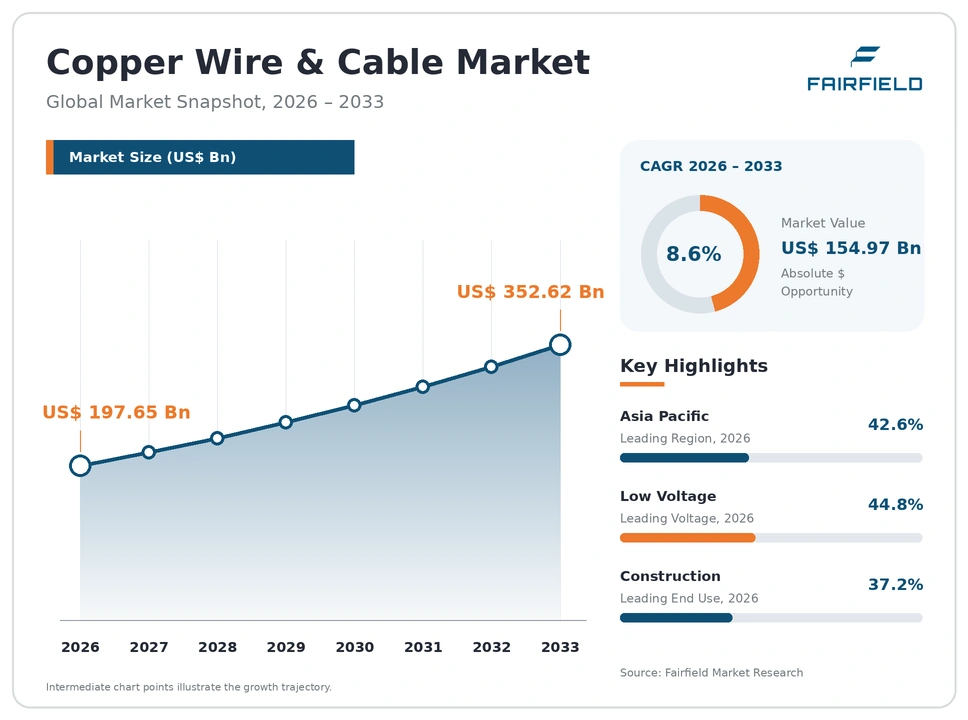
The global copper wire & cable market size is expected to be valued at US$ 197.65 billion in 2026 and projected to reach US$ 352.62 billion by 2033, growing at a CAGR of 8.6% between 2026 and 2033.
Between 2020 and 2025, the market grew at a CAGR of about 7.2%, as construction slowed during the pandemic and then recovered, while record copper prices raised the value of every kilometer of cable sold. Three factors now drive growth: grid modernization and renewable energy connections, rapid construction of data centers that need large volumes of power cables and data center cabling, and electrification of transport and buildings. The market is shifting toward higher-voltage cables, underground networks, and halogen-free and fire-resistant insulation, while copper price volatility and tariffs reshape supply chains.
Key Report Takeaways
- By Voltage: Low Voltage held 44.8% share in 2026, while High Voltage is projected to expand at a 10.2% CAGR through 2033, driven by transmission upgrades, renewable connections, and interconnectors.
- By Installation: Overhead held 53.6% share in 2026, while Underground is projected to expand at a 9.8% CAGR through 2033, driven by urban grid upgrades, metro projects, and resilience needs.
- By End Use: Construction held 37.2% share in 2026, while Energy & Power is projected to expand at a 10.1% CAGR through 2033, driven by utility spending and renewable energy projects.
- By Region: Asia Pacific held 42.6% share in 2026, while Middle East & Africa is projected to expand at a 9.9% CAGR through 2033, driven by giga-projects, grid expansion, and new industrial zones.
Global Copper Wire & Cable Market Trends and Insights
Drivers Impact Analysis
Two drivers carry the strongest influence on copper wire & cable demand during the forecast period.
| Driver | Impact on CAGR Forecast | Geographic Relevance | Impact Timeline |
| Grid modernization and renewable energy integration | High | Europe, North America, Asia Pacific | Long term (≥4 years) |
| Data centers, electrification, and construction growth | High | North America, Asia Pacific, Middle East & Africa | Medium term (2-4 years) |
Grid Modernization Is Driving the Copper Wire & Cable Market
Grid modernization and renewable energy integration are the strongest drivers of the copper wire & cable market. Utilities must replace aging networks and connect new wind and solar farms, which requires large volumes of copper cable.
The mechanism is rising utility investment and new generation sources. Much of the grid in North America and Europe was built decades ago and needs replacement. Wind and solar projects are often far from cities, so they need new transmission and distribution lines. The European Union grid action plan and the United States infrastructure programs fund network upgrades. Battery storage sites, electric vehicle charging, and heat pumps add load to local networks, requiring thicker copper conductors. Utilities in China and India are expanding transmission rapidly. These investments create long-term demand for medium- and high-voltage copper cables.
Data Centers and Electrification Are Expanding the Copper Wire & Cable Market
Data centers, electrification, and construction growth are expanding the copper wire & cable market. Each new data center, factory, and building needs kilometers of copper wiring.
The cause is digital infrastructure and the shift from fossil fuels to electricity. AI data centers use far more power per rack than traditional facilities, requiring heavy power cables, busways, and grounding systems. Prysmian has said that data centers and electrification drive growth in its largest market, North America. Electric vehicles contain much more copper wiring than combustion vehicles, and charging stations need cable connections. Building codes increasingly require electric heating and cooling. Residential and commercial construction in India, Indonesia, and Saudi Arabia adds demand for building wire. Semiconductor and battery factories also use large amounts of cable. These trends support strong volume growth.
Restraints Impact Analysis
Two restraints limit how quickly the copper wire & cable market grows.
| Restraint | Impact on CAGR Forecast | Geographic Relevance | Impact Timeline |
| Copper price volatility and tariffs | High | Global | Short term (≤2 years) |
| Substitution by aluminium and fiber optics | Medium | North America, Asia Pacific | Long term (≥4 years) |
Copper Price Volatility and Tariffs Squeeze the Copper Wire & Cable Market
Copper price volatility and tariffs squeeze the copper wire & cable market. Copper accounts for most of the cost of a cable, so price swings directly affect margins and project budgets.
The specific causes are tight mine supply and trade policy. Copper prices reached record highs in 2025 and 2026, driven by limited new mine supply, mine disruptions, and rising demand for electrification. The United States imposed a 50% tariff on the copper content of semi-finished products, including wire and cable, from August 2025, raising costs for importers and changing trade flows. Cable makers often use price pass-through clauses, but fixed-price contracts expose them to losses. Contractors may delay projects when cable costs rise sharply. Smaller cable makers struggle to finance higher inventory values. These factors create uncertainty for buyers and sellers.
Aluminium and Fiber Substitution Restricts the Copper Wire & Cable Market
Substitution by aluminium and fiber optics restricts the copper wire & cable market. When copper prices rise, buyers look for cheaper or more efficient alternatives.
The underlying causes are cost and technology change. Aluminium is lighter and much cheaper than copper, so utilities use it widely for overhead transmission lines and increasingly for some building and distribution cables. China has encouraged aluminium in power cables to reduce copper imports. Fiber optic cables have replaced copper in long-distance telecom networks and are replacing copper telephone lines and local networks. Wireless technologies reduce the need for some data cables. Copper still offers better conductivity and reliability in many uses, but substitution limits volume growth in price-sensitive segments and slows growth in communication cables. Recycled copper and conductor redesign partly offset this pressure.
Market Opportunities
High-voltage and Underground Cables Open a High-value Revenue Pool
High-voltage and underground cables open a high-value revenue pool in the copper wire & cable market. Utilities and developers need advanced cables to move power long distances and through dense cities.
Cable makers with high-voltage capacity can capture this opportunity. Underground cables avoid visual impact and storm damage, making them popular in cities and wildfire-prone areas, such as parts of California. Interconnectors between countries and offshore wind connections in Europe and Asia Pacific need high-voltage cables, although some use aluminium conductors. Medium- and high-voltage copper cables for substations, industrial plants, and data centers command higher margins than low-voltage wire. Long-term framework agreements with utilities provide steady order books. Installation, testing, and cable monitoring services add further revenue over each project’s life.
Data Center and Energy Transition Projects Create a Fast-growing Revenue Pool
Data center and energy transition projects create a fast-growing revenue pool in the copper wire & cable market. These projects need large volumes of cable delivered quickly and to strict specifications.
Cable makers and distributors with capacity near major projects can capture this opportunity. Hyperscale and AI data centers in North America, Europe, India, and Saudi Arabia need power, grounding, and data center cabling. Battery storage plants, solar farms, and electric vehicle charging hubs require low- and medium-voltage cables. Semiconductor and battery factories add demand for industrial cables. Prysmian, Southwire, and Nexans are expanding capacity in North America, while KEI Industries and Polycab India are expanding in India. Suppliers offering fast delivery and engineering support can win long-term contracts.
Segment Analysis
By Voltage: Low Voltage Leads While High Voltage Gains Momentum
Low Voltage held 44.8% share in 2026. Low-voltage cables include building wire, flexible cords, control cables, and power cables up to 1 kV, used in homes, offices, factories, and data centers. Every building project needs large volumes of low-voltage copper wiring, and replacement demand is steady. Medium-voltage cables serve distribution networks, industrial plants, and renewable energy projects.
High Voltage is the fastest-growing voltage segment, expanding at a 10.2% CAGR through 2033. Transmission upgrades, renewable energy connections, interconnectors, and offshore wind projects need cables above 69 kV. High-voltage cables require advanced insulation and testing, so only a few makers such as Prysmian, Nexans, NKT, Sumitomo Electric Industries, and LS Cable & System produce them. Long lead times and full order books support pricing. For the market, high-voltage growth raises value per kilometer.
By Installation: Overhead Leads While Underground Grows Fastest
Overhead held 53.6% share in 2026. Overhead lines are cheaper to build and maintain, so utilities use them for most transmission and rural distribution networks. Copper is used in overhead service drops, earth wires, and some distribution lines, while aluminium dominates long-distance conductors. Overhead networks are widespread in India, Africa, and Latin America.
Underground is the fastest-growing installation type, expanding at a 9.8% CAGR through 2033. Cities are moving power lines underground to improve reliability, safety, and appearance, and to protect them from storms and wildfires. Metro rail projects, urban substations, and data center campuses use underground copper cables. Utilities in Europe, North America, Japan, and South Korea lead underground conversion. Underground cables cost more but last longer. For the market, underground growth adds value through higher cable specifications.
By End Use: Construction Leads While Energy & Power Grows Fastest
Construction held 37.2% share in 2026. Residential, commercial, and infrastructure projects use copper wire for power distribution, lighting, and control systems. Large construction markets in China, India, the United States, and Saudi Arabia drive volume. Fire-resistant and halogen-free cables are increasingly required in public buildings, airports, and tunnels.
Energy & Power is the fastest-growing end use, expanding at a 10.1% CAGR through 2033. Utilities, renewable energy developers, and grid operators need cables for transmission, distribution, substations, and power plants. Solar and wind farms, battery storage sites, and electric vehicle charging networks add demand. Industrial, telecommunications, and automotive end uses form other important segments. For the market, energy sector growth brings large, long-term orders.
Geography Analysis
North America Expands the Copper Wire & Cable Market Through Data Centers and Grid Upgrades
North America is a large copper wire & cable market driven by data centers, grid upgrades, and manufacturing investment. The United States has seen a surge in AI data center construction, utility spending, and factory projects. Southwire, Prysmian, Nexans, and Encore Wire are major producers, and Prysmian has considered a new copper rod mill in Texas. The 50% tariff on imported copper products since August 2025 has encouraged domestic production. Nexans completed the acquisition of Electro Cables in Canada in 2025. Mexico adds manufacturing demand. One change shaping the region is local capacity growth to reduce reliance on imports.
Europe Advances the Copper Wire & Cable Market Through Energy Transition
Europe is a major copper wire & cable market shaped by the energy transition. Germany, Italy, France, the United Kingdom, and Spain invest heavily in transmission, offshore wind connections, and building renovation. Prysmian, Nexans, NKT, and Hellenic Cables are leading suppliers. The European Union Construction Products Regulation sets fire safety classes for building cables, raising demand for higher-specification products. Poland, Denmark, and Sweden add demand from wind power and grid links. High energy costs affect manufacturing, and imports from Asia Pacific compete on price in low-voltage products. Copper recycling rates are high, supporting secondary supply. One opportunity is cable for heat pumps, charging, and grid reinforcement.
Which Region Is Leading the Copper Wire & Cable Market?
Asia Pacific is leading the copper wire & cable market with a 42.6% share in 2026. China is the world’s largest producer and consumer of copper cable, driven by grid investment, construction, and electric vehicle production. India is investing heavily in power transmission, housing, and metro rail, supporting producers such as Polycab India and KEI Industries, which started production at a new plant in Sanand in December 2025. Japan and South Korea host Sumitomo Electric Industries, Furukawa Electric, and LS Cable & System. Indonesia, Vietnam, and Thailand add construction and factory demand. One change shaping the region is rapid data center construction.
Latin America Grows the Copper Wire & Cable Market Through Infrastructure and Mining
Latin America is a growing copper wire & cable market. Brazil and Mexico have large construction and industrial sectors, and Brazil is expanding transmission lines to connect wind and solar farms in the northeast. Chile and Peru are major copper producers, and mining operations use large amounts of power and control cable. Prysmian, Nexans, and local producers serve the region. Colombia and Argentina are upgrading distribution networks. Key barriers include currency swings, cable theft, and project delays caused by permitting and financing. One opportunity is transmission cable for renewable energy and data centers in Brazil and Mexico.
Which Region Is Growing Fastest in the Copper Wire & Cable Market?
Middle East & Africa is growing fastest in the copper wire & cable market at a 9.9% CAGR through 2033. Saudi Arabia is building giga-projects, new cities, and industrial zones under Vision 2030, and the United Arab Emirates is expanding data centers and grids. Local producers such as Riyadh Cables, Ducab, and Bahra Electric are expanding. In Africa, Egypt, Nigeria, and South Africa invest in power access. Qatar and Oman also invest in industrial and energy projects. One challenge is financing for African utilities, which often depend on development banks. One opportunity is local production for regional projects, supported by local content rules.
Competitive Landscape
The copper wire & cable market is fragmented. Prysmian, Nexans, Sumitomo Electric Industries, Southwire, and LS Cable & System are the largest global producers, while NKT, Furukawa Electric, Encore Wire, Polycab India, KEI Industries, and thousands of regional companies compete in local markets.
Companies compete on product range, quality certification, delivery speed, pricing, copper sourcing, and technical service. High-voltage cables require large investments and long qualification, creating high barriers to entry, while low-voltage building wire is more commoditized. Access to copper rod and scrap at competitive prices is a key cost advantage, and some producers operate their own rod mills to control quality and cost.
Strategic moves show how competition is changing. In August 2025, the United States began applying a 50% tariff to imported semi-finished copper products, including wire and cable. In December 2025, Nexans completed its acquisition of Electro Cables in Canada, and KEI Industries began production at its new Sanand cable plant. In March 2026, Prysmian said it was considering a second copper rod facility in Texas. These moves show competition shifting toward local capacity and secure copper supply, as tariffs and long lead times push buyers to favor suppliers that produce near their projects.
Three themes shape vendor strategy. First, companies are expanding capacity near major demand centers. Second, they are acquiring regional producers. Third, they are investing in copper recycling, rod mills, and supply security to manage price swings.
Copper Wire & Cable Market Industry Leaders
- Prysmian
- Nexans
- Sumitomo Electric Industries
- Southwire
- LS Cable & System
Recent Industry Developments
- March 2026: Prysmian said it was considering a second copper rod facility at McKinney, Texas - would expand North American supply for data center and grid demand.
- December 2025: Nexans completed its acquisition of Electro Cables - strengthens its low-voltage cable position in Canada.
- December 2025: KEI Industries began commercial production at its Sanand cable plant - adds capacity for India’s growing demand.
- August 2025: The United States imposed a 50% tariff on the copper content of semi-finished products, including wire and cable - reshapes trade flows and pricing.
Companies Covered in the Report
- Prysmian
- Nexans
- Sumitomo Electric Industries
- Southwire
- LS Cable & System
- NKT
- Furukawa Electric
- Encore Wire
- Polycab India
- KEI Industries
- Riyadh Cables
- Ducab
Copper Wire & Cable Market Report Scope
This report covers copper wire and cable, including building wire, power cables, control cables, communication cables, and magnet wire, across low, medium, high, and extra-high voltage, for overhead, underground, and submarine installations, used in construction, energy and power, telecommunications, industrial, and automotive applications. It excludes aluminium and fiber optic cables. The base year is 2025, and the forecast period runs from 2026 to 2033. All values are expressed in US$ Billion.
Voltage
- Low Voltage
- Medium Voltage
- High Voltage
- Extra-high Voltage
Installation
- Overhead
- Underground
- Submarine
End Use
- Construction
- Energy & Power
- Telecommunications & IT
- Industrial
- Automotive
Regions
- North America
- Europe
- Asia Pacific
- Latin America
- Middle East & Africa
Key Questions Answered in the Report
How big is the copper wire & cable market in 2026?
The copper wire & cable market is valued at US$ 197.65 billion in 2026, led by low-voltage cables used in construction.
What is the copper wire & cable market forecast to 2033?
The market is projected to reach US$ 352.62 billion by 2033, growing at a 8.6% CAGR and adding US$ 154.97 billion.
Which voltage segment is growing fastest in copper wire & cable?
High Voltage is growing fastest at a 10.2% CAGR through 2033, driven by transmission upgrades, renewable connections, and interconnectors.
Which region is growing fastest in the copper wire & cable market?
Middle East & Africa is growing fastest at a 9.9% CAGR through 2033, driven by giga-projects, grid expansion, and industrial zones.
Which region holds the largest copper wire & cable market share?
Asia Pacific holds the largest share at 42.6% in 2026, supported by grid investment and construction in China and India.
1. Executive Summary
1.1. Global Copper Wire & Cable Market Snapshot
1.2. Future Projections
1.3. Key Report Takeaways
1.4. Regional Snapshot
2. Market Overview
2.1. Market Definition and Report Scope
2.2. Historical Trends 2020–2025
2.3. Market Dynamics
2.3.1. Drivers
2.3.1.1. Grid Modernization Is Driving the Copper Wire & Cable Market
2.3.1.2. Data Centers and Electrification Are Expanding the Copper Wire & Cable Market
2.3.2. Restraints
2.3.2.1. Copper Price Volatility and Tariffs Squeeze the Copper Wire & Cable Market
2.3.2.2. Aluminium and Fiber Substitution Restricts the Copper Wire & Cable Market
2.3.3. Market Opportunities
2.3.3.1. High-voltage and Underground Cables Open a High-value Revenue Pool
2.3.3.2. Data Center and Energy Transition Projects Create a Fast-growing Revenue Pool
3. Global Copper Wire & Cable Market Outlook, 2020-2033
3.1. Global Copper Wire & Cable Market Outlook, by Voltage, Value (US$ Billion), 2020-2033
3.1.1. Low Voltage
3.1.2. Medium Voltage
3.1.3. High Voltage
3.1.4. Extra-high Voltage
3.2. Global Copper Wire & Cable Market Outlook, by Installation, Value (US$ Billion), 2020-2033
3.2.1. Overhead
3.2.2. Underground
3.2.3. Submarine
3.3. Global Copper Wire & Cable Market Outlook, by End Use, Value (US$ Billion), 2020-2033
3.3.1. Construction
3.3.2. Energy & Power
3.3.3. Telecommunications & IT
3.3.4. Industrial
3.3.5. Automotive
3.4. Global Copper Wire & Cable Market Outlook, by Region, Value (US$ Billion), 2020-2033
3.4.1. North America
3.4.2. Europe
3.4.3. Asia Pacific
3.4.4. Latin America
3.4.5. Middle East & Africa
4. North America Copper Wire & Cable Market Outlook, 2020-2033
4.1. North America Copper Wire & Cable Market Outlook, by Voltage, Value (US$ Billion), 2020-2033
4.1.1. Low Voltage
4.1.2. Medium Voltage
4.1.3. High Voltage
4.1.4. Extra-high Voltage
4.2. North America Copper Wire & Cable Market Outlook, by Installation, Value (US$ Billion), 2020-2033
4.2.1. Overhead
4.2.2. Underground
4.2.3. Submarine
4.3. North America Copper Wire & Cable Market Outlook, by End Use, Value (US$ Billion), 2020-2033
4.3.1. Construction
4.3.2. Energy & Power
4.3.3. Telecommunications & IT
4.3.4. Industrial
4.3.5. Automotive
4.4. North America Copper Wire & Cable Market Outlook, by Country, Value (US$ Billion), 2020-2033
4.4.1. United States Copper Wire & Cable Market Outlook, by Voltage, 2020-2033
4.4.2. United States Copper Wire & Cable Market Outlook, by Installation, 2020-2033
4.4.3. United States Copper Wire & Cable Market Outlook, by End Use, 2020-2033
4.4.4. Canada Copper Wire & Cable Market Outlook, by Voltage, 2020-2033
4.4.5. Canada Copper Wire & Cable Market Outlook, by Installation, 2020-2033
4.4.6. Canada Copper Wire & Cable Market Outlook, by End Use, 2020-2033
4.4.7. Mexico Copper Wire & Cable Market Outlook, by Voltage, 2020-2033
4.4.8. Mexico Copper Wire & Cable Market Outlook, by Installation, 2020-2033
4.4.9. Mexico Copper Wire & Cable Market Outlook, by End Use, 2020-2033
5. Europe Copper Wire & Cable Market Outlook, 2020-2033
5.1. Europe Copper Wire & Cable Market Outlook, by Voltage, Value (US$ Billion), 2020-2033
5.1.1. Low Voltage
5.1.2. Medium Voltage
5.1.3. High Voltage
5.1.4. Extra-high Voltage
5.2. Europe Copper Wire & Cable Market Outlook, by Installation, Value (US$ Billion), 2020-2033
5.2.1. Overhead
5.2.2. Underground
5.2.3. Submarine
5.3. Europe Copper Wire & Cable Market Outlook, by End Use, Value (US$ Billion), 2020-2033
5.3.1. Construction
5.3.2. Energy & Power
5.3.3. Telecommunications & IT
5.3.4. Industrial
5.3.5. Automotive
5.4. Europe Copper Wire & Cable Market Outlook, by Country, Value (US$ Billion), 2020-2033
5.4.1. Germany Copper Wire & Cable Market Outlook, by Voltage, 2020-2033
5.4.2. Germany Copper Wire & Cable Market Outlook, by Installation, 2020-2033
5.4.3. Germany Copper Wire & Cable Market Outlook, by End Use, 2020-2033
5.4.4. Italy Copper Wire & Cable Market Outlook, by Voltage, 2020-2033
5.4.5. Italy Copper Wire & Cable Market Outlook, by Installation, 2020-2033
5.4.6. Italy Copper Wire & Cable Market Outlook, by End Use, 2020-2033
5.4.7. France Copper Wire & Cable Market Outlook, by Voltage, 2020-2033
5.4.8. France Copper Wire & Cable Market Outlook, by Installation, 2020-2033
5.4.9. France Copper Wire & Cable Market Outlook, by End Use, 2020-2033
5.4.10. United Kingdom Copper Wire & Cable Market Outlook, by Voltage, 2020-2033
5.4.11. United Kingdom Copper Wire & Cable Market Outlook, by Installation, 2020-2033
5.4.12. United Kingdom Copper Wire & Cable Market Outlook, by End Use, 2020-2033
5.4.13. Spain Copper Wire & Cable Market Outlook, by Voltage, 2020-2033
5.4.14. Spain Copper Wire & Cable Market Outlook, by Installation, 2020-2033
5.4.15. Spain Copper Wire & Cable Market Outlook, by End Use, 2020-2033
5.4.16. Poland Copper Wire & Cable Market Outlook, by Voltage, 2020-2033
5.4.17. Poland Copper Wire & Cable Market Outlook, by Installation, 2020-2033
5.4.18. Poland Copper Wire & Cable Market Outlook, by End Use, 2020-2033
5.4.19. Denmark Copper Wire & Cable Market Outlook, by Voltage, 2020-2033
5.4.20. Denmark Copper Wire & Cable Market Outlook, by Installation, 2020-2033
5.4.21. Denmark Copper Wire & Cable Market Outlook, by End Use, 2020-2033
5.4.22. Sweden Copper Wire & Cable Market Outlook, by Voltage, 2020-2033
5.4.23. Sweden Copper Wire & Cable Market Outlook, by Installation, 2020-2033
5.4.24. Sweden Copper Wire & Cable Market Outlook, by End Use, 2020-2033
6. Asia Pacific Copper Wire & Cable Market Outlook, 2020-2033
6.1. Asia Pacific Copper Wire & Cable Market Outlook, by Voltage, Value (US$ Billion), 2020-2033
6.1.1. Low Voltage
6.1.2. Medium Voltage
6.1.3. High Voltage
6.1.4. Extra-high Voltage
6.2. Asia Pacific Copper Wire & Cable Market Outlook, by Installation, Value (US$ Billion), 2020-2033
6.2.1. Overhead
6.2.2. Underground
6.2.3. Submarine
6.3. Asia Pacific Copper Wire & Cable Market Outlook, by End Use, Value (US$ Billion), 2020-2033
6.3.1. Construction
6.3.2. Energy & Power
6.3.3. Telecommunications & IT
6.3.4. Industrial
6.3.5. Automotive
6.4. Asia Pacific Copper Wire & Cable Market Outlook, by Country, Value (US$ Billion), 2020-2033
6.4.1. China Copper Wire & Cable Market Outlook, by Voltage, 2020-2033
6.4.2. China Copper Wire & Cable Market Outlook, by Installation, 2020-2033
6.4.3. China Copper Wire & Cable Market Outlook, by End Use, 2020-2033
6.4.4. India Copper Wire & Cable Market Outlook, by Voltage, 2020-2033
6.4.5. India Copper Wire & Cable Market Outlook, by Installation, 2020-2033
6.4.6. India Copper Wire & Cable Market Outlook, by End Use, 2020-2033
6.4.7. Japan Copper Wire & Cable Market Outlook, by Voltage, 2020-2033
6.4.8. Japan Copper Wire & Cable Market Outlook, by Installation, 2020-2033
6.4.9. Japan Copper Wire & Cable Market Outlook, by End Use, 2020-2033
6.4.10. South Korea Copper Wire & Cable Market Outlook, by Voltage, 2020-2033
6.4.11. South Korea Copper Wire & Cable Market Outlook, by Installation, 2020-2033
6.4.12. South Korea Copper Wire & Cable Market Outlook, by End Use, 2020-2033
6.4.13. Indonesia Copper Wire & Cable Market Outlook, by Voltage, 2020-2033
6.4.14. Indonesia Copper Wire & Cable Market Outlook, by Installation, 2020-2033
6.4.15. Indonesia Copper Wire & Cable Market Outlook, by End Use, 2020-2033
6.4.16. Vietnam Copper Wire & Cable Market Outlook, by Voltage, 2020-2033
6.4.17. Vietnam Copper Wire & Cable Market Outlook, by Installation, 2020-2033
6.4.18. Vietnam Copper Wire & Cable Market Outlook, by End Use, 2020-2033
6.4.19. Thailand Copper Wire & Cable Market Outlook, by Voltage, 2020-2033
6.4.20. Thailand Copper Wire & Cable Market Outlook, by Installation, 2020-2033
6.4.21. Thailand Copper Wire & Cable Market Outlook, by End Use, 2020-2033
7. Latin America Copper Wire & Cable Market Outlook, 2020-2033
7.1. Latin America Copper Wire & Cable Market Outlook, by Voltage, Value (US$ Billion), 2020-2033
7.1.1. Low Voltage
7.1.2. Medium Voltage
7.1.3. High Voltage
7.1.4. Extra-high Voltage
7.2. Latin America Copper Wire & Cable Market Outlook, by Installation, Value (US$ Billion), 2020-2033
7.2.1. Overhead
7.2.2. Underground
7.2.3. Submarine
7.3. Latin America Copper Wire & Cable Market Outlook, by End Use, Value (US$ Billion), 2020-2033
7.3.1. Construction
7.3.2. Energy & Power
7.3.3. Telecommunications & IT
7.3.4. Industrial
7.3.5. Automotive
7.4. Latin America Copper Wire & Cable Market Outlook, by Country, Value (US$ Billion), 2020-2033
7.4.1. Brazil Copper Wire & Cable Market Outlook, by Voltage, 2020-2033
7.4.2. Brazil Copper Wire & Cable Market Outlook, by Installation, 2020-2033
7.4.3. Brazil Copper Wire & Cable Market Outlook, by End Use, 2020-2033
7.4.4. Mexico Copper Wire & Cable Market Outlook, by Voltage, 2020-2033
7.4.5. Mexico Copper Wire & Cable Market Outlook, by Installation, 2020-2033
7.4.6. Mexico Copper Wire & Cable Market Outlook, by End Use, 2020-2033
7.4.7. Chile Copper Wire & Cable Market Outlook, by Voltage, 2020-2033
7.4.8. Chile Copper Wire & Cable Market Outlook, by Installation, 2020-2033
7.4.9. Chile Copper Wire & Cable Market Outlook, by End Use, 2020-2033
7.4.10. Peru Copper Wire & Cable Market Outlook, by Voltage, 2020-2033
7.4.11. Peru Copper Wire & Cable Market Outlook, by Installation, 2020-2033
7.4.12. Peru Copper Wire & Cable Market Outlook, by End Use, 2020-2033
7.4.13. Colombia Copper Wire & Cable Market Outlook, by Voltage, 2020-2033
7.4.14. Colombia Copper Wire & Cable Market Outlook, by Installation, 2020-2033
7.4.15. Colombia Copper Wire & Cable Market Outlook, by End Use, 2020-2033
7.4.16. Argentina Copper Wire & Cable Market Outlook, by Voltage, 2020-2033
7.4.17. Argentina Copper Wire & Cable Market Outlook, by Installation, 2020-2033
7.4.18. Argentina Copper Wire & Cable Market Outlook, by End Use, 2020-2033
8. Middle East & Africa Copper Wire & Cable Market Outlook, 2020-2033
8.1. Middle East & Africa Copper Wire & Cable Market Outlook, by Voltage, Value (US$ Billion), 2020-2033
8.1.1. Low Voltage
8.1.2. Medium Voltage
8.1.3. High Voltage
8.1.4. Extra-high Voltage
8.2. Middle East & Africa Copper Wire & Cable Market Outlook, by Installation, Value (US$ Billion), 2020-2033
8.2.1. Overhead
8.2.2. Underground
8.2.3. Submarine
8.3. Middle East & Africa Copper Wire & Cable Market Outlook, by End Use, Value (US$ Billion), 2020-2033
8.3.1. Construction
8.3.2. Energy & Power
8.3.3. Telecommunications & IT
8.3.4. Industrial
8.3.5. Automotive
8.4. Middle East & Africa Copper Wire & Cable Market Outlook, by Country, Value (US$ Billion), 2020-2033
8.4.1. Saudi Arabia Copper Wire & Cable Market Outlook, by Voltage, 2020-2033
8.4.2. Saudi Arabia Copper Wire & Cable Market Outlook, by Installation, 2020-2033
8.4.3. Saudi Arabia Copper Wire & Cable Market Outlook, by End Use, 2020-2033
8.4.4. United Arab Emirates Copper Wire & Cable Market Outlook, by Voltage, 2020-2033
8.4.5. United Arab Emirates Copper Wire & Cable Market Outlook, by Installation, 2020-2033
8.4.6. United Arab Emirates Copper Wire & Cable Market Outlook, by End Use, 2020-2033
8.4.7. Egypt Copper Wire & Cable Market Outlook, by Voltage, 2020-2033
8.4.8. Egypt Copper Wire & Cable Market Outlook, by Installation, 2020-2033
8.4.9. Egypt Copper Wire & Cable Market Outlook, by End Use, 2020-2033
8.4.10. Nigeria Copper Wire & Cable Market Outlook, by Voltage, 2020-2033
8.4.11. Nigeria Copper Wire & Cable Market Outlook, by Installation, 2020-2033
8.4.12. Nigeria Copper Wire & Cable Market Outlook, by End Use, 2020-2033
8.4.13. South Africa Copper Wire & Cable Market Outlook, by Voltage, 2020-2033
8.4.14. South Africa Copper Wire & Cable Market Outlook, by Installation, 2020-2033
8.4.15. South Africa Copper Wire & Cable Market Outlook, by End Use, 2020-2033
8.4.16. Qatar Copper Wire & Cable Market Outlook, by Voltage, 2020-2033
8.4.17. Qatar Copper Wire & Cable Market Outlook, by Installation, 2020-2033
8.4.18. Qatar Copper Wire & Cable Market Outlook, by End Use, 2020-2033
8.4.19. Oman Copper Wire & Cable Market Outlook, by Voltage, 2020-2033
8.4.20. Oman Copper Wire & Cable Market Outlook, by Installation, 2020-2033
8.4.21. Oman Copper Wire & Cable Market Outlook, by End Use, 2020-2033
9. Competitive Landscape
9.1. Market Concentration and Industry Leaders
9.2. Competitive Differentiation
9.3. Strategic Moves and Market Direction
9.4. Recent Industry Developments
9.5. Company Profiles
9.5.1. Prysmian
9.5.2. Nexans
9.5.3. Sumitomo Electric Industries
9.5.4. Southwire
9.5.5. LS Cable & System
9.5.6. NKT
9.5.7. Furukawa Electric
9.5.8. Encore Wire
9.5.9. Polycab India
9.5.10. KEI Industries
9.5.11. Riyadh Cables
9.5.12. Ducab
10. Appendix
10.1. Research Methodology
10.2. Report Assumptions
10.3. Acronyms and Abbreviations
| Segment | Categories |
|---|---|
| Voltage | Low Voltage, Medium Voltage, High Voltage, Extra-high Voltage |
| Installation | Overhead, Underground, Submarine |
| End Use | Construction, Energy & Power, Telecommunications & IT, Industrial, Automotive |
| Regions | North America, Europe, Asia Pacific, Latin America, Middle East & Africa |
Our Research Methodology
Considering the volatility of business today, traditional approaches to strategizing a game plan can be unfruitful if not detrimental. True ambiguity is no way to determine a forecast. A myriad of predetermined factors must be accounted for such as the degree of risk involved, the magnitude of circumstances, as well as conditions or consequences that are not known or unpredictable. To circumvent binary views that cast uncertainty, the application of market research intelligence to strategically posture, move, and enable actionable outcomes is necessary.
View Methodology
Quality Assured
Rigorous Validation Process

Confidentiality Assured
End-to-end Data Security

Custom Research Services
Tailored To Your Objectives
FAQs
The copper wire & cable market is valued at US$ 197.65 billion in 2026, led by low-voltage cables used in construction.
The market is projected to reach US$ 352.62 billion by 2033, growing at a 8.6% CAGR and adding US$ 154.97 billion.
High Voltage is growing fastest at a 10.2% CAGR through 2033, driven by transmission upgrades, renewable connections, and interconnectors.
Middle East & Africa is growing fastest at a 9.9% CAGR through 2033, driven by giga-projects, grid expansion, and industrial zones.
Asia Pacific holds the largest share at 42.6% in 2026, supported by grid investment and construction in China and India.
Related Reports
Ni-based Superalloys Market Size, Share, Insights, Competitive Landscape, and Forecast 2026 to 2033
Ni-based superalloys market rises from US$10.35Bn in 2026 to US$18.92Bn by 2033 at 9.0% CAGR. Explore trends, segments and key companies.
Expanded Metal Foils Market Size, Share, Insights, Competitive Landscape, and Forecast 2026 to 2033
The global expanded metal foils market is valued at US$0.5 billion in 2026, reaching US$0.9 billion by 2033, growing at an 8.8% CAGR
Zirconium Market Size, Share, Insights, Competitive Landscape, and Forecast 2026 to 2033
The global zirconium market is valued at US$4.5 billion in 2026, reaching US$6.5 billion by 2033, growing at a 5.4% CAGR
Precision Stainless Steel Market Size, Share, Insights, Competitive Landscape, and Forecast 2026 to 2033
The global precision stainless steel market is valued at US$9.8 billion in 2026, reaching US$15.7 billion by 2033, growing at a 6.96% CAGR
Multi-mode Receiver Market Insights, Competitive Landscape, and Market Forecast 2033
Multi-Mode Receiver Market is projected to reach US$2.18 billion by 2033, driven by aircraft modernization, navigation mandates and fleet expansion
Finished Lubricants Market Insights, Competitive Landscape, and Market Forecast 2026–2033
Finished Lubricants Market is projected to reach US$253.02 billion by 2033, driven by automotive growth, industrialization and stricter emissions standards