



Expanded Metal Foils Market
Expanded Metal Foils Market Size, Share, Insights, Competitive Landscape, and Forecast 2026 to 2033
Expanded Metal Foils Market Size and Trend Analysis
How Fast Is the Expanded Metal Foils Market Growing?
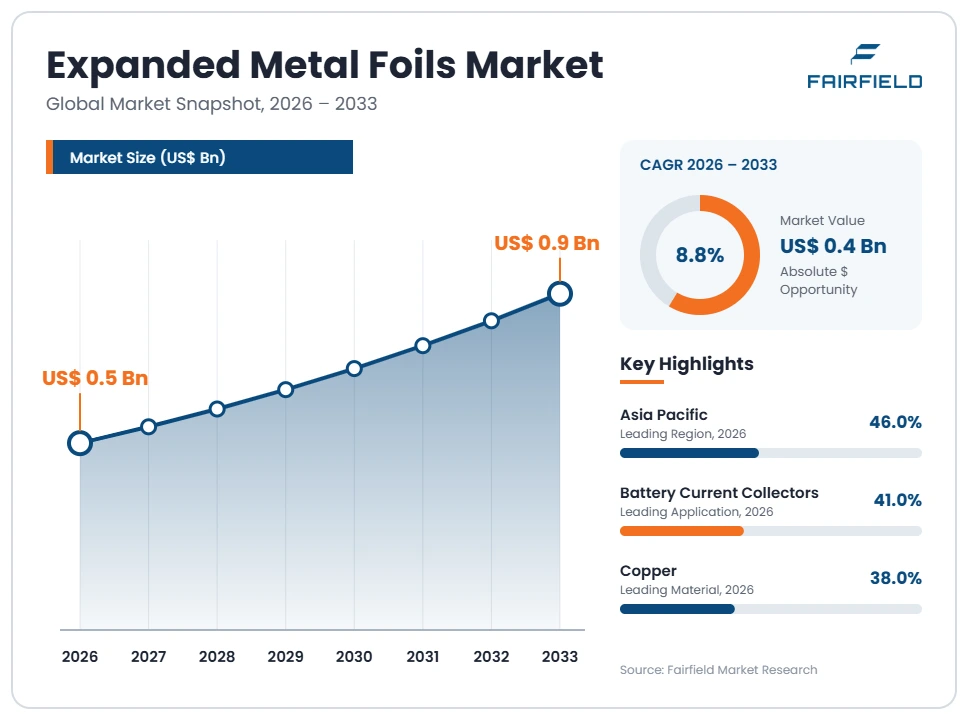
The global Expanded Metal Foils market size is expected to be valued at US$ 0.5 billion in 2026 and projected to reach US$ 0.9 billion by 2033, growing at a CAGR of 8.8% between 2026 and 2033.
In precise terms the market is worth roughly US$ 505 million in 2026 and about US$ 913 million by 2033. This is a small industrial materials niche, measured in hundreds of millions rather than billions, but it sits inside two large growth systems. Between 2020 and 2025 value grew at about 7.1% a year, with battery programme delays and aerospace build-rate disruption creating uneven quarters. Three forces shape the forecast: battery current collector demand, lightning-strike protection on composite airframes, and electrolyser and fuel cell component build-out. Metal cost pass-through makes reported value unusually sensitive to copper and aluminium pricing.
Key Report Takeaways
- By Material: Copper held 38% share in 2026, while Titanium is projected to expand at an 11.2% CAGR through 2033, driven by corrosion resistance requirements in electrolyser porous transport layers and cell hardware.
- By Application: Battery Current Collectors & Electrode Substrates held 41% share in 2026, while Fuel Cell & Electrolyser Components are projected to expand at a 12.1% CAGR through 2033, driven by hydrogen project construction and stack localisation.
- By End-Use Industry: Energy Storage & Batteries held 37% share in 2026, while Aerospace & Defense is projected to expand at a 9.8% CAGR through 2033, driven by composite airframe build rates and electromagnetic protection specifications.
- By Thickness: 30–60 Microns held 47% share in 2026, while Below 30 Microns is projected to expand at a 10.6% CAGR through 2033, driven by cell designers chasing higher energy density per unit mass.
- By Geography: Asia Pacific held 46% share in 2026, while North America is projected to expand at a 10.2% CAGR through 2033, supported by domestic battery plant construction and content requirements.
Global Expanded Metal Foils Market Trends and Insights
Drivers Impact Analysis
Two demand engines account for most forecast growth in very thin expanded metal mesh.
| Driver | Impact on CAGR Forecast | Geographic Relevance | Impact Timeline |
| Battery and energy storage cell production requiring lightweight three-dimensional current collectors | High | Asia Pacific, North America, Europe | Medium term (2–4 years) |
| Lightning-strike protection and electromagnetic shielding layers in composite aerostructures | High | North America, Europe | Long term (≥4 years) |
Battery Current Collector Demand Pulls Expanded Foil Into High-Volume Cell Production
Cell manufacturing is the largest single pull on expanded metal foil. An expanded copper or aluminium mesh weighs far less than solid foil of the same footprint while presenting a three-dimensional surface that anchors electrode coating mechanically. That combination raises active-material loading per cell and improves adhesion during calendering, which is why designers specify it in supercapacitors, lithium primary cells and several lithium-ion and sodium-ion formats.
The mechanism is energy density economics. Inactive mass inside a cell is pure parasitic weight, so removing metal from the current collector raises gravimetric energy density without changing chemistry. Expanded structures also allow electrolyte to pass through the plane, which helps wetting and reduces formation time. As manufacturers localise cell production and qualify new chemistries, they reopen component specifications that had been frozen for years, and each requalification creates an opening for expanded foil over solid foil.
Composite Airframe Lightning Protection Secures Long-Cycle Aerospace Demand for Expanded Foils
Lightning-strike protection is the most defensible demand base in this market. Carbon fibre composite structures conduct poorly compared with aluminium skins, so a conductive layer must be co-cured into the laminate to disperse strike current and protect fuel systems and avionics. Expanded copper and aluminium foils are the established solution, specified by weight per unit area and qualified into each airframe programme individually.
The causal driver is certification. Transport category aircraft must demonstrate protection against lightning effects, and the conductive layer forms part of the certified design, which makes substitution slow and expensive once approved. The same material also provides electromagnetic shielding for composite radomes, enclosures and nacelle structures. Because programmes run for decades, qualified suppliers hold positions that outlast ordinary commercial cycles, though revenue follows aircraft build rates and can swing hard with them.
Restraints Impact Analysis
Two restraints limit both margin stability and the pace of adoption across applications.
| Restraint | Impact on CAGR Forecast | Geographic Relevance | Impact Timeline |
| Copper and aluminium price exposure, since metal dominates delivered cost | High | Global | Short term (≤2 years) |
| Competition from solid foil, woven mesh and sprayed conductive coatings in each application | Medium | Global | Long term (≥4 years) |
Copper and Aluminium Price Volatility Compresses Expanded Metal Foil Converter Margins
Metal is the dominant cost in this product, so price volatility hits converters directly. Slitting and stretching add process value, but the underlying coil typically represents the majority of delivered cost, leaving a thin conversion margin to absorb raw material movement. When copper rises sharply, converters either pass cost through on a lag or absorb it, and long-term aerospace and automotive contracts often restrict how fast pass-through can happen.
The specific cost sources are measurable. Coil purchase, scrap generated during expansion, and the working capital tied up in metal inventory all scale with metal price rather than with volume. Expansion inevitably produces edge trim and off-specification material, and recovery value for thin scrap is below prime. Energy cost for annealing and surface treatment adds a second variable. Smaller converters without hedging capability or indexed contracts face the greatest earnings volatility, which discourages capacity investment during price spikes.
Substitute Conductive Architectures Limit Expanded Foil Penetration Across Applications
Substitution caps how much of each application expanded foil can win. Solid foil remains the default current collector in mainstream lithium-ion cells because it is cheaper per square metre, handles reliably on high-speed coating lines and gives a uniform coating surface. Woven and knitted metal mesh competes in filtration and catalysis supports where defined aperture geometry matters more than weight. Sprayed and plated conductive coatings challenge expanded foil in some shielding roles.
The underlying cause is process compatibility rather than performance. Expanded mesh has an open structure that can snag, stretch or tear on equipment designed for continuous solid web, and coating slurry can bleed through apertures. Retooling a coating line or adjusting slurry rheology is a qualification project with real cost and schedule risk. Unless the weight or adhesion benefit is decisive for the application, incumbent architectures retain the position by default.
Market Opportunities
Electrolyser and Fuel Cell Stack Localisation Opens a New Component Revenue Pool
Hydrogen equipment manufacturing is the clearest emerging revenue pool for expanded metal foils. Porous transport layers, gas diffusion supports, flow field components and current distribution elements all need thin, conductive, corrosion-resistant metal with controlled porosity. Titanium and nickel expanded foils fit these duties, and the price tolerance in stack hardware is far higher than in commodity battery components, so margins are better per kilogram shipped.
Specialty converters with titanium and nickel expansion capability are positioned to capture this, since handling reactive metals in very thin gauge is not a routine skill. Demand originates with electrolyser and fuel cell stack builders who are localising supply chains to reduce dependence on a small number of incumbent suppliers. Hydrogen support policy in several large economies underwrites project pipelines, which gives component suppliers enough forward visibility to invest in dedicated tooling.
Ultra-Thin Gauge Capability Creates a Defensible High-Specification Niche
Expansion below thirty microns is a technically difficult capability that commands premium pricing. At these gauges the web tears easily, strand geometry becomes hard to hold within tolerance, and tooling wear shows up quickly in the finished mesh. Converters that solve these problems can serve applications where no alternative exists, and because qualification is slow, the resulting positions are unusually durable.
Battery cell developers, microelectronics shielding specialists and medical device makers generate this demand. Cell designers chasing higher energy density want every micron of inactive mass removed, while shielding applications in compact electronics need conformable conductive layers that add negligible thickness. Precision tooling, in-line optical inspection and tighter annealing control are the enabling developments. Suppliers who combine these with documented process capability data can price on scarcity rather than on metal cost plus conversion.
Segment Analysis
- By Material: Copper Leads While Titanium Expands Fastest
Copper is the leading material with 38% share in 2026, because its conductivity makes it the default for anode current collectors, grounding layers and lightning-strike protection foils in composite laminates. Aluminium follows closely, used for cathode current collectors and weight-critical shielding where conductivity per unit mass matters more than absolute conductivity. Titanium is the fastest-growing material at an 11.2% CAGR through 2033, because electrolyser porous transport layers and stack hardware operate in acidic, oxidising conditions that corrode cheaper metals. Nickel serves alkaline electrolysis and high-temperature filtration, while Stainless Steel covers general industrial filtration and catalysis supports. Metal price movement passes through to reported value in every case. The implication for converters is that titanium and nickel capability, though low in volume, carries the pricing power that commodity copper and aluminium work has lost.
- By Application: Battery Current Collectors Hold Scale as Electrolyser Components Accelerate
Battery Current Collectors & Electrode Substrates form the largest application at 41% share in 2026, reflecting the sheer unit volume of cell production and the weight advantage expanded mesh offers over solid foil. Lightning-Strike Protection & EMI Shielding is the second major pool and the most technically entrenched, since the conductive layer is part of a certified airframe design. Fuel Cell & Electrolyser Components are the fastest-growing application at a 12.1% CAGR through 2033, from a small base, driven by stack construction and the need for corrosion-resistant porous metal layers. Filtration & Catalysis Supports and Grounding & Shielding provide steadier industrial baseload demand. Both leading applications are tied to capital investment cycles that can swing hard, so converters serving only one of them carry concentrated risk that the industrial applications help offset.
- By End-Use Industry: Energy Storage Leads While Aerospace and Defense Grows Quickest
Energy Storage & Batteries account for 37% of demand in 2026, the largest end-use position, because cell manufacturing consumes expanded foil in continuous production volumes rather than in programme batches. Automotive and Electronics follow, drawing on shielding, grounding and thermal management requirements. Aerospace & Defense is the fastest-growing end-use industry at a 9.8% CAGR through 2033, as composite content in new airframes rises and electromagnetic protection specifications extend to more structures, radomes and enclosures. Industrial Filtration & Process remains a stable, lower-growth base with long replacement cycles. Aerospace demand is specification-led and slow to qualify but very sticky once approved, which gives suppliers predictable multi-year volume. The practical conclusion is that a balanced portfolio across cell production and certified aerospace work smooths the capital-cycle volatility inherent in this niche.
- By Thickness: Mid-Gauge Foils Dominate While Ultra-Thin Grades Gain Share Rapidly
Foils in the 30–60 micron band hold 47% share in 2026, the leading thickness class, because this range balances handling robustness against weight saving and suits most current collector, shielding and lightning protection duties. Gauges above 60 microns serve filtration, catalysis supports and structural grounding applications where mechanical strength governs. Material below 30 microns is the fastest-growing class at a 10.6% CAGR through 2033, as cell designers strip inactive mass to raise energy density and electronics designers seek conformable shielding layers that add negligible stack height. Expanding at these gauges demands precision tooling, controlled annealing and in-line inspection, so few converters qualify. That capability gap is commercially significant: ultra-thin work carries higher conversion margin and faces far less price competition than standard gauge production.
Geography Analysis
Regional demand tracks where cells, aerostructures and electrolyser stacks are physically built, not where the finished systems are eventually used.
- Which Region Is Growing Fastest in the Expanded Metal Foils Market?
North America is the fastest-growing geography at a 10.2% CAGR between 2026 and 2033, from 24% share in 2026. The United States drives almost all of that growth, with Canada and Mexico adding battery and automotive component capacity. Domestic cell plant construction is the main engine, because content and sourcing requirements attached to clean vehicle incentives push cell makers to qualify local component suppliers rather than import. The region also holds a strong aerospace position, where expanded copper and aluminium foils are embedded in certified composite structures for commercial and defence programmes. Specialty converters here have deep experience in thin-gauge expansion and aerospace qualification documentation. The principal risk is timing: several announced cell projects have slipped, so component demand can arrive later than plant schedules imply.
- Europe: Certification Depth and Battery Regulation Shape Regional Specification
Europe holds 22% share in 2026, anchored by Germany, France, the United Kingdom, Sweden and Italy. Aerospace is the regional strength, with a long-established supply base producing expanded foils for composite wing, fuselage and nacelle structures that must meet lightning protection certification requirements. Battery cell projects add a second demand stream, though several have advanced more slowly than planned. Regulation (EU) 2023/1542 on batteries introduces carbon footprint declaration and recycled content obligations that reach into component sourcing, which favours suppliers able to document metal provenance and recycled input. Industrial filtration and catalysis supports provide steady baseline volume. The main regional change is procurement attention shifting from unit price toward documented material traceability, which advantages established converters with auditable supply chains over low-cost importers.
- Which Region Is Leading the Expanded Metal Foils Market?
Asia Pacific leads the market with 46% share in 2026, because the overwhelming majority of global cell manufacturing capacity sits in the region. China, Japan and South Korea account for most of that position, with India adding fast-growing cell and electronics demand. Japan is the technical centre for thin-gauge metal foil conversion, home to specialists with long experience in copper and aluminium foil processing for electronics and energy storage. Chinese converters supply enormous volumes of current collector material at aggressive pricing, which has compressed margins in standard gauges. Electronics manufacturing adds shielding and grounding demand across the region. The clearest opportunity is sodium-ion and next-generation cell chemistries, where component specifications are still open and expanded aluminium collectors are being evaluated against solid foil in pilot production.
- Latin America: Industrial Filtration Anchors a Small Import-Dependent Base
Latin America accounts for 4% of global value in 2026, the joint-smallest regional position. Brazil and Mexico generate nearly all identifiable demand, with Argentina and Chile contributing through mining and process industries. Consumption concentrates in industrial filtration, catalysis supports, grounding and shielding for electrical infrastructure, and automotive component manufacturing in Mexico. The barriers are substantial: there is effectively no local thin-gauge expansion capacity, so material is imported with freight and duty attached, and currency volatility makes metal-indexed pricing hard for buyers to plan around. Technical support is handled remotely, which slows qualification of new applications. The upside is automotive assembly growth in Mexico, where proximity to vehicle and component plants could eventually justify regional converting or at least local stockholding.
- Middle East & Africa: Energy Infrastructure Creates Narrow but Rising Demand
Middle East & Africa represents 4% of global value in 2026, the smallest base alongside its peer. Saudi Arabia, the United Arab Emirates, Turkey and South Africa account for most measurable consumption. Demand comes from petrochemical and refining filtration, catalysis supports, electrical grounding in power infrastructure, and a growing volume of shielding work in telecommunications installations. Turkey adds genuine metal processing capability and automotive component manufacturing that consumes expanded material. The constraints are familiar: no significant local thin-gauge capacity, long lead times on imported specialty gauges, and limited application engineering support. Large planned hydrogen and renewable energy projects in the Gulf states are the main upside, since electrolyser installation would create demand for titanium and nickel expanded components if any stack assembly is localised.
Competitive Landscape
The expanded metal foils market is moderately concentrated. A handful of specialist converters hold strong positions in thin-gauge work, while the broader expanded metal industry is fragmented across many producers who operate at heavier gauges and cannot serve foil applications. Dexmet Corporation, Fukuda Metal Foil & Powder Co., Ltd., Toyo Aluminium K.K., The Expanded Metal Company Limited and Metal Deployé SAS are among the recognised names, with Chinese and Japanese foil processors supplying large volumes into cell manufacturing. Concentration is highest in aerospace-qualified material, where the approved supplier list for any given programme is short.
Competition runs on gauge capability, strand geometry tolerance, weight per unit area consistency, surface treatment and qualification documentation. Aerospace customers weigh certification history and traceability above price, while cell manufacturers weigh cost per square metre, web handling performance and the ability to supply in wide coil at production speed. New entrants are mainly battery foil processors in Asia Pacific extending from solid foil into expanded formats, plus coating specialists offering sprayed conductive layers as an alternative architecture.
Strategic activity across the sector follows consistent themes rather than isolated transactions. Converters invest in precision tooling and in-line inspection to reach thinner gauges, add surface treatment and alloy options to widen application fit, and locate stockholding close to cell and aerostructure plants to shorten qualification cycles. Metal sourcing arrangements and scrap recovery programmes have also become competitive tools as recycled content documentation gains weight in procurement.
Strategic direction is converging on three themes: ultra-thin gauge capability, corrosion-resistant alloys for hydrogen equipment, and verifiable material traceability. Suppliers combining these with local presence near customer plants are best placed as battery and aerospace supply chains regionalise.
Recent Industry Developments
- August 2022: The United States enacted the Inflation Reduction Act, attaching domestic content and sourcing conditions to clean vehicle and energy storage incentives – it gave cell makers a direct financial reason to qualify locally produced current collector materials.
- July 2023: Regulation (EU) 2023/1542 concerning batteries and waste batteries was adopted – its carbon footprint declaration and recycled content provisions extend sourcing scrutiny down to metallic cell components.
- May 2024: The European Union Critical Raw Materials Act, Regulation (EU) 2024/1252, entered into force – benchmarks for domestic extraction, processing and recycling of strategic metals including copper and nickel affect feedstock planning for foil converters.
- Ongoing: ASTM F1267 remains the general material specification for expanded metal, while IEC and ISO electromagnetic compatibility and shielding effectiveness standards, together with airworthiness requirements for lightning protection of composite structures, define the test regimes customers apply – these frameworks determine which grades can be specified at all.
Companies Covered in the Report
- Dexmet Corporation
- Fukuda Metal Foil & Powder Co., Ltd.
- Toyo Aluminium K.K.
- The Expanded Metal Company Limited
- Metal Deployé SAS
- Niles Expanded Metals & Plastics
- Nippon Steel Corporation
- Sumitomo Electric Industries, Ltd.
- Zhejiang Hailiang Co., Ltd.
- Nuode New Materials Co., Ltd.
Expanded Metal Foils Market Report Scope
| Metric | Value |
| Study Period | 2020–2033 |
| Market Size 2026 | US$ 0.5 Billion |
| Market Size 2033 | US$ 0.9 Billion |
| CAGR 2026–2033 | 8.8% |
| Absolute Dollar Opportunity | US$ 0.4 Billion |
| Largest Market | Asia Pacific (46% share in 2026) |
| Fastest-Growing Market | North America (10.2% CAGR) |
| Market Concentration | Medium |
| Major Players | Dexmet Corporation, Fukuda Metal Foil & Powder Co., Ltd., Toyo Aluminium K.K., The Expanded Metal Company Limited, Metal Deployé SAS |
Expanded Metal Foils Market Segmentation
Material
- Copper
- Aluminium
- Nickel
- Stainless Steel
- Titanium
Application
- Battery Current Collectors & Electrode Substrates
- Lightning-Strike Protection & EMI Shielding
- Filtration & Catalysis Supports
- Fuel Cell & Electrolyser Components
- Grounding & Shielding
End-Use Industry
- Energy Storage & Batteries
- Aerospace & Defense
- Automotive
- Industrial Filtration & Process
- Electronics
Thickness
- Below 30 Microns
- 30–60 Microns
- Above 60 Microns
Regions
- North America
- Europe
- Asia Pacific
- Latin America
- Middle East & Africa
- Executive Summary
- Global Expanded Metal Foils Market Snapshot
- Future Projections
- Key Report Takeaways
- Regional Snapshot
- Market Overview
- Market Definition and Report Scope
- Historical Trends 2020–2025
- Market Dynamics
- Drivers
- Battery Current Collector Demand Pulls Expanded Foil Into High-Volume Cell Production
- Composite Airframe Lightning Protection Secures Long-Cycle Aerospace Demand for Expanded Foils
- Restraints
- Copper and Aluminium Price Volatility Compresses Expanded Metal Foil Converter Margins
- Substitute Conductive Architectures Limit Expanded Foil Penetration Across Applications
- Market Opportunities
- Electrolyser and Fuel Cell Stack Localisation Opens a New Component Revenue Pool
- Ultra-Thin Gauge Capability Creates a Defensible High-Specification Niche
- Drivers
- Global Expanded Metal Foils Market Outlook, 2020–2033
- Global Expanded Metal Foils Market Outlook, by Material, Value (US$ Billion), 2020–2033
- Copper
- Aluminium
- Nickel
- Stainless Steel
- Titanium
- Global Expanded Metal Foils Market Outlook, by Application, Value (US$ Billion), 2020–2033
- Battery Current Collectors & Electrode Substrates
- Lightning-Strike Protection & EMI Shielding
- Filtration & Catalysis Supports
- Fuel Cell & Electrolyser Components
- Grounding & Shielding
- Global Expanded Metal Foils Market Outlook, by End-Use Industry, Value (US$ Billion), 2020–2033
- Energy Storage & Batteries
- Aerospace & Defense
- Automotive
- Industrial Filtration & Process
- Electronics
- Global Expanded Metal Foils Market Outlook, by Thickness, Value (US$ Billion), 2020–2033
- Below 30 Microns
- 30–60 Microns
- Above 60 Microns
- Global Expanded Metal Foils Market Outlook, by Region, Value (US$ Billion), 2020–2033
- North America
- Europe
- Asia Pacific
- Latin America
- Middle East & Africa
- Global Expanded Metal Foils Market Outlook, by Material, Value (US$ Billion), 2020–2033
- North America Expanded Metal Foils Market Outlook, 2020–2033
- North America Expanded Metal Foils Market Outlook, by Material, Value (US$ Billion), 2020–2033
- Copper
- Aluminium
- Nickel
- Stainless Steel
- Titanium
- North America Expanded Metal Foils Market Outlook, by Application, Value (US$ Billion), 2020–2033
- Battery Current Collectors & Electrode Substrates
- Lightning-Strike Protection & EMI Shielding
- Filtration & Catalysis Supports
- Fuel Cell & Electrolyser Components
- Grounding & Shielding
- North America Expanded Metal Foils Market Outlook, by End-Use Industry, Value (US$ Billion), 2020–2033
- Energy Storage & Batteries
- Aerospace & Defense
- Automotive
- Industrial Filtration & Process
- Electronics
- North America Expanded Metal Foils Market Outlook, by Thickness, Value (US$ Billion), 2020–2033
- Below 30 Microns
- 30–60 Microns
- Above 60 Microns
- North America Expanded Metal Foils Market Outlook, by Country, Value (US$ Billion), 2020–2033
- United States Expanded Metal Foils Market Outlook, by Material, 2020–2033
- United States Expanded Metal Foils Market Outlook, by Application, 2020–2033
- United States Expanded Metal Foils Market Outlook, by End-Use Industry, 2020–2033
- United States Expanded Metal Foils Market Outlook, by Thickness, 2020–2033
- Canada Expanded Metal Foils Market Outlook, by Material, 2020–2033
- Canada Expanded Metal Foils Market Outlook, by Application, 2020–2033
- Canada Expanded Metal Foils Market Outlook, by End-Use Industry, 2020–2033
- Canada Expanded Metal Foils Market Outlook, by Thickness, 2020–2033
- Mexico Expanded Metal Foils Market Outlook, by Material, 2020–2033
- Mexico Expanded Metal Foils Market Outlook, by Application, 2020–2033
- Mexico Expanded Metal Foils Market Outlook, by End-Use Industry, 2020–2033
- Mexico Expanded Metal Foils Market Outlook, by Thickness, 2020–2033
- North America Expanded Metal Foils Market Outlook, by Material, Value (US$ Billion), 2020–2033
- Europe Expanded Metal Foils Market Outlook, 2020–2033
- Europe Expanded Metal Foils Market Outlook, by Material, Value (US$ Billion), 2020–2033
- Copper
- Aluminium
- Nickel
- Stainless Steel
- Titanium
- Europe Expanded Metal Foils Market Outlook, by Application, Value (US$ Billion), 2020–2033
- Battery Current Collectors & Electrode Substrates
- Lightning-Strike Protection & EMI Shielding
- Filtration & Catalysis Supports
- Fuel Cell & Electrolyser Components
- Grounding & Shielding
- Europe Expanded Metal Foils Market Outlook, by End-Use Industry, Value (US$ Billion), 2020–2033
- Energy Storage & Batteries
- Aerospace & Defense
- Automotive
- Industrial Filtration & Process
- Electronics
- Europe Expanded Metal Foils Market Outlook, by Thickness, Value (US$ Billion), 2020–2033
- Below 30 Microns
- 30–60 Microns
- Above 60 Microns
- Europe Expanded Metal Foils Market Outlook, by Country, Value (US$ Billion), 2020–2033
- Germany Expanded Metal Foils Market Outlook, by Material, 2020–2033
- Germany Expanded Metal Foils Market Outlook, by Application, 2020–2033
- Germany Expanded Metal Foils Market Outlook, by End-Use Industry, 2020–2033
- Germany Expanded Metal Foils Market Outlook, by Thickness, 2020–2033
- France Expanded Metal Foils Market Outlook, by Material, 2020–2033
- France Expanded Metal Foils Market Outlook, by Application, 2020–2033
- France Expanded Metal Foils Market Outlook, by End-Use Industry, 2020–2033
- France Expanded Metal Foils Market Outlook, by Thickness, 2020–2033
- United Kingdom Expanded Metal Foils Market Outlook, by Material, 2020–2033
- United Kingdom Expanded Metal Foils Market Outlook, by Application, 2020–2033
- United Kingdom Expanded Metal Foils Market Outlook, by End-Use Industry, 2020–2033
- United Kingdom Expanded Metal Foils Market Outlook, by Thickness, 2020–2033
- Sweden Expanded Metal Foils Market Outlook, by Material, 2020–2033
- Sweden Expanded Metal Foils Market Outlook, by Application, 2020–2033
- Sweden Expanded Metal Foils Market Outlook, by End-Use Industry, 2020–2033
- Sweden Expanded Metal Foils Market Outlook, by Thickness, 2020–2033
- Italy Expanded Metal Foils Market Outlook, by Material, 2020–2033
- Italy Expanded Metal Foils Market Outlook, by Application, 2020–2033
- Italy Expanded Metal Foils Market Outlook, by End-Use Industry, 2020–2033
- Italy Expanded Metal Foils Market Outlook, by Thickness, 2020–2033
- Europe Expanded Metal Foils Market Outlook, by Material, Value (US$ Billion), 2020–2033
- Asia Pacific Expanded Metal Foils Market Outlook, 2020–2033
- Asia Pacific Expanded Metal Foils Market Outlook, by Material, Value (US$ Billion), 2020–2033
- Copper
- Aluminium
- Nickel
- Stainless Steel
- Titanium
- Asia Pacific Expanded Metal Foils Market Outlook, by Application, Value (US$ Billion), 2020–2033
- Battery Current Collectors & Electrode Substrates
- Lightning-Strike Protection & EMI Shielding
- Filtration & Catalysis Supports
- Fuel Cell & Electrolyser Components
- Grounding & Shielding
- Asia Pacific Expanded Metal Foils Market Outlook, by End-Use Industry, Value (US$ Billion), 2020–2033
- Energy Storage & Batteries
- Aerospace & Defense
- Automotive
- Industrial Filtration & Process
- Electronics
- Asia Pacific Expanded Metal Foils Market Outlook, by Thickness, Value (US$ Billion), 2020–2033
- Below 30 Microns
- 30–60 Microns
- Above 60 Microns
- Asia Pacific Expanded Metal Foils Market Outlook, by Country, Value (US$ Billion), 2020–2033
- China Expanded Metal Foils Market Outlook, by Material, 2020–2033
- China Expanded Metal Foils Market Outlook, by Application, 2020–2033
- China Expanded Metal Foils Market Outlook, by End-Use Industry, 2020–2033
- China Expanded Metal Foils Market Outlook, by Thickness, 2020–2033
- Japan Expanded Metal Foils Market Outlook, by Material, 2020–2033
- Japan Expanded Metal Foils Market Outlook, by Application, 2020–2033
- Japan Expanded Metal Foils Market Outlook, by End-Use Industry, 2020–2033
- Japan Expanded Metal Foils Market Outlook, by Thickness, 2020–2033
- South Korea Expanded Metal Foils Market Outlook, by Material, 2020–2033
- South Korea Expanded Metal Foils Market Outlook, by Application, 2020–2033
- South Korea Expanded Metal Foils Market Outlook, by End-Use Industry, 2020–2033
- South Korea Expanded Metal Foils Market Outlook, by Thickness, 2020–2033
- India Expanded Metal Foils Market Outlook, by Material, 2020–2033
- India Expanded Metal Foils Market Outlook, by Application, 2020–2033
- India Expanded Metal Foils Market Outlook, by End-Use Industry, 2020–2033
- India Expanded Metal Foils Market Outlook, by Thickness, 2020–2033
- Asia Pacific Expanded Metal Foils Market Outlook, by Material, Value (US$ Billion), 2020–2033
- Latin America Expanded Metal Foils Market Outlook, 2020–2033
- Latin America Expanded Metal Foils Market Outlook, by Material, Value (US$ Billion), 2020–2033
- Copper
- Aluminium
- Nickel
- Stainless Steel
- Titanium
- Latin America Expanded Metal Foils Market Outlook, by Application, Value (US$ Billion), 2020–2033
- Battery Current Collectors & Electrode Substrates
- Lightning-Strike Protection & EMI Shielding
- Filtration & Catalysis Supports
- Fuel Cell & Electrolyser Components
- Grounding & Shielding
- Latin America Expanded Metal Foils Market Outlook, by End-Use Industry, Value (US$ Billion), 2020–2033
- Energy Storage & Batteries
- Aerospace & Defense
- Automotive
- Industrial Filtration & Process
- Electronics
- Latin America Expanded Metal Foils Market Outlook, by Thickness, Value (US$ Billion), 2020–2033
- Below 30 Microns
- 30–60 Microns
- Above 60 Microns
- Latin America Expanded Metal Foils Market Outlook, by Country, Value (US$ Billion), 2020–2033
- Brazil Expanded Metal Foils Market Outlook, by Material, 2020–2033
- Brazil Expanded Metal Foils Market Outlook, by Application, 2020–2033
- Brazil Expanded Metal Foils Market Outlook, by End-Use Industry, 2020–2033
- Brazil Expanded Metal Foils Market Outlook, by Thickness, 2020–2033
- Mexico Expanded Metal Foils Market Outlook, by Material, 2020–2033
- Mexico Expanded Metal Foils Market Outlook, by Application, 2020–2033
- Mexico Expanded Metal Foils Market Outlook, by End-Use Industry, 2020–2033
- Mexico Expanded Metal Foils Market Outlook, by Thickness, 2020–2033
- Argentina Expanded Metal Foils Market Outlook, by Material, 2020–2033
- Argentina Expanded Metal Foils Market Outlook, by Application, 2020–2033
- Argentina Expanded Metal Foils Market Outlook, by End-Use Industry, 2020–2033
- Argentina Expanded Metal Foils Market Outlook, by Thickness, 2020–2033
- Chile Expanded Metal Foils Market Outlook, by Material, 2020–2033
- Chile Expanded Metal Foils Market Outlook, by Application, 2020–2033
- Chile Expanded Metal Foils Market Outlook, by End-Use Industry, 2020–2033
- Chile Expanded Metal Foils Market Outlook, by Thickness, 2020–2033
- Latin America Expanded Metal Foils Market Outlook, by Material, Value (US$ Billion), 2020–2033
- Middle East & Africa Expanded Metal Foils Market Outlook, 2020–2033
- Middle East & Africa Expanded Metal Foils Market Outlook, by Material, Value (US$ Billion), 2020–2033
- Copper
- Aluminium
- Nickel
- Stainless Steel
- Titanium
- Middle East & Africa Expanded Metal Foils Market Outlook, by Application, Value (US$ Billion), 2020–2033
- Battery Current Collectors & Electrode Substrates
- Lightning-Strike Protection & EMI Shielding
- Filtration & Catalysis Supports
- Fuel Cell & Electrolyser Components
- Grounding & Shielding
- Middle East & Africa Expanded Metal Foils Market Outlook, by End-Use Industry, Value (US$ Billion), 2020–2033
- Energy Storage & Batteries
- Aerospace & Defense
- Automotive
- Industrial Filtration & Process
- Electronics
- Middle East & Africa Expanded Metal Foils Market Outlook, by Thickness, Value (US$ Billion), 2020–2033
- Below 30 Microns
- 30–60 Microns
- Above 60 Microns
- Middle East & Africa Expanded Metal Foils Market Outlook, by Country, Value (US$ Billion), 2020–2033
- Saudi Arabia Expanded Metal Foils Market Outlook, by Material, 2020–2033
- Saudi Arabia Expanded Metal Foils Market Outlook, by Application, 2020–2033
- Saudi Arabia Expanded Metal Foils Market Outlook, by End-Use Industry, 2020–2033
- Saudi Arabia Expanded Metal Foils Market Outlook, by Thickness, 2020–2033
- United Arab Emirates Expanded Metal Foils Market Outlook, by Material, 2020–2033
- United Arab Emirates Expanded Metal Foils Market Outlook, by Application, 2020–2033
- United Arab Emirates Expanded Metal Foils Market Outlook, by End-Use Industry, 2020–2033
- United Arab Emirates Expanded Metal Foils Market Outlook, by Thickness, 2020–2033
- Turkey Expanded Metal Foils Market Outlook, by Material, 2020–2033
- Turkey Expanded Metal Foils Market Outlook, by Application, 2020–2033
- Turkey Expanded Metal Foils Market Outlook, by End-Use Industry, 2020–2033
- Turkey Expanded Metal Foils Market Outlook, by Thickness, 2020–2033
- South Africa Expanded Metal Foils Market Outlook, by Material, 2020–2033
- South Africa Expanded Metal Foils Market Outlook, by Application, 2020–2033
- South Africa Expanded Metal Foils Market Outlook, by End-Use Industry, 2020–2033
- South Africa Expanded Metal Foils Market Outlook, by Thickness, 2020–2033
- Middle East & Africa Expanded Metal Foils Market Outlook, by Material, Value (US$ Billion), 2020–2033
- Competitive Landscape
- Market Concentration and Industry Leaders
- Competitive Differentiation
- Strategic Moves and Market Direction
- Recent Industry Developments
- Company Profiles
- Dexmet Corporation
- Fukuda Metal Foil & Powder Co., Ltd.
- Toyo Aluminium K.K.
- The Expanded Metal Company Limited
- Metal Deployé SAS
- Niles Expanded Metals & Plastics
- Nippon Steel Corporation
- Sumitomo Electric Industries, Ltd.
- Zhejiang Hailiang Co., Ltd.
- Nuode New Materials Co., Ltd.
- Appendix
- Research Methodology
- Report Assumptions
- Acronyms and Abbreviations
Material
- Copper
- Aluminium
- Nickel
- Stainless Steel
- Titanium
Application
- Battery Current Collectors & Electrode Substrates
- Lightning-Strike Protection & EMI Shielding
- Filtration & Catalysis Supports
- Fuel Cell & Electrolyser Components
- Grounding & Shielding
End-Use Industry
- Energy Storage & Batteries
- Aerospace & Defense
- Automotive
- Industrial Filtration & Process
- Electronics
Thickness
- Below 30 Microns
- 30–60 Microns
- Above 60 Microns
Regions
- North America
- Europe
- Asia Pacific
- Latin America
- Middle East & Africa
Our Research Methodology
Considering the volatility of business today, traditional approaches to strategizing a game plan can be unfruitful if not detrimental. True ambiguity is no way to determine a forecast. A myriad of predetermined factors must be accounted for such as the degree of risk involved, the magnitude of circumstances, as well as conditions or consequences that are not known or unpredictable. To circumvent binary views that cast uncertainty, the application of market research intelligence to strategically posture, move, and enable actionable outcomes is necessary.
View Methodology
Quality Assured
Rigorous Validation Process

Confidentiality Assured
End-to-end Data Security

Custom Research Services
Tailored To Your Objectives
FAQs
The market is valued at US$ 0.5 billion in 2026, about US$ 505 million, covering thin expanded mesh across five metal families globally.
Value reaches US$ 0.9 billion by 2033 at an 8.8% CAGR, an absolute dollar opportunity of US$ 0.4 billion across the forecast period.
Battery Current Collectors & Electrode Substrates lead with 41% share in 2026, reflecting the continuous production volumes of global cell manufacturing.
Titanium grows fastest at an 11.2% CAGR to 2033, because electrolyser porous transport layers need corrosion resistance in oxidising acidic conditions.
Asia Pacific leads with 46% share in 2026, since most global battery cell and electronics manufacturing capacity is located there.
Related Reports
Zirconium Market Size, Share, Insights, Competitive Landscape, and Forecast 2026 to 2033
The global zirconium market is valued at US$4.5 billion in 2026, reaching US$6.5 billion by 2033, growing at a 5.4% CAGR
Precision Stainless Steel Market Size, Share, Insights, Competitive Landscape, and Forecast 2026 to 2033
The global precision stainless steel market is valued at US$9.8 billion in 2026, reaching US$15.7 billion by 2033, growing at a 6.96% CAGR
Multi-mode Receiver Market Insights, Competitive Landscape, and Market Forecast 2033
Multi-Mode Receiver Market is projected to reach US$2.18 billion by 2033, driven by aircraft modernization, navigation mandates and fleet expansion
Finished Lubricants Market Insights, Competitive Landscape, and Market Forecast 2026–2033
Finished Lubricants Market is projected to reach US$253.02 billion by 2033, driven by automotive growth, industrialization and stricter emissions standards
Discrete Capacitor Market Insights, Competitive Landscape, and Market Forecast 2026–2033
Discrete Capacitor Market is projected to reach US$32.51 billion by 2033, driven by EV production, AI infrastructure, semiconductor manufacturing
Polishing and Finishing Machine Market Insights, Competitive Landscape, and Market Forecast 2033
Polishing and Finishing Machine Market to reach US$7.41 Bn by 2033 at 3.3% CAGR, driven by EVs, semiconductors, automation, and precision manufacturing.