



Dental Adhesives Market
Dental Adhesives Market Insights, Competitive Landscape, and Market Forecast - 2033
Global Dental Adhesives Market Forecast
- Dental adhesives market size poised to reach USD 4.2 Bn in 2033, up from USD 2.9 Bn attained in 2026
- Dental adhesives market revenue projected to witness a CAGR of 6% during 2026-2033
Dental Adhesives Market Insights
- The global dental adhesives market is experiencing robust growth, driven by increasing dental procedures and advancements in adhesive technology.
- Innovations such as self-etching adhesives, universal adhesives, and adhesive systems with enhanced bond strength and durability are shaping the market landscape.
- Rising demand for cosmetic dentistry, restorative procedures, and dental implants is fueling the adoption of dental adhesives globally.
- Growing preference for adhesive systems that simplify application procedures, reduce chair-side time, and improve patient comfort is a significant trend driving market growth.
- Stringent regulatory standards and approvals for dental adhesives ensure product safety, efficacy, and compliance with regional healthcare guidelines.
- Dental adhesives find extensive applications in bonding restorations, crowns, bridges, veneers, and orthodontic brackets, enhancing patient outcomes and treatment durability.
- North America, and Europe dominate the global market due to high healthcare expenditure, while Asia Pacific is witnessing rapid growth driven by increasing dental awareness and healthcare infrastructure development.
A Look Back and a Look Forward - Comparative Analysis
Due to increased patient demand for improved adhesives and a more aesthetically pleasing oral appearance, product development, and material development for durable treatment are growing at a rapid pace.
Dental adhesives benefit both the patient and the doctor by simplifying the procedure, unlike the mix-and-match procedure for adhesion that was used years ago. This is a major factor driving an increase in the production of high-quality dental adhesives.
The development of novel technologies to meet the demand for high-quality adhesives at reasonable prices is said to drive market expansion over the coming years.
Key Growth Determinants
Rising Demand for Minimally Invasive Procedures
The trend towards minimally invasive dentistry is a major growth driver for dental adhesives. These procedures aim to preserve as much natural tooth structure as possible.
Unlike traditional methods that involve significant drilling, minimally invasive techniques rely on strong adhesives to bond restorations like fillings, crowns, and veneers to the remaining tooth. This not only improves patient comfort during and after the procedure but also promotes better long-term oral health.
Advancements in adhesive technology, with improved bond strength and biocompatibility, are perfectly aligned with this growing demand for minimally invasive dentistry.
Increasing Prevalence of Dental Diseases
Unfortunately, dental diseases like tooth decay, gum disease, and tooth loss remain prevalent globally. This creates a continuous need for restorative procedures, where dental adhesives play a critical role. Factors like poor dietary habits, increasing consumption of sugary beverages, and inadequate oral hygiene contribute to the rise in dental problems.
Additionally, the ageing population requires more dental restorations due to wear and tear on teeth. This growing demand for restorative procedures translates to a higher need for effective dental adhesives to ensure the longevity and success of these treatments.
Growing Focus on Aesthetics, and Cosmetic Dentistry
The desire for a bright, healthy smile is driving the demand for cosmetic dentistry procedures. These procedures often involve bonding techniques to enhance the appearance of teeth. Dental adhesives play a crucial role in achieving natural-looking results. Advancements in adhesive technology are creating possibilities for bonding veneers and other cosmetic restorations with minimal tooth preparation.
Additionally, the development of tooth-colored adhesives improves the aesthetics of the final restoration. This growing focus on aesthetics, coupled with advancements in adhesive materials, is expected to significantly contribute to the dental adhesives market growth.
Key Growth Barriers
High Cost of Dental Care
Dental procedures, including those utilizing dental adhesives, can be very expensive, which can be a barrier for some patients seeking restorative or cosmetic treatments. The cost factors include material costs, dental professional fees and limited insurance coverage.
Dental adhesives, especially high-performance ones, can be expensive, which is a major restraining factor for the market. Further, the expertise required for procedures involving adhesives contributes to the overall cost of treatment, which includes the fees of dentists as well.
Moreover, dental insurance plans may not always cover the full cost of procedures using advanced adhesives. This high price point can deter patients from seeking necessary dental treatments, impacting the overall demand for dental adhesives.
Stringent Regulatory Requirements
The focus on safety and efficacy enforced by regulatory bodies like the FDA can act as a growth restraint. Rigorous testing and approval processes can delay the introduction of new and innovative adhesives to the market.
Additionally, constant advancements in technology often require revisions to regulatory guidelines, further adding complexity for manufacturers. While regulations are crucial for patient safety, these stringent requirements can limit the pace of innovation and product availability, potentially slowing down market growth.
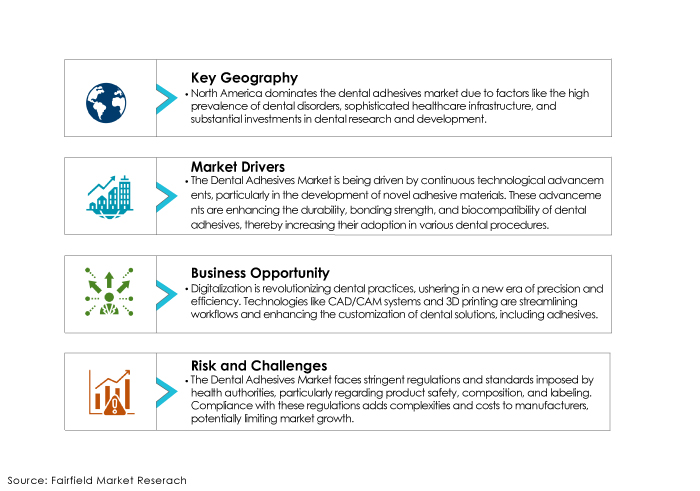
Dental Adhesives Market Trends and Opportunities
Adoption of Bioactive Dental Adhesives
The global dental adhesives market is witnessing a growing trend towards the development and adoption of bioactive adhesives. These next-generation adhesives offer several advantages over traditional materials. The bioactive adhesives offer enhanced bond strength and durability and can not only create a strong initial bond between the restoration and tooth structure but also promote a chemical bond over time. This can lead to longer-lasting restorations and reduced risk of leakage and micro-failures.
Bioactive adhesives are designed to mimic the natural composition of tooth enamel and dentin. This minimizes the risk of allergic reactions and promotes better integration with the surrounding tooth structure. Some bioactive adhesives can stimulate the remineralisation of dentin, a process where lost minerals are redeposited into the tooth structure. This can help strengthen the tooth and potentially prevent future decay.
The development of bioactive adhesives is driven by the continuous pursuit of minimally invasive dentistry and the desire for long-lasting, biocompatible restorations. As research in this area progresses, we can expect to see even more advanced bioactive adhesives with additional functionalities emerge in the global dental adhesives market share.
Emerging Markets Globally
The dental adhesives market presents a significant opportunity for growth in emerging economies like those in southeast Asia, and Latin America. These regions are experiencing a rise in disposable incomes, leading to increased demand for dental care.
Additionally, there is a growing awareness of oral health and a growing middle class willing to invest in aesthetic dentistry procedures. However, these markets often have limited access to advanced dental technologies, lower penetration of dental insurance, and a need for cost-effective solutions.
Dental adhesive manufacturers can capitalize on this opportunity by developing cost-effective versions of high-performance adhesives, educational programs to raise awareness about oral health and partnerships with local dental providers to improve access to dental care.
By addressing these specific needs and creating a strong market presence, dental adhesive companies can tap into the vast potential of emerging markets and contribute to improved oral healthcare globally.
Segment Covered in the Report
Strips Remain Dominant in the Product Category
Strips represent the dominant market segment in the dental fluoride category. The ease of application, precise dosage, and growing consumer preference for convenient oral care products have contributed to the dominance of strips in the dental adhesives market. They offer a practical and effective way to deliver fluoride, leading to increased adoption among both adults and children. While creams and powders continue to hold a market share, strips have gained significant traction due to their user-friendly format.
Preference for Pit and Fissure Sealants Maximum Based on Application
Pit and fissure sealants is the dominant segment in the dental fluoride application category. The primary function of fluoride in preventing dental caries is by strengthening tooth enamel. Pit and fissure sealants are applied to the chewing surfaces of teeth to prevent cavities by filling in the grooves where food particles and bacteria can accumulate. This segment benefits significantly from increasing dental awareness and preventive dental care practices, driving its dominance in the market.
Dental Clinics Take the Charge in Distribution Channels
The dental clinics possessed the highest market share value at 40%. The rise in dental health awareness and the prevalence of restorative and prosthetic dental procedures among private dental practitioners are the primary factors contributing to the increased use of these adhesives in dental clinics.
Additionally, the placement of orthodontic brackets and their alignments is primarily performed in dental clinics, necessitating the use of etchants and adhesives. Therefore, dental clinics contribute to the demand for dental adhesives during the forecast period of 2026 to 2033.
Regional Analysis
North America Maintains the Most Prominent Position
High product availability, the presence of sophisticated technologies, and a favourable reimbursement structure are all potential explanations for this phenomenon.
For instance, the Children's Health Insurance Program (CHIP), and Medicaid offer coverage for dental sealants, which increases their affordability and subsequently promotes the adoption of sealants and related services.
The market in Asia Pacific is expected to experience rapid growth during the forecast period as a result of the rapidly ageing population, evolving lifestyles, and increasing awareness of oral health. Additionally, the prevalence of dental caries is expected to increase.
The demand for the "Hollywood smile" is expected to increase due to the increasing prevalence of social media and the growing awareness of attractiveness. This is expected to facilitate the growth of the market in the region.
Fairfield’s Competitive Landscape Analysis
The global dental adhesives market is fiercely competitive, characterized by a diverse range of players striving to innovate and capture market share. Key market participants include multinational corporations, regional players, and niche manufacturers, each leveraging distinct strategies to maintain and expand their foothold in the industry.
The global dental adhesives market is marked by intense competition driven by innovation, regional specialization, and strategic partnerships. Understanding these dynamics is crucial for stakeholders aiming to capitalize on growth opportunities in this dynamic and rapidly evolving sector.
Key Market Players
- Stryker Corporation
- 3M Company
- Dental Tech
- DENTSPLY International
- Baxter International
- Ultradent Products Inc.
- DETAX Ettlingen
- Procter and Gamble
- GlaxoSmithKline
- BISCO
- Dental Speed Graph
Global Dental Adhesives Market is Segmented as Below -
By Product
- Cream
- Powders
- Strips
By Technique
- Generations
- Etching Techniques
By Application
- Denture
- Pit and Fissure
- Restorative
By End User
- Dental Clinics
- Hospitals
- Academic Institutes
- Others
By Region
- North America
- Europe
- Asia Pacific
- Latin America
- Middle East & Africa
- Executive Summary
- Global Dental Adhesives Market Snapshot
- Future Projections
- Key Market Trends
- Regional Snapshot, by Value, 2026
- Analyst Recommendations
- Market Overview
- Market Definitions and Segmentations
- Market Dynamics
- Drivers
- Restraints
- Market Opportunities
- Value Chain Analysis
- COVID-19 Impact Analysis
- Porter's Five Forces Analysis
- Impact of Russia-Ukraine Conflict
- PESTLE Analysis
- Regulatory Analysis
- Price Trend Analysis
- Current Prices and Future Projections, 2025-2033
- Price Impact Factors
- Global Dental Adhesives Market Outlook, 2020 - 2033
- Global Dental Adhesives Market Outlook, by Product, Value (US$ Mn), 2020-2033
- Cream
- Powders
- Strips
- Global Dental Adhesives Market Outlook, by Technique, Value (US$ Mn), 2020-2033
- Generations
- Etching Techniques
- Global Dental Adhesives Market Outlook, by Application, Value (US$ Mn), 2020-2033
- Denture
- Pit and Fissure
- Restorative
- Global Dental Adhesives Market Outlook, by End User, Value (US$ Mn), 2020-2033
- Dental Clinics
- Hospitals
- Academic Institutes
- Others
- Global Dental Adhesives Market Outlook, by Region, Value (US$ Mn), 2020-2033
- North America
- Europe
- Asia Pacific
- Latin America
- Middle East & Africa
- Global Dental Adhesives Market Outlook, by Product, Value (US$ Mn), 2020-2033
- North America Dental Adhesives Market Outlook, 2020 - 2033
- North America Dental Adhesives Market Outlook, by Product, Value (US$ Mn), 2020-2033
- Cream
- Powders
- Strips
- North America Dental Adhesives Market Outlook, by Technique, Value (US$ Mn), 2020-2033
- Generations
- Etching Techniques
- North America Dental Adhesives Market Outlook, by Application, Value (US$ Mn), 2020-2033
- Denture
- Pit and Fissure
- Restorative
- North America Dental Adhesives Market Outlook, by End User, Value (US$ Mn), 2020-2033
- Dental Clinics
- Hospitals
- Academic Institutes
- Others
- North America Dental Adhesives Market Outlook, by Country, Value (US$ Mn), 2020-2033
- U.S. Dental Adhesives Market Outlook, by Product, 2020-2033
- U.S. Dental Adhesives Market Outlook, by Technique, 2020-2033
- U.S. Dental Adhesives Market Outlook, by Application, 2020-2033
- U.S. Dental Adhesives Market Outlook, by End User, 2020-2033
- Canada Dental Adhesives Market Outlook, by Product, 2020-2033
- Canada Dental Adhesives Market Outlook, by Technique, 2020-2033
- Canada Dental Adhesives Market Outlook, by Application, 2020-2033
- Canada Dental Adhesives Market Outlook, by End User, 2020-2033
- BPS Analysis/Market Attractiveness Analysis
- North America Dental Adhesives Market Outlook, by Product, Value (US$ Mn), 2020-2033
- Europe Dental Adhesives Market Outlook, 2020 - 2033
- Europe Dental Adhesives Market Outlook, by Product, Value (US$ Mn), 2020-2033
- Cream
- Powders
- Strips
- Europe Dental Adhesives Market Outlook, by Technique, Value (US$ Mn), 2020-2033
- Generations
- Etching Techniques
- Europe Dental Adhesives Market Outlook, by Application, Value (US$ Mn), 2020-2033
- Denture
- Pit and Fissure
- Restorative
- Europe Dental Adhesives Market Outlook, by End User, Value (US$ Mn), 2020-2033
- Dental Clinics
- Hospitals
- Academic Institutes
- Others
- Europe Dental Adhesives Market Outlook, by Country, Value (US$ Mn), 2020-2033
- Germany Dental Adhesives Market Outlook, by Product, 2020-2033
- Germany Dental Adhesives Market Outlook, by Technique, 2020-2033
- Germany Dental Adhesives Market Outlook, by Application, 2020-2033
- Germany Dental Adhesives Market Outlook, by End User, 2020-2033
- Italy Dental Adhesives Market Outlook, by Product, 2020-2033
- Italy Dental Adhesives Market Outlook, by Technique, 2020-2033
- Italy Dental Adhesives Market Outlook, by Application, 2020-2033
- Italy Dental Adhesives Market Outlook, by End User, 2020-2033
- France Dental Adhesives Market Outlook, by Product, 2020-2033
- France Dental Adhesives Market Outlook, by Technique, 2020-2033
- France Dental Adhesives Market Outlook, by Application, 2020-2033
- France Dental Adhesives Market Outlook, by End User, 2020-2033
- U.K. Dental Adhesives Market Outlook, by Product, 2020-2033
- U.K. Dental Adhesives Market Outlook, by Technique, 2020-2033
- U.K. Dental Adhesives Market Outlook, by Application, 2020-2033
- U.K. Dental Adhesives Market Outlook, by End User, 2020-2033
- Spain Dental Adhesives Market Outlook, by Product, 2020-2033
- Spain Dental Adhesives Market Outlook, by Technique, 2020-2033
- Spain Dental Adhesives Market Outlook, by Application, 2020-2033
- Spain Dental Adhesives Market Outlook, by End User, 2020-2033
- Russia Dental Adhesives Market Outlook, by Product, 2020-2033
- Russia Dental Adhesives Market Outlook, by Technique, 2020-2033
- Russia Dental Adhesives Market Outlook, by Application, 2020-2033
- Russia Dental Adhesives Market Outlook, by End User, 2020-2033
- Rest of Europe Dental Adhesives Market Outlook, by Product, 2020-2033
- Rest of Europe Dental Adhesives Market Outlook, by Technique, 2020-2033
- Rest of Europe Dental Adhesives Market Outlook, by Application, 2020-2033
- Rest of Europe Dental Adhesives Market Outlook, by End User, 2020-2033
- BPS Analysis/Market Attractiveness Analysis
- Europe Dental Adhesives Market Outlook, by Product, Value (US$ Mn), 2020-2033
- Asia Pacific Dental Adhesives Market Outlook, 2020 - 2033
- Asia Pacific Dental Adhesives Market Outlook, by Product, Value (US$ Mn), 2020-2033
- Cream
- Powders
- Strips
- Asia Pacific Dental Adhesives Market Outlook, by Technique, Value (US$ Mn), 2020-2033
- Generations
- Etching Techniques
- Asia Pacific Dental Adhesives Market Outlook, by Application, Value (US$ Mn), 2020-2033
- Denture
- Pit and Fissure
- Restorative
- Asia Pacific Dental Adhesives Market Outlook, by End User, Value (US$ Mn), 2020-2033
- Dental Clinics
- Hospitals
- Academic Institutes
- Others
- Asia Pacific Dental Adhesives Market Outlook, by Country, Value (US$ Mn), 2020-2033
- China Dental Adhesives Market Outlook, by Product, 2020-2033
- China Dental Adhesives Market Outlook, by Technique, 2020-2033
- China Dental Adhesives Market Outlook, by Application, 2020-2033
- China Dental Adhesives Market Outlook, by End User, 2020-2033
- Japan Dental Adhesives Market Outlook, by Product, 2020-2033
- Japan Dental Adhesives Market Outlook, by Technique, 2020-2033
- Japan Dental Adhesives Market Outlook, by Application, 2020-2033
- Japan Dental Adhesives Market Outlook, by End User, 2020-2033
- South Korea Dental Adhesives Market Outlook, by Product, 2020-2033
- South Korea Dental Adhesives Market Outlook, by Technique, 2020-2033
- South Korea Dental Adhesives Market Outlook, by Application, 2020-2033
- South Korea Dental Adhesives Market Outlook, by End User, 2020-2033
- India Dental Adhesives Market Outlook, by Product, 2020-2033
- India Dental Adhesives Market Outlook, by Technique, 2020-2033
- India Dental Adhesives Market Outlook, by Application, 2020-2033
- India Dental Adhesives Market Outlook, by End User, 2020-2033
- Southeast Asia Dental Adhesives Market Outlook, by Product, 2020-2033
- Southeast Asia Dental Adhesives Market Outlook, by Technique, 2020-2033
- Southeast Asia Dental Adhesives Market Outlook, by Application, 2020-2033
- Southeast Asia Dental Adhesives Market Outlook, by End User, 2020-2033
- Rest of SAO Dental Adhesives Market Outlook, by Product, 2020-2033
- Rest of SAO Dental Adhesives Market Outlook, by Technique, 2020-2033
- Rest of SAO Dental Adhesives Market Outlook, by Application, 2020-2033
- Rest of SAO Dental Adhesives Market Outlook, by End User, 2020-2033
- BPS Analysis/Market Attractiveness Analysis
- Asia Pacific Dental Adhesives Market Outlook, by Product, Value (US$ Mn), 2020-2033
- Latin America Dental Adhesives Market Outlook, 2020 - 2033
- Latin America Dental Adhesives Market Outlook, by Product, Value (US$ Mn), 2020-2033
- Cream
- Powders
- Strips
- Latin America Dental Adhesives Market Outlook, by Technique, Value (US$ Mn), 2020-2033
- Generations
- Etching Techniques
- Latin America Dental Adhesives Market Outlook, by Application, Value (US$ Mn), 2020-2033
- Denture
- Pit and Fissure
- Restorative
- Latin America Dental Adhesives Market Outlook, by End User, Value (US$ Mn), 2020-2033
- Dental Clinics
- Hospitals
- Academic Institutes
- Others
- Latin America Dental Adhesives Market Outlook, by Country, Value (US$ Mn), 2020-2033
- Brazil Dental Adhesives Market Outlook, by Product, 2020-2033
- Brazil Dental Adhesives Market Outlook, by Technique, 2020-2033
- Brazil Dental Adhesives Market Outlook, by Application, 2020-2033
- Brazil Dental Adhesives Market Outlook, by End User, 2020-2033
- Mexico Dental Adhesives Market Outlook, by Product, 2020-2033
- Mexico Dental Adhesives Market Outlook, by Technique, 2020-2033
- Mexico Dental Adhesives Market Outlook, by Application, 2020-2033
- Mexico Dental Adhesives Market Outlook, by End User, 2020-2033
- Argentina Dental Adhesives Market Outlook, by Product, 2020-2033
- Argentina Dental Adhesives Market Outlook, by Technique, 2020-2033
- Argentina Dental Adhesives Market Outlook, by Application, 2020-2033
- Argentina Dental Adhesives Market Outlook, by End User, 2020-2033
- Rest of LATAM Dental Adhesives Market Outlook, by Product, 2020-2033
- Rest of LATAM Dental Adhesives Market Outlook, by Technique, 2020-2033
- Rest of LATAM Dental Adhesives Market Outlook, by Application, 2020-2033
- Rest of LATAM Dental Adhesives Market Outlook, by End User, 2020-2033
- BPS Analysis/Market Attractiveness Analysis
- Latin America Dental Adhesives Market Outlook, by Product, Value (US$ Mn), 2020-2033
- Middle East & Africa Dental Adhesives Market Outlook, 2020 - 2033
- Middle East & Africa Dental Adhesives Market Outlook, by Product, Value (US$ Mn), 2020-2033
- Cream
- Powders
- Strips
- Middle East & Africa Dental Adhesives Market Outlook, by Technique, Value (US$ Mn), 2020-2033
- Generations
- Etching Techniques
- Middle East & Africa Dental Adhesives Market Outlook, by Application, Value (US$ Mn), 2020-2033
- Denture
- Pit and Fissure
- Restorative
- Middle East & Africa Dental Adhesives Market Outlook, by End User, Value (US$ Mn), 2020-2033
- Dental Clinics
- Hospitals
- Academic Institutes
- Others
- Middle East & Africa Dental Adhesives Market Outlook, by Country, Value (US$ Mn), 2020-2033
- GCC Dental Adhesives Market Outlook, by Product, 2020-2033
- GCC Dental Adhesives Market Outlook, by Technique, 2020-2033
- GCC Dental Adhesives Market Outlook, by Application, 2020-2033
- GCC Dental Adhesives Market Outlook, by End User, 2020-2033
- South Africa Dental Adhesives Market Outlook, by Product, 2020-2033
- South Africa Dental Adhesives Market Outlook, by Technique, 2020-2033
- South Africa Dental Adhesives Market Outlook, by Application, 2020-2033
- South Africa Dental Adhesives Market Outlook, by End User, 2020-2033
- Egypt Dental Adhesives Market Outlook, by Product, 2020-2033
- Egypt Dental Adhesives Market Outlook, by Technique, 2020-2033
- Egypt Dental Adhesives Market Outlook, by Application, 2020-2033
- Egypt Dental Adhesives Market Outlook, by End User, 2020-2033
- Nigeria Dental Adhesives Market Outlook, by Product, 2020-2033
- Nigeria Dental Adhesives Market Outlook, by Technique, 2020-2033
- Nigeria Dental Adhesives Market Outlook, by Application, 2020-2033
- Nigeria Dental Adhesives Market Outlook, by End User, 2020-2033
- Rest of Middle East Dental Adhesives Market Outlook, by Product, 2020-2033
- Rest of Middle East Dental Adhesives Market Outlook, by Technique, 2020-2033
- Rest of Middle East Dental Adhesives Market Outlook, by Application, 2020-2033
- Rest of Middle East Dental Adhesives Market Outlook, by End User, 2020-2033
- BPS Analysis/Market Attractiveness Analysis
- Middle East & Africa Dental Adhesives Market Outlook, by Product, Value (US$ Mn), 2020-2033
- Competitive Landscape
- Company Vs Segment Heatmap
- Company Market Share Analysis, 2025
- Competitive Dashboard
- Company Profiles
- Stryker Corporation
- Company Overview
- Product Portfolio
- Financial Overview
- Business Strategies and Developments
- 3M Company
- Dental Tech
- DENTSPLY International
- Baxter International
- Ultradent Products Inc.
- DETAX Ettlingen
- Procter and Gamble
- GlaxoSmithKline
- BISCO
- Stryker Corporation
- Appendix
- Research Methodology
- Report Assumptions
- Acronyms and Abbreviations
|
BASE YEAR |
HISTORICAL DATA |
FORECAST PERIOD |
UNITS |
|||
 |
2025 |
 |
2019 - 2024 |
 |
2026 - 2033 |
Value: US$ Billion |
|
REPORT FEATURES |
DETAILS |
|
Product Coverage |
|
|
Technique Coverage |
|
|
Application Coverage |
|
|
End User Coverage |
|
|
Geographical Coverage |
|
|
Leading Companies |
|
|
Report Highlights |
Key Market Indicators, Macro-micro economic impact analysis, Technological Roadmap, Key Trends, Driver, Restraints, and Future Opportunities & Revenue Pockets, Porter’s 5 Forces Analysis, Historical Trend (2019-2021), Market Estimates and Forecast, Market Dynamics, Industry Trends, Competition Landscape, Category, Region, Country-wise Trends & Analysis, COVID-19 Impact Analysis (Demand and Supply Chain) |
Our Research Methodology
Considering the volatility of business today, traditional approaches to strategizing a game plan can be unfruitful if not detrimental. True ambiguity is no way to determine a forecast. A myriad of predetermined factors must be accounted for such as the degree of risk involved, the magnitude of circumstances, as well as conditions or consequences that are not known or unpredictable. To circumvent binary views that cast uncertainty, the application of market research intelligence to strategically posture, move, and enable actionable outcomes is necessary.
View Methodology
Quality Assured
Rigorous Validation Process

Confidentiality Assured
End-to-end Data Security

Custom Research Services
Tailored To Your Objectives
FAQs
Dental adhesives are materials used to bond dental restorations, such as fillings and crowns, to tooth structures. They ensure a strong and durable attachment, improving the longevity of dental treatments.
Market growth is driven by increasing dental disorders, advancements in adhesive technology, and rising demand for cosmetic dentistry. The aging population also contributes to the demand for dental restorations.
Common types include total-etch, self-etch, and universal adhesives. Each type has specific applications and benefits, depending on the clinical situation and the material being bonded.
North America and Europe lead due to their advanced healthcare systems and high awareness of oral health. The Asia Pacific region is also growing rapidly, driven by increasing dental care awareness and healthcare investments.
Challenges include high costs of advanced adhesives, need for skilled application, and varying performance in different clinical conditions. Regulatory hurdles and the demand for biocompatibility also impact market dynamics.
Related Reports
Ankle Boots Market Insights, Competitive Landscape, and Market Forecast 2033
The ankle boots market is valued at USD 18.50 Bn in 2026 and is projected to reach USD 27.45 Bn by 2033, expanding at a CAGR of 5.8% during 2026-2033
Foot And Ankle Devices Market Insights, Competitive Landscape, and Market Forecast 2033
The foot and ankle devices market will grow from USD 6.40 Bn in 2026 to USD 10.14 Bn by 2033 at a CAGR of 6.8%, driven by rising trauma & sports injuries.
Digital Therapeutics Delivery Devices Market Insights, Competitive Landscape, and Market Forecast 2033
The digital therapeutics delivery devices market will expand at a 15.5% CAGR from USD 2.10 Bn in 2026 to USD 5.76 Bn by 2033, led by wearable devices.
Global Infant Incubator Insights, Competitive Landscape, and Market Forecast 2033
Infant Incubator Market to reach US$1,306.72 Mn by 2033, growing at 5.3% CAGR, driven by preterm births, NICU expansion and transport incubators care.
Pulse Electromagnetic Field Therapy Devices Market Insights, Competitive Landscape, and Market Forecast 2026–2033
Pulse Electromagnetic Field Therapy Devices Market to reach US$930.86 Mn by 2033, driven by pain management and wearable devices.
Vaginal Rejuvenation Market Insights, Competitive Landscape, and Market Forecast 2026–2033
Vaginal Rejuvenation Market to Reach US$26.75 Billion by 2033, Driven by Rising Demand for Minimally Invasive Women's Health Solutions.