



Electric Brooms Market
Electric Brooms Market Insights, Competitive Landscape, and Market Forecast - 2033
Global Electric Brooms Market Forecast`
- The electric brooms market is projected to be valued at USD 19.3 Bn by 2033, exhibiting significant growth from the USD 5.8 Bn achieved in 2026.
- The market for electric brooms is expected to show a significant expansion rate with an a remarkable CAGR of 19% during the forecast period between 2026 and 2033.
Electric Brooms Market Insights
- Increasingly busy lifestyles especially among millennials are leading to a preference for lightweight and cordless electric brooms.
- The residential sector is anticipated to experience the significant growth in the electric brooms market due to urbanization and the need for compact cleaning devices in small living spaces.
- Increasing concerns over allergies and respiratory issues make electric brooms with advanced filtration systems appealing to consumers.
- Asia Pacific remains a significant market driven by consumer preferences for cleanliness and convenient cleaning solutions.
- Rising consumer interest in eco-friendly products prompts manufacturers to explore sustainable materials and energy-efficient technologies.
- Companies in the electric broom market have embraced acquisition as a central strategy for growth, allowing them to enhance their geographic presence and innovate their product technologies.
- Electric brooms represent cutting-edge technology, and leading companies in the industry are leveraging innovative advancements to enhance battery longevity and cleaning efficiency
- Growing Older Population Drives Demand for Electric Brooms
- Increasing Demand for Convenience and Efficiency in Cleaning
- High Initial Cost of Advanced Electric Brooms
- Limited Battery Life and Performance Issues
- Rise of Cordless and Lightweight Designs
- Integration of Smart Technology
- Cordless Electric Booms Remain Top Product Category
- Residential Sector to Stand Out with Increased Time Spent at Home
- Asia Pacific Region to Acquire Notable Market Share
- Viomi Technology Co., Ltd
- Diya Enterprises
- Alfred Kärcher SE & Co. KG
- Dyson Ltd.
- Makita Power Tools, Bissell Inc.
- The Hoover Company
- Tineco Ltd.
- SharkNinja Operating LLC
- Fuller Brush Company
- The busy lifestyles of millennials are propelling the demand for electric brooms. These products are lightweight, cordless, and ideal for quick cleaning tasks catering to the need for convenience.
- Electric brooms' advanced filtration systems attract consumers who are concerned about allergies and respiratory issues.
- Leading companies in the electric broom market include Alfred Kärcher, Dyson, Bissell, and SharkNinja focusing on product innovation and partnerships to enhance their market presence.
- North America market is a key player with robust demand for electric brooms influenced by trends in home cleanliness and convenience
- Corded Electric Brooms
- Cordless Electric Brooms
- 120V/60Hz
- 220-240V/50Hz
- Horizontal
- Vertical
- Handheld
- Barrel
- Pusher
- Residential
- Commercial
- North America
- Europe
- Asia Pacific
- Latin America
- The Middle East & Africa
A Look Back and a Look Forward - Comparative Analysis
The electric brooms market is highly competitive, with key players focusing on innovation, product differentiation, and strategic collaborations to gain significant market share. Prominent companies like SharkNinja, BISSELL, Dyson, and Hoover dominate the market offering a range of electric brooms featuring advanced cleaning technologies, cordless designs, and enhanced battery life.
Small players are emerging with cost-effective and eco-friendly options intensifying competition. The rise in demand for lightweight and convenient cleaning solutions has driven companies to invest in research and development and expand their product portfolios.
Partnerships with retailers, strong online distribution channels, and marketing strategies are crucial in capturing consumer attention. Regional players especially in Asia Pacific and Europe are also gaining ground with products tailored to local preferences.
Key Growth Determinants
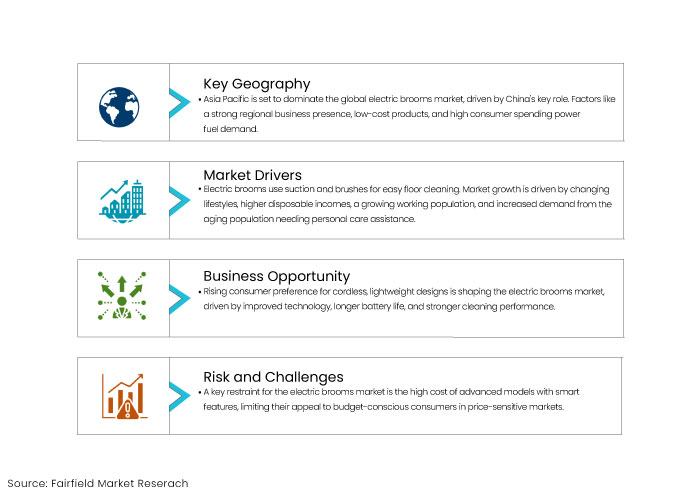
Electric brooms employ a combination of suction and brushes to clean the floors with the least effort possible. Key factors driving global electric brooms market expansion include changing lifestyles, increasing disposable incomes, a growing working population, and rising purchasing power. The consistently increasing aging population and the shortage of personal care assistance drive sales boosting the market growth.
According to the United Nations Database on World Population Ageing 2020, the global geriatric population will expand from 727 million in 2020 to 1.5 billion by 2050. Hence, the expanding aging population will remain one of the key factors elevating the prospects of the market worldwide.
The prevalence of chronic and bone diseases increases with the growing elderly population. The growing number of such diseases will likely to propel demand to help alleviate rising age-related fatigue.
The number of persons over 50 with reduced bone mass including osteoporosis increased from 54 million to 64.4 million in 2020. By 2030, this figure will rise to 71.2 million (a 29% increase from 2010). The number of fractures is expected to rise correspondingly. The growing number of such diseases will further contribute toward the mounting sales of electric brooms thereby fuelling market growth.
One of the primary growth drivers for the electric brooms market is the rising demand for convenient, efficient cleaning solutions. Modern consumers especially those living in urban areas have increasingly busy lifestyles and prefer cleaning tools that save time and effort.
Electric brooms being lightweight, cordless, and easy to use offer a practical alternative to traditional vacuum cleaners and manual brooms. The practicality of electric brooms in compact living spaces particularly in apartments and small homes, where bulky vacuum cleaners are less practical, further enhances their appeal. Features like quick charge, improved battery life, and portability make them a preferred choice for space-saving cleaning equipment.
Key Growth Barriers
One of the key growth restraints for the electric brooms market is relatively high initial cost of advanced models. While basic electric brooms may be affordable, those equipped with cutting-edge features like smart sensors, high-capacity batteries, and advanced brushless motors can be significantly more expensive. It limits their appeal to budget-conscious consumers, especially in price-sensitive markets.
In regions where traditional vacuum cleaners or manual brooms are more widely accepted, the cost difference can be a deterrent to adopting electric brooms. Consumers may hesitate to invest in premium models if they feel the cleaning performance does not justify the high price point, particularly when cheap alternatives are available. This price-sensitive behaviour can slow market penetration particularly in emerging economies.
Another significant restraint for the electric brooms market is some models' battery life limitations and potential performance issues. While technological advancements have improved battery capacity, many electric brooms still offer limited runtime compared to corded vacuum cleaners. This can be a drawback for users with large homes or extended cleaning needs.
Battery degradation over time can lead to reduced efficiency, requiring costly battery replacements. Performance issues like inadequate suction power or difficulty cleaning thick carpets and heavy debris can also hinder widespread adoption.
Consumers who prioritize deep cleaning may find electric brooms less effective than traditional vacuums limiting the market growth potential particularly among users with specific cleaning requirements.
Electric Brooms Market Trends and Opportunities
The increasing consumer preference for cordless and lightweight designs is a prominent trend shaping the electric brooms market. As technology has improved, cordless electric brooms have become efficient and capable of providing extended battery life and robust cleaning performance.
Consumers, particularly in urban areas and small households appreciate these models' flexibility and convenience. Cordless brooms eliminate the inconvenience of tangled cords and allow users to clean hard-to-reach areas without being constrained by an electrical outlet. This trend aligns with the broader shift toward portable, easy-to-store household appliances that cater to fast-paced, modern lifestyles.
The trend toward minimalism and decluttering in home interiors has fueled the demand for compact, lightweight cleaning tools that take up less space but remain effective. Manufacturers are responding by designing slim, ergonomic electric brooms that are easy to manoeuvre, especially for elderly users or individuals with limited mobility.
Brands like Dyson, SharkNinja, and Hoover have already capitalized on this trend by offering models that combine powerful suction with user-friendly portability. As technology continues to improve, consumers can expect more advanced features like longer battery life, fast charging, and better filtration systems, reinforcing the appeal of cordless and lightweight designs.
One of the most transformative opportunities in the electric brooms market is the integrating smart technology. As smart homes become more common, there is a growing demand for appliances that can be integrated into these systems including cleaning tools.
Electric brooms with smart features like Wi-Fi connectivity, app controls, and voice-activated assistants (like Alexa or Google Home) can offer users enhanced convenience and efficiency. These devices can be programmed to start cleaning at specific times, notify users about battery levels, or provide cleaning performance data in real-time.
By incorporating such intelligent features, manufacturers can attract tech-savvy consumers willing to invest in smart appliances that make household chores easy. The opportunity is particularly significant as consumers increasingly look for personalized, automated solutions that allow them to maintain cleanliness with minimal effort.
The rise of Internet of Things (IoT) technology also means electric brooms could eventually be integrated into broad smart cleaning systems, communicating with other smart devices like robotic vacuums or air purifiers for a fully automated home cleaning experience. Smart technology adds value and enables manufacturers to differentiate their products in a crowded market creating a premium segment with high profit margins.
How Does Regulatory Scenario Shape this Industry?
The regulatory scenario is increasingly shaping the electric brooms market particularly with a growing emphasis on energy efficiency and environmental sustainability. Governments and regulatory bodies across the globe are implementing strict guidelines for energy consumption in household appliances. For instance,
Regulations from the European Union's Eco-design Directive and the U.S. Department of Energy's energy efficiency standards require manufacturers to meet specific energy performance benchmarks. Non-compliance could result in restricted market access or penalties.
Increasing environmental concerns have led to strict regulations regarding using non-recyclable plastics and hazardous materials in product manufacturing. Many countries, particularly in Europe and North America, promote eco-friendly materials and sustainable production practices. These regulations encourage companies to adopt green manufacturing methods including using recyclable materials and energy-efficient designs.
Safety standards for electrical devices such as those imposed by Underwriters Laboratories (UL) and the International Electro Technical Commission (IEC), also govern the quality and safety of electric brooms. These evolving regulations shape product innovation, ensuring manufacturers prioritize sustainability and safety in their designs.
Segments Covered in the Report
The cordless electric brooms are leading product type in the electric brooms market. This dominance is driven by several factors primarily their mobility, convenience, and growing technological advancements.
Cordless electric brooms offer a hassle-free cleaning experience without the limitations of power cords making them highly suitable for quick, on-the-go cleaning tasks and for reaching difficult areas like stairs, under furniture, and car interiors.
The cordless design allows users to move freely throughout their homes without switching outlets or dealing with tangled cords. This level of convenience is particularly appealing to urban consumers with small living spaces where manoeuvrability is essential.
Cordless electric brooms are generally lightweight and easy to store making them ideal for consumers who value minimalism and space-saving designs. This portability factor is significant for elderly users or those with limited physical mobility.
The residential segment will lead the electric brooms market during the forecast period, accounting for a significant share of the market. The increasing prevalence of allergies and asthma caused by dust and grime in residential settings and the need to keep homes clean will likely to increase demand for the electric brooms market.
The increasing availability of improved products that can successfully capture the small contaminants is driving market expansion in residential applications.
Regional Analysis
Asia Pacific is estimated to dominate the global electric brooms market accounting for a significant market share during the forecast period with China being one of the most important markets. Some of the primary elements fuelling demand for electric brooms in the region are the strong presence of regional enterprises, the availability of low-cost products, and customers' high spending power.
The increasing electrification of rural areas and the widespread use of online sales channels in developing countries such as India are boosting the demand for electric brooms. Japan has seen significant expansion in the global market for electric brooms due to the introduction of new technologies and novel products.
China is the world's most significant manufacturing hub with numerous local robotic vacuum machine producers. These companies also provide high-tech items at reduced costs and with increased productivity.
China's industrial robot manufacturing volume was over 363,000 units in 2021, a more than 50 percent increase over 2020. As China's manufacturing capacity expands, so does the need for residential and commercial robots. On the other hand, yellow sand from the Gobi Desert causes home and business pollution in China, North Korea, and South Korea. As a result, the manufacturing and sales of these automated devices are becoming more prevalent in Asia.
Fairfield’s Competitive Landscape Analysis
The electric brooms market is competitive with key players such as SharkNinja, BISSELL, Dyson, and Hoover leading the charge. These companies focus on product innovation, integrating advanced features like cordless designs, smart connectivity, and improved battery performance to differentiate their offerings.
Dyson and SharkNinja dominate the premium segment with high-performance technologically advanced models, while BISSELL and Hoover capture a wide audience with affordable, reliable products.
Emerging brands are entering the market with eco-friendly and cost-effective solutions, intensifying competition. Strong distribution networks both online and offline play a critical role in brand competitiveness. Regional players especially in Asia-Pacific are gaining market share by catering to local preferences with customized products at competitive prices.
Key Market Companies
An Expert’s Eye
Global Electric Brooms Market is Segmented as-
By Product Type
By Voltage
By Shape
By End Use
By Region
- Executive Summary
- Global Electric Brooms Market Snapshot
- Future Projections
- Key Market Trends
- Regional Snapshot, by Value, 2026
- Analyst Recommendations
- Market Overview
- Market Definitions and Segmentations
- Market Dynamics
- Drivers
- Restraints
- Market Opportunities
- Value Chain Analysis
- COVID-19 Impact Analysis
- Porter's Five Forces Analysis
- Impact of Russia-Ukraine Conflict
- PESTLE Analysis
- Regulatory Analysis
- Price Trend Analysis
- Current Prices and Future Projections, 2025-2033
- Price Impact Factors
- Global Electric Brooms Market Outlook, 2020 - 2033
- Global Electric Brooms Market Outlook, by Product Type, Value (US$ Mn), 2020-2033
- Corded Electric Brooms
- Cordless Electric Brooms
- Global Electric Brooms Market Outlook, by Voltage, Value (US$ Mn), 2020-2033
- 120V/60Hz
- 220-240V/50Hz
- Global Electric Brooms Market Outlook, by Shape, Value (US$ Mn), 2020-2033
- Horizontal
- Vertical
- Handheld
- Barrel
- Pusher
- Global Electric Brooms Market Outlook, by End Use, Value (US$ Mn), 2020-2033
- Residential
- Commercial
- Global Electric Brooms Market Outlook, by Region, Value (US$ Mn), 2020-2033
- North America
- Europe
- Asia Pacific
- Latin America
- Middle East & Africa
- Global Electric Brooms Market Outlook, by Product Type, Value (US$ Mn), 2020-2033
- North America Electric Brooms Market Outlook, 2020 - 2033
- North America Electric Brooms Market Outlook, by Product Type, Value (US$ Mn), 2020-2033
- Corded Electric Brooms
- Cordless Electric Brooms
- North America Electric Brooms Market Outlook, by Voltage, Value (US$ Mn), 2020-2033
- 120V/60Hz
- 220-240V/50Hz
- North America Electric Brooms Market Outlook, by Shape, Value (US$ Mn), 2020-2033
- Horizontal
- Vertical
- Handheld
- Barrel
- Pusher
- North America Electric Brooms Market Outlook, by End Use, Value (US$ Mn), 2020-2033
- Residential
- Commercial
- North America Electric Brooms Market Outlook, by Country, Value (US$ Mn), 2020-2033
- U.S. Electric Brooms Market Outlook, by Product Type, 2020-2033
- U.S. Electric Brooms Market Outlook, by Voltage, 2020-2033
- U.S. Electric Brooms Market Outlook, by Shape, 2020-2033
- U.S. Electric Brooms Market Outlook, by End Use, 2020-2033
- Canada Electric Brooms Market Outlook, by Product Type, 2020-2033
- Canada Electric Brooms Market Outlook, by Voltage, 2020-2033
- Canada Electric Brooms Market Outlook, by Shape, 2020-2033
- Canada Electric Brooms Market Outlook, by End Use, 2020-2033
- BPS Analysis/Market Attractiveness Analysis
- North America Electric Brooms Market Outlook, by Product Type, Value (US$ Mn), 2020-2033
- Europe Electric Brooms Market Outlook, 2020 - 2033
- Europe Electric Brooms Market Outlook, by Product Type, Value (US$ Mn), 2020-2033
- Corded Electric Brooms
- Cordless Electric Brooms
- Europe Electric Brooms Market Outlook, by Voltage, Value (US$ Mn), 2020-2033
- 120V/60Hz
- 220-240V/50Hz
- Europe Electric Brooms Market Outlook, by Shape, Value (US$ Mn), 2020-2033
- Horizontal
- Vertical
- Handheld
- Barrel
- Pusher
- Europe Electric Brooms Market Outlook, by End Use, Value (US$ Mn), 2020-2033
- Residential
- Commercial
- Europe Electric Brooms Market Outlook, by Country, Value (US$ Mn), 2020-2033
- Germany Electric Brooms Market Outlook, by Product Type, 2020-2033
- Germany Electric Brooms Market Outlook, by Voltage, 2020-2033
- Germany Electric Brooms Market Outlook, by Shape, 2020-2033
- Germany Electric Brooms Market Outlook, by End Use, 2020-2033
- Italy Electric Brooms Market Outlook, by Product Type, 2020-2033
- Italy Electric Brooms Market Outlook, by Voltage, 2020-2033
- Italy Electric Brooms Market Outlook, by Shape, 2020-2033
- Italy Electric Brooms Market Outlook, by End Use, 2020-2033
- France Electric Brooms Market Outlook, by Product Type, 2020-2033
- France Electric Brooms Market Outlook, by Voltage, 2020-2033
- France Electric Brooms Market Outlook, by Shape, 2020-2033
- France Electric Brooms Market Outlook, by End Use, 2020-2033
- U.K. Electric Brooms Market Outlook, by Product Type, 2020-2033
- U.K. Electric Brooms Market Outlook, by Voltage, 2020-2033
- U.K. Electric Brooms Market Outlook, by Shape, 2020-2033
- U.K. Electric Brooms Market Outlook, by End Use, 2020-2033
- Spain Electric Brooms Market Outlook, by Product Type, 2020-2033
- Spain Electric Brooms Market Outlook, by Voltage, 2020-2033
- Spain Electric Brooms Market Outlook, by Shape, 2020-2033
- Spain Electric Brooms Market Outlook, by End Use, 2020-2033
- Russia Electric Brooms Market Outlook, by Product Type, 2020-2033
- Russia Electric Brooms Market Outlook, by Voltage, 2020-2033
- Russia Electric Brooms Market Outlook, by Shape, 2020-2033
- Russia Electric Brooms Market Outlook, by End Use, 2020-2033
- Rest of Europe Electric Brooms Market Outlook, by Product Type, 2020-2033
- Rest of Europe Electric Brooms Market Outlook, by Voltage, 2020-2033
- Rest of Europe Electric Brooms Market Outlook, by Shape, 2020-2033
- Rest of Europe Electric Brooms Market Outlook, by End Use, 2020-2033
- BPS Analysis/Market Attractiveness Analysis
- Europe Electric Brooms Market Outlook, by Product Type, Value (US$ Mn), 2020-2033
- Asia Pacific Electric Brooms Market Outlook, 2020 - 2033
- Asia Pacific Electric Brooms Market Outlook, by Product Type, Value (US$ Mn), 2020-2033
- Corded Electric Brooms
- Cordless Electric Brooms
- Asia Pacific Electric Brooms Market Outlook, by Voltage, Value (US$ Mn), 2020-2033
- 120V/60Hz
- 220-240V/50Hz
- Asia Pacific Electric Brooms Market Outlook, by Shape, Value (US$ Mn), 2020-2033
- Horizontal
- Vertical
- Handheld
- Barrel
- Pusher
- Asia Pacific Electric Brooms Market Outlook, by End Use, Value (US$ Mn), 2020-2033
- Residential
- Commercial
- Asia Pacific Electric Brooms Market Outlook, by Country, Value (US$ Mn), 2020-2033
- China Electric Brooms Market Outlook, by Product Type, 2020-2033
- China Electric Brooms Market Outlook, by Voltage, 2020-2033
- China Electric Brooms Market Outlook, by Shape, 2020-2033
- China Electric Brooms Market Outlook, by End Use, 2020-2033
- Japan Electric Brooms Market Outlook, by Product Type, 2020-2033
- Japan Electric Brooms Market Outlook, by Voltage, 2020-2033
- Japan Electric Brooms Market Outlook, by Shape, 2020-2033
- Japan Electric Brooms Market Outlook, by End Use, 2020-2033
- South Korea Electric Brooms Market Outlook, by Product Type, 2020-2033
- South Korea Electric Brooms Market Outlook, by Voltage, 2020-2033
- South Korea Electric Brooms Market Outlook, by Shape, 2020-2033
- South Korea Electric Brooms Market Outlook, by End Use, 2020-2033
- India Electric Brooms Market Outlook, by Product Type, 2020-2033
- India Electric Brooms Market Outlook, by Voltage, 2020-2033
- India Electric Brooms Market Outlook, by Shape, 2020-2033
- India Electric Brooms Market Outlook, by End Use, 2020-2033
- Southeast Asia Electric Brooms Market Outlook, by Product Type, 2020-2033
- Southeast Asia Electric Brooms Market Outlook, by Voltage, 2020-2033
- Southeast Asia Electric Brooms Market Outlook, by Shape, 2020-2033
- Southeast Asia Electric Brooms Market Outlook, by End Use, 2020-2033
- Rest of SAO Electric Brooms Market Outlook, by Product Type, 2020-2033
- Rest of SAO Electric Brooms Market Outlook, by Voltage, 2020-2033
- Rest of SAO Electric Brooms Market Outlook, by Shape, 2020-2033
- Rest of SAO Electric Brooms Market Outlook, by End Use, 2020-2033
- BPS Analysis/Market Attractiveness Analysis
- Asia Pacific Electric Brooms Market Outlook, by Product Type, Value (US$ Mn), 2020-2033
- Latin America Electric Brooms Market Outlook, 2020 - 2033
- Latin America Electric Brooms Market Outlook, by Product Type, Value (US$ Mn), 2020-2033
- Corded Electric Brooms
- Cordless Electric Brooms
- Latin America Electric Brooms Market Outlook, by Voltage, Value (US$ Mn), 2020-2033
- 120V/60Hz
- 220-240V/50Hz
- Latin America Electric Brooms Market Outlook, by Shape, Value (US$ Mn), 2020-2033
- Horizontal
- Vertical
- Handheld
- Barrel
- Pusher
- Latin America Electric Brooms Market Outlook, by End Use, Value (US$ Mn), 2020-2033
- Residential
- Commercial
- Latin America Electric Brooms Market Outlook, by Country, Value (US$ Mn), 2020-2033
- Brazil Electric Brooms Market Outlook, by Product Type, 2020-2033
- Brazil Electric Brooms Market Outlook, by Voltage, 2020-2033
- Brazil Electric Brooms Market Outlook, by Shape, 2020-2033
- Brazil Electric Brooms Market Outlook, by End Use, 2020-2033
- Mexico Electric Brooms Market Outlook, by Product Type, 2020-2033
- Mexico Electric Brooms Market Outlook, by Voltage, 2020-2033
- Mexico Electric Brooms Market Outlook, by Shape, 2020-2033
- Mexico Electric Brooms Market Outlook, by End Use, 2020-2033
- Argentina Electric Brooms Market Outlook, by Product Type, 2020-2033
- Argentina Electric Brooms Market Outlook, by Voltage, 2020-2033
- Argentina Electric Brooms Market Outlook, by Shape, 2020-2033
- Argentina Electric Brooms Market Outlook, by End Use, 2020-2033
- Rest of LATAM Electric Brooms Market Outlook, by Product Type, 2020-2033
- Rest of LATAM Electric Brooms Market Outlook, by Voltage, 2020-2033
- Rest of LATAM Electric Brooms Market Outlook, by Shape, 2020-2033
- Rest of LATAM Electric Brooms Market Outlook, by End Use, 2020-2033
- BPS Analysis/Market Attractiveness Analysis
- Latin America Electric Brooms Market Outlook, by Product Type, Value (US$ Mn), 2020-2033
- Middle East & Africa Electric Brooms Market Outlook, 2020 - 2033
- Middle East & Africa Electric Brooms Market Outlook, by Product Type, Value (US$ Mn), 2020-2033
- Corded Electric Brooms
- Cordless Electric Brooms
- Middle East & Africa Electric Brooms Market Outlook, by Voltage, Value (US$ Mn), 2020-2033
- 120V/60Hz
- 220-240V/50Hz
- Middle East & Africa Electric Brooms Market Outlook, by Shape, Value (US$ Mn), 2020-2033
- Horizontal
- Vertical
- Handheld
- Barrel
- Pusher
- Middle East & Africa Electric Brooms Market Outlook, by End Use, Value (US$ Mn), 2020-2033
- Residential
- Commercial
- Middle East & Africa Electric Brooms Market Outlook, by Country, Value (US$ Mn), 2020-2033
- GCC Electric Brooms Market Outlook, by Product Type, 2020-2033
- GCC Electric Brooms Market Outlook, by Voltage, 2020-2033
- GCC Electric Brooms Market Outlook, by Shape, 2020-2033
- GCC Electric Brooms Market Outlook, by End Use, 2020-2033
- South Africa Electric Brooms Market Outlook, by Product Type, 2020-2033
- South Africa Electric Brooms Market Outlook, by Voltage, 2020-2033
- South Africa Electric Brooms Market Outlook, by Shape, 2020-2033
- South Africa Electric Brooms Market Outlook, by End Use, 2020-2033
- Egypt Electric Brooms Market Outlook, by Product Type, 2020-2033
- Egypt Electric Brooms Market Outlook, by Voltage, 2020-2033
- Egypt Electric Brooms Market Outlook, by Shape, 2020-2033
- Egypt Electric Brooms Market Outlook, by End Use, 2020-2033
- Nigeria Electric Brooms Market Outlook, by Product Type, 2020-2033
- Nigeria Electric Brooms Market Outlook, by Voltage, 2020-2033
- Nigeria Electric Brooms Market Outlook, by Shape, 2020-2033
- Nigeria Electric Brooms Market Outlook, by End Use, 2020-2033
- Rest of Middle East Electric Brooms Market Outlook, by Product Type, 2020-2033
- Rest of Middle East Electric Brooms Market Outlook, by Voltage, 2020-2033
- Rest of Middle East Electric Brooms Market Outlook, by Shape, 2020-2033
- Rest of Middle East Electric Brooms Market Outlook, by End Use, 2020-2033
- BPS Analysis/Market Attractiveness Analysis
- Middle East & Africa Electric Brooms Market Outlook, by Product Type, Value (US$ Mn), 2020-2033
- Competitive Landscape
- Company Vs Segment Heatmap
- Company Market Share Analysis, 2025
- Competitive Dashboard
- Company Profiles
- Viomi Technology Co., Ltd
- Company Overview
- Product Portfolio
- Financial Overview
- Business Strategies and Developments
- Diya Enterprises
- Alfred Kärcher SE & Co. KG
- Dyson Ltd.
- Makita Power Tools, Bissell Inc.
- The Hoover Company
- Tineco Ltd.
- SharkNinja Operating LLC
- Fuller Brush Company
- Viomi Technology Co., Ltd
- Appendix
- Research Methodology
- Report Assumptions
- Acronyms and Abbreviations
|
BASE YEAR |
HISTORICAL DATA |
FORECAST PERIOD |
UNITS |
|||
 |
2025 |
 |
2019 - 2024 |
 |
2026 - 2033 |
Value: US$ Billion |
|
REPORT FEATURES |
DETAILS |
|
Product Type Coverage |
|
|
Voltage Coverage |
|
|
Shape Coverage |
|
|
End Use Coverage |
|
|
Geographical Coverage |
|
|
Leading Companies |
|
|
Report Highlights |
Key Market Indicators, Macro-micro economic impact analysis, Technological Roadmap, Key Trends, Driver, Restraints, and Future Opportunities & Revenue Pockets, Porter’s 5 Forces Analysis, Historical Trend (2019-2021), Market Estimates and Forecast, Market Dynamics, Industry Trends, Competition Landscape, Category, Region, Country-wise Trends & Analysis, COVID-19 Impact Analysis (Demand and Supply Chain) |
Our Research Methodology
Considering the volatility of business today, traditional approaches to strategizing a game plan can be unfruitful if not detrimental. True ambiguity is no way to determine a forecast. A myriad of predetermined factors must be accounted for such as the degree of risk involved, the magnitude of circumstances, as well as conditions or consequences that are not known or unpredictable. To circumvent binary views that cast uncertainty, the application of market research intelligence to strategically posture, move, and enable actionable outcomes is necessary.
View Methodology
Quality Assured
Rigorous Validation Process

Confidentiality Assured
End-to-end Data Security

Custom Research Services
Tailored To Your Objectives
FAQs
The market is expected to be valued USD 5.8 Bn in 2026.
The market is projected to exhibit a remarkable CAGR of 19% over the forecast period.
A few of the prominent industry players in the market are Oxford Biochar, Circular Carbon GmbH, and Carbon Gold Ltd.
Asia Pacific region dominates the market for electric brooms.
Residential segment stands out by end use and accounts for significant market share.
Related Reports
Landscaping Products Market Size, Share, Insights, Competitive Landscape, and Forecast 2026 to 2033
Explore the landscaping products market, reaching US$ 187.02 billion by 2033 at 6.8% CAGR, with product, power source and regional insights.
Landscaping and Gardening Service Market Size, Share, Insights, Competitive Landscape, and Forecast 2026 to 2033
Landscaping and gardening services reach US$ 249.19 billion by 2033 at 6.9% CAGR. Explore service, customer, provider and regional insights.
Fabric Softener Sheet Market Size, Share, Insights, Competitive Landscape, and Forecast 2026 to 2033
The global fabric softener sheet market is valued at US$2.1 billion in 2026, reaching US$2.7 billion by 2033, growing at a 3.7% CAGR
Eyewear Market Size, Share, Insights, Competitive Landscape, and Forecast 2026 to 2033
The global eyewear market is valued at US$178.0 billion in 2026, reaching US$268.0 billion by 2033, growing at a 6.0% CAGR
Exotic Pets Market Size, Share, Insights, Competitive Landscape, and Forecast 2026 to 2033
The global exotic pets market is valued at US$21.4 billion in 2026, reaching US$33.6 billion by 2033, growing at a 6.7% CAGR
3D Drawing Doodle Printing Pen Market Size, Share, Insights, Competitive Landscape, and Forecast 2026 to 2033
The global 3D drawing doodle printing pen market is valued at US$0.16 billion in 2026, reaching US$0.28 billion by 2033, growing at an 8.32% CAGR