



Electric DC Motors Market
Electric DC Motors Market Insights, Competitive Landscape, and Market Forecast - 2033
Global Electric DC Motors Market Forecast
The Electric DC Motors Market is valued at USD 27 Bn in 2026 and is projected to reach USD 42.5 Bn, growing at a CAGR of 7% by 2033.
Electric DC Motors Market Insights
- Electric DC motors market growth is predominantly driven by industrial automation and energy efficiency.
- Regulations push the electric DC motors industry towards sustainability and efficiency.
- Industrial automation, EVs, and focus on energy efficiency are key growth drivers.
- AC motor competition, and mature markets are key growth restraints.
- Miniaturization and automation in developing economies are key trends and opportunities.
- BLDC motors dominate due to superior efficiency and controllability.
- Industrial automation is the dominant application segment but EVs are catching up.
- Asia Pacific is the leading regional market due to manufacturing and automation.
- The future regional landscape depends on innovation, infrastructure, and policies.
A Look Back and a Look Forward - Comparative Analysis
The electric DC motors market experienced steady growth pre-2023, fueled by the increasing adoption of industrial automation and the rising demand for energy-efficient motors. Urbanization and automation advancements in emerging economies further propelled market expansion. However, post-2024 growth forecasts diverge.
Predictions suggest a slight decline due to advancements and cost-effectiveness of AC motors. The continued growth of the market is however fueled by niche applications and brushless DC motor advancements. The future trajectory will likely depend on the pace of technological innovation in both DC and AC motor technologies, along with the evolving regulatory landscape and cost pressures within key industries.
Key Growth Determinants
Growing Ubiquity of Industrial Automation
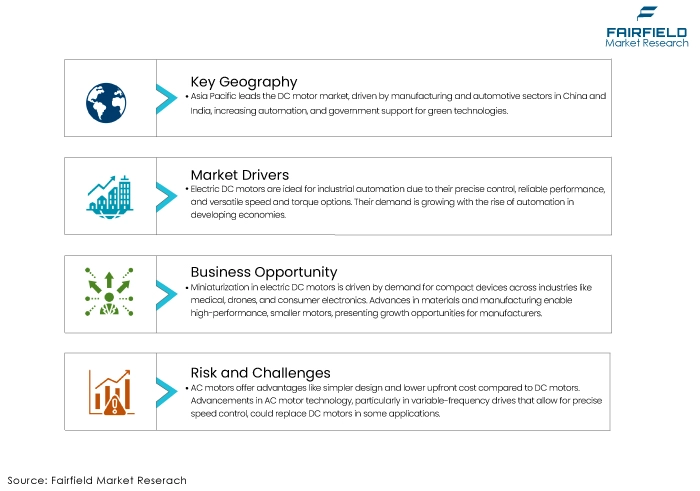
Electric DC motors offer several advantages for industrial automation applications, including precise control, reliable performance, and a wide range of speed and torque options. This makes them ideal for robots, conveyor systems, and machine tools. Growth in the industrial automation sector, particularly in developing economies with increasing industrialization and focus on automation, will drive demand for electric DC motors.
Additionally, the growing adoption of collaborative robots (cobots) in various industries is creating new opportunities due to their ability to provide the precise control and safety features needed for human-robot interaction.
Pacing Growth of Electric Vehicles (EVs)
The rise of electric vehicles is creating a significant demand for DC motors in various applications like power steering, window lifts, cooling fans, and pumps. As the EV market continues to expand globally, the demand for DC motors specifically designed for EV applications is expected to experience significant growth. Manufacturers are focusing on developing lightweight, high-efficiency DC motors to optimize vehicle range and performance, further propelling market growth in this segment.
Increasing Worldwide Focus on Energy Efficiency
With rising energy costs and growing environmental concerns, industries are increasingly adopting energy-efficient DC motors. These motors offer significant energy savings compared to traditional AC motors, particularly when combined with variable speed drives. Government initiatives promoting energy-saving technologies further propel this growth by providing incentives for businesses to adopt energy-efficient solutions. This focus on energy efficiency is expected to remain a key driver for the electric DC motors market in the coming years.
Key Growth Barriers
Competition from AC Motors
AC motors offer advantages like simpler design and lower upfront cost compared to DC motors. Advancements in AC motor technology, particularly in variable-frequency drives that allow for precise speed control, could replace DC motors in some applications.
Additionally, the development of more efficient AC motor designs could further erode market share for DC motors, especially in cost-sensitive applications. Manufacturers of DC motors need to focus on innovation to maintain their competitive edge, emphasizing factors like superior efficiency in specific applications, lower maintenance requirements, and potentially developing cost-competitive solutions for volume production.
Maturity in Traditional Markets
The electric DC motors market in mature industrial sectors might face saturation as many factories have already implemented automation solutions. Additionally, cost pressures within these sectors may incentivize companies to explore cheaper alternatives, such as lower-cost AC motors or even simpler mechanical solutions.
DC motor manufacturers can potentially mitigate this by focusing on offering customized solutions, providing value-added services like maintenance programs, and demonstrating the long-term cost benefits of high-efficiency DC motors compared to cheaper alternatives.
Electric DC Motors Market Trends and Opportunities
The Thriving Miniaturization Trend
Miniaturization is a growing trend in the electric DC motors market. Smaller, lighter DC motors cater to the demand for compact and portable devices in various industries, including medical equipment, drones, power tools, and even consumer electronics. This trend is driven by advancements in material science and manufacturing techniques that allow for the development of high-performance motors in smaller form factors. The increasing demand for these compact motors presents a significant opportunity for manufacturers who can develop and produce reliable, efficient miniaturized DC motors that meet the specific needs of various applications.
Rapid Expansion of Automation and Robotics Across Developing Markets
The growing automation and robotics market in developing economies presents a significant opportunity for DC motor manufacturers. These regions offer vast potential for market expansion due to increasing industrialization, government initiatives promoting automation, and a growing focus on technological adoption.
Manufacturers can capitalize on this opportunity by establishing a presence in these markets, tailoring their product offerings to meet local needs, and potentially developing partnerships with local companies for production or distribution. However, navigating the regulatory landscape and addressing potential infrastructure challenges in these regions will be crucial for success.
How is Regulatory Scenario Shaping this Industry?
Regulations are shaping the electric DC motors industry towards sustainability and efficiency. Stringent energy-saving mandates like Minimum Energy Performance Standards (MEPS) are pushing manufacturers to develop high-efficiency DC motors. These regulations not only improve overall energy consumption but also contribute to environmental benefits.
Additionally, regulations on hazardous materials restrict the use of certain components, impacting production costs for manufacturers. Companies need to adapt their production processes and material sourcing to comply with these regulations, which can influence overall motor pricing and potentially impact market dynamics.
Fairfield’s Ranking Board
Top Segments
Dominance of BLDC Motors Prevails Throughout Forecast Period
Brushless DC (BLDC) motors are expected to dominate the electric DC motors market due to their superior efficiency, lower maintenance needs, and precise controllability. Unlike brushed DC motors, BLDC motors utilize electronic commutation to control the rotation of the rotor, eliminating the need for physical brushes that wear out over time. This translates to longer lifespan, lower maintenance costs, and higher efficiency.
Additionally, BLDC motors offer superior controllability, making them ideal for applications requiring precise speed and torque regulation, such as electric vehicles and industrial automation equipment.
However, it is also important to note that brushed DC motors might still be relevant in some scenarios. Low-power applications where upfront cost is a primary concern, brushed DC motors might remain the preferred choice. In cases where high efficiency or precise control are not essential, brushed DC motors can be a viable option for low-speed, low-torque applications.
Overall, while brushed DC motors will likely experience a decline in market share, they might still retain a niche presence in specific applications. Nevertheless, the future of the electric DC motors market clearly lies with BLDC motors due to their numerous advantages.
While brushed DC motors might still find application in some cost-sensitive areas with less demanding performance requirements, the overall outlook for BLDC motors is positive. Their superior efficiency, lower maintenance needs, precise control, and longer lifespan make them a compelling choice for a growing number of applications.
Industrial Automation Maintains a Stronghold by Application
Industrial automation is currently the dominant application segment for DC motors, utilizing them in robots, conveyor systems, machine tools, and various other automated processes. Industrial automation continues to reign supreme as the leading application segment for DC motors. This dominance stems from the motors' ideal characteristics for automated systems, including durability, reliability, precise control, and availability of a wide range of options.
On the other hand, while industrial automation is a well-established market for DC motors, the electric vehicle (EV) market is rapidly emerging as a major driver for DC motors. As EV adoption accelerates, the demand for DC motors specifically designed for EVs is expected to surpass the demand from industrial automation in the long run. This shift will require manufacturers to focus on developing lightweight, highly efficient, and durable DC motors optimized for the unique requirements of electric vehicles.
The EV market is projected to experience significant growth in the coming years, creating a strong demand for DC motors specifically designed for EV applications. These motors need to be lightweight, highly efficient, and capable of withstanding the demanding operating conditions within an electric vehicle. As the EV market expands, the demand for DC motors in this segment is expected to surpass industrial automation in the long term.
Regional Frontrunners
Asia Pacific’s Prime Position Strengthens with Growing Emphasis on Automation and Electrification
Asia Pacific is currently the leading regional market for DC motors due to the strong presence of manufacturing and automotive industries, particularly in China, and India. These regions offer a large consumer base, and a growing focus on automation and electrification, driving demand for DC motors in various applications. Additionally, government initiatives promoting industrial automation and green technologies further contribute to market growth in this region.
Continued dominance of Asia Pacific is expected in the long term. If Asia Pacific can bridge the technological gap, address skill shortages, and leverage its vast market potential, it could solidify its position as the leader. Developing economies will most likely take the lead. Within Asia Pacific, individual emerging economies that successfully address the challenges and capitalize on their advantages could become regional leaders themselves.
Widespread Automation Adoption Keeps Market Prospects Afloat in North America, and Europe
Europe, and North America, on the other hand, are expected to maintain significant market share due to their technological advancements in motor design, and manufacturing. These regions are also at the forefront of automation adoption in various industries, creating a sustained demand for high-performance DC motors.
The future landscape of the dominant regional market might depend on the pace of technological innovation and infrastructure development in emerging economies, along with government policies, and incentives related to automation and energy efficiency.
The market could become bipolar, with Asia Pacific dominating in terms of volume, and North America and Europe focusing on high-performance, niche applications. In a nutshell, government policies, infrastructure development, technological innovation, and the success of automation initiatives will influence the future landscape of regional dominance in the electric DC motors market.
Fairfield’s Competitive Landscape Analysis
The electric DC motors market is a fragmented landscape with established players like ABB, Nidec, and Siemens holding significant market share. These established players have a global presence, strong brand recognition, and extensive product portfolios. However, rising players in emerging economies like China, and India are offering cost-competitive solutions, challenging the dominance of established players.
The competitive landscape revolves around factors like efficiency, reliability, cost-effectiveness, ability to cater to specific application needs, and responsiveness to evolving market demands. Manufacturers that can successfully navigate this dynamic environment by focusing on innovation, cost optimization, and regional expansion are likely to succeed in the long run.
Key Market Players
Global Electric DC Motors Market is Segmented as-
By Type
- Brushed DC Motors
- Brushless DC (BLDC) Motors
By Voltage
- 0-750 Watts
- 750 Watts – 3KW
- 3KW – 75KW
- Above 75KW
By Technology
- Low Speed (Less Than 1,000 rpm)
- Medium Speed (1,001 to 25,000 rpm)
- High Speed (25,001 to 75,000 rpm)
- Ultra-High Speed (Greater Than 75,001 rpm)
By End Use
- Industrial Automation & Machinery
- Automotive Aerospace & Transportation
- Electric Vehicles
- HVAC Equipment
- Household Appliances
- Others
By Region
- North America
- Europe
- Asia Pacific
- Latin America
- Middle East & Africa
- Executive Summary
- Global Electric DC Motors Market Snapshot
- Future Projections
- Key Market Trends
- Regional Snapshot, by Value, 2026
- Analyst Recommendations
- Market Overview
- Market Definitions and Segmentations
- Market Dynamics
- Drivers
- Restraints
- Market Opportunities
- Value Chain Analysis
- COVID-19 Impact Analysis
- Porter's Five Forces Analysis
- Impact of Russia-Ukraine Conflict
- PESTLE Analysis
- Regulatory Analysis
- Price Trend Analysis
- Current Prices and Future Projections, 2025-2033
- Price Impact Factors
- Global Electric DC Motors Market Outlook, 2020 - 2033
- Global Electric DC Motors Market Outlook, by Type, Value (US$ Bn), 2020-2033
- Brushed DC Motors
- Brushless DC (BLDC) Motors
- Global Electric DC Motors Market Outlook, by Voltage, Value (US$ Bn), 2020-2033
- 0-750 Watts
- 750 Watts – 3KW
- 3KW – 75KW
- Above 75KW
- Global Electric DC Motors Market Outlook, by Technology, Value (US$ Bn), 2020-2033
- Low Speed (Less Than 1,000 rpm)
- Medium Speed (1,001 to 25,000 rpm)
- High Speed (25,001 to 75,000 rpm)
- Ultra-High Speed (Greater Than 75,001 rpm)
- Global Electric DC Motors Market Outlook, by End Use, Value (US$ Bn), 2020-2033
- Industrial Automation & Machinery
- Automotive Aerospace & Transportation
- Electric Vehicles
- HVAC Equipment
- Household Appliances
- Others
- Global Electric DC Motors Market Outlook, by Region, Value (US$ Bn), 2020-2033
- North America
- Europe
- Asia Pacific
- Latin America
- Middle East & Africa
- Global Electric DC Motors Market Outlook, by Type, Value (US$ Bn), 2020-2033
- North America Electric DC Motors Market Outlook, 2020 - 2033
- North America Electric DC Motors Market Outlook, by Type, Value (US$ Bn), 2020-2033
- Brushed DC Motors
- Brushless DC (BLDC) Motors
- North America Electric DC Motors Market Outlook, by Voltage, Value (US$ Bn), 2020-2033
- 0-750 Watts
- 750 Watts – 3KW
- 3KW – 75KW
- Above 75KW
- North America Electric DC Motors Market Outlook, by Technology, Value (US$ Bn), 2020-2033
- Low Speed (Less Than 1,000 rpm)
- Medium Speed (1,001 to 25,000 rpm)
- High Speed (25,001 to 75,000 rpm)
- Ultra-High Speed (Greater Than 75,001 rpm)
- North America Electric DC Motors Market Outlook, by End Use, Value (US$ Bn), 2020-2033
- Industrial Automation & Machinery
- Automotive Aerospace & Transportation
- Electric Vehicles
- HVAC Equipment
- Household Appliances
- Others
- North America Electric DC Motors Market Outlook, by Country, Value (US$ Bn), 2020-2033
- U.S. Electric DC Motors Market Outlook, by Type, 2020-2033
- U.S. Electric DC Motors Market Outlook, by Voltage, 2020-2033
- U.S. Electric DC Motors Market Outlook, by Technology, 2020-2033
- U.S. Electric DC Motors Market Outlook, by End Use, 2020-2033
- Canada Electric DC Motors Market Outlook, by Type, 2020-2033
- Canada Electric DC Motors Market Outlook, by Voltage, 2020-2033
- Canada Electric DC Motors Market Outlook, by Technology, 2020-2033
- Canada Electric DC Motors Market Outlook, by End Use, 2020-2033
- BPS Analysis/Market Attractiveness Analysis
- North America Electric DC Motors Market Outlook, by Type, Value (US$ Bn), 2020-2033
- Europe Electric DC Motors Market Outlook, 2020 - 2033
- Europe Electric DC Motors Market Outlook, by Type, Value (US$ Bn), 2020-2033
- Brushed DC Motors
- Brushless DC (BLDC) Motors
- Europe Electric DC Motors Market Outlook, by Voltage, Value (US$ Bn), 2020-2033
- 0-750 Watts
- 750 Watts – 3KW
- 3KW – 75KW
- Above 75KW
- Europe Electric DC Motors Market Outlook, by Technology, Value (US$ Bn), 2020-2033
- Low Speed (Less Than 1,000 rpm)
- Medium Speed (1,001 to 25,000 rpm)
- High Speed (25,001 to 75,000 rpm)
- Ultra-High Speed (Greater Than 75,001 rpm)
- Europe Electric DC Motors Market Outlook, by End Use, Value (US$ Bn), 2020-2033
- Industrial Automation & Machinery
- Automotive Aerospace & Transportation
- Electric Vehicles
- HVAC Equipment
- Household Appliances
- Others
- Europe Electric DC Motors Market Outlook, by Country, Value (US$ Bn), 2020-2033
- Germany Electric DC Motors Market Outlook, by Type, 2020-2033
- Germany Electric DC Motors Market Outlook, by Voltage, 2020-2033
- Germany Electric DC Motors Market Outlook, by Technology, 2020-2033
- Germany Electric DC Motors Market Outlook, by End Use, 2020-2033
- Italy Electric DC Motors Market Outlook, by Type, 2020-2033
- Italy Electric DC Motors Market Outlook, by Voltage, 2020-2033
- Italy Electric DC Motors Market Outlook, by Technology, 2020-2033
- Italy Electric DC Motors Market Outlook, by End Use, 2020-2033
- France Electric DC Motors Market Outlook, by Type, 2020-2033
- France Electric DC Motors Market Outlook, by Voltage, 2020-2033
- France Electric DC Motors Market Outlook, by Technology, 2020-2033
- France Electric DC Motors Market Outlook, by End Use, 2020-2033
- U.K. Electric DC Motors Market Outlook, by Type, 2020-2033
- U.K. Electric DC Motors Market Outlook, by Voltage, 2020-2033
- U.K. Electric DC Motors Market Outlook, by Technology, 2020-2033
- U.K. Electric DC Motors Market Outlook, by End Use, 2020-2033
- Spain Electric DC Motors Market Outlook, by Type, 2020-2033
- Spain Electric DC Motors Market Outlook, by Voltage, 2020-2033
- Spain Electric DC Motors Market Outlook, by Technology, 2020-2033
- Spain Electric DC Motors Market Outlook, by End Use, 2020-2033
- Russia Electric DC Motors Market Outlook, by Type, 2020-2033
- Russia Electric DC Motors Market Outlook, by Voltage, 2020-2033
- Russia Electric DC Motors Market Outlook, by Technology, 2020-2033
- Russia Electric DC Motors Market Outlook, by End Use, 2020-2033
- Rest of Europe Electric DC Motors Market Outlook, by Type, 2020-2033
- Rest of Europe Electric DC Motors Market Outlook, by Voltage, 2020-2033
- Rest of Europe Electric DC Motors Market Outlook, by Technology, 2020-2033
- Rest of Europe Electric DC Motors Market Outlook, by End Use, 2020-2033
- BPS Analysis/Market Attractiveness Analysis
- Europe Electric DC Motors Market Outlook, by Type, Value (US$ Bn), 2020-2033
- Asia Pacific Electric DC Motors Market Outlook, 2020 - 2033
- Asia Pacific Electric DC Motors Market Outlook, by Type, Value (US$ Bn), 2020-2033
- Brushed DC Motors
- Brushless DC (BLDC) Motors
- Asia Pacific Electric DC Motors Market Outlook, by Voltage, Value (US$ Bn), 2020-2033
- 0-750 Watts
- 750 Watts – 3KW
- 3KW – 75KW
- Above 75KW
- Asia Pacific Electric DC Motors Market Outlook, by Technology, Value (US$ Bn), 2020-2033
- Low Speed (Less Than 1,000 rpm)
- Medium Speed (1,001 to 25,000 rpm)
- High Speed (25,001 to 75,000 rpm)
- Ultra-High Speed (Greater Than 75,001 rpm)
- Asia Pacific Electric DC Motors Market Outlook, by End Use, Value (US$ Bn), 2020-2033
- Industrial Automation & Machinery
- Automotive Aerospace & Transportation
- Electric Vehicles
- HVAC Equipment
- Household Appliances
- Others
- Asia Pacific Electric DC Motors Market Outlook, by Country, Value (US$ Bn), 2020-2033
- China Electric DC Motors Market Outlook, by Type, 2020-2033
- China Electric DC Motors Market Outlook, by Voltage, 2020-2033
- China Electric DC Motors Market Outlook, by Technology, 2020-2033
- China Electric DC Motors Market Outlook, by End Use, 2020-2033
- Japan Electric DC Motors Market Outlook, by Type, 2020-2033
- Japan Electric DC Motors Market Outlook, by Voltage, 2020-2033
- Japan Electric DC Motors Market Outlook, by Technology, 2020-2033
- Japan Electric DC Motors Market Outlook, by End Use, 2020-2033
- South Korea Electric DC Motors Market Outlook, by Type, 2020-2033
- South Korea Electric DC Motors Market Outlook, by Voltage, 2020-2033
- South Korea Electric DC Motors Market Outlook, by Technology, 2020-2033
- South Korea Electric DC Motors Market Outlook, by End Use, 2020-2033
- India Electric DC Motors Market Outlook, by Type, 2020-2033
- India Electric DC Motors Market Outlook, by Voltage, 2020-2033
- India Electric DC Motors Market Outlook, by Technology, 2020-2033
- India Electric DC Motors Market Outlook, by End Use, 2020-2033
- Southeast Asia Electric DC Motors Market Outlook, by Type, 2020-2033
- Southeast Asia Electric DC Motors Market Outlook, by Voltage, 2020-2033
- Southeast Asia Electric DC Motors Market Outlook, by Technology, 2020-2033
- Southeast Asia Electric DC Motors Market Outlook, by End Use, 2020-2033
- Rest of SAO Electric DC Motors Market Outlook, by Type, 2020-2033
- Rest of SAO Electric DC Motors Market Outlook, by Voltage, 2020-2033
- Rest of SAO Electric DC Motors Market Outlook, by Technology, 2020-2033
- Rest of SAO Electric DC Motors Market Outlook, by End Use, 2020-2033
- BPS Analysis/Market Attractiveness Analysis
- Asia Pacific Electric DC Motors Market Outlook, by Type, Value (US$ Bn), 2020-2033
- Latin America Electric DC Motors Market Outlook, 2020 - 2033
- Latin America Electric DC Motors Market Outlook, by Type, Value (US$ Bn), 2020-2033
- Brushed DC Motors
- Brushless DC (BLDC) Motors
- Latin America Electric DC Motors Market Outlook, by Voltage, Value (US$ Bn), 2020-2033
- 0-750 Watts
- 750 Watts – 3KW
- 3KW – 75KW
- Above 75KW
- Latin America Electric DC Motors Market Outlook, by Technology, Value (US$ Bn), 2020-2033
- Low Speed (Less Than 1,000 rpm)
- Medium Speed (1,001 to 25,000 rpm)
- High Speed (25,001 to 75,000 rpm)
- Ultra-High Speed (Greater Than 75,001 rpm)
- Latin America Electric DC Motors Market Outlook, by End Use, Value (US$ Bn), 2020-2033
- Industrial Automation & Machinery
- Automotive Aerospace & Transportation
- Electric Vehicles
- HVAC Equipment
- Household Appliances
- Others
- Latin America Electric DC Motors Market Outlook, by Country, Value (US$ Bn), 2020-2033
- Brazil Electric DC Motors Market Outlook, by Type, 2020-2033
- Brazil Electric DC Motors Market Outlook, by Voltage, 2020-2033
- Brazil Electric DC Motors Market Outlook, by Technology, 2020-2033
- Brazil Electric DC Motors Market Outlook, by End Use, 2020-2033
- Mexico Electric DC Motors Market Outlook, by Type, 2020-2033
- Mexico Electric DC Motors Market Outlook, by Voltage, 2020-2033
- Mexico Electric DC Motors Market Outlook, by Technology, 2020-2033
- Mexico Electric DC Motors Market Outlook, by End Use, 2020-2033
- Argentina Electric DC Motors Market Outlook, by Type, 2020-2033
- Argentina Electric DC Motors Market Outlook, by Voltage, 2020-2033
- Argentina Electric DC Motors Market Outlook, by Technology, 2020-2033
- Argentina Electric DC Motors Market Outlook, by End Use, 2020-2033
- Rest of LATAM Electric DC Motors Market Outlook, by Type, 2020-2033
- Rest of LATAM Electric DC Motors Market Outlook, by Voltage, 2020-2033
- Rest of LATAM Electric DC Motors Market Outlook, by Technology, 2020-2033
- Rest of LATAM Electric DC Motors Market Outlook, by End Use, 2020-2033
- BPS Analysis/Market Attractiveness Analysis
- Latin America Electric DC Motors Market Outlook, by Type, Value (US$ Bn), 2020-2033
- Middle East & Africa Electric DC Motors Market Outlook, 2020 - 2033
- Middle East & Africa Electric DC Motors Market Outlook, by Type, Value (US$ Bn), 2020-2033
- Brushed DC Motors
- Brushless DC (BLDC) Motors
- Middle East & Africa Electric DC Motors Market Outlook, by Voltage, Value (US$ Bn), 2020-2033
- 0-750 Watts
- 750 Watts – 3KW
- 3KW – 75KW
- Above 75KW
- Middle East & Africa Electric DC Motors Market Outlook, by Technology, Value (US$ Bn), 2020-2033
- Low Speed (Less Than 1,000 rpm)
- Medium Speed (1,001 to 25,000 rpm)
- High Speed (25,001 to 75,000 rpm)
- Ultra-High Speed (Greater Than 75,001 rpm)
- Middle East & Africa Electric DC Motors Market Outlook, by End Use, Value (US$ Bn), 2020-2033
- Industrial Automation & Machinery
- Automotive Aerospace & Transportation
- Electric Vehicles
- HVAC Equipment
- Household Appliances
- Others
- Middle East & Africa Electric DC Motors Market Outlook, by Country, Value (US$ Bn), 2020-2033
- GCC Electric DC Motors Market Outlook, by Type, 2020-2033
- GCC Electric DC Motors Market Outlook, by Voltage, 2020-2033
- GCC Electric DC Motors Market Outlook, by Technology, 2020-2033
- GCC Electric DC Motors Market Outlook, by End Use, 2020-2033
- South Africa Electric DC Motors Market Outlook, by Type, 2020-2033
- South Africa Electric DC Motors Market Outlook, by Voltage, 2020-2033
- South Africa Electric DC Motors Market Outlook, by Technology, 2020-2033
- South Africa Electric DC Motors Market Outlook, by End Use, 2020-2033
- Egypt Electric DC Motors Market Outlook, by Type, 2020-2033
- Egypt Electric DC Motors Market Outlook, by Voltage, 2020-2033
- Egypt Electric DC Motors Market Outlook, by Technology, 2020-2033
- Egypt Electric DC Motors Market Outlook, by End Use, 2020-2033
- Nigeria Electric DC Motors Market Outlook, by Type, 2020-2033
- Nigeria Electric DC Motors Market Outlook, by Voltage, 2020-2033
- Nigeria Electric DC Motors Market Outlook, by Technology, 2020-2033
- Nigeria Electric DC Motors Market Outlook, by End Use, 2020-2033
- Rest of Middle East Electric DC Motors Market Outlook, by Type, 2020-2033
- Rest of Middle East Electric DC Motors Market Outlook, by Voltage, 2020-2033
- Rest of Middle East Electric DC Motors Market Outlook, by Technology, 2020-2033
- Rest of Middle East Electric DC Motors Market Outlook, by End Use, 2020-2033
- BPS Analysis/Market Attractiveness Analysis
- Middle East & Africa Electric DC Motors Market Outlook, by Type, Value (US$ Bn), 2020-2033
- Competitive Landscape
- Company Vs Segment Heatmap
- Company Market Share Analysis, 2025
- Competitive Dashboard
- Company Profiles
- ABB Ltd.
- Company Overview
- Product Portfolio
- Financial Overview
- Business Strategies and Developments
- AMETEK Inc. (Dunkermotoren GmbH)
- Johnson Electric Holdings Limited
- Nidec Corporation
- Siemens AG
- Franklin Electric Co.
- Maxon Motor AG
- Parker Hannifin Corporation
- Regal Beloit Corporation
- Rockwell Automation Inc.
- Emerson Electric Co.
- TE Connectivity Ltd.
- ABB Ltd.
- Appendix
- Research Methodology
- Report Assumptions
- Acronyms and Abbreviations
|
BASE YEAR |
HISTORICAL DATA |
FORECAST PERIOD |
UNITS |
|||
 |
2025 |
 |
2019 - 2025 |
 |
2026 - 2033 |
Value: US$ Billion |
|
REPORT FEATURES |
DETAILS |
|
Type Coverage |
|
|
Voltage Coverage |
|
|
Technology Coverage |
|
|
End Use Coverage |
|
|
Geographical Coverage |
|
|
Leading Companies |
|
|
Report Highlights |
Key Market Indicators, Macro-micro economic impact analysis, Technological Roadmap, Key Trends, Driver, Restraints, and Future Opportunities & Revenue Pockets, Porter’s 5 Forces Analysis, Historical Trend (2019-2021), Market Estimates and Forecast, Market Dynamics, Industry Trends, Competition Landscape, Category, Region, Country-wise Trends & Analysis, COVID-19 Impact Analysis (Demand and Supply Chain) |
Our Research Methodology
Considering the volatility of business today, traditional approaches to strategizing a game plan can be unfruitful if not detrimental. True ambiguity is no way to determine a forecast. A myriad of predetermined factors must be accounted for such as the degree of risk involved, the magnitude of circumstances, as well as conditions or consequences that are not known or unpredictable. To circumvent binary views that cast uncertainty, the application of market research intelligence to strategically posture, move, and enable actionable outcomes is necessary.
View Methodology
Quality Assured
Rigorous Validation Process

Confidentiality Assured
End-to-end Data Security

Custom Research Services
Tailored To Your Objectives
FAQs
An electric DC motor is a machine that converts direct current (DC) electrical energy into mechanical energy.
Growth is driven by increasing automation, rising demand for electric vehicles, and advancements in motor technology.
Key industries include automotive, industrial machinery, consumer electronics, and healthcare.
Advantages include high efficiency, precise speed control, and ease of installation and maintenance.
Challenges include high initial costs, competition from AC motors, and the need for ongoing technological advancements.
Related Reports
Micro Turbine Market Insights, Competitive Landscape, and Market Forecast 2033
The micro turbine market is projected to rise from US$2.4 billion in 2026 to US$4.1 billion by 2033 at a 7.9% CAGR, driven by decentralized energy generation.
U.S. Fire Protection System Market Insights, Competitive Landscape, and Market Forecast 2026–2033
U.S. Fire Protection System Market is projected to reach US$12.86 billion by 2033, driven by stringent safety regulations and smart systems.
Underfloor Heating Market Insights, Competitive Landscape, and Market Forecast 2026–2033
Underfloor Heating Market is projected to reach US$9.72 billion by 2033, driven by energy efficiency, smart homes, premium housing, and retrofit demand.
Power Boiler Market Insights, Competitive Landscape, and Market Forecast 2026–2033
Power Boiler Market is projected to reach US$31.38 billion by 2033, driven by industrial modernization, power generation expansion, fleet replacement
Offshore Mooring Systems Market Insights, Competitive Landscape, and Market Forecast 2026–2033
Offshore Mooring Systems Market is projected to reach US$2.28 billion by 2033, driven by deepwater investments, FPSO deployment, floating wind projects
Generator Rental Market Insights, Competitive Landscape, and Market Forecast 2026–2033
Generator Rental Market is projected to reach US$22.09 billion by 2033, driven by infrastructure development and data center expansion