



Electric Vehicle Tires Market
Electric Vehicle Tires Market Size, Share, Insights, Competitive Landscape, and Forecast 2026 to 2033
Electric Vehicle Tires Market Size and Trend Analysis
How Fast Is the Electric Vehicle Tires Market Growing?
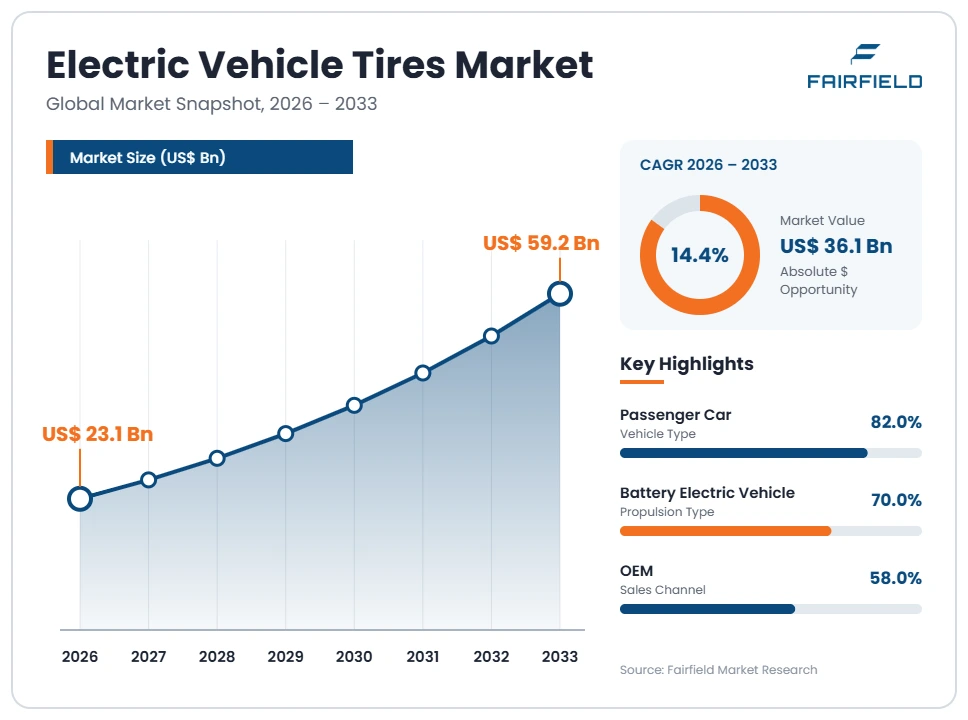
The global electric vehicle tires market size is expected to be valued at US$ 23.1 billion in 2026 and projected to reach US$ 59.2 billion by 2033, growing at a CAGR of 14.4% between 2026 and 2033.
Between 2020 and 2025, the market grew at a CAGR of about 25.5%, rising from roughly US$ 6.5 billion to about US$ 20.2 billion, as electric vehicle sales rose sharply in China, Europe, and the United States, automakers specified dedicated low-rolling-resistance tires for new models, and early electric vehicles began needing replacement tires. The electric vehicle tires market covers tires designed for the higher weight, instant torque, quiet cabins, and range needs of electric vehicles. These tires use low-rolling-resistance compounds, reinforced structures, noise-reducing foam, and wear-resistant treads. They are fitted to passenger cars and commercial vehicles with battery electric and hybrid electric propulsion and sold through OEM and aftermarket channels in a range of sizes. In July 2026, Hankook launched its iON FlexClimate all-season electric vehicle tire in South Korea.
Key Report Takeaways
- By Vehicle Type: Passenger Car held about 82% share in 2025, while Commercial Vehicle is projected to expand at a 16.5% CAGR through 2033, driven by electric buses, delivery vans, and trucks that need high-load, long-wearing tires with low rolling resistance for fleet efficiency.
- By Propulsion Type: Battery Electric Vehicle held about 70% share in 2025, while Hybrid Electric Vehicle is projected to expand at a 15.0% CAGR through 2033, driven by strong plug-in hybrid and range-extender sales in China and growing hybrid demand in North America and Europe.
- By Sales Channel: OEM held about 58% share in 2025, while Aftermarket is projected to expand at a 16.0% CAGR through 2033, driven by the growing installed base of electric vehicles, faster tire wear from heavy batteries and high torque, and more dedicated replacement products.
- By Region: Asia Pacific held about 52% share in 2025, while India is projected to expand at a 18.0% CAGR through 2033, driven by government electric vehicle incentives, fast growth of electric cars and buses, and new tire plants from domestic and global makers.
Global Electric Vehicle Tires Market Trends and Insights
Drivers Impact Analysis
Two drivers carry the strongest influence on electric vehicle tires market demand during the forecast period.
| Driver | Impact on CAGR Forecast | Geographic Relevance | Impact Timeline |
| Rising electric vehicle sales and fleet growth | High | Global | Long term (≥4 years) |
| Demand for range, low noise, and durability | High | Europe, North America, Asia Pacific | Medium term (2-4 years) |
Rising Electric Vehicle Sales Are Driving the Electric Vehicle Tires Market
Rising electric vehicle sales and fleet growth are the strongest driver of the electric vehicle tires market. Every new electric vehicle needs four or more tires.
The mechanism is that global electric vehicle sales have grown quickly, led by China, which produces and buys most of the world's electric cars, with strong growth in Europe, the United States, India, and other markets. Governments are tightening emission rules and offering incentives for zero-emission vehicles, and automakers are launching many new electric models across all price ranges. Each new electric vehicle needs original equipment tires, and the growing number of electric vehicles on the road creates steady replacement demand. As the global electric fleet expands into the hundreds of millions of vehicles over the forecast period, demand for dedicated electric vehicle tires rises in both OEM and aftermarket channels.
Range, Noise, and Durability Demands Are Expanding the Electric Vehicle Tires Market
Demand for range, low noise, and durability is expanding the electric vehicle tires market. Tires have a big impact on electric vehicle performance.
The cause is that rolling resistance strongly affects driving range, so automakers and drivers want tires that use less energy. Electric vehicles are heavier because of their batteries and deliver instant torque, which wears tires faster, while quiet electric motors make tire noise more noticeable. Tire makers are responding with special compounds, stronger casings, and noise-reducing foam. In March 2026, Michelin launched its Primacy 5 energy tire, which it says delivers up to 10% more driving range for electric vehicles compared with competitors. These features let tire makers charge higher prices and increase value per tire. Larger wheel sizes on electric SUVs and crossovers also raise the average selling price of each tire.
Restraints Impact Analysis
Two restraints limit how quickly the electric vehicle tires market grows.
| Restraint | Impact on CAGR Forecast | Geographic Relevance | Impact Timeline |
| Higher tire prices and replacement costs | High | Global | Medium term (2-4 years) |
| Slower electric vehicle growth in some markets | Medium | North America, Europe | Medium term (2-4 years) |
Higher Prices and Replacement Costs Slow the Electric Vehicle Tires Market
Higher tire prices and replacement costs slow the electric vehicle tires market. Many buyers find electric vehicle tires expensive.
The problem is that dedicated electric vehicle tires use advanced compounds, reinforced structures, and noise-reducing foam, which make them more expensive than standard tires. Heavy batteries and high torque mean that electric vehicle tires can wear faster, so owners may need replacements sooner, adding to ownership costs. Some drivers replace electric vehicle tires with cheaper standard tires, reducing demand for premium products. Competition from low-cost tires made in China and other countries pressures prices. Raw material costs for natural and synthetic rubber, carbon black, and silica can swing sharply. These factors limit premium pricing and slow growth in price-sensitive markets, where many drivers choose the cheapest available option when replacing worn tires.
Slower Electric Vehicle Growth Restricts the Electric Vehicle Tires Market
Slowing electric vehicle growth in some markets restricts the electric vehicle tires market. Demand depends on electric vehicle sales.
The constraint is that electric vehicle sales growth has slowed in parts of North America and Europe because of reduced incentives, high vehicle prices, limited charging infrastructure, and policy changes. Some automakers have delayed electric models and shifted investment toward hybrids. Tire makers that built capacity for fast growth face lower utilization in some regions. Trade tariffs on tires and vehicles add uncertainty to supply chains. Many tire makers also now design standard tires as electric vehicle ready, blurring the line between dedicated and general tires. These factors slow growth in some regions even as global electric vehicle sales keep rising. Lower used electric vehicle prices, however, are bringing more vehicles into the aftermarket over time.
Market Opportunities
Premium and Performance Electric Vehicle Tires Open a Premium Revenue Pool
Premium and performance electric vehicle tires open a premium revenue pool. Drivers of high-end electric vehicles want specialized tires.
The opportunity comes from luxury and performance electric vehicles, such as electric sedans and SUVs from Porsche, BMW, Mercedes-Benz, Audi, Tesla, and Chinese premium brands, that need tires with high grip, low noise, high load capacity, and long life. Tire makers develop original equipment tires with automakers, building strong replacement demand for the same products. Michelin launched its Pilot Sport 5 energy in March 2026, and Bridgestone began rolling out its Potenza Sport EVO with ENLITEN technology in January 2026. Sensor-equipped smart tires add data services. Companies with strong automaker ties and technology can capture premium margins and build loyal replacement customers.
India and Commercial Electric Vehicles Create a Growth Revenue Pool
India and commercial electric vehicles create a growth revenue pool. New electric vehicle segments are scaling up quickly.
The opportunity reflects rapid growth of electric two-wheelers, three-wheelers, cars, and buses in India, supported by the PM E-DRIVE scheme and state policies, along with rising electric vehicle production in Indonesia, Thailand, and Vietnam. Electric buses, delivery vans, and trucks around the world need high-load tires with low rolling resistance and long wear to cut fleet costs. Indian tire makers such as MRF, Apollo Tyres, CEAT, and JK Tyre are launching electric vehicle ranges. Companies that offer affordable, durable tires, local production, and fleet service programs can capture this growth across emerging markets and commercial fleets that need reliable, low-cost tires.
Segment Analysis
- By Vehicle Type: Passenger Car Leads While Commercial Vehicle Grows Fastest
Passenger Car held about 82% share in 2025. Electric sedans, hatchbacks, SUVs, and crossovers make up most electric vehicle sales worldwide, led by China, Europe, and the United States. High production volumes, many tire sizes, and growing replacement demand give this vehicle type the largest share, with premium electric SUVs using large, high-value tires.
Commercial Vehicle is the fastest-growing vehicle type, expanding at a 16.5% CAGR through 2033. Electric buses, delivery vans, light trucks, and heavy trucks need tires with high load capacity, low rolling resistance, and long tread life to cut operating costs. Fleet operators often buy tires through service contracts, creating steady demand. City bus electrification in China, India, and Europe supports growth. For the market, commercial growth adds high-value tires.
- By Propulsion Type: Battery Electric Vehicle Leads While Hybrid Electric Vehicle Grows Fastest
Battery Electric Vehicle held about 70% share in 2025. Fully electric vehicles are heavier and more sensitive to rolling resistance than other vehicles, so automakers fit dedicated electric vehicle tires as standard. Strong battery electric sales in China and Europe give this propulsion type the largest share.
Hybrid Electric Vehicle is the fastest-growing propulsion type, expanding at a 15.0% CAGR through 2033. Plug-in hybrids, range-extended electric vehicles, and full hybrids are growing strongly in China, North America, and Japan as buyers seek electric driving without range worries. These vehicles also benefit from low-rolling-resistance tires that improve efficiency. Automakers are expanding hybrid lineups in many segments. For the market, hybrid growth broadens demand.
- By Sales Channel: OEM Leads While Aftermarket Grows Fastest
OEM held about 58% share in 2025. Tire makers supply original equipment tires directly to automakers under long-term programs, often developing special tires for each model. Strong electric vehicle production and close technical partnerships give this channel the largest share.
Aftermarket is the fastest-growing sales channel, expanding at a 16.0% CAGR through 2033. The growing number of electric vehicles on the road, faster tire wear, and drivers' preference to replace original tires with the same or similar electric vehicle products are boosting replacement sales through dealers, tire shops, and online retailers. Tire makers are adding dedicated replacement lines and wider size ranges. Online tire sales and mobile fitting services are making replacement easier. For the market, aftermarket growth creates steady recurring demand.
Geography Analysis
- Why Is North America Important to the Electric Vehicle Tires Market?
North America is important to the electric vehicle tires market because of its large premium electric vehicle and pickup segment. The United States is home to Tesla, Rivian, Lucid, and electric models from General Motors and Ford, which use large, high-value tires. Goodyear is based in the region and offers its ElectricDrive line, while Michelin, Bridgestone, and Continental have large local plants. Canada adds demand, especially for winter tires. Key barriers include slower electric vehicle growth and tariffs. One change shaping the region is rising replacement demand for electric vehicle tires as early models age.
- Europe Shapes the Electric Vehicle Tires Market Through Efficiency Rules and Premium Brands
Europe is a major electric vehicle tires market. Germany, France, the United Kingdom, Norway, Sweden, and the Netherlands have strong electric vehicle sales, and Michelin, Continental, and Pirelli are based in the region. EU tire labeling rules for rolling resistance, wet grip, and noise push makers to improve efficiency, and new Euro 7 rules will set limits on tire wear particles. Premium automakers use specialized tires. Key barriers include high costs and Chinese competition. One opportunity is low-wear, high-efficiency tires designed to meet the new tire abrasion rules and winter tires for northern markets.
- Which Region Is Leading the Electric Vehicle Tires Market?
Asia Pacific is leading the electric vehicle tires market with about 52% share in 2025, and India is the fastest-growing country, expanding at a 18.0% CAGR through 2033. China is the world's largest electric vehicle market and home to ZC Rubber, Linglong, and Sailun, while Japan has Bridgestone, Yokohama, and Sumitomo Rubber, and South Korea has Hankook and Kumho. India has MRF, Apollo, and CEAT. Key barriers include price competition. One change shaping the region is rapid growth of Chinese tire makers supplying domestic electric vehicle brands.
- Latin America Grows the Electric Vehicle Tires Market Through Early Electric Vehicle Adoption
Latin America is a growing electric vehicle tires market with early electric vehicle adoption. Brazil, Mexico, Chile, Colombia, and Argentina are adding electric cars and buses, and BYD has opened an electric vehicle plant in Brazil. Santiago and Bogotá operate large electric bus fleets that need high-load tires. Mexico and Brazil have tire plants operated by global makers. Key barriers include high electric vehicle prices, limited charging networks, import duties, and currency swings. One opportunity is tires for electric buses and fleet vehicles in large cities, along with replacement tires for imported Chinese electric cars.
- Middle East & Africa Builds the Electric Vehicle Tires Market Through Electric Vehicle Investment
Middle East & Africa is an emerging electric vehicle tires market with growing electric vehicle investment. Saudi Arabia is building electric vehicle production through Ceer and Lucid and plans local tire manufacturing, while the United Arab Emirates has fast-growing electric vehicle sales and charging networks. Hot climates and high road temperatures increase tire wear, requiring durable and heat-resistant compounds. Morocco and South Africa have growing automotive manufacturing sectors. Key barriers include low electric vehicle adoption in many countries and reliance on imports. One opportunity is heat-resistant electric vehicle tires for premium vehicles and electric buses in large cities.
Competitive Landscape
The electric vehicle tires market is moderately consolidated. Bridgestone, Goodyear, Michelin, ZC Rubber, and Continental are leading players, while Pirelli, Hankook, Yokohama, Sumitomo Rubber, Kumho, Linglong, and Apollo Tyres compete strongly. Large global tire makers dominate original equipment supply to major automakers, while Chinese tire makers have grown quickly by supplying domestic electric vehicle brands and exporting lower-cost replacement tires. Continental says that 17 of the 20 highest-volume electric vehicle makers use its tires. Mid-tier brands from South Korea and Japan compete on value and quality in both original equipment and replacement channels.
Companies compete on rolling resistance, range gains, noise reduction, tread wear, load capacity, grip, sustainability of materials, original equipment approvals, brand strength, distribution networks, and price. Close engineering work with automakers on new models is critical, because original equipment fitments drive later replacement sales, and many drivers return to the tire brand fitted on their car.
Strategic moves show how competition is changing. Bridgestone began rolling out the Potenza Sport EVO in January 2026, and Michelin launched its Primacy 5 energy in March 2026. Hankook expanded its iON line in July 2026, and Goodyear widened its ElectricDrive range in August 2026.
Three themes shape vendor strategy. First, companies are making all new tires electric vehicle ready rather than relying only on dedicated lines. Second, they are cutting rolling resistance and tread wear to meet range targets and new abrasion rules. Third, they are using more renewable and recycled materials.
Electric Vehicle Tires Market Industry Leaders
- Bridgestone Corporation
- The Goodyear Tire & Rubber Company
- Michelin
- ZC Rubber
- Continental AG
Recent Industry Developments
- August 2026: Goodyear made its ElectricDrive 2 all-season electric vehicle tire, announced earlier in the year, available to order in the United States in 17 sizes for electric sedans and crossovers - expands its dedicated replacement line.
- July 2026: Hankook Tire launched its iON FlexClimate all-weather tire dedicated to electric vehicles in South Korea, after its initial European launch in 2023, with eight sizes to be released in sequence - extends its electric vehicle brand in Asia Pacific.
- March 2026: Michelin launched its Primacy 5 energy and Pilot Sport 5 energy summer tires, with the Primacy 5 energy claimed to deliver up to 10% more driving range for electric vehicles than competitors - raises efficiency benchmarks for electric vehicle tires.
- January 2026: Bridgestone began rolling out its Potenza Sport EVO with ENLITEN technology in 92 sizes across multiple global markets, with the remaining sizes due in 2027, fully suited to electric and combustion vehicles - strengthens its premium performance range.
Companies Covered in the Report
- Bridgestone Corporation
- The Goodyear Tire & Rubber Company
- Compagnie Générale des Établissements Michelin
- ZC Rubber (Zhongce Rubber Group)
- Continental AG
- Pirelli & C. S.p.A.
- Hankook Tire & Technology Co., Ltd.
- The Yokohama Rubber Co., Ltd.
- Sumitomo Rubber Industries, Ltd.
- Kumho Tire Co., Inc.
- Shandong Linglong Tyre Co., Ltd.
- Apollo Tyres Ltd.
Electric Vehicle Tires Market Report Scope
| Metric | Value |
| Study Period | 2020-2033 |
| Market Size 2026 | US$ 23.1 Billion |
| Market Size 2033 | US$ 59.2 Billion |
| CAGR 2026-2033 | 14.4% |
| Absolute Dollar Opportunity | US$ 36.1 Billion |
| Largest Market | Asia Pacific |
| Fastest-Growing Market | India |
| Market Concentration | Moderately Consolidated |
| Major Players | Bridgestone Corporation, The Goodyear Tire & Rubber Company, Michelin, ZC Rubber, Continental AG |
Electric Vehicle Tires Market Segmentation
Vehicle Type
- Passenger Car
- Commercial Vehicle
Propulsion Type
- Battery Electric Vehicle (BEV)
- Hybrid Electric Vehicle (HEV)
Sales Channel
- OEM
- Aftermarket
Regions
- North America
- Europe
- Asia Pacific
- Latin America
- Middle East & Africa
- Executive Summary
- Electric Vehicle Tires Market Snapshot
- Future Projections
- Key Market Trends
- Regional Snapshot
- Market Overview
- Market Definition and Report Scope
- Historical Market Trends
- Market Dynamics
- Drivers
- Rising Electric Vehicle Sales Are Driving the Electric Vehicle Tires Market
- Range, Noise, and Durability Demands Are Expanding the Electric Vehicle Tires Market
- Restraints
- Higher Prices and Replacement Costs Slow the Electric Vehicle Tires Market
- Slower Electric Vehicle Growth Restricts the Electric Vehicle Tires Market
- Market Opportunities
- Premium and Performance Electric Vehicle Tires Open a Premium Revenue Pool
- India and Commercial Electric Vehicles Create a Growth Revenue Pool
- Drivers
- Global Electric Vehicle Tires Market Outlook, 2020–2033
- Global Electric Vehicle Tires Market Outlook, by Vehicle Type, Value (US$ Billion), 2020–2033
- Passenger Car
- Commercial Vehicle
- Global Electric Vehicle Tires Market Outlook, by Propulsion Type, Value (US$ Billion), 2020–2033
- Battery Electric Vehicle (BEV)
- Hybrid Electric Vehicle (HEV)
- Global Electric Vehicle Tires Market Outlook, by Sales Channel, Value (US$ Billion), 2020–2033
- OEM
- Aftermarket
- Global Electric Vehicle Tires Market Outlook, by Region, Value (US$ Billion), 2020–2033
- North America
- Europe
- Asia Pacific
- Latin America
- Middle East & Africa
- Global Electric Vehicle Tires Market Outlook, by Vehicle Type, Value (US$ Billion), 2020–2033
- North America Electric Vehicle Tires Market Outlook, 2020–2033
- North America Electric Vehicle Tires Market Outlook, by Vehicle Type, Value (US$ Billion), 2020–2033
- Passenger Car
- Commercial Vehicle
- North America Electric Vehicle Tires Market Outlook, by Propulsion Type, Value (US$ Billion), 2020–2033
- Battery Electric Vehicle (BEV)
- Hybrid Electric Vehicle (HEV)
- North America Electric Vehicle Tires Market Outlook, by Sales Channel, Value (US$ Billion), 2020–2033
- OEM
- Aftermarket
- North America Electric Vehicle Tires Market Outlook, by Country, Value (US$ Billion), 2020–2033
- United States Electric Vehicle Tires Market Outlook, by Vehicle Type, 2020–2033
- United States Electric Vehicle Tires Market Outlook, by Propulsion Type, 2020–2033
- United States Electric Vehicle Tires Market Outlook, by Sales Channel, 2020–2033
- Canada Electric Vehicle Tires Market Outlook, by Vehicle Type, 2020–2033
- Canada Electric Vehicle Tires Market Outlook, by Propulsion Type, 2020–2033
- Canada Electric Vehicle Tires Market Outlook, by Sales Channel, 2020–2033
- North America Electric Vehicle Tires Market Outlook, by Vehicle Type, Value (US$ Billion), 2020–2033
- Europe Electric Vehicle Tires Market Outlook, 2020–2033
- Europe Electric Vehicle Tires Market Outlook, by Vehicle Type, Value (US$ Billion), 2020–2033
- Passenger Car
- Commercial Vehicle
- Europe Electric Vehicle Tires Market Outlook, by Propulsion Type, Value (US$ Billion), 2020–2033
- Battery Electric Vehicle (BEV)
- Hybrid Electric Vehicle (HEV)
- Europe Electric Vehicle Tires Market Outlook, by Sales Channel, Value (US$ Billion), 2020–2033
- OEM
- Aftermarket
- Europe Electric Vehicle Tires Market Outlook, by Country, Value (US$ Billion), 2020–2033
- Germany Electric Vehicle Tires Market Outlook, by Vehicle Type, 2020–2033
- Germany Electric Vehicle Tires Market Outlook, by Propulsion Type, 2020–2033
- Germany Electric Vehicle Tires Market Outlook, by Sales Channel, 2020–2033
- France Electric Vehicle Tires Market Outlook, by Vehicle Type, 2020–2033
- France Electric Vehicle Tires Market Outlook, by Propulsion Type, 2020–2033
- France Electric Vehicle Tires Market Outlook, by Sales Channel, 2020–2033
- United Kingdom Electric Vehicle Tires Market Outlook, by Vehicle Type, 2020–2033
- United Kingdom Electric Vehicle Tires Market Outlook, by Propulsion Type, 2020–2033
- United Kingdom Electric Vehicle Tires Market Outlook, by Sales Channel, 2020–2033
- Norway Electric Vehicle Tires Market Outlook, by Vehicle Type, 2020–2033
- Norway Electric Vehicle Tires Market Outlook, by Propulsion Type, 2020–2033
- Norway Electric Vehicle Tires Market Outlook, by Sales Channel, 2020–2033
- Sweden Electric Vehicle Tires Market Outlook, by Vehicle Type, 2020–2033
- Sweden Electric Vehicle Tires Market Outlook, by Propulsion Type, 2020–2033
- Sweden Electric Vehicle Tires Market Outlook, by Sales Channel, 2020–2033
- Netherlands Electric Vehicle Tires Market Outlook, by Vehicle Type, 2020–2033
- Netherlands Electric Vehicle Tires Market Outlook, by Propulsion Type, 2020–2033
- Netherlands Electric Vehicle Tires Market Outlook, by Sales Channel, 2020–2033
- Europe Electric Vehicle Tires Market Outlook, by Vehicle Type, Value (US$ Billion), 2020–2033
- Asia Pacific Electric Vehicle Tires Market Outlook, 2020–2033
- Asia Pacific Electric Vehicle Tires Market Outlook, by Vehicle Type, Value (US$ Billion), 2020–2033
- Passenger Car
- Commercial Vehicle
- Asia Pacific Electric Vehicle Tires Market Outlook, by Propulsion Type, Value (US$ Billion), 2020–2033
- Battery Electric Vehicle (BEV)
- Hybrid Electric Vehicle (HEV)
- Asia Pacific Electric Vehicle Tires Market Outlook, by Sales Channel, Value (US$ Billion), 2020–2033
- OEM
- Aftermarket
- Asia Pacific Electric Vehicle Tires Market Outlook, by Country, Value (US$ Billion), 2020–2033
- India Electric Vehicle Tires Market Outlook, by Vehicle Type, 2020–2033
- India Electric Vehicle Tires Market Outlook, by Propulsion Type, 2020–2033
- India Electric Vehicle Tires Market Outlook, by Sales Channel, 2020–2033
- China Electric Vehicle Tires Market Outlook, by Vehicle Type, 2020–2033
- China Electric Vehicle Tires Market Outlook, by Propulsion Type, 2020–2033
- China Electric Vehicle Tires Market Outlook, by Sales Channel, 2020–2033
- Japan Electric Vehicle Tires Market Outlook, by Vehicle Type, 2020–2033
- Japan Electric Vehicle Tires Market Outlook, by Propulsion Type, 2020–2033
- Japan Electric Vehicle Tires Market Outlook, by Sales Channel, 2020–2033
- South Korea Electric Vehicle Tires Market Outlook, by Vehicle Type, 2020–2033
- South Korea Electric Vehicle Tires Market Outlook, by Propulsion Type, 2020–2033
- South Korea Electric Vehicle Tires Market Outlook, by Sales Channel, 2020–2033
- Asia Pacific Electric Vehicle Tires Market Outlook, by Vehicle Type, Value (US$ Billion), 2020–2033
- Latin America Electric Vehicle Tires Market Outlook, 2020–2033
- Latin America Electric Vehicle Tires Market Outlook, by Vehicle Type, Value (US$ Billion), 2020–2033
- Passenger Car
- Commercial Vehicle
- Latin America Electric Vehicle Tires Market Outlook, by Propulsion Type, Value (US$ Billion), 2020–2033
- Battery Electric Vehicle (BEV)
- Hybrid Electric Vehicle (HEV)
- Latin America Electric Vehicle Tires Market Outlook, by Sales Channel, Value (US$ Billion), 2020–2033
- OEM
- Aftermarket
- Latin America Electric Vehicle Tires Market Outlook, by Country, Value (US$ Billion), 2020–2033
- Brazil Electric Vehicle Tires Market Outlook, by Vehicle Type, 2020–2033
- Brazil Electric Vehicle Tires Market Outlook, by Propulsion Type, 2020–2033
- Brazil Electric Vehicle Tires Market Outlook, by Sales Channel, 2020–2033
- Mexico Electric Vehicle Tires Market Outlook, by Vehicle Type, 2020–2033
- Mexico Electric Vehicle Tires Market Outlook, by Propulsion Type, 2020–2033
- Mexico Electric Vehicle Tires Market Outlook, by Sales Channel, 2020–2033
- Chile Electric Vehicle Tires Market Outlook, by Vehicle Type, 2020–2033
- Chile Electric Vehicle Tires Market Outlook, by Propulsion Type, 2020–2033
- Chile Electric Vehicle Tires Market Outlook, by Sales Channel, 2020–2033
- Colombia Electric Vehicle Tires Market Outlook, by Vehicle Type, 2020–2033
- Colombia Electric Vehicle Tires Market Outlook, by Propulsion Type, 2020–2033
- Colombia Electric Vehicle Tires Market Outlook, by Sales Channel, 2020–2033
- Argentina Electric Vehicle Tires Market Outlook, by Vehicle Type, 2020–2033
- Argentina Electric Vehicle Tires Market Outlook, by Propulsion Type, 2020–2033
- Argentina Electric Vehicle Tires Market Outlook, by Sales Channel, 2020–2033
- Latin America Electric Vehicle Tires Market Outlook, by Vehicle Type, Value (US$ Billion), 2020–2033
- Middle East & Africa Electric Vehicle Tires Market Outlook, 2020–2033
- Middle East & Africa Electric Vehicle Tires Market Outlook, by Vehicle Type, Value (US$ Billion), 2020–2033
- Passenger Car
- Commercial Vehicle
- Middle East & Africa Electric Vehicle Tires Market Outlook, by Propulsion Type, Value (US$ Billion), 2020–2033
- Battery Electric Vehicle (BEV)
- Hybrid Electric Vehicle (HEV)
- Middle East & Africa Electric Vehicle Tires Market Outlook, by Sales Channel, Value (US$ Billion), 2020–2033
- OEM
- Aftermarket
- Middle East & Africa Electric Vehicle Tires Market Outlook, by Country, Value (US$ Billion), 2020–2033
- Saudi Arabia Electric Vehicle Tires Market Outlook, by Vehicle Type, 2020–2033
- Saudi Arabia Electric Vehicle Tires Market Outlook, by Propulsion Type, 2020–2033
- Saudi Arabia Electric Vehicle Tires Market Outlook, by Sales Channel, 2020–2033
- United Arab Emirates Electric Vehicle Tires Market Outlook, by Vehicle Type, 2020–2033
- United Arab Emirates Electric Vehicle Tires Market Outlook, by Propulsion Type, 2020–2033
- United Arab Emirates Electric Vehicle Tires Market Outlook, by Sales Channel, 2020–2033
- Morocco Electric Vehicle Tires Market Outlook, by Vehicle Type, 2020–2033
- Morocco Electric Vehicle Tires Market Outlook, by Propulsion Type, 2020–2033
- Morocco Electric Vehicle Tires Market Outlook, by Sales Channel, 2020–2033
- South Africa Electric Vehicle Tires Market Outlook, by Vehicle Type, 2020–2033
- South Africa Electric Vehicle Tires Market Outlook, by Propulsion Type, 2020–2033
- South Africa Electric Vehicle Tires Market Outlook, by Sales Channel, 2020–2033
- Middle East & Africa Electric Vehicle Tires Market Outlook, by Vehicle Type, Value (US$ Billion), 2020–2033
- Competitive Landscape
- Electric Vehicle Tires Market Industry Leaders
- Recent Industry Developments
- Company Profiles
- Bridgestone Corporation
- The Goodyear Tire & Rubber Company
- Compagnie Générale des Établissements Michelin
- ZC Rubber (Zhongce Rubber Group)
- Continental AG
- Pirelli & C. S.p.A.
- Hankook Tire & Technology Co., Ltd.
- The Yokohama Rubber Co., Ltd.
- Sumitomo Rubber Industries, Ltd.
- Kumho Tire Co., Inc.
- Shandong Linglong Tyre Co., Ltd.
- Apollo Tyres Ltd.
- Appendix
- Research Methodology
- Report Assumptions
- Acronyms and Abbreviations
Vehicle Type
- Passenger Car
- Commercial Vehicle
Propulsion Type
- Battery Electric Vehicle (BEV)
- Hybrid Electric Vehicle (HEV)
Sales Channel
- OEM
- Aftermarket
Regions
- North America
- Europe
- Asia Pacific
- Latin America
- Middle East & Africa
Our Research Methodology
Considering the volatility of business today, traditional approaches to strategizing a game plan can be unfruitful if not detrimental. True ambiguity is no way to determine a forecast. A myriad of predetermined factors must be accounted for such as the degree of risk involved, the magnitude of circumstances, as well as conditions or consequences that are not known or unpredictable. To circumvent binary views that cast uncertainty, the application of market research intelligence to strategically posture, move, and enable actionable outcomes is necessary.
View Methodology
Quality Assured
Rigorous Validation Process

Confidentiality Assured
End-to-end Data Security

Custom Research Services
Tailored To Your Objectives
FAQs
The global electric vehicle tires market is expected to be valued at US$ 23.1 billion in 2026, driven by rising electric vehicle sales.
The market is projected to grow at a 14.4% CAGR from 2026 to 2033, reaching about US$ 59.2 billion by 2033.
Asia Pacific leads with about 52% share, supported by the world's largest electric vehicle market and strong tire makers in China.
India is growing fastest at a 18.0% CAGR, driven by electric vehicle incentives and rapid growth of electric cars and buses.
Key players include Bridgestone, Goodyear, Michelin, ZC Rubber, and Continental, competing on efficiency, durability, noise, and price.
Related Reports
Logistics Management Services Market Size, Share, Insights, Competitive Landscape, and Forecast 2026 to 2033
The global logistics management services market is valued at US$834.0 billion in 2026, reaching US$1,764.5 billion by 2033, growing at an 11.3% CAGR
eVTOL Air Taxi Market Size, Share, Insights, Competitive Landscape, and Forecast 2026 to 2033
The global eVTOL air taxi market is valued at US$0.6 billion in 2026, reaching US$6.4 billion by 2033, growing at a 40.2% CAGR
Electric Boats & Ships Market Size, Share, Insights, Competitive Landscape, and Forecast 2026 to 2033
The global electric boats & ships market is valued at US$9.2 billion in 2026, reaching US$21.0 billion by 2033, growing at a 12.5% CAGR
Autonomous Last Mile Delivery Market Size, Share, Insights, Competitive Landscape, and Forecast 2026 to 2033
The global autonomous last mile delivery market is valued at US$1.5 billion in 2026, reaching US$5.3 billion by 2033, growing at a 19.8% CAGR
Vehicle Battery Market Size, Share, Insights, Competitive Landscape, and Forecast 2026 to 2033
The global vehicle battery market is valued at US$58.7 billion in 2026, reaching US$90.7 billion by 2033, growing at a 6.4% CAGR
Automotive Battery Thermal Management System Market Size, Share, Insights, Competitive Landscape, and Forecast 2026 to 2033
Explore the Automotive Battery Thermal Management System Market, valued at US$4.8 billion in 2026 and forecast at US$12.2 billion by 2033, at 14.3% CAGR.