



Electronics Recycling Market
Electronics Recycling Market Size, Share, Insights, Competitive Landscape, and Forecast 2026 to 2033
Report Overview
Electronics Recycling Market Size and Trend Analysis
How Fast Is the Electronics Recycling Market Growing?
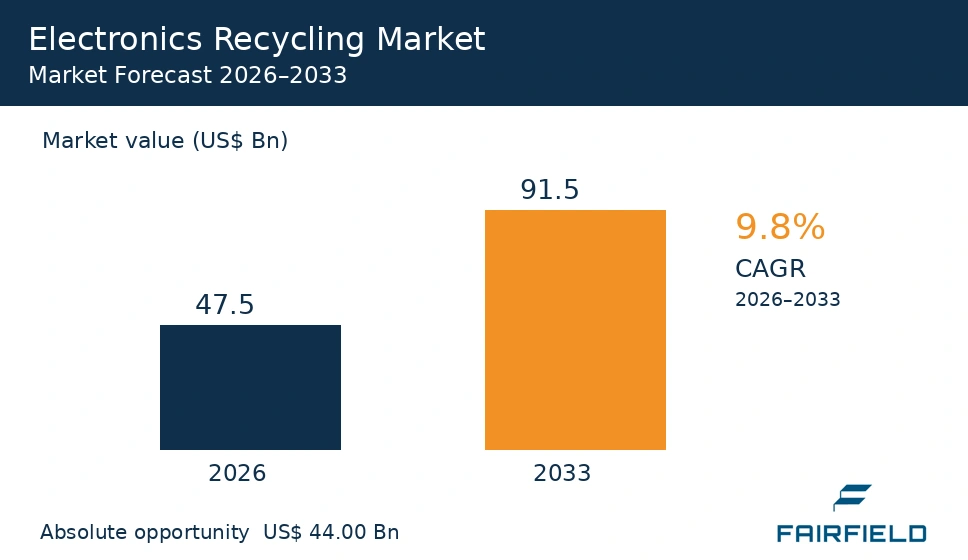
The global electronics recycling market size is expected to be valued at US$ 47.50 billion in 2026 and projected to reach US$ 91.50 billion by 2033, growing at a CAGR of 9.8% between 2026 and 2033.
Between 2020 and 2025, the market grew at a CAGR of about 8.5%, rising from roughly US$ 30.00 billion to about US$ 45.20 billion, as remote work and digital lifestyles raised device turnover, more countries adopted producer responsibility laws, and high gold, copper, and silver prices made metal recovery more profitable. The electronics recycling market covers the collection, sorting, dismantling, shredding, and processing of discarded electronic products to recover valuable materials and safely handle hazardous substances. Feedstock includes smartphones, laptops, servers, televisions, household appliances, telecom equipment, and medical devices. Recovered outputs include precious metals, copper, aluminum, steel, plastics, and glass, while services include IT asset disposition, data destruction, and refurbishment. In August 2026, Electronic Recyclers International expanded into Vietnam through a domestic e-waste recycling venture.
Key Report Takeaways
- By Material: Metal held about 60% share in 2025, while Plastic is projected to expand at a 10.5% CAGR through 2033, driven by recycled content targets for electronics, better sorting technology, and brand owner demand for certified recycled plastics in new devices.
- By Source: Household Appliances held about 35% share in 2025, while IT and Telecommunication is projected to expand at an 11.0% CAGR through 2033, driven by data center hardware retirement, telecom network upgrades, and faster replacement cycles for servers and laptops.
- By Process: Mechanical Processing held about 45% share in 2025, while Hydrometallurgical Processing is projected to expand at a 12.0% CAGR through 2033, driven by lower-emission metal recovery, higher purity outputs, and critical mineral supply goals.
- By Region: Europe held about 32% share in 2025, while Asia Pacific is projected to expand at an 11.5% CAGR through 2033, driven by huge device volumes in China and India, new e-waste rules, and investment in formal recycling plants.
Global Electronics Recycling Market Trends and Insights
Drivers Impact Analysis
Two drivers carry the strongest influence on electronics recycling market demand during the forecast period.
| Driver | Impact on CAGR Forecast | Geographic Relevance | Impact Timeline |
| Rising e-waste volumes and regulation | High | Global | Long term (≥4 years) |
| Demand for precious and critical metals | High | Europe, North America, Asia Pacific | Medium term (2-4 years) |
Rising E-Waste and Regulation Are Driving the Electronics Recycling Market
Rising e-waste volumes and regulation are the strongest driver of the electronics recycling market. The world throws away more devices every year.
The mechanism is that people and businesses replace phones, computers, televisions, and appliances more often, and new categories such as wearables, smart home devices, and electric bikes add to the waste stream. Global e-waste reached 62 million tonnes in 2022, but only about 22% was formally collected and recycled, leaving a large opportunity. Governments are responding with extended producer responsibility laws that require manufacturers to fund collection and recycling, along with landfill bans and collection targets. The European Union’s waste electrical and electronic equipment rules, India’s e-waste management rules, and state laws in the United States all push more material into formal recycling channels.
Metal Recovery Value Is Expanding the Electronics Recycling Market
Demand for precious and critical metals is expanding the electronics recycling market. Old devices contain valuable materials.
The cause is that circuit boards, processors, and connectors contain gold, silver, palladium, and copper at concentrations often higher than mined ore, while batteries and magnets contain cobalt, lithium, nickel, and rare earth elements. High metal prices make recovery more profitable, and governments in Europe, North America, and Asia Pacific treat recycling as a secure source of critical minerals. Smelters and refiners such as Umicore, Aurubis, and Boliden process large volumes of electronic scrap alongside mined materials. In December 2025, Mitsubishi Materials invested in a United States e-waste business to secure feedstock. Battery recycling from phones, laptops, and power tools adds another valuable stream. These trends attract investment and increase recycling capacity worldwide.
Restraints Impact Analysis
Two restraints limit how quickly the electronics recycling market grows.
| Restraint | Impact on CAGR Forecast | Geographic Relevance | Impact Timeline |
| Low collection rates and informal recycling | High | Asia Pacific, Latin America, Middle East & Africa | Long term (≥4 years) |
| High processing costs and complex devices | Medium | Global | Medium term (2-4 years) |
Low Collection and Informal Recycling Slow the Electronics Recycling Market
Low collection rates and informal recycling slow the electronics recycling market. Much e-waste never reaches proper recyclers.
The problem is that many consumers keep old devices in drawers, throw them in household trash, or sell them to informal collectors, who strip valuable parts using unsafe methods such as open burning and acid baths. In many developing countries, the informal sector handles most e-waste because it pays more for scrap and has lower costs than licensed recyclers. Illegal exports of e-waste from wealthy countries to poorer ones also continue despite international rules, and countries such as Malaysia have recently cracked down on illegal imports. Weak enforcement and limited collection points reduce feedstock for formal plants. These factors limit volumes, profits, and environmental benefits for formal recyclers across many regions.
Processing Costs Restrict the Electronics Recycling Market
High processing costs and complex devices restrict the electronics recycling market. Modern electronics are hard to take apart.
The constraint is that devices are increasingly small, glued, and made of many mixed materials, which makes manual dismantling slow and mechanical separation less efficient. Lithium-ion batteries inside phones, laptops, and tools can cause fires in collection trucks and shredders, raising insurance and safety costs. Hazardous substances such as mercury, lead, cadmium, and flame retardants require special handling. Data security rules require certified data destruction and detailed tracking, adding cost and time. Revenue depends heavily on volatile metal prices, so profits can fall sharply when prices drop. Large smelters and refineries also need major investment and long permitting times. These factors raise costs, squeeze margins, and slow expansion for many smaller recyclers.
Market Opportunities
Data Center and IT Asset Disposition Open a Fast-Growth Revenue Pool
Data center and IT asset disposition open a fast-growth revenue pool. Huge volumes of servers are being retired.
The opportunity comes from the rapid build-out of cloud and artificial intelligence data centers, which replace servers, storage, networking gear, and memory on short cycles, creating large flows of high-value equipment. Hyperscale operators want secure data destruction, component reuse, and certified recycling with full tracking. Sims Lifecycle Services has grown strongly in this area and is opening a 120,000 square foot facility in Ireland near major data center clusters. In July 2026, Re-Teck launched a high-capacity IT asset disposition facility in Taiwan. Reusing memory modules and drives also lowers carbon footprints for data center operators. Companies that combine reuse, resale, data security, and recycling can capture strong growth in every region.
Critical Mineral Recovery and Asia Pacific Create a Growth Revenue Pool
Critical mineral recovery and Asia Pacific create a growth revenue pool. New technologies and markets are emerging.
The opportunity reflects government efforts to recover rare earth elements, lithium, cobalt, gallium, and other critical minerals from electronics and batteries to reduce dependence on imports. Hydrometallurgical and direct recycling methods can recover these materials with lower emissions and energy use than traditional smelting. In Asia Pacific, China, India, Japan, South Korea, and Vietnam are expanding formal recycling rules and capacity, and Japan has invested heavily in metals and plastics recycling. In August 2026, ERI formed a domestic e-waste venture in Vietnam. Companies that build local plants, partner with governments, and invest in advanced recovery technology can capture strong regional growth over the forecast period.
Segment Analysis
By Material: Metal Leads While Plastic Grows Fastest
Metal held about 60% share in 2025. Precious metals such as gold, silver, and palladium, along with copper, aluminum, and steel, provide most of the value recovered from electronic waste. Circuit boards and cables are the richest sources, and smelters pay high prices for well-sorted metal-bearing scrap.
Plastic is the fastest-growing material, expanding at a 10.5% CAGR through 2033. Electronics contain large amounts of mixed plastics, and better sorting, flame retardant removal, and recycled content targets from brand owners are increasing demand for recycled plastic resins. Glass and Other Materials form other segments, including display glass and battery materials. For the market, plastic growth adds value from material that was often sent to landfill or incinerated.
By Source: Household Appliances Lead While IT and Telecommunication Grows Fastest
Household Appliances held about 35% share in 2025. Refrigerators, washing machines, air conditioners, ovens, and small kitchen appliances make up a large share of e-waste by weight, and many countries require retailers to take back old appliances when selling new ones. Cooling appliances also require safe removal of refrigerant gases, adding specialized processing demand.
IT and Telecommunication is the fastest-growing source, expanding at an 11.0% CAGR through 2033. Servers, laptops, phones, routers, and telecom equipment contain high levels of precious metals and are replaced quickly. Consumer Electronics, Industrial and Commercial Equipment, and Medical Equipment form other segments. For the market, IT growth increases high-value feedstock and demand for secure disposition services, data wiping, and certified reuse programs.
By Process: Mechanical Processing Leads While Hydrometallurgical Processing Grows Fastest
Mechanical Processing held about 45% share in 2025. Shredding, magnetic separation, eddy current separation, and optical sorting are the first steps in most recycling plants, separating metals, plastics, and glass for further processing. These methods handle large volumes at relatively low cost, and new sensor-based sorting with artificial intelligence is improving the purity of separated materials.
Hydrometallurgical Processing is the fastest-growing process, expanding at a 12.0% CAGR through 2033. Chemical leaching recovers metals with high purity and lower emissions, and it suits battery and critical mineral recovery. Pyrometallurgical and Biometallurgical Processing form other segments. For the market, hydrometallurgical growth supports cleaner recovery of high-value metals and critical minerals close to where e-waste is collected.
Geography Analysis
North America Advances the Electronics Recycling Market Through IT Asset Disposition
North America is a major electronics recycling market. The United States generates one of the highest volumes of e-waste per person, and many states have laws requiring manufacturers to fund recycling programs. Electronic Recyclers International, Sims Lifecycle Services, Cascade Asset Management, and Colt Recycling operate large facilities, and hyperscale data centers create strong IT asset disposition demand. Canada has provincial producer responsibility programs that fund collection across the country. Key barriers include the lack of a national law and high labor costs. One change shaping the region is growing investment from domestic and Japanese metals companies in recycling capacity.
Which Region Is Leading the Electronics Recycling Market?
Europe is leading the electronics recycling market with about 32% share in 2025. The European Union’s waste electrical and electronic equipment rules set strict collection and recycling targets, and countries such as Germany, France, Sweden, the Netherlands, and Belgium have advanced recycling systems. Umicore in Belgium, Aurubis in Germany, and Boliden in Sweden run some of the world’s largest electronic scrap smelters. Key barriers include high energy costs and illegal exports of some waste. One opportunity is critical mineral recovery, supported by new raw material policies, right-to-repair rules, and growing recycled content requirements for new products.
Which Region Is Growing Fastest in the Electronics Recycling Market?
Asia Pacific is the fastest-growing electronics recycling market, expanding at an 11.5% CAGR through 2033. China generates the largest volume of e-waste in the world and runs state-supported recycling programs, while India is expanding formal recycling through producer responsibility rules and companies such as Attero. Japan and South Korea have strong recycling laws and metal recovery companies such as DOWA, and Vietnam and Malaysia are attracting new investment. Key barriers include informal recycling, illegal imports, and low consumer awareness. One change shaping the region is fast growth of licensed recycling capacity and tighter controls on imports.
Latin America Grows the Electronics Recycling Market Through New Regulations
Latin America is a growing electronics recycling market. Brazil, Mexico, Argentina, Colombia, and Chile generate rising volumes of e-waste as device use grows, and several countries have adopted or proposed producer responsibility laws for electronics and batteries. Brazil has a national solid waste policy with reverse logistics rules for electronics, while Chile has introduced producer responsibility requirements. Key barriers include informal collection, limited processing plants, high logistics costs over long distances, and low public awareness. One opportunity is formal collection networks and regional processing hubs, supported by new laws, brand owner take-back programs, and partnerships with international recycling companies.
Middle East & Africa Builds the Electronics Recycling Market Through Infrastructure Investment
Middle East & Africa is an emerging electronics recycling market. The United Arab Emirates and Saudi Arabia are building modern recycling facilities under national sustainability plans, and Israel has producer responsibility rules for electronics and batteries. South Africa, Nigeria, Kenya, and Ghana handle large volumes of e-waste, much of it through informal channels that cause health and environmental harm. Key barriers include weak enforcement, limited infrastructure, and illegal imports of used electronics. One opportunity is formal recycling plants, supported by government programs, international partnerships, development funding, and producer responsibility schemes that are being introduced in several countries.
Competitive Landscape
The electronics recycling market is fragmented. Umicore, Aurubis AG, Boliden AB, Sims Limited (Sims Lifecycle Services), and Veolia Environnement S.A. are leading players, while SK tes, Electronic Recyclers International, Stena Recycling, Attero Recycling, DOWA Holdings, Mitsubishi Materials, and Cascade Asset Management compete strongly. Even the largest companies hold only small shares because thousands of local collectors, dismantlers, and processors operate in every country. The market has two main layers: collection, dismantling, and IT asset disposition companies that handle devices and data, and large smelters and refiners that recover metals from processed scrap.
Companies compete on metal recovery rates, processing capacity, environmental certifications, data security, collection networks, logistics, pricing for feedstock, and relationships with manufacturers and producer responsibility organizations. Long-term contracts with hyperscale data centers, electronics brands, and governments are especially valuable.
Strategic moves show how competition is changing. In December 2025, Mitsubishi Materials invested in Elemental USA E-Waste & ITAD. In February 2026, Sims Lifecycle Services highlighted its new facility in Ireland. In July 2026, Re-Teck opened a facility in Taiwan, and ERI partnered with Cyclic Materials on rare earth recovery. In August 2026, ERI expanded into Vietnam.
Three themes shape vendor strategy. First, metals companies are investing in recycling to secure feedstock and critical minerals. Second, recyclers are expanding IT asset disposition services for data centers. Third, they are building local capacity in Asia Pacific and other emerging markets as countries restrict e-waste imports.
Electronics Recycling Market Industry Leaders
Umicore Aurubis AG Boliden AB Sims Limited (Sims Lifecycle Services) Veolia Environnement S.A.
Recent Industry Developments
- August 2026: Electronic Recyclers International expanded into Vietnam with a domestic e-waste recycling and IT asset disposition venture that will source material locally and avoid cross-border imports - strengthens formal capacity in the electronics recycling market in Asia Pacific.
- July 2026: Re-Teck launched a new high-capacity IT asset disposition facility in Taiwan - expands secure processing for retired IT and data center equipment.
- February 2026: Sims Lifecycle Services highlighted strong growth from hyperscale data center decommissioning and a new 120,000 square foot facility in Ireland - positions it closer to major data center clusters.
- December 2025: Mitsubishi Materials agreed to invest in Elemental USA E-Waste & ITAD, which operates through Colt Recycling - expands Japanese metal company access to North America e-waste feedstock.
Companies Covered in the Report
- Umicore
- Aurubis AG
- Boliden AB
- Sims Limited (Sims Lifecycle Services)
- Veolia Environnement S.A.
- SK tes
- Electronic Recyclers International, Inc.
- Stena Recycling
- Attero Recycling Pvt. Ltd.
- DOWA Holdings Co., Ltd.
- Mitsubishi Materials Corporation
- Cascade Asset Management
Electronics Recycling Market Report Scope
This report covers the electronics recycling market, including metal, plastic, glass, and other materials recovered from household appliances, IT and telecommunication equipment, consumer electronics, industrial and commercial equipment, and medical equipment, using mechanical, pyrometallurgical, hydrometallurgical, and biometallurgical processes. The base year is 2025, and the forecast period runs from 2026 to 2033. All values are expressed in US$ Billion.
| Material | Metal, Plastic, Glass, Other Materials |
| Source | Household Appliances, IT and Telecommunication, Consumer Electronics, Industrial and Commercial Equipment, Medical Equipment |
| Process | Mechanical Processing, Pyrometallurgical Processing, Hydrometallurgical Processing, Biometallurgical Processing |
| Regions | North America, Europe, Asia Pacific, Latin America, Middle East & Africa |
1. Executive Summary
1.1 Electronics Recycling Market Snapshot
1.2 Future Projections
1.3 Key Market Trends
1.4 Regional Snapshot
2. Market Overview
2.1 Market Definition and Report Scope
2.2 Historical Market Trends
2.3 Market Dynamics
2.3.1 Drivers
2.3.1.1 Rising E-Waste and Regulation Are Driving the Electronics Recycling Market
2.3.1.2 Metal Recovery Value Is Expanding the Electronics Recycling Market
2.3.2 Restraints
2.3.2.1 Low Collection and Informal Recycling Slow the Electronics Recycling Market
2.3.2.2 Processing Costs Restrict the Electronics Recycling Market
2.3.3 Market Opportunities
2.3.3.1 Data Center and IT Asset Disposition Open a Fast-Growth Revenue Pool
2.3.3.2 Critical Mineral Recovery and Asia Pacific Create a Growth Revenue Pool
3. Global Electronics Recycling Market Outlook, 2020–2033
3.1 Global Electronics Recycling Market Outlook, by Material, Value (US$ Billion), 2020–2033
3.1.1 Metal
3.1.2 Plastic
3.1.3 Glass
3.1.4 Other Materials
3.2 Global Electronics Recycling Market Outlook, by Source, Value (US$ Billion), 2020–2033
3.2.1 Household Appliances
3.2.2 IT and Telecommunication
3.2.3 Consumer Electronics
3.2.4 Industrial and Commercial Equipment
3.2.5 Medical Equipment
3.3 Global Electronics Recycling Market Outlook, by Process, Value (US$ Billion), 2020–2033
3.3.1 Mechanical Processing
3.3.2 Pyrometallurgical Processing
3.3.3 Hydrometallurgical Processing
3.3.4 Biometallurgical Processing
3.4 Global Electronics Recycling Market Outlook, by Region, Value (US$ Billion), 2020–2033
3.4.1 North America
3.4.2 Europe
3.4.3 Asia Pacific
3.4.4 Latin America
3.4.5 Middle East & Africa
4. North America Electronics Recycling Market Outlook, 2020–2033
4.1 North America Electronics Recycling Market Outlook, by Material, Value (US$ Billion), 2020–2033
4.1.1 Metal
4.1.2 Plastic
4.1.3 Glass
4.1.4 Other Materials
4.2 North America Electronics Recycling Market Outlook, by Source, Value (US$ Billion), 2020–2033
4.2.1 Household Appliances
4.2.2 IT and Telecommunication
4.2.3 Consumer Electronics
4.2.4 Industrial and Commercial Equipment
4.2.5 Medical Equipment
4.3 North America Electronics Recycling Market Outlook, by Process, Value (US$ Billion), 2020–2033
4.3.1 Mechanical Processing
4.3.2 Pyrometallurgical Processing
4.3.3 Hydrometallurgical Processing
4.3.4 Biometallurgical Processing
4.4 North America Electronics Recycling Market Outlook, by Country, Value (US$ Billion), 2020–2033
4.4.1 United States Electronics Recycling Market Outlook, by Material, 2020–2033
4.4.2 United States Electronics Recycling Market Outlook, by Source, 2020–2033
4.4.3 United States Electronics Recycling Market Outlook, by Process, 2020–2033
4.4.4 Canada Electronics Recycling Market Outlook, by Material, 2020–2033
4.4.5 Canada Electronics Recycling Market Outlook, by Source, 2020–2033
4.4.6 Canada Electronics Recycling Market Outlook, by Process, 2020–2033
5. Europe Electronics Recycling Market Outlook, 2020–2033
5.1 Europe Electronics Recycling Market Outlook, by Material, Value (US$ Billion), 2020–2033
5.1.1 Metal
5.1.2 Plastic
5.1.3 Glass
5.1.4 Other Materials
5.2 Europe Electronics Recycling Market Outlook, by Source, Value (US$ Billion), 2020–2033
5.2.1 Household Appliances
5.2.2 IT and Telecommunication
5.2.3 Consumer Electronics
5.2.4 Industrial and Commercial Equipment
5.2.5 Medical Equipment
5.3 Europe Electronics Recycling Market Outlook, by Process, Value (US$ Billion), 2020–2033
5.3.1 Mechanical Processing
5.3.2 Pyrometallurgical Processing
5.3.3 Hydrometallurgical Processing
5.3.4 Biometallurgical Processing
5.4 Europe Electronics Recycling Market Outlook, by Country, Value (US$ Billion), 2020–2033
5.4.1 Germany Electronics Recycling Market Outlook, by Material, 2020–2033
5.4.2 Germany Electronics Recycling Market Outlook, by Source, 2020–2033
5.4.3 Germany Electronics Recycling Market Outlook, by Process, 2020–2033
5.4.4 France Electronics Recycling Market Outlook, by Material, 2020–2033
5.4.5 France Electronics Recycling Market Outlook, by Source, 2020–2033
5.4.6 France Electronics Recycling Market Outlook, by Process, 2020–2033
5.4.7 Sweden Electronics Recycling Market Outlook, by Material, 2020–2033
5.4.8 Sweden Electronics Recycling Market Outlook, by Source, 2020–2033
5.4.9 Sweden Electronics Recycling Market Outlook, by Process, 2020–2033
5.4.10 Netherlands Electronics Recycling Market Outlook, by Material, 2020–2033
5.4.11 Netherlands Electronics Recycling Market Outlook, by Source, 2020–2033
5.4.12 Netherlands Electronics Recycling Market Outlook, by Process, 2020–2033
5.4.13 Belgium Electronics Recycling Market Outlook, by Material, 2020–2033
5.4.14 Belgium Electronics Recycling Market Outlook, by Source, 2020–2033
5.4.15 Belgium Electronics Recycling Market Outlook, by Process, 2020–2033
6. Asia Pacific Electronics Recycling Market Outlook, 2020–2033
6.1 Asia Pacific Electronics Recycling Market Outlook, by Material, Value (US$ Billion), 2020–2033
6.1.1 Metal
6.1.2 Plastic
6.1.3 Glass
6.1.4 Other Materials
6.2 Asia Pacific Electronics Recycling Market Outlook, by Source, Value (US$ Billion), 2020–2033
6.2.1 Household Appliances
6.2.2 IT and Telecommunication
6.2.3 Consumer Electronics
6.2.4 Industrial and Commercial Equipment
6.2.5 Medical Equipment
6.3 Asia Pacific Electronics Recycling Market Outlook, by Process, Value (US$ Billion), 2020–2033
6.3.1 Mechanical Processing
6.3.2 Pyrometallurgical Processing
6.3.3 Hydrometallurgical Processing
6.3.4 Biometallurgical Processing
6.4 Asia Pacific Electronics Recycling Market Outlook, by Country, Value (US$ Billion), 2020–2033
6.4.1 China Electronics Recycling Market Outlook, by Material, 2020–2033
6.4.2 China Electronics Recycling Market Outlook, by Source, 2020–2033
6.4.3 China Electronics Recycling Market Outlook, by Process, 2020–2033
6.4.4 India Electronics Recycling Market Outlook, by Material, 2020–2033
6.4.5 India Electronics Recycling Market Outlook, by Source, 2020–2033
6.4.6 India Electronics Recycling Market Outlook, by Process, 2020–2033
6.4.7 Japan Electronics Recycling Market Outlook, by Material, 2020–2033
6.4.8 Japan Electronics Recycling Market Outlook, by Source, 2020–2033
6.4.9 Japan Electronics Recycling Market Outlook, by Process, 2020–2033
6.4.10 South Korea Electronics Recycling Market Outlook, by Material, 2020–2033
6.4.11 South Korea Electronics Recycling Market Outlook, by Source, 2020–2033
6.4.12 South Korea Electronics Recycling Market Outlook, by Process, 2020–2033
6.4.13 Vietnam Electronics Recycling Market Outlook, by Material, 2020–2033
6.4.14 Vietnam Electronics Recycling Market Outlook, by Source, 2020–2033
6.4.15 Vietnam Electronics Recycling Market Outlook, by Process, 2020–2033
6.4.16 Malaysia Electronics Recycling Market Outlook, by Material, 2020–2033
6.4.17 Malaysia Electronics Recycling Market Outlook, by Source, 2020–2033
6.4.18 Malaysia Electronics Recycling Market Outlook, by Process, 2020–2033
7. Latin America Electronics Recycling Market Outlook, 2020–2033
7.1 Latin America Electronics Recycling Market Outlook, by Material, Value (US$ Billion), 2020–2033
7.1.1 Metal
7.1.2 Plastic
7.1.3 Glass
7.1.4 Other Materials
7.2 Latin America Electronics Recycling Market Outlook, by Source, Value (US$ Billion), 2020–2033
7.2.1 Household Appliances
7.2.2 IT and Telecommunication
7.2.3 Consumer Electronics
7.2.4 Industrial and Commercial Equipment
7.2.5 Medical Equipment
7.3 Latin America Electronics Recycling Market Outlook, by Process, Value (US$ Billion), 2020–2033
7.3.1 Mechanical Processing
7.3.2 Pyrometallurgical Processing
7.3.3 Hydrometallurgical Processing
7.3.4 Biometallurgical Processing
7.4 Latin America Electronics Recycling Market Outlook, by Country, Value (US$ Billion), 2020–2033
7.4.1 Brazil Electronics Recycling Market Outlook, by Material, 2020–2033
7.4.2 Brazil Electronics Recycling Market Outlook, by Source, 2020–2033
7.4.3 Brazil Electronics Recycling Market Outlook, by Process, 2020–2033
7.4.4 Mexico Electronics Recycling Market Outlook, by Material, 2020–2033
7.4.5 Mexico Electronics Recycling Market Outlook, by Source, 2020–2033
7.4.6 Mexico Electronics Recycling Market Outlook, by Process, 2020–2033
7.4.7 Argentina Electronics Recycling Market Outlook, by Material, 2020–2033
7.4.8 Argentina Electronics Recycling Market Outlook, by Source, 2020–2033
7.4.9 Argentina Electronics Recycling Market Outlook, by Process, 2020–2033
7.4.10 Colombia Electronics Recycling Market Outlook, by Material, 2020–2033
7.4.11 Colombia Electronics Recycling Market Outlook, by Source, 2020–2033
7.4.12 Colombia Electronics Recycling Market Outlook, by Process, 2020–2033
7.4.13 Chile Electronics Recycling Market Outlook, by Material, 2020–2033
7.4.14 Chile Electronics Recycling Market Outlook, by Source, 2020–2033
7.4.15 Chile Electronics Recycling Market Outlook, by Process, 2020–2033
8. Middle East & Africa Electronics Recycling Market Outlook, 2020–2033
8.1 Middle East & Africa Electronics Recycling Market Outlook, by Material, Value (US$ Billion), 2020–2033
8.1.1 Metal
8.1.2 Plastic
8.1.3 Glass
8.1.4 Other Materials
8.2 Middle East & Africa Electronics Recycling Market Outlook, by Source, Value (US$ Billion), 2020–2033
8.2.1 Household Appliances
8.2.2 IT and Telecommunication
8.2.3 Consumer Electronics
8.2.4 Industrial and Commercial Equipment
8.2.5 Medical Equipment
8.3 Middle East & Africa Electronics Recycling Market Outlook, by Process, Value (US$ Billion), 2020–2033
8.3.1 Mechanical Processing
8.3.2 Pyrometallurgical Processing
8.3.3 Hydrometallurgical Processing
8.3.4 Biometallurgical Processing
8.4 Middle East & Africa Electronics Recycling Market Outlook, by Country, Value (US$ Billion), 2020–2033
8.4.1 United Arab Emirates Electronics Recycling Market Outlook, by Material, 2020–2033
8.4.2 United Arab Emirates Electronics Recycling Market Outlook, by Source, 2020–2033
8.4.3 United Arab Emirates Electronics Recycling Market Outlook, by Process, 2020–2033
8.4.4 Saudi Arabia Electronics Recycling Market Outlook, by Material, 2020–2033
8.4.5 Saudi Arabia Electronics Recycling Market Outlook, by Source, 2020–2033
8.4.6 Saudi Arabia Electronics Recycling Market Outlook, by Process, 2020–2033
8.4.7 Israel Electronics Recycling Market Outlook, by Material, 2020–2033
8.4.8 Israel Electronics Recycling Market Outlook, by Source, 2020–2033
8.4.9 Israel Electronics Recycling Market Outlook, by Process, 2020–2033
8.4.10 South Africa Electronics Recycling Market Outlook, by Material, 2020–2033
8.4.11 South Africa Electronics Recycling Market Outlook, by Source, 2020–2033
8.4.12 South Africa Electronics Recycling Market Outlook, by Process, 2020–2033
8.4.13 Nigeria Electronics Recycling Market Outlook, by Material, 2020–2033
8.4.14 Nigeria Electronics Recycling Market Outlook, by Source, 2020–2033
8.4.15 Nigeria Electronics Recycling Market Outlook, by Process, 2020–2033
8.4.16 Kenya Electronics Recycling Market Outlook, by Material, 2020–2033
8.4.17 Kenya Electronics Recycling Market Outlook, by Source, 2020–2033
8.4.18 Kenya Electronics Recycling Market Outlook, by Process, 2020–2033
8.4.19 Ghana Electronics Recycling Market Outlook, by Material, 2020–2033
8.4.20 Ghana Electronics Recycling Market Outlook, by Source, 2020–2033
8.4.21 Ghana Electronics Recycling Market Outlook, by Process, 2020–2033
9. Competitive Landscape
9.1 Electronics Recycling Market Industry Leaders
9.2 Recent Industry Developments
9.3 Company Profiles
9.3.1 Umicore
9.3.2 Aurubis AG
9.3.3 Boliden AB
9.3.4 Sims Limited (Sims Lifecycle Services)
9.3.5 Veolia Environnement S.A.
9.3.6 SK tes
9.3.7 Electronic Recyclers International, Inc.
9.3.8 Stena Recycling
9.3.9 Attero Recycling Pvt. Ltd.
9.3.10 DOWA Holdings Co., Ltd.
9.3.11 Mitsubishi Materials Corporation
9.3.12 Cascade Asset Management
10. Appendix
10.1 Research Methodology
10.2 Report Assumptions
10.3 Acronyms and Abbreviations
| Material | Metal, Plastic, Glass, Other Materials |
| Source | Household Appliances, IT and Telecommunication, Consumer Electronics, Industrial and Commercial Equipment, Medical Equipment |
| Process | Mechanical Processing, Pyrometallurgical Processing, Hydrometallurgical Processing, Biometallurgical Processing |
| Regions | North America, Europe, Asia Pacific, Latin America, Middle East & Africa |
Our Research Methodology
Considering the volatility of business today, traditional approaches to strategizing a game plan can be unfruitful if not detrimental. True ambiguity is no way to determine a forecast. A myriad of predetermined factors must be accounted for such as the degree of risk involved, the magnitude of circumstances, as well as conditions or consequences that are not known or unpredictable. To circumvent binary views that cast uncertainty, the application of market research intelligence to strategically posture, move, and enable actionable outcomes is necessary.
View Methodology
Quality Assured
Rigorous Validation Process

Confidentiality Assured
End-to-end Data Security

Custom Research Services
Tailored To Your Objectives
FAQs
The global electronics recycling market is expected to be valued at US$ 47.50 billion in 2026, driven by rising e-waste and regulation.
The market is projected to grow at a 9.8% CAGR from 2026 to 2033, reaching about US$ 91.50 billion by 2033.
Europe leads with about 32% share, supported by strict collection targets, advanced recycling systems, and large electronic scrap smelters in the region.
Metal dominates with about 60% share, because gold, silver, palladium, and copper provide most of the value recovered from e-waste.
Key players include Umicore, Aurubis, Boliden, Sims Limited, and Veolia, competing on recovery rates, capacity, compliance, and data security.
Related Reports
Bunker Fuel Market Size, Share, Insights, Competitive Landscape, and Forecast 2026 to 2033
Explore the bunker fuel market outlook for 2026–2033, covering fuel types, vessels, sellers, regional trends, and leading companies.
Shale Gas Market Size, Share, Insights, Competitive Landscape, and Forecast 2026 to 2033
Explore the shale gas market outlook for 2026–2033, covering technologies, applications, gas types, regional trends, and leading companies.
Bus HVAC Systems Market Size, Share, Insights, Competitive Landscape, and Forecast 2026 to 2033
Explore the bus HVAC systems market outlook for 2026–2033, covering bus types, propulsion, cooling capacity, regional trends, and leading companies.
Frameless Solar Panels Market Size, Share, Insights, Competitive Landscape, and Forecast 2026 to 2033
Explore the frameless solar panels market outlook for 2026–2033, with cell technologies, mounting trends, regional demand, and competitive insights.
Building Energy Management Systems Market Size, Share, Insights, Competitive Landscape, and Forecast 2026 to 2033
Explore the building energy management systems market outlook for 2026–2033, with component trends, deployment insights, regions, and key suppliers.
Fuel Management System Market Size, Share, Insights, Competitive Landscape, and Forecast 2026 to 2033
The global fuel management system market is valued at US$21.4 billion in 2026, reaching US$38.6 billion by 2033, growing at an 8.8% CAGR