



EV Contactor Relay Market
EV Contactor Relay Market Size, Share, Insights, Competitive Landscape, and Forecast 2026 to 2033
EV Contactor Relay Market Size and Trend Analysis
How Fast Will EV Contactor Relay Demand Grow?
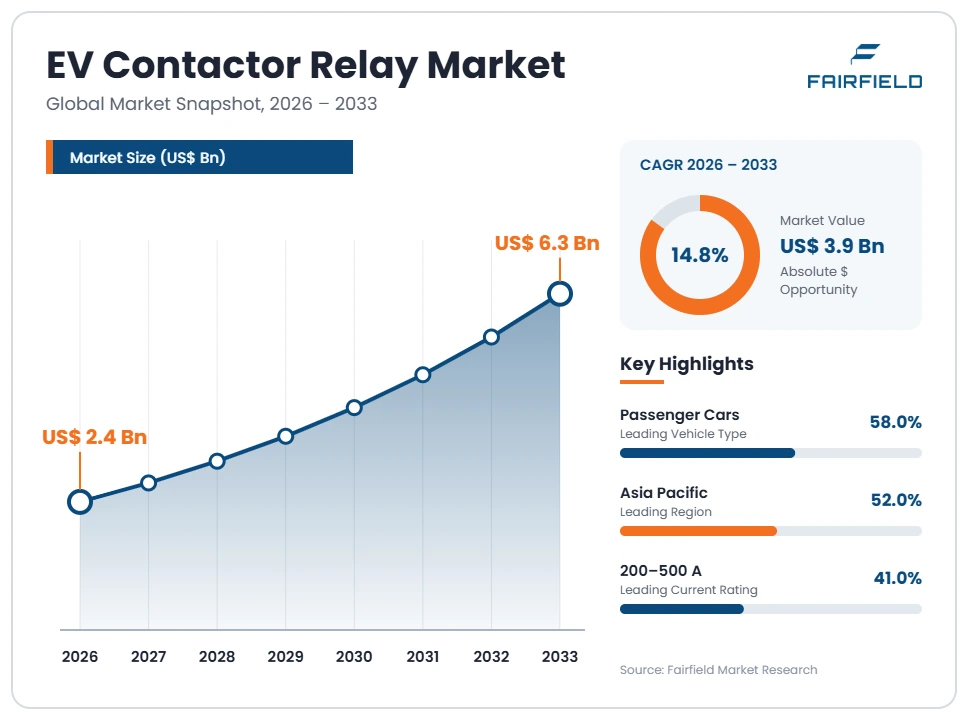
The global EV Contactor Relay market size is expected to be valued at US$ 2.4 billion in 2026 and projected to reach US$ 6.3 billion by 2033, growing at a CAGR of 14.8% between 2026 and 2033. Growth follows electric vehicle output, rising battery pack voltages and the spread of DC fast charging. Every pack needs main, pre-charge and auxiliary switching, so content per vehicle climbs with each added circuit. The absolute dollar opportunity across the period is US$ 3.9 billion, after historical growth of roughly 16.5% CAGR between 2020 and 2025. Demand is shifting toward sealed, gas-filled designs rated above 500 A.
Key Report Takeaways
- By Product Type: Main pack contactors led with 38% share in 2026, while fast-charge and DC charging contactors are projected to expand at a 17.2% CAGR through 2033, driven by public charger deployment at 350 kW and above.
- By Current Rating: The 200–500 A class led with 41% share in 2026, while units above 500 A are projected to expand at an 18.1% CAGR through 2033, driven by 800 V architectures that raise peak discharge currents.
- By Vehicle Type: Passenger cars led with 58% share in 2026, while heavy commercial vehicles and buses are projected to expand at a 17.5% CAGR through 2033, driven by depot electrification and megawatt truck charging programmes.
- By Application: Battery pack and battery management systems led with 34% share in 2026, while charging systems are projected to expand at an 18.4% CAGR through 2033, driven by onboard charger and wallbox integration.
- By Region: Asia Pacific led with 52% share in 2026, while North America is projected to expand at a 16.4% CAGR through 2033; Europe, Latin America and Middle East & Africa follow, supported by local assembly and grid upgrades.
Global EV Contactor Relay Market Trends and Insights
Market Growth Drivers
Electric Vehicle Output Is Multiplying Switching Content Per Platform
Rising electric vehicle assembly is the single largest source of demand for high-voltage contactors and relays. Each battery electric platform carries a positive main contactor, a negative main contactor, a pre-charge relay and a resistor, plus auxiliary devices for heating, cooling and the onboard charger. A fast-charge inlet adds two more high-current poles. Content per vehicle therefore scales faster than vehicle counts alone, which lifts unit volumes and average selling prices together.
Automakers have moved high-voltage switching from a loose harness into an integrated battery disconnect unit. That change pushed contactor suppliers into assembly work covering busbars, fuses, current sensors and connectors. Battery pack integrators now qualify these units as a single part number. The shift raises the value captured per platform and ties suppliers into programme life cycles that often run seven to ten years.
Higher Pack Voltages Raise Technical Requirements and Unit Value
The move from 400 V to 800 V battery architectures lifts demand for contactors able to interrupt far more energetic direct-current arcs. Direct current does not cross zero, so breaking a fault at higher voltage needs stronger magnetic blowout, sealed ceramic chambers and inert gas filling. Those designs command higher prices than earlier automotive relays. The result is value growth that runs ahead of unit growth across premium and performance segments.
Component makers have responded with hermetically sealed designs using hydrogen-rich fill gas and silver alloy contact materials. Qualification follows automotive and electrical safety practice set out by bodies such as ISO, IEC and UL, covering dielectric strength, short-circuit withstand and endurance. Suppliers that already hold these capabilities in industrial switchgear have transferred them into automotive lines, which has widened the competitive field.
Market Restraints
Sustained Price Pressure From Vehicle Makers Compresses Supplier Margins
Automotive purchasing practice constrains earnings across the contactor supply base. Vehicle makers negotiate annual price reductions over a programme life, while demanding the same reliability. Because a contactor is a safety-critical but low-visibility part, it rarely carries a brand premium with buyers. Suppliers absorb cost increases in silver, copper and rare-earth magnet materials without matching price relief, which limits reinvestment in capacity and engineering.
Price pressure has intensified as Chinese component makers scaled high-voltage relay output and exported aggressively. Competing offers have narrowed the gap on sealed contactor performance, so differentiation rests increasingly on validation data and supply reliability rather than function alone. Several established vendors have answered by automating assembly, localising production near pack plants and moving up into integrated disconnect units where engineering content is harder to commoditise.
Long Validation Cycles and Field Reliability Risk Slow Adoption
Qualification timelines restrain how quickly new contactor designs reach volume production. A high-voltage contactor must survive thermal cycling, vibration, humidity, corrosion and tens of thousands of mechanical operations, plus a defined number of load breaks at full pack voltage. Testing often runs for many months before a new part is released for volume. That cadence delays revenue from new designs and discourages smaller entrants without established laboratory capability.
Field risk compounds the problem. A welded contact can leave a battery pack permanently connected, so welding detection, contact resistance monitoring and redundant architecture are now expected. Safety recalls tied to high-voltage components are costly, and they damage supplier standing well beyond the affected programme. Vehicle makers consequently favour vendors with long automotive records, which slows the entry of otherwise capable industrial relay manufacturers into traction applications.
Market Opportunities
Charging Infrastructure Creates Demand Outside the Vehicle
Public and depot charging equipment is opening a second demand pool that is independent of vehicle build rates. A DC fast charger uses contactors on the input, the output and each dispenser cable, with additional relays for isolation monitoring and insulation testing. High-power cabinets specified at 350 kW and above need devices rated well beyond typical vehicle duty. Charger manufacturers therefore buy heavier parts in growing quantities.
The opportunity widens as fleet depots, bus garages and freight corridors install megawatt charging for heavy vehicles. These installations run many more switching cycles per day than a passenger car ever will, which raises endurance requirements and shortens replacement intervals. Suppliers able to serve both vehicle and infrastructure channels gain volume stability, because charger demand continues even when vehicle programme launches slip or when model changeovers pause assembly lines.
Solid-State and Hybrid Switching Opens a Premium Product Tier
Semiconductor-assisted switching gives suppliers a route out of commodity pricing. Hybrid designs pair a mechanical contact with silicon carbide or silicon devices that carry the arc during make and break. The contact then handles only steady-state current. This removes arc erosion, cuts audible noise, shrinks package size and allows far faster fault interruption than a purely electromechanical part can achieve.
Commercial interest is strongest where switching frequency is especially high, such as battery disconnect units with cell balancing, bidirectional chargers and vehicle-to-grid equipment. Fully solid-state breakers remain costly, because conduction losses demand larger heat sinks and more expensive semiconductors, so hybrid architectures are the practical near-term step for most programmes. Vendors with power electronics and relay expertise under one roof are positioned to capture this tier, which carries better margins than conventional contactors.
Segment Analysis
- Which Product Type Leads EV Contactor Relay Demand?
Main pack contactors led the product mix with 38% share in 2026, because every battery electric and plug-in hybrid platform needs at least two of them. These devices sit on the positive and negative rails of the pack and must break full system voltage under fault conditions. Their safety role makes them non-negotiable content, which gives the category a stable base tied directly to vehicle output.
Fast-charge and DC charging contactors are growing fastest at a 17.2% CAGR through 2033. Growth comes from higher charging power and from the separate inlet circuit that most new platforms now carry. Pre-charge relays and auxiliary devices add steady volume for thermal management, air conditioning and onboard chargers. For the wider market, the pattern means suppliers cannot rely on a single device family. Winning a platform increasingly requires a complete switching portfolio rather than one qualified part.
- Higher Current Ratings Move From Niche to Mainstream
The 200–500 A class held the largest share of ratings at 41% in 2026, matching the continuous and peak currents of mainstream passenger car packs. This band covers most 400 V architectures in compact and mid-size vehicles, where cost control matters more than peak power. Volume manufacturing in this range is mature, so unit prices are keenly contested among established and newer suppliers.
Devices rated above 500 A are expanding fastest at an 18.1% CAGR through 2033. Performance cars, electric trucks, buses and megawatt charging equipment all draw currents that exceed mid-range capability. Meeting those loads requires larger contact areas, stronger arc chutes and improved heat dissipation through busbar design. Units below 200 A remain important for auxiliary and pre-charge duty. The upward drift in ratings favours manufacturers with heavy-current engineering heritage from industrial switchgear and traction equipment.
- Passenger Cars Dominate While Heavy Vehicles Set the Pace
Passenger cars accounted for 58% of demand in 2026, reflecting their share of global electric vehicle assembly. High build volumes and standardised pack designs let suppliers amortise tooling across millions of units. Compact and mid-size models use well-defined contactor sets, which keeps engineering effort per programme low and supports the automated production lines that serve this segment.
Heavy commercial vehicles and buses are the fastest-growing category at a 17.5% CAGR through 2033. Electric trucks and transit fleets carry much larger packs, often split into multiple strings, with each string needing its own disconnect and pre-charge circuit. Duty cycles are harsher and service life expectations longer. Light commercial vehicles add steady volume from delivery fleets, while two- and three-wheelers and off-highway machines contribute lower-rated units. Commercial platforms therefore deliver higher value per vehicle than passenger programmes.
- Which Application Is Growing Fastest Across EV Platforms?
Charging systems are the fastest-growing application at an 18.4% CAGR through 2033, covering onboard chargers, wallboxes and public DC equipment. Each new high-power charger carries several heavy contactors plus isolation relays, and charger installation is running ahead of vehicle sales in several markets. Bidirectional charging adds further switching content, since power must be routed safely in both directions.
Battery pack and battery management applications still led with 34% share in 2026, anchored by main disconnect, pre-charge and service disconnect functions inside the pack. Powertrain and inverter circuits follow, while auxiliary systems such as cabin heaters, compressors and DC-DC converters use smaller relays. The split matters strategically. It shows that suppliers serving only vehicle makers address a slower-growing pool than those also selling into charging equipment manufacturers and grid-connected infrastructure projects.
Geography Analysis
- Which Region Is Growing Fastest in the EV Contactor Relay Market?
North America is the fastest-growing region at a 16.4% CAGR through 2033, from an 18% share in 2026. Growth rests on new battery and vehicle assembly capacity across the United States, Canada and Mexico, much of it built since federal incentives tied benefits to domestic content. Pack plants in the southern United States have pulled component sourcing closer to final assembly.
Charging build-out adds a second engine. National highway charging programmes and private fleet depots are installing high-power cabinets that consume heavy contactors. Electric truck pilots along freight corridors raise requirements further. Mexico contributes low-cost assembly for both vehicle and charger supply chains, while Canada supports pack and materials capacity. Tariff policy and content rules have encouraged relay makers to localise production rather than import finished devices.
- Europe Pairs Strict Regulation With Premium Vehicle Architectures
Europe held 23% share in 2026 and is growing at a 14.2% CAGR through 2033. The region’s carbon dioxide limits for new cars and vans push manufacturers in Germany, France, Sweden and Spain toward full electrification. Premium German platforms adopted 800 V architectures early, which raised demand for high-interrupt contactors well before mass-market vehicles needed them.
Safety and electrical standards developed through IEC and applied across national regimes shape product requirements, particularly for insulation monitoring and isolation. Bus fleet electrification in Nordic cities and tenders across western Europe support heavy-duty switching volumes. Established industrial relay manufacturers already operating in the region have transferred switchgear know-how into automotive programmes. Slower vehicle sales growth in some markets tempers the regional rate despite strong engineering intensity.
- Which Region Is Leading the EV Contactor Relay Market?
Asia Pacific leads the market with 52% share in 2026 and is growing at a 15.1% CAGR through 2033. China anchors that position through the largest concentration of electric vehicle assembly, battery cell output and pack integration anywhere. Domestic relay manufacturers scaled high-voltage contactor capacity alongside that build-out, giving vehicle makers short, local supply chains and aggressive pricing.
Japan and South Korea contribute deep component engineering, supplying sealed contactors and relays to global programmes. India is adding assembly for electric two- and three-wheelers, buses and passenger cars under national manufacturing incentives. Charging deployment across China is extensive, which raises infrastructure demand on top of vehicle content. Regional strength in silver alloys, ceramics and precision stamping further supports cost-competitive production at scale.
- Latin America Builds Capacity From a Small Starting Base
Latin America accounted for 4% share in 2026, expanding at a 13.0% CAGR through 2033. Mexico dominates regional activity through established automotive manufacturing serving North American assembly, including growing work on electrified platforms and wiring systems. Brazil follows, supported by incentive programmes for cleaner vehicles and by early electric bus adoption in large cities.
Growth is constrained by limited charging networks and by vehicle affordability relative to incomes. Hybrid and plug-in hybrid vehicles are therefore taking an important share of electrified sales, which still requires pack contactors and pre-charge relays. Fleet operators in logistics and public transport are the main early adopters. Local content rules and regional trade agreements encourage component assembly rather than full device manufacture at present.
- Middle East & Africa Advances Through Fleet and Infrastructure Projects
Middle East & Africa held 3% share in 2026 and is growing at a 12.4% CAGR through 2033. Demand is concentrated in the United Arab Emirates, Saudi Arabia and South Africa. Gulf states have linked electric mobility to national economic diversification plans, funding charging corridors and government fleet conversion alongside new vehicle assembly ventures.
High ambient temperatures place real constraints on contactor selection, because coil power and contact resistance both worsen with heat. That favours sealed designs with strong thermal margins. South Africa retains established vehicle manufacturing and exports to Europe, which gradually pulls electrified platforms into local production. Elsewhere, grid reliability and charging coverage limit adoption, so bus and commercial fleet projects lead rather than private passenger demand.
Competitive Landscape
The market is moderately concentrated. A small group of automotive and industrial component manufacturers holds most qualified high-voltage contactor business, because vehicle makers accept only suppliers with proven safety records and multi-year validation data. Below that tier sits a broad base of relay manufacturers competing on price and on regional supply. Positions have shifted as Chinese producers scaled sealed contactor capacity and moved from domestic programmes into export work. Consolidation has mostly taken the form of established groups buying specialist high-voltage switching capability rather than merging at scale. The pattern signals a market maturing from a components business into a systems business.
Technical competition centres on arc interruption at high direct-current voltage, contact material life, coil power consumption, sealing integrity and package size. Weight and volume matter because every cubic centimetre inside a battery pack is contested. Vendors also compete on welding detection, auxiliary contact feedback and the ability to supply complete battery disconnect units with busbars, fuses and current sensing integrated. Entrants from power electronics are relevant because hybrid and solid-state switching changes the basis of competition from mechanical durability to semiconductor cost and thermal design.
Strategic activity concentrates on capacity localisation near battery plants, automation of contact assembly, and research into alternative contact alloys that reduce silver content. Suppliers are extending portfolios across vehicle and charging equipment so that a single qualified platform serves both channels. Several are investing in testing laboratories, since validation capability has become a commercial asset rather than an overhead.
Competitive direction favours breadth and integration. Vendors that combine heavy-current engineering, automotive quality systems and power electronics capability are best placed as architectures move toward higher voltages and hybrid switching.
Industry Leaders
- TE Connectivity Ltd.
- Panasonic Industry Co., Ltd.
- OMRON Corporation
- Xiamen Hongfa Electroacoustic Co., Ltd.
- Sensata Technologies Holding plc
- Eaton Corporation plc
Companies Covered in the Report
- TE Connectivity Ltd.
- Panasonic Industry Co., Ltd.
- OMRON Corporation
- Xiamen Hongfa Electroacoustic Co., Ltd.
- Sensata Technologies Holding plc
- Eaton Corporation plc
- ABB Ltd.
- Schneider Electric SE
- Littelfuse, Inc.
- Fuji Electric Co., Ltd.
- DENSO Corporation
- LS Electric Co., Ltd.
- Song Chuan Precision Co., Ltd.
- Zhejiang Chint Electrics Co., Ltd.
- NIDEC CORPORATION
EV Contactor Relay Market Report Scope
| Metric | Value |
| Study Period | 2020–2033 |
| Market Size 2026 | US$ 2.4 Billion |
| Market Size 2033 | US$ 6.3 Billion |
| CAGR 2026–2033 | 14.8% |
| Absolute Dollar Opportunity | US$ 3.9 Billion |
| Largest Market | Asia Pacific (52% share in 2026) |
| Fastest-Growing Market | North America (16.4% CAGR 2026–2033) |
| Market Concentration | Moderately Concentrated |
| Major Players | TE Connectivity Ltd., Panasonic Industry Co., Ltd., OMRON Corporation, Xiamen Hongfa Electroacoustic Co., Ltd., Sensata Technologies Holding plc |
EV Contactor Relay Market Segmentation
- Executive Summary
- EV Contactor Relay Market Snapshot
- Future Projections
- Key Market Trends
- Regional Snapshot
- Market Overview
- Market Definition and Report Scope
- Historical Market Trends
- Market Dynamics
- Drivers
- Restraints
- Market Opportunities
- Global EV Contactor Relay Market Outlook, 2026–2033
- Global EV Contactor Relay Market Outlook, by Product Type, Value (US$ Billion), 2026–2033
- Main Pack Contactors
- Fast-Charge and DC Charging Contactors
- Pre-Charge Relays
- Auxiliary and Signal Relays
- Global EV Contactor Relay Market Outlook, by Current Rating, Value (US$ Billion), 2026–2033
- Up to 200 A
- 200–500 A
- Above 500 A
- Global EV Contactor Relay Market Outlook, by Vehicle Type, Value (US$ Billion), 2026–2033
- Passenger Cars
- Heavy Commercial Vehicles and Buses
- Light Commercial Vehicles
- Two-Wheelers, Three-Wheelers and Off-Highway Vehicles
- Global EV Contactor Relay Market Outlook, by Application, Value (US$ Billion), 2026–2033
- Battery Pack and Battery Management Systems
- Charging Systems
- Powertrain and Inverter Systems
- Auxiliary Systems
- Global EV Contactor Relay Market Outlook, by Region, Value (US$ Billion), 2026–2033
- North America
- Europe
- Asia Pacific
- Latin America
- Middle East & Africa
- Global EV Contactor Relay Market Outlook, by Product Type, Value (US$ Billion), 2026–2033
- North America EV Contactor Relay Market Outlook, 2026–2033
- North America EV Contactor Relay Market Outlook, by Product Type, Value (US$ Billion), 2026–2033
- Main Pack Contactors
- Fast-Charge and DC Charging Contactors
- Pre-Charge Relays
- Auxiliary and Signal Relays
- North America EV Contactor Relay Market Outlook, by Current Rating, Value (US$ Billion), 2026–2033
- Up to 200 A
- 200–500 A
- Above 500 A
- North America EV Contactor Relay Market Outlook, by Vehicle Type, Value (US$ Billion), 2026–2033
- Passenger Cars
- Heavy Commercial Vehicles and Buses
- Light Commercial Vehicles
- Two-Wheelers, Three-Wheelers and Off-Highway Vehicles
- North America EV Contactor Relay Market Outlook, by Application, Value (US$ Billion), 2026–2033
- Battery Pack and Battery Management Systems
- Charging Systems
- Powertrain and Inverter Systems
- Auxiliary Systems
- North America EV Contactor Relay Market Outlook, by Country, Value (US$ Billion), 2026–2033
- United States EV Contactor Relay Market Outlook, by Product Type, 2026–2033
- United States EV Contactor Relay Market Outlook, by Current Rating, 2026–2033
- United States EV Contactor Relay Market Outlook, by Vehicle Type, 2026–2033
- United States EV Contactor Relay Market Outlook, by Application, 2026–2033
- Canada EV Contactor Relay Market Outlook, by Product Type, 2026–2033
- Canada EV Contactor Relay Market Outlook, by Current Rating, 2026–2033
- Canada EV Contactor Relay Market Outlook, by Vehicle Type, 2026–2033
- Canada EV Contactor Relay Market Outlook, by Application, 2026–2033
- Mexico EV Contactor Relay Market Outlook, by Product Type, 2026–2033
- Mexico EV Contactor Relay Market Outlook, by Current Rating, 2026–2033
- Mexico EV Contactor Relay Market Outlook, by Vehicle Type, 2026–2033
- Mexico EV Contactor Relay Market Outlook, by Application, 2026–2033
- North America EV Contactor Relay Market Outlook, by Product Type, Value (US$ Billion), 2026–2033
- Europe EV Contactor Relay Market Outlook, 2026–2033
- Europe EV Contactor Relay Market Outlook, by Product Type, Value (US$ Billion), 2026–2033
- Main Pack Contactors
- Fast-Charge and DC Charging Contactors
- Pre-Charge Relays
- Auxiliary and Signal Relays
- Europe EV Contactor Relay Market Outlook, by Current Rating, Value (US$ Billion), 2026–2033
- Up to 200 A
- 200–500 A
- Above 500 A
- Europe EV Contactor Relay Market Outlook, by Vehicle Type, Value (US$ Billion), 2026–2033
- Passenger Cars
- Heavy Commercial Vehicles and Buses
- Light Commercial Vehicles
- Two-Wheelers, Three-Wheelers and Off-Highway Vehicles
- Europe EV Contactor Relay Market Outlook, by Application, Value (US$ Billion), 2026–2033
- Battery Pack and Battery Management Systems
- Charging Systems
- Powertrain and Inverter Systems
- Auxiliary Systems
- Europe EV Contactor Relay Market Outlook, by Country, Value (US$ Billion), 2026–2033
- Germany EV Contactor Relay Market Outlook, by Product Type, 2026–2033
- Germany EV Contactor Relay Market Outlook, by Current Rating, 2026–2033
- Germany EV Contactor Relay Market Outlook, by Vehicle Type, 2026–2033
- Germany EV Contactor Relay Market Outlook, by Application, 2026–2033
- France EV Contactor Relay Market Outlook, by Product Type, 2026–2033
- France EV Contactor Relay Market Outlook, by Current Rating, 2026–2033
- France EV Contactor Relay Market Outlook, by Vehicle Type, 2026–2033
- France EV Contactor Relay Market Outlook, by Application, 2026–2033
- Sweden EV Contactor Relay Market Outlook, by Product Type, 2026–2033
- Sweden EV Contactor Relay Market Outlook, by Current Rating, 2026–2033
- Sweden EV Contactor Relay Market Outlook, by Vehicle Type, 2026–2033
- Sweden EV Contactor Relay Market Outlook, by Application, 2026–2033
- Spain EV Contactor Relay Market Outlook, by Product Type, 2026–2033
- Spain EV Contactor Relay Market Outlook, by Current Rating, 2026–2033
- Spain EV Contactor Relay Market Outlook, by Vehicle Type, 2026–2033
- Spain EV Contactor Relay Market Outlook, by Application, 2026–2033
- Europe EV Contactor Relay Market Outlook, by Product Type, Value (US$ Billion), 2026–2033
- Asia Pacific EV Contactor Relay Market Outlook, 2026–2033
- Asia Pacific EV Contactor Relay Market Outlook, by Product Type, Value (US$ Billion), 2026–2033
- Main Pack Contactors
- Fast-Charge and DC Charging Contactors
- Pre-Charge Relays
- Auxiliary and Signal Relays
- Asia Pacific EV Contactor Relay Market Outlook, by Current Rating, Value (US$ Billion), 2026–2033
- Up to 200 A
- 200–500 A
- Above 500 A
- Asia Pacific EV Contactor Relay Market Outlook, by Vehicle Type, Value (US$ Billion), 2026–2033
- Passenger Cars
- Heavy Commercial Vehicles and Buses
- Light Commercial Vehicles
- Two-Wheelers, Three-Wheelers and Off-Highway Vehicles
- Asia Pacific EV Contactor Relay Market Outlook, by Application, Value (US$ Billion), 2026–2033
- Battery Pack and Battery Management Systems
- Charging Systems
- Powertrain and Inverter Systems
- Auxiliary Systems
- Asia Pacific EV Contactor Relay Market Outlook, by Country, Value (US$ Billion), 2026–2033
- China EV Contactor Relay Market Outlook, by Product Type, 2026–2033
- China EV Contactor Relay Market Outlook, by Current Rating, 2026–2033
- China EV Contactor Relay Market Outlook, by Vehicle Type, 2026–2033
- China EV Contactor Relay Market Outlook, by Application, 2026–2033
- Japan EV Contactor Relay Market Outlook, by Product Type, 2026–2033
- Japan EV Contactor Relay Market Outlook, by Current Rating, 2026–2033
- Japan EV Contactor Relay Market Outlook, by Vehicle Type, 2026–2033
- Japan EV Contactor Relay Market Outlook, by Application, 2026–2033
- South Korea EV Contactor Relay Market Outlook, by Product Type, 2026–2033
- South Korea EV Contactor Relay Market Outlook, by Current Rating, 2026–2033
- South Korea EV Contactor Relay Market Outlook, by Vehicle Type, 2026–2033
- South Korea EV Contactor Relay Market Outlook, by Application, 2026–2033
- India EV Contactor Relay Market Outlook, by Product Type, 2026–2033
- India EV Contactor Relay Market Outlook, by Current Rating, 2026–2033
- India EV Contactor Relay Market Outlook, by Vehicle Type, 2026–2033
- India EV Contactor Relay Market Outlook, by Application, 2026–2033
- Asia Pacific EV Contactor Relay Market Outlook, by Product Type, Value (US$ Billion), 2026–2033
- Latin America EV Contactor Relay Market Outlook, 2026–2033
- Latin America EV Contactor Relay Market Outlook, by Product Type, Value (US$ Billion), 2026–2033
- Main Pack Contactors
- Fast-Charge and DC Charging Contactors
- Pre-Charge Relays
- Auxiliary and Signal Relays
- Latin America EV Contactor Relay Market Outlook, by Current Rating, Value (US$ Billion), 2026–2033
- Up to 200 A
- 200–500 A
- Above 500 A
- Latin America EV Contactor Relay Market Outlook, by Vehicle Type, Value (US$ Billion), 2026–2033
- Passenger Cars
- Heavy Commercial Vehicles and Buses
- Light Commercial Vehicles
- Two-Wheelers, Three-Wheelers and Off-Highway Vehicles
- Latin America EV Contactor Relay Market Outlook, by Application, Value (US$ Billion), 2026–2033
- Battery Pack and Battery Management Systems
- Charging Systems
- Powertrain and Inverter Systems
- Auxiliary Systems
- Latin America EV Contactor Relay Market Outlook, by Country, Value (US$ Billion), 2026–2033
- Mexico EV Contactor Relay Market Outlook, by Product Type, 2026–2033
- Mexico EV Contactor Relay Market Outlook, by Current Rating, 2026–2033
- Mexico EV Contactor Relay Market Outlook, by Vehicle Type, 2026–2033
- Mexico EV Contactor Relay Market Outlook, by Application, 2026–2033
- Brazil EV Contactor Relay Market Outlook, by Product Type, 2026–2033
- Brazil EV Contactor Relay Market Outlook, by Current Rating, 2026–2033
- Brazil EV Contactor Relay Market Outlook, by Vehicle Type, 2026–2033
- Brazil EV Contactor Relay Market Outlook, by Application, 2026–2033
- Latin America EV Contactor Relay Market Outlook, by Product Type, Value (US$ Billion), 2026–2033
- Middle East & Africa EV Contactor Relay Market Outlook, 2026–2033
- Middle East & Africa EV Contactor Relay Market Outlook, by Product Type, Value (US$ Billion), 2026–2033
- Main Pack Contactors
- Fast-Charge and DC Charging Contactors
- Pre-Charge Relays
- Auxiliary and Signal Relays
- Middle East & Africa EV Contactor Relay Market Outlook, by Current Rating, Value (US$ Billion), 2026–2033
- Up to 200 A
- 200–500 A
- Above 500 A
- Middle East & Africa EV Contactor Relay Market Outlook, by Vehicle Type, Value (US$ Billion), 2026–2033
- Passenger Cars
- Heavy Commercial Vehicles and Buses
- Light Commercial Vehicles
- Two-Wheelers, Three-Wheelers and Off-Highway Vehicles
- Middle East & Africa EV Contactor Relay Market Outlook, by Application, Value (US$ Billion), 2026–2033
- Battery Pack and Battery Management Systems
- Charging Systems
- Powertrain and Inverter Systems
- Auxiliary Systems
- Middle East & Africa EV Contactor Relay Market Outlook, by Country and Subregion, Value (US$ Billion), 2026–2033
- United Arab Emirates EV Contactor Relay Market Outlook, by Product Type, 2026–2033
- United Arab Emirates EV Contactor Relay Market Outlook, by Current Rating, 2026–2033
- United Arab Emirates EV Contactor Relay Market Outlook, by Vehicle Type, 2026–2033
- United Arab Emirates EV Contactor Relay Market Outlook, by Application, 2026–2033
- Saudi Arabia EV Contactor Relay Market Outlook, by Product Type, 2026–2033
- Saudi Arabia EV Contactor Relay Market Outlook, by Current Rating, 2026–2033
- Saudi Arabia EV Contactor Relay Market Outlook, by Vehicle Type, 2026–2033
- Saudi Arabia EV Contactor Relay Market Outlook, by Application, 2026–2033
- South Africa EV Contactor Relay Market Outlook, by Product Type, 2026–2033
- South Africa EV Contactor Relay Market Outlook, by Current Rating, 2026–2033
- South Africa EV Contactor Relay Market Outlook, by Vehicle Type, 2026–2033
- South Africa EV Contactor Relay Market Outlook, by Application, 2026–2033
- Gulf states EV Contactor Relay Market Outlook, by Product Type, 2026–2033
- Gulf states EV Contactor Relay Market Outlook, by Current Rating, 2026–2033
- Gulf states EV Contactor Relay Market Outlook, by Vehicle Type, 2026–2033
- Gulf states EV Contactor Relay Market Outlook, by Application, 2026–2033
- Middle East & Africa EV Contactor Relay Market Outlook, by Product Type, Value (US$ Billion), 2026–2033
- Competitive Landscape
- Industry Leaders
- Company Profiles
- TE Connectivity Ltd.
- Panasonic Industry Co., Ltd.
- OMRON Corporation
- Xiamen Hongfa Electroacoustic Co., Ltd.
- Sensata Technologies Holding plc
- Eaton Corporation plc
- ABB Ltd.
- Schneider Electric SE
- Littelfuse, Inc.
- Fuji Electric Co., Ltd.
- DENSO Corporation
- LS Electric Co., Ltd.
- Song Chuan Precision Co., Ltd.
- Zhejiang Chint Electrics Co., Ltd.
- NIDEC CORPORATION
- Appendix
- Research Methodology
- Report Assumptions
- Acronyms and Abbreviations
Product Type
- Main Pack Contactors
- Fast-Charge and DC Charging Contactors
- Pre-Charge Relays
- Auxiliary and Signal Relays
Current Rating
- Up to 200 A
- 200–500 A
- Above 500 A
Vehicle Type
- Passenger Cars
- Heavy Commercial Vehicles and Buses
- Light Commercial Vehicles
- Two-Wheelers, Three-Wheelers and Off-Highway Vehicles
Application
- Battery Pack and Battery Management Systems
- Charging Systems
- Powertrain and Inverter Systems
- Auxiliary Systems
Region
- North America
- Europe
- Asia Pacific
- Latin America
- Middle East & Africa
Our Research Methodology
Considering the volatility of business today, traditional approaches to strategizing a game plan can be unfruitful if not detrimental. True ambiguity is no way to determine a forecast. A myriad of predetermined factors must be accounted for such as the degree of risk involved, the magnitude of circumstances, as well as conditions or consequences that are not known or unpredictable. To circumvent binary views that cast uncertainty, the application of market research intelligence to strategically posture, move, and enable actionable outcomes is necessary.
View Methodology
Quality Assured
Rigorous Validation Process

Confidentiality Assured
End-to-end Data Security

Custom Research Services
Tailored To Your Objectives
FAQs
The market is valued at US$ 2.4 billion in 2026, rising to US$ 6.3 billion by 2033, an absolute gain of US$ 3.9 billion.
The market is projected to grow at a 14.8% CAGR between 2026 and 2033, following historical growth of roughly 16.5% CAGR from 2020 to 2025.
Main pack contactors led with 38% share in 2026, because every battery electric and plug-in hybrid platform requires positive and negative pack disconnect devices.
Asia Pacific led with 52% share in 2026, while North America is the fastest-growing region at a 16.4% CAGR through 2033.
Related Reports
Locomotive Market Size, Share, Insights, Competitive Landscape, and Forecast 2026 to 2033
The locomotive market is projected to reach US$29.5 billion by 2033. Explore propulsion trends, freight and passenger demand, and regional growth.
Li-ion Battery Management Systems Market Size, Share, Insights, Competitive Landscape, and Forecast 2026 to 2033
The Li-ion battery management systems market is projected to reach US$30.2 billion by 2033. Explore trends by topology, pack voltage, and application.
In-Vehicle Payment Services Market Size, Share, Insights, Competitive Landscape, and Forecast 2026 to 2033
The in-vehicle payment services market is forecast to reach US$30.86 billion by 2033 at a 17.3% CAGR as connected cars expand access to in-car payments.
Automotive TIC Services Market Size, Share, Insights, Competitive Landscape, and Forecast 2026 to 2033
The global automotive TIC services market is valued at US$25.30 billion in 2026, reaching US$37.79 billion by 2033, growing at a 5.9% CAGR
Recreational Vehicle Market Size, Share, Insights, Competitive Landscape, and Forecast 2026 to 2033
The global recreational vehicle market is valued at US$78.3 billion in 2026, reaching US$168.3 billion by 2033, growing at an 11.6% CAGR
Off-highway Electric Vehicle Market Size, Share, Insights, Competitive Landscape, and Forecast 2026 to 2033
The global off-highway electric vehicle market is valued at US$3.64 billion in 2026, reaching US$10.11 billion by 2033, growing at a 15.7% CAGR