



eVTOL Air Taxi Market
eVTOL Air Taxi Market Insights, Competitive Landscape, and Market Forecast - 2033
The eVTOL Air Taxi Market is valued at USD 0.6 Bn in 2026 and is projected to reach USD 6.4 Bn, growing at a CAGR of 40% by 2033.
Market Analysis in Brief
An electric vertical take-off and landing (eVTOL) air taxi is an aircraft with multiple electric rotors or ducted fans for lift and propulsion, comparable to helicopters, which can do vertical take-offs and landings using electric propulsion systems. These vehicles offer on-demand air transportation service for short- to medium-distance passenger travel within urban or suburban areas. The market for electric vertical take-off and landing air taxis is a segment of the larger urban air mobility (UAM) sector that intends to transform urban and metropolitan areas with congested transportation systems. The adoption of electric vehicles (EVs), especially eVTOL air taxis, is driven by the demand for cleaner and more environmentally friendly transportation options. Compared to conventional fossil fuel-powered aircraft, these planes with electric propulsion systems have the potential to drastically reduce emissions. Significant research, development, and testing investments are needed to create an established eVTOL air taxi ecosystem and a supportive infrastructure. The large upfront expenses are however hampering the lengthy commercialisation process, and fewer firms are joining the market.
Key Report Findings
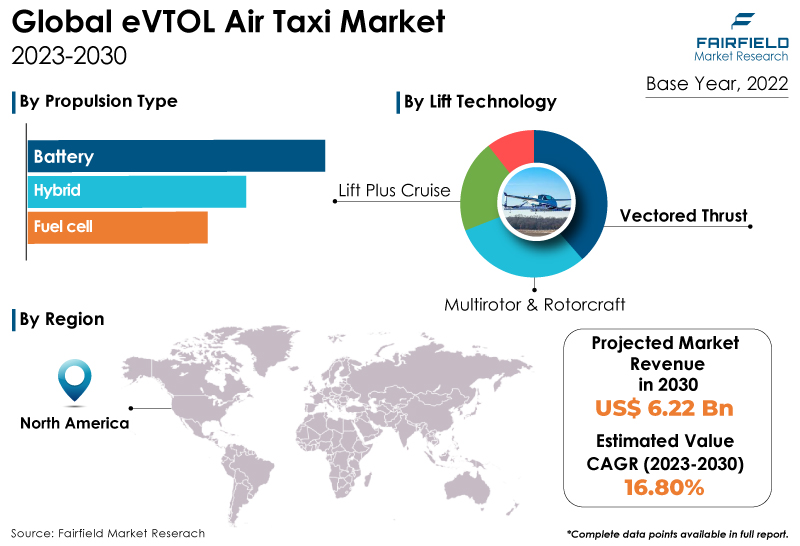
- The global eVTOL air taxi market will expand at a significant rate of 16.8% CAGR between 2023 and 2030.
- The demand for eVTOL air taxi is rising on account of the advancements in battery, motor, and power electronics technologies.
- Demand for vectored thrust lift technology remains higher in the market.
- The battery-electric propulsion type category held the highest eVTOL Air Taxi market revenue share in 2022.
- North America will continue to lead its way, whereas the Asia Pacific eVTOL Air Taxi market will experience the strongest growth till 2030.
Growth Drivers
Advancements in Battery, Motor, and Power Electronics Technologies
The development of battery, motor, and power electronics technology is one of the key factors driving the growth of the eVTOL air taxi market. These developments could help eVTOL aircraft overcome major problems and improve their effectiveness, dependability, and economic viability. An essential part of electric aircraft like eVTOL air taxis is batteries. High energy density-battery technology has allowed eVTOLs to store more electrical energy in a more compact and lightweight form. Increased flying range and cargo capacity result from this, which is essential for making eVTOLs workable for various transportation purposes.
Additionally, advances in battery charging rates and energy efficiency aid in reducing turnaround times between flights and enhancing eVTOL air taxi services' overall operational effectiveness. For eVTOL air taxis to produce the necessary thrust and lift, efficient electric motors are required. Electric motors that can produce the power required for vertical take-offs, cruises, and landings have been developed due to technological developments. High-efficiency motors aid eVTOL air taxis in extending their range and improving their overall performance. In eVTOL air taxis, power electronics are essential for controlling the electrical power flow between the battery, motor, and other subsystems.
Modern power electronics systems help with reduced energy usage, improved power distribution, and increased reliability of the aircraft. The eVTOL air taxi sector is expanding due to advances in batteries, motors, and power electronics. Compared to conventional fossil-fuel-powered aircraft, eVTOLs are becoming more feasible, efficient, and cost-effective as these technologies grow.
Optimistic Investment Scenario
Major aircraft producers like the Boeing Company, Airbus SE, and Bell Helicopter are actively working on eVTOL research. The major aircraft suppliers, including GE Aviation, Raytheon Technologies Inc., Honeywell International, and Rolls Royce PLC are investing heavily in eVTOL-related technology, including electric motors, and hybrid-electric powertrain components. Automotive behemoths like Toyota, Hyundai, and Daimler AG have also invested in and worked together to create their eVTOL projects. For example, Toyota made a roughly US$400 Mn investment in Joby Aviation, an eVTOL startup, in January 2020.
Additionally, OEMs and composite material producers like Hexcel, and Toray Advanced Composites are working in collaboration on cutting-edge lightweight materials for the various parts and features of vertical take-off and landing aircraft. As a result, significant investments from various industries are predicted to boost the expansion of the eVTOL air taxi market.
Market Challenges
High Development Costs
The eVTOL air taxi market growth is expected to be restrained by expensive development costs. A capital-intensive endeavour, the development of eVTOL aircraft entails cutting-edge technological and engineering concerns. The high upfront fees may serve as an entry barrier for smaller start-ups and businesses with limited resources. This restriction might make it difficult for them to enter the market, lowering competition and innovation, thereby casting a long-term impact on the development of the entire industry.
Lack of R&D Investments, and Lengthy TTM
Potential investors may be discouraged from supporting eVTOL ventures because of the prohibitive development expenses, especially in the beginning. The speed of technical breakthroughs may be slowed down by this lack of investment in research and development. The lengthy time to market (TTM) for eVTOL aircraft may result from the difficult development process and the requirement for stringent safety testing. Delays in commercial availability can affect adoption in the market and a company's ability to generate sufficient funds. The eVTOL makers and operators may have financial difficulties in the early years of the industry due to the initial high development expenses. Despite considerable initial outlays, achieving profitability might also be difficult.
Overview of Key Segments
Vectored Thrust Segment Remains a Dominant Lift Technology
During the forecast period, the vectored thrust lift technology segment will dominate the global market. The eVTOL air taxis can take off and land vertically, like helicopters, due to vectored thrust. As a result, they may now operate from small vertiports in cities instead of large helipads or runways. For point-to-point mobility in congested cities without the need for significant ground infrastructure, VTOL capabilities are essential.
When compared to conventional fixed-wing aircraft, vectored thrust offers improved manoeuvrability. eVTOL air taxis can do accurate turns, agile manoeuvres, and hover in place because they can alter the direction and intensity of the propulsion. This manoeuvrability is crucial for negotiating urban environments and dodging obstacles while flying at low speeds. The use of sophisticated flight control systems and vector thrust technologies is closely related. These systems are especially crucial for stabilising the aircraft during difficult manoeuvres when conducting autonomous or partially autonomous flying operations in the eVTOL air taxi sector.
An essential component for eVTOL air taxis' successful functioning is vector thrust lift technology. It is a key component of many eVTOL aircraft designs due to its advantages in terms of VTOL capabilities, manoeuvrability, safety, and efficiency, helping shape the future of on-demand transportation and urban air mobility.
Demand Across Battery-Electric Segment Will Grow Strong
The battery-electric propulsion type segment is expected to be the fastest-growing eVTOL air taxi market segment. Compared to fossil fuel engines, battery-electric propulsion significantly decreases greenhouse gas emissions and air pollutants. The eVTOL air taxis may operate with no direct emissions because electricity is their main energy source, which promotes cleaner and more environmentally friendly urban air transportation. Inherently quieter than internal combustion engines, electric motors minimise noise pollution during take-off, landing, and flight.
In urban settings, where noise concerns are important, eVTOL air taxis are more socially acceptable owing to their reduced noise footprint. The performance and range of eVTOL air taxis continue to be enhanced by ongoing developments in battery technology, including increased energy density and quicker charging speeds. The operational capabilities of eVTOL air taxis are anticipated to increase considerably more as battery technology advances.
Overall, battery-electric propulsion significantly enables the eVTOL air taxi sector by providing a cleaner, quieter, and more effective means of air mobility in cities. The advantages of electric propulsion are anticipated to increase as technology develops, hastening the acceptance and integration of eVTOL air taxis into the transportation ecosystem.
Growth Opportunities Across Regions
North America’s eVTOL Air Taxi Takes up the Largest Share of the Pie
North America is expected to dominate the eVTOL air taxi market during the forecast period. Major eVTOL manufacturers and other stakeholders were actively involved in the development of regulations and certification standards for eVTOL operations by regulatory agencies in North America. Authorities working on laws to ensure the safe and responsible deployment of eVTOL aircraft included the Federal Aviation Administration (FAA) in the United States and Transport Canada. Some eVTOL operators in North America have begun commercial operations, providing on-demand air taxi services in a few locations, following the successful completion of pilot projects and regulatory permits.
In the United States, eVTOL air taxis can solve the last mile delivery issue by taking passengers from important transportation hubs, such as airports or train stations, to their destinations in crowded urban areas. This opportunity could boost general connectivity and speed up passenger travel. For emergency medical services, eVTOL air taxis could be modified to provide quicker and more effective transportation of medical personnel and supplies to distant or difficult-to-reach locations, notably during emergencies or natural disasters.
Asia Pacific Set to Showcase the Fastest Growing Market
The market for eVTOL air taxi across the Asia Pacific will display a significant CAGR during the forecast period. Leading aerospace manufacturers, IT firms, and start-ups were developing strategic agreements and collaborations in the Asia Pacific region to combine their resources and expertise for quicker eVTOL development and deployment. These alliances seek to use each company's advantages to build a complete ecosystem for eVTOL operations.
Like many other nations, South Korea has been emphasizing sustainability and lowering carbon emissions. As electric aircraft, eVTOLs provide a sustainable transportation choice that supports the nation's sustainability objectives. Export potential for eVTOL aircraft and associated components to other nations in the Asia Pacific region and beyond may arise if South Korea establishes itself as a centre for eVTOL technology development and manufacturing.
eVTOL Air Taxi Market: Competitive Landscape
Some of the leading players at the forefront in the eVTOL Air Taxi market space include Lilium, Ehang, Volocopter GmbH, Airbus S.A.S, Boeing Inc., and Urban Aeronautics Ltd.
Recent Notable Developments
In April 2021, to begin time-sensitive zero-emission deliveries, United Parcel Service signed a contract with Beta Technologies to buy 150 e-VTOL aircraft. By 2024, deliveries of the aircraft are anticipated to begin.
In May 2021, Wisk Aero, a start-up sponsored by Boeing, signed its first agreement to operate Air taxis in the US. Wisk and Blade Urban Air Mobility Inc. have a partnership through which Wisk will provide the UAM business with up to 30 eVTOL aircraft.
In June 2021, Helisul Aviation, a Latin American helicopter operator, bought 50 electric VTOL air taxis from Eve Urban Air Mobility for use in urban air mobility operations in Brazil. By 2026, deliveries are anticipated to start.
In June 2021, Halo, a Directional Aviation brand founded by the alignment of Associated Aircraft Group (AAG) in the United States, ordered 200 four-passenger eVTOL air taxis with Eve Urban Air Mobility. By 2026, deliveries of the aircraft are anticipated to start.
In March 2022, NetJets and Lilium NV agreed to a Memorandum of Understanding (MoU) for a potential strategic alliance. Additionally, the contract gives NetJets the option to buy up to 150 Lilium aircraft.
The Global eVTOL Air Taxi Market is Segmented as Below:
By Lift Technology
- Vectored Thrust
- Multirotor & Rotorcraft
- Lift Plus Cruise
By Mode of Operation
- Piloted
- Autonomous
- Semi-autonomous
By Maximum Take-off Weight (MTOW)
- Upto 500 Kg
- 500 Kg to 1000 Kg
- Above 1000 Kg
By Propulsion Type
- Battery
- Hybrid
- Fuel cell
By End User
- Military & Defence
- Civil & Commercial
By Geographic Coverage
- North America
- U.S.
- Canada
- Europe
- Germany
- U.K.
- France
- Italy
- Turkey
- Russia
- Rest of Europe
- Asia Pacific
- China
- Japan
- South Korea
- India
- Southeast Asia
- Rest of Asia Pacific
- Latin America
- Brazil
- Mexico
- Rest of Latin America
- Middle East & Africa
- GCC
- South Africa
- Rest of Middle East & Africa
Leading Companies
- Lilium GmbH
- Ehang
- Volocopter GmbH
- Bell Textron Inc.
- Airbus S.A.S
- Boeing Inc.
- Beta Technologies
- Joby Aviation
- Urban Aeronautics Ltd.
- Executive Summary
- Global eVTOL Air Taxi Market Snapshot
- Future Projections
- Key Market Trends
- Regional Snapshot, by Value, 2026
- Analyst Recommendations
- Market Overview
- Market Definitions and Segmentations
- Market Dynamics
- Drivers
- Restraints
- Market Opportunities
- Value Chain Analysis
- COVID-19 Impact Analysis
- Porter's Fiver Forces Analysis
- Impact of Russia-Ukraine Conflict
- PESTLE Analysis
- Regulatory Analysis
- Price Trend Analysis
- Current Prices and Future Projections, 2025-2033
- Price Impact Factors
- Global eVTOL Air Taxi Market Outlook, 2020 - 2033
- Global eVTOL Air Taxi Market Outlook, by Lift Technology, Value (US$ Mn), 2020-2033
- Vectored Thrust
- Multirotor & Rotorcraft
- Lift Plus Cruise
- Global eVTOL Air Taxi Market Outlook, by Mode of Operation, Value (US$ Mn), 2020-2033
- Piloted
- Autonomous
- Semi-autonomous
- Global eVTOL Air Taxi Market Outlook, by Maximum Take-off Weight (MTOW), Value (US$ Mn), 2020-2033
- Upto 500 Kg
- 500 Kg to 1000 Kg
- Above 1000 Kg
- Global eVTOL Air Taxi Market Outlook, by Propulsion Type, Value (US$ Mn), 2020-2033
- Battery
- Hybrid
- Fuel cell
- Global eVTOL Air Taxi Market Outlook, by Region, Value (US$ Mn), 2020-2033
- North America
- Europe
- Asia Pacific
- Latin America
- Middle East & Africa
- Global eVTOL Air Taxi Market Outlook, by Lift Technology, Value (US$ Mn), 2020-2033
- North America eVTOL Air Taxi Market Outlook, 2020 - 2033
- North America eVTOL Air Taxi Market Outlook, by Lift Technology, Value (US$ Mn), 2020-2033
- Vectored Thrust
- Multirotor & Rotorcraft
- Lift Plus Cruise
- North America eVTOL Air Taxi Market Outlook, by Mode of Operation, Value (US$ Mn), 2020-2033
- Piloted
- Autonomous
- Semi-autonomous
- North America eVTOL Air Taxi Market Outlook, by Maximum Take-off Weight (MTOW), Value (US$ Mn), 2020-2033
- Upto 500 Kg
- 500 Kg to 1000 Kg
- Above 1000 Kg
- North America eVTOL Air Taxi Market Outlook, by Propulsion Type, Value (US$ Mn), 2020-2033
- Battery
- Hybrid
- Fuel cell
- North America eVTOL Air Taxi Market Outlook, by Country, Value (US$ Mn), 2020-2033
- S. eVTOL Air Taxi Market Outlook, by Lift Technology, 2020-2033
- S. eVTOL Air Taxi Market Outlook, by Mode of Operation, 2020-2033
- S. eVTOL Air Taxi Market Outlook, by Maximum Take-off Weight (MTOW), 2020-2033
- S. eVTOL Air Taxi Market Outlook, by Propulsion Type, 2020-2033
- Canada eVTOL Air Taxi Market Outlook, by Lift Technology, 2020-2033
- Canada eVTOL Air Taxi Market Outlook, by Mode of Operation, 2020-2033
- Canada eVTOL Air Taxi Market Outlook, by Maximum Take-off Weight (MTOW), 2020-2033
- Canada eVTOL Air Taxi Market Outlook, by Propulsion Type, 2020-2033
- BPS Analysis/Market Attractiveness Analysis
- North America eVTOL Air Taxi Market Outlook, by Lift Technology, Value (US$ Mn), 2020-2033
- Europe eVTOL Air Taxi Market Outlook, 2020 - 2033
- Europe eVTOL Air Taxi Market Outlook, by Lift Technology, Value (US$ Mn), 2020-2033
- Vectored Thrust
- Multirotor & Rotorcraft
- Lift Plus Cruise
- Europe eVTOL Air Taxi Market Outlook, by Mode of Operation, Value (US$ Mn), 2020-2033
- Piloted
- Autonomous
- Semi-autonomous
- Europe eVTOL Air Taxi Market Outlook, by Maximum Take-off Weight (MTOW), Value (US$ Mn), 2020-2033
- Upto 500 Kg
- 500 Kg to 1000 Kg
- Above 1000 Kg
- Europe eVTOL Air Taxi Market Outlook, by Propulsion Type, Value (US$ Mn), 2020-2033
- Battery
- Hybrid
- Fuel cell
- Europe eVTOL Air Taxi Market Outlook, by Country, Value (US$ Mn), 2020-2033
- Germany eVTOL Air Taxi Market Outlook, by Lift Technology, 2020-2033
- Germany eVTOL Air Taxi Market Outlook, by Mode of Operation, 2020-2033
- Germany eVTOL Air Taxi Market Outlook, by Maximum Take-off Weight (MTOW), 2020-2033
- Germany eVTOL Air Taxi Market Outlook, by Propulsion Type, 2020-2033
- Italy eVTOL Air Taxi Market Outlook, by Lift Technology, 2020-2033
- Italy eVTOL Air Taxi Market Outlook, by Mode of Operation, 2020-2033
- Italy eVTOL Air Taxi Market Outlook, by Maximum Take-off Weight (MTOW), 2020-2033
- Italy eVTOL Air Taxi Market Outlook, by Propulsion Type, 2020-2033
- France eVTOL Air Taxi Market Outlook, by Lift Technology, 2020-2033
- France eVTOL Air Taxi Market Outlook, by Mode of Operation, 2020-2033
- France eVTOL Air Taxi Market Outlook, by Maximum Take-off Weight (MTOW), 2020-2033
- France eVTOL Air Taxi Market Outlook, by Propulsion Type, 2020-2033
- K. eVTOL Air Taxi Market Outlook, by Lift Technology, 2020-2033
- K. eVTOL Air Taxi Market Outlook, by Mode of Operation, 2020-2033
- K. eVTOL Air Taxi Market Outlook, by Maximum Take-off Weight (MTOW), 2020-2033
- K. eVTOL Air Taxi Market Outlook, by Propulsion Type, 2020-2033
- Spain eVTOL Air Taxi Market Outlook, by Lift Technology, 2020-2033
- Spain eVTOL Air Taxi Market Outlook, by Mode of Operation, 2020-2033
- Spain eVTOL Air Taxi Market Outlook, by Maximum Take-off Weight (MTOW), 2020-2033
- Spain eVTOL Air Taxi Market Outlook, by Propulsion Type, 2020-2033
- Russia eVTOL Air Taxi Market Outlook, by Lift Technology, 2020-2033
- Russia eVTOL Air Taxi Market Outlook, by Mode of Operation, 2020-2033
- Russia eVTOL Air Taxi Market Outlook, by Maximum Take-off Weight (MTOW), 2020-2033
- Russia eVTOL Air Taxi Market Outlook, by Propulsion Type, 2020-2033
- Rest of Europe eVTOL Air Taxi Market Outlook, by Lift Technology, 2020-2033
- Rest of Europe eVTOL Air Taxi Market Outlook, by Mode of Operation, 2020-2033
- Rest of Europe eVTOL Air Taxi Market Outlook, by Maximum Take-off Weight (MTOW), 2020-2033
- Rest of Europe eVTOL Air Taxi Market Outlook, by Propulsion Type, 2020-2033
- BPS Analysis/Market Attractiveness Analysis
- Europe eVTOL Air Taxi Market Outlook, by Lift Technology, Value (US$ Mn), 2020-2033
- Asia Pacific eVTOL Air Taxi Market Outlook, 2020 - 2033
- Asia Pacific eVTOL Air Taxi Market Outlook, by Lift Technology, Value (US$ Mn), 2020-2033
- Vectored Thrust
- Multirotor & Rotorcraft
- Lift Plus Cruise
- Asia Pacific eVTOL Air Taxi Market Outlook, by Mode of Operation, Value (US$ Mn), 2020-2033
- Piloted
- Autonomous
- Semi-autonomous
- Asia Pacific eVTOL Air Taxi Market Outlook, by Maximum Take-off Weight (MTOW), Value (US$ Mn), 2020-2033
- Upto 500 Kg
- 500 Kg to 1000 Kg
- Above 1000 Kg
- Asia Pacific eVTOL Air Taxi Market Outlook, by Propulsion Type, Value (US$ Mn), 2020-2033
- Battery
- Hybrid
- Fuel cell
- Asia Pacific eVTOL Air Taxi Market Outlook, by Country, Value (US$ Mn), 2020-2033
- China eVTOL Air Taxi Market Outlook, by Lift Technology, 2020-2033
- China eVTOL Air Taxi Market Outlook, by Mode of Operation, 2020-2033
- China eVTOL Air Taxi Market Outlook, by Maximum Take-off Weight (MTOW), 2020-2033
- China eVTOL Air Taxi Market Outlook, by Propulsion Type, 2020-2033
- Japan eVTOL Air Taxi Market Outlook, by Lift Technology, 2020-2033
- Japan eVTOL Air Taxi Market Outlook, by Mode of Operation, 2020-2033
- Japan eVTOL Air Taxi Market Outlook, by Maximum Take-off Weight (MTOW), 2020-2033
- Japan eVTOL Air Taxi Market Outlook, by Propulsion Type, 2020-2033
- South Korea eVTOL Air Taxi Market Outlook, by Lift Technology, 2020-2033
- South Korea eVTOL Air Taxi Market Outlook, by Mode of Operation, 2020-2033
- South Korea eVTOL Air Taxi Market Outlook, by Maximum Take-off Weight (MTOW), 2020-2033
- South Korea eVTOL Air Taxi Market Outlook, by Propulsion Type, 2020-2033
- India eVTOL Air Taxi Market Outlook, by Lift Technology, 2020-2033
- India eVTOL Air Taxi Market Outlook, by Mode of Operation, 2020-2033
- India eVTOL Air Taxi Market Outlook, by Maximum Take-off Weight (MTOW), 2020-2033
- India eVTOL Air Taxi Market Outlook, by Propulsion Type, 2020-2033
- Southeast Asia eVTOL Air Taxi Market Outlook, by Lift Technology, 2020-2033
- Southeast Asia eVTOL Air Taxi Market Outlook, by Mode of Operation, 2020-2033
- Southeast Asia eVTOL Air Taxi Market Outlook, by Maximum Take-off Weight (MTOW), 2020-2033
- Southeast Asia eVTOL Air Taxi Market Outlook, by Propulsion Type, 2020-2033
- Rest of SAO eVTOL Air Taxi Market Outlook, by Lift Technology, 2020-2033
- Rest of SAO eVTOL Air Taxi Market Outlook, by Mode of Operation, 2020-2033
- Rest of SAO eVTOL Air Taxi Market Outlook, by Maximum Take-off Weight (MTOW), 2020-2033
- Rest of SAO eVTOL Air Taxi Market Outlook, by Propulsion Type, 2020-2033
- BPS Analysis/Market Attractiveness Analysis
- Asia Pacific eVTOL Air Taxi Market Outlook, by Lift Technology, Value (US$ Mn), 2020-2033
- Latin America eVTOL Air Taxi Market Outlook, 2020 - 2033
- Latin America eVTOL Air Taxi Market Outlook, by Lift Technology, Value (US$ Mn), 2020-2033
- Vectored Thrust
- Multirotor & Rotorcraft
- Lift Plus Cruise
- Latin America eVTOL Air Taxi Market Outlook, by Mode of Operation, Value (US$ Mn), 2020-2033
- Piloted
- Autonomous
- Semi-autonomous
- Latin America eVTOL Air Taxi Market Outlook, by Maximum Take-off Weight (MTOW), Value (US$ Mn), 2020-2033
- Upto 500 Kg
- 500 Kg to 1000 Kg
- Above 1000 Kg
- Latin America eVTOL Air Taxi Market Outlook, by Propulsion Type, Value (US$ Mn), 2020-2033
- Battery
- Hybrid
- Fuel cell
- Latin America eVTOL Air Taxi Market Outlook, by Country, Value (US$ Mn), 2020-2033
- Brazil eVTOL Air Taxi Market Outlook, by Lift Technology, 2020-2033
- Brazil eVTOL Air Taxi Market Outlook, by Mode of Operation, 2020-2033
- Brazil eVTOL Air Taxi Market Outlook, by Maximum Take-off Weight (MTOW), 2020-2033
- Brazil eVTOL Air Taxi Market Outlook, by Propulsion Type, 2020-2033
- Mexico eVTOL Air Taxi Market Outlook, by Lift Technology, 2020-2033
- Mexico eVTOL Air Taxi Market Outlook, by Mode of Operation, 2020-2033
- Mexico eVTOL Air Taxi Market Outlook, by Maximum Take-off Weight (MTOW), 2020-2033
- Mexico eVTOL Air Taxi Market Outlook, by Propulsion Type, 2020-2033
- Argentina eVTOL Air Taxi Market Outlook, by Lift Technology, 2020-2033
- Argentina eVTOL Air Taxi Market Outlook, by Mode of Operation, 2020-2033
- Argentina eVTOL Air Taxi Market Outlook, by Maximum Take-off Weight (MTOW), 2020-2033
- Argentina eVTOL Air Taxi Market Outlook, by Propulsion Type, 2020-2033
- Rest of LATAM eVTOL Air Taxi Market Outlook, by Lift Technology, 2020-2033
- Rest of LATAM eVTOL Air Taxi Market Outlook, by Mode of Operation, 2020-2033
- Rest of LATAM eVTOL Air Taxi Market Outlook, by Maximum Take-off Weight (MTOW), 2020-2033
- Rest of LATAM eVTOL Air Taxi Market Outlook, by Propulsion Type, 2020-2033
- BPS Analysis/Market Attractiveness Analysis
- Latin America eVTOL Air Taxi Market Outlook, by Lift Technology, Value (US$ Mn), 2020-2033
- Middle East & Africa eVTOL Air Taxi Market Outlook, 2020 - 2033
- Middle East & Africa eVTOL Air Taxi Market Outlook, by Lift Technology, Value (US$ Mn), 2020-2033
- Vectored Thrust
- Multirotor & Rotorcraft
- Lift Plus Cruise
- Middle East & Africa eVTOL Air Taxi Market Outlook, by Mode of Operation, Value (US$ Mn), 2020-2033
- Piloted
- Autonomous
- Semi-autonomous
- Middle East & Africa eVTOL Air Taxi Market Outlook, by Maximum Take-off Weight (MTOW), Value (US$ Mn), 2020-2033
- Upto 500 Kg
- 500 Kg to 1000 Kg
- Above 1000 Kg
- Middle East & Africa eVTOL Air Taxi Market Outlook, by Propulsion Type, Value (US$ Mn), 2020-2033
- Battery
- Hybrid
- Fuel cell
- Middle East & Africa eVTOL Air Taxi Market Outlook, by Country, Value (US$ Mn), 2020-2033
- GCC eVTOL Air Taxi Market Outlook, by Lift Technology, 2020-2033
- GCC eVTOL Air Taxi Market Outlook, by Mode of Operation, 2020-2033
- GCC eVTOL Air Taxi Market Outlook, by Maximum Take-off Weight (MTOW), 2020-2033
- GCC eVTOL Air Taxi Market Outlook, by Propulsion Type, 2020-2033
- South Africa eVTOL Air Taxi Market Outlook, by Lift Technology, 2020-2033
- South Africa eVTOL Air Taxi Market Outlook, by Mode of Operation, 2020-2033
- South Africa eVTOL Air Taxi Market Outlook, by Maximum Take-off Weight (MTOW), 2020-2033
- South Africa eVTOL Air Taxi Market Outlook, by Propulsion Type, 2020-2033
- Egypt eVTOL Air Taxi Market Outlook, by Lift Technology, 2020-2033
- Egypt eVTOL Air Taxi Market Outlook, by Mode of Operation, 2020-2033
- Egypt eVTOL Air Taxi Market Outlook, by Maximum Take-off Weight (MTOW), 2020-2033
- Egypt eVTOL Air Taxi Market Outlook, by Propulsion Type, 2020-2033
- Nigeria eVTOL Air Taxi Market Outlook, by Lift Technology, 2020-2033
- Nigeria eVTOL Air Taxi Market Outlook, by Mode of Operation, 2020-2033
- Nigeria eVTOL Air Taxi Market Outlook, by Maximum Take-off Weight (MTOW), 2020-2033
- Nigeria eVTOL Air Taxi Market Outlook, by Propulsion Type, 2020-2033
- Rest of Middle East eVTOL Air Taxi Market Outlook, by Lift Technology, 2020-2033
- Rest of Middle East eVTOL Air Taxi Market Outlook, by Mode of Operation, 2020-2033
- Rest of Middle East eVTOL Air Taxi Market Outlook, by Maximum Take-off Weight (MTOW), 2020-2033
- Rest of Middle East eVTOL Air Taxi Market Outlook, by Propulsion Type, 2020-2033
- BPS Analysis/Market Attractiveness Analysis
- Middle East & Africa eVTOL Air Taxi Market Outlook, by Lift Technology, Value (US$ Mn), 2020-2033
- Competitive Landscape
- Company Vs Segment Heatmap
- Company Market Share Analysis, 2025
- Competitive Dashboard
- Company Profiles
- Lilium GmbH
- Company Overview
- Product Portfolio
- Financial Overview
- Business Strategies and Developments
- Ehang
- Volocopter GmbH
- Bell Textron Inc.
- Airbus S.A.S
- Boeing Inc.
- Beta Technologies
- Joby Aviation
- Urban Aeronautics Ltd.
- Lilium GmbH
- Appendix
- Research Methodology
- Report Assumptions
- Acronyms and Abbreviations
|
BASE YEAR |
HISTORICAL DATA |
FORECAST PERIOD |
UNITS |
|||
 |
2025 |
 |
2019 - 2024 |
 |
2026 - 2033 |
Value: US$ Bn |
|
REPORT FEATURES |
DETAILS |
|
Lift Technology Coverage |
|
|
Mode of Operation Coverage |
|
|
Maximum Take-off Weight Coverage |
|
|
Propulsion Type Coverage |
|
|
End User Coverage |
|
|
Geographical Coverage |
|
|
Leading Companies |
|
|
Report Highlights |
Market Estimates and Forecast, Market Dynamics, Industry Trends, Production Output, Trade Statistics, Price Trend Analysis, Competition Landscape, Grade-, Application-, Region-, Country-wise Trends & Analysis, COVID-19 Impact Analysis (Demand and Supply), Key Market Trends |
Our Research Methodology
Considering the volatility of business today, traditional approaches to strategizing a game plan can be unfruitful if not detrimental. True ambiguity is no way to determine a forecast. A myriad of predetermined factors must be accounted for such as the degree of risk involved, the magnitude of circumstances, as well as conditions or consequences that are not known or unpredictable. To circumvent binary views that cast uncertainty, the application of market research intelligence to strategically posture, move, and enable actionable outcomes is necessary.
View Methodology
Quality Assured
Rigorous Validation Process

Confidentiality Assured
End-to-end Data Security

Custom Research Services
Tailored To Your Objectives
FAQs
The eVTOL Air Taxi market size is USD 0.6 Bn in 2026.
Fairfield’s research forecasts a solid CAGR of more than 16.8% for the global eVTOL air taxi market between the years of forecast, 2026 and 2033.
North America, led by the US, is expected to dominate the worldwide eVTOL air taxi market during the forecast period.
Critically growing demand for cleaner and more environmentally friendly transportation options, as well as the rapid advances in battery, motor, and power electronics technologies, constitute the key growth indicators for the global eVTOL air taxi market.
Kitty Hawk Corporation, Lilium, Ehang, Volocopter GmbH, Airbus S.A.S, Boeing Inc., and Urban Aeronautics Ltd. are some of the prominent players leading the competition landscape of the market.
Related Reports
Automotive Airbag Inflator Market Insights, Competitive Landscape, and Market Forecast 2033
Automotive Airbag Inflator Market to reach USD 9.44 Bn by 2033, growing at 4.8% CAGR, driven by safety regulations, vehicle production, and airbags.
In-Car Wellness Monitoring System Market Insights, Competitive Landscape, and Market Forecast 2033
The The global in-car wellness monitoring system market is projected to reach USD 6.04 billion by 2033, growing at a 14.8% CAGR from 2026 to 2033.
Automotive Parts Magnesium Die Casting Market Insights, Competitive Landscape, and Market Forecast 2033
Automotive Parts Magnesium Die Casting Market to reach USD 4.84 Bn by 2033, growing at 7.6% CAGR, driven by lightweighting, EVs, and vehicle efficiency.
Fire Truck Market Insights, Competitive Landscape, and Market Forecast - 2033
The global fire truck market is set to reach US$ 9.08 Bn by 2033, growing at a 5.6% CAGR, driven by rising demand for emergency response vehicles
Vehicle as a Service Market Insights, Competitive Landscape, and Market Forecast - 2033
Thr vehicle as a service market is valued at USD 6.80 Bn in 2026 and projected to reach USD 20.17 Bn by 2033, growing at a 16.8% CAGR in key market
Airport Cabin Baggage Scanner Market Insights, Competitive Landscape, and Market Forecast 2033
Airport Cabin Baggage Scanner Market to grow from USD 1.35 Billion in 2026 to USD 2.28 Billion by 2033, expanding at a 7.8% CAGR during the forecast period.