



Exotic Pets Market
Exotic Pets Market Size, Share, Insights, Competitive Landscape, and Forecast 2026 to 2033
Exotic Pets Market Size and Trend Analysis
How Big Is the Exotic Pets Market in 2026?
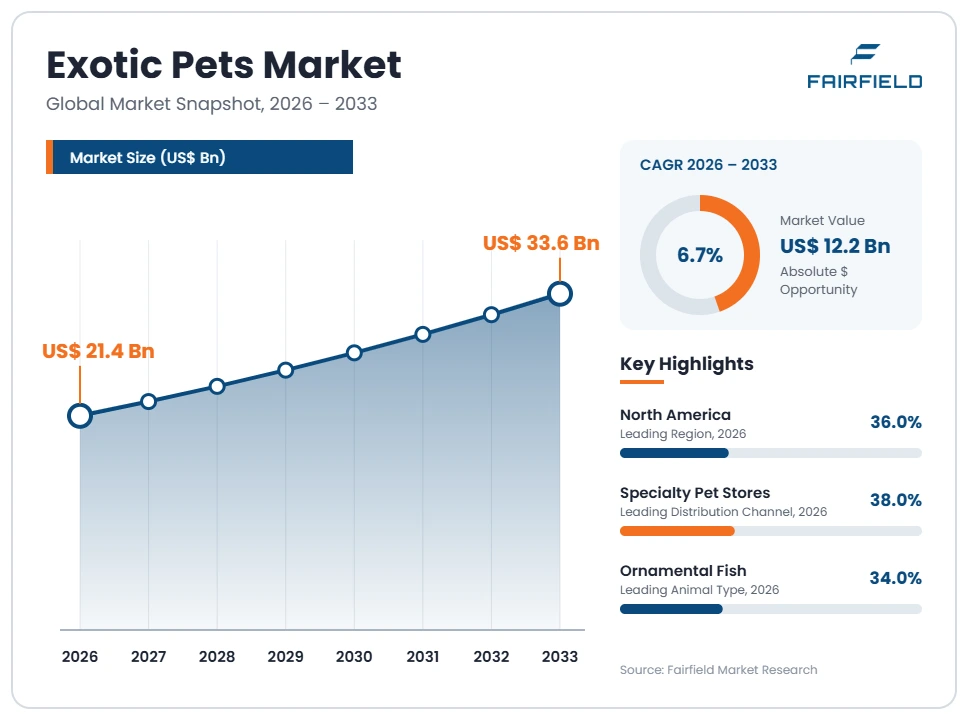
The global Exotic Pets market size is expected to be valued at US$ 21.4 billion in 2026 and projected to reach US$ 33.6 billion by 2033, growing at a CAGR of 6.7% between 2026 and 2033.
This figure counts live animal sales together with enclosures, heating and lighting, substrates, feed and veterinary care. Live animals alone represent under a fifth of the total, so scope definition changes the headline several times over. Between 2020 and 2025 the category grew at roughly 5.4% a year, lifted by household formation of new keepers. Three factors carry growth forward: a widening captive-breeding base that reduces reliance on wild collection, steady replacement spending on controlled vivarium technology, and the spread of specialist veterinary practice for reptiles, birds and small mammals. The direction of travel is fewer impulse purchases, higher annual spend per keeper, and tighter legal control over which species may lawfully be kept.
Key Report Takeaways
- By Animal Type: Ornamental Fish held 34% share in 2026, while Reptiles & Amphibians are projected to expand at a 7.9% CAGR through 2033, driven by wider availability of captive-bred morphs from established breeder networks.
- By Offering: Housing & Enclosure Equipment held 29% share in 2026, while Veterinary & Healthcare Services are projected to expand at an 8.6% CAGR through 2033, driven by growth in exotic-certified clinical practice and diagnostics.
- By Distribution Channel: Specialty Pet Stores held 38% share in 2026, while Online Retail is projected to expand at a 9.1% CAGR through 2033, driven by subscription delivery of frozen feed and consumable substrates.
- By End User: Household Keepers held 64% share in 2026, while Hobbyist Breeders are projected to expand at a 7.6% CAGR through 2033, driven by demand for documented captive-bred stock under tightening permit rules.
- By Geography: North America held 36% share in 2026, while Asia Pacific is projected to expand at an 8.4% CAGR through 2033, supported by rising urban disposable income and apartment-friendly species choices.
Global Exotic Pets Market Trends and Insights
Drivers Impact Analysis
Two forces account for most of the forecast growth in non-traditional companion animal keeping.
| Driver | Impact on CAGR Forecast | Geographic Relevance | Impact Timeline |
| Expansion of the captive-breeding supply base for reptiles, amphibians and ornamental birds | High | North America, Europe, Asia Pacific | Medium term (2–4 years) |
| Higher equipment and consumable spend per household from controlled vivarium technology | Medium | North America, Europe | Short term (≤2 years) |
Captive Breeding Networks Widen the Lawful Supply Base for Exotic Pets
Captive breeding is now the main lawful supply route for reptiles, amphibians and ornamental birds in mature markets. It raises transaction volumes because bred animals arrive with documentation, predictable health status and known provenance, which retailers and veterinary practices can accept with less risk. Captive-bred stock also carries higher average prices than collected animals, so the same unit volume generates more revenue across the chain.
The mechanism is regulatory as much as commercial. Permit systems under the Convention on International Trade in Endangered Species place documentation burdens on wild-sourced specimens, and several jurisdictions restrict or prohibit the keeping of listed species outright. Breeders respond by producing within the destination country, which shortens supply chains and removes import risk. That shift concentrates value in genetics, grow-out facilities and health certification rather than in collection and freight.
Controlled Vivarium Technology Lifts Recurring Equipment Spend per Exotic Pet Household
Equipment and consumables now generate the largest share of category revenue, and the technology content of that equipment keeps rising. Thermostatically controlled heating, ultraviolet and full-spectrum LED lighting, humidity control and monitoring sensors replace simple glass tanks and basic heat mats. Each upgrade raises the installed value of a single enclosure and creates a replacement cycle measured in years rather than decades.
The causal driver is husbandry standards written into codes of practice and, in several countries, into animal welfare legislation. Minimum enclosure dimensions, temperature gradients and lighting provisions push keepers toward larger, instrumented systems. Retailers and manufacturers respond with bundled starter systems and species-specific kits that carry higher basket values. Consumables such as substrates, supplements, and frozen or live feed then recur monthly, giving the segment a subscription-like revenue profile that is less exposed to animal sales volumes.
Restraints Impact Analysis
Two restraints materially limit expansion and are well documented across veterinary and regulatory literature.
| Restraint | Impact on CAGR Forecast | Geographic Relevance | Impact Timeline |
| Zoonotic disease risk and the public-health controls that follow outbreaks | High | North America, Europe, Asia Pacific | Long term (≥4 years) |
| Welfare outcomes, relinquishment and mortality, and overlap between legal and illegal trade | High | Global | Long term (≥4 years) |
Zoonotic Disease Risk and Public-Health Controls Restrict Exotic Pet Retail Channels
Zoonotic disease risk is the single clearest brake on category expansion. Reptiles and amphibians are recognised reservoirs of Salmonella, and ornamental birds carry psittacosis risk, so retail of these animals operates under health-based restrictions in many markets. Where an outbreak is traced to companion animals, authorities have historically responded with import bans and sales prohibitions that remove entire species groups from legal commerce within weeks.
The underlying cause is biological rather than commercial, so it cannot be engineered away by suppliers. Enforcement costs fall on retailers through hygiene protocols, point-of-sale health warnings, separate handling areas and staff training. The United States Food and Drug Administration restriction on selling small turtles with a carapace under four inches, in force since the 1970s on salmonellosis grounds, shows how durable such measures are. Insurance and liability exposure compounds the effect, and smaller independent retailers often exit rather than absorb the compliance burden.
Welfare Outcomes and Illegal Trade Overlap Suppress Mainstream Exotic Pet Demand
Animal welfare concerns reduce addressable demand and invite restrictive legislation. Wild capture, long transport chains and inadequate husbandry after sale are associated with high early mortality in several species groups, and relinquishment rates for reptiles and small mammals are substantial within the first year of ownership. Rescue and rehoming organisations absorb those animals, which depresses new sales and damages category reputation among mainstream retailers and landlords.
The structural cause is the overlap between lawful commerce and wildlife trafficking. Laundering of wild-caught specimens through claimed captive-bred paperwork is a documented enforcement problem, and it forces authorities to treat the whole sector as higher risk. The Lacey Act in the United States criminalises trade in wildlife taken in violation of other laws, and its injurious wildlife provisions bar listed species from import and interstate transport. Compliance verification therefore adds cost to every legitimate cross-border transaction.
Market Opportunities
Exotic Animal Veterinary Practice Opens a Recurring Clinical Revenue Pool
Specialist veterinary care for reptiles, birds, small mammals and ornamental fish is the most underserved revenue pool in the category. Most general practices do not treat these species, so keepers travel to a small number of exotic-certified clinics. That scarcity supports premium consultation fees, diagnostic imaging revenue and referral volumes, and it converts a one-off animal purchase into a multi-year clinical relationship worth far more than the animal itself.
Veterinary groups, diagnostic laboratories and pet insurers are positioned to capture this pool. Demand comes from established keepers whose animals are long-lived: many parrots, tortoises and larger lizards outlive the household’s other pets by decades. Expansion of exotic companion mammal and reptile medicine as a recognised clinical discipline, together with insurance products that now extend beyond cats and dogs, gives practices a predictable payment mechanism to build capacity against.
Certified Captive-Bred Supply and Traceability Services Monetise Positive-List Compliance
Positive-list regulation creates a paid market for provenance documentation and certified stock. Under a positive list only species on an approved schedule may be kept, so every transaction requires species identification and, increasingly, proof of captive origin. That turns traceability from a cost of doing business into a service line covering microchipping, registry management, studbook software and third-party certification audits.
Breeders, registries, software vendors and specialist insurers can monetise this. The demand comes from retailers and keepers who must demonstrate compliance to inspectors, and from cross-border shippers who need permit paperwork accepted on arrival. Several European countries have adopted or are phasing in positive lists for mammals and reptiles, and the direction of policy in the European Union points toward harmonised species schedules. Vendors that build registry infrastructure early gain a defensible position in each national market.
Segment Analysis
- By Animal Type: Ornamental Fish Lead While Reptiles and Amphibians Gain Momentum
Ornamental Fish hold the largest animal-type position with 34% share in 2026, because aquaria carry the lowest entry cost, the fewest legal restrictions and the broadest retail distribution of any exotic category. Freshwater species dominate within that share, and the attached equipment base of filtration, lighting and water treatment is unusually deep. Reptiles & Amphibians are the fastest-growing group at a 7.9% CAGR through 2033, driven by established captive-breeding networks that supply colour and pattern morphs of common snake, gecko and bearded dragon lines without wild collection. Ornamental Birds remain significant but face psittacosis controls and import limits, while Small Mammals turn over quickly because of short lifespans. Invertebrates stay a small specialist niche. The business implication is that equipment and feed suppliers serving aquaria enjoy stable volume, while reptile-focused brands capture the faster unit growth and higher accessory attachment rates.
- By Offering: Housing and Enclosure Equipment Holds Scale While Veterinary Services Accelerate
Housing & Enclosure Equipment is the leading offering at 29% share in 2026, reflecting the high installed cost of vivaria, aquaria, thermostats, heating elements and ultraviolet lighting relative to the animals themselves. Feed & Nutrition, including frozen and live prey, follows closely and recurs monthly. Veterinary & Healthcare Services are the fastest-growing offering at an 8.6% CAGR through 2033, because specialist clinical capacity is scarce and consultation, diagnostic and surgical fees for exotic species run above companion-animal averages. Accessories and water treatment products fill out the remainder. Minimum husbandry standards written into national welfare codes keep pushing enclosure specifications upward, which supports equipment value even when animal sales are flat. For suppliers, the practical conclusion is that margin resilience sits in consumables and clinical services rather than in live animal turnover.
- By Distribution Channel: Specialty Pet Stores Dominate While Online Retail Scales Quickly
Specialty Pet Stores lead distribution with 38% share in 2026 because exotic species need informed point-of-sale advice, live inventory handling and compliance checks that general retailers avoid. Breeders & Expos remain an important source for reptiles and ornamental birds, particularly for documented captive-bred animals. Online Retail is the fastest-growing channel at a 9.1% CAGR through 2033, concentrated in equipment, substrates, supplements and frozen feed rather than live animals, which face shipping restrictions and carrier policies in most jurisdictions. General Pet Superstores and Veterinary Clinics round out the channel mix. Subscription delivery of consumables is the clearest structural change, since it locks in repeat purchase and shifts bargaining power toward brands with direct customer relationships. Independent specialists respond by emphasising husbandry advice, livestock quarantine standards and local compliance knowledge that online sellers cannot replicate.
- By End User: Household Keepers Anchor Volume While Hobbyist Breeders Expand Fastest
Household Keepers account for 64% of demand in 2026, the largest end-user share, because single-animal or single-tank households make up the bulk of the installed base across every region. Their spending is dominated by feed, lighting and periodic equipment replacement. Hobbyist Breeders are the fastest-expanding end user at a 7.6% CAGR through 2033, as permit regimes and positive lists raise the value of documented captive-bred animals and encourage domestic production over import. Breeders buy at commercial scale: rack systems, incubators, bulk frozen feed and veterinary health screening. Institutional & Educational Facilities form a smaller but stable group with procurement cycles tied to public budgets. The implication for manufacturers is that professional-grade equipment lines, once a niche, now carry enough volume to justify dedicated product development and distribution.
Geography Analysis
Regional performance reflects differences in regulation, household income and the maturity of specialist retail and veterinary infrastructure.
- Which Region Is Leading the Exotic Pets Market?
North America leads the global market with 36% share in 2026, supported by the deepest specialist retail network and the largest base of exotic-certified veterinary practices anywhere. The United States accounts for most of that position, with Canada adding a smaller but high-spend base. Household penetration of aquaria and reptiles is long established, and the equipment aftermarket is mature, so revenue per keeper is high. Regulation is layered: federal injurious wildlife listings and the small-turtle sales restriction operate alongside state statutes that differ sharply on which species may be kept. That patchwork raises compliance costs for multi-state retailers. The clearest regional change is the build-out of exotic animal services inside corporate veterinary groups, which is converting scarce specialist capacity into a scalable service offering.
- Europe: Positive Lists and Union-Level Species Controls Reshape Availability
Europe holds 28% share in 2026 and has the most restrictive species framework of any major market. Germany, the United Kingdom, France, the Netherlands and Italy drive the bulk of regional spending. Regulation (EU) No 1143/2014 on invasive alien species bans keeping, breeding and trade in species on the Union list, and several member states have gone further by adopting positive lists that permit only approved species. The practical effect is a narrower catalogue sold at higher average prices, with compliance documentation built into retail processes. Demand has shifted decisively toward captive-bred animals and toward equipment, premium feed and veterinary care. Growth is therefore value-led rather than volume-led, and suppliers compete on welfare credentials, husbandry guidance and certified provenance rather than on species novelty.
- Which Region Is Growing Fastest in the Exotic Pets Market?
Asia Pacific is the fastest-growing geography at an 8.4% CAGR between 2026 and 2033, from 24% share in 2026. China, Japan, India, South Korea and Australia supply most of that momentum. Urban apartment living favours aquaria, small mammals and smaller reptile species that need limited space, and rising disposable income is lifting spend on filtration, lighting and branded feed. Japan has the region’s most developed ornamental fish and specialist equipment culture, while China combines large domestic breeding capacity with fast-expanding online retail. Enforcement capacity for wildlife trade rules varies widely across the region, which remains a genuine risk to supply legitimacy. The opportunity lies in professionalising domestic captive breeding and building veterinary competence for non-traditional species, both of which are currently thin relative to the size of the keeper base.
- Latin America: Domestic Breeding Capacity Builds Against Enforcement Gaps
Latin America represents 7% of global value in 2026, with Brazil, Mexico, Argentina and Colombia forming the core. The region is biologically rich, which makes it a source geography as much as a consumer market, and that duality shapes its regulation. National wildlife agencies license captive breeding facilities and require registration of many kept species, but enforcement resources are uneven and illegal collection remains a documented problem. Consumer demand is concentrated in ornamental fish and birds, where domestic breeding capacity is strongest and import dependence is lowest. The main barriers are currency volatility that raises the cost of imported equipment, and limited availability of exotic veterinary services outside major cities. The opportunity is formal registration schemes that give licensed breeders a verifiable commercial advantage over informal supply.
- Middle East & Africa: Premium Avian Demand Grows From a Narrow Infrastructure Base
Middle East & Africa accounts for 5% of global value in 2026, the smallest regional position. The United Arab Emirates, Saudi Arabia, Israel, Turkey and South Africa generate most measurable spending. Ornamental birds and high-value aquaria dominate demand in the Gulf states, where falconry traditions support a long-established avian veterinary capability that is unusually strong for the region’s size. South Africa has a developed reptile keeping and breeding community with its own permit requirements. The constraints are real: specialist retail is concentrated in a few cities, cold-chain supply for frozen feed is limited, and veterinary training for non-traditional species is scarce outside avian practice. Tighter controls on undocumented wildlife imports are gradually pushing demand toward registered captive-bred supply, which favours organised retailers.
Competitive Landscape
The exotic pet sector is highly fragmented and sits at the low end of concentration. No single company holds a double-digit share of global value, because the market combines large general pet retailers, thousands of independent specialist stores, breeder networks, equipment manufacturers and veterinary practices. Equipment manufacturing is the most organised layer, where brands such as Zoo Med Laboratories, Inc., Rolf C. Hagen Inc., Spectrum Brands Holdings, Inc., Oase GmbH and JBL GmbH & Co. KG have recognisable positions in vivarium, aquarium and lighting products. Live animal supply is the least consolidated layer and is likely to remain so, since breeding is labour-intensive and locally regulated.
Vendors compete on species expertise, husbandry support, product reliability and compliance credibility rather than on price alone. Equipment buyers judge thermostats, ultraviolet lamps and filtration systems on measurable performance and safety certification. Retailers compete on livestock health, quarantine practice and staff knowledge, which are difficult to replicate online. New entrants are mostly digital: consumable subscription services, telehealth platforms connecting keepers to exotic-capable veterinarians, and registry software vendors serving permit compliance.
Strategic activity across the sector follows recognisable patterns. General pet retailers have broadened into aquatics and reptile categories to raise basket value, veterinary groups have added exotic species capability to differentiate clinic networks, and equipment makers have extended into connected monitoring and bundled habitat systems. Each move targets recurring revenue rather than one-off animal sales.
Strategic direction is converging on three themes: verifiable captive-bred provenance, welfare-credible product design, and services that generate recurring income. Companies that can evidence compliance across multiple jurisdictions are best placed as positive-list regulation spreads.
Recent Industry Developments
- July 1975: The Convention on International Trade in Endangered Species of Wild Fauna and Flora entered into force, establishing the appendix and permit system that still governs cross-border movement of protected species – it remains the baseline compliance framework for every lawful international exotic pet transaction.
- June 2003: The United States prohibited imports of African rodents and restricted related species movements following the domestic monkeypox outbreak – the measure showed how quickly a zoonotic event can close an entire supply segment.
- October 2014: Regulation (EU) No 1143/2014 on the prevention and management of the introduction and spread of invasive alien species was adopted – it created the legal basis for banning the keeping, breeding and sale of listed species across the bloc.
- August 2016: The first Union list of invasive alien species of Union concern took effect under Regulation (EU) No 1143/2014 – listed species were removed from legal trade, forcing European retailers and breeders to re-plan their catalogues.
Companies Covered in the Report
- Petco Health and Wellness Company, Inc.
- PetSmart LLC
- Central Garden & Pet Company
- Spectrum Brands Holdings, Inc.
- Zoo Med Laboratories, Inc.
- Rolf C. Hagen Inc.
- Oase GmbH
- JBL GmbH & Co. KG
- Chewy, Inc.
- Mars, Incorporated
- IDEXX Laboratories, Inc.
- Zoetis Inc.
Exotic Pets Market Report Scope
| Metric | Value |
| Study Period | 2020–2033 |
| Market Size 2026 | US$ 21.4 Billion |
| Market Size 2033 | US$ 33.6 Billion |
| CAGR 2026–2033 | 6.7% |
| Absolute Dollar Opportunity | US$ 12.2 Billion |
| Largest Market | North America (36% share in 2026) |
| Fastest-Growing Market | Asia Pacific (8.4% CAGR) |
| Market Concentration | Low |
| Major Players | Petco Health and Wellness Company, Inc., PetSmart LLC, Central Garden & Pet Company, Spectrum Brands Holdings, Inc., Zoo Med Laboratories, Inc. |
Exotic Pets Market Segmentation
Animal Type
- Ornamental Fish
- Reptiles & Amphibians
- Ornamental Birds
- Small Mammals
- Invertebrates
Offering
- Live Animals
- Housing & Enclosure Equipment
- Feed & Nutrition
- Veterinary & Healthcare Services
- Accessories
Distribution Channel
- Specialty Pet Stores
- Breeders & Expos
- Online Retail
- General Pet Superstores
- Veterinary Clinics
End User
- Household Keepers
- Hobbyist Breeders
- Institutional & Educational Facilities
Regions
- North America
- Europe
- Asia Pacific
- Latin America
- Middle East & Africa
- Executive Summary
- Global Exotic Pets Market Snapshot
- Future Projections
- Key Report Takeaways
- Regional Snapshot
- Market Overview
- Market Definition and Report Scope
- Historical Trends 2020–2025
- Market Dynamics
- Drivers
- Captive Breeding Networks Widen the Lawful Supply Base for Exotic Pets
- Controlled Vivarium Technology Lifts Recurring Equipment Spend per Exotic Pet Household
- Restraints
- Zoonotic Disease Risk and Public-Health Controls Restrict Exotic Pet Retail Channels
- Welfare Outcomes and Illegal Trade Overlap Suppress Mainstream Exotic Pet Demand
- Market Opportunities
- Exotic Animal Veterinary Practice Opens a Recurring Clinical Revenue Pool
- Certified Captive-Bred Supply and Traceability Services Monetise Positive-List Compliance
- Drivers
- Global Exotic Pets Market Outlook, 2020–2033
- Global Exotic Pets Market Outlook, by Animal Type, Value (US$ Billion), 2020–2033
- Ornamental Fish
- Reptiles & Amphibians
- Ornamental Birds
- Small Mammals
- Invertebrates
- Global Exotic Pets Market Outlook, by Offering, Value (US$ Billion), 2020–2033
- Live Animals
- Housing & Enclosure Equipment
- Feed & Nutrition
- Veterinary & Healthcare Services
- Accessories
- Global Exotic Pets Market Outlook, by Distribution Channel, Value (US$ Billion), 2020–2033
- Specialty Pet Stores
- Breeders & Expos
- Online Retail
- General Pet Superstores
- Veterinary Clinics
- Global Exotic Pets Market Outlook, by End User, Value (US$ Billion), 2020–2033
- Household Keepers
- Hobbyist Breeders
- Institutional & Educational Facilities
- Global Exotic Pets Market Outlook, by Region, Value (US$ Billion), 2020–2033
- North America
- Europe
- Asia Pacific
- Latin America
- Middle East & Africa
- Global Exotic Pets Market Outlook, by Animal Type, Value (US$ Billion), 2020–2033
- North America Exotic Pets Market Outlook, 2020–2033
- North America Exotic Pets Market Outlook, by Animal Type, Value (US$ Billion), 2020–2033
- Ornamental Fish
- Reptiles & Amphibians
- Ornamental Birds
- Small Mammals
- Invertebrates
- North America Exotic Pets Market Outlook, by Offering, Value (US$ Billion), 2020–2033
- Live Animals
- Housing & Enclosure Equipment
- Feed & Nutrition
- Veterinary & Healthcare Services
- Accessories
- North America Exotic Pets Market Outlook, by Distribution Channel, Value (US$ Billion), 2020–2033
- Specialty Pet Stores
- Breeders & Expos
- Online Retail
- General Pet Superstores
- Veterinary Clinics
- North America Exotic Pets Market Outlook, by End User, Value (US$ Billion), 2020–2033
- Household Keepers
- Hobbyist Breeders
- Institutional & Educational Facilities
- North America Exotic Pets Market Outlook, by Country, Value (US$ Billion), 2020–2033
- United States Exotic Pets Market Outlook, by Animal Type, 2020–2033
- United States Exotic Pets Market Outlook, by Offering, 2020–2033
- United States Exotic Pets Market Outlook, by Distribution Channel, 2020–2033
- United States Exotic Pets Market Outlook, by End User, 2020–2033
- Canada Exotic Pets Market Outlook, by Animal Type, 2020–2033
- Canada Exotic Pets Market Outlook, by Offering, 2020–2033
- Canada Exotic Pets Market Outlook, by Distribution Channel, 2020–2033
- Canada Exotic Pets Market Outlook, by End User, 2020–2033
- North America Exotic Pets Market Outlook, by Animal Type, Value (US$ Billion), 2020–2033
- Europe Exotic Pets Market Outlook, 2020–2033
- Europe Exotic Pets Market Outlook, by Animal Type, Value (US$ Billion), 2020–2033
- Ornamental Fish
- Reptiles & Amphibians
- Ornamental Birds
- Small Mammals
- Invertebrates
- Europe Exotic Pets Market Outlook, by Offering, Value (US$ Billion), 2020–2033
- Live Animals
- Housing & Enclosure Equipment
- Feed & Nutrition
- Veterinary & Healthcare Services
- Accessories
- Europe Exotic Pets Market Outlook, by Distribution Channel, Value (US$ Billion), 2020–2033
- Specialty Pet Stores
- Breeders & Expos
- Online Retail
- General Pet Superstores
- Veterinary Clinics
- Europe Exotic Pets Market Outlook, by End User, Value (US$ Billion), 2020–2033
- Household Keepers
- Hobbyist Breeders
- Institutional & Educational Facilities
- Europe Exotic Pets Market Outlook, by Country, Value (US$ Billion), 2020–2033
- Germany Exotic Pets Market Outlook, by Animal Type, 2020–2033
- Germany Exotic Pets Market Outlook, by Offering, 2020–2033
- Germany Exotic Pets Market Outlook, by Distribution Channel, 2020–2033
- Germany Exotic Pets Market Outlook, by End User, 2020–2033
- United Kingdom Exotic Pets Market Outlook, by Animal Type, 2020–2033
- United Kingdom Exotic Pets Market Outlook, by Offering, 2020–2033
- United Kingdom Exotic Pets Market Outlook, by Distribution Channel, 2020–2033
- United Kingdom Exotic Pets Market Outlook, by End User, 2020–2033
- France Exotic Pets Market Outlook, by Animal Type, 2020–2033
- France Exotic Pets Market Outlook, by Offering, 2020–2033
- France Exotic Pets Market Outlook, by Distribution Channel, 2020–2033
- France Exotic Pets Market Outlook, by End User, 2020–2033
- Netherlands Exotic Pets Market Outlook, by Animal Type, 2020–2033
- Netherlands Exotic Pets Market Outlook, by Offering, 2020–2033
- Netherlands Exotic Pets Market Outlook, by Distribution Channel, 2020–2033
- Netherlands Exotic Pets Market Outlook, by End User, 2020–2033
- Italy Exotic Pets Market Outlook, by Animal Type, 2020–2033
- Italy Exotic Pets Market Outlook, by Offering, 2020–2033
- Italy Exotic Pets Market Outlook, by Distribution Channel, 2020–2033
- Italy Exotic Pets Market Outlook, by End User, 2020–2033
- Europe Exotic Pets Market Outlook, by Animal Type, Value (US$ Billion), 2020–2033
- Asia Pacific Exotic Pets Market Outlook, 2020–2033
- Asia Pacific Exotic Pets Market Outlook, by Animal Type, Value (US$ Billion), 2020–2033
- Ornamental Fish
- Reptiles & Amphibians
- Ornamental Birds
- Small Mammals
- Invertebrates
- Asia Pacific Exotic Pets Market Outlook, by Offering, Value (US$ Billion), 2020–2033
- Live Animals
- Housing & Enclosure Equipment
- Feed & Nutrition
- Veterinary & Healthcare Services
- Accessories
- Asia Pacific Exotic Pets Market Outlook, by Distribution Channel, Value (US$ Billion), 2020–2033
- Specialty Pet Stores
- Breeders & Expos
- Online Retail
- General Pet Superstores
- Veterinary Clinics
- Asia Pacific Exotic Pets Market Outlook, by End User, Value (US$ Billion), 2020–2033
- Household Keepers
- Hobbyist Breeders
- Institutional & Educational Facilities
- Asia Pacific Exotic Pets Market Outlook, by Country, Value (US$ Billion), 2020–2033
- China Exotic Pets Market Outlook, by Animal Type, 2020–2033
- China Exotic Pets Market Outlook, by Offering, 2020–2033
- China Exotic Pets Market Outlook, by Distribution Channel, 2020–2033
- China Exotic Pets Market Outlook, by End User, 2020–2033
- Japan Exotic Pets Market Outlook, by Animal Type, 2020–2033
- Japan Exotic Pets Market Outlook, by Offering, 2020–2033
- Japan Exotic Pets Market Outlook, by Distribution Channel, 2020–2033
- Japan Exotic Pets Market Outlook, by End User, 2020–2033
- India Exotic Pets Market Outlook, by Animal Type, 2020–2033
- India Exotic Pets Market Outlook, by Offering, 2020–2033
- India Exotic Pets Market Outlook, by Distribution Channel, 2020–2033
- India Exotic Pets Market Outlook, by End User, 2020–2033
- South Korea Exotic Pets Market Outlook, by Animal Type, 2020–2033
- South Korea Exotic Pets Market Outlook, by Offering, 2020–2033
- South Korea Exotic Pets Market Outlook, by Distribution Channel, 2020–2033
- South Korea Exotic Pets Market Outlook, by End User, 2020–2033
- Australia Exotic Pets Market Outlook, by Animal Type, 2020–2033
- Australia Exotic Pets Market Outlook, by Offering, 2020–2033
- Australia Exotic Pets Market Outlook, by Distribution Channel, 2020–2033
- Australia Exotic Pets Market Outlook, by End User, 2020–2033
- Asia Pacific Exotic Pets Market Outlook, by Animal Type, Value (US$ Billion), 2020–2033
- Latin America Exotic Pets Market Outlook, 2020–2033
- Latin America Exotic Pets Market Outlook, by Animal Type, Value (US$ Billion), 2020–2033
- Ornamental Fish
- Reptiles & Amphibians
- Ornamental Birds
- Small Mammals
- Invertebrates
- Latin America Exotic Pets Market Outlook, by Offering, Value (US$ Billion), 2020–2033
- Live Animals
- Housing & Enclosure Equipment
- Feed & Nutrition
- Veterinary & Healthcare Services
- Accessories
- Latin America Exotic Pets Market Outlook, by Distribution Channel, Value (US$ Billion), 2020–2033
- Specialty Pet Stores
- Breeders & Expos
- Online Retail
- General Pet Superstores
- Veterinary Clinics
- Latin America Exotic Pets Market Outlook, by End User, Value (US$ Billion), 2020–2033
- Household Keepers
- Hobbyist Breeders
- Institutional & Educational Facilities
- Latin America Exotic Pets Market Outlook, by Country, Value (US$ Billion), 2020–2033
- Brazil Exotic Pets Market Outlook, by Animal Type, 2020–2033
- Brazil Exotic Pets Market Outlook, by Offering, 2020–2033
- Brazil Exotic Pets Market Outlook, by Distribution Channel, 2020–2033
- Brazil Exotic Pets Market Outlook, by End User, 2020–2033
- Mexico Exotic Pets Market Outlook, by Animal Type, 2020–2033
- Mexico Exotic Pets Market Outlook, by Offering, 2020–2033
- Mexico Exotic Pets Market Outlook, by Distribution Channel, 2020–2033
- Mexico Exotic Pets Market Outlook, by End User, 2020–2033
- Argentina Exotic Pets Market Outlook, by Animal Type, 2020–2033
- Argentina Exotic Pets Market Outlook, by Offering, 2020–2033
- Argentina Exotic Pets Market Outlook, by Distribution Channel, 2020–2033
- Argentina Exotic Pets Market Outlook, by End User, 2020–2033
- Colombia Exotic Pets Market Outlook, by Animal Type, 2020–2033
- Colombia Exotic Pets Market Outlook, by Offering, 2020–2033
- Colombia Exotic Pets Market Outlook, by Distribution Channel, 2020–2033
- Colombia Exotic Pets Market Outlook, by End User, 2020–2033
- Latin America Exotic Pets Market Outlook, by Animal Type, Value (US$ Billion), 2020–2033
- Middle East & Africa Exotic Pets Market Outlook, 2020–2033
- Middle East & Africa Exotic Pets Market Outlook, by Animal Type, Value (US$ Billion), 2020–2033
- Ornamental Fish
- Reptiles & Amphibians
- Ornamental Birds
- Small Mammals
- Invertebrates
- Middle East & Africa Exotic Pets Market Outlook, by Offering, Value (US$ Billion), 2020–2033
- Live Animals
- Housing & Enclosure Equipment
- Feed & Nutrition
- Veterinary & Healthcare Services
- Accessories
- Middle East & Africa Exotic Pets Market Outlook, by Distribution Channel, Value (US$ Billion), 2020–2033
- Specialty Pet Stores
- Breeders & Expos
- Online Retail
- General Pet Superstores
- Veterinary Clinics
- Middle East & Africa Exotic Pets Market Outlook, by End User, Value (US$ Billion), 2020–2033
- Household Keepers
- Hobbyist Breeders
- Institutional & Educational Facilities
- Middle East & Africa Exotic Pets Market Outlook, by Country, Value (US$ Billion), 2020–2033
- United Arab Emirates Exotic Pets Market Outlook, by Animal Type, 2020–2033
- United Arab Emirates Exotic Pets Market Outlook, by Offering, 2020–2033
- United Arab Emirates Exotic Pets Market Outlook, by Distribution Channel, 2020–2033
- United Arab Emirates Exotic Pets Market Outlook, by End User, 2020–2033
- Saudi Arabia Exotic Pets Market Outlook, by Animal Type, 2020–2033
- Saudi Arabia Exotic Pets Market Outlook, by Offering, 2020–2033
- Saudi Arabia Exotic Pets Market Outlook, by Distribution Channel, 2020–2033
- Saudi Arabia Exotic Pets Market Outlook, by End User, 2020–2033
- Israel Exotic Pets Market Outlook, by Animal Type, 2020–2033
- Israel Exotic Pets Market Outlook, by Offering, 2020–2033
- Israel Exotic Pets Market Outlook, by Distribution Channel, 2020–2033
- Israel Exotic Pets Market Outlook, by End User, 2020–2033
- Turkey Exotic Pets Market Outlook, by Animal Type, 2020–2033
- Turkey Exotic Pets Market Outlook, by Offering, 2020–2033
- Turkey Exotic Pets Market Outlook, by Distribution Channel, 2020–2033
- Turkey Exotic Pets Market Outlook, by End User, 2020–2033
- South Africa Exotic Pets Market Outlook, by Animal Type, 2020–2033
- South Africa Exotic Pets Market Outlook, by Offering, 2020–2033
- South Africa Exotic Pets Market Outlook, by Distribution Channel, 2020–2033
- South Africa Exotic Pets Market Outlook, by End User, 2020–2033
- Middle East & Africa Exotic Pets Market Outlook, by Animal Type, Value (US$ Billion), 2020–2033
- Competitive Landscape
- Market Concentration and Industry Leaders
- Competitive Differentiation
- Strategic Moves and Market Direction
- Recent Industry Developments
- Company Profiles
- Petco Health and Wellness Company, Inc.
- PetSmart LLC
- Central Garden & Pet Company
- Spectrum Brands Holdings, Inc.
- Zoo Med Laboratories, Inc.
- Rolf C. Hagen Inc.
- Oase GmbH
- JBL GmbH & Co. KG
- Chewy, Inc.
- Mars, Incorporated
- IDEXX Laboratories, Inc.
- Zoetis Inc.
- Appendix
- Research Methodology
- Report Assumptions
- Acronyms and Abbreviations
Animal Type
- Ornamental Fish
- Reptiles & Amphibians
- Ornamental Birds
- Small Mammals
- Invertebrates
Offering
- Live Animals
- Housing & Enclosure Equipment
- Feed & Nutrition
- Veterinary & Healthcare Services
- Accessories
Distribution Channel
- Specialty Pet Stores
- Breeders & Expos
- Online Retail
- General Pet Superstores
- Veterinary Clinics
End User
- Household Keepers
- Hobbyist Breeders
- Institutional & Educational Facilities
Regions
- North America
- Europe
- Asia Pacific
- Latin America
- Middle East & Africa
Our Research Methodology
Considering the volatility of business today, traditional approaches to strategizing a game plan can be unfruitful if not detrimental. True ambiguity is no way to determine a forecast. A myriad of predetermined factors must be accounted for such as the degree of risk involved, the magnitude of circumstances, as well as conditions or consequences that are not known or unpredictable. To circumvent binary views that cast uncertainty, the application of market research intelligence to strategically posture, move, and enable actionable outcomes is necessary.
View Methodology
Quality Assured
Rigorous Validation Process

Confidentiality Assured
End-to-end Data Security

Custom Research Services
Tailored To Your Objectives
FAQs
The market is valued at US$ 21.4 billion in 2026, counting live animals together with enclosures, equipment, feed and veterinary services worldwide.
Value reaches US$ 33.6 billion by 2033, a 6.7% CAGR, giving an absolute dollar opportunity of US$ 12.2 billion over the period.
Ornamental Fish lead with 34% share in 2026, helped by low entry cost, light regulation and the widest specialist retail distribution.
Asia Pacific grows fastest at an 8.4% CAGR to 2033, driven by urban apartment living and rising household spending on aquaria.
Concentration is low and the sector is highly fragmented, spanning large retailers, independent specialists, breeder networks, equipment makers and veterinary practices.
Related Reports
3D Drawing Doodle Printing Pen Market Size, Share, Insights, Competitive Landscape, and Forecast 2026 to 2033
The global 3D drawing doodle printing pen market is valued at US$0.16 billion in 2026, reaching US$0.28 billion by 2033, growing at an 8.32% CAGR
Knee High Boots Market Size, Share, Insights, Competitive Landscape, and Forecast 2026 to 2033
The global knee high boots market is valued at US$18.7 billion in 2026, reaching US$26.4 billion by 2033, growing at a 5.05% CAGR
Drop Shipping Market Size, Share, Insights, Competitive Landscape, and Forecast 2026 to 2033
The global drop shipping market is valued at US$420.0 billion in 2026, reaching US$985.0 billion by 2033, growing at a 12.95% CAGR
Esports Arenas Market Size, Share, Insights, Competitive Landscape, and Forecast 2026 to 2033
Esports Arenas Market to reach US$6.5 Bn by 2033, growing at 14.0% CAGR, driven by esports events, venue upgrades, and broadcast infrastructure.
Automated Tape Application Systems (ATAS) Market Size, Share, Insights, Competitive Landscape, and Forecast 2026 to 2033
The Automated Tape Application Systems market, valued at US$ 0.46 billion in 2026, and projected to reach US$ 0.82 billion by 2033 at an 8.6% CAGR.
Surf Parks Market Size, Share, Insights, Competitive Landscape, and Forecast 2026 to 2033
Surf Parks Market to reach US$4.1 Bn by 2033, growing at 16.59% CAGR, driven by wave technology, resort development, and tourism investment.