



Facial Implants Market
Facial Implants Market Insights, Competitive Landscape, and Market Forecast - 2033
Global Facial Implants Market Forecast
• Global Facial Implants Market size to reach USD 7.9 Bn in 2033, up from USD 4 Bn attained in 2026
• Market revenue projected to exhibit a remarkable rate of expansion, at an estimated CAGR of 10% during 2026- 2033
Quick Report Digest
A Look Back and a Look Forward - Comparative Analysis
The Facial Implants Market experienced a growth spurt between 2019 and 2024. While specific figures are unavailable without a full report, industry trends suggest a positive trajectory. This growth can be attributed to factors like rising disposable income, increasing awareness of facial cosmetic procedures, and an ageing population seeking rejuvenation. However, the exact impact of the COVID-19 pandemic on elective surgeries like facial implants remains to be seen in the historical data (2019-2024). Advancements in implant materials and techniques. For instance, the development of biocompatible and customizable implants is likely to attract a wider range of patients. Additionally, the growing popularity of minimally invasive procedures using facial implants is expected to further drive market expansion.
Geographically, the Asia Pacific region is anticipated to witness the fastest growth due to factors like a burgeoning middle class and a growing acceptance of cosmetic procedures. However, established markets in North America, and Europe are expected to hold a significant share throughout the forecast period. It is important to note that this analysis is based on general market trends and might not reflect the impact of unforeseen circumstances. A comprehensive report would provide a deeper dive into specific implant types (chin, cheek, nose etc.), applications (cosmetic, reconstructive), and competitor analysis for a more nuanced understanding of the Facial Implants Market.
Key Growth Determinants
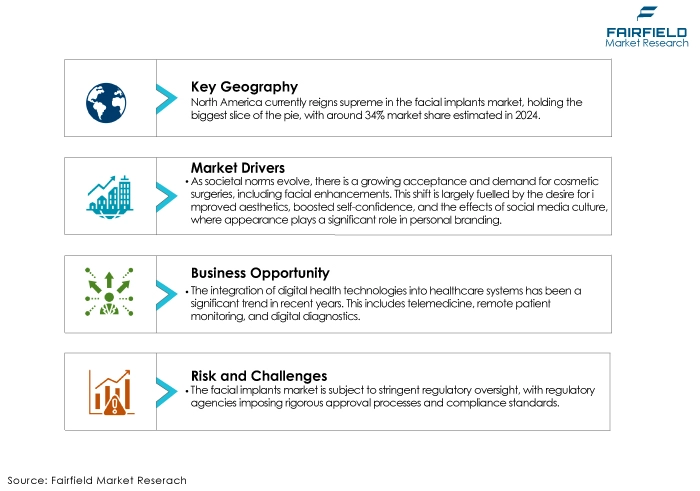
As societal norms evolve, there is a growing acceptance and demand for cosmetic surgeries, including facial enhancements. This shift is largely fuelled by the desire for improved aesthetics, boosted self-confidence, and the effects of social media culture, where appearance plays a significant role in personal branding. Facial implants, offering permanent solutions for facial contouring and rejuvenation, are increasingly sought after by those looking to enhance their facial features.
The market is benefiting from continuous improvements in surgical techniques and the development of safer, more durable implant materials. These advancements not only reduce the risks associated with surgeries but also improve the outcomes, making the procedures more appealing to potential patients. Additionally, the use of 3D printing technology for customising implants to fit individual anatomical structures precisely is enhancing the effectiveness and satisfaction rates of facial implant surgeries.
With the global population ageing, there's a significant increase in the demand for anti-ageing solutions. Facial implants serve as an effective option for addressing age-related facial volume loss and sagging, providing a more youthful appearance. This demographic trend, coupled with the rising financial capability of the ageing population to invest in cosmetic procedures, is driving the market growth.
Major Growth Barriers
1. Regulatory Hurdles
The facial implants market is subject to stringent regulatory oversight, with regulatory agencies imposing rigorous approval processes and compliance standards. These requirements often involve extensive clinical trials and documentation, significantly prolonging the time and resources required to bring new facial implant products to market.
Additionally, regulatory changes or updates in standards can further complicate the approval process, creating uncertainty for manufacturers and potentially delaying product launches. Navigating these regulatory hurdles demands substantial investments in regulatory affairs expertise and resources, which can be particularly challenging for smaller companies or startups in the facial implants industry.
2. Limited Reimbursement Coverage
Despite the increasing popularity of facial implant procedures, many healthcare insurers offer limited or no coverage for such elective cosmetic surgeries. This lack of reimbursement coverage places a financial burden on patients seeking facial enhancements, making these procedures inaccessible to a significant portion of the population.
Without adequate insurance support, patients may be deterred from pursuing facial implant surgeries due to concerns about affordability and out-of-pocket expenses. Consequently, the limited reimbursement coverage acts as a barrier to market growth, restricting the potential customer base and overall demand for facial implants.
3. Lack of Long-Term Data
While facial implants have been utilised for aesthetic and reconstructive purposes for decades, there remains a notable gap in comprehensive long-term data regarding their safety and efficacy. This lack of robust evidence on the long-term outcomes and potential complications associated with facial implants contributes to uncertainty among both patients and healthcare providers.
Without clear data demonstrating the durability and safety of these implants over extended periods, there may be hesitancy in adopting or recommending these procedures, particularly among risk-averse individuals or medical professionals. Addressing this knowledge gap requires ongoing research efforts, longitudinal studies, and data collection initiatives to provide clinicians and patients with more reliable information for informed decision-making regarding facial implant procedures.
Key Trends and Opportunities to Look at
1. Digital Health Integration
The integration of digital health technologies into healthcare systems has been a significant trend in recent years. This includes telemedicine, remote patient monitoring, and digital diagnostics. In the facial implants market, digital health technologies are being utilised for preoperative planning, allowing surgeons to precisely tailor implants to individual patient needs. This trend enhances patient outcomes by improving accuracy and reducing surgical risks.
2. Rising Demand for Minimally Invasive Procedures
There is a growing preference among patients for minimally invasive cosmetic procedures. This trend is driven by factors such as shorter recovery times, reduced scarring, and lower risk compared to traditional surgeries. In the facial implants market, minimally invasive techniques like injectable fillers, and thread lifts are gaining popularity for augmenting facial features. Advancements in materials and techniques are making these procedures more accessible and effective.
3. Technological Advancements in Materials
One significant opportunity lies in the development of innovative materials for facial implants. Biocompatible materials that mimic natural tissue properties while providing long-lasting results are in high demand. Research into bioabsorbable materials that integrate seamlessly with surrounding tissues and promote natural regeneration could revolutionise the field. Players investing in research and development to create such advanced materials stand to gain a competitive edge in the market.
4. Expansion into Emerging Markets
Another promising opportunity for facial implants market players is expanding into emerging markets. Rising disposable incomes, increasing awareness about cosmetic procedures, and improving healthcare infrastructure in countries across Asia Pacific, Latin America, and the Middle East present untapped potential. By understanding the unique needs and preferences of these markets, companies can tailor their products and marketing strategies to effectively penetrate and capitalise on the growing demand for facial augmentation procedures.
How Does the Regulatory Scenario Shape this Industry?
The regulatory landscape plays a critical role in shaping the Facial Implants Market by dictating safety, quality, and operational standards. Stringent regulations are a double-edged sword. On one hand, they ensure patient safety and build trust with consumers, fostering a competitive advantage for companies that adhere to them. This is becoming increasingly important as consumers prioritise safety and ethical practices. Navigating the complex web of regulations can be challenging for manufacturers. They need to stay agile and adapt to evolving laws to ensure compliance. This can stifle innovation to some extent, as bringing new implant materials or techniques to market requires navigating lengthy approval processes.
Furthermore, regulatory frameworks influence international trade. Fluctuations in import-export regulations and tariffs can disrupt supply chains and impact market stability. This highlights the need for a balance between robust regulations and fostering a dynamic market environment.
Looking ahead, we can expect the regulatory scenario to continue influencing the facial implants market in key ways. Firstly, the focus on biocompatibility and traceability of materials is likely to intensify. Secondly, regulations might become more standardised across regions, streamlining the approval process for manufacturers. Finally, there could be a growing emphasis on regulations around marketing practices to ensure transparency and ethical advertising. In conclusion, the regulatory environment plays a vital role in shaping the facial implants market, impacting everything from product safety to market access. By staying abreast of evolving regulations and embracing them strategically, manufacturers can ensure not only patient safety but also their own long-term success in this dynamic market.
Fairfield’s Ranking Board
Top Segments
1. Chin Implants Most Extensively Sought-After as Chin Augmentation Gains Popularity
Chin implants have witnessed significant growth due to the increasing demand for chin augmentation procedures. This is attributed to factors such as the desire for facial symmetry, enhanced jawline definition, and overall facial aesthetics. Advances in implant materials and surgical techniques have improved the safety, efficacy, and customisation of chin implants. Surgeons can now offer patients more natural-looking results with reduced risks and shorter recovery times.
The ageing population, along with cultural influences emphasising a well-defined jawline, contributes to the sustained popularity of chin augmentation procedures. Additionally, the rise of social media platforms has fuelled awareness and acceptance of cosmetic enhancements, further driving demand for chin implants.
2. Cheek Implants Gain Traction
Cheek implants are sought-after for enhancing facial contour and restoring volume to the midface region. As individuals age, they experience volume loss in the cheeks, leading to a sunken appearance. Cheek implants address this concern by providing a fuller, more youthful appearance. Advancements in implant design and manufacturing technologies allow for greater customisation to match individual patient anatomy and desired outcomes.
Surgeons can achieve natural-looking results tailored to each patient's facial structure, and aesthetic preferences. While surgical cheek augmentation remains popular, the market is also witnessing increasing demand for non-surgical alternatives such as injectable fillers. These minimally invasive options offer temporary results with minimal downtime, appealing to a broader patient demographic.
3. Demand for Nasal Implants Heightens as Rhinoplasty Captures Spotlight
Nasal implants serve both functional and aesthetic purposes, addressing issues such as nasal asymmetry, deformities, or deficiencies in nasal projection. Patients seek nasal augmentation to improve facial harmony, and self-confidence. Rhinoplasty, including the use of nasal implants, has evolved with advancements in surgical techniques and materials. Surgeons can now achieve more precise and predictable outcomes, resulting in improved patient satisfaction and reduced revision rates. Cultural norms and societal beauty standards influence the demand for nasal implants. In some cultures, a well-defined nose is considered a symbol of attractiveness and status, driving individuals to seek nasal augmentation procedures to achieve desired aesthetic ideals.
Regional Frontrunners
North America Takes the Charge with over a Third of Market Value
North America currently reigns supreme in the facial implants market, holding the biggest slice of the pie, with around 34% market share estimated in 2024. This dominance is fuelled by a combination of factors: people here have more money to spend on themselves, boast a well-established healthcare system, and have easy access to skilled surgeons. North America is expected to cling to its significant share thanks to these same advantages.
Asia Pacific, and Europe Ripe with Opportunities, Growth in Cosmetic Procedures Drive Demand
The Asia Pacific region is experiencing the fastest growth spurt. A burgeoning middle class with increasing disposable income is a key driver. Additionally, cosmetic procedures are becoming increasingly popular, particularly in countries like China, South Korea, and Japan. These trends are expected to propel the Asia Pacific region to the forefront of the facial implants market in the coming years.
Europe rounds out the top three, boasting a well-developed healthcare system with strong regulations. This translates to a high level of patient awareness regarding facial aesthetics. While not experiencing the explosive growth of Asia, Europe's established infrastructure and focus on safety are likely to secure it a steady market share in the foreseeable future.
Fairfield’s Competitive Landscape Analysis
The facial implants market is fiercely competitive, with several prominent players striving for dominance through strategic manoeuvres and innovative approaches. Among the leading contenders are esteemed companies like Sientra Inc., Allergan Inc. (now a part of AbbVie), GC Aesthetics PLC, KLS Martin Group, and Implantech Associates Inc. These industry leaders employ a spectrum of growth strategies to solidify their positions.
One of the foremost tactics involves relentless product innovation and development, where companies continually invest in research and development to introduce cutting-edge implant designs, materials, and surgical techniques, ensuring enhanced patient outcomes and satisfaction. Additionally, strategic collaborations and partnerships play a pivotal role, facilitating access to complementary expertise, accelerating product commercialisation, and expanding market reach.
Furthermore, geographical expansion remains a key strategy, with companies actively seeking opportunities in emerging markets by establishing robust distribution networks, forging strategic alliances, and investing in localised marketing efforts, thereby amplifying their global footprint and market share.
Who are the Leaders in Global Facial Implants Space?
- Implantech
- Stryker
- Matrix Surgical USA
- Yuyao Jiusheng Medical Supplies Factory
- SurgiSil, L.L.P.
- GRAND AESPIO INC.
- Sebbin
- Surgiform Innovative Surgical Products.
- Poriferous
- Alpha Aesthetics (AART, Inc.)
- Hanson Medical Inc.
- Guangzhou Wanhe Plastic Materials Co., Ltd.
- Calavera Surgical Design
- Johnson & Johnson Medical GmbH (DePuy Synthes)
- Zimmer Biomet.
- KLS Martin Group
- Silimed
- Medartis AG
An Expert’s Eye
Global Facial Implants market is Segmented as Below:
By Product Type
- Temporal Implants
- Standard Temporal Implants
- Extended Temporal Implants
- Chin & Mandibular Implants
- Jaw Implants
- Lip Implants
- Orbital Implants
- Craniofacial Implants
- Others
By Procedure
- Malar Augmentation
- Chin Augmentation
- Anterior Temporal Hollowing
- Total Temporal Augmentation
- Facelift
- Forehead lift
- Blepharoplasty
By Shape
- Anatomical
- Oval
- Round
- Customized
- Adjustable
- Others
By End User
- Hospitals
- Cosmetic & Plastic Surgery Clinics
- Ambulatory Surgical Centers
By Region
- North America
- Europe
- Asia Pacific
- Latin America
- Middle East & Africa
- Executive Summary
- Global Facial Implants Market Snapshot
- Future Projections
- Key Market Trends
- Regional Snapshot, by Value, 2026
- Analyst Recommendations
- Market Overview
- Market Definitions and Segmentations
- Market Dynamics
- Drivers
- Restraints
- Market Opportunities
- Value Chain Analysis
- COVID-19 Impact Analysis
- Porter's Five Forces Analysis
- Impact of Russia-Ukraine Conflict
- PESTLE Analysis
- Regulatory Analysis
- Price Trend Analysis
- Current Prices and Future Projections, 2025-2033
- Price Impact Factors
- Global Facial Implants Market Outlook, 2020 - 2033
- Global Facial Implants Market Outlook, by Product Type, Value (US$ Mn), 2020-2033
- Temporal Implants
- Standard Temporal Implants
- Extended Temporal Implants
- Chin & Mandibular Implants
- Jaw Implants
- Lip Implants
- Orbital Implants
- Craniofacial Implants
- Others
- Global Facial Implants Market Outlook, by Procedure, Value (US$ Mn), 2020-2033
- Malar Augmentation
- Chin Augmentation
- Anterior Temporal Hollowing
- Total Temporal Augmentation
- Facelift
- Forehead lift
- Blepharoplasty
- Global Facial Implants Market Outlook, by Shape, Value (US$ Mn), 2020-2033
- Anatomical
- Oval
- Round
- Customized
- Adjustable
- Others
- Global Facial Implants Market Outlook, by End User, Value (US$ Mn), 2020-2033
- Hospitals
- Cosmetic & Plastic Surgery Clinics
- Ambulatory Surgical Centers
- Global Facial Implants Market Outlook, by Region, Value (US$ Mn), 2020-2033
- North America
- Europe
- Asia Pacific
- Latin America
- Middle East & Africa
- Global Facial Implants Market Outlook, by Product Type, Value (US$ Mn), 2020-2033
- North America Facial Implants Market Outlook, 2020 - 2033
- North America Facial Implants Market Outlook, by Product Type, Value (US$ Mn), 2020-2033
- Temporal Implants
- Standard Temporal Implants
- Extended Temporal Implants
- Chin & Mandibular Implants
- Jaw Implants
- Lip Implants
- Orbital Implants
- Craniofacial Implants
- Others
- North America Facial Implants Market Outlook, by Procedure, Value (US$ Mn), 2020-2033
- Malar Augmentation
- Chin Augmentation
- Anterior Temporal Hollowing
- Total Temporal Augmentation
- Facelift
- Forehead lift
- Blepharoplasty
- North America Facial Implants Market Outlook, by Shape, Value (US$ Mn), 2020-2033
- Anatomical
- Oval
- Round
- Customized
- Adjustable
- Others
- North America Facial Implants Market Outlook, by End User, Value (US$ Mn), 2020-2033
- Hospitals
- Cosmetic & Plastic Surgery Clinics
- Ambulatory Surgical Centers
- North America Facial Implants Market Outlook, by Country, Value (US$ Mn), 2020-2033
- U.S. Facial Implants Market Outlook, by Product Type, 2020-2033
- U.S. Facial Implants Market Outlook, by Procedure, 2020-2033
- U.S. Facial Implants Market Outlook, by Shape, 2020-2033
- U.S. Facial Implants Market Outlook, by End User, 2020-2033
- Canada Facial Implants Market Outlook, by Product Type, 2020-2033
- Canada Facial Implants Market Outlook, by Procedure, 2020-2033
- Canada Facial Implants Market Outlook, by Shape, 2020-2033
- Canada Facial Implants Market Outlook, by End User, 2020-2033
- BPS Analysis/Market Attractiveness Analysis
- North America Facial Implants Market Outlook, by Product Type, Value (US$ Mn), 2020-2033
- Europe Facial Implants Market Outlook, 2020 - 2033
- Europe Facial Implants Market Outlook, by Product Type, Value (US$ Mn), 2020-2033
- Temporal Implants
- Standard Temporal Implants
- Extended Temporal Implants
- Chin & Mandibular Implants
- Jaw Implants
- Lip Implants
- Orbital Implants
- Craniofacial Implants
- Others
- Europe Facial Implants Market Outlook, by Procedure, Value (US$ Mn), 2020-2033
- Malar Augmentation
- Chin Augmentation
- Anterior Temporal Hollowing
- Total Temporal Augmentation
- Facelift
- Forehead lift
- Blepharoplasty
- Europe Facial Implants Market Outlook, by Shape, Value (US$ Mn), 2020-2033
- Anatomical
- Oval
- Round
- Customized
- Adjustable
- Others
- Europe Facial Implants Market Outlook, by End User, Value (US$ Mn), 2020-2033
- Hospitals
- Cosmetic & Plastic Surgery Clinics
- Ambulatory Surgical Centers
- Europe Facial Implants Market Outlook, by Country, Value (US$ Mn), 2020-2033
- Germany Facial Implants Market Outlook, by Product Type, 2020-2033
- Germany Facial Implants Market Outlook, by Procedure, 2020-2033
- Germany Facial Implants Market Outlook, by Shape, 2020-2033
- Germany Facial Implants Market Outlook, by End User, 2020-2033
- Italy Facial Implants Market Outlook, by Product Type, 2020-2033
- Italy Facial Implants Market Outlook, by Procedure, 2020-2033
- Italy Facial Implants Market Outlook, by Shape, 2020-2033
- Italy Facial Implants Market Outlook, by End User, 2020-2033
- France Facial Implants Market Outlook, by Product Type, 2020-2033
- France Facial Implants Market Outlook, by Procedure, 2020-2033
- France Facial Implants Market Outlook, by Shape, 2020-2033
- France Facial Implants Market Outlook, by End User, 2020-2033
- U.K. Facial Implants Market Outlook, by Product Type, 2020-2033
- U.K. Facial Implants Market Outlook, by Procedure, 2020-2033
- U.K. Facial Implants Market Outlook, by Shape, 2020-2033
- U.K. Facial Implants Market Outlook, by End User, 2020-2033
- Spain Facial Implants Market Outlook, by Product Type, 2020-2033
- Spain Facial Implants Market Outlook, by Procedure, 2020-2033
- Spain Facial Implants Market Outlook, by Shape, 2020-2033
- Spain Facial Implants Market Outlook, by End User, 2020-2033
- Russia Facial Implants Market Outlook, by Product Type, 2020-2033
- Russia Facial Implants Market Outlook, by Procedure, 2020-2033
- Russia Facial Implants Market Outlook, by Shape, 2020-2033
- Russia Facial Implants Market Outlook, by End User, 2020-2033
- Rest of Europe Facial Implants Market Outlook, by Product Type, 2020-2033
- Rest of Europe Facial Implants Market Outlook, by Procedure, 2020-2033
- Rest of Europe Facial Implants Market Outlook, by Shape, 2020-2033
- Rest of Europe Facial Implants Market Outlook, by End User, 2020-2033
- BPS Analysis/Market Attractiveness Analysis
- Europe Facial Implants Market Outlook, by Product Type, Value (US$ Mn), 2020-2033
- Asia Pacific Facial Implants Market Outlook, 2020 - 2033
- Asia Pacific Facial Implants Market Outlook, by Product Type, Value (US$ Mn), 2020-2033
- Temporal Implants
- Standard Temporal Implants
- Extended Temporal Implants
- Chin & Mandibular Implants
- Jaw Implants
- Lip Implants
- Orbital Implants
- Craniofacial Implants
- Others
- Asia Pacific Facial Implants Market Outlook, by Procedure, Value (US$ Mn), 2020-2033
- Malar Augmentation
- Chin Augmentation
- Anterior Temporal Hollowing
- Total Temporal Augmentation
- Facelift
- Forehead lift
- Blepharoplasty
- Asia Pacific Facial Implants Market Outlook, by Shape, Value (US$ Mn), 2020-2033
- Anatomical
- Oval
- Round
- Customized
- Adjustable
- Others
- Asia Pacific Facial Implants Market Outlook, by End User, Value (US$ Mn), 2020-2033
- Hospitals
- Cosmetic & Plastic Surgery Clinics
- Ambulatory Surgical Centers
- Asia Pacific Facial Implants Market Outlook, by Country, Value (US$ Mn), 2020-2033
- China Facial Implants Market Outlook, by Product Type, 2020-2033
- China Facial Implants Market Outlook, by Procedure, 2020-2033
- China Facial Implants Market Outlook, by Shape, 2020-2033
- China Facial Implants Market Outlook, by End User, 2020-2033
- Japan Facial Implants Market Outlook, by Product Type, 2020-2033
- Japan Facial Implants Market Outlook, by Procedure, 2020-2033
- Japan Facial Implants Market Outlook, by Shape, 2020-2033
- Japan Facial Implants Market Outlook, by End User, 2020-2033
- South Korea Facial Implants Market Outlook, by Product Type, 2020-2033
- South Korea Facial Implants Market Outlook, by Procedure, 2020-2033
- South Korea Facial Implants Market Outlook, by Shape, 2020-2033
- South Korea Facial Implants Market Outlook, by End User, 2020-2033
- India Facial Implants Market Outlook, by Product Type, 2020-2033
- India Facial Implants Market Outlook, by Procedure, 2020-2033
- India Facial Implants Market Outlook, by Shape, 2020-2033
- India Facial Implants Market Outlook, by End User, 2020-2033
- Southeast Asia Facial Implants Market Outlook, by Product Type, 2020-2033
- Southeast Asia Facial Implants Market Outlook, by Procedure, 2020-2033
- Southeast Asia Facial Implants Market Outlook, by Shape, 2020-2033
- Southeast Asia Facial Implants Market Outlook, by End User, 2020-2033
- Rest of SAO Facial Implants Market Outlook, by Product Type, 2020-2033
- Rest of SAO Facial Implants Market Outlook, by Procedure, 2020-2033
- Rest of SAO Facial Implants Market Outlook, by Shape, 2020-2033
- Rest of SAO Facial Implants Market Outlook, by End User, 2020-2033
- BPS Analysis/Market Attractiveness Analysis
- Asia Pacific Facial Implants Market Outlook, by Product Type, Value (US$ Mn), 2020-2033
- Latin America Facial Implants Market Outlook, 2020 - 2033
- Latin America Facial Implants Market Outlook, by Product Type, Value (US$ Mn), 2020-2033
- Temporal Implants
- Standard Temporal Implants
- Extended Temporal Implants
- Chin & Mandibular Implants
- Jaw Implants
- Lip Implants
- Orbital Implants
- Craniofacial Implants
- Others
- Latin America Facial Implants Market Outlook, by Procedure, Value (US$ Mn), 2020-2033
- Malar Augmentation
- Chin Augmentation
- Anterior Temporal Hollowing
- Total Temporal Augmentation
- Facelift
- Forehead lift
- Blepharoplasty
- Latin America Facial Implants Market Outlook, by Shape, Value (US$ Mn), 2020-2033
- Anatomical
- Oval
- Round
- Customized
- Adjustable
- Others
- Latin America Facial Implants Market Outlook, by End User, Value (US$ Mn), 2020-2033
- Hospitals
- Cosmetic & Plastic Surgery Clinics
- Ambulatory Surgical Centers
- Latin America Facial Implants Market Outlook, by Country, Value (US$ Mn), 2020-2033
- Brazil Facial Implants Market Outlook, by Product Type, 2020-2033
- Brazil Facial Implants Market Outlook, by Procedure, 2020-2033
- Brazil Facial Implants Market Outlook, by Shape, 2020-2033
- Brazil Facial Implants Market Outlook, by End User, 2020-2033
- Mexico Facial Implants Market Outlook, by Product Type, 2020-2033
- Mexico Facial Implants Market Outlook, by Procedure, 2020-2033
- Mexico Facial Implants Market Outlook, by Shape, 2020-2033
- Mexico Facial Implants Market Outlook, by End User, 2020-2033
- Argentina Facial Implants Market Outlook, by Product Type, 2020-2033
- Argentina Facial Implants Market Outlook, by Procedure, 2020-2033
- Argentina Facial Implants Market Outlook, by Shape, 2020-2033
- Argentina Facial Implants Market Outlook, by End User, 2020-2033
- Rest of LATAM Facial Implants Market Outlook, by Product Type, 2020-2033
- Rest of LATAM Facial Implants Market Outlook, by Procedure, 2020-2033
- Rest of LATAM Facial Implants Market Outlook, by Shape, 2020-2033
- Rest of LATAM Facial Implants Market Outlook, by End User, 2020-2033
- BPS Analysis/Market Attractiveness Analysis
- Latin America Facial Implants Market Outlook, by Product Type, Value (US$ Mn), 2020-2033
- Middle East & Africa Facial Implants Market Outlook, 2020 - 2033
- Middle East & Africa Facial Implants Market Outlook, by Product Type, Value (US$ Mn), 2020-2033
- Temporal Implants
- Standard Temporal Implants
- Extended Temporal Implants
- Chin & Mandibular Implants
- Jaw Implants
- Lip Implants
- Orbital Implants
- Craniofacial Implants
- Others
- Middle East & Africa Facial Implants Market Outlook, by Procedure, Value (US$ Mn), 2020-2033
- Malar Augmentation
- Chin Augmentation
- Anterior Temporal Hollowing
- Total Temporal Augmentation
- Facelift
- Forehead lift
- Blepharoplasty
- Middle East & Africa Facial Implants Market Outlook, by Shape, Value (US$ Mn), 2020-2033
- Anatomical
- Oval
- Round
- Customized
- Adjustable
- Others
- Middle East & Africa Facial Implants Market Outlook, by End User, Value (US$ Mn), 2020-2033
- Hospitals
- Cosmetic & Plastic Surgery Clinics
- Ambulatory Surgical Centers
- Middle East & Africa Facial Implants Market Outlook, by Country, Value (US$ Mn), 2020-2033
- GCC Facial Implants Market Outlook, by Product Type, 2020-2033
- GCC Facial Implants Market Outlook, by Procedure, 2020-2033
- GCC Facial Implants Market Outlook, by Shape, 2020-2033
- GCC Facial Implants Market Outlook, by End User, 2020-2033
- South Africa Facial Implants Market Outlook, by Product Type, 2020-2033
- South Africa Facial Implants Market Outlook, by Procedure, 2020-2033
- South Africa Facial Implants Market Outlook, by Shape, 2020-2033
- South Africa Facial Implants Market Outlook, by End User, 2020-2033
- Egypt Facial Implants Market Outlook, by Product Type, 2020-2033
- Egypt Facial Implants Market Outlook, by Procedure, 2020-2033
- Egypt Facial Implants Market Outlook, by Shape, 2020-2033
- Egypt Facial Implants Market Outlook, by End User, 2020-2033
- Nigeria Facial Implants Market Outlook, by Product Type, 2020-2033
- Nigeria Facial Implants Market Outlook, by Procedure, 2020-2033
- Nigeria Facial Implants Market Outlook, by Shape, 2020-2033
- Nigeria Facial Implants Market Outlook, by End User, 2020-2033
- Rest of Middle East Facial Implants Market Outlook, by Product Type, 2020-2033
- Rest of Middle East Facial Implants Market Outlook, by Procedure, 2020-2033
- Rest of Middle East Facial Implants Market Outlook, by Shape, 2020-2033
- Rest of Middle East Facial Implants Market Outlook, by End User, 2020-2033
- BPS Analysis/Market Attractiveness Analysis
- Middle East & Africa Facial Implants Market Outlook, by Product Type, Value (US$ Mn), 2020-2033
- Competitive Landscape
- Company Vs Segment Heatmap
- Company Market Share Analysis, 2025
- Competitive Dashboard
- Company Profiles
- Implantech
- Company Overview
- Product Portfolio
- Financial Overview
- Business Strategies and Developments
- Stryker
- Matrix Surgical USA
- Yuyao Jiusheng Medical Supplies Factory
- SurgiSil, L.L.P.
- GRAND AESPIO INC.
- Sebbin
- Surgiform Innovative Surgical Products.
- Poriferous
- Alpha Aesthetics (AART, Inc.)
- Implantech
- Appendix
- Research Methodology
- Report Assumptions
- Acronyms and Abbreviations
|
BASE YEAR |
HISTORICAL DATA |
FORECAST PERIOD |
UNITS |
|||
 |
2025 |
 |
2019 - 2024 |
 |
2026 - 2033 |
Value: US$ Billion Volume :Million Units |
|
REPORT FEATURES |
DETAILS |
|
Product Type Coverage |
|
|
Procedure Coverage |
|
|
Shape Coverage |
|
|
End User Coverage |
|
|
Geographical Coverage |
|
|
Leading Companies |
|
|
Report Highlights |
Key Market Indicators, Macro-micro economic impact analysis, Technological Roadmap, Key Trends, Driver, Restraints, and Future Opportunities & Revenue Pockets, Porter’s 5 Forces Analysis, Historical Trend (2019-2021), Market Estimates and Forecast, Market Dynamics, Industry Trends, Competition Landscape, Category, Region, Country-wise Trends & Analysis, COVID-19 Impact Analysis (Demand and Supply Chain) |
Our Research Methodology
Considering the volatility of business today, traditional approaches to strategizing a game plan can be unfruitful if not detrimental. True ambiguity is no way to determine a forecast. A myriad of predetermined factors must be accounted for such as the degree of risk involved, the magnitude of circumstances, as well as conditions or consequences that are not known or unpredictable. To circumvent binary views that cast uncertainty, the application of market research intelligence to strategically posture, move, and enable actionable outcomes is necessary.
View Methodology
Quality Assured
Rigorous Validation Process

Confidentiality Assured
End-to-end Data Security

Custom Research Services
Tailored To Your Objectives
FAQs
Increasing demand for cosmetic procedures and facial reconstruction surgeries due to accidents, birth defects, and aging.
Chin, cheek, and jaw implants are among the most commonly sought-after facial implants.
Silicone, polyethylene, and porous polyethylene are widely used due to their biocompatibility and safety.
Advances in 3D printing and custom implants are enhancing patient outcomes with more personalized and precise solutions.
North America, and Europe lead the market due to high demand for cosmetic surgeries, while Asia Pacific shows emerging growth driven by increasing disposable incomes and aesthetic awareness.
Related Reports
Ankle Boots Market Insights, Competitive Landscape, and Market Forecast 2033
The ankle boots market is valued at USD 18.50 Bn in 2026 and is projected to reach USD 27.45 Bn by 2033, expanding at a CAGR of 5.8% during 2026-2033
Foot And Ankle Devices Market Insights, Competitive Landscape, and Market Forecast 2033
The foot and ankle devices market will grow from USD 6.40 Bn in 2026 to USD 10.14 Bn by 2033 at a CAGR of 6.8%, driven by rising trauma & sports injuries.
Digital Therapeutics Delivery Devices Market Insights, Competitive Landscape, and Market Forecast 2033
The digital therapeutics delivery devices market will expand at a 15.5% CAGR from USD 2.10 Bn in 2026 to USD 5.76 Bn by 2033, led by wearable devices.
Global Infant Incubator Insights, Competitive Landscape, and Market Forecast 2033
Infant Incubator Market to reach US$1,306.72 Mn by 2033, growing at 5.3% CAGR, driven by preterm births, NICU expansion and transport incubators care.
Pulse Electromagnetic Field Therapy Devices Market Insights, Competitive Landscape, and Market Forecast 2026–2033
Pulse Electromagnetic Field Therapy Devices Market to reach US$930.86 Mn by 2033, driven by pain management and wearable devices.
Vaginal Rejuvenation Market Insights, Competitive Landscape, and Market Forecast 2026–2033
Vaginal Rejuvenation Market to Reach US$26.75 Billion by 2033, Driven by Rising Demand for Minimally Invasive Women's Health Solutions.