



Flanges Market
Flanges Market Insights, Competitive Landscape, and Market Forecast - 2033
The Flanges Market is expected to grow from USD 6.7 Billion in 2026 to USD 9.9 Billion by 2033, reflecting strong industry expansion and registering a CAGR of 5.8% during the forecast period from 2026 to 2033.
Quick Report Digest
A Look Back and a Look Forward - Comparative Analysis
The flanges market is experiencing growth due to escalating demand in industries such as oil and gas, petrochemicals, and construction. Global infrastructure projects, expanding industrial activities, and the need for efficient fluid and gas transportation are propelling the market. Additionally, technological advancements in manufacturing processes and materials, coupled with the versatility and reliability of flanges, contribute to their increased adoption across various sectors, fostering overall market expansion.
The market witnessed staggered growth during the historical period 2018 – 2022. This is due to the substantial growth of major applications such as the oil and gas industry, chemical and petrochemical industry, and water and wastewater treatment. However, in some applications, the demand for flangess has increased, including in the aerospace and defense industry, and other areas.
The future of the flanges market appears promising, driven by ongoing industrialisation, infrastructural development, and increased energy demand. Technological advancements will likely lead to more efficient manufacturing processes and innovative designs, enhancing the performance of flanges. The market is expected to witness sustained growth across diverse end-user industries, such as oil and gas, petrochemicals, and construction. Global economic expansion and the need for reliable fluid and gas transportation systems will further contribute to the continued success and evolution of the Flanges Market.
Key Growth Determinants
- Growing Infrastructural Developments
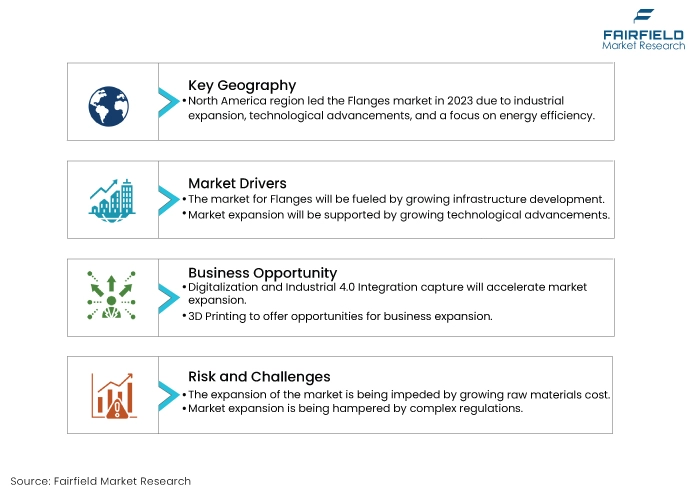
Growing infrastructure development is a significant driver for the flanges market due to the integral role flanges play in various construction applications. As nations invest in expanding their infrastructure, such as bridges, roads, and buildings, there is a heightened demand for reliable and durable components like flanges.
Flanges are crucial in connecting pipes, facilitating fluid and gas transportation, and ensuring the integrity of pipelines in construction projects. The expansion of sectors like water supply, wastewater treatment, and power generation further amplifies the need for flanges. The versatility, strength, and adaptability of flanges make them indispensable in supporting the robust growth of infrastructure development globally.
- Growing Technological Advancements
Growing technological advancements are propelling the flanges market by enhancing manufacturing processes, materials, and product design. Innovations such as precision machining, automation, and digital tools contribute to increased production efficiency, reduced costs, and improved product quality. Advanced technologies allow flange manufacturers to meet evolving industry requirements, ensuring products are more reliable and tailored to diverse applications.
Additionally, technological progress enables the development of specialised and high-performance flanges that can withstand demanding conditions. As industries increasingly embrace these advancements, the flanges market experiences a surge in demand, driven by the need for efficient, durable, and technologically advanced components in sectors like oil and gas, petrochemicals, and power generation.
- Increasing Construction Activities
Increasing construction activities are a key driver for the Flanges Market, as flanges play a crucial role in connecting pipes, ensuring structural integrity, and facilitating fluid and gas transportation. The rise in residential, commercial, and infrastructure construction projects globally demands a consistent supply of durable and reliable components like flanges.
Flanges are essential in applications such as plumbing, HVAC systems, and pipeline construction. The adaptability of flanges to diverse construction needs and their ability to provide leak-proof connections contribute to their growing demand. As construction activities expand, so does the requirement for high-quality flanges, making them integral to the success of the construction industry and driving sustained growth in the Flanges Market.
Major Growth Barriers
- Fluctuating Raw Material Prices
Fluctuating raw material prices present a challenge to the flanges market by influencing production costs and profit margins. The market relies heavily on materials like steel, and price volatility in these inputs can disrupt pricing strategies and impact the competitiveness of manufacturers.
Unpredictable raw material costs make it challenging for businesses to maintain stable pricing for flanges, affecting overall profitability and potentially hindering investment in research, development, and process improvements within the industry.
- Complex Regulations
Complex regulations pose a challenge to the flanges market as manufacturers must navigate various industry standards and certifications. Meeting stringent environmental, safety, and quality control requirements demands significant resources and expertise.
Compliance issues can lead to delays, increased costs, and reputational damage. The need for continuous adaptation to evolving regulations adds complexity to production processes, requiring manufacturers to stay informed and invest in ensuring their products meet the diverse and often intricate standards set by different industries and regions.
Key Trends and Opportunities to Look at
Integration of digital technologies, sensors, and automation to enhance manufacturing processes, monitor equipment health, and optimise production efficiency.
- 3D Printing
- Advanced Materials
We are utilising additive manufacturing techniques to produce complex and customised flange designs, reducing waste and lead times.
Exploration of high-performance materials with enhanced durability, corrosion resistance, and temperature tolerance to improve flange performance in challenging environments.
How Does the Regulatory Scenario Shape this Industry?
The regulatory framework for the flanges market includes adherence to international standards and regional regulations. In the United States, regulatory bodies like the American National Standards Institute (ANSI) and the American Society of Mechanical Engineers (ASME) set standards for flanges. In the European Union, compliance with directives such as the Pressure Equipment Directive (PED) is essential.
Additionally, industry-specific regulations in the oil and gas sector, such as API specifications, influence the market. Changes in these regulations impact product specifications, quality standards, and market access. Region-specific modifications, such as evolving environmental standards or safety guidelines, can influence manufacturing processes and market dynamics, requiring companies to adapt to ensure regulatory compliance and market competitiveness.
Fairfield’s Ranking Board
Top Segments
The slip-on type flange has captured the largest market share in the flanges market due to its simplicity, cost-effectiveness, and ease of installation. Offering quick alignment and welding capabilities, the Slip-on flange reduces labor costs and enhances efficiency. Its versatility and compatibility with various pipe materials make it a preferred choice across industries. As demand grows for easy-to-install solutions, the Slip-on type flange stands out, contributing to its significant market share within the overall flanges market.
The socket weld type flange is experiencing the highest CAGR in the flanges market due to its robust design and superior strength. Offering secure and leak-proof connections, it is widely adopted in high-pressure and high-temperature applications. As industries such as oil and gas, chemical, and power generation demand reliable and durable flange solutions, the socket weld type meets these requirements. Its effectiveness in critical conditions and the increasing focus on safety and efficiency contribute to its growing popularity, establishing it as a leading choice within the evolving flanges market.
- Carbon Steel Remains the Materials of Choice for Flanges
- Oil and Gas Industry to be the Top End User
Carbon steel flanges have secured the largest market share in the flanges market due to their widespread use in various industries. Known for their strength, durability, and cost-effectiveness, carbon steel flanges are extensively utilised in critical applications such as oil and gas, petrochemicals, and construction. Their high tensile strength, resistance to corrosion, and compatibility with diverse applications contribute to their popularity. Additionally, the material's ability to withstand demanding conditions positions carbon steel flanges as a preferred choice, driving significant market share within the broader flanges market.
Stainless steel flanges, one the other hand, due to their superior corrosion resistance, durability, and versatility. Increasing demand for corrosion-resistant materials in critical applications, such as chemical processing and marine environments, drives the adoption of stainless steel flanges. The material's hygienic properties also contribute to its growth in industries like food and beverages. As stringent quality standards become paramount, stainless steel flanges are increasingly favoured, propelling their market share and establishing them as a leading choice for various applications within the flanges market.
The oil and gas industry has secured the largest market share in the flanges market due to its extensive use of flanges in critical applications. Flanges play a pivotal role in connecting pipes, ensuring integrity and reliability in pipelines, refineries, and exploration activities. The industry's constant need for pipeline construction, maintenance, and expansion drives significant demand for flanges. As the global demand for energy continues to rise, the oil and gas sector remains a key driver for the growth of the flanges market, solidifying its position as a major market shareholder.
The food and beverage industry is growing at the highest CAGR in the flanges market due to increasing demand for food processing equipment and efficient fluid handling systems. Flanges play a crucial role in connecting pipes in food and beverage processing plants, ensuring hygiene and compliance with industry standards. As the demand for processed food and beverages rises globally, the industry invests in infrastructure, leading to a significant surge in the adoption of flanges. This trend positions the food and beverage sector as a key driver for the growth of the flanges market.
Regional Frontrunners
North America Contributes the Largest Share
North America has captured the largest market share in the flanges market due to its well-established industrial base, significant investments in oil and gas infrastructure, and ongoing technological advancements. Robust economic conditions, coupled with stringent quality standards, drive demand for high-quality flanges.
The region's focus on pipeline construction, especially in the oil and gas sector, contributes to its dominant market position. Moreover, the revival of manufacturing activities and continuous upgrades in industrial processes bolster the demand for flanges. Strong collaborations between key market players and strategic initiatives further solidify North America's position as a major contributor to the overall market share in the flanges market.
Asia Pacific’s Evolving Industrial Landscape Brings in Profits
The Asia Pacific region is experiencing the highest CAGR in the flanges market due to rapid industrialisation, infrastructure development, and economic growth. Increasing construction activities, particularly in emerging economies, drive demand for flanges.
Additionally, the expanding oil and gas industry and the rising focus on renewable energy contribute to the region's growth. A large population, and urbanisation further fuel infrastructure projects. The Asia Pacific's dynamic market conditions, and evolving industrial landscape position it as a key contributor to the increasing demand for flanges.
Fairfield’s Competitive Landscape Analysis
The presence of key players such as Weldbend Corporation, Metalfar, Sandvik AB, and Bonney Forge Corporation characterises the competitive landscape of the flanges market. Factors like technological innovation, product quality, and pricing strategies drive intense competition.
Companies focus on expanding their product portfolios, enhancing manufacturing capabilities, and global market reach to gain a competitive edge. Strategic collaborations, mergers, and acquisitions are common, contributing to the dynamic nature of the competitive landscape in the flanges market.
Who are the Leaders in the Global Flanges Space
• MRC Global Inc.
• Mueller Water Products, Inc.
• PCC Forged Products
• Core Pipe
• Weldbend Corporation
• Jinan Hyupshin Flanges Co., Ltd.
• Forged Components, Inc.
• Maass Flange Corporation
• Rajendra Industrial Corporation
• Coastal Flange, Inc.
Global Flanges Market is Segmented as Below:
By Type:
- Slip-on
- Weld Neck
- Socket Weld
- Threaded
- Misc
By Material Type:
- Carbon Steel Flanges
- Stainless Steel Flanges
- Copper and Brass Flanges
- Misc (including Titanium, Inconel, others)
By End-Use Industry:
- Oil and Gas Industry
- Chemical and Petrochemical Industry
- Power Generation
- Water and Wastewater Treatment
- Food and Beverage Industry
- Construction and Infrastructure
- Automotive Industry
- Aerospace and Defense Industry
- Misc
By Geographic Coverage:
• North America
• Europe
• Asia Pacific
• Latin America
• Middle East & Africa
- Executive Summary
- Global Flanges Market Snapshot
- Future Projections
- Key Market Trends
- Regional Snapshot, by Value, 2026
- Analyst Recommendations
- Market Overview
- Market Definitions and Segmentations
- Market Dynamics
- Drivers
- Restraints
- Market Opportunities
- Value Chain Analysis
- COVID-19 Impact Analysis
- Porter's Five Forces Analysis
- Impact of Russia-Ukraine Conflict
- PESTLE Analysis
- Regulatory Analysis
- Price Trend Analysis
- Current Prices and Future Projections, 2025-2033
- Price Impact Factors
- Global Flanges Market Outlook, 2020 - 2033
- Global Flanges Market Outlook, by Type, Value (US$ Bn), 2020-2033
- Slip-on
- Weld Neck
- Socket Weld
- Threaded
- Misc
- Global Flanges Market Outlook, by Material Type, Value (US$ Bn), 2020-2033
- Carbon Steel Flanges
- Stainless Steel Flanges
- Copper and Brass Flanges
- Global Flanges Market Outlook, by End-Use Industry, Value (US$ Bn), 2020-2033
- Oil and Gas Industry
- Chemical and Petrochemical Industry
- Power Generation
- Water and Wastewater Treatment
- Food and Beverage Industry
- Construction and Infrastructure
- Automotive Industry
- Aerospace and Defense Industry
- Misc
- Global Flanges Market Outlook, by Region, Value (US$ Bn), 2020-2033
- North America
- Europe
- Asia Pacific
- Latin America
- Middle East & Africa
- Global Flanges Market Outlook, by Type, Value (US$ Bn), 2020-2033
- North America Flanges Market Outlook, 2020 - 2033
- North America Flanges Market Outlook, by Type, Value (US$ Bn), 2020-2033
- Slip-on
- Weld Neck
- Socket Weld
- Threaded
- Misc
- North America Flanges Market Outlook, by Material Type, Value (US$ Bn), 2020-2033
- Carbon Steel Flanges
- Stainless Steel Flanges
- Copper and Brass Flanges
- North America Flanges Market Outlook, by End-Use Industry, Value (US$ Bn), 2020-2033
- Oil and Gas Industry
- Chemical and Petrochemical Industry
- Power Generation
- Water and Wastewater Treatment
- Food and Beverage Industry
- Construction and Infrastructure
- Automotive Industry
- Aerospace and Defense Industry
- Misc
- North America Flanges Market Outlook, by Country, Value (US$ Bn), 2020-2033
- U.S. Flanges Market Outlook, by Type, 2020-2033
- U.S. Flanges Market Outlook, by Material Type, 2020-2033
- U.S. Flanges Market Outlook, by End-Use Industry, 2020-2033
- Canada Flanges Market Outlook, by Type, 2020-2033
- Canada Flanges Market Outlook, by Material Type, 2020-2033
- Canada Flanges Market Outlook, by End-Use Industry, 2020-2033
- BPS Analysis/Market Attractiveness Analysis
- North America Flanges Market Outlook, by Type, Value (US$ Bn), 2020-2033
- Europe Flanges Market Outlook, 2020 - 2033
- Europe Flanges Market Outlook, by Type, Value (US$ Bn), 2020-2033
- Slip-on
- Weld Neck
- Socket Weld
- Threaded
- Misc
- Europe Flanges Market Outlook, by Material Type, Value (US$ Bn), 2020-2033
- Carbon Steel Flanges
- Stainless Steel Flanges
- Copper and Brass Flanges
- Europe Flanges Market Outlook, by End-Use Industry, Value (US$ Bn), 2020-2033
- Oil and Gas Industry
- Chemical and Petrochemical Industry
- Power Generation
- Water and Wastewater Treatment
- Food and Beverage Industry
- Construction and Infrastructure
- Automotive Industry
- Aerospace and Defense Industry
- Misc
- Europe Flanges Market Outlook, by Country, Value (US$ Bn), 2020-2033
- Germany Flanges Market Outlook, by Type, 2020-2033
- Germany Flanges Market Outlook, by Material Type, 2020-2033
- Germany Flanges Market Outlook, by End-Use Industry, 2020-2033
- Italy Flanges Market Outlook, by Type, 2020-2033
- Italy Flanges Market Outlook, by Material Type, 2020-2033
- Italy Flanges Market Outlook, by End-Use Industry, 2020-2033
- France Flanges Market Outlook, by Type, 2020-2033
- France Flanges Market Outlook, by Material Type, 2020-2033
- France Flanges Market Outlook, by End-Use Industry, 2020-2033
- U.K. Flanges Market Outlook, by Type, 2020-2033
- U.K. Flanges Market Outlook, by Material Type, 2020-2033
- U.K. Flanges Market Outlook, by End-Use Industry, 2020-2033
- Spain Flanges Market Outlook, by Type, 2020-2033
- Spain Flanges Market Outlook, by Material Type, 2020-2033
- Spain Flanges Market Outlook, by End-Use Industry, 2020-2033
- Russia Flanges Market Outlook, by Type, 2020-2033
- Russia Flanges Market Outlook, by Material Type, 2020-2033
- Russia Flanges Market Outlook, by End-Use Industry, 2020-2033
- Rest of Europe Flanges Market Outlook, by Type, 2020-2033
- Rest of Europe Flanges Market Outlook, by Material Type, 2020-2033
- Rest of Europe Flanges Market Outlook, by End-Use Industry, 2020-2033
- BPS Analysis/Market Attractiveness Analysis
- Europe Flanges Market Outlook, by Type, Value (US$ Bn), 2020-2033
- Asia Pacific Flanges Market Outlook, 2020 - 2033
- Asia Pacific Flanges Market Outlook, by Type, Value (US$ Bn), 2020-2033
- Slip-on
- Weld Neck
- Socket Weld
- Threaded
- Misc
- Asia Pacific Flanges Market Outlook, by Material Type, Value (US$ Bn), 2020-2033
- Carbon Steel Flanges
- Stainless Steel Flanges
- Copper and Brass Flanges
- Asia Pacific Flanges Market Outlook, by End-Use Industry, Value (US$ Bn), 2020-2033
- Oil and Gas Industry
- Chemical and Petrochemical Industry
- Power Generation
- Water and Wastewater Treatment
- Food and Beverage Industry
- Construction and Infrastructure
- Automotive Industry
- Aerospace and Defense Industry
- Misc
- Asia Pacific Flanges Market Outlook, by Country, Value (US$ Bn), 2020-2033
- China Flanges Market Outlook, by Type, 2020-2033
- China Flanges Market Outlook, by Material Type, 2020-2033
- China Flanges Market Outlook, by End-Use Industry, 2020-2033
- Japan Flanges Market Outlook, by Type, 2020-2033
- Japan Flanges Market Outlook, by Material Type, 2020-2033
- Japan Flanges Market Outlook, by End-Use Industry, 2020-2033
- South Korea Flanges Market Outlook, by Type, 2020-2033
- South Korea Flanges Market Outlook, by Material Type, 2020-2033
- South Korea Flanges Market Outlook, by End-Use Industry, 2020-2033
- India Flanges Market Outlook, by Type, 2020-2033
- India Flanges Market Outlook, by Material Type, 2020-2033
- India Flanges Market Outlook, by End-Use Industry, 2020-2033
- Southeast Asia Flanges Market Outlook, by Type, 2020-2033
- Southeast Asia Flanges Market Outlook, by Material Type, 2020-2033
- Southeast Asia Flanges Market Outlook, by End-Use Industry, 2020-2033
- Rest of SAO Flanges Market Outlook, by Type, 2020-2033
- Rest of SAO Flanges Market Outlook, by Material Type, 2020-2033
- Rest of SAO Flanges Market Outlook, by End-Use Industry, 2020-2033
- BPS Analysis/Market Attractiveness Analysis
- Asia Pacific Flanges Market Outlook, by Type, Value (US$ Bn), 2020-2033
- Latin America Flanges Market Outlook, 2020 - 2033
- Latin America Flanges Market Outlook, by Type, Value (US$ Bn), 2020-2033
- Slip-on
- Weld Neck
- Socket Weld
- Threaded
- Misc
- Latin America Flanges Market Outlook, by Material Type, Value (US$ Bn), 2020-2033
- Carbon Steel Flanges
- Stainless Steel Flanges
- Copper and Brass Flanges
- Latin America Flanges Market Outlook, by End-Use Industry, Value (US$ Bn), 2020-2033
- Oil and Gas Industry
- Chemical and Petrochemical Industry
- Power Generation
- Water and Wastewater Treatment
- Food and Beverage Industry
- Construction and Infrastructure
- Automotive Industry
- Aerospace and Defense Industry
- Misc
- Latin America Flanges Market Outlook, by Country, Value (US$ Bn), 2020-2033
- Brazil Flanges Market Outlook, by Type, 2020-2033
- Brazil Flanges Market Outlook, by Material Type, 2020-2033
- Brazil Flanges Market Outlook, by End-Use Industry, 2020-2033
- Mexico Flanges Market Outlook, by Type, 2020-2033
- Mexico Flanges Market Outlook, by Material Type, 2020-2033
- Mexico Flanges Market Outlook, by End-Use Industry, 2020-2033
- Argentina Flanges Market Outlook, by Type, 2020-2033
- Argentina Flanges Market Outlook, by Material Type, 2020-2033
- Argentina Flanges Market Outlook, by End-Use Industry, 2020-2033
- Rest of LATAM Flanges Market Outlook, by Type, 2020-2033
- Rest of LATAM Flanges Market Outlook, by Material Type, 2020-2033
- Rest of LATAM Flanges Market Outlook, by End-Use Industry, 2020-2033
- BPS Analysis/Market Attractiveness Analysis
- Latin America Flanges Market Outlook, by Type, Value (US$ Bn), 2020-2033
- Middle East & Africa Flanges Market Outlook, 2020 - 2033
- Middle East & Africa Flanges Market Outlook, by Type, Value (US$ Bn), 2020-2033
- Slip-on
- Weld Neck
- Socket Weld
- Threaded
- Misc
- Middle East & Africa Flanges Market Outlook, by Material Type, Value (US$ Bn), 2020-2033
- Carbon Steel Flanges
- Stainless Steel Flanges
- Copper and Brass Flanges
- Middle East & Africa Flanges Market Outlook, by End-Use Industry, Value (US$ Bn), 2020-2033
- Oil and Gas Industry
- Chemical and Petrochemical Industry
- Power Generation
- Water and Wastewater Treatment
- Food and Beverage Industry
- Construction and Infrastructure
- Automotive Industry
- Aerospace and Defense Industry
- Misc
- Middle East & Africa Flanges Market Outlook, by Country, Value (US$ Bn), 2020-2033
- GCC Flanges Market Outlook, by Type, 2020-2033
- GCC Flanges Market Outlook, by Material Type, 2020-2033
- GCC Flanges Market Outlook, by End-Use Industry, 2020-2033
- South Africa Flanges Market Outlook, by Type, 2020-2033
- South Africa Flanges Market Outlook, by Material Type, 2020-2033
- South Africa Flanges Market Outlook, by End-Use Industry, 2020-2033
- Egypt Flanges Market Outlook, by Type, 2020-2033
- Egypt Flanges Market Outlook, by Material Type, 2020-2033
- Egypt Flanges Market Outlook, by End-Use Industry, 2020-2033
- Nigeria Flanges Market Outlook, by Type, 2020-2033
- Nigeria Flanges Market Outlook, by Material Type, 2020-2033
- Nigeria Flanges Market Outlook, by End-Use Industry, 2020-2033
- Rest of Middle East Flanges Market Outlook, by Type, 2020-2033
- Rest of Middle East Flanges Market Outlook, by Material Type, 2020-2033
- Rest of Middle East Flanges Market Outlook, by End-Use Industry, 2020-2033
- BPS Analysis/Market Attractiveness Analysis
- Middle East & Africa Flanges Market Outlook, by Type, Value (US$ Bn), 2020-2033
- Competitive Landscape
- Company Vs Segment Heatmap
- Company Market Share Analysis, 2025
- Competitive Dashboard
- Company Profiles
- MRC Global Inc.
- Company Overview
- Product Portfolio
- Financial Overview
- Business Strategies and Developments
- Mueller Water Products, Inc.
- PCC Forged Products
- Core Pipe
- Weldbend Corporation
- Jinan Hyupshin Flanges Co., Ltd.
- Forged Components, Inc.
- Maass Flange Corporation
- Rajendra Industrial Corporation
- Coastal Flange, Inc.
- MRC Global Inc.
- Appendix
- Research Methodology
- Report Assumptions
- Acronyms and Abbreviations
|
BASE YEAR |
HISTORICAL DATA |
FORECAST PERIOD |
UNITS |
|||
 |
2025 |
 |
2020 - 2025 |
 |
2026 - 2033 |
Value: US$ Million |
Our Research Methodology
Considering the volatility of business today, traditional approaches to strategizing a game plan can be unfruitful if not detrimental. True ambiguity is no way to determine a forecast. A myriad of predetermined factors must be accounted for such as the degree of risk involved, the magnitude of circumstances, as well as conditions or consequences that are not known or unpredictable. To circumvent binary views that cast uncertainty, the application of market research intelligence to strategically posture, move, and enable actionable outcomes is necessary.
View Methodology
Quality Assured
Rigorous Validation Process

Confidentiality Assured
End-to-end Data Security

Custom Research Services
Tailored To Your Objectives
FAQs
as of 2023, the global flanges market size was around US$6.7 billion.
North America holds the largest share of the global flanges market.
The primary factor projected to drive the flanges market expansion is the growing technological advancements.
In 2026, the slip-on category held a significant share of the global market.
Carbon steel flanges constitute a major share of the global flanges market.
Related Reports
Built To Rent Residential Market Insights, Competitive Landscape, and Market Forecast 2033
Built to Rent Residential Market to reach USD 76.26 Bn by 2033, growing at 8.9% CAGR, driven by rental demand, housing affordability, and institutional investment.
Building Inspection Services Market Insights, Competitive Landscape, and Market Forecast 2033
Building Inspection Services Market to reach USD 23.93 Bn by 2033, growing at 6.7% CAGR, driven by aging buildings, safety regulations, and real estate demand.
Transformer Protection Equipment Market Forecast - 2033
The global transformer protection equipment market is set to reach US$ 8.66 billion by 2033, growing at a 6.4% CAGR from 2026-2033
Industrial Demand Response Management Systems Market Forecast - 2033
The global industrial demand response management systems market is set to reach US$ 6.81 billion by 2033, growing at an 11.4% CAGR from 2026-2033
Embroidery Machine Market Insights, Competitive Landscape, and Market Forecast 2033
The embroidery machines market will grow from USD 1.85 billion in 2026 to USD 2.64 billion by 2033, driven by customized and branded apparel demand.
Electric Vehicle CNC Turning Centers Market Insights, Competitive Landscape, and Market Forecast 2033
The electric vehicle CNC turning centers market is projected to rise from USD 1.35 billion in 2026 to USD 2.60 billion by 2033, driven by rising EV production.