



Flexible Office Market
Flexible Office Market Insights, Competitive Landscape, and Market Forecast - 2033
The Flexible Office Market is valued at USD 45 Bn in 2026 and is projected to reach USD 132.7 Bn, growing at a CAGR of 17% by 2033.
Quick Report Digest
A Look Back and a Look Forward - Comparative Analysis
The flexible office is now a reality thanks to an expanding number of enterprises worldwide and the rise of co-working spaces. A completely furnished office space with facilities is referred to as a flexible office and is made available to small to large organisations and businesses through flexible leasing periods. The market is blooming due to factors such as the consistent transition from traditional offices to flexible offices, expanding demand for remote workplaces, rising availability of open-floor office spaces, and rising acceptance of flexible offices by small and medium-sized businesses.
The market witnessed staggered growth during the historical period 2019 - 2024. The global flexible office market is demonstrating expansion due to increasing usage and popularity by various advertising and media agencies, technology firms and startups, which were the main factors responsible for enhancing this flexible office market. Cost reduction, variable property expenses, a volatile economic climate, and evolving job patterns are all factors influencing market growth.
A number of small businesses and startups looking for temporary office space, the government's increasingly supportive policies encouraging new businesses, increased focus of market players on providing more services at reasonable rates are a few more factors anticipated to support market growth in the future.
Key Growth Determinants
- Rise in Number of Start-ups and SMEs
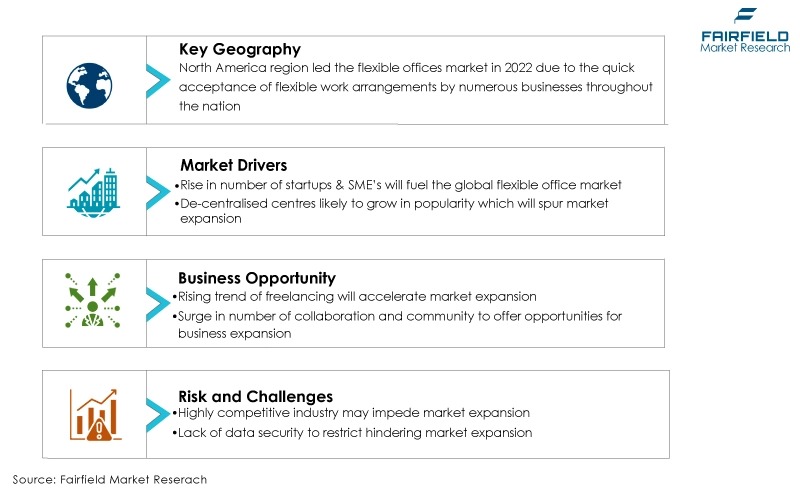
During the projected period, the expanding tendency to establish small- and medium-sized businesses and establish startup businesses in important cities would significantly contribute to the overall market increase.
In addition, startups in developing and developed areas now require a flexible office, which will drive demand for flexible offices over the projection period.
Moreover, a sizable portion of the demand for flexible offices from large multinational organisations is anticipated to impact the market's growth throughout the projected period significantly. It appears that corporate businesses are looking for flexible spaces and are, therefore, attempting to rent out flexible spaces.
- Popularity of De-centralised Centres
Since employees living in the suburbs seek to save on commute expenses and time, the focus is shifting away from major business districts and suburban cities.
The future of the flexible office market is anticipated to be heavily influenced by travel times, forcing service providers to consider decentralised sites as an alternative.
Considering the challenging macroeconomic conditions, particularly in Europe and the US, Mark Dixon, the founder and CEO of International Workplace Group (IWG), forecasts a swift transition to new suburban locations to fulfil rising demand and cut costs.
- Evolving Corporate Landscape, Coupled with Emphasis on Minimising Overhead Costs
Flexible offices have significantly increased in popularity over the past ten years due to the changing corporate landscape. Additionally, the need for flexible offices has increased significantly in recent years due to the remote working trend, which is another reason that is anticipated to propel the global flexible office market during the forecast period.
Furthermore, the prospect of working from a flexible office has become a reality as high-speed Internet access spreads across big centers in developed and emerging nations. The rise in open floor plan office spaces and the influx of several co-working places have significantly influenced the overall expansion of the worldwide flexible office market.
To obtain an advantage in the current market environment, market players operating in the flexible office industry are increasingly concentrating on striking a balance between rising real estate prices and growing technological influence.
Major Growth Barriers
- Highly Competitive Industry
The introduction of multiple companies has increased competition in the market for flexible offices. Due to this saturation, it may be difficult for individual suppliers to stand out from the competition and draw tenants.
Offering distinctive value propositions, such as specialised industry-focused facilities, cutting-edge amenities, or specialised services, is necessary to stand out among the competition.
It takes strategic planning, ongoing innovation, and a thorough understanding of market dynamics to meet these difficulties. Providers who can successfully overcome these challenges will have a better chance of dominating a market and satisfying the changing needs of professionals and enterprises.
- Lack of Data Security
The necessity for a data-centric security solution to safeguard the datasets has arisen due to the increasing volume of data being kept and used for routine operations across numerous locations of enterprises.
Employees with access to the company's databases and systems may give other employees access to sensitive data. This threat potential increases by implementing a hybrid environment across organisations where workers can work remotely or in the cloud.
As a result, direct data protection is required to create more obstacles that prevent unauthorised data distribution.
Key Trends and Opportunities to Look at
Many professionals work for multiple organisations rather than just one and are not employed by any one of them. They need a flexible office as a result to serve a certain organisation.
More than 1.5 billion people throughout the world work as independent contractors, according to a new analysis.
- Surge in Number of Collaborations and Community
- Growing Awareness
Flexible office for encouraging teamwork and community building in a shared workspace. These frequently facilitate professional networking opportunities, neighbourhood gatherings, and sector-specific initiatives that unite individuals from varied backgrounds.
People feel drowsy in their familiar surroundings and have lost interest in the traditional corporate culture at their place of employment.
Over the past ten years, the commercial real estate market has significantly changed as flexible offices and co-working spaces have gained global appeal. The global market for flexible offices is expanding due to the rising awareness of these spaces.
The introduction of flexible offices has continued to change the corporate environment, which is projected to continue during the evaluation period.
How Does the Regulatory Scenario Shape this Industry?
By implementing modifications to the current structure, government policy may ensure that the broader societal benefits of flexible working are maximised. To boost the availability and uptake of flexible working, the proposed changes to the Right to Request Flexible Working legislation aim to promote conversation between employer and employee on balancing work requirements and an individual's needs.
The UK government initially made it possible for parents and some other caretakers to request flexible working schedules in April 2003. The right included asking for a change in the place of employment, the amount of hours worked, and the corresponding work schedule. In 2014, all employees with 26 weeks of continuous employment were granted that right. Similarly, a new decision by the Fair Work Commission (FWC) Australia on December 1 stated that employees could request flexible work (about the hours, location, and/or pattern of their work), and employers must sincerely try to agree on the same.
Fairfield’s Ranking Board
Top Segments
The coworking space segment dominated the market in 2025. Due to the growing popularity of this working style among most businesses, the coworking space industry has become the largest. In contrast to the conventional practice of offices, many businesses worldwide are leasing coworking facilities.
Furthermore, the virtual offices category is projected to experience the fastest market growth. With the increased internet usage and digitisation, people have been encouraged to save time and money by developing virtual platforms that assist in carrying out business operations without owning a physical location for work. This trend of virtual offices has grown.
- Retail Sector Surges Ahead
- Big Brands Lead
In 2025, the retail sector dominated the industry. The segment's growth is attributed to the continuance of retail features that emphasise on providing a service. Retail service providers and retail operators also have long-term liabilities in addition to short-term cash flows. Users can choose from a variety of spaces that both retail operators and service providers provide. Segment growth will result during the predicted period.
The IT and communication sector is anticipated to grow substantially throughout the projected period. Due to the quick uptake of coworking patterns, the IT and communication sector has become a very successful market in terms of flexible office patterns. The IT sector is well supplied with devices and the internet, which makes it very simple for them to do business through the devices and allows them to embrace the flexible office model quickly.
The big brand segment dominated the market in 2025. Due to the enormous demand for flexible office spaces among them, the big brand segment has emerged as the largest segment. Due to the growing trend of hybrid workspaces, it is anticipated that the sector of major brands will continue to hold its position in the future. The independent brands category is expected to experience the fastest growth within the forecast time frame.
Independent brands typically own the main hub, which aids in monitoring the entire system and operation of the business. This sector of independent brands is also anticipated to make a sizable contribution to the flexible office market due to the leading market participants' rapid adoption of flexible work schedules to draw in prospective employees worldwide.
Regional Outlook
North America
In the flexible office industries, flexible office adoption is anticipated to dominate in the North American region. This is because flexible coworking spaces have been built in many locations around this region, along with the quick uptake seen in office spaces.
Additionally, the enormous quantity of disposable income readily available to individuals enables them to establish numerous work zones that will aid in maintaining the sector's operations and, as a result, significantly raise the company's profit margin.
Co-working has rapidly taken over the flexible office marketplaces in important US cities, with an average of 38% of space in Los Angeles, New York, San Francisco, and Chicago currently designated as co-working spaces.
Opportunities Appear on Asia Pacific’s Horizon
Asia Pacific has made a substantial contribution to the expansion of the flexible office market due to the quick adoption of flexible office layouts, and workspaces that multinational corporations have permitted to draw in prospective employees.
By lowering the overall cost and expense incurred on transit and other facilities, this working pattern assists the employee in amassing a sizeable amount of savings.
A flexible office approach has been used by incubator and accelerator companies operating online in nations like India, China, and Australia. As a result, such tactics are expected to accelerate the expansion of the local market for flexible offices.
Fairfield’s Competitive Landscape Analysis
The global flexible office industry is consolidated, with fewer significant competitors present worldwide. The major firms are launching new items and enhancing their distribution networks to increase their global footprint. In addition, Fairfield Market Research anticipates that there will be further market consolidation during the next few years.
Who are the Leaders in Global Flexible Office Space?
- Alley
- ShareDesk
- Davinci Virtual
- Green desk
- Serendipity Labs
- Croissant
- Hubble
- The Office Group
- We Work India
- 91Springboard
- JLL
- Industrious
- Newmark Group
- The Great Room
An Expert’s Eye
Demand and Future Growth
As per Fairfield’s Analysis, the new trend of working in a distinctive flexible office is driving the market. The rising demand for a comfortable coworking space may result in a growth in coworking flexible offices, where the flexible office is favoured in large quantities in the retail sector since it aids in efficient cash flow, increasing the need for flexible offices.
Furthermore, technological developments have greatly aided the growth and development of various flexible offices. However, the flexible office market is expected to face considerable challenges because of high industry competition and the constant threat of data security.
Supply Side of the Market
According to our analysis, flexible office product producers are concentrating on expanding the capabilities and competencies of flexible offices by offering new concepts, particularly in the coworking category, which will aid the end users in working more effectively and efficiently.
To boost productivity, accuracy, and adaptability, flexible office manufacturers are working on technologically advanced versions that combine automation and AI. Real-time monitoring and intelligent features are becoming more common.
In addition, work-from-home culture is in response to rising sudden environmental changes. This can mean implementing a work-from-home culture and bring your own device system. These might make the flexible office impact even larger.
Global Flexible Office Market is Segmented as Below:
By Type:
- Coworking space
- Private offices
- Virtual offices
- Others
By Application:
- Media and entertainment
- IT and Communications
- Retail
- Consumer goods
- Others
By Space Provider:
- Independent brands
- Big brands
By Geographic Coverage:
- North America
- Europe
- Asia Pacific
- Latin America
- Middle East & Africa
- Executive Summary
- Global Flexible Office Market Snapshot
- Future Projections
- Key Market Trends
- Regional Snapshot, by Value, 2026
- Analyst Recommendations
- Market Overview
- Market Definitions and Segmentations
- Market Dynamics
- Drivers
- Restraints
- Market Opportunities
- Value Chain Analysis
- COVID-19 Impact Analysis
- Porter's Five Forces Analysis
- Impact of Russia-Ukraine Conflict
- PESTLE Analysis
- Regulatory Analysis
- Price Trend Analysis
- Current Prices and Future Projections, 2025-2033
- Price Impact Factors
- Global Flexible Office Market Outlook, 2020 - 2033
- Global Flexible Office Market Outlook, by Type, Value (US$ Mn), 2020-2033
- Coworking space
- Private offices
- Virtual offices
- Others
- Global Flexible Office Market Outlook, by Application, Value (US$ Mn), 2020-2033
- Media and entertainment
- IT and Communications
- Retail
- Consumer goods
- Others
- Global Flexible Office Market Outlook, by Space Provider, Value (US$ Mn), 2020-2033
- Independent brands
- Big brands
- Global Flexible Office Market Outlook, by Region, Value (US$ Mn), 2020-2033
- North America
- Europe
- Asia Pacific
- Latin America
- Middle East & Africa
- Global Flexible Office Market Outlook, by Type, Value (US$ Mn), 2020-2033
- North America Flexible Office Market Outlook, 2020 - 2033
- North America Flexible Office Market Outlook, by Type, Value (US$ Mn), 2020-2033
- Coworking space
- Private offices
- Virtual offices
- Others
- North America Flexible Office Market Outlook, by Application, Value (US$ Mn), 2020-2033
- Media and entertainment
- IT and Communications
- Retail
- Consumer goods
- Others
- North America Flexible Office Market Outlook, by Space Provider, Value (US$ Mn), 2020-2033
- Independent brands
- Big brands
- North America Flexible Office Market Outlook, by Country, Value (US$ Mn), 2020-2033
- U.S. Flexible Office Market Outlook, by Type, 2020-2033
- U.S. Flexible Office Market Outlook, by Application, 2020-2033
- U.S. Flexible Office Market Outlook, by Space Provider, 2020-2033
- Canada Flexible Office Market Outlook, by Type, 2020-2033
- Canada Flexible Office Market Outlook, by Application, 2020-2033
- Canada Flexible Office Market Outlook, by Space Provider, 2020-2033
- BPS Analysis/Market Attractiveness Analysis
- North America Flexible Office Market Outlook, by Type, Value (US$ Mn), 2020-2033
- Europe Flexible Office Market Outlook, 2020 - 2033
- Europe Flexible Office Market Outlook, by Type, Value (US$ Mn), 2020-2033
- Coworking space
- Private offices
- Virtual offices
- Others
- Europe Flexible Office Market Outlook, by Application, Value (US$ Mn), 2020-2033
- Media and entertainment
- IT and Communications
- Retail
- Consumer goods
- Others
- Europe Flexible Office Market Outlook, by Space Provider, Value (US$ Mn), 2020-2033
- Independent brands
- Big brands
- Europe Flexible Office Market Outlook, by Country, Value (US$ Mn), 2020-2033
- Germany Flexible Office Market Outlook, by Type, 2020-2033
- Germany Flexible Office Market Outlook, by Application, 2020-2033
- Germany Flexible Office Market Outlook, by Space Provider, 2020-2033
- Italy Flexible Office Market Outlook, by Type, 2020-2033
- Italy Flexible Office Market Outlook, by Application, 2020-2033
- Italy Flexible Office Market Outlook, by Space Provider, 2020-2033
- France Flexible Office Market Outlook, by Type, 2020-2033
- France Flexible Office Market Outlook, by Application, 2020-2033
- France Flexible Office Market Outlook, by Space Provider, 2020-2033
- U.K. Flexible Office Market Outlook, by Type, 2020-2033
- U.K. Flexible Office Market Outlook, by Application, 2020-2033
- U.K. Flexible Office Market Outlook, by Space Provider, 2020-2033
- Spain Flexible Office Market Outlook, by Type, 2020-2033
- Spain Flexible Office Market Outlook, by Application, 2020-2033
- Spain Flexible Office Market Outlook, by Space Provider, 2020-2033
- Russia Flexible Office Market Outlook, by Type, 2020-2033
- Russia Flexible Office Market Outlook, by Application, 2020-2033
- Russia Flexible Office Market Outlook, by Space Provider, 2020-2033
- Rest of Europe Flexible Office Market Outlook, by Type, 2020-2033
- Rest of Europe Flexible Office Market Outlook, by Application, 2020-2033
- Rest of Europe Flexible Office Market Outlook, by Space Provider, 2020-2033
- BPS Analysis/Market Attractiveness Analysis
- Europe Flexible Office Market Outlook, by Type, Value (US$ Mn), 2020-2033
- Asia Pacific Flexible Office Market Outlook, 2020 - 2033
- Asia Pacific Flexible Office Market Outlook, by Type, Value (US$ Mn), 2020-2033
- Coworking space
- Private offices
- Virtual offices
- Others
- Asia Pacific Flexible Office Market Outlook, by Application, Value (US$ Mn), 2020-2033
- Media and entertainment
- IT and Communications
- Retail
- Consumer goods
- Others
- Asia Pacific Flexible Office Market Outlook, by Space Provider, Value (US$ Mn), 2020-2033
- Independent brands
- Big brands
- Asia Pacific Flexible Office Market Outlook, by Country, Value (US$ Mn), 2020-2033
- China Flexible Office Market Outlook, by Type, 2020-2033
- China Flexible Office Market Outlook, by Application, 2020-2033
- China Flexible Office Market Outlook, by Space Provider, 2020-2033
- Japan Flexible Office Market Outlook, by Type, 2020-2033
- Japan Flexible Office Market Outlook, by Application, 2020-2033
- Japan Flexible Office Market Outlook, by Space Provider, 2020-2033
- South Korea Flexible Office Market Outlook, by Type, 2020-2033
- South Korea Flexible Office Market Outlook, by Application, 2020-2033
- South Korea Flexible Office Market Outlook, by Space Provider, 2020-2033
- India Flexible Office Market Outlook, by Type, 2020-2033
- India Flexible Office Market Outlook, by Application, 2020-2033
- India Flexible Office Market Outlook, by Space Provider, 2020-2033
- Southeast Asia Flexible Office Market Outlook, by Type, 2020-2033
- Southeast Asia Flexible Office Market Outlook, by Application, 2020-2033
- Southeast Asia Flexible Office Market Outlook, by Space Provider, 2020-2033
- Rest of SAO Flexible Office Market Outlook, by Type, 2020-2033
- Rest of SAO Flexible Office Market Outlook, by Application, 2020-2033
- Rest of SAO Flexible Office Market Outlook, by Space Provider, 2020-2033
- BPS Analysis/Market Attractiveness Analysis
- Asia Pacific Flexible Office Market Outlook, by Type, Value (US$ Mn), 2020-2033
- Latin America Flexible Office Market Outlook, 2020 - 2033
- Latin America Flexible Office Market Outlook, by Type, Value (US$ Mn), 2020-2033
- Coworking space
- Private offices
- Virtual offices
- Others
- Latin America Flexible Office Market Outlook, by Application, Value (US$ Mn), 2020-2033
- Media and entertainment
- IT and Communications
- Retail
- Consumer goods
- Others
- Latin America Flexible Office Market Outlook, by Space Provider, Value (US$ Mn), 2020-2033
- Independent brands
- Big brands
- Latin America Flexible Office Market Outlook, by Country, Value (US$ Mn), 2020-2033
- Brazil Flexible Office Market Outlook, by Type, 2020-2033
- Brazil Flexible Office Market Outlook, by Application, 2020-2033
- Brazil Flexible Office Market Outlook, by Space Provider, 2020-2033
- Mexico Flexible Office Market Outlook, by Type, 2020-2033
- Mexico Flexible Office Market Outlook, by Application, 2020-2033
- Mexico Flexible Office Market Outlook, by Space Provider, 2020-2033
- Argentina Flexible Office Market Outlook, by Type, 2020-2033
- Argentina Flexible Office Market Outlook, by Application, 2020-2033
- Argentina Flexible Office Market Outlook, by Space Provider, 2020-2033
- Rest of LATAM Flexible Office Market Outlook, by Type, 2020-2033
- Rest of LATAM Flexible Office Market Outlook, by Application, 2020-2033
- Rest of LATAM Flexible Office Market Outlook, by Space Provider, 2020-2033
- BPS Analysis/Market Attractiveness Analysis
- Latin America Flexible Office Market Outlook, by Type, Value (US$ Mn), 2020-2033
- Middle East & Africa Flexible Office Market Outlook, 2020 - 2033
- Middle East & Africa Flexible Office Market Outlook, by Type, Value (US$ Mn), 2020-2033
- Coworking space
- Private offices
- Virtual offices
- Others
- Middle East & Africa Flexible Office Market Outlook, by Application, Value (US$ Mn), 2020-2033
- Media and entertainment
- IT and Communications
- Retail
- Consumer goods
- Others
- Middle East & Africa Flexible Office Market Outlook, by Space Provider, Value (US$ Mn), 2020-2033
- Independent brands
- Big brands
- Middle East & Africa Flexible Office Market Outlook, by Country, Value (US$ Mn), 2020-2033
- GCC Flexible Office Market Outlook, by Type, 2020-2033
- GCC Flexible Office Market Outlook, by Application, 2020-2033
- GCC Flexible Office Market Outlook, by Space Provider, 2020-2033
- South Africa Flexible Office Market Outlook, by Type, 2020-2033
- South Africa Flexible Office Market Outlook, by Application, 2020-2033
- South Africa Flexible Office Market Outlook, by Space Provider, 2020-2033
- Egypt Flexible Office Market Outlook, by Type, 2020-2033
- Egypt Flexible Office Market Outlook, by Application, 2020-2033
- Egypt Flexible Office Market Outlook, by Space Provider, 2020-2033
- Nigeria Flexible Office Market Outlook, by Type, 2020-2033
- Nigeria Flexible Office Market Outlook, by Application, 2020-2033
- Nigeria Flexible Office Market Outlook, by Space Provider, 2020-2033
- Rest of Middle East Flexible Office Market Outlook, by Type, 2020-2033
- Rest of Middle East Flexible Office Market Outlook, by Application, 2020-2033
- Rest of Middle East Flexible Office Market Outlook, by Space Provider, 2020-2033
- BPS Analysis/Market Attractiveness Analysis
- Middle East & Africa Flexible Office Market Outlook, by Type, Value (US$ Mn), 2020-2033
- Competitive Landscape
- Company Vs Segment Heatmap
- Company Market Share Analysis, 2025
- Competitive Dashboard
- Company Profiles
- Alley
- Company Overview
- Product Portfolio
- Financial Overview
- Business Strategies and Developments
- ShareDesk
- Davinci Virtual
- Green desk
- Serendipity Labs
- Croissant
- Hubble
- The Office Group
- We Work India
- 91Springboard
- Alley
- Appendix
- Research Methodology
- Report Assumptions
- Acronyms and Abbreviations
|
BASE YEAR |
HISTORICAL DATA |
FORECAST PERIOD |
UNITS |
|||
 |
2025 |
 |
2019 - 2024 |
 |
2026 - 2033 |
Value: US$ Billion |
|
REPORT FEATURES |
DETAILS |
|
Type Coverage |
|
|
Application Coverage |
|
|
Space Provider Coverage |
|
|
Geographical Coverage |
|
|
Leading Companies |
|
|
Report Highlights |
Key Market Indicators, Macro-micro economic impact analysis, Technological Roadmap, Key Trends, Driver, Restraints, and Future Opportunities & Revenue Pockets, Porter’s 5 Forces Analysis, Historical Trend (2019-2021), Market Estimates and Forecast, Market Dynamics, Industry Trends, Competition Landscape, Category, Region, Country-wise Trends & Analysis, COVID-19 Impact Analysis (Demand and Supply Chain) |
Our Research Methodology
Considering the volatility of business today, traditional approaches to strategizing a game plan can be unfruitful if not detrimental. True ambiguity is no way to determine a forecast. A myriad of predetermined factors must be accounted for such as the degree of risk involved, the magnitude of circumstances, as well as conditions or consequences that are not known or unpredictable. To circumvent binary views that cast uncertainty, the application of market research intelligence to strategically posture, move, and enable actionable outcomes is necessary.
View Methodology
Quality Assured
Rigorous Validation Process

Confidentiality Assured
End-to-end Data Security

Custom Research Services
Tailored To Your Objectives
FAQs
The global flexible office market achieved a market size of USD 45 Bn in 2026 and is projected to witness around 17% growth in revenue between 2026 and 2033.
North America presently holds the largest share of the global flexible office market space.
Increasing adoption and promotion of flexible offices by advertising and media agencies, technology firms, and startups are expected be the key elements driving the growth of this flexible office industry.
In 2025, the coworking space category held a significant share of the global market for flexible offices.
The retail sector constitutes a major share of the global flexible office market.
Related Reports
Sports Eyewear Market Insights, Competitive Landscape, and Market Forecast 2026–2033
Sports Eyewear Market to reach US$11.56 Bn by 2033, driven by sports participation, outdoor recreation, and prescription eyewear demand.
Gardening Hand Tools Market Insights, Competitive Landscape, and Market Forecast 2026–2033
Gardening Hand Tools Market to reach US$21.46 Bn by 2033, growing at 8.4% CAGR, driven by urban gardening, e-commerce, and sustainable tool demand.
Heritage Tourism Market Insights, Competitive Landscape, and Market Forecast 2026–2033
The heritage tourism market is expected to grow from US$648.50 billion in 2026 to US$937.12 billion by 2033, growing at a 5.4% CAGR over the forecast period.
Cooling Fabrics Market Insights, Competitive Landscape, and Market Forecast 2026–2033
The cooling fabrics market is projected to rise from US$2.30 billion in 2026 to US$3.99 billion by 2033, expanding at an 8.2% CAGR over the forecast period.
Wood and Timber Products Market Insights, Competitive Landscape, and Market Forecast 2026–2033
Wood and Timber Products Market is projected to reach US$1.52 billion by 2033, driven by construction, furniture, packaging, and sustainable timber demand.
Pet Travel Services Market Insights, Competitive Landscape, and Market Forecast 2026–2033
Pet Travel Services Market is projected to reach US$5.09 billion by 2033, driven by rising pet ownership, travel, and specialized relocation services.