



Mosquito Trap Market
Mosquito Trap Market Insights, Competitive Landscape, and Market Forecast - 2033
Global Mosquito Trap Market Forecast
The Mosquito Trap Market is expected to grow from USD 475.2 Million in 2026 to USD 724.1 Million by 2033, reflecting strong industry expansion and registering a CAGR of 6.2% during the forecast period from 2026 to 2033.
Executive Summary & Key Highlights
- Electric Shock Mosquito Killers lead the product landscape with 55% share, reflecting dominant adoption across residential areas and commercial establishments.
- The Indoor category dominates overall usage with 65% share, driven by strong residential integration and growing adoption in commercial environments.
- Offline Retail maintains channel leadership with 60% share, while Online Retail holds 40% share and continues gaining traction through digital purchasing behavior.
- Residential Areas command the end-user segment with 70% share, supported by household preference for accessible, low-maintenance mosquito trap options.
- Asia Pacific leads regionally with 45% share, driven by strong participation from China (20–25%) and India (15–18%), while North America and Europe each contribute 20% share.
- Brazil, Indonesia, and Malaysia lead globally in mosquito diversity, each hosting more than 400 species, with Brazil topping the list at 447 species and 148 endemic varieties. Other highly diverse regions include Thailand (379 species), India (338), and the Philippines (294, with a notably high 128 endemic species).
- Panama, Colombia, DR Congo, and China also rank among the top ten, with 238–264 total mosquito species each. China stands out in this group with 85 endemic species, while Panama, Colombia, and DR Congo collectively contribute to the high concentration of mosquito biodiversity across tropical climates.
Market Dynamics: Drivers, Restraints, and Opportunities Analysis
Market Drivers
- Escalating Mosquito-Borne Disease Prevalence and Public Health Response
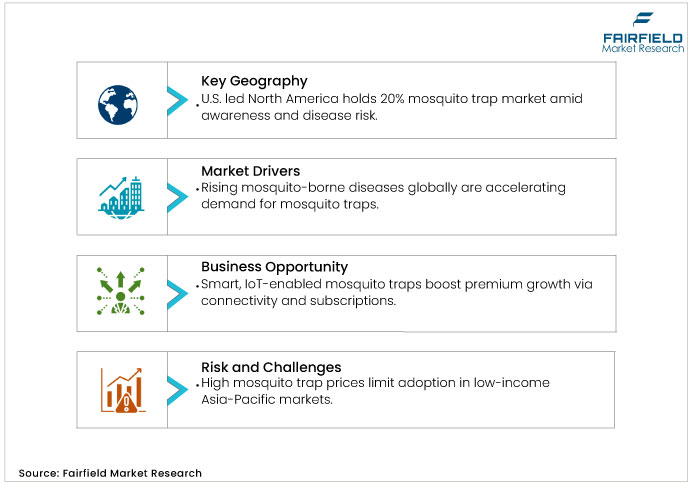
Mosquito-borne diseases remain a severe global threat, killing over one million people and infecting up to 700 million annually. Dengue, the fastest-spreading mosquito-borne disease, reached record levels in 2024 with more than 14 million cases and nearly 12,000 deaths worldwide. The trend continues in 2025, with 3.6 million cases and over 1,900 deaths reported across 94 countries, alongside major outbreaks in Samoa, Fiji, Tonga, and the Cook Islands. Rising disease incidence has become a key catalyst for mosquito trap adoption, as demand increases in line with outbreak intensity.
Public health campaigns and government subsidies in high-risk regions are accelerating the shift toward professional-grade trapping equipment among hospitals, hospitality operators, and municipal health agencies. In residential segments, persistent dengue activity is driving steady annual growth. Brands emphasizing disease-prevention benefits gain stronger market credibility, while those lacking such positioning risk losing ground in institutional procurement.
- Urbanization and Climate-Driven Habitat Expansion
Urbanization and climate variation are expanding mosquito breeding environments and enabling year-round population growth in regions previously considered low-risk. Aedes aegypti, once concentrated in tropical zones, is now establishing populations in higher-latitude areas, widening transmission windows and geographic opportunities. Growing urban density in Asia-Pacific is also increasing mosquito presence in residential and hospitality settings, boosting demand for on-premises trapping solutions.
This driver is steadily supporting market expansion across rapidly urbanizing regions, creating distinct opportunities between emerging secondary cities and mature metropolitan centers. Its long-term sustainability depends on continued urban migration patterns and climate stability assumptions used in forecasting. Ongoing monitoring is essential to maintain accurate projections and strategic alignment.
Market Restraints
- Price Sensitivity and Affordability Barriers in Developing Markets
Mosquito trap equipment pricing continues to be a major adoption barrier in lower-income segments, especially across developing Asia-Pacific mosquito trap markets, where limited disposable incomes restrict access to premium products. Although average pricing has declined due to better manufacturing efficiency and competition, affordability challenges persist. This restraint is estimated to reduce market growth by 1.5–2.0 percentage points annually in low-income regions.
These pricing limitations create a split competitive landscape, with premium brands targeting higher-income consumers while regional manufacturers compete on volume through aggressive pricing. Mitigation pathways include subscription or rental models, government-supported subsidy programs in endemic zones, and diversified product portfolios across multiple price tiers. These approaches help broaden accessibility and reduce price-driven adoption barriers.
- Seasonal Demand Fluctuation and Market Predictability Challenges
Mosquito trap market demand is highly seasonal, shaped by climatic cycles and mosquito population patterns, creating challenges for supply chain planning and inventory management. Northern Hemisphere regions see peak demand in spring and summer, while tropical markets maintain more stable year-round activity.
Mitigation approaches include diversifying geographic exposure across hemispheric markets and expanding product portfolios into complementary pest-control categories with different seasonal profiles. Companies can also increase focus on commercial segments, where year-round demand aligns more closely with stable industrial utilization. These strategies help counteract cash flow volatility and improve operational continuity.
Market Opportunities
- Technological Integration with Smart Home and IoT Ecosystems
Integration of mosquito trap equipment with smart home platforms is creating strong expansion potential, as manufacturers introduce connected devices with remote monitoring, automated schedules, and performance analytics via IoT-enabled applications. This technological convergence supports premium pricing, subscription-based monitoring services, and differentiated positioning among tech-oriented consumers. The addressable opportunity for IoT-integrated traps is estimated to grow at 15–20% annually within early-adopter segments.
Market penetration is expected to accelerate as price premiums for connectivity features decline through scale efficiencies and wider ecosystem adoption. These connected solutions allow brands to expand recurring-revenue models and strengthen customer retention in smart-home categories. As integration costs fall, mass-market uptake is likely to increase, widening the overall growth trajectory for IoT-enabled mosquito control devices.
- Commercial and Institutional Market Expansion in Healthcare and Hospitality
Commercial establishments, including hospitals, hotels, restaurants, and care facilities form the fastest-growing mosquito trap market segment, expanding 2–3 percentage points faster than residential segments. These institutions face rising pressure to uphold disease-prevention standards and maintain insect-free environments for guest and patient safety. Post-pandemic hospitality recovery and increased healthcare investment are further strengthening demand for professional-grade mosquito control systems.
This opportunity segment is currently estimated to account for 25–30% of total market value and is expanding at accelerated rates. Its concentrated purchasing power makes it a primary growth vector for enterprise-focused manufacturers and distribution partners. As regulatory expectations and operational standards rise, commercial buyers continue to drive strong, sustained adoption.
Regional Market Assessment: Strategic Geography Analysis
- North America Market: Mature Market Dynamics and Regulatory Framework
The North American mosquito trap market, led by the U.S., accounts for 20% of global mosquito trap value, totaling US$90 million in 2025, supported by high consumer awareness and low endemic disease transmission risk. Mosquito-borne diseases remain a concern across North America, shaped by diverse species and changing environmental conditions. In the United States, malaria was once widespread well into the 20th century, and competent Anopheles species, particularly An. freeborni and An. quadrimaculatus—are still present. Over the past 50 years, more than 150 locally acquired malaria cases and over 60 limited outbreaks have been recorded, alongside more than 2,000 annual cases, primarily among returning travelers. States with the highest mosquito populations include Florida, Texas, Louisiana, Georgia, North Carolina, Alabama, South Dakota, Oklahoma, Montana, and Virginia.
In Canada, approximately 80 mosquito species are known, though only a small proportion can transmit disease due to harsh winters. West Nile Virus (WNV) remains the most significant threat, with cases reported across all provinces except Newfoundland and the Territories. Other endemic viruses such as Eastern equine encephalitis (EEEV), Jamestown Canyon virus (JCV), and snowshoe hare virus (SSHV) occur in smaller numbers.
These evolving disease risks are driving the North American mosquito control market. Growth is reinforced by the climate-driven expansion of Aedes aegypti, increased investment in outdoor living, and strong hospitality-sector demand. However, strict EPA and provincial regulations require rigorous testing and compliance. Innovation—particularly IoT-enabled traps and photocatalytic technologies—continues to shape competitive strategies across residential, commercial, and municipal applications.
- Europe: Regulatory Harmonization and Sustainability Integration
The European mosquito trap market is projected to reach US$108 million in 2025, accounting for 20% of global market value. Regional demand varies significantly, with Germany representing 18–20% and the U.K. contributing 10–15%, reflecting differences in climate conditions, mosquito species distribution, and disease-risk exposure. Europe’s regulatory environment—guided by EU Directive 2009/128/EC and strict national environmental policies—prioritizes sustainability, reduced chemical usage, and standardized safety. This framework is accelerating the shift toward non-chemical trap technologies, while also imposing stringent compliance requirements that influence product design, testing, and commercialization timelines.
Parallel to these market forces, Europe is entering a new public-health phase. According to ECDC (2025), mosquito-borne diseases are becoming more frequent, widespread, and intense, signaling a “new normal” for the region. Aedes albopictus, the mosquito capable of spreading chikungunya virus, is now established in 16 countries and 369 regions, compared with just 114 regions a decade ago. Increased international travel further elevates outbreak risk, with Europe recording 27 chikungunya outbreaks in 2025 the highest ever. The first locally acquired case in France’s Alsace region marks an unprecedented northward shift in transmission risk.
This growing epidemiological pressure strengthens demand for advanced mosquito control solutions across Europe. Regions show strong willingness to adopt premium, IoT-enabled, performance-monitoring traps, while successful market expansion depends on navigating country-specific regulations, competitive dynamics, and evolving consumer expectations.
- Asia-Pacific: Rapid Growth and Market Leadership
The Asia-Pacific region dominates the global mosquito trap market with a 45% share, valued at US$202.5 million in 2025 and projected to surpass US$314.68 million by 2032. Market expansion is closely linked to the region’s escalating mosquito-borne disease burden. According to UNITEDengue.org, Asia-Pacific recorded over 1.5 million dengue cases in 2025, along with major chikungunya outbreaks—including the largest ever documented in China with more than 16,000 cases—while Zika surveillance remains active. Monsoon-driven humidity, rapid urbanization, and climate variability continue to create ideal breeding conditions for Aedes mosquitoes.
Within the region, China contributes 20–25% of total market value, driven by persistent disease prevalence, urban density, and growing middle-class adoption of prevention products, though high competition constrains margins. India holds 15–18% and represents the fastest-growing national market, expanding at 8–10% annually as rising incomes and health awareness fuel residential and institutional demand. ASEAN markets—including Indonesia, Thailand, and Vietnam—represent 10–15% of regional value and grow 7–9% annually, supported by tourism, urban expansion, and public-sector procurement. In contrast, Japan’s mature market grows at 4–5%, reflecting lower disease risk and stable product penetration.
Asia-Pacific’s strong manufacturing ecosystem and supply chain depth enable rapid product innovation and cost competitiveness. To succeed, companies must tailor strategies to each market’s growth profile, regulatory environment, and evolving consumer expectations, particularly in high-opportunity regions such as India and Southeast Asia.
Competitive Landscape: Market Structure and Strategic Positioning
The global mosquito trap market is moderately to highly fragmented, with leadership held by multinational players such as Mosquito Magnet, Good Riddance, and Insect Shield, alongside numerous regional manufacturers. The top five companies collectively hold 30–35% of global market share, reflecting moderate consolidation with strong regional variation. Competitive differentiation focuses on technology leadership including photocatalytic and IoT-integrated solutions cost-efficiency, geographic targeting, and specialization in commercial or premium residential segments.
Entry barriers remain moderate due to manufacturing capital needs, regulatory certification costs, advanced technology requirements, and established distribution relationships. Consolidation activity is limited, with M&A primarily centered on technology acquisition and geographic expansion rather than broad industry roll-ups. This environment sustains fluid market share dynamics and ongoing competitive intensity across global and regional participants.
Key Players
• Woodstream Corp.
• Inzecto Corp.
• TNT Mosquito LLC.
• Novelty Manufacturing Co.
• Milo Enterprises Inc.
• Armatron International Inc.
• Kensizer Inc.
• Awoco
• Shenzhen Tesenni Industrial Co Ltd.
• Biogents AG
Global Mosquito Trap Market Segmentation-
By Product Type:
• Electric Shock Mosquito Killer
• Photocatalytic Mosquito Killer
• Sticky Trap Mosquito Killer
By Category:
• Indoor
• Outdoor
By Distribution Channel:
• Online Retail
• Offline Retail
• Wholesalers/Distributors
• Hypermarket/Supermarket
• Specialty Stores
By End User:
• Residential Areas
• Commercial Establishments
• Public Sector
By Region:
• North America
• Europe
• Asia Pacific
• Latin America
• Middle East & Africa
- Executive Summary
- Global Mosquito Trap Market Snapshot
- Future Projections
- Key Market Trends
- Regional Snapshot, by Value, 2026
- Analyst Recommendations
- Market Overview
- Market Definitions and Segmentations
- Market Dynamics
- Drivers
- Restraints
- Market Opportunities
- Value Chain Analysis
- COVID-19 Impact Analysis
- Porter's Five Forces Analysis
- Impact of Russia-Ukraine Conflict
- PESTLE Analysis
- Regulatory Analysis
- Price Trend Analysis
- Current Prices and Future Projections, 2025-2033
- Price Impact Factors
- Global Mosquito Trap Market Outlook, 2020 - 2033
- Global Mosquito Trap Market Outlook, by Product Type, Value (US$ Mn), 2020-2033
- Electric Shock Mosquito Killer
- Photocatalytic Mosquito Killer
- Sticky Trap Mosquito Killer
- Global Mosquito Trap Market Outlook, by Category, Value (US$ Mn), 2020-2033
- Indoor
- Outdoor
- Global Mosquito Trap Market Outlook, by Distribution Channel, Value (US$ Mn), 2020-2033
- Online Retail
- Offline Retail
- Wholesalers/Distributors
- Hypermarket/Supermarket
- Specialty Stores
- Global Mosquito Trap Market Outlook, by End User, Value (US$ Mn), 2020-2033
- Residential Areas
- Commercial Establishments
- Public Sector
- Global Mosquito Trap Market Outlook, by Region, Value (US$ Mn), 2020-2033
- North America
- Europe
- Asia Pacific
- Latin America
- Middle East & Africa
- Global Mosquito Trap Market Outlook, by Product Type, Value (US$ Mn), 2020-2033
- North America Mosquito Trap Market Outlook, 2020 - 2033
- North America Mosquito Trap Market Outlook, by Product Type, Value (US$ Mn), 2020-2033
- Electric Shock Mosquito Killer
- Photocatalytic Mosquito Killer
- Sticky Trap Mosquito Killer
- North America Mosquito Trap Market Outlook, by Category, Value (US$ Mn), 2020-2033
- Indoor
- Outdoor
- North America Mosquito Trap Market Outlook, by Distribution Channel, Value (US$ Mn), 2020-2033
- Online Retail
- Offline Retail
- Wholesalers/Distributors
- Hypermarket/Supermarket
- Specialty Stores
- North America Mosquito Trap Market Outlook, by End User, Value (US$ Mn), 2020-2033
- Residential Areas
- Commercial Establishments
- Public Sector
- North America Mosquito Trap Market Outlook, by Country, Value (US$ Mn), 2020-2033
- U.S. Mosquito Trap Market Outlook, by Product Type, 2020-2033
- U.S. Mosquito Trap Market Outlook, by Category, 2020-2033
- U.S. Mosquito Trap Market Outlook, by Distribution Channel, 2020-2033
- U.S. Mosquito Trap Market Outlook, by End User, 2020-2033
- Canada Mosquito Trap Market Outlook, by Product Type, 2020-2033
- Canada Mosquito Trap Market Outlook, by Category, 2020-2033
- Canada Mosquito Trap Market Outlook, by Distribution Channel, 2020-2033
- Canada Mosquito Trap Market Outlook, by End User, 2020-2033
- BPS Analysis/Market Attractiveness Analysis
- North America Mosquito Trap Market Outlook, by Product Type, Value (US$ Mn), 2020-2033
- Europe Mosquito Trap Market Outlook, 2020 - 2033
- Europe Mosquito Trap Market Outlook, by Product Type, Value (US$ Mn), 2020-2033
- Electric Shock Mosquito Killer
- Photocatalytic Mosquito Killer
- Sticky Trap Mosquito Killer
- Europe Mosquito Trap Market Outlook, by Category, Value (US$ Mn), 2020-2033
- Indoor
- Outdoor
- Europe Mosquito Trap Market Outlook, by Distribution Channel, Value (US$ Mn), 2020-2033
- Online Retail
- Offline Retail
- Wholesalers/Distributors
- Hypermarket/Supermarket
- Specialty Stores
- Europe Mosquito Trap Market Outlook, by End User, Value (US$ Mn), 2020-2033
- Residential Areas
- Commercial Establishments
- Public Sector
- Europe Mosquito Trap Market Outlook, by Country, Value (US$ Mn), 2020-2033
- Germany Mosquito Trap Market Outlook, by Product Type, 2020-2033
- Germany Mosquito Trap Market Outlook, by Category, 2020-2033
- Germany Mosquito Trap Market Outlook, by Distribution Channel, 2020-2033
- Germany Mosquito Trap Market Outlook, by End User, 2020-2033
- Italy Mosquito Trap Market Outlook, by Product Type, 2020-2033
- Italy Mosquito Trap Market Outlook, by Category, 2020-2033
- Italy Mosquito Trap Market Outlook, by Distribution Channel, 2020-2033
- Italy Mosquito Trap Market Outlook, by End User, 2020-2033
- France Mosquito Trap Market Outlook, by Product Type, 2020-2033
- France Mosquito Trap Market Outlook, by Category, 2020-2033
- France Mosquito Trap Market Outlook, by Distribution Channel, 2020-2033
- France Mosquito Trap Market Outlook, by End User, 2020-2033
- U.K. Mosquito Trap Market Outlook, by Product Type, 2020-2033
- U.K. Mosquito Trap Market Outlook, by Category, 2020-2033
- U.K. Mosquito Trap Market Outlook, by Distribution Channel, 2020-2033
- U.K. Mosquito Trap Market Outlook, by End User, 2020-2033
- Spain Mosquito Trap Market Outlook, by Product Type, 2020-2033
- Spain Mosquito Trap Market Outlook, by Category, 2020-2033
- Spain Mosquito Trap Market Outlook, by Distribution Channel, 2020-2033
- Spain Mosquito Trap Market Outlook, by End User, 2020-2033
- Russia Mosquito Trap Market Outlook, by Product Type, 2020-2033
- Russia Mosquito Trap Market Outlook, by Category, 2020-2033
- Russia Mosquito Trap Market Outlook, by Distribution Channel, 2020-2033
- Russia Mosquito Trap Market Outlook, by End User, 2020-2033
- Rest of Europe Mosquito Trap Market Outlook, by Product Type, 2020-2033
- Rest of Europe Mosquito Trap Market Outlook, by Category, 2020-2033
- Rest of Europe Mosquito Trap Market Outlook, by Distribution Channel, 2020-2033
- Rest of Europe Mosquito Trap Market Outlook, by End User, 2020-2033
- BPS Analysis/Market Attractiveness Analysis
- Europe Mosquito Trap Market Outlook, by Product Type, Value (US$ Mn), 2020-2033
- Asia Pacific Mosquito Trap Market Outlook, 2020 - 2033
- Asia Pacific Mosquito Trap Market Outlook, by Product Type, Value (US$ Mn), 2020-2033
- Electric Shock Mosquito Killer
- Photocatalytic Mosquito Killer
- Sticky Trap Mosquito Killer
- Asia Pacific Mosquito Trap Market Outlook, by Category, Value (US$ Mn), 2020-2033
- Indoor
- Outdoor
- Asia Pacific Mosquito Trap Market Outlook, by Distribution Channel, Value (US$ Mn), 2020-2033
- Online Retail
- Offline Retail
- Wholesalers/Distributors
- Hypermarket/Supermarket
- Specialty Stores
- Asia Pacific Mosquito Trap Market Outlook, by End User, Value (US$ Mn), 2020-2033
- Residential Areas
- Commercial Establishments
- Public Sector
- Asia Pacific Mosquito Trap Market Outlook, by Country, Value (US$ Mn), 2020-2033
- China Mosquito Trap Market Outlook, by Product Type, 2020-2033
- China Mosquito Trap Market Outlook, by Category, 2020-2033
- China Mosquito Trap Market Outlook, by Distribution Channel, 2020-2033
- China Mosquito Trap Market Outlook, by End User, 2020-2033
- Japan Mosquito Trap Market Outlook, by Product Type, 2020-2033
- Japan Mosquito Trap Market Outlook, by Category, 2020-2033
- Japan Mosquito Trap Market Outlook, by Distribution Channel, 2020-2033
- Japan Mosquito Trap Market Outlook, by End User, 2020-2033
- South Korea Mosquito Trap Market Outlook, by Product Type, 2020-2033
- South Korea Mosquito Trap Market Outlook, by Category, 2020-2033
- South Korea Mosquito Trap Market Outlook, by Distribution Channel, 2020-2033
- South Korea Mosquito Trap Market Outlook, by End User, 2020-2033
- India Mosquito Trap Market Outlook, by Product Type, 2020-2033
- India Mosquito Trap Market Outlook, by Category, 2020-2033
- India Mosquito Trap Market Outlook, by Distribution Channel, 2020-2033
- India Mosquito Trap Market Outlook, by End User, 2020-2033
- Southeast Asia Mosquito Trap Market Outlook, by Product Type, 2020-2033
- Southeast Asia Mosquito Trap Market Outlook, by Category, 2020-2033
- Southeast Asia Mosquito Trap Market Outlook, by Distribution Channel, 2020-2033
- Southeast Asia Mosquito Trap Market Outlook, by End User, 2020-2033
- Rest of SAO Mosquito Trap Market Outlook, by Product Type, 2020-2033
- Rest of SAO Mosquito Trap Market Outlook, by Category, 2020-2033
- Rest of SAO Mosquito Trap Market Outlook, by Distribution Channel, 2020-2033
- Rest of SAO Mosquito Trap Market Outlook, by End User, 2020-2033
- BPS Analysis/Market Attractiveness Analysis
- Asia Pacific Mosquito Trap Market Outlook, by Product Type, Value (US$ Mn), 2020-2033
- Latin America Mosquito Trap Market Outlook, 2020 - 2033
- Latin America Mosquito Trap Market Outlook, by Product Type, Value (US$ Mn), 2020-2033
- Electric Shock Mosquito Killer
- Photocatalytic Mosquito Killer
- Sticky Trap Mosquito Killer
- Latin America Mosquito Trap Market Outlook, by Category, Value (US$ Mn), 2020-2033
- Indoor
- Outdoor
- Latin America Mosquito Trap Market Outlook, by Distribution Channel, Value (US$ Mn), 2020-2033
- Online Retail
- Offline Retail
- Wholesalers/Distributors
- Hypermarket/Supermarket
- Specialty Stores
- Latin America Mosquito Trap Market Outlook, by End User, Value (US$ Mn), 2020-2033
- Residential Areas
- Commercial Establishments
- Public Sector
- Latin America Mosquito Trap Market Outlook, by Country, Value (US$ Mn), 2020-2033
- Brazil Mosquito Trap Market Outlook, by Product Type, 2020-2033
- Brazil Mosquito Trap Market Outlook, by Category, 2020-2033
- Brazil Mosquito Trap Market Outlook, by Distribution Channel, 2020-2033
- Brazil Mosquito Trap Market Outlook, by End User, 2020-2033
- Mexico Mosquito Trap Market Outlook, by Product Type, 2020-2033
- Mexico Mosquito Trap Market Outlook, by Category, 2020-2033
- Mexico Mosquito Trap Market Outlook, by Distribution Channel, 2020-2033
- Mexico Mosquito Trap Market Outlook, by End User, 2020-2033
- Argentina Mosquito Trap Market Outlook, by Product Type, 2020-2033
- Argentina Mosquito Trap Market Outlook, by Category, 2020-2033
- Argentina Mosquito Trap Market Outlook, by Distribution Channel, 2020-2033
- Argentina Mosquito Trap Market Outlook, by End User, 2020-2033
- Rest of LATAM Mosquito Trap Market Outlook, by Product Type, 2020-2033
- Rest of LATAM Mosquito Trap Market Outlook, by Category, 2020-2033
- Rest of LATAM Mosquito Trap Market Outlook, by Distribution Channel, 2020-2033
- Rest of LATAM Mosquito Trap Market Outlook, by End User, 2020-2033
- BPS Analysis/Market Attractiveness Analysis
- Latin America Mosquito Trap Market Outlook, by Product Type, Value (US$ Mn), 2020-2033
- Middle East & Africa Mosquito Trap Market Outlook, 2020 - 2033
- Middle East & Africa Mosquito Trap Market Outlook, by Product Type, Value (US$ Mn), 2020-2033
- Electric Shock Mosquito Killer
- Photocatalytic Mosquito Killer
- Sticky Trap Mosquito Killer
- Middle East & Africa Mosquito Trap Market Outlook, by Category, Value (US$ Mn), 2020-2033
- Indoor
- Outdoor
- Middle East & Africa Mosquito Trap Market Outlook, by Distribution Channel, Value (US$ Mn), 2020-2033
- Online Retail
- Offline Retail
- Wholesalers/Distributors
- Hypermarket/Supermarket
- Specialty Stores
- Middle East & Africa Mosquito Trap Market Outlook, by End User, Value (US$ Mn), 2020-2033
- Residential Areas
- Commercial Establishments
- Public Sector
- Middle East & Africa Mosquito Trap Market Outlook, by Country, Value (US$ Mn), 2020-2033
- GCC Mosquito Trap Market Outlook, by Product Type, 2020-2033
- GCC Mosquito Trap Market Outlook, by Category, 2020-2033
- GCC Mosquito Trap Market Outlook, by Distribution Channel, 2020-2033
- GCC Mosquito Trap Market Outlook, by End User, 2020-2033
- South Africa Mosquito Trap Market Outlook, by Product Type, 2020-2033
- South Africa Mosquito Trap Market Outlook, by Category, 2020-2033
- South Africa Mosquito Trap Market Outlook, by Distribution Channel, 2020-2033
- South Africa Mosquito Trap Market Outlook, by End User, 2020-2033
- Egypt Mosquito Trap Market Outlook, by Product Type, 2020-2033
- Egypt Mosquito Trap Market Outlook, by Category, 2020-2033
- Egypt Mosquito Trap Market Outlook, by Distribution Channel, 2020-2033
- Egypt Mosquito Trap Market Outlook, by End User, 2020-2033
- Nigeria Mosquito Trap Market Outlook, by Product Type, 2020-2033
- Nigeria Mosquito Trap Market Outlook, by Category, 2020-2033
- Nigeria Mosquito Trap Market Outlook, by Distribution Channel, 2020-2033
- Nigeria Mosquito Trap Market Outlook, by End User, 2020-2033
- Rest of Middle East Mosquito Trap Market Outlook, by Product Type, 2020-2033
- Rest of Middle East Mosquito Trap Market Outlook, by Category, 2020-2033
- Rest of Middle East Mosquito Trap Market Outlook, by Distribution Channel, 2020-2033
- Rest of Middle East Mosquito Trap Market Outlook, by End User, 2020-2033
- BPS Analysis/Market Attractiveness Analysis
- Middle East & Africa Mosquito Trap Market Outlook, by Product Type, Value (US$ Mn), 2020-2033
- Competitive Landscape
- Company Vs Segment Heatmap
- Company Market Share Analysis, 2025
- Competitive Dashboard
- Company Profiles
- Woodstream Corp.
- Company Overview
- Product Portfolio
- Financial Overview
- Business Strategies and Developments
- Inzecto Corp.
- TNT Mosquito LLC.
- Novelty Manufacturing Co.
- Milo Enterprises Inc.
- Armatron International Inc.
- Kensizer Inc.
- Awoco
- Shenzhen Tesenni Industrial Co Ltd.
- Biogents AG
- Woodstream Corp.
- Appendix
- Research Methodology
- Report Assumptions
- Acronyms and Abbreviations
|
BASE YEAR |
HISTORICAL DATA |
FORECAST PERIOD |
UNITS |
|||
 |
2025 |
 |
2020 - 2025 |
 |
2026 - 2033 |
Value: US$ Billion |
Our Research Methodology
Considering the volatility of business today, traditional approaches to strategizing a game plan can be unfruitful if not detrimental. True ambiguity is no way to determine a forecast. A myriad of predetermined factors must be accounted for such as the degree of risk involved, the magnitude of circumstances, as well as conditions or consequences that are not known or unpredictable. To circumvent binary views that cast uncertainty, the application of market research intelligence to strategically posture, move, and enable actionable outcomes is necessary.
View Methodology
Quality Assured
Rigorous Validation Process

Confidentiality Assured
End-to-end Data Security

Custom Research Services
Tailored To Your Objectives
FAQs
The Mosquito Trap market is expected to reach USD 475.2 million in 2026.
The Mosquito Trap market is projected to grow at a 6.2% CAGR through 2033.
The Mosquito Trap market growth is driven by rising mosquito-borne disease prevalence, rapid urbanization and climate-driven habitat expansion, and increasing adoption of smart IoT-enabled mosquito control solutions.
Asia Pacific is the dominating region for the mosquito trap market.
Woodstream Corp., Inzecto Corp., TNT Mosquito LLC, Biogents AG, and Armatron International Inc. are some of the leading industry players in the Mosquito Trap market.
Related Reports
Heritage Tourism Market Insights, Competitive Landscape, and Market Forecast 2026–2033
The heritage tourism market is expected to grow from US$648.50 billion in 2026 to US$937.12 billion by 2033, growing at a 5.4% CAGR over the forecast period.
Cooling Fabrics Market Insights, Competitive Landscape, and Market Forecast 2026–2033
The cooling fabrics market is projected to rise from US$2.30 billion in 2026 to US$3.99 billion by 2033, expanding at an 8.2% CAGR over the forecast period.
Wood and Timber Products Market Insights, Competitive Landscape, and Market Forecast 2026–2033
Wood and Timber Products Market is projected to reach US$1.52 billion by 2033, driven by construction, furniture, packaging, and sustainable timber demand.
Pet Travel Services Market Insights, Competitive Landscape, and Market Forecast 2026–2033
Pet Travel Services Market is projected to reach US$5.09 billion by 2033, driven by rising pet ownership, travel, and specialized relocation services.
Natural Hair Care Products Market Insights, Competitive Landscape, and Market Forecast 2026–2033
Natural Hair Care Products Market is set for strong growth, driven by clean beauty trends, ingredient regulations, and rising demand for textured-hair care
Decorated Apparel Market Insights, Competitive Landscape, and Market Forecast 2026–2033
Decorated Apparel Market is projected to reach US$98 billion by 2033, driven by e-commerce, on-demand printing, customization and digital printing