



Flying Bikes Market
Flying Bikes Market Size, Share, Insights, Competitive Landscape, and Forecast 2026 to 2033
Flying Bikes Market Size and Trend Analysis
How Large Is the Flying Bike Market Today?
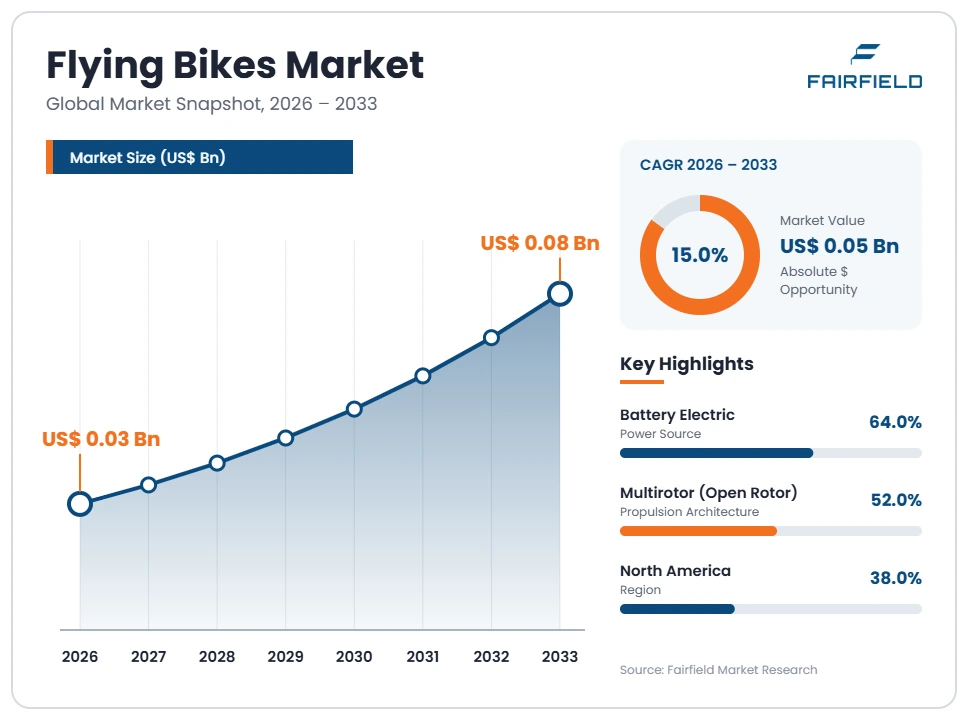
The global Flying Bikes market size is expected to be valued at US$ 0.03 billion in 2026 and projected to reach US$ 0.08 billion by 2033, growing at a CAGR of 15.0% between 2026 and 2033.
In plain figures that is about US$ 30 million in 2026 rising to roughly US$ 80 million by 2033, against an estimated US$ 26 million in 2025 and a 14.2% CAGR since 2020. This is not a market in the ordinary sense. No flying bike is certified or in series production, annual deliveries are counted in dozens, and buyers are collectors, demonstration operators, and research institutions. Growth rests on three contingencies: an ultralight or purpose-built certification route, meaningful gains in battery energy density, and continued discretionary spending by a very small customer base. The forecast is therefore speculative.
Key Report Takeaways
- By Propulsion Architecture: Multirotor open-rotor designs held 52% share in 2026, while ducted-fan machines are projected to expand at an 18.9% CAGR through 2033, driven by the blade-strike protection that shrouds provide near people.
- By Power Source: Battery-electric craft held 64% share in 2026, while hybrid-electric systems are projected to expand at a 19.4% CAGR through 2033, because an onboard generator is the only practical way to extend flight beyond a few minutes.
- By Regulatory Class: Uncertified demonstration platforms held 46% share in 2026, while ultralight-class machines are projected to expand at a 20.2% CAGR through 2033, reflecting the only realistic legal operating route in the United States.
- By End User: Private collectors held 41% share in 2026, while public safety trial programmes are projected to expand at a 21.5% CAGR through 2033, supported by agency evaluation budgets rather than consumer demand.
- By Geography: North America held 38% share in 2026, while Middle East & Africa is projected to expand at a 19.8% CAGR through 2033, on government-funded demonstration and tourism showcase spending.
Global Flying Bikes Market Trends and Insights
Drivers Impact Analysis
Two narrow forces explain almost all of the incremental spending on personal flying craft through 2033.
| Driver | Impact on CAGR Forecast | Geographic Relevance | Impact Timeline |
| Falling cost of high-power electric motors, controllers, and cells | Medium | Global, led by North America and Asia Pacific | Medium term (2–4 years) |
| Ultralight vehicle rules providing a legal operating route for single-seat craft | High | North America | Short term (≤2 years) |
Cheaper Electric Powertrains Make Low-Volume Hoverbike Builds Financially Possible
Component cost decline is the main reason small teams can build hoverbikes at all. High-power brushless motors, electronic speed controllers, lithium cells, and flight controllers all became far cheaper and more capable through the growth of large uncrewed aircraft and electric vehicle supply chains. A builder today can assemble a flyable single-seat multirotor for a fraction of what the same airframe would have cost a decade ago.
The causal chain runs from adjacent industries rather than from aviation itself. Electric vehicle cell manufacturing in China, South Korea, and the United States drove down pack costs, while industrial drone production standardised motor and controller hardware. Carbon fibre tube and plate fabrication is now a commodity service. These inputs let a company fund a prototype programme from private capital alone, which is why the field consists of small firms rather than established aerospace manufacturers.
Ultralight Vehicle Rules Give Single-Seat Hoverbikes Their Only Legal Route to Flight
Ultralight regulation is the practical gateway to lawful operation in the United States. Part 103 of the Federal Aviation Administration rules allows a single-seat vehicle to fly without aircraft certification or a pilot certificate, provided it stays within strict empty weight, speed, and fuel limits. Several flying bike designs are engineered specifically to those numbers, because the alternative is an experimental airworthiness certificate with far tighter operating conditions.
The mechanism is regulatory arbitrage, not technical progress. Meeting the weight limit forces minimal airframes and small battery packs, which is one reason endurance stays short. Part 103 also prohibits operation over congested areas, so lawful flights happen over private land, deserts, and closed venues. That constraint shapes the entire product: machines are designed for open-area recreational and demonstration flying rather than for transport.
Restraints Impact Analysis
Two fundamental constraints keep the personal air vehicle category below commercial scale.
| Restraint | Impact on CAGR Forecast | Geographic Relevance | Impact Timeline |
| No purpose-built certification pathway for single-seat flying bikes | High | Global | Long term (≥4 years) |
| Battery energy density capping endurance at a few minutes | High | Global | Long term (≥4 years) |
Missing Certification Pathways Keep Flying Bikes Out of Series Production
The absence of a certification route is the reason no flying bike reaches series production. No civil aviation authority has written airworthiness standards purpose-built for a single-occupant hoverbike. The European Union Aviation Safety Agency issued a special condition covering small-category vertical take-off and landing aircraft, and the Federal Aviation Administration created a powered-lift framework, but both were written around passenger-carrying air taxis rather than open-frame personal craft.
The underlying cause is a mismatch between the product and the regulatory categories available. Certification cost for a small aircraft type runs to tens of millions of dollars, a figure no company selling dozens of units can recover. Manufacturers therefore operate as uncertified demonstrators, experimental aircraft, or ultralights. Each route caps where, how, and for whom the machine can fly, which in turn caps addressable demand to collectors, venues, and research buyers.
Battery Energy Density Limits Hoverbike Endurance to a Handful of Minutes
Short endurance is the hard physical ceiling on this category. Hovering is the most power-hungry mode of flight, and a multirotor carrying an adult pilot draws tens of kilowatts continuously. With current lithium-ion cells, practical flight time for a battery-electric flying bike is commonly between five and fifteen minutes, including reserves. That makes the machine a recreational or demonstration device rather than a means of travel.
The specific constraint is gravimetric energy density. Commercial lithium-ion packs deliver roughly 250 to 300 watt-hours per kilogram at cell level and less once structure, cooling, and wiring are included, against several thousand for aviation fuel. Adding cells adds weight, which raises hover power, producing rapidly diminishing returns. Solid-state and lithium-sulphur chemistries may improve this, but neither is available at the discharge rates hovering demands.
Market Opportunities
Two revenue pools are realistically open to flying bike developers within the forecast period.
Demonstration, Venue, and Tourism Flying Opens the Nearest Revenue Pool
Paid demonstration flying is the most accessible revenue pool because it does not require certification or customer pilot training. Theme parks, motorsport circuits, air shows, resort operators, and brand activation agencies pay for spectacle, and a hovering single-seat craft delivers it. Revenue arrives as show fees, sponsorship, and tethered experience rides rather than as unit sales, which suits companies producing a handful of airframes a year.
Developers with experienced display pilots and reliable, maintainable airframes are best placed to capture this. The demand comes from entertainment and tourism operators in the United States, the United Arab Emirates, Japan, and Saudi Arabia, where large event budgets exist. Supporting this pool are the drone show industry’s established safety case templates and venue airspace waivers, which give operators a documented route to permission for low-altitude flying over controlled crowds.
Public Safety and Defence Evaluation Programmes Create Funded Demand
Agency evaluation contracts form the second pool, and they pay for development rather than for volume. Police, civil defence, border, and military organisations have an interest in rapid single-person movement over obstructed terrain, and they fund trials long before procurement. These contracts cover engineering time, which matters far more to a small developer than a single retail sale.
Firms with existing aerospace or defence contracting experience can capture this most easily, since the requirement is documentation and test discipline rather than consumer polish. Demand originates with search and rescue units, wildfire reconnaissance teams, and special operations groups evaluating alternatives to small helicopters. Supporting it are the national uncrewed systems test ranges and military innovation units that give unconventional aircraft a controlled place to fly, which no commercial venue can offer.
Segment Analysis
- By Propulsion Architecture: Open Rotors Lead While Ducted Fans Gain Ground
Multirotor open-rotor designs held 52% of flying bike revenue in 2026, the leading architecture. They dominate because they are the cheapest and best-understood configuration, drawing directly on large uncrewed aircraft hardware and control software. Ducted-fan machines hold about 27%, hybrid turbine designs 14%, and direct jet-thrust platforms the remaining 7%.
Ducted-fan architectures are the fastest-growing at an 18.9% CAGR through 2033. Shrouds raise static thrust efficiency modestly and, more importantly, shield exposed blades from people and obstacles, which is central to any safety case for flying near crowds or in urban trials. Jet-thrust platforms deliver the highest speed but consume fuel rapidly and demand exceptional pilot skill. The implication is that architecture choice now follows regulatory strategy: builders chasing demonstration permissions favour ducts, while cost-led recreational builders stay with open rotors.
- By Power Source: Battery-Electric Dominance Meets Hybrid-Electric Acceleration
Battery-electric systems accounted for 64% of the market in 2026, the leading power source by a wide margin. Electric drive is simpler, quieter, and cheaper to integrate, and it suits the short demonstration sorties that define current use. Hybrid-electric configurations hold roughly 21%, with internal combustion and turbine machines at 15%.
Hybrid-electric is the fastest-growing power source at a 19.4% CAGR, because an onboard generator is currently the only credible way to push endurance past the battery ceiling. Serial hybrids using small piston or turbogenerator sets can extend flight into the half-hour range, at the cost of weight, noise, heat, and mechanical complexity. That trade-off matters most to defence and public safety evaluators, who value duration over refinement. For developers the business implication is clear: electric suits shows, hybrid suits any mission with an operational purpose.
- By Regulatory Class: Uncertified Demonstrators Lead as Ultralight Builds Expand Fastest
Uncertified demonstration platforms represented 46% of 2026 revenue, the largest regulatory class. These machines fly under event waivers, on private land, or outside civil aviation oversight entirely, and they account for most prototypes and show aircraft worldwide. Experimental and research airframes hold about 21%, operating under national experimental or research airworthiness arrangements.
Ultralight-class machines are the fastest-growing at a 20.2% CAGR from a 33% base, because that classification is the only realistic near-term route to legal recreational flight in the United States. Designing to the empty weight, speed, and fuel ceilings forces engineering discipline that uncertified demonstrators avoid, and it produces a product a private buyer can legally fly without a pilot certificate. The implication is that regulatory class, not performance, is becoming the primary product specification in this category.
- By End User: Private Collectors Lead While Public Safety Trials Scale Fastest
Private collectors and enthusiasts made up 41% of 2026 spending, the leading buyer group. These are individuals purchasing a novelty aircraft at prices comparable to a supercar, often with no intention of routine flying. Demonstration and entertainment operators hold about 28%, and research and defence institutions roughly 20%, buying airframes as test platforms.
Public safety trial programmes are the fastest-growing end user at a 21.5% CAGR, albeit from an 11% base. Police, civil defence, and search and rescue organisations fund structured evaluations of rapid single-person mobility over terrain that vehicles cannot cross. These buyers pay for engineering support, spares, and training rather than for the airframe alone, which raises revenue per unit sharply. The business implication is that institutional customers, not consumers, are the pathway to repeatable revenue in personal air mobility hardware.
Geography Analysis
- Which Region Is Leading the Flying Bikes Market?
North America leads the flying bikes market with 38% share in 2026, chiefly because of its regulatory environment and its concentration of private capital. Part 103 of the Federal Aviation Administration rules permits single-seat ultralight operation without certification, which exists in few other jurisdictions in comparable form. The United States also hosts most of the category’s developers, together with the aerospace suppliers, test ranges, and insurance brokers they depend on.
Regional growth of 13.5% CAGR trails the global average, reflecting a mature regulatory position rather than weak interest. The restriction on flying over congested areas confines activity to deserts, private ranches, and closed venues in states such as Nevada, Arizona, and Texas. The change worth watching is the Federal Aviation Administration powered-lift framework, which does not cover flying bikes today but establishes the first crewed electric vertical flight rule set in the country.
- Europe Combines Strict Airworthiness Oversight With Deep Engineering Capability
Europe accounts for 20% of global revenue in 2026 and grows at 14.0% CAGR. The region’s strength is engineering rather than permissive rules. The European Union Aviation Safety Agency enforces airworthiness standards that leave little room for uncertified crewed flight, and its special condition for small vertical take-off and landing aircraft was written for passenger-carrying designs, not open-frame single-seaters. National microlight rules vary and are generally stricter than the United States equivalent.
France, Germany, Italy, and the United Kingdom host most development, supported by composite fabrication, motorsport engineering, and electric powertrain expertise. Barriers are regulatory rather than technical: insurers and venues require documented airworthiness that uncertified machines cannot provide. The emerging change is the European Union U-space framework for drone airspace, which is building the traffic management foundations that any future low-altitude crewed operation would need.
- Asia Pacific Pairs Manufacturing Depth With Supportive Sandbox Policy
Asia Pacific holds 29% of the market in 2026 and grows at 16.5% CAGR, the second-fastest performance globally. Japan is the centre of activity, with regulatory sandbox arrangements that allow personal flying vehicle testing under controlled conditions and sustained government interest in advanced air mobility. China contributes the component base, supplying most of the world’s motors, controllers, carbon fibre parts, and lithium cells.
South Korea, Singapore, and Australia support the category through urban air mobility roadmaps and test corridors. Demand comes from technology showcases, corporate demonstrations, and research institutes rather than from private buyers. The constraint is dense population: almost all suitable airspace sits over built-up areas where crewed low-altitude flight is prohibited. The opportunity is vertical integration, since regional manufacturers can build complete airframes from domestic supply chains at costs others cannot match.
- Latin America Remains a Marginal Market With Limited Local Development
Latin America represents just 4% of global flying bike revenue in 2026 and grows at 12.0% CAGR, the weakest of the five regions. Brazil holds most of what activity exists, drawing on an established general aviation sector and a large experimental aircraft community. Mexico, Chile, and Colombia contribute occasional demonstration events rather than sustained demand.
The barriers are economic and institutional. Discretionary spending on a novelty aircraft is scarce, import duties on aerospace components are high, and national civil aviation authorities have not created ultralight categories that accommodate powered-lift designs. Certified maintenance and pilot training support is effectively absent. The one change shaping the region is the growth of commercial drone services in agriculture and mining, which is building operator familiarity, airspace procedures, and regulatory experience that a crewed category could eventually draw on.
- Which Region Is Growing Fastest in the Flying Bikes Market?
Middle East & Africa is growing fastest in the flying bikes market at 19.8% CAGR through 2033, from a 9% share in 2026. Growth is funded by governments rather than consumers. The United Arab Emirates and Saudi Arabia invest heavily in advanced air mobility demonstrations, tourism showcases, and public safety technology evaluation, and their civil aviation authorities have been willing to authorise controlled trials of unconventional aircraft.
Dubai, Abu Dhabi, and Riyadh host most of the activity, often tied to major events and giga-project marketing. Barriers remain substantial: extreme summer heat degrades battery performance and reduces air density, there is no regional manufacturing base, and sustained demand beyond showcase spending is unproven. Across the African continent, activity is negligible. The regional opportunity lies in acting as a permissive proving ground where developers can accumulate flight hours unavailable elsewhere.
Competitive Landscape
The flying bikes market has low concentration, and it is better described as a developer community than an industry. Fewer than twenty organisations worldwide build crewed single-seat flying machines, most employ small teams, and annual output across the entire field is measured in dozens of units. A.L.I. Technologies, Aerwins Technologies, JetPack Aviation, Mayman Aerospace, Jetson Aero, Lazareth, Hoversurf, and Volonaut each occupy distinct technical niches rather than competing head to head. No established aerospace manufacturer has entered the category, which tells its own story about the commercial case.
Competition is based on flight demonstration credibility, regulatory positioning, and the ability to stay funded. Buyers and partners judge developers on verified crewed flight footage, safety record, and whether a machine fits a lawful operating category. Price matters less than it would in a normal market, because units sell at supercar prices to buyers who are not comparing alternatives. New approaches come from two directions: motorcycle and performance vehicle designers entering from the ground side, and drone engineers scaling up multirotor hardware. Several firms have pivoted from consumer sales toward defence and public safety work after finding retail demand thinner than projected.
Strategic activity centres on survival and credibility rather than on scale. Developers pursue airshow and venue contracts for cash flow, seek agency evaluation work for funded engineering, and design toward ultralight weight limits to preserve a legal sales route. Partnerships with battery suppliers, composite fabricators, and flight control software providers substitute for in-house capability. Some have merged with or been absorbed by larger holding structures seeking a listed vehicle for the concept.
The direction of travel across the field is a retreat from the personal transport narrative toward narrower, fundable propositions: entertainment, defence evaluation, and collector sales. Developers that frame their machine as a certified mobility product face an unresolved regulatory wall, while those targeting demonstration and institutional buyers can generate revenue now.
Recent Industry Developments
- 1982: The Federal Aviation Administration adopted Part 103, creating the ultralight vehicle category for single-seat craft within set weight, speed, and fuel limits – still the only route to legal unlicensed single-seat flight in the United States and the specification most flying bikes are designed against.
- July 2019: The European Union Aviation Safety Agency published its Special Condition for small-category vertical take-off and landing aircraft – the first European airworthiness standard for electric vertical flight, though written around passenger-carrying designs rather than open-frame personal craft.
- January 2023: The European Union U-space regulatory framework became applicable, establishing airspace services and operator obligations for low-altitude drone traffic – building the traffic management foundation any future crewed low-altitude category would require.
- October 2024: The Federal Aviation Administration published its powered-lift special federal aviation regulation, setting pilot certification and operating rules for crewed electric vertical take-off and landing aircraft – a landmark for air taxis that notably still leaves single-seat flying bikes without a dedicated certification basis.
Companies Covered in the Report
- A.L.I. Technologies
- Aerwins Technologies
- JetPack Aviation
- Mayman Aerospace
- Jetson Aero
- Lazareth
- Hoversurf
- Volonaut
- Rictor
- Bellwether Industries
Flying Bikes Market Report Scope
| Metric | Value |
| Study Period | 2020–2033 |
| Market Size 2026 | US$ 0.03 Billion |
| Market Size 2033 | US$ 0.08 Billion |
| CAGR 2026–2033 | 15.0% |
| Absolute Dollar Opportunity | US$ 0.05 Billion |
| Largest Market | North America, 38% share in 2026 |
| Fastest-Growing Market | Middle East & Africa, 19.8% CAGR |
| Market Concentration | Low |
| Major Players | A.L.I. Technologies, JetPack Aviation, Mayman Aerospace, Jetson Aero |
Flying Bikes Market Segmentation
Propulsion Architecture
- Multirotor (Open Rotor)
- Ducted Fan
- Hybrid Turbine
- Jet Thrust
Power Source
- Battery Electric
- Hybrid Electric
- Internal Combustion and Turbine
Regulatory Class
- Uncertified Demonstration Platforms
- Ultralight Class
- Experimental and Research Aircraft
End User
- Private Collectors and Enthusiasts
- Demonstration and Entertainment Operators
- Research and Defence Institutions
- Public Safety Trial Programmes
Regions
- North America
- Europe
- Asia Pacific
- Latin America
- Middle East & Africa
- Executive Summary
- Global Flying Bikes Market Snapshot
- Future Projections
- Key Report Takeaways
- Regional Snapshot
- Market Overview
- Market Definition and Report Scope
- Historical Trends 2020–2025
- Market Dynamics
- Drivers
- Cheaper Electric Powertrains Make Low-Volume Hoverbike Builds Financially Possible
- Ultralight Vehicle Rules Give Single-Seat Hoverbikes Their Only Legal Route to Flight
- Restraints
- Missing Certification Pathways Keep Flying Bikes Out of Series Production
- Battery Energy Density Limits Hoverbike Endurance to a Handful of Minutes
- Market Opportunities
- Demonstration, Venue, and Tourism Flying Opens the Nearest Revenue Pool
- Public Safety and Defence Evaluation Programmes Create Funded Demand
- Drivers
- Global Flying Bikes Market Outlook, 2020–2033
- Global Flying Bikes Market Outlook, by Propulsion Architecture, Value (US$ Billion), 2020–2033
- Multirotor (Open Rotor)
- Ducted Fan
- Hybrid Turbine
- Jet Thrust
- Global Flying Bikes Market Outlook, by Power Source, Value (US$ Billion), 2020–2033
- Battery Electric
- Hybrid Electric
- Internal Combustion and Turbine
- Global Flying Bikes Market Outlook, by Regulatory Class, Value (US$ Billion), 2020–2033
- Uncertified Demonstration Platforms
- Ultralight Class
- Experimental and Research Aircraft
- Global Flying Bikes Market Outlook, by End User, Value (US$ Billion), 2020–2033
- Private Collectors and Enthusiasts
- Demonstration and Entertainment Operators
- Research and Defence Institutions
- Public Safety Trial Programmes
- Global Flying Bikes Market Outlook, by Region, Value (US$ Billion), 2020–2033
- North America
- Europe
- Asia Pacific
- Latin America
- Middle East & Africa
- Global Flying Bikes Market Outlook, by Propulsion Architecture, Value (US$ Billion), 2020–2033
- North America Flying Bikes Market Outlook, 2020–2033
- North America Flying Bikes Market Outlook, by Propulsion Architecture, Value (US$ Billion), 2020–2033
- Multirotor (Open Rotor)
- Ducted Fan
- Hybrid Turbine
- Jet Thrust
- North America Flying Bikes Market Outlook, by Power Source, Value (US$ Billion), 2020–2033
- Battery Electric
- Hybrid Electric
- Internal Combustion and Turbine
- North America Flying Bikes Market Outlook, by Regulatory Class, Value (US$ Billion), 2020–2033
- Uncertified Demonstration Platforms
- Ultralight Class
- Experimental and Research Aircraft
- North America Flying Bikes Market Outlook, by End User, Value (US$ Billion), 2020–2033
- Private Collectors and Enthusiasts
- Demonstration and Entertainment Operators
- Research and Defence Institutions
- Public Safety Trial Programmes
- North America Flying Bikes Market Outlook, by Country, Value (US$ Billion), 2020–2033
- United States Flying Bikes Market Outlook, by Propulsion Architecture, 2020–2033
- United States Flying Bikes Market Outlook, by Power Source, 2020–2033
- United States Flying Bikes Market Outlook, by Regulatory Class, 2020–2033
- United States Flying Bikes Market Outlook, by End User, 2020–2033
- North America Flying Bikes Market Outlook, by Propulsion Architecture, Value (US$ Billion), 2020–2033
- Europe Flying Bikes Market Outlook, 2020–2033
- Europe Flying Bikes Market Outlook, by Propulsion Architecture, Value (US$ Billion), 2020–2033
- Multirotor (Open Rotor)
- Ducted Fan
- Hybrid Turbine
- Jet Thrust
- Europe Flying Bikes Market Outlook, by Power Source, Value (US$ Billion), 2020–2033
- Battery Electric
- Hybrid Electric
- Internal Combustion and Turbine
- Europe Flying Bikes Market Outlook, by Regulatory Class, Value (US$ Billion), 2020–2033
- Uncertified Demonstration Platforms
- Ultralight Class
- Experimental and Research Aircraft
- Europe Flying Bikes Market Outlook, by End User, Value (US$ Billion), 2020–2033
- Private Collectors and Enthusiasts
- Demonstration and Entertainment Operators
- Research and Defence Institutions
- Public Safety Trial Programmes
- Europe Flying Bikes Market Outlook, by Country, Value (US$ Billion), 2020–2033
- France Flying Bikes Market Outlook, by Propulsion Architecture, 2020–2033
- France Flying Bikes Market Outlook, by Power Source, 2020–2033
- France Flying Bikes Market Outlook, by Regulatory Class, 2020–2033
- France Flying Bikes Market Outlook, by End User, 2020–2033
- Germany Flying Bikes Market Outlook, by Propulsion Architecture, 2020–2033
- Germany Flying Bikes Market Outlook, by Power Source, 2020–2033
- Germany Flying Bikes Market Outlook, by Regulatory Class, 2020–2033
- Germany Flying Bikes Market Outlook, by End User, 2020–2033
- Italy Flying Bikes Market Outlook, by Propulsion Architecture, 2020–2033
- Italy Flying Bikes Market Outlook, by Power Source, 2020–2033
- Italy Flying Bikes Market Outlook, by Regulatory Class, 2020–2033
- Italy Flying Bikes Market Outlook, by End User, 2020–2033
- United Kingdom Flying Bikes Market Outlook, by Propulsion Architecture, 2020–2033
- United Kingdom Flying Bikes Market Outlook, by Power Source, 2020–2033
- United Kingdom Flying Bikes Market Outlook, by Regulatory Class, 2020–2033
- United Kingdom Flying Bikes Market Outlook, by End User, 2020–2033
- Europe Flying Bikes Market Outlook, by Propulsion Architecture, Value (US$ Billion), 2020–2033
- Asia Pacific Flying Bikes Market Outlook, 2020–2033
- Asia Pacific Flying Bikes Market Outlook, by Propulsion Architecture, Value (US$ Billion), 2020–2033
- Multirotor (Open Rotor)
- Ducted Fan
- Hybrid Turbine
- Jet Thrust
- Asia Pacific Flying Bikes Market Outlook, by Power Source, Value (US$ Billion), 2020–2033
- Battery Electric
- Hybrid Electric
- Internal Combustion and Turbine
- Asia Pacific Flying Bikes Market Outlook, by Regulatory Class, Value (US$ Billion), 2020–2033
- Uncertified Demonstration Platforms
- Ultralight Class
- Experimental and Research Aircraft
- Asia Pacific Flying Bikes Market Outlook, by End User, Value (US$ Billion), 2020–2033
- Private Collectors and Enthusiasts
- Demonstration and Entertainment Operators
- Research and Defence Institutions
- Public Safety Trial Programmes
- Asia Pacific Flying Bikes Market Outlook, by Country, Value (US$ Billion), 2020–2033
- Japan Flying Bikes Market Outlook, by Propulsion Architecture, 2020–2033
- Japan Flying Bikes Market Outlook, by Power Source, 2020–2033
- Japan Flying Bikes Market Outlook, by Regulatory Class, 2020–2033
- Japan Flying Bikes Market Outlook, by End User, 2020–2033
- China Flying Bikes Market Outlook, by Propulsion Architecture, 2020–2033
- China Flying Bikes Market Outlook, by Power Source, 2020–2033
- China Flying Bikes Market Outlook, by Regulatory Class, 2020–2033
- China Flying Bikes Market Outlook, by End User, 2020–2033
- South Korea Flying Bikes Market Outlook, by Propulsion Architecture, 2020–2033
- South Korea Flying Bikes Market Outlook, by Power Source, 2020–2033
- South Korea Flying Bikes Market Outlook, by Regulatory Class, 2020–2033
- South Korea Flying Bikes Market Outlook, by End User, 2020–2033
- Singapore Flying Bikes Market Outlook, by Propulsion Architecture, 2020–2033
- Singapore Flying Bikes Market Outlook, by Power Source, 2020–2033
- Singapore Flying Bikes Market Outlook, by Regulatory Class, 2020–2033
- Singapore Flying Bikes Market Outlook, by End User, 2020–2033
- Australia Flying Bikes Market Outlook, by Propulsion Architecture, 2020–2033
- Australia Flying Bikes Market Outlook, by Power Source, 2020–2033
- Australia Flying Bikes Market Outlook, by Regulatory Class, 2020–2033
- Australia Flying Bikes Market Outlook, by End User, 2020–2033
- Asia Pacific Flying Bikes Market Outlook, by Propulsion Architecture, Value (US$ Billion), 2020–2033
- Latin America Flying Bikes Market Outlook, 2020–2033
- Latin America Flying Bikes Market Outlook, by Propulsion Architecture, Value (US$ Billion), 2020–2033
- Multirotor (Open Rotor)
- Ducted Fan
- Hybrid Turbine
- Jet Thrust
- Latin America Flying Bikes Market Outlook, by Power Source, Value (US$ Billion), 2020–2033
- Battery Electric
- Hybrid Electric
- Internal Combustion and Turbine
- Latin America Flying Bikes Market Outlook, by Regulatory Class, Value (US$ Billion), 2020–2033
- Uncertified Demonstration Platforms
- Ultralight Class
- Experimental and Research Aircraft
- Latin America Flying Bikes Market Outlook, by End User, Value (US$ Billion), 2020–2033
- Private Collectors and Enthusiasts
- Demonstration and Entertainment Operators
- Research and Defence Institutions
- Public Safety Trial Programmes
- Latin America Flying Bikes Market Outlook, by Country, Value (US$ Billion), 2020–2033
- Brazil Flying Bikes Market Outlook, by Propulsion Architecture, 2020–2033
- Brazil Flying Bikes Market Outlook, by Power Source, 2020–2033
- Brazil Flying Bikes Market Outlook, by Regulatory Class, 2020–2033
- Brazil Flying Bikes Market Outlook, by End User, 2020–2033
- Mexico Flying Bikes Market Outlook, by Propulsion Architecture, 2020–2033
- Mexico Flying Bikes Market Outlook, by Power Source, 2020–2033
- Mexico Flying Bikes Market Outlook, by Regulatory Class, 2020–2033
- Mexico Flying Bikes Market Outlook, by End User, 2020–2033
- Chile Flying Bikes Market Outlook, by Propulsion Architecture, 2020–2033
- Chile Flying Bikes Market Outlook, by Power Source, 2020–2033
- Chile Flying Bikes Market Outlook, by Regulatory Class, 2020–2033
- Chile Flying Bikes Market Outlook, by End User, 2020–2033
- Colombia Flying Bikes Market Outlook, by Propulsion Architecture, 2020–2033
- Colombia Flying Bikes Market Outlook, by Power Source, 2020–2033
- Colombia Flying Bikes Market Outlook, by Regulatory Class, 2020–2033
- Colombia Flying Bikes Market Outlook, by End User, 2020–2033
- Latin America Flying Bikes Market Outlook, by Propulsion Architecture, Value (US$ Billion), 2020–2033
- Middle East & Africa Flying Bikes Market Outlook, 2020–2033
- Middle East & Africa Flying Bikes Market Outlook, by Propulsion Architecture, Value (US$ Billion), 2020–2033
- Multirotor (Open Rotor)
- Ducted Fan
- Hybrid Turbine
- Jet Thrust
- Middle East & Africa Flying Bikes Market Outlook, by Power Source, Value (US$ Billion), 2020–2033
- Battery Electric
- Hybrid Electric
- Internal Combustion and Turbine
- Middle East & Africa Flying Bikes Market Outlook, by Regulatory Class, Value (US$ Billion), 2020–2033
- Uncertified Demonstration Platforms
- Ultralight Class
- Experimental and Research Aircraft
- Middle East & Africa Flying Bikes Market Outlook, by End User, Value (US$ Billion), 2020–2033
- Private Collectors and Enthusiasts
- Demonstration and Entertainment Operators
- Research and Defence Institutions
- Public Safety Trial Programmes
- Middle East & Africa Flying Bikes Market Outlook, by Country, Value (US$ Billion), 2020–2033
- United Arab Emirates Flying Bikes Market Outlook, by Propulsion Architecture, 2020–2033
- United Arab Emirates Flying Bikes Market Outlook, by Power Source, 2020–2033
- United Arab Emirates Flying Bikes Market Outlook, by Regulatory Class, 2020–2033
- United Arab Emirates Flying Bikes Market Outlook, by End User, 2020–2033
- Saudi Arabia Flying Bikes Market Outlook, by Propulsion Architecture, 2020–2033
- Saudi Arabia Flying Bikes Market Outlook, by Power Source, 2020–2033
- Saudi Arabia Flying Bikes Market Outlook, by Regulatory Class, 2020–2033
- Saudi Arabia Flying Bikes Market Outlook, by End User, 2020–2033
- Middle East & Africa Flying Bikes Market Outlook, by Propulsion Architecture, Value (US$ Billion), 2020–2033
- Competitive Landscape
- Market Concentration and Industry Leaders
- Competitive Differentiation
- Strategic Moves and Market Direction
- Recent Industry Developments
- Company Profiles
- A.L.I. Technologies
- Aerwins Technologies
- JetPack Aviation
- Mayman Aerospace
- Jetson Aero
- Lazareth
- Hoversurf
- Volonaut
- Rictor
- Bellwether Industries
- Appendix
- Research Methodology
- Report Assumptions
- Acronyms and Abbreviations
Propulsion Architecture
- Multirotor (Open Rotor)
- Ducted Fan
- Hybrid Turbine
- Jet Thrust
Power Source
- Battery Electric
- Hybrid Electric
- Internal Combustion and Turbine
Regulatory Class
- Uncertified Demonstration Platforms
- Ultralight Class
- Experimental and Research Aircraft
End User
- Private Collectors and Enthusiasts
- Demonstration and Entertainment Operators
- Research and Defence Institutions
- Public Safety Trial Programmes
Regions
- North America
- Europe
- Asia Pacific
- Latin America
- Middle East & Africa
Our Research Methodology
Considering the volatility of business today, traditional approaches to strategizing a game plan can be unfruitful if not detrimental. True ambiguity is no way to determine a forecast. A myriad of predetermined factors must be accounted for such as the degree of risk involved, the magnitude of circumstances, as well as conditions or consequences that are not known or unpredictable. To circumvent binary views that cast uncertainty, the application of market research intelligence to strategically posture, move, and enable actionable outcomes is necessary.
View Methodology
Quality Assured
Rigorous Validation Process

Confidentiality Assured
End-to-end Data Security

Custom Research Services
Tailored To Your Objectives
FAQs
The flying bikes market is valued at US$ 0.03 billion, about US$ 30 million, in 2026, with annual deliveries worldwide numbering only a few dozen units.
The market is projected to reach US$ 0.08 billion by 2033 at a 15.0% CAGR, an absolute opportunity of US$ 0.05 billion contingent on certification progress.
Multirotor open-rotor designs lead with 52% share in 2026, because they are the cheapest configuration and reuse proven uncrewed aircraft motors and control systems.
Public safety trial programmes grow fastest among end users at 21.5% CAGR, while Middle East & Africa leads regional growth at 19.8% CAGR to 2033.
North America holds 38% share in 2026, driven by ultralight vehicle rules, a concentration of developers, and available private capital and test space.
Related Reports
Zero-Emission Aircraft Market Size, Share, Insights, Competitive Landscape, and Forecast 2026 to 2033
The global zero-emission aircraft market is valued at US$1.6 billion in 2026, reaching US$6.4 billion by 2033, growing at a 21.9% CAGR
Automotive Alternator and Starter Motor Market Size, Share, Insights, Competitive Landscape, and Forecast 2026 to 2033
The global automotive alternator and starter motor market is valued at US$32.0 billion in 2026, reaching US$38.0 billion by 2033, at a 2.5% CAGR
Automotive Start-Stop Battery Market Size, Share, Insights, Competitive Landscape, and Forecast 2026 to 2033
Hybrid Electric Vehicle (EV) Conversion Kit Market Size, Share, Insights, Competitive Landscape, and Forecast 2026 to 2033
The global hybrid EV conversion kit market will reach US$ 1.42 Bn by 2033, growing at 11.09% CAGR from 2026-2033, driven by cost-effective electrification
Passenger Vehicles HVAC Services Market Size, Share, Insights, Competitive Landscape, and Forecast 2026 to 2033
The passenger vehicles HVAC services market, valued at US$ 48.6 billion in 2026, and projected to reach US$ 73.4 billion by 2033, growing at 6.1% CAGR
Automotive 48-Volt Electronic Junction Box and Power Distribution Center Market Size, Share, Insights, Competitive Landscape, and Forecast 2026 to 2033
The global automotive 48-volt junction box and power distribution center market will reach US$ 4.55 Bn by 2033, growing at 11.68% CAGR from 2026-2033