



Zero-Emission Aircraft Market
Zero-Emission Aircraft Market Size, Share, Insights, Competitive Landscape, and Forecast 2026 to 2033
Zero-Emission Aircraft Market Size and Trend Analysis
How Fast Will Zero-Emission Aircraft Sales Grow to 2033?
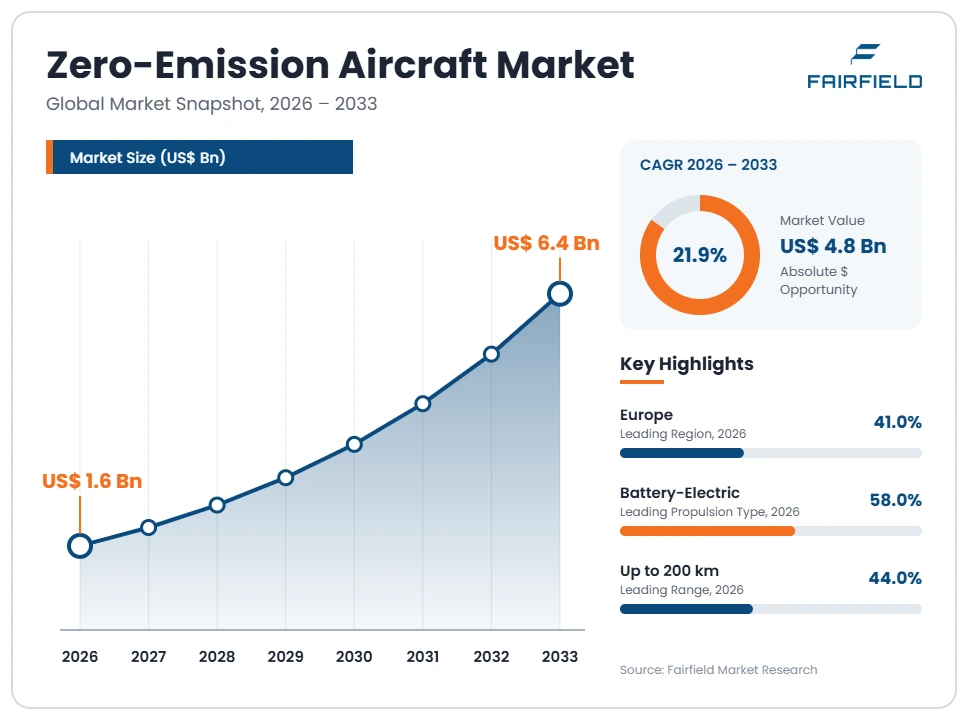
The global Zero-Emission Aircraft market size is expected to be valued at US$ 1.6 billion in 2026 and projected to reach US$ 6.4 billion by 2033, growing at a CAGR of 21.9% between 2026 and 2033.
Revenue grew from roughly US$ 460 million in 2020 to about US$ 1.32 billion in 2025, a historical CAGR of 23.5%. The 2026 figure of US$ 1,605 million counts airframes, propulsion systems and airport hydrogen and charging infrastructure together, because airframe deliveries alone remain too small to describe the sector. This is a pre-commercial market. Announced entry-into-service dates have slipped repeatedly, no certification basis exists for hydrogen-powered transport aircraft, and liquid hydrogen refuelling barely exists at airports. Growth therefore comes from certified battery-electric trainers, light general aviation, demonstrator programmes and early commuter conversions, not from any mainline fleet transition before 2033.
Key Report Takeaways
- By Propulsion Type: Battery-Electric held 58% share in 2026, while Hydrogen Fuel Cell systems are projected to expand at a 29.5% CAGR through 2033, as fuel cell powertrains clear the payload-range ceiling that limits battery aircraft.
- By Aircraft Type: Trainer & Light Sport Aircraft held 34% share in 2026, while Commuter Aircraft are projected to expand at a 27.4% CAGR through 2033, because thin regional routes tolerate short stage lengths and fixed ground infrastructure.
- By Component: Propulsion Systems held 34% share in 2026, while Ground Infrastructure is projected to expand at a 26.4% CAGR through 2033, driven by first hydrogen handling and megawatt charging installations at regional airfields.
- By Range: Up to 200 km held 44% share in 2026, while the 500–1,000 km band is projected to expand at a 27.1% CAGR through 2033, reflecting fuel cell commuter designs aimed at island and feeder services.
- By Geography: Europe held 41% share in 2026, while Asia Pacific is projected to expand at a 25.4% CAGR through 2033, supported by national electric aircraft certification work and domestic training fleet renewal.
Global Zero-Emission Aircraft Market Trends and Insights
Drivers Impact Analysis
Two forces account for most of the forecast expansion in electric and hydrogen-powered aircraft programmes.
| Driver | Impact on CAGR Forecast | Geographic Relevance | Impact Timeline |
| Binding aviation climate targets and public research funding | High | Europe, North America | Long term (≥4 years) |
| Flight training economics favouring battery-electric aircraft | High | Europe, Asia Pacific | Short term (≤2 years) |
Aviation Net-Zero Commitments Direct Public Funding Into Zero-Emission Aircraft Programmes
Policy commitments, not customer orders, supply most of the capital behind zero-emission flight today. States that have accepted a net-zero aviation target need an aircraft technology answer for the portion of emissions that fuels alone cannot remove. That expectation keeps government research budgets, national aerospace plans and airframe manufacturer development spending pointed at electric and hydrogen propulsion despite weak near-term sales.
The mechanism runs through funded programmes and compliance pressure. The International Civil Aviation Organization adopted a long-term aspirational goal of net-zero carbon emissions from international aviation by 2050, and its CORSIA scheme already obliges operators to monitor and offset growth in emissions. In Europe, the Clean Aviation Joint Undertaking channels public and industry money into hydrogen and hybrid-electric demonstrators. These instruments convert a political target into multi-year engineering contracts for airframers, propulsion suppliers and test facilities.
Lower Flight Training Costs Make Battery-Electric Trainers the First Commercial Application
Flight schools are buying electric aircraft because the operating arithmetic already works, which makes training the only genuinely commercial segment in this market. A two-seat electric trainer flies a circuit pattern that rarely exceeds an hour, returns to the same field, and recharges between lessons. Energy cost per flight hour falls well below aviation gasoline, and the absence of a piston engine removes most scheduled maintenance.
The causal mechanism is duty cycle, not technology leadership. Training sorties are short, repetitive and based at one airfield, so limited endurance is tolerable and a single charger serves the fleet. Certified light electric types now exist under EASA rules for very light aircraft, giving schools an insurable, financeable asset rather than an experimental one. Pilot shortages across airline groups have expanded academy fleets, and noise complaints around training airfields give operators a second reason to switch.
Restraints Impact Analysis
Two constraints keep zero-emission aircraft confined to light types and demonstrator fleets through the forecast period.
| Restraint | Impact on CAGR Forecast | Geographic Relevance | Impact Timeline |
| Battery energy density and reserve-fuel rules capping payload-range | High | Global | Long term (≥4 years) |
| Sustainable aviation fuel absorbing airline decarbonisation budgets | High | Europe, North America | Medium term (2–4 years) |
Battery Energy Density Confines Electric Aircraft to Short-Range Light Airframes
Energy density is the single reason this market is small, and it limits electric aircraft to two to nine seats over short stage lengths. Every kilogram of battery stays aboard for the whole flight, unlike fuel, so an electric design carries its full energy mass on approach. Designers respond by cutting seats, baggage or range, which removes most of the revenue an operator needs to justify the aircraft.
The cost source is cell chemistry and certification reserves rather than manufacturing scale. Current aviation-qualified lithium-ion packs deliver far less usable energy per kilogram than kerosene once casing, cooling, structural mounting and state-of-charge margins are subtracted. Operating rules also require diversion and holding reserves, and those reserves must be carried as additional battery mass. Thermal runaway containment adds further weight. Until usable pack-level energy density improves substantially, regional and narrowbody electric aircraft remain engineering studies.
Sustainable Aviation Fuel Competes for the Same Airline Decarbonisation Spending
Sustainable aviation fuel is the most serious commercial obstacle to zero-emission airframes, because it cuts emissions without new aircraft, new airport systems or new type certificates. An airline can buy blended fuel today and apply it across its existing fleet, including widebodies that no electric or hydrogen design will serve this decade. Every compliance dollar spent that way is a dollar not spent on novel airframes.
The driver of this substitution is regulation plus asset protection. The European Union ReFuelEU Aviation Regulation sets rising blending obligations at EU airports, so fuel suppliers and carriers must build volume regardless of airframe technology. Aircraft in service have twenty-year residual values that operators are unwilling to strand. Procurement teams therefore treat drop-in fuel as the low-risk route and restrict zero-emission aircraft purchases to small training, demonstration and corporate-reputation fleets.
Market Opportunities
Two revenue pools sit outside airframe sales and can be captured before any clean-sheet transport aircraft is certified.
Airport Hydrogen Handling and Megawatt Charging Create a Non-Airframe Revenue Pool
Ground infrastructure is the clearest near-term revenue pool in zero-emission aviation, because every aircraft programme needs it and almost none of it exists. Regional airports require high-power charging bays, electrical upgrades, gaseous or liquid hydrogen storage, refuelling vehicles and safety zoning long before airline deliveries begin. That spending is independent of which airframe eventually wins certification, which makes it unusually low-risk.
Energy utilities, industrial gas suppliers, ground support equipment makers and airport operators are positioned to capture it. Demand comes first from flight academies needing fast charging between lessons, then from commuter operators on fixed island and feeder routes where a single airfield pair serves the whole network. Hydrogen production incentives in several national energy strategies improve the economics of co-locating electrolysis with airport demand, letting one facility serve aviation and road transport together.
Retrofit Powertrain Conversions of In-Service Commuter Aircraft Shorten the Revenue Timeline
Converting existing commuter airframes to electric or hydrogen fuel cell power opens revenue years before clean-sheet aircraft can be certified. A supplemental type certificate on a proven nineteen-seat airframe avoids structural, systems and handling-qualities approval for the whole aircraft, narrowing the certification task to the powertrain and its installation. That path converts a decade-long programme into a shorter, far cheaper one.
Propulsion specialists and maintenance organisations rather than airframers are best placed to capture this pool. Demand comes from operators flying short island, offshore and essential air service routes, where ageing turboprops face rising maintenance bills and tightening noise limits at community airfields. EASA and the FAA both have established supplemental type certificate routes, and special conditions issued for electric and hybrid propulsion give applicants a workable, if still evolving, compliance framework.
Segment Analysis
- By Propulsion Type: Battery-Electric Dominates Deliveries While Hydrogen Fuel Cells Scale Quickest
Battery-Electric propulsion held 58% share in 2026, the clear leader, because it is the only technology with certified aircraft in series production and schools operating them daily. Its advantages are simplicity, a short approval history and low energy cost on circuits lasting under an hour. Hydrogen Fuel Cell propulsion is the fastest-growing type at a 29.5% CAGR to 2033, since fuel cells store far more energy per kilogram than batteries and therefore address the payload-range wall that caps electric designs. Hydrogen Combustion remains a demonstrator technology, attractive because it reuses gas turbine architecture but burdened by cryogenic tank integration. Hybrid-Electric systems serve as a transitional architecture for commuter airframes needing diversion capability. The implication is that battery systems will carry volume while hydrogen attracts development spending and most of the headline programme announcements.
- By Aircraft Type: Training Fleets Lead Volumes While Commuter Aircraft Accelerate
Trainer & Light Sport Aircraft held 34% share in 2026, the largest position, because flight academies buy repeatable, low-cost airframes and their mission profile suits limited endurance. General Aviation follows, covering privately owned two and four-seat electric types bought partly for low running costs and partly for airfield noise compliance. Commuter Aircraft are the fastest-growing category at a 27.4% CAGR through 2033, as nine to nineteen-seat conversions and clean-sheet designs target island, offshore and feeder routes with fixed infrastructure at both ends. Regional Aircraft above thirty seats remain outside the certified envelope for this forecast. Technology Demonstrators still absorb substantial spending, funded by public research programmes rather than customers. The business implication is that near-term revenue concentrates in light airframes while the strategic contest is fought in the commuter class.
- By Component: Propulsion Systems Capture the Largest Value While Ground Infrastructure Expands Fastest
Propulsion Systems represented 34% of value in 2026, the leading component, since electric motors, inverters, fuel cell stacks and thermal management account for most of the cost and nearly all of the technical risk in a zero-emission aircraft. Airframe & Structures follow, with composite designs reworked around heavy batteries or bulky cryogenic tanks. Energy Storage & Hydrogen Systems cover aviation-qualified battery packs, gaseous and liquid hydrogen tanks and distribution hardware. Ground Infrastructure is the fastest-growing component at a 26.4% CAGR to 2033, because airports, flight academies and commuter operators must install charging bays, electrical capacity and hydrogen handling before aircraft can operate. For suppliers, the practical conclusion is that infrastructure and propulsion generate billable work today, while airframe revenue depends on certification milestones still years away.
- By Range: Short Sectors Lead Today While Mid-Range Commuter Missions Grow Fastest
Aircraft capable of Up to 200 km held 44% share in 2026, the dominant band, because almost every certified battery-electric type in service flies training circuits or short local sorties within that envelope. The 200–500 km band covers longer general aviation flights and early hybrid commuter demonstrators. The 500–1,000 km band is the fastest-growing range class at a 27.1% CAGR to 2033, driven by hydrogen fuel cell commuter designs aimed at island chains, offshore energy support and thin feeder routes that turboprops currently serve. Above 1,000 km remains negligible, since no credible zero-emission transport aircraft is expected to be certified for that distance within the forecast. The implication for operators is that route networks, not aircraft marketing, will determine which designs find paying customers.
Geography Analysis
- North America Combines Certification Capacity With Private Investment in Electric Propulsion
North America holds 29% share in 2026, the second-largest position, and concentrates the deepest pool of private capital in the sector. The United States supplies most of this through electric trainer manufacturers, propulsion specialists and retrofit programmes for nine-seat commuter airframes. The FAA maintains established type and supplemental type certification routes and has issued rules covering powered-lift operations, which gives applicants procedural clarity even where technical standards are still being written. Canada contributes through regional operators testing electric conversions on short float and island routes. Essential air service networks in Alaska and remote communities provide realistic early missions. The main barrier is grid capacity at small airfields. The clearest opportunity lies in converting ageing nineteen-seat turboprops, where maintenance costs are rising and route structures already suit limited range.
- Which Region Is Leading the Zero-Emission Aircraft Market?
Europe leads the zero-emission aircraft market with 41% share in 2026, and its position rests on coordinated public funding rather than commercial demand. The Clean Aviation Joint Undertaking finances hydrogen and hybrid-electric demonstrator work across France, Germany, the Netherlands, Spain and the Nordic countries, while national programmes add further support. EASA has issued special conditions for electric and hybrid propulsion installations and certified light electric aircraft under its very light aircraft rules, giving the region the only meaningful body of approval precedent. Flight academies in France, Germany, Switzerland and Scandinavia operate the largest electric training fleets anywhere. The ReFuelEU Aviation Regulation reinforces decarbonisation obligations across the bloc. The constraint is that funding is concentrated in demonstrators, so programme slippage directly reduces regional revenue in any given year.
- Which Region Is Growing Fastest in the Zero-Emission Aircraft Market?
Asia Pacific is growing fastest in the zero-emission aircraft market, at a 25.4% CAGR between 2026 and 2033 from 21% share in 2026. China is the principal driver, having certified domestically designed electric light aircraft and built a supporting battery and motor supply chain that no other aviation market can match on cost. Japan and South Korea fund hydrogen aviation research alongside their wider national hydrogen strategies, and both have aerospace suppliers moving into fuel cell powertrains. Australia and New Zealand operate short island and regional sectors well matched to early electric aircraft. India is expanding pilot training capacity rapidly, creating demand for low-cost trainers. The limitation is a thinner certification precedent outside China, which slows cross-border acceptance of regionally approved aircraft.
- Latin America Approaches Electric Aviation Through Pilot Training and Short Regional Links
Latin America represents 4% share in 2026, the smallest regional position, with early activity in Brazil, Chile, Colombia and Mexico. Flight training academies account for most interest, since trainer economics translate directly and the aircraft are relatively affordable. Brazil adds genuine engineering capability through its established commercial aircraft industry and its aviation authority’s experience with novel certification. Remote communities in the Amazon basin and Andean states depend on short air links that suit limited-range aircraft. The barriers are financial and operational: aircraft are imported and dollar-priced, charging infrastructure competes with basic airfield maintenance for scarce capital, and local service support is thin. The most practical opportunity is academy fleet renewal funded by rising demand for commercial pilots across the region’s expanding carriers.
- Middle East & Africa Ties Zero-Emission Aviation Ambition to Green Hydrogen Development
Middle East & Africa accounts for 5% share in 2026 and grows at a 23.6% CAGR, with activity concentrated in the United Arab Emirates, Saudi Arabia and Oman. These states are building large electrolytic hydrogen projects for export and treat aviation as a visible domestic demonstration of that output, which makes airport hydrogen handling easier to fund here than almost anywhere else. Sovereign investment vehicles have also taken positions in advanced air mobility and propulsion ventures. In Africa, South Africa, Kenya and Morocco show early interest linked to renewable electricity and pilot training. The barriers are severe: extreme ambient temperatures degrade battery performance and cooling margins, maintenance networks are limited, and most airfields lack electrical capacity. The opportunity is co-locating aviation refuelling with hydrogen production already under construction.
Competitive Landscape
The zero-emission aircraft market has low concentration, and its structure looks nothing like conventional aerospace. Established airframers such as Airbus, Embraer, Textron eAviation and Deutsche Aircraft run hydrogen and electric development alongside their core businesses, while most visible activity comes from ventures that did not exist a decade ago. Propulsion specialists including ZeroAvia, magniX, H55 and Cranfield Aerospace Solutions compete directly with Rolls-Royce, Safran and Honeywell International. Airframe developers such as Heart Aerospace, Eviation Aircraft, Bye Aerospace, VoltAero, Ampaire and Beta Technologies pursue different configurations. Several well-funded entrants have already failed, so the population of credible competitors is unstable.
Competition is based on certification progress rather than product performance, because almost nothing is yet for sale. Buyers and investors evaluate how far an applicant has advanced through an agreed certification basis, whether flight testing uses a conforming aircraft, and whether the supply chain can produce qualified parts. Secondary factors include payload-range at realistic reserves, charging or refuelling turnaround time, and maintenance cost per flight hour. New entrants increasingly come from automotive electrification and industrial fuel cell backgrounds, bringing manufacturing discipline but limited airworthiness experience.
Strategic behaviour centres on partnership rather than consolidation. Propulsion developers pair with airframe owners to pursue supplemental type certificates, airlines sign non-binding commitments that cost little but signal demand, and energy companies join airport infrastructure consortia. Public research funding shapes alliances as much as commercial logic does, because consortium membership determines access to it.
Strategic direction is shifting from clean-sheet ambition toward retrofit programmes, light aircraft and ground infrastructure, where revenue can be earned while certification work continues.
Recent Industry Developments
- October 2022: The International Civil Aviation Organization adopted a long-term aspirational goal of net-zero carbon emissions from international aviation by 2050 at its 41st Assembly – this gave states a common target that justifies sustained public funding for zero-emission propulsion research.
- October 2023: The European Union adopted the ReFuelEU Aviation Regulation (EU) 2023/2405, setting rising sustainable aviation fuel blending obligations at EU airports – it confirms drop-in fuel as the primary compliance route, which both funds decarbonisation and competes with new airframes.
- January 2024: CORSIA entered its first phase under ICAO, moving beyond the earlier voluntary pilot phase – mandatory offsetting obligations raise the cost of emissions growth and strengthen the business case for lower-emission aircraft on short sectors.
- October 2024: The FAA issued its final rule on powered-lift pilot certification and operations in the United States – the first comprehensive operating framework for a new aircraft category in decades, and a useful precedent for how novel propulsion types may be regulated.
Companies Covered in the Report
- Airbus
- Embraer
- Textron eAviation
- Deutsche Aircraft
- ZeroAvia
- magniX
- H55
- Cranfield Aerospace Solutions
- Rolls-Royce
- Safran
- Honeywell International
- Heart Aerospace
- Eviation Aircraft
- Bye Aerospace
- VoltAero
- Ampaire
- Beta Technologies
Zero-Emission Aircraft Market Report Scope
| Metric | Value |
| Study Period | 2020–2033 |
| Market Size 2026 | US$ 1.6 Billion |
| Market Size 2033 | US$ 6.4 Billion |
| CAGR 2026–2033 | 21.9% |
| Absolute Dollar Opportunity | US$ 4.8 Billion |
| Largest Market | Europe (41% share in 2026) |
| Fastest-Growing Market | Asia Pacific (25.4% CAGR) |
| Market Concentration | Low |
| Major Players | Airbus, ZeroAvia, Textron eAviation, magniX, Rolls-Royce |
Zero-Emission Aircraft Market Segmentation
Propulsion Type
- Battery-Electric
- Hydrogen Fuel Cell
- Hydrogen Combustion
- Hybrid-Electric
Aircraft Type
- Trainer & Light Sport Aircraft
- General Aviation
- Commuter Aircraft
- Regional Aircraft
- Technology Demonstrators
Component
- Airframe & Structures
- Propulsion Systems
- Energy Storage & Hydrogen Systems
- Ground Infrastructure
Range
- Up to 200 km
- 200–500 km
- 500–1,000 km
- Above 1,000 km
Regions
- North America
- Europe
- Asia Pacific
- Latin America
- Middle East & Africa
- Executive Summary
- Global Zero-Emission Aircraft Market Snapshot
- Future Projections
- Key Report Takeaways
- Regional Snapshot
- Market Overview
- Market Definition and Report Scope
- Historical Trends 2020–2025
- Market Dynamics
- Drivers
- Aviation Net-Zero Commitments Direct Public Funding Into Zero-Emission Aircraft Programmes
- Lower Flight Training Costs Make Battery-Electric Trainers the First Commercial Application
- Restraints
- Battery Energy Density Confines Electric Aircraft to Short-Range Light Airframes
- Sustainable Aviation Fuel Competes for the Same Airline Decarbonisation Spending
- Market Opportunities
- Airport Hydrogen Handling and Megawatt Charging Create a Non-Airframe Revenue Pool
- Retrofit Powertrain Conversions of In-Service Commuter Aircraft Shorten the Revenue Timeline
- Drivers
- Global Zero-Emission Aircraft Market Outlook, 2020–2033
- Global Zero-Emission Aircraft Market Outlook, by Propulsion Type, Value (US$ Billion), 2020–2033
- Battery-Electric
- Hydrogen Fuel Cell
- Hydrogen Combustion
- Hybrid-Electric
- Global Zero-Emission Aircraft Market Outlook, by Aircraft Type, Value (US$ Billion), 2020–2033
- Trainer & Light Sport Aircraft
- General Aviation
- Commuter Aircraft
- Regional Aircraft
- Technology Demonstrators
- Global Zero-Emission Aircraft Market Outlook, by Component, Value (US$ Billion), 2020–2033
- Airframe & Structures
- Propulsion Systems
- Energy Storage & Hydrogen Systems
- Ground Infrastructure
- Global Zero-Emission Aircraft Market Outlook, by Range, Value (US$ Billion), 2020–2033
- Up to 200 km
- 200–500 km
- 500–1,000 km
- Above 1,000 km
- Global Zero-Emission Aircraft Market Outlook, by Region, Value (US$ Billion), 2020–2033
- North America
- Europe
- Asia Pacific
- Latin America
- Middle East & Africa
- Global Zero-Emission Aircraft Market Outlook, by Propulsion Type, Value (US$ Billion), 2020–2033
- North America Zero-Emission Aircraft Market Outlook, 2020–2033
- North America Zero-Emission Aircraft Market Outlook, by Propulsion Type, Value (US$ Billion), 2020–2033
- Battery-Electric
- Hydrogen Fuel Cell
- Hydrogen Combustion
- Hybrid-Electric
- North America Zero-Emission Aircraft Market Outlook, by Aircraft Type, Value (US$ Billion), 2020–2033
- Trainer & Light Sport Aircraft
- General Aviation
- Commuter Aircraft
- Regional Aircraft
- Technology Demonstrators
- North America Zero-Emission Aircraft Market Outlook, by Component, Value (US$ Billion), 2020–2033
- Airframe & Structures
- Propulsion Systems
- Energy Storage & Hydrogen Systems
- Ground Infrastructure
- North America Zero-Emission Aircraft Market Outlook, by Range, Value (US$ Billion), 2020–2033
- Up to 200 km
- 200–500 km
- 500–1,000 km
- Above 1,000 km
- North America Zero-Emission Aircraft Market Outlook, by Country, Value (US$ Billion), 2020–2033
- United States Zero-Emission Aircraft Market Outlook, by Propulsion Type, 2020–2033
- United States Zero-Emission Aircraft Market Outlook, by Aircraft Type, 2020–2033
- United States Zero-Emission Aircraft Market Outlook, by Component, 2020–2033
- United States Zero-Emission Aircraft Market Outlook, by Range, 2020–2033
- Canada Zero-Emission Aircraft Market Outlook, by Propulsion Type, 2020–2033
- Canada Zero-Emission Aircraft Market Outlook, by Aircraft Type, 2020–2033
- Canada Zero-Emission Aircraft Market Outlook, by Component, 2020–2033
- Canada Zero-Emission Aircraft Market Outlook, by Range, 2020–2033
- North America Zero-Emission Aircraft Market Outlook, by Propulsion Type, Value (US$ Billion), 2020–2033
- Europe Zero-Emission Aircraft Market Outlook, 2020–2033
- Europe Zero-Emission Aircraft Market Outlook, by Propulsion Type, Value (US$ Billion), 2020–2033
- Battery-Electric
- Hydrogen Fuel Cell
- Hydrogen Combustion
- Hybrid-Electric
- Europe Zero-Emission Aircraft Market Outlook, by Aircraft Type, Value (US$ Billion), 2020–2033
- Trainer & Light Sport Aircraft
- General Aviation
- Commuter Aircraft
- Regional Aircraft
- Technology Demonstrators
- Europe Zero-Emission Aircraft Market Outlook, by Component, Value (US$ Billion), 2020–2033
- Airframe & Structures
- Propulsion Systems
- Energy Storage & Hydrogen Systems
- Ground Infrastructure
- Europe Zero-Emission Aircraft Market Outlook, by Range, Value (US$ Billion), 2020–2033
- Up to 200 km
- 200–500 km
- 500–1,000 km
- Above 1,000 km
- Europe Zero-Emission Aircraft Market Outlook, by Country, Value (US$ Billion), 2020–2033
- France Zero-Emission Aircraft Market Outlook, by Propulsion Type, 2020–2033
- France Zero-Emission Aircraft Market Outlook, by Aircraft Type, 2020–2033
- France Zero-Emission Aircraft Market Outlook, by Component, 2020–2033
- France Zero-Emission Aircraft Market Outlook, by Range, 2020–2033
- Germany Zero-Emission Aircraft Market Outlook, by Propulsion Type, 2020–2033
- Germany Zero-Emission Aircraft Market Outlook, by Aircraft Type, 2020–2033
- Germany Zero-Emission Aircraft Market Outlook, by Component, 2020–2033
- Germany Zero-Emission Aircraft Market Outlook, by Range, 2020–2033
- Netherlands Zero-Emission Aircraft Market Outlook, by Propulsion Type, 2020–2033
- Netherlands Zero-Emission Aircraft Market Outlook, by Aircraft Type, 2020–2033
- Netherlands Zero-Emission Aircraft Market Outlook, by Component, 2020–2033
- Netherlands Zero-Emission Aircraft Market Outlook, by Range, 2020–2033
- Spain Zero-Emission Aircraft Market Outlook, by Propulsion Type, 2020–2033
- Spain Zero-Emission Aircraft Market Outlook, by Aircraft Type, 2020–2033
- Spain Zero-Emission Aircraft Market Outlook, by Component, 2020–2033
- Spain Zero-Emission Aircraft Market Outlook, by Range, 2020–2033
- Nordic countries Zero-Emission Aircraft Market Outlook, by Propulsion Type, 2020–2033
- Nordic countries Zero-Emission Aircraft Market Outlook, by Aircraft Type, 2020–2033
- Nordic countries Zero-Emission Aircraft Market Outlook, by Component, 2020–2033
- Nordic countries Zero-Emission Aircraft Market Outlook, by Range, 2020–2033
- Switzerland Zero-Emission Aircraft Market Outlook, by Propulsion Type, 2020–2033
- Switzerland Zero-Emission Aircraft Market Outlook, by Aircraft Type, 2020–2033
- Switzerland Zero-Emission Aircraft Market Outlook, by Component, 2020–2033
- Switzerland Zero-Emission Aircraft Market Outlook, by Range, 2020–2033
- Europe Zero-Emission Aircraft Market Outlook, by Propulsion Type, Value (US$ Billion), 2020–2033
- Asia Pacific Zero-Emission Aircraft Market Outlook, 2020–2033
- Asia Pacific Zero-Emission Aircraft Market Outlook, by Propulsion Type, Value (US$ Billion), 2020–2033
- Battery-Electric
- Hydrogen Fuel Cell
- Hydrogen Combustion
- Hybrid-Electric
- Asia Pacific Zero-Emission Aircraft Market Outlook, by Aircraft Type, Value (US$ Billion), 2020–2033
- Trainer & Light Sport Aircraft
- General Aviation
- Commuter Aircraft
- Regional Aircraft
- Technology Demonstrators
- Asia Pacific Zero-Emission Aircraft Market Outlook, by Component, Value (US$ Billion), 2020–2033
- Airframe & Structures
- Propulsion Systems
- Energy Storage & Hydrogen Systems
- Ground Infrastructure
- Asia Pacific Zero-Emission Aircraft Market Outlook, by Range, Value (US$ Billion), 2020–2033
- Up to 200 km
- 200–500 km
- 500–1,000 km
- Above 1,000 km
- Asia Pacific Zero-Emission Aircraft Market Outlook, by Country, Value (US$ Billion), 2020–2033
- China Zero-Emission Aircraft Market Outlook, by Propulsion Type, 2020–2033
- China Zero-Emission Aircraft Market Outlook, by Aircraft Type, 2020–2033
- China Zero-Emission Aircraft Market Outlook, by Component, 2020–2033
- China Zero-Emission Aircraft Market Outlook, by Range, 2020–2033
- Japan Zero-Emission Aircraft Market Outlook, by Propulsion Type, 2020–2033
- Japan Zero-Emission Aircraft Market Outlook, by Aircraft Type, 2020–2033
- Japan Zero-Emission Aircraft Market Outlook, by Component, 2020–2033
- Japan Zero-Emission Aircraft Market Outlook, by Range, 2020–2033
- South Korea Zero-Emission Aircraft Market Outlook, by Propulsion Type, 2020–2033
- South Korea Zero-Emission Aircraft Market Outlook, by Aircraft Type, 2020–2033
- South Korea Zero-Emission Aircraft Market Outlook, by Component, 2020–2033
- South Korea Zero-Emission Aircraft Market Outlook, by Range, 2020–2033
- Australia Zero-Emission Aircraft Market Outlook, by Propulsion Type, 2020–2033
- Australia Zero-Emission Aircraft Market Outlook, by Aircraft Type, 2020–2033
- Australia Zero-Emission Aircraft Market Outlook, by Component, 2020–2033
- Australia Zero-Emission Aircraft Market Outlook, by Range, 2020–2033
- New Zealand Zero-Emission Aircraft Market Outlook, by Propulsion Type, 2020–2033
- New Zealand Zero-Emission Aircraft Market Outlook, by Aircraft Type, 2020–2033
- New Zealand Zero-Emission Aircraft Market Outlook, by Component, 2020–2033
- New Zealand Zero-Emission Aircraft Market Outlook, by Range, 2020–2033
- India Zero-Emission Aircraft Market Outlook, by Propulsion Type, 2020–2033
- India Zero-Emission Aircraft Market Outlook, by Aircraft Type, 2020–2033
- India Zero-Emission Aircraft Market Outlook, by Component, 2020–2033
- India Zero-Emission Aircraft Market Outlook, by Range, 2020–2033
- Asia Pacific Zero-Emission Aircraft Market Outlook, by Propulsion Type, Value (US$ Billion), 2020–2033
- Latin America Zero-Emission Aircraft Market Outlook, 2020–2033
- Latin America Zero-Emission Aircraft Market Outlook, by Propulsion Type, Value (US$ Billion), 2020–2033
- Battery-Electric
- Hydrogen Fuel Cell
- Hydrogen Combustion
- Hybrid-Electric
- Latin America Zero-Emission Aircraft Market Outlook, by Aircraft Type, Value (US$ Billion), 2020–2033
- Trainer & Light Sport Aircraft
- General Aviation
- Commuter Aircraft
- Regional Aircraft
- Technology Demonstrators
- Latin America Zero-Emission Aircraft Market Outlook, by Component, Value (US$ Billion), 2020–2033
- Airframe & Structures
- Propulsion Systems
- Energy Storage & Hydrogen Systems
- Ground Infrastructure
- Latin America Zero-Emission Aircraft Market Outlook, by Range, Value (US$ Billion), 2020–2033
- Up to 200 km
- 200–500 km
- 500–1,000 km
- Above 1,000 km
- Latin America Zero-Emission Aircraft Market Outlook, by Country, Value (US$ Billion), 2020–2033
- Brazil Zero-Emission Aircraft Market Outlook, by Propulsion Type, 2020–2033
- Brazil Zero-Emission Aircraft Market Outlook, by Aircraft Type, 2020–2033
- Brazil Zero-Emission Aircraft Market Outlook, by Component, 2020–2033
- Brazil Zero-Emission Aircraft Market Outlook, by Range, 2020–2033
- Chile Zero-Emission Aircraft Market Outlook, by Propulsion Type, 2020–2033
- Chile Zero-Emission Aircraft Market Outlook, by Aircraft Type, 2020–2033
- Chile Zero-Emission Aircraft Market Outlook, by Component, 2020–2033
- Chile Zero-Emission Aircraft Market Outlook, by Range, 2020–2033
- Colombia Zero-Emission Aircraft Market Outlook, by Propulsion Type, 2020–2033
- Colombia Zero-Emission Aircraft Market Outlook, by Aircraft Type, 2020–2033
- Colombia Zero-Emission Aircraft Market Outlook, by Component, 2020–2033
- Colombia Zero-Emission Aircraft Market Outlook, by Range, 2020–2033
- Mexico Zero-Emission Aircraft Market Outlook, by Propulsion Type, 2020–2033
- Mexico Zero-Emission Aircraft Market Outlook, by Aircraft Type, 2020–2033
- Mexico Zero-Emission Aircraft Market Outlook, by Component, 2020–2033
- Mexico Zero-Emission Aircraft Market Outlook, by Range, 2020–2033
- Latin America Zero-Emission Aircraft Market Outlook, by Propulsion Type, Value (US$ Billion), 2020–2033
- Middle East & Africa Zero-Emission Aircraft Market Outlook, 2020–2033
- Middle East & Africa Zero-Emission Aircraft Market Outlook, by Propulsion Type, Value (US$ Billion), 2020–2033
- Battery-Electric
- Hydrogen Fuel Cell
- Hydrogen Combustion
- Hybrid-Electric
- Middle East & Africa Zero-Emission Aircraft Market Outlook, by Aircraft Type, Value (US$ Billion), 2020–2033
- Trainer & Light Sport Aircraft
- General Aviation
- Commuter Aircraft
- Regional Aircraft
- Technology Demonstrators
- Middle East & Africa Zero-Emission Aircraft Market Outlook, by Component, Value (US$ Billion), 2020–2033
- Airframe & Structures
- Propulsion Systems
- Energy Storage & Hydrogen Systems
- Ground Infrastructure
- Middle East & Africa Zero-Emission Aircraft Market Outlook, by Range, Value (US$ Billion), 2020–2033
- Up to 200 km
- 200–500 km
- 500–1,000 km
- Above 1,000 km
- Middle East & Africa Zero-Emission Aircraft Market Outlook, by Country, Value (US$ Billion), 2020–2033
- United Arab Emirates Zero-Emission Aircraft Market Outlook, by Propulsion Type, 2020–2033
- United Arab Emirates Zero-Emission Aircraft Market Outlook, by Aircraft Type, 2020–2033
- United Arab Emirates Zero-Emission Aircraft Market Outlook, by Component, 2020–2033
- United Arab Emirates Zero-Emission Aircraft Market Outlook, by Range, 2020–2033
- Saudi Arabia Zero-Emission Aircraft Market Outlook, by Propulsion Type, 2020–2033
- Saudi Arabia Zero-Emission Aircraft Market Outlook, by Aircraft Type, 2020–2033
- Saudi Arabia Zero-Emission Aircraft Market Outlook, by Component, 2020–2033
- Saudi Arabia Zero-Emission Aircraft Market Outlook, by Range, 2020–2033
- Oman Zero-Emission Aircraft Market Outlook, by Propulsion Type, 2020–2033
- Oman Zero-Emission Aircraft Market Outlook, by Aircraft Type, 2020–2033
- Oman Zero-Emission Aircraft Market Outlook, by Component, 2020–2033
- Oman Zero-Emission Aircraft Market Outlook, by Range, 2020–2033
- South Africa Zero-Emission Aircraft Market Outlook, by Propulsion Type, 2020–2033
- South Africa Zero-Emission Aircraft Market Outlook, by Aircraft Type, 2020–2033
- South Africa Zero-Emission Aircraft Market Outlook, by Component, 2020–2033
- South Africa Zero-Emission Aircraft Market Outlook, by Range, 2020–2033
- Kenya Zero-Emission Aircraft Market Outlook, by Propulsion Type, 2020–2033
- Kenya Zero-Emission Aircraft Market Outlook, by Aircraft Type, 2020–2033
- Kenya Zero-Emission Aircraft Market Outlook, by Component, 2020–2033
- Kenya Zero-Emission Aircraft Market Outlook, by Range, 2020–2033
- Morocco Zero-Emission Aircraft Market Outlook, by Propulsion Type, 2020–2033
- Morocco Zero-Emission Aircraft Market Outlook, by Aircraft Type, 2020–2033
- Morocco Zero-Emission Aircraft Market Outlook, by Component, 2020–2033
- Morocco Zero-Emission Aircraft Market Outlook, by Range, 2020–2033
- Middle East & Africa Zero-Emission Aircraft Market Outlook, by Propulsion Type, Value (US$ Billion), 2020–2033
- Competitive Landscape
- Market Concentration and Industry Leaders
- Competitive Differentiation
- Strategic Moves and Market Direction
- Recent Industry Developments
- Company Profiles
- Airbus
- Embraer
- Textron eAviation
- Deutsche Aircraft
- ZeroAvia
- magniX
- H55
- Cranfield Aerospace Solutions
- Rolls-Royce
- Safran
- Honeywell International
- Heart Aerospace
- Eviation Aircraft
- Bye Aerospace
- VoltAero
- Ampaire
- Beta Technologies
- Appendix
- Research Methodology
- Report Assumptions
- Acronyms and Abbreviations
Propulsion Type
- Battery-Electric
- Hydrogen Fuel Cell
- Hydrogen Combustion
- Hybrid-Electric
Aircraft Type
- Trainer & Light Sport Aircraft
- General Aviation
- Commuter Aircraft
- Regional Aircraft
- Technology Demonstrators
Component
- Airframe & Structures
- Propulsion Systems
- Energy Storage & Hydrogen Systems
- Ground Infrastructure
Range
- Up to 200 km
- 200–500 km
- 500–1,000 km
- Above 1,000 km
Regions
- North America
- Europe
- Asia Pacific
- Latin America
- Middle East & Africa
Our Research Methodology
Considering the volatility of business today, traditional approaches to strategizing a game plan can be unfruitful if not detrimental. True ambiguity is no way to determine a forecast. A myriad of predetermined factors must be accounted for such as the degree of risk involved, the magnitude of circumstances, as well as conditions or consequences that are not known or unpredictable. To circumvent binary views that cast uncertainty, the application of market research intelligence to strategically posture, move, and enable actionable outcomes is necessary.
View Methodology
Quality Assured
Rigorous Validation Process

Confidentiality Assured
End-to-end Data Security

Custom Research Services
Tailored To Your Objectives
FAQs
The market is valued at US$ 1.6 billion in 2026, counting airframes, propulsion systems and airport hydrogen and charging infrastructure together worldwide.
It is projected to reach US$ 6.4 billion by 2033 at a 21.9% CAGR, representing US$ 4.8 billion of absolute dollar opportunity.
Battery-Electric propulsion leads with 58% share in 2026, because it is the only technology with certified aircraft in series production today.
Hydrogen Fuel Cell propulsion grows fastest at a 29.5% CAGR, since stored hydrogen offers far more usable energy per kilogram than batteries.
Europe holds 41% share in 2026, supported by the Clean Aviation Joint Undertaking, EASA certification precedent and the largest electric training fleets.
Related Reports
Automotive Alternator and Starter Motor Market Size, Share, Insights, Competitive Landscape, and Forecast 2026 to 2033
The global automotive alternator and starter motor market is valued at US$32.0 billion in 2026, reaching US$38.0 billion by 2033, at a 2.5% CAGR
Automotive Start-Stop Battery Market Size, Share, Insights, Competitive Landscape, and Forecast 2026 to 2033
Hybrid Electric Vehicle (EV) Conversion Kit Market Size, Share, Insights, Competitive Landscape, and Forecast 2026 to 2033
The global hybrid EV conversion kit market will reach US$ 1.42 Bn by 2033, growing at 11.09% CAGR from 2026-2033, driven by cost-effective electrification
Passenger Vehicles HVAC Services Market Size, Share, Insights, Competitive Landscape, and Forecast 2026 to 2033
The passenger vehicles HVAC services market, valued at US$ 48.6 billion in 2026, and projected to reach US$ 73.4 billion by 2033, growing at 6.1% CAGR
Automotive 48-Volt Electronic Junction Box and Power Distribution Center Market Size, Share, Insights, Competitive Landscape, and Forecast 2026 to 2033
The global automotive 48-volt junction box and power distribution center market will reach US$ 4.55 Bn by 2033, growing at 11.68% CAGR from 2026-2033
Ultra-Fast EV Charging (350kW+) Systems Market Size, Share, Insights, Competitive Landscape, and Forecast 2026 to 2033
The global Ultra-Fast EV charging systems market will grow from US$ 7.1 billion in 2026 to US$ 34.5 billion by 2033, at a 25.3% CAGR. Discover key trends