



Food Grade Packaging Market
Food Grade Packaging Market Insights, Competitive Landscape, and Market Forecast - 2033
Food Grade Packaging Market Size, Share, and Growth Forecast 2026 - 2033
Key Market Highlights
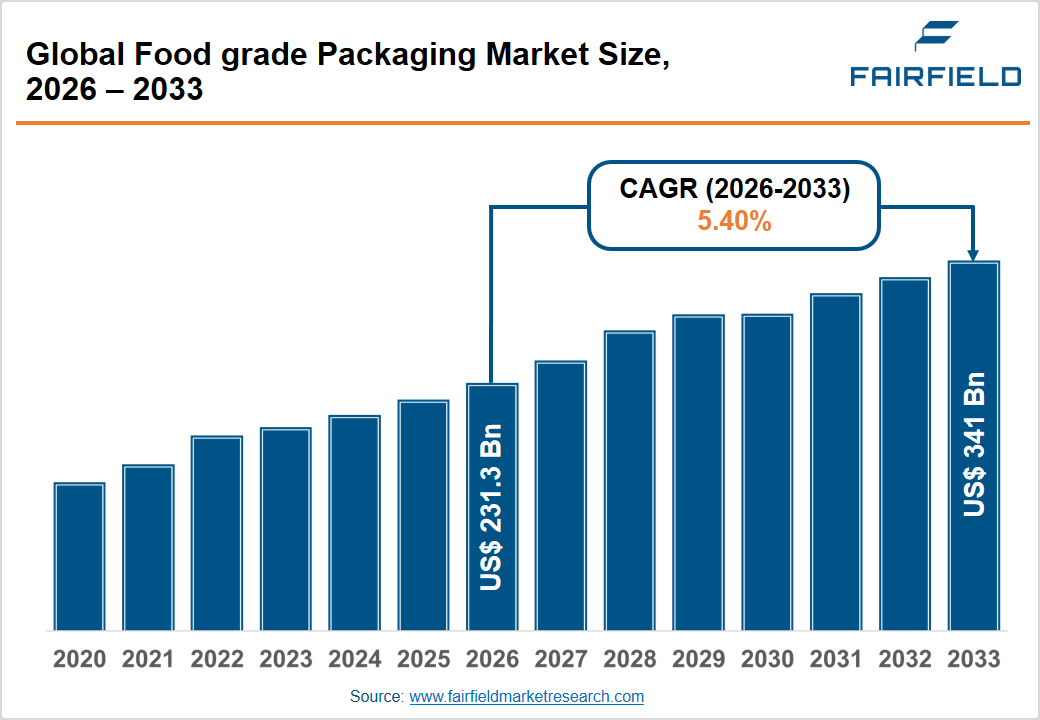
- The global Food Grade Packaging Market size is likely to be valued at US$ 231.3 Billion in 2026 and is expected to reach US$ 341 Billion by 2033, growing at a CAGR of 5.70% during the forecast period from 2026 to 2033.
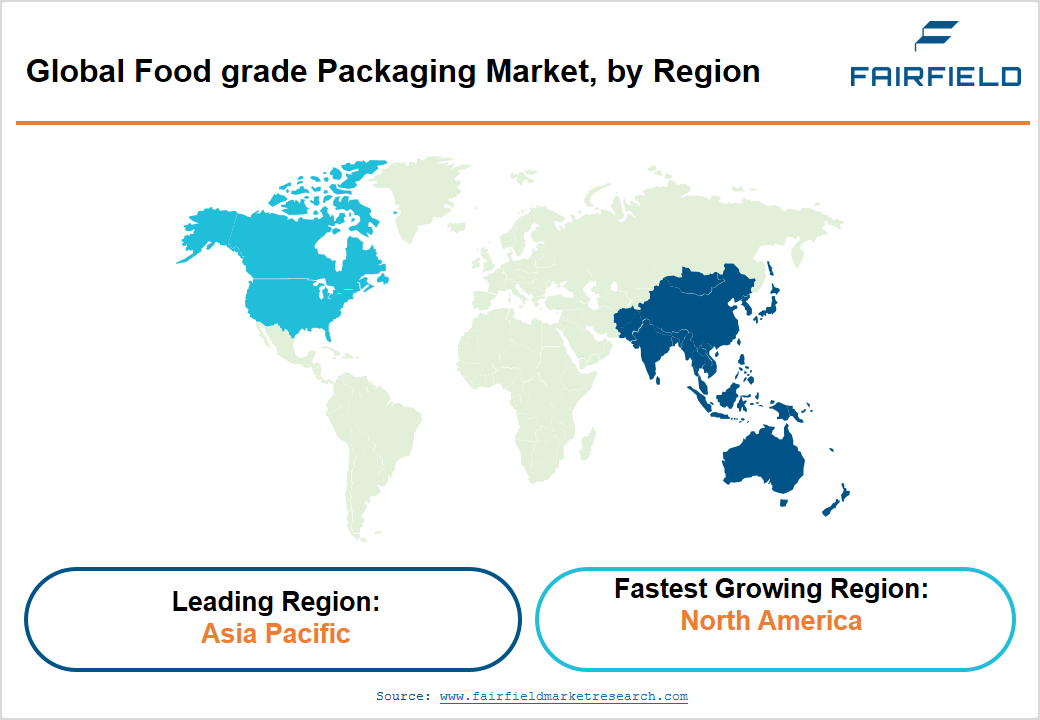
- Leading Region Market: Asia Pacific dominates the global Food Grade Packaging Market with approximately 41% market share in 2026, driven by China's massive food manufacturing output, India's PLI-supported food processing growth, and expanding modern retail across ASEAN nations.
- Fastest Growing Region Market: North America leads regional growth, propelled by FSMA compliance requirements, state-level single-use plastics bans, and major QSR chains' commitments to transition to recyclable and compostable food grade packaging by 2030.
- Dominant Material Segment: Plastics hold approximately 38% of the market share in 2026, underpinned by superior barrier performance, formability, and cost competitiveness across both rigid containers and flexible pouches, with biodegradable variants gaining rapidly increasing share.
- Fastest Growing Packaging Segment: Biodegradable food grade packaging is the fastest-growing material segment, driven by EU PPWR recyclability mandates, USDA BioPreferred incentives, and food brand commitments to compostable PLA- and PHA-based solutions certified to ASTM D6400 and EN 13432
- Key Market Opportunity: Active packaging technologies including oxygen scavengers, MAP, and smart labels represent a high-value opportunity, addressing FAO's finding that 14% of global food is lost pre-retail, with European Commission Farm to Fork targets driving adoption across meat, dairy, and fresh produce supply chains.
Market Dynamics
Market Growth Drivers
- Rising Global Food Safety Standards and Regulatory Compliance Requirements
Stringent global food safety frameworks are compelling food manufacturers and retailers to adopt certified, high-performance food grade packaging that prevents contamination and extends shelf life. The U.S. Food and Drug Administration (FDA) enforces food-contact material compliance under 21 CFR, while the European Food Safety Authority (EFSA) regulates food packaging materials through Regulation (EC) No 1935/2004. Globally, the Codex Alimentarius Commission of the Food and Agriculture Organization (FAO) and World Health Organization (WHO) sets internationally recognized food packaging safety benchmarks adopted by over 180 member countries. As food supply chains become increasingly complex and cross-border, the requirement for standardized, traceable, and safety-certified packaging solutions is intensifying, directly stimulating procurement across all major food grade packaging material categories and geographies.
- Rapid Expansion of the Global Quick-Service Restaurant and Food Delivery Ecosystem
The global proliferation of quick-service restaurants (QSRs) and app-based food delivery platforms is generating sustained incremental demand for food grade disposable and single-use packaging. The U.S. restaurant industry generated substantial sales in 2023, according to the National Restaurant Association, with delivery and takeout comprising a growing portion. Globally, the World Food Programme (WFP) notes accelerated urbanization is concentrating food consumption in cities, fueling QSR expansion across Asia, the Middle East, and Africa. Each delivery transaction requires multiple packaging touchpoints containers, bags, insulating wraps, sauce sachets collectively driving high-volume, recurring demand for compliant food grade packaging formats including flexible pouches, clamshells, and laminated paperboard boxes.
Market Restraints
- Escalating Raw Material Price Volatility Compressing Manufacturer Margins
Food grade packaging manufacturers face persistent margin pressure from raw material price volatility across plastics resins, aluminum, recycled paperboard, and glass. The World Bank Commodity Markets Outlook documented significant price swings in petrochemical feedstocks critical for plastic packaging resin production driven by crude oil market fluctuations and supply chain disruptions. Energy-intensive processes such as glass manufacturing and metal can production are further exposed to natural gas and electricity price volatility. For mid-tier converters operating on thin margins, these input cost pressures limit their capacity to invest in sustainable packaging innovation, constraining the pace of portfolio transition across the market.
- Complex Regulatory Landscape Surrounding Food-Contact Material Compliance
Manufacturers of food grade packaging must navigate a fragmented and continuously evolving global regulatory environment. Divergent standards between the FDA, EFSA, Food Safety and Standards Authority of India (FSSAI), and other national bodies create compliance complexity for companies operating across multiple geographies. The ongoing regulatory scrutiny of bisphenol A (BPA), PFAS, and phthalates in food-contact materials with the European Chemicals Agency (ECHA) progressively restricting such substances under REACH forces frequent reformulation of packaging materials. These compliance burdens impose significant R&D and legal costs, particularly challenging for smaller manufacturers seeking to maintain market access across multiple regulatory jurisdictions.
Market Opportunities
- Accelerating Demand for Sustainable and Biodegradable Food Packaging Solutions
The structural shift toward environmentally responsible food packaging represents one of the most significant growth opportunities in the market. The EU Packaging and Packaging Waste Regulation (PPWR) proposes that all packaging placed on the EU market be recyclable by 2030, while mandating minimum recycled content thresholds for plastic packaging. The USDA BioPreferred Program incentivizes bio-based packaging procurement by U.S. federal agencies and contractors. The compostable food packaging segment is gaining traction backed by ASTM D6400 and EN 13432 certification standards. Companies investing in starch-blend films, molded fiber trays, and PLA-based flexible pouches are positioned to capture premium pricing and preferred supplier status with sustainability-committed food brands. The growing consumer willingness to pay a premium for sustainably packaged products, documented by surveys from the World Economic Forum (WEF), further amplifies the commercial opportunity for biodegradable food grade packaging innovators.
- Growth of Active and Intelligent Packaging Technologies for Food Shelf-Life Extension
Active and intelligent packaging technologies including oxygen scavengers, moisture absorbers, antimicrobial coatings, and time-temperature indicators represent a high-value frontier for food grade packaging market participants. These technologies directly address the FAO's finding that approximately 14% of global food is lost between harvest and retail, representing approximately US$ 400 billion in annual losses. The U.S. Department of Agriculture (USDA) has actively funded research into shelf-life-extending packaging to reduce post-harvest food waste as part of national food security objectives. The European Commission's Farm to Fork Strategy similarly identifies packaging innovation as a lever to cut food waste by 50% by 2030. Meat, poultry, seafood, and dairy end-users are early adopters, creating significant procurement opportunity for converters specializing in barrier films, modified atmosphere packaging (MAP), and smart labeling solutions.
Segmental Insights
- By Material Analysis
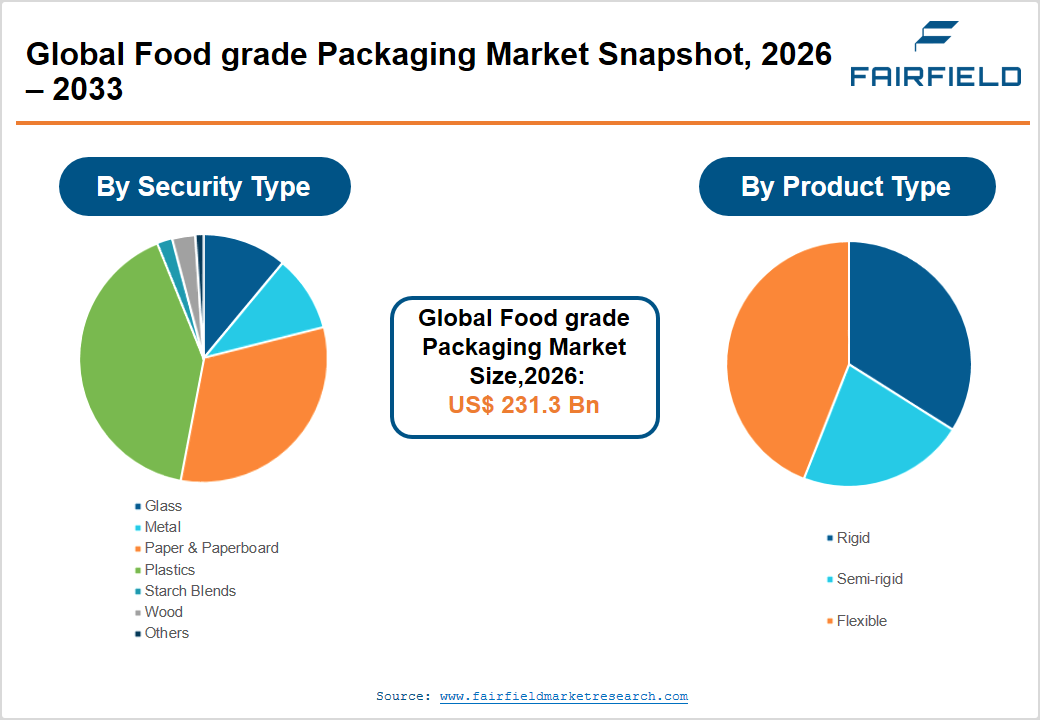
The Plastics segment encompassing both non-biodegradable and biodegradable variants dominates the By Material category, accounting for 38% of market share in 2026. Plastics' leadership stems from their unmatched combination of lightweight properties, barrier performance, formability, and cost competitiveness across both rigid and flexible packaging formats. The American Chemistry Council (ACC) reports that plastics packaging extends the shelf life of fresh meat by up to 4x compared to unpackaged alternatives, reducing food waste at retail. While regulatory pressure is accelerating the transition toward biodegradable plastic alternatives such as PLA, PHA, and starch blends, non-biodegradable grades continue to dominate in volume terms due to established infrastructure, superior barrier properties, and lower production costs, sustaining the segment's leading market position.
- By Product Type Analysis
The Rigid packaging segment leads the By Product Type category, capturing approximately 45% of market share in 2026. Rigid formats including glass bottles, metal cans, plastic containers, and paperboard boxes are preferred across dairy, beverages, canned goods, and ready-to-eat meal applications for their structural integrity, superior barrier properties, and tamper evidence. The Glass Packaging Institute (GPI) confirms that glass is the only food packaging material with GRAS (Generally Recognized As Safe) status under FDA regulations, reinforcing preference in premium food and beverage categories. Metal cans, validated by the Can Manufacturers Institute (CMI), offer an effectively indefinite shelf life for shelf-stable products, cementing rigid packaging's dominant share among food manufacturers globally.
- By Packaging Type Analysis
The Boxes & Cartons segment leads the By Packaging Type category, holding approximately 22% market share in 2026. Paperboard boxes and cartons are the packaging format of choice across bakery, confectionery, frozen foods, cereals, and dairy applications, benefiting from their printability, structural rigidity, recyclability, and compliance with global food safety standards. The Paperboard Packaging Council (PPC) reports that paperboard is among the most recycled packaging materials globally, with recycling rates exceeding 70% in several European markets per CEPI (Confederation of European Paper Industries) data. The growing demand for sustainable packaging from major food brands and the rapid expansion of e-commerce grocery delivery are jointly elevating boxes and cartons as the fastest-scaling food grade packaging format by volume.
- By Application Analysis
The Meat, Poultry & Seafood application segment is the leading revenue contributor within the By Application category, accounting for 26% of market share in 2026. The segment's dominance reflects the critical role of packaging in maintaining protein product safety, preventing microbial contamination, and extending chilled or frozen shelf life. The FAO estimates global meat production exceeded 340 million metric tonnes in 2022, with cross-border trade requiring robust, tamper-evident, and barrier-grade packaging. Modified atmosphere packaging (MAP), vacuum skin packaging (VSP), and multilayer barrier films are extensively deployed across this segment. Rising per-capita protein consumption in Asia Pacific and Latin America is further amplifying demand, reinforcing the meat, poultry, and seafood segment's leadership in the global food grade packaging market.
- By End-user Analysis
The Quick Service Restaurants (QSR) end-user segment leads the By End-user category, accounting for 33% of market share in 2026. QSRs are high-frequency, high-volume consumers of disposable and single-use food grade packaging across cups, lids, bags, boxes, wraps, and sauce sachets. The National Restaurant Association estimated that fast-food and QSR chains collectively accounted for over 50% of total U.S. foodservice sales in 2023. The ongoing global expansion of major chains including McDonald's, Yum! Brands, and Restaurant Brands International across Asia, the Middle East, and Latin America is generating sustained high-volume procurement of compliant food grade packaging, reinforcing the QSR segment's dominance within this category.
Regional Insights
- North America Food Grade Packaging Market Trends
North America is the fastest-growing regional market for food grade packaging, propelled by rigorous food safety regulation, an active sustainability transition, and a highly developed food delivery ecosystem. The U.S. FDA's enforcement of Food Safety Modernization Act (FSMA) requirements including preventive controls for human food mandates certified food-contact packaging across the supply chain. The U.S. Environmental Protection Agency (EPA)'s advancing rules on PFAS in food-contact paper, and several U.S. state-level bans on polystyrene food service ware (including California, New York, and Maryland), are accelerating material substitution.
Canada's Single-Use Plastics Prohibition Regulations (effective 2023) are similarly reshaping procurement decisions for food service operators. Major food companies including McDonald's, Starbucks, and Subway have publicly committed to transitioning toward recyclable or compostable packaging formats across North American operations by 2025-2030, creating an active co-development pipeline with regional packaging converters and sustaining the region's growth momentum across biodegradable and paper-based food grade packaging categories.
- Europe Food Grade Packaging Market Trends
Germany is Europe's largest food grade packaging market, supported by its robust food and beverage manufacturing sector, which the Federal Statistical Office of Germany (Destatis) ranks as one of the country's largest industrial sectors by turnover. The EU Green Deal and the Farm to Fork Strategy mandate a reduction of food packaging's environmental footprint, catalyzing investment in recyclable and reusable formats. DS Smith plc, Smurfit WestRock plc, and Mondi plc are expanding corrugated and paperboard food grade packaging capacity across European mills to serve growing e-grocery and meal-kit delivery markets.
The United Kingdom's Extended Producer Responsibility (EPR) for packaging scheme effective 2024 places financial responsibility for packaging end-of-life management on producers, incentivizing lightweighting and recyclable material selection. In France, the AGEC Law (Anti-Waste for a Circular Economy) mandates the elimination of single-use plastic food packaging for certain categories by 2025. Spain's food export sector one of the EU's largest is driving sophisticated modified atmosphere and vacuum packaging adoption for fresh produce and seafood, underpinning sustained regional demand for high-performance food grade packaging solutions.
- Asia Pacific Food Grade Packaging Market Trends
Asia Pacific commands approximately 41% of the global food grade packaging market in 2026, driven by its vast food manufacturing base, rapidly urbanizing consumer demographics, and expanding modern retail and foodservice infrastructure. China the world's largest food producer per FAO data is implementing aggressive plastic reduction policies under its 14th Five-Year Plan and the Opinions on Further Strengthening the Control of Plastic Pollution guidelines, redirecting demand toward paper-based and biodegradable food grade packaging. Huhtamäki Oyj and Amcor plc have expanded manufacturing footprints across China to serve growing demand.
India's food grade packaging sector is buoyed by the government's Production Linked Incentive (PLI) Scheme for Food Processing, which targets increasing the sector's share in global food trade and is stimulating packaging material demand across processed foods, dairy, and beverages. The FSSAI's Food Safety and Standards Regulations set stringent food-contact material requirements. Japan's advanced packaging technology sector leads in active and intelligent packaging innovation. ASEAN markets particularly Vietnam, Indonesia, and Thailand are emerging as high-growth manufacturing and consumption hubs for food grade packaging driven by rapid middle-class expansion, food export growth, and increasing modern retail penetration.
Competitive Landscape
The global food grade packaging market is moderately consolidated at the top, with multinational leaders Amcor plc, Sealed Air Corporation, Berry Global Inc., Tetra Pak International S.A., and Smurfit WestRock plc commanding significant global market share, alongside a fragmented mid-tier of regional converters and specialty players. Key competitive differentiators include proprietary barrier technology, breadth of compliant material portfolio, sustainability certifications, and global manufacturing scale. Strategic priorities center on M&A to expand geographic reach and product portfolios, heavy R&D investment in active packaging and biodegradable alternatives, and long-term supply agreements with major QSR and food manufacturing clients. Outcome-based packaging partnerships and co-innovation models with brand owners are emerging as key business model differentiators.
Key Market Developments
- March 2025: Amcor plc announced a strategic investment to expand its AmLite recyclable flexible packaging platform across Asian manufacturing sites, targeting food brands seeking mono-material, recyclable alternatives to conventional multilayer barrier films in compliance with EU PPWR and regional mandates.
- October 2024: Tetra Pak International S.A. launched its next-generation Tetra Brik Aseptic 200 Slim carton with a fully renewable and recyclable package structure achieving 90% plant-based material content, targeting dairy and plant-based beverage brands in Europe and Asia Pacific.
- June 2024: Sealed Air Corporation introduced its CRYOVAC® Darfresh® on Tray vacuum skin packaging solution featuring enhanced oxygen barrier performance for extended fresh meat shelf life, reducing food waste across retail meat packaging operations in North America and Europe.
Companies Covered in Food Grade Packaging Market
- Amcor plc
- Sealed Air Corporation
- Berry Global Inc.
- Mondi plc
- Tetra Pak International S.A.
- Smurfit WestRock plc
- DS Smith plc
- Stora Enso Oyj
- Huhtamäki Oyj
- Ball Corporation
- Crown Holdings, Inc.
- International Paper Company
- Constantia Flexibles Group GmbH
- Ardagh Group S.A.
- Plastipak Holdings, Inc.
- Coveris Holdings S.A.
- Pactiv Evergreen Inc.
- Silgan Holdings Inc.
- Graphic Packaging Holding Company
- Sonoco Products Company
Market Segmentation
By Material
- Glass
- Metal
- Paper & Paperboard
- Plastics (Non-biodegradable, Biodegradable)
- Starch Blends
- Wood
- Others
By Product Type
- Rigid
- Semi-rigid
- Flexible
By Packaging Type
- Bags & Pouches
- Films & Wraps
- Stick Packs & Sachets
- Bottles & Jars
- Boxes & Cartons
- Cans
- Trays
- Clamshells
- Others
By Application
- Fruits & Vegetables
- Bakery & Confectionery
- Dairy Products
- Meat, Poultry & Seafood
- Sauces, Dressings, and Condiments
- Others
By End-user
- Quick Service Restaurants
- Cafe & Kiosks
- Full-Service Restaurants
- Chain Restaurants
- Others (FMCG, Hotels, Retailers)
By Region
- North America
- Europe
- Asia Pacific
- Latin America
- Middle East & Africa
- Executive Summary
- Global Food grade Packaging Market Snapshot
- Future Projections
- Key Market Trends
- Regional Snapshot, by Value, 2026
- Analyst Recommendations
- Market Overview
- Market Definitions and Segmentations
- Market Dynamics
- Drivers
- Restraints
- Market Opportunities
- Value Chain Analysis
- COVID-19 Impact Analysis
- Porter's Five Forces Analysis
- Impact of Russia-Ukraine Conflict
- PESTLE Analysis
- Regulatory Analysis
- Price Trend Analysis
- Current Prices and Future Projections, 2025-2033
- Price Impact Factors
- Global Food grade Packaging Market Outlook, 2020 - 2033
- Global Food grade Packaging Market Outlook, by Material, Value (US$ Bn), 2020-2033
- Glass
- Metal
- Paper & Paperboard
- Plastics
- Non-biodegradable
- Biodegradable
- Starch Blends
- Wood
- Others
- Global Food grade Packaging Market Outlook, by Product Type, Value (US$ Bn), 2020-2033
- Rigid
- Semi-rigid
- Flexible
- Global Food grade Packaging Market Outlook, by Packaging Type, Value (US$ Bn), 2020-2033
- Bags & Pouches
- Films & Wraps
- Stick Packs & Sachets
- Bottles & Jars
- Boxes & Cartons
- Cans
- Trays
- Clamshells
- Others
- Global Food grade Packaging Market Outlook, by Application, Value (US$ Bn), 2020-2033
- Fruits & Vegetables
- Bakery & Confectionery
- Dairy Products
- Meat, Poultry & Seafood
- Sauces, Dressings, and Condiments
- Others
- Global Food grade Packaging Market Outlook, by End-user, Value (US$ Bn), 2020-2033
- Quick Service Restaurants
- Café & Kiosks
- Full-Service Restaurants
- Chain Restaurants
- Others (FMCG, Hotels, Retailers)
- Global Food grade Packaging Market Outlook, by Region, Value (US$ Bn), 2020-2033
- North America
- Europe
- Asia Pacific
- Latin America
- Middle East & Africa
- Global Food grade Packaging Market Outlook, by Material, Value (US$ Bn), 2020-2033
- North America Food grade Packaging Market Outlook, 2020 - 2033
- North America Food grade Packaging Market Outlook, by Material, Value (US$ Bn), 2020-2033
- Glass
- Metal
- Paper & Paperboard
- Plastics
- Non-biodegradable
- Biodegradable
- Starch Blends
- Wood
- Others
- North America Food grade Packaging Market Outlook, by Product Type, Value (US$ Bn), 2020-2033
- Rigid
- Semi-rigid
- Flexible
- North America Food grade Packaging Market Outlook, by Packaging Type, Value (US$ Bn), 2020-2033
- Bags & Pouches
- Films & Wraps
- Stick Packs & Sachets
- Bottles & Jars
- Boxes & Cartons
- Cans
- Trays
- Clamshells
- Others
- North America Food grade Packaging Market Outlook, by Application, Value (US$ Bn), 2020-2033
- Fruits & Vegetables
- Bakery & Confectionery
- Dairy Products
- Meat, Poultry & Seafood
- Sauces, Dressings, and Condiments
- Others
- North America Food grade Packaging Market Outlook, by End-user, Value (US$ Bn), 2020-2033
- Quick Service Restaurants
- Café & Kiosks
- Full-Service Restaurants
- Chain Restaurants
- Others (FMCG, Hotels, Retailers)
- North America Food grade Packaging Market Outlook, by Country, Value (US$ Bn), 2020-2033
- U.S. Food grade Packaging Market Outlook, by Material, 2020-2033
- U.S. Food grade Packaging Market Outlook, by Product Type, 2020-2033
- U.S. Food grade Packaging Market Outlook, by Packaging Type, 2020-2033
- U.S. Food grade Packaging Market Outlook, by Application, 2020-2033
- U.S. Food grade Packaging Market Outlook, by End-user, 2020-2033
- Canada Food grade Packaging Market Outlook, by Material, 2020-2033
- Canada Food grade Packaging Market Outlook, by Product Type, 2020-2033
- Canada Food grade Packaging Market Outlook, by Packaging Type, 2020-2033
- Canada Food grade Packaging Market Outlook, by Application, 2020-2033
- Canada Food grade Packaging Market Outlook, by End-user, 2020-2033
- BPS Analysis/Market Attractiveness Analysis
- North America Food grade Packaging Market Outlook, by Material, Value (US$ Bn), 2020-2033
- Europe Food grade Packaging Market Outlook, 2020 - 2033
- Europe Food grade Packaging Market Outlook, by Material, Value (US$ Bn), 2020-2033
- Glass
- Metal
- Paper & Paperboard
- Plastics
- Non-biodegradable
- Biodegradable
- Starch Blends
- Wood
- Others
- Europe Food grade Packaging Market Outlook, by Product Type, Value (US$ Bn), 2020-2033
- Rigid
- Semi-rigid
- Flexible
- Europe Food grade Packaging Market Outlook, by Packaging Type, Value (US$ Bn), 2020-2033
- Bags & Pouches
- Films & Wraps
- Stick Packs & Sachets
- Bottles & Jars
- Boxes & Cartons
- Cans
- Trays
- Clamshells
- Others
- Europe Food grade Packaging Market Outlook, by Application, Value (US$ Bn), 2020-2033
- Fruits & Vegetables
- Bakery & Confectionery
- Dairy Products
- Meat, Poultry & Seafood
- Sauces, Dressings, and Condiments
- Others
- Europe Food grade Packaging Market Outlook, by End-user, Value (US$ Bn), 2020-2033
- Quick Service Restaurants
- Café & Kiosks
- Full-Service Restaurants
- Chain Restaurants
- Others (FMCG, Hotels, Retailers)
- Europe Food grade Packaging Market Outlook, by Country, Value (US$ Bn), 2020-2033
- Germany Food grade Packaging Market Outlook, by Material, 2020-2033
- Germany Food grade Packaging Market Outlook, by Product Type, 2020-2033
- Germany Food grade Packaging Market Outlook, by Packaging Type, 2020-2033
- Germany Food grade Packaging Market Outlook, by Application, 2020-2033
- Germany Food grade Packaging Market Outlook, by End-user, 2020-2033
- Italy Food grade Packaging Market Outlook, by Material, 2020-2033
- Italy Food grade Packaging Market Outlook, by Product Type, 2020-2033
- Italy Food grade Packaging Market Outlook, by Packaging Type, 2020-2033
- Italy Food grade Packaging Market Outlook, by Application, 2020-2033
- Italy Food grade Packaging Market Outlook, by End-user, 2020-2033
- France Food grade Packaging Market Outlook, by Material, 2020-2033
- France Food grade Packaging Market Outlook, by Product Type, 2020-2033
- France Food grade Packaging Market Outlook, by Packaging Type, 2020-2033
- France Food grade Packaging Market Outlook, by Application, 2020-2033
- France Food grade Packaging Market Outlook, by End-user, 2020-2033
- U.K. Food grade Packaging Market Outlook, by Material, 2020-2033
- U.K. Food grade Packaging Market Outlook, by Product Type, 2020-2033
- U.K. Food grade Packaging Market Outlook, by Packaging Type, 2020-2033
- U.K. Food grade Packaging Market Outlook, by Application, 2020-2033
- U.K. Food grade Packaging Market Outlook, by End-user, 2020-2033
- Spain Food grade Packaging Market Outlook, by Material, 2020-2033
- Spain Food grade Packaging Market Outlook, by Product Type, 2020-2033
- Spain Food grade Packaging Market Outlook, by Packaging Type, 2020-2033
- Spain Food grade Packaging Market Outlook, by Application, 2020-2033
- Spain Food grade Packaging Market Outlook, by End-user, 2020-2033
- Russia Food grade Packaging Market Outlook, by Material, 2020-2033
- Russia Food grade Packaging Market Outlook, by Product Type, 2020-2033
- Russia Food grade Packaging Market Outlook, by Packaging Type, 2020-2033
- Russia Food grade Packaging Market Outlook, by Application, 2020-2033
- Russia Food grade Packaging Market Outlook, by End-user, 2020-2033
- Rest of Europe Food grade Packaging Market Outlook, by Material, 2020-2033
- Rest of Europe Food grade Packaging Market Outlook, by Product Type, 2020-2033
- Rest of Europe Food grade Packaging Market Outlook, by Packaging Type, 2020-2033
- Rest of Europe Food grade Packaging Market Outlook, by Application, 2020-2033
- Rest of Europe Food grade Packaging Market Outlook, by End-user, 2020-2033
- BPS Analysis/Market Attractiveness Analysis
- Europe Food grade Packaging Market Outlook, by Material, Value (US$ Bn), 2020-2033
- Asia Pacific Food grade Packaging Market Outlook, 2020 - 2033
- Asia Pacific Food grade Packaging Market Outlook, by Material, Value (US$ Bn), 2020-2033
- Glass
- Metal
- Paper & Paperboard
- Plastics
- Non-biodegradable
- Biodegradable
- Starch Blends
- Wood
- Others
- Asia Pacific Food grade Packaging Market Outlook, by Product Type, Value (US$ Bn), 2020-2033
- Rigid
- Semi-rigid
- Flexible
- Asia Pacific Food grade Packaging Market Outlook, by Packaging Type, Value (US$ Bn), 2020-2033
- Bags & Pouches
- Films & Wraps
- Stick Packs & Sachets
- Bottles & Jars
- Boxes & Cartons
- Cans
- Trays
- Clamshells
- Others
- Asia Pacific Food grade Packaging Market Outlook, by Application, Value (US$ Bn), 2020-2033
- Fruits & Vegetables
- Bakery & Confectionery
- Dairy Products
- Meat, Poultry & Seafood
- Sauces, Dressings, and Condiments
- Others
- Asia Pacific Food grade Packaging Market Outlook, by End-user, Value (US$ Bn), 2020-2033
- Quick Service Restaurants
- Café & Kiosks
- Full-Service Restaurants
- Chain Restaurants
- Others (FMCG, Hotels, Retailers)
- Asia Pacific Food grade Packaging Market Outlook, by Country, Value (US$ Bn), 2020-2033
- China Food grade Packaging Market Outlook, by Material, 2020-2033
- China Food grade Packaging Market Outlook, by Product Type, 2020-2033
- China Food grade Packaging Market Outlook, by Packaging Type, 2020-2033
- China Food grade Packaging Market Outlook, by Application, 2020-2033
- China Food grade Packaging Market Outlook, by End-user, 2020-2033
- Japan Food grade Packaging Market Outlook, by Material, 2020-2033
- Japan Food grade Packaging Market Outlook, by Product Type, 2020-2033
- Japan Food grade Packaging Market Outlook, by Packaging Type, 2020-2033
- Japan Food grade Packaging Market Outlook, by Application, 2020-2033
- Japan Food grade Packaging Market Outlook, by End-user, 2020-2033
- South Korea Food grade Packaging Market Outlook, by Material, 2020-2033
- South Korea Food grade Packaging Market Outlook, by Product Type, 2020-2033
- South Korea Food grade Packaging Market Outlook, by Packaging Type, 2020-2033
- South Korea Food grade Packaging Market Outlook, by Application, 2020-2033
- South Korea Food grade Packaging Market Outlook, by End-user, 2020-2033
- India Food grade Packaging Market Outlook, by Material, 2020-2033
- India Food grade Packaging Market Outlook, by Product Type, 2020-2033
- India Food grade Packaging Market Outlook, by Packaging Type, 2020-2033
- India Food grade Packaging Market Outlook, by Application, 2020-2033
- India Food grade Packaging Market Outlook, by End-user, 2020-2033
- Southeast Asia Food grade Packaging Market Outlook, by Material, 2020-2033
- Southeast Asia Food grade Packaging Market Outlook, by Product Type, 2020-2033
- Southeast Asia Food grade Packaging Market Outlook, by Packaging Type, 2020-2033
- Southeast Asia Food grade Packaging Market Outlook, by Application, 2020-2033
- Southeast Asia Food grade Packaging Market Outlook, by End-user, 2020-2033
- Rest of SAO Food grade Packaging Market Outlook, by Material, 2020-2033
- Rest of SAO Food grade Packaging Market Outlook, by Product Type, 2020-2033
- Rest of SAO Food grade Packaging Market Outlook, by Packaging Type, 2020-2033
- Rest of SAO Food grade Packaging Market Outlook, by Application, 2020-2033
- Rest of SAO Food grade Packaging Market Outlook, by End-user, 2020-2033
- BPS Analysis/Market Attractiveness Analysis
- Asia Pacific Food grade Packaging Market Outlook, by Material, Value (US$ Bn), 2020-2033
- Latin America Food grade Packaging Market Outlook, 2020 - 2033
- Latin America Food grade Packaging Market Outlook, by Material, Value (US$ Bn), 2020-2033
- Glass
- Metal
- Paper & Paperboard
- Plastics
- Non-biodegradable
- Biodegradable
- Starch Blends
- Wood
- Others
- Latin America Food grade Packaging Market Outlook, by Product Type, Value (US$ Bn), 2020-2033
- Rigid
- Semi-rigid
- Flexible
- Latin America Food grade Packaging Market Outlook, by Packaging Type, Value (US$ Bn), 2020-2033
- Bags & Pouches
- Films & Wraps
- Stick Packs & Sachets
- Bottles & Jars
- Boxes & Cartons
- Cans
- Trays
- Clamshells
- Others
- Latin America Food grade Packaging Market Outlook, by Application, Value (US$ Bn), 2020-2033
- Fruits & Vegetables
- Bakery & Confectionery
- Dairy Products
- Meat, Poultry & Seafood
- Sauces, Dressings, and Condiments
- Others
- Latin America Food grade Packaging Market Outlook, by End-user, Value (US$ Bn), 2020-2033
- Quick Service Restaurants
- Café & Kiosks
- Full-Service Restaurants
- Chain Restaurants
- Others (FMCG, Hotels, Retailers)
- Latin America Food grade Packaging Market Outlook, by Country, Value (US$ Bn), 2020-2033
- Brazil Food grade Packaging Market Outlook, by Material, 2020-2033
- Brazil Food grade Packaging Market Outlook, by Product Type, 2020-2033
- Brazil Food grade Packaging Market Outlook, by Packaging Type, 2020-2033
- Brazil Food grade Packaging Market Outlook, by Application, 2020-2033
- Brazil Food grade Packaging Market Outlook, by End-user, 2020-2033
- Mexico Food grade Packaging Market Outlook, by Material, 2020-2033
- Mexico Food grade Packaging Market Outlook, by Product Type, 2020-2033
- Mexico Food grade Packaging Market Outlook, by Packaging Type, 2020-2033
- Mexico Food grade Packaging Market Outlook, by Application, 2020-2033
- Mexico Food grade Packaging Market Outlook, by End-user, 2020-2033
- Argentina Food grade Packaging Market Outlook, by Material, 2020-2033
- Argentina Food grade Packaging Market Outlook, by Product Type, 2020-2033
- Argentina Food grade Packaging Market Outlook, by Packaging Type, 2020-2033
- Argentina Food grade Packaging Market Outlook, by Application, 2020-2033
- Argentina Food grade Packaging Market Outlook, by End-user, 2020-2033
- Rest of LATAM Food grade Packaging Market Outlook, by Material, 2020-2033
- Rest of LATAM Food grade Packaging Market Outlook, by Product Type, 2020-2033
- Rest of LATAM Food grade Packaging Market Outlook, by Packaging Type, 2020-2033
- Rest of LATAM Food grade Packaging Market Outlook, by Application, 2020-2033
- Rest of LATAM Food grade Packaging Market Outlook, by End-user, 2020-2033
- BPS Analysis/Market Attractiveness Analysis
- Latin America Food grade Packaging Market Outlook, by Material, Value (US$ Bn), 2020-2033
- Middle East & Africa Food grade Packaging Market Outlook, 2020 - 2033
- Middle East & Africa Food grade Packaging Market Outlook, by Material, Value (US$ Bn), 2020-2033
- Glass
- Metal
- Paper & Paperboard
- Plastics
- Non-biodegradable
- Biodegradable
- Starch Blends
- Wood
- Others
- Middle East & Africa Food grade Packaging Market Outlook, by Product Type, Value (US$ Bn), 2020-2033
- Rigid
- Semi-rigid
- Flexible
- Middle East & Africa Food grade Packaging Market Outlook, by Packaging Type, Value (US$ Bn), 2020-2033
- Bags & Pouches
- Films & Wraps
- Stick Packs & Sachets
- Bottles & Jars
- Boxes & Cartons
- Cans
- Trays
- Clamshells
- Others
- Middle East & Africa Food grade Packaging Market Outlook, by Application, Value (US$ Bn), 2020-2033
- Fruits & Vegetables
- Bakery & Confectionery
- Dairy Products
- Meat, Poultry & Seafood
- Sauces, Dressings, and Condiments
- Others
- Middle East & Africa Food grade Packaging Market Outlook, by End-user, Value (US$ Bn), 2020-2033
- Quick Service Restaurants
- Café & Kiosks
- Full-Service Restaurants
- Chain Restaurants
- Others (FMCG, Hotels, Retailers)
- Middle East & Africa Food grade Packaging Market Outlook, by Country, Value (US$ Bn), 2020-2033
- GCC Food grade Packaging Market Outlook, by Material, 2020-2033
- GCC Food grade Packaging Market Outlook, by Product Type, 2020-2033
- GCC Food grade Packaging Market Outlook, by Packaging Type, 2020-2033
- GCC Food grade Packaging Market Outlook, by Application, 2020-2033
- GCC Food grade Packaging Market Outlook, by End-user, 2020-2033
- South Africa Food grade Packaging Market Outlook, by Material, 2020-2033
- South Africa Food grade Packaging Market Outlook, by Product Type, 2020-2033
- South Africa Food grade Packaging Market Outlook, by Packaging Type, 2020-2033
- South Africa Food grade Packaging Market Outlook, by Application, 2020-2033
- South Africa Food grade Packaging Market Outlook, by End-user, 2020-2033
- Egypt Food grade Packaging Market Outlook, by Material, 2020-2033
- Egypt Food grade Packaging Market Outlook, by Product Type, 2020-2033
- Egypt Food grade Packaging Market Outlook, by Packaging Type, 2020-2033
- Egypt Food grade Packaging Market Outlook, by Application, 2020-2033
- Egypt Food grade Packaging Market Outlook, by End-user, 2020-2033
- Nigeria Food grade Packaging Market Outlook, by Material, 2020-2033
- Nigeria Food grade Packaging Market Outlook, by Product Type, 2020-2033
- Nigeria Food grade Packaging Market Outlook, by Packaging Type, 2020-2033
- Nigeria Food grade Packaging Market Outlook, by Application, 2020-2033
- Nigeria Food grade Packaging Market Outlook, by End-user, 2020-2033
- Rest of Middle East Food grade Packaging Market Outlook, by Material, 2020-2033
- Rest of Middle East Food grade Packaging Market Outlook, by Product Type, 2020-2033
- Rest of Middle East Food grade Packaging Market Outlook, by Packaging Type, 2020-2033
- Rest of Middle East Food grade Packaging Market Outlook, by Application, 2020-2033
- Rest of Middle East Food grade Packaging Market Outlook, by End-user, 2020-2033
- BPS Analysis/Market Attractiveness Analysis
- Middle East & Africa Food grade Packaging Market Outlook, by Material, Value (US$ Bn), 2020-2033
- Competitive Landscape
- Company Vs Segment Heatmap
- Company Market Share Analysis, 2025
- Competitive Dashboard
- Company Profiles
- Amcor plc
- Company Overview
- Product Portfolio
- Financial Overview
- Business Strategies and Developments
- Sealed Air Corporation
- Berry Global Inc.
- Mondi plc
- Tetra Pak International S.A.
- Smurfit WestRock plc
- DS Smith plc
- Stora Enso Oyj
- Huhtamäki Oyj
- Ball Corporation
- Crown Holdings, Inc.
- International Paper Company
- Constantia Flexibles Group GmbH
- Ardagh Group S.A.
- Plastipak Holdings, Inc.
- Amcor plc
- Appendix
- Research Methodology
- Report Assumptions
- Acronyms and Abbreviations
|
BASE YEAR |
HISTORICAL DATA |
FORECAST PERIOD |
UNITS |
|||
 |
2025 |
 |
2019 - 2024 |
 |
2026 - 2033 |
Value: US$ Million |
|
REPORT FEATURES |
DETAILS |
|
By Material Coverage |
|
|
By Product Coverage |
|
|
Geographical Coverage |
|
|
Leading Companies |
|
|
Report Highlights |
Key Market Indicators, Macro-micro economic impact analysis, Technological Roadmap, Key Trends, Driver, Restraints, and Future Opportunities & Revenue Pockets, Porter’s 5 Forces Analysis, Historical Trend (2019-2024), Market Estimates and Forecast, Market Dynamics, Industry Trends, Competition Landscape, Category, Region, Country-wise Trends & Analysis, COVID-19 Impact Analysis (Demand and Supply Chain) |
Our Research Methodology
Considering the volatility of business today, traditional approaches to strategizing a game plan can be unfruitful if not detrimental. True ambiguity is no way to determine a forecast. A myriad of predetermined factors must be accounted for such as the degree of risk involved, the magnitude of circumstances, as well as conditions or consequences that are not known or unpredictable. To circumvent binary views that cast uncertainty, the application of market research intelligence to strategically posture, move, and enable actionable outcomes is necessary.
View Methodology
Quality Assured
Rigorous Validation Process

Confidentiality Assured
End-to-end Data Security

Custom Research Services
Tailored To Your Objectives
FAQs
The Food Grade Packaging market size is US$ 231.3 Billion in 2026.
The Food Grade Packaging market is projected to grow at a CAGR of 5.70% by 2033.
The Food Grade Packaging market growth drivers include rising food safety regulations, expansion of QSR and food delivery services, and increasing demand for sustainable packaging.
Asia Pacific is a dominating region for the Food Grade Packaging market.
Amcor plc, Sealed Air Corporation, Berry Global Inc., Tetra Pak International S.A., and Smurfit WestRock plc are some leading industry players in the Food Grade Packaging market.
Related Reports
Hydrogen Cyanide Market
Hydrogen Cyanide Market reaches USD 3.98 Billion by 2033 from USD 2.85 Billion in 2026, growing at 4.9% CAGR, with Chemicals & Plastics leading at 57%.
Seed Treatment Fungicides Market Insights, Competitive Landscape, and Market Forecast 2033
Seed Treatment Fungicides Market to reach USD 5.74 Bn by 2033, growing at 6.9% CAGR, driven by crop protection, disease control, and sustainable farming.
SDHI Fungicide Market Insights, Competitive Landscape, and Market Forecast 2033
SDHI Fungicide Market to reach USD 3.89 Bn by 2033, growing at 7.8% CAGR, driven by crop protection, disease control, and resistance management.
Lithium Manganese Iron Phosphate (LMFP) Battery Market Forecast - 2033
The global lithium manganese iron phosphate (LMFP) battery market is set to reach US$ 7.24 billion by 2033, growing at a 22.0% CAGR from 2026-2033
Ball Clay Market Insights, Competitive Landscape, and Market Forecast - 2033
Ball clay market is valued at USD 1.65 Billion in 2026 and projected to reach USD 2.26 Billion by 2033, expanding at a CAGR of 4.6%.
N-Vinylformamide Market Insights, Competitive Landscape, and Market Forecast - 2033
N-vinylformamide market is valued at USD 420.00 Million in 2026 and projected to reach USD 683.30 Million by 2033, expanding at a CAGR of 7.2%.