



Foot Care Products Market
Foot Care Products Market Insights, Competitive Landscape, and Market Forecast - 2033
Global Foot Care Products Market Forecast
- The foot care products market is projected to reach a size of USD 19.3 Bn by 2033 from USD 12.2 Bn predicted in 2026.
- The market for foot care products is likely to witness a significant CAGR of 7% from 2026 to 2033.
Foot Care Products Market Insights
Key Growth Determinants
- Increasing Awareness of Foot Health
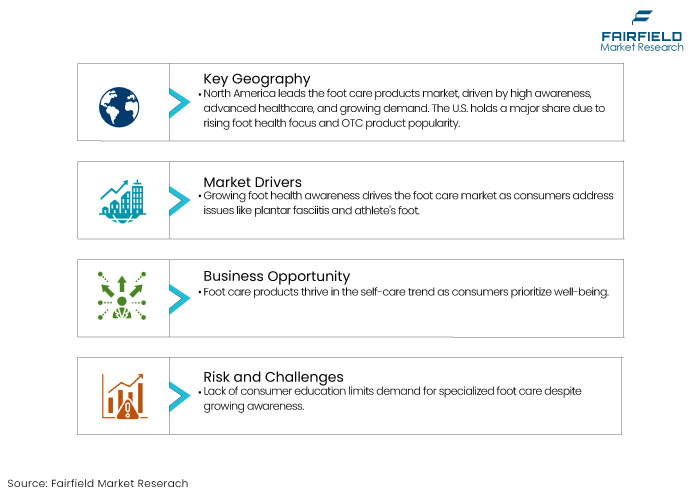
Rising awareness about the importance of foot health is one of the key growth drivers for the foot care products market. With rising concerns about conditions like plantar fasciitis, bunions, athlete's foot, and other foot-related issues, consumers are becoming increasingly conscious about taking proper care of their feet.
Rise of social media, blogs, and health influencers has played a significant role in educating the public about foot health. People are increasingly looking for solutions that can help lower foot pain, improve comfort, and maintain foot hygiene.
Foot care brands are hence introducing various products designed to meet these needs, from moisturizing lotions to specialized creams that target specific foot issues. As more consumers recognize the long-term benefits of foot care, the market continues to rise.
- Rising Prevalence of Foot Disorders and Conditions
Increasing prevalence of foot-related disorders and conditions has significantly surged the foot care products market growth. Conditions such as diabetic neuropathy, arthritis, heel pain, and bunions are on the rise, especially among older individuals and those with sedentary lifestyles.
Growing burden of foot health issues is driving the need for specialized orthopedic foot care products, such as arch support insoles and therapeutic foot creams. As people spend more time on their feet due to work and leisure activities, they become more prone to foot problems, increasing the demand for solutions like foot cleansing and exfoliating products.
With the rise of electric foot massagers and other therapeutic foot care devices, consumers are turning to products that relieve foot pain and enhance comfort. The trend will likely continue as more individuals seek preventive measures and solutions to common foot ailments.
Key Growth Barriers
- Lack of Consumer Education on Foot Health is a Key Barrier
Despite surging awareness, a significant lack of comprehensive consumer education on proper foot care remains a key challenge. Several consumers still underestimate the importance of foot health, leading to insufficient demand for specialized foot care products.
Lack of awareness hinders the market's potential, particularly in regions where foot health issues are not a primary concern. Consumers often overlook the long-term benefits of foot care products, such as foot exfoliating creams and therapeutic insoles, due to limited education on the risks of neglecting foot health. This restraint is particularly noticeable in emerging markets, where more urgent health concerns often overshadow foot care.
To overcome this challenge, companies must educate consumers about the significance of proper foot care, particularly in preventing common ailments like bunions and plantar fasciitis. Until this knowledge gap is bridged, market growth may remain slower than expected.
Foot Care Products Market Trends and Opportunities
- Integration of Foot Care with Wellness and Self-care Trends
Foot care products are increasingly incorporated into the broader wellness and self-care movement, which presents a transformative growth opportunity. As more consumers prioritize their well-being, foot health is gaining attention as an essential aspect of self-care.
Foot relaxation therapies, aromatherapy foot creams, and at-home pedicure kits are gaining popularity, especially as consumers seek holistic approaches to relaxation and health. This trend has opened the door for foot care brands to align their products with wellness lifestyles, tapping into the high demand for natural and organic foot care products.
- Rising Demand for Foot Care Solutions among Aging Populations
One of the most transformative opportunities in the foot care products market is addressing the needs of the aging population. As the global population ages, foot health has become a significant concern, especially among seniors who experience conditions such as arthritis, plantar fasciitis, and diabetic neuropathy.
Growing awareness of the importance of foot care has led to a surging demand for products like orthopedic insoles, foot creams for dryness, and specialized foot health solutions. The elderly are increasingly seeking products that can provide comfort, relieve pain, and improve mobility. This shift presents a unique opportunity for brands to offer targeted foot care products that cater to specific age-related concerns.
Due to the increasing prevalence of diabetes worldwide, there is a rising demand for diabetic foot care products. Companies can capitalize on this opportunity by developing products that address these specific needs, further tapping into a large, underserved market segment.
Segment Covered in the Report
- Orthopedic Products to Lead Amid Urgent Need to Alleviate Pain
Orthopedic products hold the dominant position based on product type in the foot care products market, accumulating around 45% of the total share in 2025. The segment includes a wide range of products designed to address specific foot health issues, such as foot orthotics, insoles, heel cups, arch supports, and similar corrective footwear.
Orthopedic foot care products are showcasing high demand as more people seek effective solutions for managing foot pain, particularly in regions with an aging population or rising incidences of chronic foot conditions. Rising number of consumers, especially among older adults who experience foot-related issues or those involved in physical activities, is a key factor driving the segment's growth.
- Online Stores to Gain Traction with Easy Access to Products
Online stores have witnessed substantial growth in the past few years in the foot care products market. It was due to increasing consumer preference for the convenience and variety offered by e-commerce platforms. With a simple click, customers can access a wide range of foot care products, including orthopedic items, foot creams, nail care solutions, and exfoliating products, all from the comfort of their homes.
Direct-to-consumer brands, e-commerce giants like Amazon and Walmart, and specialized platforms for health and wellness products have significantly boosted online sales of foot care items. Consumers are increasingly relying on these platforms not only for the convenience of shopping but also for the availability of personalized recommendations and targeted marketing that aligns with their foot care needs.
Growing trend of digitalization and the rise in mobile commerce are contributing to the rapid growth of the online segment. As more people prioritize self-care and health, online stores remain a convenient and accessible option for purchasing foot care products. With continuous improvements in e-commerce technologies, including faster shipping and easier return policies, the online store distribution channel is likely to maintain its leading position in the market.
Regional Analysis
- North America to Dominate Amid High Demand for Insoles and Creams
North America dominates the foot care products market due to high consumer awareness, novel healthcare infrastructure, and increasing demand for personal care items. The U.S. holds a significant share, driven by a surging emphasis on foot health and rising popularity of over-the-counter foot care products such as insoles, creams, and specialized footwear.
North America-based consumers increasingly prioritize natural and organic foot care options, further broadening the eco-friendly and sustainable products market. The region’s extensive retail networks, e-commerce platforms, and innovative product offerings are key contributors to its leadership in the market.
- Europe Sees Steady Growth Amid Prevalence of Arthritis
Europe stands as the second-largest foot care products market, with significant contributions from countries like Germany, the U.K., and France. The region benefits from a rising awareness of foot health, particularly among the aging population, which requires more foot care due to age-related issues such as bunions and arthritis.
Local consumers have increasingly preferred high-quality, clinically tested foot care products, including antifungal treatments, creams, and insoles. Sustainability is another key driver in this region, as several consumers are shifting toward brands that prioritize eco-friendly packaging and natural ingredients.
Fairfield’s Competitive Landscape Analysis
The foot care products market is highly competitive, with a mix of established players and emerging brands boosting innovation. Leading companies focus on enhancing product efficacy and sustainability, often incorporating natural ingredients to appeal to eco-conscious consumers.
New entrants, especially those emphasizing organic and vegan formulations, are making their mark, capitalizing on the high demand for health-conscious foot care products. Key market trends include the rise of athleisure and increased foot health awareness, contributing to the demand for superior-quality, performance-driven foot care items. The dynamic landscape creates ample opportunities for innovation, particularly in personalized foot care solutions.
Key Market Companies
- Reckitt Benckiser Group Plc
- Pedifix Inc
- Medi GmbH & Co. KG
- Aetna Foot Products
- Alva-Amco Pharmacal Companies, Inc.
- Blistex Inc.
- GlaxoSmithKline Plc.
- HoMedics USA LLC
Global Foot Care Products Market is Segmented as-
By Product Type
- Orthopedic Products
- Foot Creams and Lotions
- Foot Cleansing and Exfoliating Products
- Nail Care Products
By Distribution Channel
- Drug Stores & Pharmacies
- Hospitals & Specialty Clinics
- Online Stores
By Region
- North America
- Europe
- Asia Pacific
- Latin America
- Middle East & Africa
- Executive Summary
- Global Foot Care Products Market Snapshot
- Future Projections
- Key Market Trends
- Regional Snapshot, by Value, 2026
- Analyst Recommendations
- Market Overview
- Market Definitions and Segmentations
- Market Dynamics
- Drivers
- Restraints
- Market Opportunities
- Value Chain Analysis
- COVID-19 Impact Analysis
- Porter's Five Forces Analysis
- Impact of Russia-Ukraine Conflict
- PESTLE Analysis
- Regulatory Analysis
- Price Trend Analysis
- Current Prices and Future Projections, 2025-2033
- Price Impact Factors
- Global Foot Care Products Market Outlook, 2020 - 2033
- Global Foot Care Products Market Outlook, by Product Type, Value (US$ Mn), 2020-2033
- Orthopedic Products
- Foot Creams and Lotions
- Foot Cleansing and Exfoliating Products
- Nail Care Products
- Global Foot Care Products Market Outlook, by Distribution Channel, Value (US$ Mn), 2020-2033
- Drug Stores & Pharmacies
- Hospitals & Specialty Clinics
- Online Stores
- Global Foot Care Products Market Outlook, by Region, Value (US$ Mn), 2020-2033
- North America
- Europe
- Asia Pacific
- Latin America
- Middle East & Africa
- Global Foot Care Products Market Outlook, by Product Type, Value (US$ Mn), 2020-2033
- North America Foot Care Products Market Outlook, 2020 - 2033
- North America Foot Care Products Market Outlook, by Product Type, Value (US$ Mn), 2020-2033
- Orthopedic Products
- Foot Creams and Lotions
- Foot Cleansing and Exfoliating Products
- Nail Care Products
- North America Foot Care Products Market Outlook, by Distribution Channel, Value (US$ Mn), 2020-2033
- Drug Stores & Pharmacies
- Hospitals & Specialty Clinics
- Online Stores
- North America Foot Care Products Market Outlook, by Country, Value (US$ Mn), 2020-2033
- U.S. Foot Care Products Market Outlook, by Product Type, 2020-2033
- U.S. Foot Care Products Market Outlook, by Distribution Channel, 2020-2033
- Canada Foot Care Products Market Outlook, by Product Type, 2020-2033
- Canada Foot Care Products Market Outlook, by Distribution Channel, 2020-2033
- BPS Analysis/Market Attractiveness Analysis
- North America Foot Care Products Market Outlook, by Product Type, Value (US$ Mn), 2020-2033
- Europe Foot Care Products Market Outlook, 2020 - 2033
- Europe Foot Care Products Market Outlook, by Product Type, Value (US$ Mn), 2020-2033
- Orthopedic Products
- Foot Creams and Lotions
- Foot Cleansing and Exfoliating Products
- Nail Care Products
- Europe Foot Care Products Market Outlook, by Distribution Channel, Value (US$ Mn), 2020-2033
- Drug Stores & Pharmacies
- Hospitals & Specialty Clinics
- Online Stores
- Europe Foot Care Products Market Outlook, by Country, Value (US$ Mn), 2020-2033
- Germany Foot Care Products Market Outlook, by Product Type, 2020-2033
- Germany Foot Care Products Market Outlook, by Distribution Channel, 2020-2033
- Italy Foot Care Products Market Outlook, by Product Type, 2020-2033
- Italy Foot Care Products Market Outlook, by Distribution Channel, 2020-2033
- France Foot Care Products Market Outlook, by Product Type, 2020-2033
- France Foot Care Products Market Outlook, by Distribution Channel, 2020-2033
- U.K. Foot Care Products Market Outlook, by Product Type, 2020-2033
- U.K. Foot Care Products Market Outlook, by Distribution Channel, 2020-2033
- Spain Foot Care Products Market Outlook, by Product Type, 2020-2033
- Spain Foot Care Products Market Outlook, by Distribution Channel, 2020-2033
- Russia Foot Care Products Market Outlook, by Product Type, 2020-2033
- Russia Foot Care Products Market Outlook, by Distribution Channel, 2020-2033
- Rest of Europe Foot Care Products Market Outlook, by Product Type, 2020-2033
- Rest of Europe Foot Care Products Market Outlook, by Distribution Channel, 2020-2033
- BPS Analysis/Market Attractiveness Analysis
- Europe Foot Care Products Market Outlook, by Product Type, Value (US$ Mn), 2020-2033
- Asia Pacific Foot Care Products Market Outlook, 2020 - 2033
- Asia Pacific Foot Care Products Market Outlook, by Product Type, Value (US$ Mn), 2020-2033
- Orthopedic Products
- Foot Creams and Lotions
- Foot Cleansing and Exfoliating Products
- Nail Care Products
- Asia Pacific Foot Care Products Market Outlook, by Distribution Channel, Value (US$ Mn), 2020-2033
- Drug Stores & Pharmacies
- Hospitals & Specialty Clinics
- Online Stores
- Asia Pacific Foot Care Products Market Outlook, by Country, Value (US$ Mn), 2020-2033
- China Foot Care Products Market Outlook, by Product Type, 2020-2033
- China Foot Care Products Market Outlook, by Distribution Channel, 2020-2033
- Japan Foot Care Products Market Outlook, by Product Type, 2020-2033
- Japan Foot Care Products Market Outlook, by Distribution Channel, 2020-2033
- South Korea Foot Care Products Market Outlook, by Product Type, 2020-2033
- South Korea Foot Care Products Market Outlook, by Distribution Channel, 2020-2033
- India Foot Care Products Market Outlook, by Product Type, 2020-2033
- India Foot Care Products Market Outlook, by Distribution Channel, 2020-2033
- Southeast Asia Foot Care Products Market Outlook, by Product Type, 2020-2033
- Southeast Asia Foot Care Products Market Outlook, by Distribution Channel, 2020-2033
- Rest of SAO Foot Care Products Market Outlook, by Product Type, 2020-2033
- Rest of SAO Foot Care Products Market Outlook, by Distribution Channel, 2020-2033
- BPS Analysis/Market Attractiveness Analysis
- Asia Pacific Foot Care Products Market Outlook, by Product Type, Value (US$ Mn), 2020-2033
- Latin America Foot Care Products Market Outlook, 2020 - 2033
- Latin America Foot Care Products Market Outlook, by Product Type, Value (US$ Mn), 2020-2033
- Orthopedic Products
- Foot Creams and Lotions
- Foot Cleansing and Exfoliating Products
- Nail Care Products
- Latin America Foot Care Products Market Outlook, by Distribution Channel, Value (US$ Mn), 2020-2033
- Drug Stores & Pharmacies
- Hospitals & Specialty Clinics
- Online Stores
- Latin America Foot Care Products Market Outlook, by Country, Value (US$ Mn), 2020-2033
- Brazil Foot Care Products Market Outlook, by Product Type, 2020-2033
- Brazil Foot Care Products Market Outlook, by Distribution Channel, 2020-2033
- Mexico Foot Care Products Market Outlook, by Product Type, 2020-2033
- Mexico Foot Care Products Market Outlook, by Distribution Channel, 2020-2033
- Argentina Foot Care Products Market Outlook, by Product Type, 2020-2033
- Argentina Foot Care Products Market Outlook, by Distribution Channel, 2020-2033
- Rest of LATAM Foot Care Products Market Outlook, by Product Type, 2020-2033
- Rest of LATAM Foot Care Products Market Outlook, by Distribution Channel, 2020-2033
- BPS Analysis/Market Attractiveness Analysis
- Latin America Foot Care Products Market Outlook, by Product Type, Value (US$ Mn), 2020-2033
- Middle East & Africa Foot Care Products Market Outlook, 2020 - 2033
- Middle East & Africa Foot Care Products Market Outlook, by Product Type, Value (US$ Mn), 2020-2033
- Orthopedic Products
- Foot Creams and Lotions
- Foot Cleansing and Exfoliating Products
- Nail Care Products
- Middle East & Africa Foot Care Products Market Outlook, by Distribution Channel, Value (US$ Mn), 2020-2033
- Drug Stores & Pharmacies
- Hospitals & Specialty Clinics
- Online Stores
- Middle East & Africa Foot Care Products Market Outlook, by Country, Value (US$ Mn), 2020-2033
- GCC Foot Care Products Market Outlook, by Product Type, 2020-2033
- GCC Foot Care Products Market Outlook, by Distribution Channel, 2020-2033
- South Africa Foot Care Products Market Outlook, by Product Type, 2020-2033
- South Africa Foot Care Products Market Outlook, by Distribution Channel, 2020-2033
- Egypt Foot Care Products Market Outlook, by Product Type, 2020-2033
- Egypt Foot Care Products Market Outlook, by Distribution Channel, 2020-2033
- Nigeria Foot Care Products Market Outlook, by Product Type, 2020-2033
- Nigeria Foot Care Products Market Outlook, by Distribution Channel, 2020-2033
- Rest of Middle East Foot Care Products Market Outlook, by Product Type, 2020-2033
- Rest of Middle East Foot Care Products Market Outlook, by Distribution Channel, 2020-2033
- BPS Analysis/Market Attractiveness Analysis
- Middle East & Africa Foot Care Products Market Outlook, by Product Type, Value (US$ Mn), 2020-2033
- Competitive Landscape
- Company Vs Segment Heatmap
- Company Market Share Analysis, 2025
- Competitive Dashboard
- Company Profiles
- Reckitt Benckiser Group Plc
- Company Overview
- Product Portfolio
- Financial Overview
- Business Strategies and Developments
- Pedifix Inc
- Medi GmbH & Co. KG
- Aetna Foot Products
- Alva-Amco Pharmacal Companies, Inc.
- Blistex Inc.
- GlaxoSmithKline Plc.
- HoMedics USA LLC
- Reckitt Benckiser Group Plc
- Appendix
- Research Methodology
- Report Assumptions
- Acronyms and Abbreviations
|
BASE YEAR |
HISTORICAL DATA |
FORECAST PERIOD |
UNITS |
|||
 |
2025 |
 |
2019 - 2024 |
 |
2026 - 2033 |
Value: US$ Billion |
|
REPORT FEATURES |
DETAILS |
|
Product Type Coverage |
|
|
Distribution Channel Coverage |
|
|
Geographical Coverage |
|
|
Leading Companies |
|
|
Report Highlights |
Key Market Indicators, Macro-micro economic impact analysis, Technological Roadmap, Key Trends, Driver, Restraints, and Future Opportunities & Revenue Pockets, Porter’s 5 Forces Analysis, Historical Trend (2019-2023), Market Estimates and Forecast, Market Dynamics, Industry Trends, Competition Landscape, Category, Region, Country-wise Trends & Analysis, COVID-19 Impact Analysis (Demand and Supply Chain) |
Our Research Methodology
Considering the volatility of business today, traditional approaches to strategizing a game plan can be unfruitful if not detrimental. True ambiguity is no way to determine a forecast. A myriad of predetermined factors must be accounted for such as the degree of risk involved, the magnitude of circumstances, as well as conditions or consequences that are not known or unpredictable. To circumvent binary views that cast uncertainty, the application of market research intelligence to strategically posture, move, and enable actionable outcomes is necessary.
View Methodology
Quality Assured
Rigorous Validation Process

Confidentiality Assured
End-to-end Data Security

Custom Research Services
Tailored To Your Objectives
FAQs
The foot care products industry is estimated to be valued at USD 12.2 Bn in 2026.
Asia Pacific is projected to account for the largest market share in 2025.
The industry for foot care products is estimated to witness a CAGR of 7% through 2032.
The foot care products market is estimated to reach USD 19.3 Bn by 2033.
Reckitt Benckiser Group Plc, Pedifix Inc., and Medi GmbH & Co. KG are few businesses.
Related Reports
E-commerce Last-mile Delivery Market Insights, Competitive Landscape, and Market Forecast 2033
The E-commerce last-mile delivery market is valued at USD 145.00 Bn in 2026 and projected to reach USD 275.58 Bn by 2033, growing at a 9.6% CAGR
Stone Plastic Composite Flooring Market Insights, Competitive Landscape, and Market Forecast 2033
The stone plastic composite flooring market to reach USD9.64 Bn by 2033, growing at 10.8% CAGR from USD4.70 Bn in 2026, driven by high flooring demand worldwide
Recycled and Bio-Based Flooring Market Insights, Competitive Landscape, and Market Forecast 2033
The recycled and bio-based flooring market reaches USD 6.50 Bn by 2033, growing at 9.7% CAGR from USD 3.40 Bn in 2026, driven by sustainable construction
Lithium-Ion Battery Safety Systems Market Insights, Competitive Landscape, and Market Forecast 2033
The lithium-ion battery safety systems market reaches USD 6.35 Bn by 2033, growing at 13.6% CAGR from USD 2.60 Bn in 2026, driven by battery safety needs
Fans And Blowers Market Forecast - 2033
The global fans and blowers market is set to reach US$ 27.45 Bn by 2033, growing at a 5.8% CAGR, driven by rising demand for efficient ventilation
Diabetic Footwear Market Insights, Competitive Landscape, and Market Forecast 2033
The diabetic footwear market will grow from USD 5.60 billion in 2026 to USD 9.85 billion by 2033, driven by rising diabetes prevalence and foot care awareness.