



Fragrance Ingredients Market
Fragrance Ingredients Market Insights, Competitive Landscape, and Market Forecast - 2033
The Fragrance Ingredients Market is valued at USD 12.4 Bn in 2026 and is projected to reach USD 16.5 Bn, growing at a CAGR of 4% by 2033.
Fragrance Ingredients Market Insights
Key Growth Determinants
- Increasing Popularity of Sustainable Fragrances
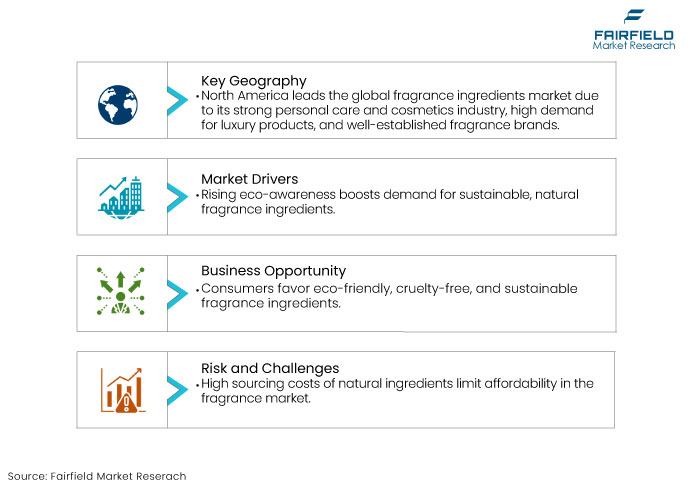
Consumers are becoming more environmentally conscious, which greatly impacts the fragrance ingredients market. The demand for sustainable and natural fragrance ingredients has surged as consumers seek effective and ethically sourced products.
Brands that embrace sustainability are gaining customer loyalty as they meet the demand for transparency and eco-conscious practices. This shift is particularly influencing the beauty and personal care industries, with several companies opting to replace synthetic fragrances with plant-based, biodegradable ingredients.
- Rising Demand for Personal Care Products
Growing consumer focus on personal hygiene and wellness is a significant driver of the fragrance ingredients market. In the U.S., 88% of consumers actively seek out personal care products made with natural ingredients, reflecting a strong preference for clean-label options.
As people become more aware of the benefits of personal care routines, they are increasingly turning to products like perfumes, deodorants, lotions, and shampoos that offer a sensory experience. The rise of e-commerce platforms has also facilitated easy access to premium personal care products, making it convenient for customers to discover and purchase fragrances that match their style and well-being, further boosting market growth.
Key Growth Barriers
- High Cost of Natural Fragrance Ingredients
One key restraint for the fragrance ingredients market is the high cost of sourcing natural ingredients. These ingredients are often more expensive than synthetic alternatives due to the labor-intensive harvesting processes, limited supply, and higher production costs. The price disparity can be a barrier for manufacturers and consumers, particularly regarding premium products.
Natural fragrances are in high demand due to their perceived health and environmental benefits, but the higher cost can make these products less accessible to a broader market. To combat this, companies are exploring ways to reduce costs by improving production methods and seeking more cost-effective sourcing. However, premium pricing remains a challenge for broader adoption.
Fragrance Ingredients Market Trends and Opportunities
- Emergence of Cruelty-free Fragrance Ingredients
A key trend shaping the fragrance ingredients market is the growing consumer preference for eco-friendly ingredients. Consumers are prioritizing brands that use sustainable, cruelty-free, and biodegradable fragrance ingredients, driven by concerns about environmental impact and personal health.
In Japan, consumer behavior reflects a strong inclination toward eco-friendly products, with 25% of beauty product consumers opting for items that boast environmental or eco-friendly claims. Companies are also exploring alternatives to synthetic fragrances, which are often linked to adverse environmental impacts.
- Market Players to Expand in Emerging Countries
Emerging markets such as Asia Pacific, Latin America, and the Middle East offer immense growth potential for the fragrance ingredients market. Several emerging economies are experiencing robust economic growth, which has led to high disposable income. This enables consumers to spend more on premium and luxury products, including fine fragrances and scented personal care items.
Middle-class expansion in countries like India, China, Brazil, and Indonesia is particularly significant. As these consumers seek to improve their lifestyles, demand for products with appealing fragrances, such as skincare, cosmetics, and home care items, is on the rise.
Segments Covered in the Report
- Synthetic Sources to Lead with High Cost-effectiveness
Synthetically sourced fragrances lead the fragrance ingredients market and are set to hold around 60% of share in 2025. Among the vast varieties of synthetically sourced fragrances, synthetic aroma chemicals are favored for their affordability, versatility, and consistent quality.
Producing synthetic fragrance ingredients is significantly cheaper than sourcing natural alternatives, making luxurious scents more accessible to a broader audience. Synthetic aroma chemicals allow perfumers to craft unique and complex fragrances that might be difficult or impossible to replicate using natural sources alone.
- Surging Disposable Income to Spur Personal Care Application
Based on application, the personal care segment will likely hold 58% market share in 2025. Rising disposable income and increased awareness of personal hygiene as well as appearance fuel the personal care industry's growth. As people become more conscious of their well-being, there is a high demand for products that serve functional purposes and offer pleasant sensory experiences.
Consumers increasingly seek items formulated with natural fragrance ingredients, reflecting a broader movement toward eco-friendly and health-conscious choices. The personal care segment's dominance in the fragrance ingredients market is a testament to evolving consumer behaviors and preferences.
Regional Analysis
- North America to Witness High Demand for Premium Products
North America holds the largest share of the global fragrance ingredients market, driven by a well-established personal care and cosmetics industry. The region’s consumers strongly prefer premium and luxury products, including perfumes, skincare items, and home care products enhanced with high-quality fragrances. The widespread availability of prominent fragrance brands and novel distribution networks has solidified North America’s dominance.
The U.S., as the most significant contributor to the region’s revenue, benefits from continuous product innovation and rising consumer interest in clean-label fragrance ingredients. Leading companies, such as Estée Lauder and Procter & Gamble, also invest heavily in marketing and sustainable practices, further bolstering regional growth.
- Entry of International Fragrance Brands to Boost Asia Pacific
Asia Pacific is rapidly emerging as a key region in the fragrance ingredients market. The region’s share, currently at 28%, is set to increase significantly in the next ten years. Countries such as China, India, and South Korea are leading this growth, with consumers prioritizing personal grooming and luxury goods. India is the fastest-growing market in the region, supported by a young population, rising awareness of grooming products, and presence of international fragrance brands.
Cultural preferences in Asia Pacific, such as using fragrances in daily rituals and traditional ceremonies, further fuel demand for personal and fabric care products. With consumers increasingly leaning toward products made with natural fragrance ingredients, manufacturers are extending their portfolios to cater to these preferences.
Fairfield’s Competitive Landscape Analysis
The fragrance ingredients market is highly competitive, with key players focusing on innovation, sustainability, and extending product portfolios. Companies like Givaudan, Firmenich, and International Flavors & Fragrances (IFF) dominate the market, leveraging unique research and development to introduce unique, eco-friendly scents.
Emerging players are also catering to niche markets and offering region-specific fragrances. Strategic collaborations, acquisitions, and partnerships are common strategies to strengthen their presence. As consumer preferences shift toward clean-label products, companies emphasize transparency and traceability, fostering customer trust and loyalty while staying ahead in the dynamic fragrance industry.
Key Market Companies
- BASF SE
- Fine Fragrance Pvt. Ltd
- Firmenich SA (Sentarom SA)
- Givaudan
- International Flavors & Fragrances Inc.
- Kalpsutra Chemicals Pvt. Ltd.
- Mane SA
- Robertet Group
- S H Kelkar & Co. Limited
- Hasegawa Co. Ltd
Global Fragrance Ingredients Market is Segmented as-
By Type
- Natural Source
- Synthetic Source
By Application
- Hair Care
- Personal Care
- Fabric Care
- Others
By Region
- North America
- Europe
- Asia Pacific
- Latin America
- Middle East & Africa
- Executive Summary
- Global Fragrance Ingredients Market Snapshot
- Future Projections
- Key Market Trends
- Regional Snapshot, by Value, 2026
- Analyst Recommendations
- Market Overview
- Market Definitions and Segmentations
- Market Dynamics
- Drivers
- Restraints
- Market Opportunities
- Value Chain Analysis
- COVID-19 Impact Analysis
- Porter's Five Forces Analysis
- Impact of Russia-Ukraine Conflict
- PESTLE Analysis
- Regulatory Analysis
- Price Trend Analysis
- Current Prices and Future Projections, 2025-2033
- Price Impact Factors
- Global Fragrance Ingredients Market Outlook, 2020 - 2033
- Global Fragrance Ingredients Market Outlook, by Type, Value (US$ Mn), 2020-2033
- Natural Source
- Synthetic Source
- Global Fragrance Ingredients Market Outlook, by Application, Value (US$ Mn), 2020-2033
- Hair Care
- Personal Care
- Fabric Care
- Others
- Global Fragrance Ingredients Market Outlook, by Region, Value (US$ Mn), 2020-2033
- North America
- Europe
- Asia Pacific
- Latin America
- Middle East & Africa
- Global Fragrance Ingredients Market Outlook, by Type, Value (US$ Mn), 2020-2033
- North America Fragrance Ingredients Market Outlook, 2020 - 2033
- North America Fragrance Ingredients Market Outlook, by Type, Value (US$ Mn), 2020-2033
- Natural Source
- Synthetic Source
- North America Fragrance Ingredients Market Outlook, by Application, Value (US$ Mn), 2020-2033
- Hair Care
- Personal Care
- Fabric Care
- Others
- North America Fragrance Ingredients Market Outlook, by Country, Value (US$ Mn), 2020-2033
- U.S. Fragrance Ingredients Market Outlook, by Type, 2020-2033
- U.S. Fragrance Ingredients Market Outlook, by Application, 2020-2033
- Canada Fragrance Ingredients Market Outlook, by Type, 2020-2033
- Canada Fragrance Ingredients Market Outlook, by Application, 2020-2033
- BPS Analysis/Market Attractiveness Analysis
- North America Fragrance Ingredients Market Outlook, by Type, Value (US$ Mn), 2020-2033
- Europe Fragrance Ingredients Market Outlook, 2020 - 2033
- Europe Fragrance Ingredients Market Outlook, by Type, Value (US$ Mn), 2020-2033
- Natural Source
- Synthetic Source
- Europe Fragrance Ingredients Market Outlook, by Application, Value (US$ Mn), 2020-2033
- Hair Care
- Personal Care
- Fabric Care
- Others
- Europe Fragrance Ingredients Market Outlook, by Country, Value (US$ Mn), 2020-2033
- Germany Fragrance Ingredients Market Outlook, by Type, 2020-2033
- Germany Fragrance Ingredients Market Outlook, by Application, 2020-2033
- Italy Fragrance Ingredients Market Outlook, by Type, 2020-2033
- Italy Fragrance Ingredients Market Outlook, by Application, 2020-2033
- France Fragrance Ingredients Market Outlook, by Type, 2020-2033
- France Fragrance Ingredients Market Outlook, by Application, 2020-2033
- U.K. Fragrance Ingredients Market Outlook, by Type, 2020-2033
- U.K. Fragrance Ingredients Market Outlook, by Application, 2020-2033
- Spain Fragrance Ingredients Market Outlook, by Type, 2020-2033
- Spain Fragrance Ingredients Market Outlook, by Application, 2020-2033
- Russia Fragrance Ingredients Market Outlook, by Type, 2020-2033
- Russia Fragrance Ingredients Market Outlook, by Application, 2020-2033
- Rest of Europe Fragrance Ingredients Market Outlook, by Type, 2020-2033
- Rest of Europe Fragrance Ingredients Market Outlook, by Application, 2020-2033
- BPS Analysis/Market Attractiveness Analysis
- Europe Fragrance Ingredients Market Outlook, by Type, Value (US$ Mn), 2020-2033
- Asia Pacific Fragrance Ingredients Market Outlook, 2020 - 2033
- Asia Pacific Fragrance Ingredients Market Outlook, by Type, Value (US$ Mn), 2020-2033
- Natural Source
- Synthetic Source
- Asia Pacific Fragrance Ingredients Market Outlook, by Application, Value (US$ Mn), 2020-2033
- Hair Care
- Personal Care
- Fabric Care
- Others
- Asia Pacific Fragrance Ingredients Market Outlook, by Country, Value (US$ Mn), 2020-2033
- China Fragrance Ingredients Market Outlook, by Type, 2020-2033
- China Fragrance Ingredients Market Outlook, by Application, 2020-2033
- Japan Fragrance Ingredients Market Outlook, by Type, 2020-2033
- Japan Fragrance Ingredients Market Outlook, by Application, 2020-2033
- South Korea Fragrance Ingredients Market Outlook, by Type, 2020-2033
- South Korea Fragrance Ingredients Market Outlook, by Application, 2020-2033
- India Fragrance Ingredients Market Outlook, by Type, 2020-2033
- India Fragrance Ingredients Market Outlook, by Application, 2020-2033
- Southeast Asia Fragrance Ingredients Market Outlook, by Type, 2020-2033
- Southeast Asia Fragrance Ingredients Market Outlook, by Application, 2020-2033
- Rest of SAO Fragrance Ingredients Market Outlook, by Type, 2020-2033
- Rest of SAO Fragrance Ingredients Market Outlook, by Application, 2020-2033
- BPS Analysis/Market Attractiveness Analysis
- Asia Pacific Fragrance Ingredients Market Outlook, by Type, Value (US$ Mn), 2020-2033
- Latin America Fragrance Ingredients Market Outlook, 2020 - 2033
- Latin America Fragrance Ingredients Market Outlook, by Type, Value (US$ Mn), 2020-2033
- Natural Source
- Synthetic Source
- Latin America Fragrance Ingredients Market Outlook, by Application, Value (US$ Mn), 2020-2033
- Hair Care
- Personal Care
- Fabric Care
- Others
- Latin America Fragrance Ingredients Market Outlook, by Country, Value (US$ Mn), 2020-2033
- Brazil Fragrance Ingredients Market Outlook, by Type, 2020-2033
- Brazil Fragrance Ingredients Market Outlook, by Application, 2020-2033
- Mexico Fragrance Ingredients Market Outlook, by Type, 2020-2033
- Mexico Fragrance Ingredients Market Outlook, by Application, 2020-2033
- Argentina Fragrance Ingredients Market Outlook, by Type, 2020-2033
- Argentina Fragrance Ingredients Market Outlook, by Application, 2020-2033
- Rest of LATAM Fragrance Ingredients Market Outlook, by Type, 2020-2033
- Rest of LATAM Fragrance Ingredients Market Outlook, by Application, 2020-2033
- BPS Analysis/Market Attractiveness Analysis
- Latin America Fragrance Ingredients Market Outlook, by Type, Value (US$ Mn), 2020-2033
- Middle East & Africa Fragrance Ingredients Market Outlook, 2020 - 2033
- Middle East & Africa Fragrance Ingredients Market Outlook, by Type, Value (US$ Mn), 2020-2033
- Natural Source
- Synthetic Source
- Middle East & Africa Fragrance Ingredients Market Outlook, by Application, Value (US$ Mn), 2020-2033
- Hair Care
- Personal Care
- Fabric Care
- Others
- Middle East & Africa Fragrance Ingredients Market Outlook, by Country, Value (US$ Mn), 2020-2033
- GCC Fragrance Ingredients Market Outlook, by Type, 2020-2033
- GCC Fragrance Ingredients Market Outlook, by Application, 2020-2033
- South Africa Fragrance Ingredients Market Outlook, by Type, 2020-2033
- South Africa Fragrance Ingredients Market Outlook, by Application, 2020-2033
- Egypt Fragrance Ingredients Market Outlook, by Type, 2020-2033
- Egypt Fragrance Ingredients Market Outlook, by Application, 2020-2033
- Nigeria Fragrance Ingredients Market Outlook, by Type, 2020-2033
- Nigeria Fragrance Ingredients Market Outlook, by Application, 2020-2033
- Rest of Middle East Fragrance Ingredients Market Outlook, by Type, 2020-2033
- Rest of Middle East Fragrance Ingredients Market Outlook, by Application, 2020-2033
- BPS Analysis/Market Attractiveness Analysis
- Middle East & Africa Fragrance Ingredients Market Outlook, by Type, Value (US$ Mn), 2020-2033
- Competitive Landscape
- Company Vs Segment Heatmap
- Company Market Share Analysis, 2025
- Competitive Dashboard
- Company Profiles
- BASF SE
- Company Overview
- Product Portfolio
- Financial Overview
- Business Strategies and Developments
- Fine Fragrance Pvt. Ltd
- Firmenich SA (Sentarom SA)
- Givaudan
- International Flavors & Fragrances Inc.
- Kalpsutra Chemicals Pvt. Ltd.
- Mane SA
- Robertet Group
- S H Kelkar & Co. Limited
- Hasegawa Co. Ltd
- BASF SE
- Appendix
- Research Methodology
- Report Assumptions
- Acronyms and Abbreviations
|
BASE YEAR |
HISTORICAL DATA |
FORECAST PERIOD |
UNITS |
|||
 |
2025 |
 |
2019 - 2024 |
 |
2026 - 2033 |
Value: US$ Billion |
|
REPORT FEATURES |
DETAILS |
|
Type Coverage |
|
|
Application Coverage |
|
|
Geographical Coverage |
|
|
Leading Companies |
|
|
Report Highlights |
Key Market Indicators, Macro-micro economic impact analysis, Technological Roadmap, Key Trends, Driver, Restraints, and Future Opportunities & Revenue Pockets, Porter’s 5 Forces Analysis, Historical Trend (2019-2021), Market Estimates and Forecast, Market Dynamics, Industry Trends, Competition Landscape, Category, Region, Country-wise Trends & Analysis, COVID-19 Impact Analysis (Demand and Supply Chain) |
Our Research Methodology
Considering the volatility of business today, traditional approaches to strategizing a game plan can be unfruitful if not detrimental. True ambiguity is no way to determine a forecast. A myriad of predetermined factors must be accounted for such as the degree of risk involved, the magnitude of circumstances, as well as conditions or consequences that are not known or unpredictable. To circumvent binary views that cast uncertainty, the application of market research intelligence to strategically posture, move, and enable actionable outcomes is necessary.
View Methodology
Quality Assured
Rigorous Validation Process

Confidentiality Assured
End-to-end Data Security

Custom Research Services
Tailored To Your Objectives
FAQs
The industry is anticipated to witness a CAGR of 4% through 2033.
Asia Pacific is projected to account for the largest market share in 2026.
The industry is estimated to be valued at USD 12.4 Bn in 2026.
The fragrance ingredients industry is set to reach USD 16.5 Bn by 2033.
BASF SE, Fine Fragrance Pvt. Ltd., and Firmenich SA (Sentarom SA) are a few firms.
Related Reports
Hydrogen Cyanide Market
Hydrogen Cyanide Market reaches USD 3.98 Billion by 2033 from USD 2.85 Billion in 2026, growing at 4.9% CAGR, with Chemicals & Plastics leading at 57%.
Seed Treatment Fungicides Market Insights, Competitive Landscape, and Market Forecast 2033
Seed Treatment Fungicides Market to reach USD 5.74 Bn by 2033, growing at 6.9% CAGR, driven by crop protection, disease control, and sustainable farming.
SDHI Fungicide Market Insights, Competitive Landscape, and Market Forecast 2033
SDHI Fungicide Market to reach USD 3.89 Bn by 2033, growing at 7.8% CAGR, driven by crop protection, disease control, and resistance management.
Lithium Manganese Iron Phosphate (LMFP) Battery Market Forecast - 2033
The global lithium manganese iron phosphate (LMFP) battery market is set to reach US$ 7.24 billion by 2033, growing at a 22.0% CAGR from 2026-2033
Ball Clay Market Insights, Competitive Landscape, and Market Forecast - 2033
Ball clay market is valued at USD 1.65 Billion in 2026 and projected to reach USD 2.26 Billion by 2033, expanding at a CAGR of 4.6%.
N-Vinylformamide Market Insights, Competitive Landscape, and Market Forecast - 2033
N-vinylformamide market is valued at USD 420.00 Million in 2026 and projected to reach USD 683.30 Million by 2033, expanding at a CAGR of 7.2%.