



Gas Insulated Transformer Market
Gas Insulated Transformer Market Insights, Competitive Landscape, and Market Forecast - 2033
Global Gas Insulated Transformer Market Forecast
The Gas Insulated Transformer Market is expected to grow from USD 3.2 Billion in 2026 to USD 4.4 Billion by 2033, reflecting strong industry expansion and registering a CAGR of 4.8% during the forecast period from 2026 to 2033.
Gas-insulated Transformer Market Summary: Key Insights & Trends
- Step-up transformers lead the global gas-insulated transformer market, capturing around 60% share, driven by their dominance in long-distance power transmission and integration with high-voltage substations.
- Step-down transformers represent the fastest-growing segment, gradually increasing their share as urban electrification and smart city infrastructure boost demand for compact distribution systems.
- Poly-phase technology holds the largest share of over 80%, favored for its balanced power flow and efficiency across industrial and utility-grade networks.
- Two-phase technology is gaining share in emerging applications, supported by hybrid renewable systems and decentralized energy grids seeking improved stability.
- The utility sector commands nearly 75% share, reflecting continued investments in grid modernization, transmission reliability, and fault-resilient infrastructure worldwide.
- Non-utility applications hold a smaller yet rising share, driven by industrial electrification, data center expansion, and modular energy systems.
- Electrification and renewable integration remain core global growth drivers, as utilities increasingly adopt gas-insulated transformers for compact, efficient, and low-emission power networks.
- Asia Pacific accounts for over 40% of global share, maintaining its lead through large-scale electrification, renewable integration, and smart grid deployment across China, India, and Japan.
Key Growth Drivers
- Urbanization Spurs Demand for Compact Space Saving Gas-insulated Transformers
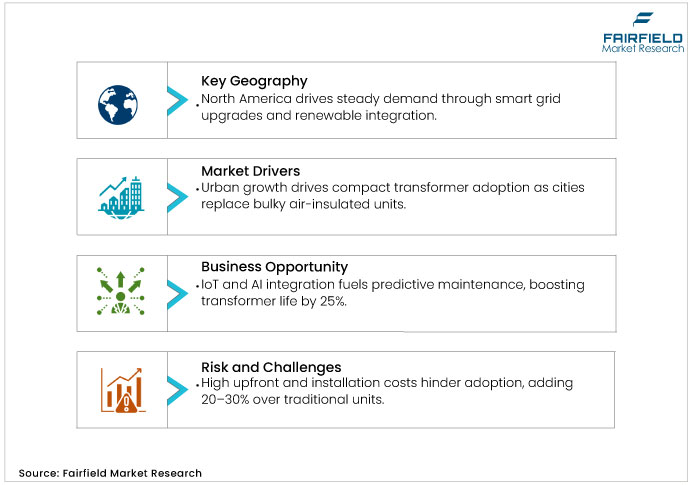
Urbanization accelerates the demand for gas-insulated transformers, as cities expand and traditional air-insulated systems prove impractical in dense environments. These transformers, using SF6 or alternative gases for insulation, occupy up to 90% less space than conventional designs, enabling seamless integration into metropolitan grids.
According to the U.S. Department of Energy's Electric Grid Supply Chain Review, infrastructure growth drivers include a projected 160-260% increase in distribution transformer capacity by 2050 to support electrification. This trend aligns with global theories of network densification, where compact technologies mitigate land scarcity and reduce installation timelines by 30-40%. In practice, utilities leverage gas-insulated solutions to enhance grid reliability, minimizing outage risks in high-load urban corridors.
- Electrification and Renewables Drive Adoption of Advanced Gas-insulated Transformers
Electrification of transport, industry, and residential sectors propels the gas-insulated transformer market, as these transformers efficiently step up voltages for renewable sources such as wind and solar. The International Energy Agency notes that global electricity demand from renewables could double by 2030, necessitating advanced insulation to handle variable loads without efficiency losses. Theoretically, this embodies the "energy transition hypothesis," where gas-insulated designs minimize transmission losses—estimated at 5-7% in conventional systems—through superior dielectric strength. In Asia Pacific, for instance, China's ultra-high-voltage projects exemplify this, integrating gigawatt-scale renewables with minimal environmental footprint. Justifications include regulatory mandates, such as the U.S. Energy Department's initiatives for grid resilience, which prioritize low-loss components to support net-zero goals. This driver not only boosts market velocity but also reinforces supply chain theories emphasizing diversified sourcing for critical minerals in transformer cores.
Key Restraints
- High Capital Costs and Complex Manufacturing Limit Gas-insulated Transformer Adoption
The gas-insulated transformer industry faces hurdles from elevated upfront costs, stemming from specialized materials such as high-purity SF6 gas and precision engineering. Installation expenses can exceed traditional transformers by 20-30%, deterring budget-constrained utilities in emerging regions. Theoretically, this embodies capital intensity barriers in heavy industry, where economies of scale lag due to low-volume production. Recent analyses indicate supply chain vulnerabilities amplify these costs, with raw material fluctuations adding 5-10% variability. Mitigation requires phased financing models, yet persistent complexity hampers widespread penetration.
- Environmental Regulations on SF6 Challenge Growth of Gas-insulated Transformers
SF6's potent greenhouse effect—23,500 times that of CO2—invites stringent regulations, challenging the gas-insulated transformer market's core technology. The EPA's emissions overview underscores utilities' shift away from SF6, with phase-out mandates in Europe by 2030 risking non-compliance penalties up to 15% of project budgets. This restraint aligns with environmental economics theory, where externalities impose transition costs estimated at US$500 million globally by 2025. Alternatives such as G3 gas have emerged, but certification delays constrain growth.
Gas-insulated Transformer Market Trends and Opportunities
- Smart Grid Integration Enhances Efficiency and Reliability of Gas-insulated Transformers
The convergence of IoT and AI opens avenues in the Gas-insulated Transformer Market, theoretically enabling predictive maintenance through real-time monitoring. Systems theory frames this as a feedback loop, where data analytics optimize performance and extend asset life by 25%. Theoretical justifications draw from digital twin models, simulating operations to preempt failures in dynamic grids. As renewables proliferate, this opportunity theoretically bridges legacy systems with future-proof designs, unlocking efficiency gains in volatile energy landscapes. Stakeholders can leverage this for a competitive edge in data-driven utilities.
- Renewable Energy Expansion Fuels Demand for Gas-insulated Transformers
Rising renewable deployments create tailwinds for the Gas-insulated Transformer Market, theoretically supporting decentralized generation via compact, high-efficiency units. Energy transition theory posits that gas insulation facilitates voltage stepping in remote solar farms, reducing transmission losses theoretically by 10-15%. Justifications include global targets for 50% clean energy by 2030, spurring infrastructure overhauls. This opportunity theoretically diversifies applications beyond urban grids, into offshore wind and microgrids, fostering inclusive growth in underserved areas.
Segment-wise Trends & Analysis
- Step Up Transformers Lead While Step Down Units Show Rapid Growth
Step-up transformers lead the gas-insulated transformer market with approximately 60% share in 2025, valued at USD 2.1 billion, driven by their role in elevating voltages for long-distance transmission. This dominance stems from theoretical advantages in power flow optimization, where higher insulation withstands elevated stresses without spatial trade-offs. Competitors such as Siemens AG position strongly through integrated solutions that bundle step-up units with GIS, capturing utility contracts.
The step-down transformer segment emerges as fast-growing, fueled by urban distribution needs. Theoretical drivers include load balancing in smart cities, where voltage reduction minimizes end-user disruptions. Eaton Corporation gains footing via cost-effective designs, theoretically outpacing rivals in non-utility deployments.
- Poly Phase Technology Dominates While Two Phase Systems Gain Momentum
Poly-phase technology commands over 80% market share in 2025, equating to US$ 2.8 billion, underpinned by its efficiency in three-phase systems prevalent in industrial grids. Theoretical superiority lies in balanced power distribution, reducing harmonics per electrical engineering axioms. ABB Ltd. excels competitively with scalable poly-phase offerings, securing 25% of premium installations.
Two-phase technology represents the emerging frontier, with an anticipated CAGR, propelled by hybrid renewable integrations. Drivers theoretically encompass phased power delivery for variable loads, enhancing stability in off-grid setups. Toshiba Corporation advances positioning through R&D in adaptive controls, targeting 15% share growth by 2030.
- Utility Sector Leads While Non-Utility Applications Witness Strong Expansion
The utility sector dominates the Gas-insulated Transformer Market at ~75% share in 2025, worth US$ 2.6 billion, anchored by infrastructure investments for reliable supply. Theoretical imperatives from network theory emphasize resilience against faults, justifying bulk procurements. GE leverages this via long-term service agreements, holding 30% utility penetration.
Non-utility applications fast-track growth at a sustainable CAGR, driven by industrial electrification in manufacturing hubs. Theoretical enablers include customized insulation for harsh environments, mitigating downtime costs. Schneider Electric SE differentiates with modular non-utility variants, aiming for 20% segment capture amid digital factory trends.
Regional Trends & Analysis
North America Advances Grid Modernization with Compact Gas-insulated Transformers
North America represents a mature market for gas-insulated transformers, characterized by grid modernization initiatives and the replacement of aging infrastructure. The region's focus on smart grid development and renewable energy integration creates steady demand for advanced transformer technologies. Major utility companies are investing in compact, reliable solutions to upgrade existing substations and improve grid resilience against extreme weather events.
U.S. Gas-insulated Transformer Market – 2025 Snapshot & Outlook
The U.S. market is driven by substantial investments in transmission and distribution infrastructure, with federal and state policies supporting grid modernization and renewable energy integration. The Biden administration's infrastructure initiatives and clean energy mandates are creating opportunities for gas-insulated transformer deployment in critical power projects. Regulatory frameworks encouraging emission reductions are promoting the adoption of environmentally friendly transformer technologies.
The market benefits from strong utility sector demand and the need to enhance grid reliability in major metropolitan areas where space constraints favor compact solutions. Consumer trends toward electrification, including electric vehicle adoption and heat pump installations, are increasing electricity demand and driving infrastructure upgrades that require efficient, reliable transformer solutions.
Asia Pacific Leads Global Growth in Gas-insulated Transformer Adoption
Asia Pacific dominates the gas-insulated transformer market with over 40% share in 2025, representing the fastest-growing region globally. The region's rapid industrialization, urbanization, and infrastructure development create unprecedented demand for power distribution solutions. Major economies, including China, India, and Japan are implementing massive electrification programs and smart grid initiatives that require advanced transformer technologies.
Japan Gas-insulated Transformer Market – 2025 Snapshot & Outlook
Japan's market is characterized by the adoption of compact transformers for space-constrained urban areas and the integration of renewable energy sources. The country's commitment to carbon neutrality and advanced manufacturing capabilities positions it as a key market for innovative transformer technologies. Japanese utilities are investing in SF6-free alternatives and digital monitoring systems to enhance grid efficiency and environmental performance.
The market benefits from government policies promoting renewable energy integration and smart grid development. Consumer preferences for reliable power supply and environmental sustainability are driving demand for advanced transformer solutions that can support Japan's energy transition goals while maintaining the high reliability standards expected in Japanese infrastructure.
India Gas-insulated Transformer Market – 2025 Snapshot & Outlook
India's market demonstrates strong growth driven by the "Power for All" initiative and massive infrastructure development projects. The government's commitment to 24x7 power supply for all consumers is creating substantial demand for reliable, efficient transformer solutions. Major transmission and distribution projects are incorporating gas-insulated transformers to ensure grid stability and reduce power losses.
The market is supported by rapid urbanization and industrial growth, with new commercial and industrial developments requiring advanced power infrastructure. Government policies promoting renewable energy integration and grid modernization are creating opportunities for gas-insulated transformer deployment in both utility and industrial applications.
Europe Accelerates Green Energy Transition with Eco-Friendly Transformer Technologies
Europe represents a fast-growing market focused on environmental sustainability and grid modernization. The region's stringent emissions regulations and commitment to carbon neutrality are driving the adoption of eco-friendly transformer technologies. Major infrastructure projects and renewable energy integration initiatives create consistent demand for advanced power distribution solutions.
Germany Gas-insulated Transformer Market – 2025 Snapshot & Outlook
Germany's market is valued at US$ 1.25 billion in 2025 and projected to reach US$ 2.13 billion by 2032. The country's Energiewende program and commitment to renewable energy integration are driving substantial investments in power infrastructure. Major transmission projects such as the Baden Rhine Energy Corridor require advanced gas-insulated switchgear and transformer technologies.
The market benefits from strong government support for grid modernization and environmental sustainability initiatives. German utilities are leading the adoption of SF6-free technologies and digital monitoring systems, creating demand for innovative transformer solutions that can support the country's energy transition goals while meeting strict environmental standards.
U.K. Gas-insulated Transformer Market – 2025 Snapshot & Outlook
The U.K. market is driven by investments in renewable energy infrastructure and grid modernization projects supporting the country's net-zero commitments. Major offshore wind developments and urban infrastructure projects create demand for compact, reliable transformer solutions. Regulatory frameworks promoting emission reductions and energy efficiency are encouraging the adoption of advanced transformer technologies.
The market growth is supported by utility sector investments in smart grid technologies and the replacement of aging infrastructure with more efficient, environmentally friendly alternatives. Consumer trends toward electrification and renewable energy adoption are driving electricity demand growth that requires enhanced transmission and distribution capabilities.
Competitive Landscape Analysis
The players in the Gas-insulated Transformer Market are focusing on R&D in SF6 alternatives to meet global emission standards. This strategy counters regulatory pressures, as evidenced by a 25% rise in green patents since 2022, enabling premium pricing and market entry in restricted regions. Collaborations with utilities accelerate testing, such as joint pilots, reducing validation times by 30%. Such moves secure first-mover advantages in a market where compliance lapses cost 10% in fines annually.
M&A activity and EU carbon border taxes will reshape costs, with consolidations such as potential ABB-Siemens tie-ups expanding capacity by 15% in Europe. New IEC standards for G3 gases mandate redesigns, hiking short-term expenses 8% but unlocking long-term savings. Early movers will benefit from established supply chains, while latecomers may face 20% higher sourcing premiums.
Key Companies
- Siemens AG
- Toshiba Corporation
- Eaton Corporation
- ABB Ltd.
- GE
- Mitsubishi Heavy Industries, Ltd.
- Exelon Corporation
- Nissin Electric Co., Ltd.
- Schneider Electric SE
- MEIDENSHA CORPORATION
Global Gas-insulated Transformer Market Segmentation-
By Type
- Step-up Transformer
- Step-down Transformer
By Technology
- Single-phase
- Two-phase
- Poly-phase
By End-user
- Utility
- Non-utility
By Region
- North America
- Europe
- Asia Pacific
- Latin America
- Middle East & Africa
- Executive Summary
- Global Gas Insulated Transformer Market Snapshot
- Future Projections
- Key Market Trends
- Regional Snapshot, by Value, 2026
- Analyst Recommendations
- Market Overview
- Market Definitions and Segmentations
- Market Dynamics
- Drivers
- Restraints
- Market Opportunities
- Value Chain Analysis
- COVID-19 Impact Analysis
- Porter's Five Forces Analysis
- Impact of Russia-Ukraine Conflict
- PESTLE Analysis
- Regulatory Analysis
- Price Trend Analysis
- Current Prices and Future Projections, 2025-2033
- Price Impact Factors
- Global Gas Insulated Transformer Market Outlook, 2020 - 2033
- Global Gas Insulated Transformer Market Outlook, by Type, Value (US$ Bn), 2020-2033
- Step-up Transformer
- Step-down Transformer
- Global Gas Insulated Transformer Market Outlook, by Technology, Value (US$ Bn), 2020-2033
- Single-phase
- Two-phase
- Poly-phase
- Global Gas Insulated Transformer Market Outlook, by End-user, Value (US$ Bn), 2020-2033
- Utility
- Non-utility
- Global Gas Insulated Transformer Market Outlook, by Region, Value (US$ Bn), 2020-2033
- North America
- Europe
- Asia Pacific
- Latin America
- Middle East & Africa
- Global Gas Insulated Transformer Market Outlook, by Type, Value (US$ Bn), 2020-2033
- North America Gas Insulated Transformer Market Outlook, 2020 - 2033
- North America Gas Insulated Transformer Market Outlook, by Type, Value (US$ Bn), 2020-2033
- Step-up Transformer
- Step-down Transformer
- North America Gas Insulated Transformer Market Outlook, by Technology, Value (US$ Bn), 2020-2033
- Single-phase
- Two-phase
- Poly-phase
- North America Gas Insulated Transformer Market Outlook, by End-user, Value (US$ Bn), 2020-2033
- Utility
- Non-utility
- North America Gas Insulated Transformer Market Outlook, by Country, Value (US$ Bn), 2020-2033
- U.S. Gas Insulated Transformer Market Outlook, by Type, 2020-2033
- U.S. Gas Insulated Transformer Market Outlook, by Technology, 2020-2033
- U.S. Gas Insulated Transformer Market Outlook, by End-user, 2020-2033
- Canada Gas Insulated Transformer Market Outlook, by Type, 2020-2033
- Canada Gas Insulated Transformer Market Outlook, by Technology, 2020-2033
- Canada Gas Insulated Transformer Market Outlook, by End-user, 2020-2033
- BPS Analysis/Market Attractiveness Analysis
- North America Gas Insulated Transformer Market Outlook, by Type, Value (US$ Bn), 2020-2033
- Europe Gas Insulated Transformer Market Outlook, 2020 - 2033
- Europe Gas Insulated Transformer Market Outlook, by Type, Value (US$ Bn), 2020-2033
- Step-up Transformer
- Step-down Transformer
- Europe Gas Insulated Transformer Market Outlook, by Technology, Value (US$ Bn), 2020-2033
- Single-phase
- Two-phase
- Poly-phase
- Europe Gas Insulated Transformer Market Outlook, by End-user, Value (US$ Bn), 2020-2033
- Utility
- Non-utility
- Europe Gas Insulated Transformer Market Outlook, by Country, Value (US$ Bn), 2020-2033
- Germany Gas Insulated Transformer Market Outlook, by Type, 2020-2033
- Germany Gas Insulated Transformer Market Outlook, by Technology, 2020-2033
- Germany Gas Insulated Transformer Market Outlook, by End-user, 2020-2033
- Italy Gas Insulated Transformer Market Outlook, by Type, 2020-2033
- Italy Gas Insulated Transformer Market Outlook, by Technology, 2020-2033
- Italy Gas Insulated Transformer Market Outlook, by End-user, 2020-2033
- France Gas Insulated Transformer Market Outlook, by Type, 2020-2033
- France Gas Insulated Transformer Market Outlook, by Technology, 2020-2033
- France Gas Insulated Transformer Market Outlook, by End-user, 2020-2033
- U.K. Gas Insulated Transformer Market Outlook, by Type, 2020-2033
- U.K. Gas Insulated Transformer Market Outlook, by Technology, 2020-2033
- U.K. Gas Insulated Transformer Market Outlook, by End-user, 2020-2033
- Spain Gas Insulated Transformer Market Outlook, by Type, 2020-2033
- Spain Gas Insulated Transformer Market Outlook, by Technology, 2020-2033
- Spain Gas Insulated Transformer Market Outlook, by End-user, 2020-2033
- Russia Gas Insulated Transformer Market Outlook, by Type, 2020-2033
- Russia Gas Insulated Transformer Market Outlook, by Technology, 2020-2033
- Russia Gas Insulated Transformer Market Outlook, by End-user, 2020-2033
- Rest of Europe Gas Insulated Transformer Market Outlook, by Type, 2020-2033
- Rest of Europe Gas Insulated Transformer Market Outlook, by Technology, 2020-2033
- Rest of Europe Gas Insulated Transformer Market Outlook, by End-user, 2020-2033
- BPS Analysis/Market Attractiveness Analysis
- Europe Gas Insulated Transformer Market Outlook, by Type, Value (US$ Bn), 2020-2033
- Asia Pacific Gas Insulated Transformer Market Outlook, 2020 - 2033
- Asia Pacific Gas Insulated Transformer Market Outlook, by Type, Value (US$ Bn), 2020-2033
- Step-up Transformer
- Step-down Transformer
- Asia Pacific Gas Insulated Transformer Market Outlook, by Technology, Value (US$ Bn), 2020-2033
- Single-phase
- Two-phase
- Poly-phase
- Asia Pacific Gas Insulated Transformer Market Outlook, by End-user, Value (US$ Bn), 2020-2033
- Utility
- Non-utility
- Asia Pacific Gas Insulated Transformer Market Outlook, by Country, Value (US$ Bn), 2020-2033
- China Gas Insulated Transformer Market Outlook, by Type, 2020-2033
- China Gas Insulated Transformer Market Outlook, by Technology, 2020-2033
- China Gas Insulated Transformer Market Outlook, by End-user, 2020-2033
- Japan Gas Insulated Transformer Market Outlook, by Type, 2020-2033
- Japan Gas Insulated Transformer Market Outlook, by Technology, 2020-2033
- Japan Gas Insulated Transformer Market Outlook, by End-user, 2020-2033
- South Korea Gas Insulated Transformer Market Outlook, by Type, 2020-2033
- South Korea Gas Insulated Transformer Market Outlook, by Technology, 2020-2033
- South Korea Gas Insulated Transformer Market Outlook, by End-user, 2020-2033
- India Gas Insulated Transformer Market Outlook, by Type, 2020-2033
- India Gas Insulated Transformer Market Outlook, by Technology, 2020-2033
- India Gas Insulated Transformer Market Outlook, by End-user, 2020-2033
- Southeast Asia Gas Insulated Transformer Market Outlook, by Type, 2020-2033
- Southeast Asia Gas Insulated Transformer Market Outlook, by Technology, 2020-2033
- Southeast Asia Gas Insulated Transformer Market Outlook, by End-user, 2020-2033
- Rest of SAO Gas Insulated Transformer Market Outlook, by Type, 2020-2033
- Rest of SAO Gas Insulated Transformer Market Outlook, by Technology, 2020-2033
- Rest of SAO Gas Insulated Transformer Market Outlook, by End-user, 2020-2033
- BPS Analysis/Market Attractiveness Analysis
- Asia Pacific Gas Insulated Transformer Market Outlook, by Type, Value (US$ Bn), 2020-2033
- Latin America Gas Insulated Transformer Market Outlook, 2020 - 2033
- Latin America Gas Insulated Transformer Market Outlook, by Type, Value (US$ Bn), 2020-2033
- Step-up Transformer
- Step-down Transformer
- Latin America Gas Insulated Transformer Market Outlook, by Technology, Value (US$ Bn), 2020-2033
- Single-phase
- Two-phase
- Poly-phase
- Latin America Gas Insulated Transformer Market Outlook, by End-user, Value (US$ Bn), 2020-2033
- Utility
- Non-utility
- Latin America Gas Insulated Transformer Market Outlook, by Country, Value (US$ Bn), 2020-2033
- Brazil Gas Insulated Transformer Market Outlook, by Type, 2020-2033
- Brazil Gas Insulated Transformer Market Outlook, by Technology, 2020-2033
- Brazil Gas Insulated Transformer Market Outlook, by End-user, 2020-2033
- Mexico Gas Insulated Transformer Market Outlook, by Type, 2020-2033
- Mexico Gas Insulated Transformer Market Outlook, by Technology, 2020-2033
- Mexico Gas Insulated Transformer Market Outlook, by End-user, 2020-2033
- Argentina Gas Insulated Transformer Market Outlook, by Type, 2020-2033
- Argentina Gas Insulated Transformer Market Outlook, by Technology, 2020-2033
- Argentina Gas Insulated Transformer Market Outlook, by End-user, 2020-2033
- Rest of LATAM Gas Insulated Transformer Market Outlook, by Type, 2020-2033
- Rest of LATAM Gas Insulated Transformer Market Outlook, by Technology, 2020-2033
- Rest of LATAM Gas Insulated Transformer Market Outlook, by End-user, 2020-2033
- BPS Analysis/Market Attractiveness Analysis
- Latin America Gas Insulated Transformer Market Outlook, by Type, Value (US$ Bn), 2020-2033
- Middle East & Africa Gas Insulated Transformer Market Outlook, 2020 - 2033
- Middle East & Africa Gas Insulated Transformer Market Outlook, by Type, Value (US$ Bn), 2020-2033
- Step-up Transformer
- Step-down Transformer
- Middle East & Africa Gas Insulated Transformer Market Outlook, by Technology, Value (US$ Bn), 2020-2033
- Single-phase
- Two-phase
- Poly-phase
- Middle East & Africa Gas Insulated Transformer Market Outlook, by End-user, Value (US$ Bn), 2020-2033
- Utility
- Non-utility
- Middle East & Africa Gas Insulated Transformer Market Outlook, by Country, Value (US$ Bn), 2020-2033
- GCC Gas Insulated Transformer Market Outlook, by Type, 2020-2033
- GCC Gas Insulated Transformer Market Outlook, by Technology, 2020-2033
- GCC Gas Insulated Transformer Market Outlook, by End-user, 2020-2033
- South Africa Gas Insulated Transformer Market Outlook, by Type, 2020-2033
- South Africa Gas Insulated Transformer Market Outlook, by Technology, 2020-2033
- South Africa Gas Insulated Transformer Market Outlook, by End-user, 2020-2033
- Egypt Gas Insulated Transformer Market Outlook, by Type, 2020-2033
- Egypt Gas Insulated Transformer Market Outlook, by Technology, 2020-2033
- Egypt Gas Insulated Transformer Market Outlook, by End-user, 2020-2033
- Nigeria Gas Insulated Transformer Market Outlook, by Type, 2020-2033
- Nigeria Gas Insulated Transformer Market Outlook, by Technology, 2020-2033
- Nigeria Gas Insulated Transformer Market Outlook, by End-user, 2020-2033
- Rest of Middle East Gas Insulated Transformer Market Outlook, by Type, 2020-2033
- Rest of Middle East Gas Insulated Transformer Market Outlook, by Technology, 2020-2033
- Rest of Middle East Gas Insulated Transformer Market Outlook, by End-user, 2020-2033
- BPS Analysis/Market Attractiveness Analysis
- Middle East & Africa Gas Insulated Transformer Market Outlook, by Type, Value (US$ Bn), 2020-2033
- Competitive Landscape
- Company Vs Segment Heatmap
- Company Market Share Analysis, 2025
- Competitive Dashboard
- Company Profiles
- Siemens AG
- Company Overview
- Product Portfolio
- Financial Overview
- Business Strategies and Developments
- Toshiba Corporation
- Eaton Corporation
- ABB Ltd.
- GE
- Mitsubishi Heavy Industries, Ltd.
- Exelon Corporation
- Nissin Electric Co., Ltd.
- Schneider Electric SE
- MEIDENSHA CORPORATION
- Siemens AG
- Appendix
- Research Methodology
- Report Assumptions
- Acronyms and Abbreviations
|
BASE YEAR |
HISTORICAL DATA |
FORECAST PERIOD |
UNITS |
|||
|
|
2025 |
|
2020 - 2025 |
|
2026 - 2033 |
Value: US$ Billion |


|
REPORT FEATURES |
DETAILS |
|
Type Coverage |
|
|
Technology Coverage |
|
|
End-user Coverage |
|
|
Geographical Coverage |
|
|
Leading Companies |
|
|
Report Highlights |
Key Market Indicators, Macro-micro economic impact analysis, Technological Roadmap, Key Trends, Driver, Restraints, and Future Opportunities & Revenue Pockets, Porter’s 5 Forces Analysis, Historical Trend (2018-2022), Price Trend Analysis, Market Estimates and Forecast, Market Dynamics, Industry Trends, Competition Landscape, Category, Region, Country-wise Trends & Analysis, COVID-19 Impact Analysis (Demand and Supply Chain) |
Our Research Methodology
Considering the volatility of business today, traditional approaches to strategizing a game plan can be unfruitful if not detrimental. True ambiguity is no way to determine a forecast. A myriad of predetermined factors must be accounted for such as the degree of risk involved, the magnitude of circumstances, as well as conditions or consequences that are not known or unpredictable. To circumvent binary views that cast uncertainty, the application of market research intelligence to strategically posture, move, and enable actionable outcomes is necessary.
View Methodology
Quality Assured
Rigorous Validation Process

Confidentiality Assured
End-to-end Data Security

Custom Research Services
Tailored To Your Objectives
FAQs
The Gas Insulated Transformer market size is USD 3.2 Billion in 2026.
The Gas Insulated Transformer market is projected to grow at a CAGR of 4.8% by 2033.
The Gas Insulated Transformer market growth is driven by expanding power infrastructure, rising renewable energy integration, and increasing demand for compact, reliable substations.
Asia Pacific is the dominant region for the Gas Insulated Transformer market.
Siemens AG, ABB Ltd., Toshiba Corporation, GE, and Schneider Electric SE are some leading industry players in the Gas Insulated Transformer market.
Related Reports
Elevator Maintenance Market Size, Share, Insights, Competitive Landscape, and Forecast 2026 to 2033
The global elevator maintenance market is valued at US$64.8 billion in 2026, reaching US$92.6 billion by 2033, growing at a 5.2% CAGR
Gas Insulated Power Equipment Market Size, Share, Insights, Competitive Landscape, and Forecast 2026 to 2033
The gas insulated power equipment market is valued at US$ 24.0 Bn in 2026 and is projected to reach US$ 40.5 Bn by 2033, growing at a CAGR of 7.8%
Chain Conveyors Market Size, Share, Insights, Competitive Landscape, and Forecast 2026 to 2033
The global chain conveyors market will grow from US$9.78 billion in 2026 to US$15.45 billion by 2033, at a CAGR of 6.75%, driven by industrial automation.
Reciprocating Plunger Pumps Market Size, Share, Insights, Competitive Landscape, and Forecast 2026 to 2033
The reciprocating plunger pumps market will grow from US$4.89 billion in 2026 to US$7.45 billion by 2033, at a CAGR of 6.2%.
Plastic Injection Molding Machine for MedTech Market Size, Share, Insights, Competitive Landscape, and Forecast 2026 to 2033
The plastic injection molding machine for MedTech market will grow from US$2.1 billion in 2026 to US$3.46 billion by 2033, at a CAGR of 7.4%.
Plastic Processing Machinery Market Size, Share, Insights, Competitive Landscape, and Forecast 2026 to 2033
The plastic processing machinery market will grow from US$38.5 billion in 2026 to US$55.3 billion by 2033, at a 5.3% CAGR, driven by industrial demand.