



Green Tea Market
Green Tea Market Insights, Competitive Landscape, and Market Forecast - 2033
The Green Tea Market is valued at USD 21.22 Bn in 2026 and is projected to reach USD 35.9 Bn, growing at a CAGR of 8% by 2033.
Market Size and Trend Analysis
- Growing consumer knowledge of the possible health benefits of ingesting green tea and the desire to support environmentally friendly and sustainable agricultural techniques have contributed to the growth of the market for green tea.
- Green tea's rich content of antioxidants, particularly epigallocatechin gallate (EGCG), has gained recognition for its potential to combat free radicals and reduce oxidative stress. This has contributed to its appeal in the market.
- The green tea market is primarily constrained by its susceptibility to oxidation and quality degradation compared to black tea. Maintaining freshness can be a challenge, particularly in unsuitable storage conditions.
- In 2025, Sencha has the greatest market share due to its expanding consumer popularity and its numerous health benefits. Due to its greater flavonoid and antioxidant content, Sencha is becoming more popular.
- The tea bags & sachets market has expanded rapidly worldwide as convenience and portable food and beverages become increasingly popular. Due to its simple preparation, green tea in teabags has the biggest market share.
- The supermarket/hypermarket category is exhibiting the most growth due to the wide range of products these outlets carry. Owing to advancements in storage methods, these businesses may now offer comfort to patrons, facilitating an easy shopping experience.
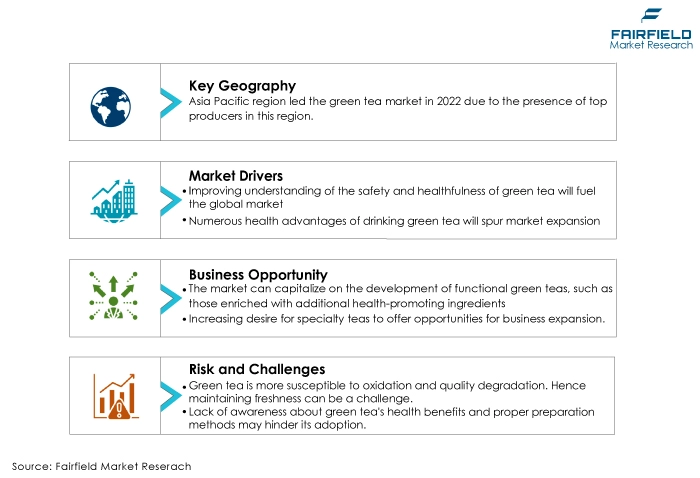
- The Asia Pacific region claims the title of the largest green tea market globally, primarily owing to its elevated production and consumption of a wide range of green tea varieties. This region's market revenue growth is driven by the rising popularity of functional and flavoured green tea for enhancing health and skin.
- North America will have the quickest growth rate in the green tea market during the forecast period driven by the rising popularity of natural and green products and the rising acceptance of healthy lifestyles. Furthermore, the rise in obese patients is a key factor boosting North America's market for green tea.
- Greater Inclination for Health Benefits Through Green Tea
- Low Caffeine Content that Makes it an Attractive Choice
- Lower Shelf-life of Green Tea
- Differences Between Cultural Habits in Various Regions
- Emergence of Functional and Specialty Green Teas
- Flavour Innovations
- Sencha Category Retains Dominant
- Tea Bags Bestseller
- Contribution of Supermarkets/Hypermarkets the Highest
- Associated British Foods plc
- AMORE Pacific Corp
- Unilever plc
- Tata Consumer Products Limited
- The Bigelow Tea Company
- The Republic of Tea, Inc.
- The Stash Tea Company
- Tazo Tea Company
- Shangri La Tea Company
- Newman’s Own, Inc.
- Compass Tea Company
- Davidson’s Green s
- Little Red Cup Tea Co.
- Numi Inc.
- Frontier Natural Products
- Kirin Beverage Corp
- Oishi Group Plc
- Oregon Chai Inc.
- Yogi Tea
- Buddha Teas
- ITO EN
- Twinings
- Pukka Herb
- Sencha
- Matcha
- Gyokuro
- Genmaicha
- Biluochun
- Longjing
- Miscellaneous
- Flavoured
- Unflavoured
- Tea Bags & Sachets
- Loose Leaves
- Loose Powder
- Ready-to-drink
- Supermarkets/Hypermarkets
- Convenience Stores
- Specialty Stores
- Online Retail
- North America
- Europe
- Asia Pacific
- Latin America
- Middle East & Africa
A Look Back and a Look Forward - Comparative Analysis
The green tea market displayed several notable trends and characteristics. Sencha and Matcha were dominant in the market, with Sencha being the most consumed type in Japan, while Matcha gained popularity worldwide, particularly in health and wellness circles. Flavoured green teas, such as jasmine, mint, and fruit-infused varieties, witnessed increased demand as consumers sought unique taste experiences.
Additionally, the market saw a growing emphasis on health and wellness, with green tea being perceived as a beneficial beverage due to its high antioxidant content and potential health benefits, including weight management and improved metabolism.
Over the years leading up to 2021, green tea transitioned from being a niche product to a mainstream beverage with global reach. Matcha became a popular superfood and ingredient, while premium and specialty green teas like gyokuro, Dragon Well, and rare artisanal varieties began to emerge. The market also witnessed the evolution of flavoured green teas, with innovative flavour combinations catering to diverse consumer preferences.
Health claims associated with green tea's potential benefits spurred extensive research and marketing efforts, contributing to the market's growth. The market for green tea is expected to continue growing, underpinned by the enduring global interest in health and wellness. Innovation in flavour profiles is likely to expand, with green tea being blended with fruits, herbs, and botanicals to cater to evolving consumer tastes.
Functional and specialty green teas, incorporating additional health-promoting ingredients, are anticipated to become more prevalent. Sustainability and eco-friendliness are expected to be paramount, with producers emphasizing environmentally responsible practices in response to the growing demand for ethical and eco-conscious products.
Key Growth Factors
The growing awareness of antioxidants, particularly in the context of health and wellness, has propelled the market for green tea. Green tea, known for its high levels of antioxidants, has become a preferred choice for health-conscious consumers seeking to harness the potential health benefits of these compounds.
Antioxidants in green tea, like catechins, have been associated with various health advantages, including heart wellness, weight management, and anti-aging effects.
The popularity of green tea has been further amplified by scientific research, media coverage, marketing efforts, and its accessibility in retail and online markets. As consumers increasingly prioritize their well-being, green tea's antioxidant content continues to drive market growth.
The market for green tea has experienced substantial growth due to its relatively low caffeine content compared to coffee and even black tea. As consumers become more conscious of their caffeine intake, green tea's milder caffeine levels offer an attractive alternative. It provides a gentle, sustained energy boost without the jittery effects associated with higher-caffeine beverages.
The lower caffeine content appeals to a broader audience, including individuals who are sensitive to caffeine, seeking a more relaxing tea experience, or simply looking for a healthier daily beverage choice. The demand for green tea as a versatile and caffeine-friendly option continues to contribute to the market's expansion.
Major Restraints
A significant market restraint in the green tea industry is its lower shelf life compared to other tea varieties. Green tea is more susceptible to oxidation and quality degradation due to its minimal processing, leaving it exposed to environmental factors that can alter its flavour and nutritional profile over time.
Maintaining freshness is a critical challenge, especially in unsuitable storage conditions or when green tea products are not sealed airtight. This limitation poses difficulties for producers and retailers in ensuring consistent product quality and taste for consumers.
While green tea holds deep cultural significance in regions like Japan and China, where tea ceremonies and traditions have been passed down for centuries, these customs may not hold the same sway in other parts of the world. In regions with a strong coffee culture or a preference for other beverages, the adoption of green tea can be hindered.
Consumer tastes and habits can be firmly rooted in local customs, making it challenging for green tea to gain widespread acceptance. The unfamiliarity with the preparation methods and the slightly astringent or grassy flavour profile of green tea can further deter potential consumers.
Addressing these cultural disparities by promoting green tea's versatility, health benefits, and ease of preparation is essential to expanding its market reach and appealing to a broader, more diverse audience.
Key Trends and Opportunities to Look at
The market can capitalize on the development of functional green teas, such as those enriched with additional health-promoting ingredients like probiotics, vitamins, or adaptogens. Specialty green teas, including rare and unique varieties, also present opportunities.
The expansion of green tea has been aided by marketing initiatives and educational campaigns emphasizing its advantages, its production processes, and its potential effects on health and the environment.
Introducing new and exotic flavour profiles in green tea is a strategy that can greatly appeal to a wider consumer base. By infusing green tea with innovative combinations of tropical fruits, herbs, and botanicals, tea producers can offer an array of enticing options that cater to evolving consumer preferences.
The flavour innovations can create a more enjoyable and diverse tea-drinking experience, attracting those who might find the traditional grassy or vegetal notes of green tea less appealing.
How Does the Regulatory Scenario Shape this Industry?
The regulatory scenario plays a significant role in shaping the green tea industry. Regulations related to food safety, labelling, and quality standards directly impact production, distribution, and marketing. Stringent quality control standards often apply to tea products, ensuring that they meet safety and health requirements. For green tea producers, adhering to these regulations is essential to maintain consumer trust and market credibility.
Moreover, certification is a vital aspect of the green tea industry, assuring consumers of the product's eco-friendly and sustainable attributes. To ensure this certification's integrity and reliability, a global system was established, known as the International Federation of Organic Agriculture Movements (IFOAM). The IFOAM unites more than a hundred countries and numerous member organisations, creating a standardised framework for green certification.
For green tea growers, organisations like INDOCERT, IMO Control, ECOCERT SA, Naturland-India, SGS India Private Limited, Onecert Asia Agri Certification Private Limited, and SKAL International Ltd. offer the means to market, label, and advertise their products as green. India's first green certification body, INDOCERT, upholds National Standards for Green Products, and it ensures compliance through testing facilities approved by the Agricultural and Processed Food Products Export Development Authority (APEDA).
The certification, endorsed by the Government of India as part of the National Program for green production, serves as a credible assurance of green tea's authenticity and adherence to sustainable practices. Understanding and adapting to these regulations and certifications are imperative for businesses seeking success in the market for green tea, ensuring both quality and sustainability.
Fairfield’s Ranking Board
Top Segments
Sencha category has consistently maintained its dominance over other segments by type, and there are several compelling reasons behind this trend. Sencha, known for elements of sharpness, astringency, savouriness, and sweetness, all with a pleasant aroma. It holds a strong presence in the market due to its widespread popularity in Japan and its adaptability to a variety of consumer preferences.
The appeal of Sencha lies in its versatility. It can be enjoyed both hot and cold, making it suitable for different seasons and occasions. The cultivation process, which involves steaming the leaves, preserves the tea's bright green colour and natural antioxidants, such as catechins, which have garnered attention for their potential health benefits.
The familiarity of Sencha, along with its reputed health-enhancing properties, has made it a favoured choice for consumers seeking the perfect balance between tradition and well-being. Its continued dominance in the green tea market is a testament to Sencha's enduring appeal and adaptability to evolving consumer tastes and health-conscious preferences.
In 2025, due to its extraordinary advantages and simplicity, green tea bags have experienced a substantial rise in popularity over the past several years. Because they are portable and simple to dispose of, the tea bags and their handy attached thread are seen to be convenient. Using tea bags to prepare green tea simplifies and expedites the tea-brewing process because no additional tools, such as a tea infuser or strainer, are needed.
Furthermore, the loose leaves category is expected to expand significantly. This is explained by the fact that leaf varieties have a first-mover advantage. In addition, these items give customers the option to choose between strong and moderate green tea flavours, giving them more control over the taste of their beverage.
In 2025, supermarkets/hypermarkets held most of the market share. Finding a certain product that suits one's tastes might be challenging given the wide range of goods on the market. As a result, it can be said that shopping for these goods is best done in supermarkets/hypermarkets that provide a wide range of options, which promotes the expansion of the channel.
During the forecasted years, online retail is anticipated to increase fastest. Leading and small green tea brewers have a chance to connect with consumers through online channels. Online shopping is a good option for some manufacturers because the order triggers a speedy item creation.
Regional Outlook
Asia Pacific Remains the Top Contributor
During that forecast period, Asia Pacific is anticipated to hold the largest market share for green tea. The world's top green tea producers, including China, Pakistan, India, and Sri Lanka, are thought to be responsible for the growth. Many nations, like China, and India, have concentrated on growing tea on large tracts of land since the area's climate, humidity, and soil texture are suitable for the crop.
China, and Japan consume the most functional drinks, including matcha tea, specialty teas, and green tea, all of which are excellent sources of nutrients. Further predictions indicate that these variables will accelerate market expansion in the area. Additionally, numerous firms are expected to strengthen and invest in their market presence across Asia Pacific soon due to the good chances in the region.
North American Consumer Says Yes to Health Benefits of Green Tea
With the fastest-growing market share for green tea, North America has a huge potential for the tea business. The region's expanding knowledge of the health advantages of green tea is primarily responsible for the market's expansion. Consumers are now more likely to have lifestyle-related health concerns like obesity, diabetes, and cardiovascular illnesses thanks to the fast-paced modern way of life.
Furthermore, the demand for green tea to lower the risk of certain illnesses has grown. The demand for green tea among millennials in the area has surged as functional beverages become increasingly popular. Moreover, with customers looking for products that align with health trends and ethical considerations, the United States, and Canada are important markets for green tea.
Fairfield’s Competitive Landscape Analysis
Although there are many companies in the market for green tea, there is fierce competition among them because tea already has a sizable portion of the global market as per the Fairfield’s analysis. A brand might become the market leader with the help of marketing strategies and fundamental processing enhancements.
Furthermore, the foundation for innovation for the participants is the addition of a green tag along with several flavours. Additionally, to increase their market share and global presence, green tea producers are implementing various methods, including new product innovations, mergers and acquisitions, and plant capacity enhancement.
Who are the Leaders in the Global Green Tea Space?
An Expert’s Eye
Demand and Future Growth
As per Fairfield’s Analysis, the market demand for green tea remains strong, driven by a global surge in health and wellness awareness. As consumers increasingly seek natural and beneficial beverages, green tea's reputation for its antioxidant content and potential health benefits has fuelled its growth.
The trend is expected to continue, with green tea expanding its reach to new regions and being incorporated into various food and beverage products. The market's promising outlook is further bolstered by ongoing research, innovative flavour profiles, and sustainability initiatives, ensuring a dynamic and prosperous future for the market for green tea.
Supply Side of the Market
The supply side of the market for green tea is marked by a global network of tea producers, primarily concentrated in regions like China, Japan, and India. These producers cultivate and process green tea using traditional methods, ensuring that the tea retains its characteristic flavours and health benefits.
The supply chain is diverse, ranging from small-scale, artisanal tea gardens to large commercial plantations. Sustainability and eco-friendly practices are increasingly prevalent, reflecting a commitment to responsible agriculture. Additionally, innovations in packaging and processing techniques aim to preserve green tea's freshness.
As demand for green tea continues to rise, the supply side responds by expanding cultivation areas and enhancing quality control to meet the growing consumer expectations for high-quality, sustainably produced green tea products.
Global Green Tea Market is Segmented as Below:
By Type
By Taste
By Form
By Distribution Channel
By Geographic Coverage:
- Executive Summary
- Global Green Tea Market Snapshot
- Future Projections
- Key Market Trends
- Regional Snapshot, by Value, 2026
- Analyst Recommendations
- Market Overview
- Market Definitions and Segmentations
- Market Dynamics
- Drivers
- Restraints
- Market Opportunities
- Value Chain Analysis
- COVID-19 Impact Analysis
- Porter's Five Forces Analysis
- Impact of Russia-Ukraine Conflict
- PESTLE Analysis
- Regulatory Analysis
- Price Trend Analysis
- Current Prices and Future Projections, 2025-2033
- Price Impact Factors
- Global Green Tea Market Outlook, 2020 - 2033
- Global Green Tea Market Outlook, by Type, Value (US$ Mn), 2020-2033
- Sencha
- Matcha
- Gyokuro
- Genmaicha
- Biluochun
- Longjing
- Miscellaneous
- Global Green Tea Market Outlook, by Taste, Value (US$ Mn), 2020-2033
- Flavoured
- Unflavoured
- Global Green Tea Market Outlook, by Form, Value (US$ Mn), 2020-2033
- Tea Bags & Sachets
- Loose Leaves
- Loose Powder
- Ready-to-drink
- Global Green Tea Market Outlook, by Distribution Channel, Value (US$ Mn), 2020-2033
- Supermarkets/Hypermarkets
- Convenience Stores
- Specialty Stores
- Online Retail
- Global Green Tea Market Outlook, by Region, Value (US$ Mn), 2020-2033
- North America
- Europe
- Asia Pacific
- Latin America
- Middle East & Africa
- Global Green Tea Market Outlook, by Type, Value (US$ Mn), 2020-2033
- North America Green Tea Market Outlook, 2020 - 2033
- North America Green Tea Market Outlook, by Type, Value (US$ Mn), 2020-2033
- Sencha
- Matcha
- Gyokuro
- Genmaicha
- Biluochun
- Longjing
- Miscellaneous
- North America Green Tea Market Outlook, by Taste, Value (US$ Mn), 2020-2033
- Flavoured
- Unflavoured
- North America Green Tea Market Outlook, by Form, Value (US$ Mn), 2020-2033
- Tea Bags & Sachets
- Loose Leaves
- Loose Powder
- Ready-to-drink
- North America Green Tea Market Outlook, by Distribution Channel, Value (US$ Mn), 2020-2033
- Supermarkets/Hypermarkets
- Convenience Stores
- Specialty Stores
- Online Retail
- North America Green Tea Market Outlook, by Country, Value (US$ Mn), 2020-2033
- U.S. Green Tea Market Outlook, by Type, 2020-2033
- U.S. Green Tea Market Outlook, by Taste, 2020-2033
- U.S. Green Tea Market Outlook, by Form, 2020-2033
- U.S. Green Tea Market Outlook, by Distribution Channel, 2020-2033
- Canada Green Tea Market Outlook, by Type, 2020-2033
- Canada Green Tea Market Outlook, by Taste, 2020-2033
- Canada Green Tea Market Outlook, by Form, 2020-2033
- Canada Green Tea Market Outlook, by Distribution Channel, 2020-2033
- BPS Analysis/Market Attractiveness Analysis
- North America Green Tea Market Outlook, by Type, Value (US$ Mn), 2020-2033
- Europe Green Tea Market Outlook, 2020 - 2033
- Europe Green Tea Market Outlook, by Type, Value (US$ Mn), 2020-2033
- Sencha
- Matcha
- Gyokuro
- Genmaicha
- Biluochun
- Longjing
- Miscellaneous
- Europe Green Tea Market Outlook, by Taste, Value (US$ Mn), 2020-2033
- Flavoured
- Unflavoured
- Europe Green Tea Market Outlook, by Form, Value (US$ Mn), 2020-2033
- Tea Bags & Sachets
- Loose Leaves
- Loose Powder
- Ready-to-drink
- Europe Green Tea Market Outlook, by Distribution Channel, Value (US$ Mn), 2020-2033
- Supermarkets/Hypermarkets
- Convenience Stores
- Specialty Stores
- Online Retail
- Europe Green Tea Market Outlook, by Country, Value (US$ Mn), 2020-2033
- Germany Green Tea Market Outlook, by Type, 2020-2033
- Germany Green Tea Market Outlook, by Taste, 2020-2033
- Germany Green Tea Market Outlook, by Form, 2020-2033
- Germany Green Tea Market Outlook, by Distribution Channel, 2020-2033
- Italy Green Tea Market Outlook, by Type, 2020-2033
- Italy Green Tea Market Outlook, by Taste, 2020-2033
- Italy Green Tea Market Outlook, by Form, 2020-2033
- Italy Green Tea Market Outlook, by Distribution Channel, 2020-2033
- France Green Tea Market Outlook, by Type, 2020-2033
- France Green Tea Market Outlook, by Taste, 2020-2033
- France Green Tea Market Outlook, by Form, 2020-2033
- France Green Tea Market Outlook, by Distribution Channel, 2020-2033
- U.K. Green Tea Market Outlook, by Type, 2020-2033
- U.K. Green Tea Market Outlook, by Taste, 2020-2033
- U.K. Green Tea Market Outlook, by Form, 2020-2033
- U.K. Green Tea Market Outlook, by Distribution Channel, 2020-2033
- Spain Green Tea Market Outlook, by Type, 2020-2033
- Spain Green Tea Market Outlook, by Taste, 2020-2033
- Spain Green Tea Market Outlook, by Form, 2020-2033
- Spain Green Tea Market Outlook, by Distribution Channel, 2020-2033
- Russia Green Tea Market Outlook, by Type, 2020-2033
- Russia Green Tea Market Outlook, by Taste, 2020-2033
- Russia Green Tea Market Outlook, by Form, 2020-2033
- Russia Green Tea Market Outlook, by Distribution Channel, 2020-2033
- Rest of Europe Green Tea Market Outlook, by Type, 2020-2033
- Rest of Europe Green Tea Market Outlook, by Taste, 2020-2033
- Rest of Europe Green Tea Market Outlook, by Form, 2020-2033
- Rest of Europe Green Tea Market Outlook, by Distribution Channel, 2020-2033
- BPS Analysis/Market Attractiveness Analysis
- Europe Green Tea Market Outlook, by Type, Value (US$ Mn), 2020-2033
- Asia Pacific Green Tea Market Outlook, 2020 - 2033
- Asia Pacific Green Tea Market Outlook, by Type, Value (US$ Mn), 2020-2033
- Sencha
- Matcha
- Gyokuro
- Genmaicha
- Biluochun
- Longjing
- Miscellaneous
- Asia Pacific Green Tea Market Outlook, by Taste, Value (US$ Mn), 2020-2033
- Flavoured
- Unflavoured
- Asia Pacific Green Tea Market Outlook, by Form, Value (US$ Mn), 2020-2033
- Tea Bags & Sachets
- Loose Leaves
- Loose Powder
- Ready-to-drink
- Asia Pacific Green Tea Market Outlook, by Distribution Channel, Value (US$ Mn), 2020-2033
- Supermarkets/Hypermarkets
- Convenience Stores
- Specialty Stores
- Online Retail
- Asia Pacific Green Tea Market Outlook, by Country, Value (US$ Mn), 2020-2033
- China Green Tea Market Outlook, by Type, 2020-2033
- China Green Tea Market Outlook, by Taste, 2020-2033
- China Green Tea Market Outlook, by Form, 2020-2033
- China Green Tea Market Outlook, by Distribution Channel, 2020-2033
- Japan Green Tea Market Outlook, by Type, 2020-2033
- Japan Green Tea Market Outlook, by Taste, 2020-2033
- Japan Green Tea Market Outlook, by Form, 2020-2033
- Japan Green Tea Market Outlook, by Distribution Channel, 2020-2033
- South Korea Green Tea Market Outlook, by Type, 2020-2033
- South Korea Green Tea Market Outlook, by Taste, 2020-2033
- South Korea Green Tea Market Outlook, by Form, 2020-2033
- South Korea Green Tea Market Outlook, by Distribution Channel, 2020-2033
- India Green Tea Market Outlook, by Type, 2020-2033
- India Green Tea Market Outlook, by Taste, 2020-2033
- India Green Tea Market Outlook, by Form, 2020-2033
- India Green Tea Market Outlook, by Distribution Channel, 2020-2033
- Southeast Asia Green Tea Market Outlook, by Type, 2020-2033
- Southeast Asia Green Tea Market Outlook, by Taste, 2020-2033
- Southeast Asia Green Tea Market Outlook, by Form, 2020-2033
- Southeast Asia Green Tea Market Outlook, by Distribution Channel, 2020-2033
- Rest of SAO Green Tea Market Outlook, by Type, 2020-2033
- Rest of SAO Green Tea Market Outlook, by Taste, 2020-2033
- Rest of SAO Green Tea Market Outlook, by Form, 2020-2033
- Rest of SAO Green Tea Market Outlook, by Distribution Channel, 2020-2033
- BPS Analysis/Market Attractiveness Analysis
- Asia Pacific Green Tea Market Outlook, by Type, Value (US$ Mn), 2020-2033
- Latin America Green Tea Market Outlook, 2020 - 2033
- Latin America Green Tea Market Outlook, by Type, Value (US$ Mn), 2020-2033
- Sencha
- Matcha
- Gyokuro
- Genmaicha
- Biluochun
- Longjing
- Miscellaneous
- Latin America Green Tea Market Outlook, by Taste, Value (US$ Mn), 2020-2033
- Flavoured
- Unflavoured
- Latin America Green Tea Market Outlook, by Form, Value (US$ Mn), 2020-2033
- Tea Bags & Sachets
- Loose Leaves
- Loose Powder
- Ready-to-drink
- Latin America Green Tea Market Outlook, by Distribution Channel, Value (US$ Mn), 2020-2033
- Supermarkets/Hypermarkets
- Convenience Stores
- Specialty Stores
- Online Retail
- Latin America Green Tea Market Outlook, by Country, Value (US$ Mn), 2020-2033
- Brazil Green Tea Market Outlook, by Type, 2020-2033
- Brazil Green Tea Market Outlook, by Taste, 2020-2033
- Brazil Green Tea Market Outlook, by Form, 2020-2033
- Brazil Green Tea Market Outlook, by Distribution Channel, 2020-2033
- Mexico Green Tea Market Outlook, by Type, 2020-2033
- Mexico Green Tea Market Outlook, by Taste, 2020-2033
- Mexico Green Tea Market Outlook, by Form, 2020-2033
- Mexico Green Tea Market Outlook, by Distribution Channel, 2020-2033
- Argentina Green Tea Market Outlook, by Type, 2020-2033
- Argentina Green Tea Market Outlook, by Taste, 2020-2033
- Argentina Green Tea Market Outlook, by Form, 2020-2033
- Argentina Green Tea Market Outlook, by Distribution Channel, 2020-2033
- Rest of LATAM Green Tea Market Outlook, by Type, 2020-2033
- Rest of LATAM Green Tea Market Outlook, by Taste, 2020-2033
- Rest of LATAM Green Tea Market Outlook, by Form, 2020-2033
- Rest of LATAM Green Tea Market Outlook, by Distribution Channel, 2020-2033
- BPS Analysis/Market Attractiveness Analysis
- Latin America Green Tea Market Outlook, by Type, Value (US$ Mn), 2020-2033
- Middle East & Africa Green Tea Market Outlook, 2020 - 2033
- Middle East & Africa Green Tea Market Outlook, by Type, Value (US$ Mn), 2020-2033
- Sencha
- Matcha
- Gyokuro
- Genmaicha
- Biluochun
- Longjing
- Miscellaneous
- Middle East & Africa Green Tea Market Outlook, by Taste, Value (US$ Mn), 2020-2033
- Flavoured
- Unflavoured
- Middle East & Africa Green Tea Market Outlook, by Form, Value (US$ Mn), 2020-2033
- Tea Bags & Sachets
- Loose Leaves
- Loose Powder
- Ready-to-drink
- Middle East & Africa Green Tea Market Outlook, by Distribution Channel, Value (US$ Mn), 2020-2033
- Supermarkets/Hypermarkets
- Convenience Stores
- Specialty Stores
- Online Retail
- Middle East & Africa Green Tea Market Outlook, by Country, Value (US$ Mn), 2020-2033
- GCC Green Tea Market Outlook, by Type, 2020-2033
- GCC Green Tea Market Outlook, by Taste, 2020-2033
- GCC Green Tea Market Outlook, by Form, 2020-2033
- GCC Green Tea Market Outlook, by Distribution Channel, 2020-2033
- South Africa Green Tea Market Outlook, by Type, 2020-2033
- South Africa Green Tea Market Outlook, by Taste, 2020-2033
- South Africa Green Tea Market Outlook, by Form, 2020-2033
- South Africa Green Tea Market Outlook, by Distribution Channel, 2020-2033
- Egypt Green Tea Market Outlook, by Type, 2020-2033
- Egypt Green Tea Market Outlook, by Taste, 2020-2033
- Egypt Green Tea Market Outlook, by Form, 2020-2033
- Egypt Green Tea Market Outlook, by Distribution Channel, 2020-2033
- Nigeria Green Tea Market Outlook, by Type, 2020-2033
- Nigeria Green Tea Market Outlook, by Taste, 2020-2033
- Nigeria Green Tea Market Outlook, by Form, 2020-2033
- Nigeria Green Tea Market Outlook, by Distribution Channel, 2020-2033
- Rest of Middle East Green Tea Market Outlook, by Type, 2020-2033
- Rest of Middle East Green Tea Market Outlook, by Taste, 2020-2033
- Rest of Middle East Green Tea Market Outlook, by Form, 2020-2033
- Rest of Middle East Green Tea Market Outlook, by Distribution Channel, 2020-2033
- BPS Analysis/Market Attractiveness Analysis
- Middle East & Africa Green Tea Market Outlook, by Type, Value (US$ Mn), 2020-2033
- Competitive Landscape
- Company Vs Segment Heatmap
- Company Market Share Analysis, 2025
- Competitive Dashboard
- Company Profiles
- Associated British Foods plc
- Company Overview
- Product Portfolio
- Financial Overview
- Business Strategies and Developments
- AMORE Pacific Corp
- Unilever plc
- Tata Consumer Products Limited
- The Bigelow Tea Company
- The Republic of Tea, Inc.
- The Stash Tea Company
- Tazo Tea Company
- Shangri La Tea Company
- Newman’s Own, Inc.
- Associated British Foods plc
- Appendix
- Research Methodology
- Report Assumptions
- Acronyms and Abbreviations
|
BASE YEAR |
HISTORICAL DATA |
FORECAST PERIOD |
UNITS |
|||
 |
2025 |
 |
2019 - 2024 |
 |
2026 - 2033 |
Value: US$ Billion |
|
REPORT FEATURES |
DETAILS |
|
Type Coverage |
|
|
Taste Coverage |
|
|
Form Coverage |
|
|
Distribution Channel Coverage |
|
|
Geographical Coverage |
|
|
Leading Companies |
|
|
Report Highlights |
Key Market Indicators, Macro-micro economic impact analysis, Technological Roadmap, Key Trends, Driver, Restraints, and Future Opportunities & Revenue Pockets, Porter’s 5 Forces Analysis, Historical Trend (2019-2021), Market Estimates and Forecast, Market Dynamics, Industry Trends, Competition Landscape, Category, Region, Country-wise Trends & Analysis, COVID-19 Impact Analysis (Demand and Supply Chain) |
Our Research Methodology
Considering the volatility of business today, traditional approaches to strategizing a game plan can be unfruitful if not detrimental. True ambiguity is no way to determine a forecast. A myriad of predetermined factors must be accounted for such as the degree of risk involved, the magnitude of circumstances, as well as conditions or consequences that are not known or unpredictable. To circumvent binary views that cast uncertainty, the application of market research intelligence to strategically posture, move, and enable actionable outcomes is necessary.
View Methodology
Quality Assured
Rigorous Validation Process

Confidentiality Assured
End-to-end Data Security

Custom Research Services
Tailored To Your Objectives
FAQs
By form, tea bags are and will remain the top selling category throughout the period of forecast. Type-wise analysis of the green tea market reveals continued dominance of Sencha that will prevail through 2030-end. Regionally, Asia Pacific is expected to maintain its dominant positioning in the global market for green tea.
The global green tea market is experiencing growth due to several factors, including increasing health awareness, demand for natural and functional beverages, and the rising popularity of green tea for its potential health benefits, such as antioxidant properties and weight management. Additionally, its application in various products, such as cosmetics and food supplements, is expanding its market reach.
Green tea is available widely on the market, in several varieties, and originates from different regions, each with unique flavour profiles, and characteristics. Businesses can differentiate themselves by sourcing tea from specific regions or by offering a diverse selection of green tea types. Clear labelling, and consumer education initiatives can help in marketing and sales.
Introducing green tea to regions with non-tea-drinking cultures can be challenging, but it also presents opportunities. Challenges include consumer unfamiliarity and taste preferences. To succeed, businesses need to invest in educational campaigns, adapt products to local tastes, and promote the potential health benefits of green tea.
Some of the biggest names in the global green tea space include companies like Unilever plc, Associated British Foods plc, The Republic of Tea, Inc., Tata Consumer Products Limited, Shangri La Tea Company, Green India Pvt. Ltd., Little Red Cup Tea Co., Oregon Chai Inc., Twinings, and Pukka Herb.
Related Reports
Pea Protein Ingredient Market Size, Share, Insights, Competitive Landscape, and Forecast 2026 to 2033
Explore the pea protein ingredient market, reaching US$ 5.4 billion by 2033 at 11.0% CAGR, with product, regional and competitive insights.
Curcumin Market Size, Share, Insights, Competitive Landscape, and Forecast 2026 to 2033
Curcumin market to reach US$ 1.5 billion by 2033 at 7.6% CAGR. Explore product types, applications, regional trends and key companies.
Whey Protein Market Size, Share, Insights, Competitive Landscape, and Forecast 2026 to 2033
Whey protein market to reach US$ 19.8 billion by 2033 at 6.4% CAGR. Explore product types, applications, regions and key companies.
Food Grade Gases Market Size, Share, Insights, Competitive Landscape, and Forecast 2026 to 2033
The global food grade gases market is valued at US$8.2 billion in 2026, reaching US$12.4 billion by 2033, growing at a 6.1% CAGR
Corn Flour Market Size, Share, Insights, Competitive Landscape, and Forecast 2026 to 2033
The global corn flour market is valued at US$18.5 billion in 2026, reaching US$26.5 billion by 2033, growing at a 5.3% CAGR
Wheat Starch Market Size, Share, Insights, Competitive Landscape, and Forecast 2026 to 2033
The global wheat starch market is valued at US$4.6 billion in 2026, reaching US$6.4 billion by 2033, growing at a 4.8% CAGR