



Ground Coffee Market
Ground Coffee Market Insights, Competitive Landscape, and Market Forecast - 2033
Global Ground Coffee Market Forecast
The Ground Coffee Market is valued at USD 14.8 Bn in 2026 and is projected to reach USD 24.3 Bn, growing at a CAGR of 6% by 2033.
Quick Report Digest
A Look Back and a Look Forward - Comparative Analysis
The ground coffee market is experiencing growth due to several factors.The increasing consumer demand for convenience and ready-to-use coffee products drives the popularity of ground coffee. Additionally, the rising trend of home brewing and the proliferation of coffee shops contribute to market expansion. Moreover, the growing popularity of specialty coffee varieties and innovative flavour offerings cater to diverse consumer preferences, fueling the growth of the ground coffee market.
The growth of the ground coffee market is primarily driven by its versatile applications in various consumption settings. These include both at-home and out-of-home consumption, such as brewing coffee in drip machines, French presses, espresso machines, and pour-over methods. Additionally, the popularity of coffee pods and capsules for single-serve brewing, along with the increasing prevalence of coffee shops and cafes, further propel the growth of the ground coffee market.
The future of the ground coffee market appears promising, with continued growth anticipated due to several factors. These include the rising global coffee consumption, increasing demand for specialty and premium coffee varieties, and the growing popularity of convenient coffee solutions. Additionally, ongoing innovations in coffee processing techniques, flavour profiles, and packaging formats are expected to further drive market expansion, catering to evolving consumer preferences and lifestyles.
Key Growth Determinants
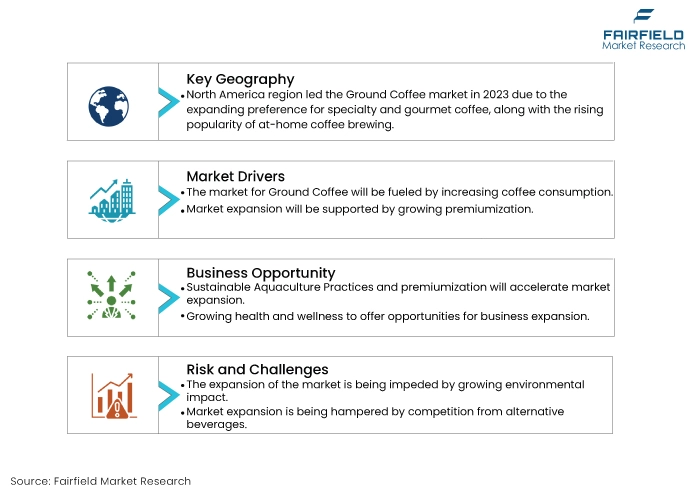
- Increasing Coffee Consumption Trend Worldwide
Increasing coffee consumption is anticipated to drive the ground coffee market due to several factors. The growing preference for at-home coffee brewing among consumers is leading to a rise in the demand for ground coffee. Additionally, the shift towards specialty and gourmet coffee varieties has fueled market growth.
Moreover, the convenience and ease of use of ground coffee products have further contributed to this trend. As consumers seek quality, flavour diversity, and convenience, the ground coffee market is expected to expand to cater to these evolving preferences. This surge in demand is likely to stimulate market growth, encouraging companies to innovate, introduce new products, and capitalise on this trend.
- Growing Premiumisation
Premiumisation is expected to drive the ground coffee market by catering to the evolving tastes and preferences of discerning consumers. As consumers become more knowledgeable about coffee, they seek higher-quality, specialty, and single-origin coffee varieties. Premium ground coffee products offer unique flavour profiles, superior quality, and a distinct origin story, commanding higher prices and profit margins.
Moreover, premiumisation enhances the overall coffee experience, elevating it beyond a mere beverage to a sensory indulgence or lifestyle choice. Brands invest in premiumisation through sourcing high-quality beans, implementing sustainable and ethical practices, and offering innovative packaging and brewing methods. This focus on premium offerings not only attracts coffee enthusiasts but also strengthens brand loyalty and differentiation in a competitive market landscape, driving growth and profitability
- Innovations in Flavour Profiles, and Packaging Formats
Innovations in flavour and packaging are propel the ground coffee market forward. The introduction of diverse and unique flavours, including exotic and seasonal variations, appeals to consumers seeking novel taste experiences. This innovation caters to evolving consumer preferences for variety and quality. Furthermore, advancements in packaging, such as resealable and eco-friendly options, enhance convenience and sustainability, aligning with consumer values.
The emphasis on user-friendly, airtight packaging also ensures prolonged freshness, a key factor for coffee enthusiasts. As a result, these innovations not only attract new consumers but also retain existing ones. By continually offering enticing flavours and sustainable packaging solutions, companies can expand their market share, foster brand loyalty, and meet the dynamic demands of the modern coffee consumer.
Major Growth Barriers
- Growing Environmental Impact
Environmental impact poses a significant challenge to the ground coffee market due to concerns about deforestation, water usage, and carbon emissions associated with coffee production. Increased awareness of these issues among consumers prompts demands for more sustainable and ethically sourced coffee products.
Meeting these demands requires significant investments in sustainable farming practices, supply chain transparency, and environmental conservation efforts, which can pose operational challenges and increase production costs for coffee producers.
- Competition from Alternative Popular Beverages
Competition from alternative beverages presents a significant challenge to the ground coffee market. With the rise of options like energy drinks, herbal teas, and specialty juices, consumers now have diverse choices beyond traditional coffee. This shift requires the coffee industry to adapt by emphasizing unique selling points, such as health benefits, sustainability, and convenience.
Moreover, to counter this challenge, the ground coffee sector must innovate, diversify product offerings, and communicate the distinct advantages of coffee to retain its consumer base amidst increasing beverage options.
Key Trends and Opportunities to Look at
Sustainable sourcing in the ground coffee market involves practices that minimise environmental impact, promote biodiversity, and support fair labour conditions. This includes sourcing beans from certified organic farms, implementing shade-grown methods, and supporting initiatives that prioritise environmental conservation and community development in coffee-producing regions.
- Digitalisation
- Flavour Innovation
Digitalisation in the ground coffee market involves advancements like online sales platforms, personalised subscription services, and IoT-enabled coffee machines. These innovations streamline purchasing, offer customised experiences, and provide data-driven insights into consumer preferences. Ultimately, digitalisation enhances convenience and connectivity, reshaping the market's customer engagement and operational efficiency.
Flavour innovation in the ground coffee market involves the development of unique and enticing flavour profiles to cater to diverse consumer preferences. This includes experimenting with different bean varieties, roasting techniques, and flavour additives to create distinctive and memorable coffee experiences that appeal to discerning coffee enthusiasts.
How Does the Regulatory Scenario Shape this Industry?
The ground coffee market is subject to various regulatory frameworks that govern food safety, labeling, and trade standards. In the United States, the Food and Drug Administration (FDA) oversees the safety and labeling of coffee products, ensuring compliance with regulations such as the Food Safety Modernisation Act (FSMA) and the Federal Food, Drug, and Cosmetic Act (FD&C Act).
Similarly, the European Union regulates coffee products under the General Food Law and the European Coffee Federation's guidelines for coffee quality and labeling. Region-specific regulatory changes may include updates to labeling requirements, allergen declarations, and geographical indications that influence market dynamics. Additionally, trade agreements and tariffs may impact the import and export of coffee products between regions. Compliance with regulatory standards is essential for market access and consumer trust, driving industry efforts to adhere to evolving regulations and maintain product quality and safety standards.
Fairfield’s Ranking Board
Top Segments
Drip ground coffee type has captured the largest market share in the ground coffee market due to its convenience and compatibility with popular brewing methods such as drip coffee makers. This pre-ground format eliminates the need for manual grinding, offering consumers a hassle-free brewing experience. Additionally, drip ground coffee's consistent particle size ensures optimal extraction and flavour consistency, making it a preferred choice for both home and commercial coffee preparation.
The classic roast ground coffee will however witness notable growth owing to its enduring popularity, and wide consumer appeal. Its traditional, well-balanced flavour resonates with a broad audience, including both long-time coffee enthusiasts and new consumers. Additionally, its versatility in various brewing methods, coupled with consistent quality, makes it a go-to choice. As a result, the classic roast ground coffee type continues to attract and retain a diverse customer base, contributing to its CAGR within the ground coffee market.
- Demand Maximum Across F&B
The food and beverage application has captured the largest market share in the ground coffee market due to its widespread usage in various culinary applications. Ground coffee serves as a versatile ingredient in recipes for desserts, marinades, sauces, and savory dishes, enhancing flavour profiles with its rich and robust taste. Additionally, its convenience and affordability make ground coffee an accessible choice for food manufacturers and culinary professionals, driving its dominance in this segment.
Application in agriculture sector is also on the rise due to several factors. This growth is attributed to the increasing use of ground coffee waste as an organic fertiliser, which aids in enhancing soil fertility and promoting sustainable agricultural practices. Furthermore, the rising adoption of coffee byproducts for composting and mulching purposes has contributed to the surge in demand within the agriculture segment, thus driving its CAGR growth.
Regional Frontrunners
North America Extends the Largest Share to Market Revenue
North America has captured the largest market share in the ground coffee market due to several factors. The region boasts a strong coffee culture and high coffee consumption rates, driven by a large population of coffee enthusiasts and widespread coffee consumption habits. Additionally, the presence of major coffee brands, extensive distribution networks, and a well-established coffee shop culture contribute to market dominance.
Moreover, North American consumers prioritise convenience and quality, leading to a preference for ground coffee products that offer consistent flavour profiles and brewing convenience. These factors collectively contribute to North America's significant share of the ground coffee market.
Asia Pacific Gears up to Exhibit Remarkable Growth Through 2033
The Asia Pacific region is expected to demonstrate a higher CAGR in the ground coffee market due to shifting consumer preferences, rapid urbanisation, and a burgeoning café culture. Increasing disposable incomes and a growing penchant for Western-style coffee consumption have fueled market expansion.
Moreover, the region's diverse landscape presents opportunities for market penetration. As a result, heightened demand for specialty coffee, evolving consumer habits, and a burgeoning café scene are propelling the remarkable CAGR growth in the Asia Pacific ground coffee market.
Fairfield’s Competitive Landscape Analysis
The competitive landscape of the ground coffee market is characterised by a mix of global giants and regional players vying for market share. Key companies such as Nestlé, J.M. Smucker, and Starbucks dominate with their extensive product portfolios and strong brand recognition.
Additionally, smaller specialty coffee roasters and boutique brands offer unique flavour profiles and artisanal blends, contributing to market diversity. Intense competition drives innovation, branding strategies, and market segmentation to cater to diverse consumer preferences.
Who are the Leaders in Global Ground Coffee Space?
- The Kraft Heinz Company
- Death Wish Coffee Company
- Starbucks
- Folgers Coffee
- Jo Coffee Royal Kona
- Hills Bros. Coffee
- Red Thread
- Kicking Horse Coffee
- Peet's Coffee
- Red Thread
- Nestlé S.A.
- The J.M. Smucker Company
- Dunkin' Brands Group, Inc.
- Keurig Dr Pepper Inc.
- Lavazza Group
An Expert’s Eye
Demand and Future Growth
The ground coffee market is experiencing robust demand and is poised for significant future growth. With a growing global coffee culture and increasing consumption habits, particularly in emerging markets, demand for ground coffee is on the rise.
Additionally, consumers' preference for convenience and affordability drives the popularity of ground coffee products. The market's future growth is further propelled by innovations in flavour profiles, sustainable sourcing practices, and the expansion of distribution channels. As coffee continues to be a staple beverage worldwide, the ground coffee market.
Supply Side of the Market
The demand-supply dynamics in the ground coffee market are influenced by various factors. Rising global coffee consumption, coupled with increasing demand for convenience and premium-quality coffee products, drives demand. Supply is affected by factors such as weather conditions, crop diseases, and labour issues in coffee-producing regions. The current pricing structure is shaped by market competition, production costs, and consumer preferences.
Premiumisation and product differentiation contribute to higher pricing for specialty and single-origin coffee varieties. Pricing will continue to influence long-term growth as consumers seek value for money and are willing to pay higher prices for quality and sustainability.
Major trends driving competition include product innovation, sustainable sourcing practices, branding strategies emphasizing quality and authenticity, and expansion into new markets. Supply chain analysis involves sourcing coffee beans, processing, packaging, distribution, and retailing, with a focus on efficiency, sustainability, and quality control throughout the supply chain to meet consumer demands and ensure long-term growth.
Global Ground Coffee Market is Segmented as Below:
By Type:
- Drip Ground Coffee
- Classic Roast Ground Coffee
- Sumatra Ground Coffee
- Others
By Application:
- Food and Beverage
- Agriculture
- Cosmetic and Personal care
- Insecticides
- Pesticides
By Geographic Coverage:
- North America
- Europe
- Asia Pacific
- Latin America
- Middle East & Africa
- Executive Summary
- Global Ground Coffee Market Snapshot
- Future Projections
- Key Market Trends
- Regional Snapshot, by Value, 2026
- Analyst Recommendations
- Market Overview
- Market Definitions and Segmentations
- Market Dynamics
- Drivers
- Restraints
- Market Opportunities
- Value Chain Analysis
- COVID-19 Impact Analysis
- Porter's Five Forces Analysis
- Impact of Russia-Ukraine Conflict
- PESTLE Analysis
- Regulatory Analysis
- Price Trend Analysis
- Current Prices and Future Projections, 2025-2033
- Price Impact Factors
- Global Ground Coffee Market Outlook, 2020 - 2033
- Global Ground Coffee Market Outlook, By Type, Value (US$ Mn), 2020-2033
- Drip Ground Coffee
- Classic Roast Ground Coffee
- Sumatra Ground Coffee
- Others
- Global Ground Coffee Market Outlook, by Application, Value (US$ Mn), 2020-2033
- Food and Beverage
- Agriculture
- Cosmetic and Personal care
- Insecticides
- Pesticides
- Global Ground Coffee Market Outlook, by Region, Value (US$ Mn), 2020-2033
- North America
- Europe
- Asia Pacific
- Latin America
- Middle East & Africa
- Global Ground Coffee Market Outlook, By Type, Value (US$ Mn), 2020-2033
- North America Ground Coffee Market Outlook, 2020 - 2033
- North America Ground Coffee Market Outlook, By Type, Value (US$ Mn), 2020-2033
- Drip Ground Coffee
- Classic Roast Ground Coffee
- Sumatra Ground Coffee
- Others
- North America Ground Coffee Market Outlook, by Application, Value (US$ Mn), 2020-2033
- Food and Beverage
- Agriculture
- Cosmetic and Personal care
- Insecticides
- Pesticides
- North America Ground Coffee Market Outlook, by Country, Value (US$ Mn), 2020-2033
- U.S. Ground Coffee Market Outlook, By Type, 2020-2033
- U.S. Ground Coffee Market Outlook, by Application, 2020-2033
- Canada Ground Coffee Market Outlook, By Type, 2020-2033
- Canada Ground Coffee Market Outlook, by Application, 2020-2033
- BPS Analysis/Market Attractiveness Analysis
- North America Ground Coffee Market Outlook, By Type, Value (US$ Mn), 2020-2033
- Europe Ground Coffee Market Outlook, 2020 - 2033
- Europe Ground Coffee Market Outlook, By Type, Value (US$ Mn), 2020-2033
- Drip Ground Coffee
- Classic Roast Ground Coffee
- Sumatra Ground Coffee
- Others
- Europe Ground Coffee Market Outlook, by Application, Value (US$ Mn), 2020-2033
- Food and Beverage
- Agriculture
- Cosmetic and Personal care
- Insecticides
- Pesticides
- Europe Ground Coffee Market Outlook, by Country, Value (US$ Mn), 2020-2033
- Germany Ground Coffee Market Outlook, By Type, 2020-2033
- Germany Ground Coffee Market Outlook, by Application, 2020-2033
- Italy Ground Coffee Market Outlook, By Type, 2020-2033
- Italy Ground Coffee Market Outlook, by Application, 2020-2033
- France Ground Coffee Market Outlook, By Type, 2020-2033
- France Ground Coffee Market Outlook, by Application, 2020-2033
- U.K. Ground Coffee Market Outlook, By Type, 2020-2033
- U.K. Ground Coffee Market Outlook, by Application, 2020-2033
- Spain Ground Coffee Market Outlook, By Type, 2020-2033
- Spain Ground Coffee Market Outlook, by Application, 2020-2033
- Russia Ground Coffee Market Outlook, By Type, 2020-2033
- Russia Ground Coffee Market Outlook, by Application, 2020-2033
- Rest of Europe Ground Coffee Market Outlook, By Type, 2020-2033
- Rest of Europe Ground Coffee Market Outlook, by Application, 2020-2033
- BPS Analysis/Market Attractiveness Analysis
- Europe Ground Coffee Market Outlook, By Type, Value (US$ Mn), 2020-2033
- Asia Pacific Ground Coffee Market Outlook, 2020 - 2033
- Asia Pacific Ground Coffee Market Outlook, By Type, Value (US$ Mn), 2020-2033
- Drip Ground Coffee
- Classic Roast Ground Coffee
- Sumatra Ground Coffee
- Others
- Asia Pacific Ground Coffee Market Outlook, by Application, Value (US$ Mn), 2020-2033
- Food and Beverage
- Agriculture
- Cosmetic and Personal care
- Insecticides
- Pesticides
- Asia Pacific Ground Coffee Market Outlook, by Country, Value (US$ Mn), 2020-2033
- China Ground Coffee Market Outlook, By Type, 2020-2033
- China Ground Coffee Market Outlook, by Application, 2020-2033
- Japan Ground Coffee Market Outlook, By Type, 2020-2033
- Japan Ground Coffee Market Outlook, by Application, 2020-2033
- South Korea Ground Coffee Market Outlook, By Type, 2020-2033
- South Korea Ground Coffee Market Outlook, by Application, 2020-2033
- India Ground Coffee Market Outlook, By Type, 2020-2033
- India Ground Coffee Market Outlook, by Application, 2020-2033
- Southeast Asia Ground Coffee Market Outlook, By Type, 2020-2033
- Southeast Asia Ground Coffee Market Outlook, by Application, 2020-2033
- Rest of SAO Ground Coffee Market Outlook, By Type, 2020-2033
- Rest of SAO Ground Coffee Market Outlook, by Application, 2020-2033
- BPS Analysis/Market Attractiveness Analysis
- Asia Pacific Ground Coffee Market Outlook, By Type, Value (US$ Mn), 2020-2033
- Latin America Ground Coffee Market Outlook, 2020 - 2033
- Latin America Ground Coffee Market Outlook, By Type, Value (US$ Mn), 2020-2033
- Drip Ground Coffee
- Classic Roast Ground Coffee
- Sumatra Ground Coffee
- Others
- Latin America Ground Coffee Market Outlook, by Application, Value (US$ Mn), 2020-2033
- Food and Beverage
- Agriculture
- Cosmetic and Personal care
- Insecticides
- Pesticides
- Latin America Ground Coffee Market Outlook, by Country, Value (US$ Mn), 2020-2033
- Brazil Ground Coffee Market Outlook, By Type, 2020-2033
- Brazil Ground Coffee Market Outlook, by Application, 2020-2033
- Mexico Ground Coffee Market Outlook, By Type, 2020-2033
- Mexico Ground Coffee Market Outlook, by Application, 2020-2033
- Argentina Ground Coffee Market Outlook, By Type, 2020-2033
- Argentina Ground Coffee Market Outlook, by Application, 2020-2033
- Rest of LATAM Ground Coffee Market Outlook, By Type, 2020-2033
- Rest of LATAM Ground Coffee Market Outlook, by Application, 2020-2033
- BPS Analysis/Market Attractiveness Analysis
- Latin America Ground Coffee Market Outlook, By Type, Value (US$ Mn), 2020-2033
- Middle East & Africa Ground Coffee Market Outlook, 2020 - 2033
- Middle East & Africa Ground Coffee Market Outlook, By Type, Value (US$ Mn), 2020-2033
- Drip Ground Coffee
- Classic Roast Ground Coffee
- Sumatra Ground Coffee
- Others
- Middle East & Africa Ground Coffee Market Outlook, by Application, Value (US$ Mn), 2020-2033
- Food and Beverage
- Agriculture
- Cosmetic and Personal care
- Insecticides
- Pesticides
- Middle East & Africa Ground Coffee Market Outlook, by Country, Value (US$ Mn), 2020-2033
- GCC Ground Coffee Market Outlook, By Type, 2020-2033
- GCC Ground Coffee Market Outlook, by Application, 2020-2033
- South Africa Ground Coffee Market Outlook, By Type, 2020-2033
- South Africa Ground Coffee Market Outlook, by Application, 2020-2033
- Egypt Ground Coffee Market Outlook, By Type, 2020-2033
- Egypt Ground Coffee Market Outlook, by Application, 2020-2033
- Nigeria Ground Coffee Market Outlook, By Type, 2020-2033
- Nigeria Ground Coffee Market Outlook, by Application, 2020-2033
- Rest of Middle East Ground Coffee Market Outlook, By Type, 2020-2033
- Rest of Middle East Ground Coffee Market Outlook, by Application, 2020-2033
- BPS Analysis/Market Attractiveness Analysis
- Middle East & Africa Ground Coffee Market Outlook, By Type, Value (US$ Mn), 2020-2033
- Competitive Landscape
- Company Vs Segment Heatmap
- Company Market Share Analysis, 2025
- Competitive Dashboard
- Company Profiles
- The Kraft Heinz Company
- Company Overview
- Product Portfolio
- Financial Overview
- Business Strategies and Developments
- Death Wish Coffee Company
- Starbucks
- Folgers Coffee
- Jo Coffee Royal Kona
- Hills Bros. Coffee
- Red Thread
- Kicking Horse Coffee
- Peet's Coffee
- Red Thread
- The Kraft Heinz Company
- Appendix
- Research Methodology
- Report Assumptions
- Acronyms and Abbreviations
|
BASE YEAR |
HISTORICAL DATA |
FORECAST PERIOD |
UNITS |
|||
 |
2025 |
 |
2019 - 2025 |
 |
2026 - 2033 |
Value: US$ Million |
|
REPORT FEATURES |
DETAILS |
|
Type Coverage |
|
|
Application Coverage |
|
|
Geographical Coverage |
|
|
Leading Companies |
|
|
Report Highlights |
Key Market Indicators, Macro-micro economic impact analysis, Technological Roadmap, Key Trends, Driver, Restraints, and Future Opportunities & Revenue Pockets, Porter’s 5 Forces Analysis, Historical Trend (2019-2021), Market Estimates and Forecast, Market Dynamics, Industry Trends, Competition Landscape, Category, Region, Country-wise Trends & Analysis, COVID-19 Impact Analysis (Demand and Supply Chain) |
Our Research Methodology
Considering the volatility of business today, traditional approaches to strategizing a game plan can be unfruitful if not detrimental. True ambiguity is no way to determine a forecast. A myriad of predetermined factors must be accounted for such as the degree of risk involved, the magnitude of circumstances, as well as conditions or consequences that are not known or unpredictable. To circumvent binary views that cast uncertainty, the application of market research intelligence to strategically posture, move, and enable actionable outcomes is necessary.
View Methodology
Quality Assured
Rigorous Validation Process

Confidentiality Assured
End-to-end Data Security

Custom Research Services
Tailored To Your Objectives
FAQs
The global ground coffee market size was USD 14.8 Bn in 2026.
North America holds the largest share of the global ground coffee market.
The primary factor projected to drive the ground coffee market expansion is an increasing coffee consumption, and premiumisation trend.
In 2025, the drip ground coffee category held a significant share of the global market.
The food and beverages industry represents the leading segment in the global ground coffee market.
Related Reports
Food Coating Ingredients Market Insights, Competitive Landscape, and Market Forecast - 2033
The global food coating ingredients market is set to reach US$ 5.04 Bn by 2033, growing at a 6.0% CAGR, driven by rising demand for processed foods
Poultry Probiotic Ingredients Market Insights, Competitive Landscape, and Market Forecast - 2033
Poultry Probiotic Ingredients Market to reach USD 1.42 Bn by 2033, growing at 8.9% CAGR, driven by antibiotic-free poultry and gut health demand.
Beta Glucan Market Size, Share & Growth Analysis, 2033
The beta glucan market is valued at USD 1.35 bn in 2026 and is projected to reach USD 2.25 bn by 2033, expanding at a CAGR of 7.6% during the 2026–2033
Cooking Coconut Milk Market Insights, Competitive Landscape, and Market Forecast 2033
Airport Cabin Baggage Scanner Market to grow from USD 1.35 Billion in 2026 to USD 2.28 Billion by 2033, expanding at a 7.8% CAGR during the forecast period.
Resistant Starch Market Research Report Insights, Competitive Landscape, and Market Forecast 2033
The global resistant starch market is projected to reach USD 2.69 bn by 2033, driven by rising demand for functional foods and digestive health benefits
Brewery Equipment Market Insights, Competitive Landscape, and Market Forecast 2033
Brewery Equipment Market to reach US$33.61 Bn by 2033, growing at 5.9% CAGR, driven by craft brewing, automation, and sustainable production.