



Guar Gum Market
Guar Gum Market Size, Share, Insights, Competitive Landscape, and Forecast 2026 to 2033
Guar Gum Market Size and Trend Analysis
How Fast Is the Guar Gum Market Growing?
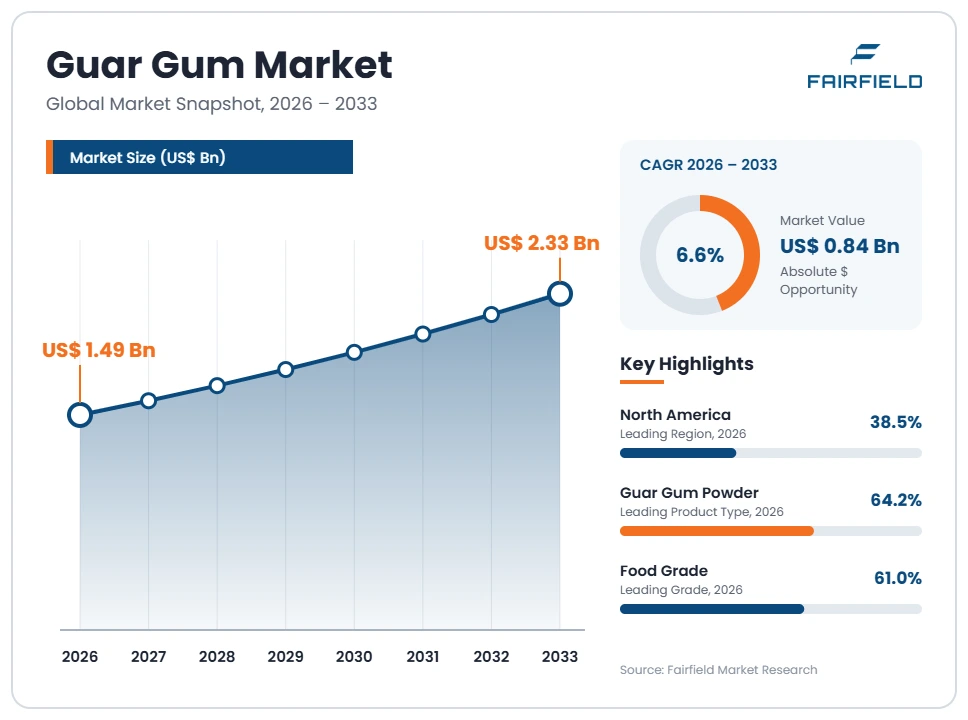
The global guar gum market size is expected to be valued at US$ 1.49 billion in 2026 and projected to reach US$ 2.33 billion by 2033, growing at a CAGR of 6.6% between 2026 and 2033.
Between 2020 and 2025, the market grew at a CAGR of about 4.9%, as demand recovered from the 2020 fall in shale drilling and food uses expanded steadily across major regions. Three factors now support growth: clean-label demand for natural hydrocolloids in food, rising use of guar as a pharmaceutical excipient, and continued hydraulic fracturing activity in North America. The market is shifting from commodity guar gum powder toward higher-value guar derivatives for personal care, pharmaceuticals, and specialty industrial uses, where processors earn better margins and face less price volatility.
Key Report Takeaways
- By Grade: Food Grade held 61.0% share in 2026, while Pharmaceutical Grade is projected to expand at a 7.3% CAGR through 2033, driven by stricter purity standards that reward processors with certified, low-microbial production lines.
- By Product Type: Guar Gum Powder held 64.2% share in 2026, while Guar Derivatives are projected to expand at an 8.1% CAGR through 2033, driven by cationic and hydroxypropyl grades used in hair care and laundry.
- By Application: Food & Beverages held 39.8% share in 2026, while Pharmaceuticals are projected to expand at an 8.4% CAGR through 2033, driven by guar's role as a binder, disintegrant, and controlled-release agent.
- By Nature: Conventional held 91.6% share in 2026, while Organic is projected to expand at a 9.1% CAGR through 2033, driven by certified organic baby food and natural product brands.
- By Region: North America held 38.5% share in 2026, while Asia Pacific is projected to expand at a 9.8% CAGR through 2033, driven by India's processing base and rising packaged food demand in China.
Global Guar Gum Market Trends and Insights
Drivers Impact Analysis
Two drivers carry the strongest influence on guar gum demand during the forecast period.
| Driver | Impact on CAGR Forecast | Geographic Relevance | Impact Timeline |
| Clean-label demand for natural food thickeners | High | Global, strongest in North America and Europe | Long term (≥4 years) |
| Hydraulic fracturing activity in shale basins | Medium | North America | Short term (≤2 years) |
Clean-Label Food Trends Are Expanding Demand for Guar Gum as a Natural Thickener
Clean-label food trends are the most durable growth driver for guar gum. Food makers use it as a thickener, stabilizer, and emulsifier in dairy, bakery, sauces, ice cream, and ready meals. Because it comes from a seed, guar gum fits the natural ingredient lists that shoppers and retailers increasingly prefer.
The mechanism is consumer preference for familiar, plant-based ingredients over synthetic additives. An International Food Information Council survey in 2024 found that 26% of United States consumers link "natural" and "organic" labels with better food safety. Guar gum is approved as food additive E412 in the European Union and is widely accepted by regulators. It is also used in gluten-free baking to replace gluten structure. Its soluble fiber supports low-calorie and fiber-enriched products, which gives food thickeners made from guar an edge over some synthetic alternatives.
Shale Drilling Keeps Hydraulic Fracturing a Major Outlet for Guar Gum
Hydraulic fracturing remains a major outlet for industrial guar gum. Oil and gas service companies use guar and its derivatives to thicken fracturing fluids so they can carry sand into rock fractures. This demand explains why North America holds the largest regional share despite growing almost no guar itself.
The mechanism is the chemistry of fracturing fluids. Guar forms a gel when cross-linked with borate or metal compounds, which suspends proppant at high temperatures and pressures. After the job, breakers reduce viscosity so fluids flow back. Shale producers in the Permian Basin and other United States basins rely on these hydraulic fracturing chemicals, and the United States produced record crude oil volumes in 2024. Each wave of drilling activity lifts orders for industrial-grade guar gum powder from Indian processors, creating a direct link between oil activity and guar exports.
Restraints Impact Analysis
Two restraints limit how smoothly the guar gum market can grow.
| Restraint | Impact on CAGR Forecast | Geographic Relevance | Impact Timeline |
| Monsoon-dependent supply and price volatility | High | Global, rooted in India | Short term (≤2 years) |
| Substitution by synthetic and competing hydrocolloids | Medium | North America, Europe | Medium term (2–4 years) |
Monsoon-Dependent Supply Creates Price Volatility in Guar Gum
Heavy dependence on one crop region creates sharp price swings in guar gum. India produces about 80% of the world's guar, and about 72% of Indian output comes from Rajasthan. A weak monsoon in this arid region can cut harvests sharply, raising prices for buyers worldwide.
The underlying cause is rain-fed, low-input farming. Guar is mostly grown on small farms without irrigation, so yields depend on monsoon timing and volume. Farmers also switch between guar, cotton, and pulses based on prior-year prices, which amplifies supply cycles. In 2012, a surge in fracking demand drove guar seed prices up roughly tenfold, leading many oilfield users to seek alternatives. Price spikes raise costs for food manufacturers, while sudden drops hurt farmers and processors that carry inventory. Limited storage and hedging tools in rural markets make this volatility difficult to manage.
Synthetic Polymers and Rival Gums Limit Guar Gum Demand
Substitution by synthetic polymers and other hydrocolloids restrains guar gum growth in several applications. In oilfields, many operators now use slickwater fracturing with synthetic friction reducers such as polyacrylamide instead of guar-based gels. In food, xanthan gum, carrageenan, and locust bean gum compete for the same thickening role.
The causes are cost stability and performance. Synthetic polymers are made from petrochemicals with steady supply, which avoids the crop risk of guar. Slickwater designs also lower fluid costs per well and reduce residue in fractures. Xanthan gum, produced by fermentation, offers consistent quality and works well in acidic foods. Food makers often blend gums to balance price and texture, and they shift away from guar when its price rises. These alternatives cap guar's pricing power and push processors to focus on applications where its properties are hardest to replace.
Market Opportunities
Pharmaceutical Excipients and Soluble Fiber Open a High-Margin Revenue Pool for Guar Gum
Pharmaceutical and nutraceutical uses form a high-margin, underpenetrated revenue pool for guar gum. Drug makers use it as a binder, disintegrant, and controlled-release matrix in tablets. Partially hydrolyzed guar gum is sold as a soluble fiber supplement for digestive health, with clinical interest in gut and blood sugar benefits.
Processors with pharmacopoeia-grade facilities can capture this demand. Generic drug makers in India and the United States, along with nutraceutical brands, are the main customers. In January 2026, researchers published a study in RSC Sustainability showing that crosslinked guar gum hydrogels could sustain transdermal delivery of anti-inflammatory drugs. This supports guar as a biodegradable alternative to synthetic polymers in patches and gels. Companies that invest in microbial control, traceability, and regulatory documentation can earn much higher prices than for food or industrial grades.
Cationic Guar Derivatives Create a Personal Care and Home Care Revenue Pool
Modified guar derivatives create a growing revenue pool in personal care and home care. Cationic guar is used in shampoos and conditioners to improve wet combing and softness, especially in sulfate-free and silicone-free formulas. It can also help fragrances and softness stick to fabrics in laundry products.
Specialty chemical companies and Indian processors that move into derivatives can capture this opportunity. In October 2026, Syensqo launched Jaguar Care, a guar-based laundry polymer that improves fragrance retention and softness, works in short, cold wash cycles, and is non-microplastic. Brand owners seeking alternatives to synthetic polymers that may face microplastic restrictions in the European Union are the main customers. Hair care, skin care, and detergent makers increasingly prefer natural-origin polymers, which supports demand for guar derivatives at prices well above commodity powder.
Segment Analysis
- By Grade: Food Grade Leads While Pharmaceutical Grade Gains Ground
Food Grade held 61.0% share in 2026. Guar is used in dairy, bakery, sauces, beverages, ice cream, and pet food, where it controls texture and prevents separation. Its broad regulatory approval and low dosage levels make it a cost-effective choice for food manufacturers worldwide.
Pharmaceutical Grade is the fastest-growing grade, expanding at a 7.3% CAGR through 2033. Pharmaceutical customers require low microbial counts, tight viscosity ranges, and full traceability, which limits supply to certified processors. Generic drug production in India and nutraceutical growth in North America support demand. Industrial grade remains important for oilfield, mining, textile, and paper uses. For the broader market, the shift toward pharmaceutical grade raises average prices and encourages investment in cleaner processing, which improves quality across all grades.
- By Product Type: Guar Gum Powder Leads While Guar Derivatives Expand
Guar Gum Powder held 64.2% share in 2026. Processors split guar seeds, remove the husk and germ, and grind the endosperm into powder. This standard product serves food, oilfield, and industrial buyers in large volumes, and India exports most of it to global buyers.
Guar Derivatives are the fastest-growing product type, expanding at an 8.1% CAGR through 2033. Chemical modification produces cationic, hydroxypropyl, and carboxymethyl guar with improved solubility and performance. These derivatives are used in hair care, laundry, fracturing fluids that tolerate high temperatures, and ophthalmic gels. Launches such as Syensqo's Jaguar Care show demand for natural-origin polymers. For the market, derivatives help processors earn higher margins and reduce exposure to commodity price swings in basic powder.
- By Application: Food & Beverages Lead While Pharmaceuticals Accelerate
Food & Beverages held 39.8% share in 2026. Guar gum is a common thickener and stabilizer in dairy products, bakery, sauces, dressings, ice cream, and gluten-free foods. Clean-label demand and steady packaged food growth keep consumption stable across North America, Europe, and Asia Pacific.
Pharmaceuticals are the fastest-growing application, expanding at an 8.4% CAGR through 2033. Guar acts as a binder and disintegrant in tablets and as a matrix for controlled-release drugs. Partially hydrolyzed guar gum is also used as a soluble fiber supplement. Research into guar hydrogels for transdermal patches adds future potential. Oil & gas remains a large industrial application, especially in North America. For the market, pharmaceutical growth adds premium demand that is less exposed to oil prices and crop-driven commodity cycles than oilfield or basic food uses.
- By Nature: Conventional Dominates as Organic Expands Fastest
Conventional held 91.6% share in 2026. Most guar is grown on rain-fed farms in Rajasthan, Gujarat, and Haryana and sold without organic certification. Conventional supply meets the needs of oilfield, industrial, and most food buyers at competitive prices.
Organic is the fastest-growing segment, expanding at a 9.1% CAGR through 2033. Organic baby food, natural snacks, and premium dairy alternatives require certified organic ingredients. Because guar is often grown with few chemical inputs, many farms can convert to organic with modest changes, although certification takes time. Organic guar commands a price premium and supports farmer incomes. For the broader market, organic growth gives processors a way to differentiate and build closer ties with natural food brands in North America and Europe.
Geography Analysis
- Which Region Is Leading the Guar Gum Market?
North America is leading the guar gum market with a 38.5% share in 2026. The United States is a major importer, using guar in hydraulic fracturing fluids across the Permian Basin and other shale basins. Food, pharmaceutical, and personal care manufacturers add steady demand for higher grades. The region grows almost no guar, so it relies on imports from India and Pakistan, which exposes buyers to supply risks. Canada adds demand from oil sands and food processing. One change shaping the region is the shift toward slickwater fracturing, which is pushing guar suppliers to focus more on food and pharmaceutical customers.
- Europe Builds Demand Through Food and Personal Care in the Guar Gum Market
Europe is a mature market where food, pharmaceutical, and personal care uses lead demand. Germany is one of the largest importers of Indian guar gum, while Norway uses guar in offshore oil and gas operations. The Netherlands, France, and the United Kingdom use guar in dairy, bakery, and processed foods. Strict European Food Safety Authority rules and food additive labeling as E412 shape quality requirements. Demand for natural-origin polymers is rising as European Union microplastic rules tighten for cosmetics and detergents. One opportunity is supplying guar derivatives to detergent and cosmetic makers replacing synthetic polymers in their formulas.
- Which Region Is Growing Fastest in the Guar Gum Market?
Asia Pacific is growing fastest in the guar gum market at a 9.8% CAGR through 2033. India grows about 80% of the world's guar and exported about 474,519 tonnes of guar gum worth US$ 550.12 million in fiscal 2025. Rajasthan accounts for about 72% of Indian output. China is a growing importer for food and industrial uses, while Southeast Asian food processing expands quickly in Vietnam, Thailand, and Indonesia. In January 2024, Brenntag opened a blending facility in Vietnam to serve regional food demand. One opportunity is domestic value addition in India, as processors invest in derivatives and pharmaceutical grades.
- Latin America Expands Industrial and Food Uses in the Guar Gum Market
Latin America is an emerging region with demand from food processing and oil and gas. Brazil and Mexico lead the region, using guar in dairy, meat products, sauces, and beverages. Argentina's Vaca Muerta shale play adds industrial demand for fracturing fluids. Key barriers include currency volatility, which raises the cost of imported guar, limited local processing capacity, and long shipping times from India. Low awareness of guar's pharmaceutical and personal care uses also restricts demand for higher grades. One opportunity is growing pet food and processed meat production in Brazil, which uses guar for texture and moisture retention.
- Middle East & Africa Develops Oilfield and Food Demand in the Guar Gum Market
Middle East & Africa is a developing region where oilfield and food uses drive demand. Saudi Arabia, the United Arab Emirates, and Oman use guar in oil and gas operations, including unconventional gas projects. Growing food processing in the Gulf adds demand for thickeners and stabilizers. In Africa, South Africa and Egypt lead food and industrial uses. Key barriers include limited awareness, price sensitivity, and reliance on imports. Some countries also have unclear food additive regulations. One opportunity is local blending and distribution hubs in the Gulf, which can serve both regional food makers and oilfield service companies.
Competitive Landscape
The guar gum market is fragmented. Many Indian processors, including Hindustan Gum & Chemicals, Vikas WSP, Lucid Colloids, Neelkanth Polymers, Supreme Gums, and Jai Bharat Gum and Chemicals, split, grind, and export guar. Global ingredient and specialty chemical companies, such as Ashland, Syensqo, Cargill, and Ingredion, buy guar and sell derivatives or blended hydrocolloids. Low entry barriers in basic processing keep competition intense and margins thin for commodity powder.
Companies compete on price, consistent viscosity, purity, certifications, and reliable supply. Larger processors win by managing seed sourcing across crop cycles, holding buffer inventory, and offering long-term supply contracts to food and oilfield buyers. Derivative makers compete on functional performance and regulatory support for food, pharmaceutical, and cosmetic customers.
Strategic moves show how competition is evolving. Syensqo launched Jaguar Care in October 2026, expanding guar's use in laundry care. Sarda Bio Polymers promoted clean-label plant hydrocolloids, including guar, at IFFA 2025 in Frankfurt. Brenntag opened a blending facility in Vietnam in January 2024 to serve Southeast Asian food demand. Indian processors are also adding pharmaceutical-grade lines and organic certification to escape commodity pricing.
Three themes shape vendor strategy. First, companies are moving from basic powder toward derivatives and specialty grades with higher margins. Second, they are strengthening farmer relationships and storage to manage monsoon-driven supply swings. Third, they are positioning guar as a natural, biodegradable alternative to synthetic polymers, especially as microplastic rules tighten in Europe and natural ingredient demand grows worldwide.
Recent Industry Developments
- October 2026: Syensqo launched Jaguar Care, a guar-based laundry polymer – extends guar derivatives into home care as a non-microplastic option.
- May 2025: Sarda Bio Polymers showcased clean-label guar and plant hydrocolloids at IFFA 2025 – targets meat and food processors seeking natural binders.
- January 2024: Brenntag opened a mixing and blending facility in Vietnam – strengthens hydrocolloid supply to Southeast Asian food makers.
Companies Covered in the Report
- Hindustan Gum & Chemicals
- Vikas WSP
- Lucid Colloids
- Neelkanth Polymers
- Supreme Gums
- Jai Bharat Gum and Chemicals
- Altrafine Gums
- India Glycols
- Ashland
- Syensqo
- Cargill
- Ingredion
Guar Gum Market Report Scope
| Metric | Value |
| Study Period | 2020–2033 |
| Market Size 2026 | US$ 1.49 Billion |
| Market Size 2033 | US$ 2.33 Billion |
| CAGR 2026–2033 | 6.6% |
| Absolute Dollar Opportunity | US$ 0.84 Billion |
| Largest Market | North America |
| Fastest-Growing Market | Asia Pacific |
| Market Concentration | Low |
| Major Players | Hindustan Gum & Chemicals, Vikas WSP, Lucid Colloids, Ashland, Syensqo |
Guar Gum Market Segmentation
Grade
- Food Grade
- Pharmaceutical Grade
- Industrial Grade
Product Type
- Guar Gum Powder
- Guar Splits
- Guar Derivatives
Application
- Food & Beverages
- Oil & Gas
- Pharmaceuticals
- Cosmetics & Personal Care
- Animal Feed & Pet Food
- Textile, Paper & Mining
Nature
- Conventional
- Organic
Regions
- North America
- Europe
- Asia Pacific
- Latin America
- Middle East & Africa
- Executive Summary
- Global Guar Gum Market Snapshot
- Future Projections
- Key Report Takeaways
- Regional Snapshot
- Market Overview
- Market Definition and Report Scope
- Historical Trends 2020–2025
- Market Dynamics
- Drivers
- Clean-Label Food Trends Are Expanding Demand for Guar Gum as a Natural Thickener
- Shale Drilling Keeps Hydraulic Fracturing a Major Outlet for Guar Gum
- Restraints
- Monsoon-Dependent Supply Creates Price Volatility in Guar Gum
- Synthetic Polymers and Rival Gums Limit Guar Gum Demand
- Market Opportunities
- Pharmaceutical Excipients and Soluble Fiber Open a High-Margin Revenue Pool for Guar Gum
- Cationic Guar Derivatives Create a Personal Care and Home Care Revenue Pool
- Drivers
- Global Guar Gum Market Outlook, 2020–2033
- Global Guar Gum Market Outlook, by Grade, Value (US$ Billion), 2020–2033
- Food Grade
- Pharmaceutical Grade
- Industrial Grade
- Global Guar Gum Market Outlook, by Product Type, Value (US$ Billion), 2020–2033
- Guar Gum Powder
- Guar Splits
- Guar Derivatives
- Global Guar Gum Market Outlook, by Application, Value (US$ Billion), 2020–2033
- Food & Beverages
- Oil & Gas
- Pharmaceuticals
- Cosmetics & Personal Care
- Animal Feed & Pet Food
- Textile, Paper & Mining
- Global Guar Gum Market Outlook, by Nature, Value (US$ Billion), 2020–2033
- Conventional
- Organic
- Global Guar Gum Market Outlook, by Region, Value (US$ Billion), 2020–2033
- North America
- Europe
- Asia Pacific
- Latin America
- Middle East & Africa
- Global Guar Gum Market Outlook, by Grade, Value (US$ Billion), 2020–2033
- North America Guar Gum Market Outlook, 2020–2033
- North America Guar Gum Market Outlook, by Grade, Value (US$ Billion), 2020–2033
- Food Grade
- Pharmaceutical Grade
- Industrial Grade
- North America Guar Gum Market Outlook, by Product Type, Value (US$ Billion), 2020–2033
- Guar Gum Powder
- Guar Splits
- Guar Derivatives
- North America Guar Gum Market Outlook, by Application, Value (US$ Billion), 2020–2033
- Food & Beverages
- Oil & Gas
- Pharmaceuticals
- Cosmetics & Personal Care
- Animal Feed & Pet Food
- Textile, Paper & Mining
- North America Guar Gum Market Outlook, by Nature, Value (US$ Billion), 2020–2033
- Conventional
- Organic
- North America Guar Gum Market Outlook, by Country, Value (US$ Billion), 2020–2033
- United States Guar Gum Market Outlook, by Grade, 2020–2033
- United States Guar Gum Market Outlook, by Product Type, 2020–2033
- United States Guar Gum Market Outlook, by Application, 2020–2033
- United States Guar Gum Market Outlook, by Nature, 2020–2033
- Canada Guar Gum Market Outlook, by Grade, 2020–2033
- Canada Guar Gum Market Outlook, by Product Type, 2020–2033
- Canada Guar Gum Market Outlook, by Application, 2020–2033
- Canada Guar Gum Market Outlook, by Nature, 2020–2033
- North America Guar Gum Market Outlook, by Grade, Value (US$ Billion), 2020–2033
- Europe Guar Gum Market Outlook, 2020–2033
- Europe Guar Gum Market Outlook, by Grade, Value (US$ Billion), 2020–2033
- Food Grade
- Pharmaceutical Grade
- Industrial Grade
- Europe Guar Gum Market Outlook, by Product Type, Value (US$ Billion), 2020–2033
- Guar Gum Powder
- Guar Splits
- Guar Derivatives
- Europe Guar Gum Market Outlook, by Application, Value (US$ Billion), 2020–2033
- Food & Beverages
- Oil & Gas
- Pharmaceuticals
- Cosmetics & Personal Care
- Animal Feed & Pet Food
- Textile, Paper & Mining
- Europe Guar Gum Market Outlook, by Nature, Value (US$ Billion), 2020–2033
- Conventional
- Organic
- Europe Guar Gum Market Outlook, by Country, Value (US$ Billion), 2020–2033
- Germany Guar Gum Market Outlook, by Grade, 2020–2033
- Germany Guar Gum Market Outlook, by Product Type, 2020–2033
- Germany Guar Gum Market Outlook, by Application, 2020–2033
- Germany Guar Gum Market Outlook, by Nature, 2020–2033
- Norway Guar Gum Market Outlook, by Grade, 2020–2033
- Norway Guar Gum Market Outlook, by Product Type, 2020–2033
- Norway Guar Gum Market Outlook, by Application, 2020–2033
- Norway Guar Gum Market Outlook, by Nature, 2020–2033
- Netherlands Guar Gum Market Outlook, by Grade, 2020–2033
- Netherlands Guar Gum Market Outlook, by Product Type, 2020–2033
- Netherlands Guar Gum Market Outlook, by Application, 2020–2033
- Netherlands Guar Gum Market Outlook, by Nature, 2020–2033
- France Guar Gum Market Outlook, by Grade, 2020–2033
- France Guar Gum Market Outlook, by Product Type, 2020–2033
- France Guar Gum Market Outlook, by Application, 2020–2033
- France Guar Gum Market Outlook, by Nature, 2020–2033
- United Kingdom Guar Gum Market Outlook, by Grade, 2020–2033
- United Kingdom Guar Gum Market Outlook, by Product Type, 2020–2033
- United Kingdom Guar Gum Market Outlook, by Application, 2020–2033
- United Kingdom Guar Gum Market Outlook, by Nature, 2020–2033
- Europe Guar Gum Market Outlook, by Grade, Value (US$ Billion), 2020–2033
- Asia Pacific Guar Gum Market Outlook, 2020–2033
- Asia Pacific Guar Gum Market Outlook, by Grade, Value (US$ Billion), 2020–2033
- Food Grade
- Pharmaceutical Grade
- Industrial Grade
- Asia Pacific Guar Gum Market Outlook, by Product Type, Value (US$ Billion), 2020–2033
- Guar Gum Powder
- Guar Splits
- Guar Derivatives
- Asia Pacific Guar Gum Market Outlook, by Application, Value (US$ Billion), 2020–2033
- Food & Beverages
- Oil & Gas
- Pharmaceuticals
- Cosmetics & Personal Care
- Animal Feed & Pet Food
- Textile, Paper & Mining
- Asia Pacific Guar Gum Market Outlook, by Nature, Value (US$ Billion), 2020–2033
- Conventional
- Organic
- Asia Pacific Guar Gum Market Outlook, by Country, Value (US$ Billion), 2020–2033
- India Guar Gum Market Outlook, by Grade, 2020–2033
- India Guar Gum Market Outlook, by Product Type, 2020–2033
- India Guar Gum Market Outlook, by Application, 2020–2033
- India Guar Gum Market Outlook, by Nature, 2020–2033
- China Guar Gum Market Outlook, by Grade, 2020–2033
- China Guar Gum Market Outlook, by Product Type, 2020–2033
- China Guar Gum Market Outlook, by Application, 2020–2033
- China Guar Gum Market Outlook, by Nature, 2020–2033
- Vietnam Guar Gum Market Outlook, by Grade, 2020–2033
- Vietnam Guar Gum Market Outlook, by Product Type, 2020–2033
- Vietnam Guar Gum Market Outlook, by Application, 2020–2033
- Vietnam Guar Gum Market Outlook, by Nature, 2020–2033
- Thailand Guar Gum Market Outlook, by Grade, 2020–2033
- Thailand Guar Gum Market Outlook, by Product Type, 2020–2033
- Thailand Guar Gum Market Outlook, by Application, 2020–2033
- Thailand Guar Gum Market Outlook, by Nature, 2020–2033
- Indonesia Guar Gum Market Outlook, by Grade, 2020–2033
- Indonesia Guar Gum Market Outlook, by Product Type, 2020–2033
- Indonesia Guar Gum Market Outlook, by Application, 2020–2033
- Indonesia Guar Gum Market Outlook, by Nature, 2020–2033
- Asia Pacific Guar Gum Market Outlook, by Grade, Value (US$ Billion), 2020–2033
- Latin America Guar Gum Market Outlook, 2020–2033
- Latin America Guar Gum Market Outlook, by Grade, Value (US$ Billion), 2020–2033
- Food Grade
- Pharmaceutical Grade
- Industrial Grade
- Latin America Guar Gum Market Outlook, by Product Type, Value (US$ Billion), 2020–2033
- Guar Gum Powder
- Guar Splits
- Guar Derivatives
- Latin America Guar Gum Market Outlook, by Application, Value (US$ Billion), 2020–2033
- Food & Beverages
- Oil & Gas
- Pharmaceuticals
- Cosmetics & Personal Care
- Animal Feed & Pet Food
- Textile, Paper & Mining
- Latin America Guar Gum Market Outlook, by Nature, Value (US$ Billion), 2020–2033
- Conventional
- Organic
- Latin America Guar Gum Market Outlook, by Country, Value (US$ Billion), 2020–2033
- Brazil Guar Gum Market Outlook, by Grade, 2020–2033
- Brazil Guar Gum Market Outlook, by Product Type, 2020–2033
- Brazil Guar Gum Market Outlook, by Application, 2020–2033
- Brazil Guar Gum Market Outlook, by Nature, 2020–2033
- Mexico Guar Gum Market Outlook, by Grade, 2020–2033
- Mexico Guar Gum Market Outlook, by Product Type, 2020–2033
- Mexico Guar Gum Market Outlook, by Application, 2020–2033
- Mexico Guar Gum Market Outlook, by Nature, 2020–2033
- Argentina Guar Gum Market Outlook, by Grade, 2020–2033
- Argentina Guar Gum Market Outlook, by Product Type, 2020–2033
- Argentina Guar Gum Market Outlook, by Application, 2020–2033
- Argentina Guar Gum Market Outlook, by Nature, 2020–2033
- Latin America Guar Gum Market Outlook, by Grade, Value (US$ Billion), 2020–2033
- Middle East & Africa Guar Gum Market Outlook, 2020–2033
- Middle East & Africa Guar Gum Market Outlook, by Grade, Value (US$ Billion), 2020–2033
- Food Grade
- Pharmaceutical Grade
- Industrial Grade
- Middle East & Africa Guar Gum Market Outlook, by Product Type, Value (US$ Billion), 2020–2033
- Guar Gum Powder
- Guar Splits
- Guar Derivatives
- Middle East & Africa Guar Gum Market Outlook, by Application, Value (US$ Billion), 2020–2033
- Food & Beverages
- Oil & Gas
- Pharmaceuticals
- Cosmetics & Personal Care
- Animal Feed & Pet Food
- Textile, Paper & Mining
- Middle East & Africa Guar Gum Market Outlook, by Nature, Value (US$ Billion), 2020–2033
- Conventional
- Organic
- Middle East & Africa Guar Gum Market Outlook, by Country, Value (US$ Billion), 2020–2033
- Saudi Arabia Guar Gum Market Outlook, by Grade, 2020–2033
- Saudi Arabia Guar Gum Market Outlook, by Product Type, 2020–2033
- Saudi Arabia Guar Gum Market Outlook, by Application, 2020–2033
- Saudi Arabia Guar Gum Market Outlook, by Nature, 2020–2033
- United Arab Emirates Guar Gum Market Outlook, by Grade, 2020–2033
- United Arab Emirates Guar Gum Market Outlook, by Product Type, 2020–2033
- United Arab Emirates Guar Gum Market Outlook, by Application, 2020–2033
- United Arab Emirates Guar Gum Market Outlook, by Nature, 2020–2033
- Oman Guar Gum Market Outlook, by Grade, 2020–2033
- Oman Guar Gum Market Outlook, by Product Type, 2020–2033
- Oman Guar Gum Market Outlook, by Application, 2020–2033
- Oman Guar Gum Market Outlook, by Nature, 2020–2033
- South Africa Guar Gum Market Outlook, by Grade, 2020–2033
- South Africa Guar Gum Market Outlook, by Product Type, 2020–2033
- South Africa Guar Gum Market Outlook, by Application, 2020–2033
- South Africa Guar Gum Market Outlook, by Nature, 2020–2033
- Egypt Guar Gum Market Outlook, by Grade, 2020–2033
- Egypt Guar Gum Market Outlook, by Product Type, 2020–2033
- Egypt Guar Gum Market Outlook, by Application, 2020–2033
- Egypt Guar Gum Market Outlook, by Nature, 2020–2033
- Middle East & Africa Guar Gum Market Outlook, by Grade, Value (US$ Billion), 2020–2033
- Competitive Landscape
- Market Concentration and Industry Leaders
- Competitive Differentiation
- Strategic Moves and Market Direction
- Recent Industry Developments
- Company Profiles
- Hindustan Gum & Chemicals
- Vikas WSP
- Lucid Colloids
- Neelkanth Polymers
- Supreme Gums
- Jai Bharat Gum and Chemicals
- Altrafine Gums
- India Glycols
- Ashland
- Syensqo
- Cargill
- Ingredion
- Appendix
- Research Methodology
- Report Assumptions
- Acronyms and Abbreviations
Grade
- Food Grade
- Pharmaceutical Grade
- Industrial Grade
Product Type
- Guar Gum Powder
- Guar Splits
- Guar Derivatives
Application
- Food & Beverages
- Oil & Gas
- Pharmaceuticals
- Cosmetics & Personal Care
- Animal Feed & Pet Food
- Textile, Paper & Mining
Nature
- Conventional
- Organic
Regions
- North America
- Europe
- Asia Pacific
- Latin America
- Middle East & Africa
Our Research Methodology
Considering the volatility of business today, traditional approaches to strategizing a game plan can be unfruitful if not detrimental. True ambiguity is no way to determine a forecast. A myriad of predetermined factors must be accounted for such as the degree of risk involved, the magnitude of circumstances, as well as conditions or consequences that are not known or unpredictable. To circumvent binary views that cast uncertainty, the application of market research intelligence to strategically posture, move, and enable actionable outcomes is necessary.
View Methodology
Quality Assured
Rigorous Validation Process

Confidentiality Assured
End-to-end Data Security

Custom Research Services
Tailored To Your Objectives
FAQs
The guar gum market is valued at US$ 1.49 billion in 2026, led by food-grade guar used as a natural thickener and stabilizer.
The market is projected to reach US$ 2.33 billion by 2033, growing at a 6.6% CAGR and adding US$ 0.84 billion.
Food & Beverages lead with 39.8% share in 2026, supported by clean-label demand in dairy, bakery, sauces, and gluten-free foods.
Asia Pacific is growing fastest at a 9.8% CAGR through 2033, driven by India's processing base and rising packaged food demand in China.
North America holds the largest share at 38.5% in 2026, supported by hydraulic fracturing demand and food and pharmaceutical manufacturing.
Related Reports
Tilapia Market Size, Share, Insights, Competitive Landscape, and Forecast 2026 to 2033
The tilapia market is projected to grow from US$14.60 billion in 2026 to US$20.10 billion by 2033, at a 4.7% CAGR, driven by protein demand and aquaculture.
Quillaja Extract Market Size, Share, Insights, Competitive Landscape, and Forecast 2026 to 2033
The quillaja extract market is projected to grow from US$397.5 million in 2026 to US$712.7 million by 2033, at an 8.7% CAGR, led by food and vaccine uses.
Organic Tobacco Market Size, Share, Insights, Competitive Landscape, and Forecast 2026 to 2033
The organic tobacco market is projected to grow from US$143.8 million in 2026 to US$193.1 million by 2033, at a 4.3% CAGR, shaped by sourcing and regulation.
Green Cardamom Market Size, Share, Insights, Competitive Landscape, and Forecast 2026 to 2033
Green cardamom market to grow from US$1.6 Bn in 2026 to US$2.3 Bn by 2033 at 5.3% CAGR. Explore forms, grades, applications and regional growth trends.
GMO Testing Market Size, Share, Insights, Competitive Landscape, and Forecast 2026 to 2033
GMO testing market to grow from US$2.2 Bn in 2026 to US$3.6 Bn by 2033 at 7.3% CAGR. Explore testing services, technologies, samples and regional trends.
Glutinous Rice Flour Market Size, Share, Insights, Competitive Landscape, and Forecast 2026 to 2033
Glutinous rice flour market to grow from US$2.4 Bn in 2026 to US$3.5 Bn by 2033 at 5.5% CAGR. Explore products, milling, applications and regions.