



Guaranteed Asset Protection (GAP) Insurance Market
GAP Insurance Market Insights, Competitive Landscape, and Market Forecast - 2033
Global Guaranteed Asset Protection (GAP) Insurance Market Forecast
- The GAP Insurance Market is valued at USD 4.2 Bn in 2026 and is projected to reach USD 6.7 Bn, growing at a CAGR of 7% by 2033.
Market Analysis in Brief
Individuals who finance or lease a car are protected from financial loss if the vehicle is stolen or totaled by guaranteed asset protection (GAP) insurance. There is frequently a discrepancy between the loan or lease amount and the car's worth when one leases or buys a car. Some factors affecting this disparity include depreciation, interest, and other costs. When a car is stolen or declared a total loss following an accident, the insurance company often pays the actual worth of the car, which may be considerably less than the remaining loan or lease sum. Rising global automobile sales mostly drive the need for GAP insurance. For instance, the sales of autos in Germany climbed from 241,330 in March 2022 to 281,361 in March 2023, according to data from the Automotive Industry Portal. The quantity of vehicles on the road means that GAP insurance providers have a larger potential customer base.
Key Report Findings
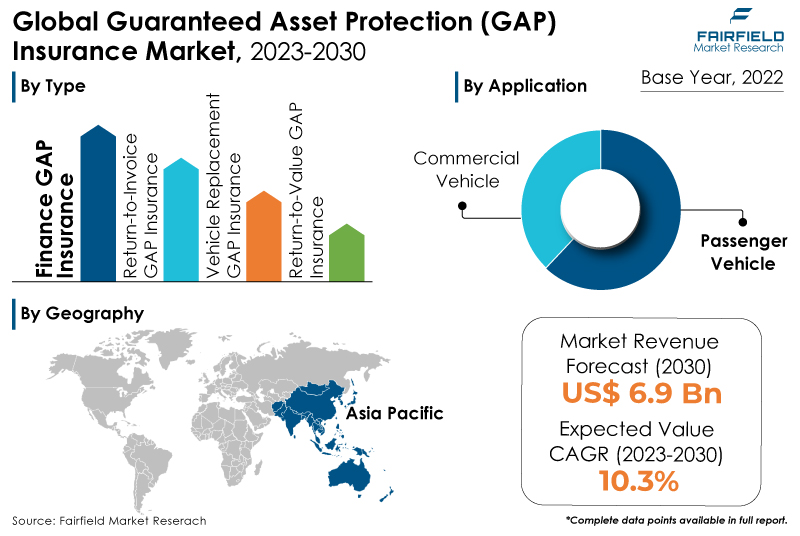
- The market for GAP insurance will demonstrate significant expansion in revenue during 2023 and 2030.
- Several variables are shaping the market, especially the climbing vehicle sales, rising demand for car loans and leases, and the consistently growing number of accidents and auto thefts.
- Demand for finance GAP insurance will remain higher in the market.
- The passenger cars category held the highest guaranteed asset protection (GAP) insurance market revenue share in 2022.
- Asia Pacific will continue to lead its way while North America's market will experience the strongest growth till 2030.
Growth Drivers
High Security and Reduced Risk on Motor Vehicles
Buying a brand-new car is a convenient experience for most people, but when the car is driven away, it ceases to be brand-new and begins to lose value. This depreciation can occasionally be as severe as 20 to 30% of the whole value. The amount of the loan is unaffected by depreciation. It is constant and must be paid regardless of the state of the drivers or the cars.
For instance, the outstanding loan debt is still owed if the vehicle is stolen, lost, or destroyed. Therefore, this insurance fills the gap between the remaining amount and the depreciated worth of automobiles. Additionally, GAP insurance can help consumers preserve money in times of need and pay for replacement vehicles. The guaranteed asset protection insurance market grows due to these causes.
Quick Claim Settlement
In cases of accidents that cause bodily harm or fatalities, third-party protection is unrestricted, and the insurance company is liable for covering all costs of damages. Third parties frequently submit claims to the Motor Accident Claims Tribunal (MACT) when there has been a death or injury. In addition, it takes a lot longer for a court to decide on a vehicle insurance claim.
However, GAP insurance offers quicker claim settlement if the necessary paperwork has been received and the motor insurance claim has been fully resolved. Additionally, gap insurance is meant to be used in addition to comprehensive or collision coverage. If the client submits a valid claim, the collision policy or comprehensive coverage will pay a portion of the replacement cost of the totaled or stolen vehicle up to the vehicle's depreciated value. As a result, the industry is expanding due to GAP insurance's speedy settlement of claims.
Market Opportunuty
Increase in Use of AI to Unlock Various Opportunites
The GAP insurance industry might develop creative ways to operate and address customer needs while maintaining the security of both customers and staff. Numerous businesses have invested in IT infrastructure, increased data capabilities, preferred digital assessment, and complaints mechanisms due to the pandemic, which has accelerated the sector's development. The underwriting procedure can be improved by using new data sources and decision models.
The growth of social networks, mobile technology, and cloud services, along with legal restrictions and the need for smart functioning due to the pandemic spread, have all contributed to an increase in cyber risk. To guarantee the continuity of financial operations in the case of a cyber-attack, many businesses are beginning to view cyber security as a significant business risk and are requesting insurance coverage.
Integrating Artificial Intelligence (AI), intelligent systems, telematics, and other cutting-edge technology to create tightly connected digital ecosystems has become standard as insurers grow to meet the demands of a digitised world. Thus, the GAP insurance sector has prospects in applying AI, cloud services, cutting-edge mobile technology, and cybersecurity.
Overview of Key Segments
Dominance of Finance GAP Insurance Type Intact
Over the projected period, the financial GAP insurance segment is anticipated to achieve the biggest revenue share. Their use is motivated by two main factors. First, they can offer repurchase and financing agreements for vehicles with warranties of up to 100% of the original purchase price. Second, these are important drivers of this segment's growth since they give customers an easy way to get auto loans without paying anything upfront.
Every insured vehicle that receives credit after being totaled also has some equity in the banks. The value will be at least equal to the outstanding loan balance, less any payouts made in connection with liability settlements and physical damage coverage payouts.
Return-to-invoice GAP insurance helps cover the gap between the vehicle's original and net invoice prices. Customers are more likely to choose this coverage if they lease or buy a car with an option agreement. It can also be applied if theft or accident causes the car's value to fall below the originally financed amount. The car may sustain entire damage due to severe accidents and natural disasters. When a claim is settled, the return to invoice cover will provide the purchase price of your car if it is beyond repair.
Passenger Cars Remain the Leading Vehicle Type
The trend towards increased use of passenger cars as a mode of transportation is expected to continue. Additionally, rising disposable incomes and a growing need for mobility at all levels have sparked an expansionary tendency towards passenger cars, which will periodically increase demand for GAP insurance policies.
The introduction of new technologies by automakers, such as autonomous vehicle driving, may require a greater financial commitment from the driver or owner but will likely increase adoption rates as people become more concerned about accidents and other losses related to conventional modes of transportation.
Every business depends on commercial vehicles, a major source of GAP Insurance claims each year. In other words, because these vehicles are only utilised for business, they will incur substantial costs if they are involved in an accident on the road. Additionally, because many businesses depend on trucks and vans regularly, protecting them is crucial for the company and the reliant staff.
The implementation of car scrappage programs, ambitious investments in rural and infrastructural development, and the formulation of strict regulatory criteria for, among other characteristics, vehicle length and weight restrictions are expected to fuel the increase in the use of commercial vehicles, thus driving the growth of the sector.
Growth Opportunities Across Regions
Asia Pacific Tops the Charts
This is explained by the fact that commercial auto insurance is officially required for most business-related vehicles in the Asia Pacific region, which also encourages the purchase of GAP insurance to guard against value loss. This is a significant market driver as a result. The industry is expanding due to rising automobile sales in nations like China, and India.
Major factors propelling the Asia Pacific market growth are the rise in disposable income, significant population growth, economic developments, particularly in developing nations like India, China, Malaysia, and Indonesia, and expanding government regulations for guaranteed asset protection insurance in the automotive industry. The likelihood of auto theft and accidents involving damaged vehicles is another factor in the expansion of the industry in the region.
The diverse mix of economies in this region, including those of Australia, Japan, and China, all of which continue to benefit from technological advancement, suggests that the GAP insurance market will likely continue to exist and grow over the next few years. In addition to rising consumer affluence and spending power, the exports and local consumption are driving the growth of auto insurance in Asia to a large extent.
North America Grows Lucrative
The early introduction of insurance and, afterward, high car ownership rates are primarily responsible for the market growth in North America. Due to the presence of major industry participants in the area, such as Allstate, State Farm, Progressive, Geico (Berkshire Hathaway), USAA, Liberty Mutual, and Travellers, the GAP insurance market in North America is forecast to have significant revenue growth throughout the projected period.
These market leaders offer innovative insurance policies like comprehensive, underinsured motorist and uninsured motorist coverage, further stimulating market growth. The US is expected to rule this region during the projection period, but the Canadian GAP Insurance Market is also expected to grow at a decent rate. The United States was one of the first nations to implement GAP insurance, so a sizeable portion of the populace is aware of the advantages it provides.
Additionally, the region's extensive use of automobiles considerably supports industry growth. Furthermore, it is projected that enforcing tight government regulations regarding automobile safety will promote business growth.
Growth Challenges
Tightening Regulatory Screws Around Insurance Players
In nations like Australia and the US, laws are being introduced more often, and regulatory organisations are being established. For instance, Australia has two regulating agencies for insurance companies: Australian Securities and Investments Commission and the Australian Prudential Regulation Authority (APRA). Additionally, the US has its own regulating agency known as the National Association of Insurance Commissioners for applying more uniform laws and regulations on auto insurance.
The growing requirements for the GAP insurance industry may thus significantly threaten motor vehicle insurance firms due to the proliferation of government rules. This will directly affect the worldwide guaranteed asset protection insurance market because of its income, which is anticipated to impede the market throughout the forecast period.
GAP Insurance Market: Competitive Landscape
Some of the leading players at the forefront in the guaranteed asset protection insurance market space include
• Zurich
• Direct Gap
• American Family Insurance
• AXA
• Admiral Group PLC
• Allstate Insurance Company
• State Farm Mutual Automobile Insurance Company
• Nationwide Mutual Insurance Company
• Aviva
• Chubb
• Liberty Mutual Insurance Company
• Allianz
• Progressive Casualty Insurance Company
• Berkshire Hathaway Inc.
• Majesco
• Kemper Corporation
• The Travelers Idemnity Company
Recent Notable Developments
In June 2021, Amica, the country's oldest mutual auto insurer, will adopt three Shift Insurance Suite products, according to Shift Technology, an innovator of AI-driven optimisation solutions and decision automation for the global insurance industry. The insurance will employ Shift Claims Fraud Detection and Shift Subrogation Detection to ensure customer claims are processed as quickly, accurately, and fairly as possible.
Similarly, in June 2021, Allstate decided to buy SafeAuto, an Ohio-based firm that offers car insurance that meets the legal requirements in 28 states. Following the acquisition by Allstate subsidiary National General, SafeAuto will be incorporated into National General's direct-to-consumer non-standard auto insurance activities. The total consideration includes a cash purchase price of US$270 Mn plus roughly US$30 Mn in pre-closing dividends on certain non-insurance assets.
Global Guaranteed Asset Protection (GAP) insurance Market is Segmented as Below:
By Type
- Return-to-Invoice GAP Insurance
- Finance GAP Insurance
- Vehicle Replacement GAP Insurance
- Return-to-Value GAP Insurance
- Miscellaneous
By Application
- Passenger Vehicle
- Commercial Vehicle
By Distribution Channel
- Agents & Brokers
- Direct Response
- Miscellaneous
By Geographic Coverage
- North America
- U.S.
- Canada
- Europe
- Germany
- U.K.
- France
- Italy
- Turkey
- Russia
- Rest of Europe
- Asia Pacific
- China
- Japan
- South Korea
- India
- Southeast Asia
- Rest of Asia Pacific
- Latin America
- Brazil
- Mexico
- Rest of Latin America
- Middle East & Africa
- GCC
- South Africa
- Rest of Middle East & Africa
- Executive Summary
- Global GAP Insurance Market Snapshot
- Future Projections
- Key Market Trends
- Regional Snapshot, by Value, 2026
- Analyst Recommendations
- Market Overview
- Market Definitions and Segmentations
- Market Dynamics
- Drivers
- Restraints
- Market Opportunities
- Value Chain Analysis
- COVID-19 Impact Analysis
- Porter's Fiver Forces Analysis
- Impact of Russia-Ukraine Conflict
- PESTLE Analysis
- Regulatory Analysis
- Price Trend Analysis
- Current Prices and Future Projections, 2025-2033
- Price Impact Factors
- Global GAP Insurance Market Outlook, 2020 - 2033
- Global GAP Insurance Market Outlook, by Type, Value (US$ Bn), 2020-2033
- Return-to-Invoice GAP Insurance
- Finance GAP Insurance
- Vehicle Replacement GAP Insurance
- Return-to-Value GAP Insurance
- Miscellaneous
- Global GAP Insurance Market Outlook, by Application, Value (US$ Bn), 2020-2033
- Passenger Vehicle
- Commercial Vehicle
- Global GAP Insurance Market Outlook, by Distribution Channel, Value (US$ Bn), 2020-2033
- Agents & Brokers
- Direct Response
- Miscellaneous
- Global GAP Insurance Market Outlook, by Region, Value (US$ Bn), 2020-2033
- North America
- Europe
- Asia Pacific
- Latin America
- Middle East & Africa
- Global GAP Insurance Market Outlook, by Type, Value (US$ Bn), 2020-2033
- North America GAP Insurance Market Outlook, 2020 - 2033
- North America GAP Insurance Market Outlook, by Type, Value (US$ Bn), 2020-2033
- Return-to-Invoice GAP Insurance
- Finance GAP Insurance
- Vehicle Replacement GAP Insurance
- Return-to-Value GAP Insurance
- Miscellaneous
- North America GAP Insurance Market Outlook, by Application, Value (US$ Bn), 2020-2033
- Passenger Vehicle
- Commercial Vehicle
- North America GAP Insurance Market Outlook, by Distribution Channel, Value (US$ Bn), 2020-2033
- Agents & Brokers
- Direct Response
- Miscellaneous
- North America GAP Insurance Market Outlook, by Country, Value (US$ Bn), 2020-2033
- S. GAP Insurance Market Outlook, by Type, 2020-2033
- S. GAP Insurance Market Outlook, by Application, 2020-2033
- S. GAP Insurance Market Outlook, by Distribution Channel, 2020-2033
- Canada GAP Insurance Market Outlook, by Type, 2020-2033
- Canada GAP Insurance Market Outlook, by Application, 2020-2033
- Canada GAP Insurance Market Outlook, by Distribution Channel, 2020-2033
- BPS Analysis/Market Attractiveness Analysis
- North America GAP Insurance Market Outlook, by Type, Value (US$ Bn), 2020-2033
- Europe GAP Insurance Market Outlook, 2020 - 2033
- Europe GAP Insurance Market Outlook, by Type, Value (US$ Bn), 2020-2033
- Return-to-Invoice GAP Insurance
- Finance GAP Insurance
- Vehicle Replacement GAP Insurance
- Return-to-Value GAP Insurance
- Miscellaneous
- Europe GAP Insurance Market Outlook, by Application, Value (US$ Bn), 2020-2033
- Passenger Vehicle
- Commercial Vehicle
- Europe GAP Insurance Market Outlook, by Distribution Channel, Value (US$ Bn), 2020-2033
- Agents & Brokers
- Direct Response
- Miscellaneous
- Europe GAP Insurance Market Outlook, by Country, Value (US$ Bn), 2020-2033
- Germany GAP Insurance Market Outlook, by Type, 2020-2033
- Germany GAP Insurance Market Outlook, by Application, 2020-2033
- Germany GAP Insurance Market Outlook, by Distribution Channel, 2020-2033
- Italy GAP Insurance Market Outlook, by Type, 2020-2033
- Italy GAP Insurance Market Outlook, by Application, 2020-2033
- Italy GAP Insurance Market Outlook, by Distribution Channel, 2020-2033
- France GAP Insurance Market Outlook, by Type, 2020-2033
- France GAP Insurance Market Outlook, by Application, 2020-2033
- France GAP Insurance Market Outlook, by Distribution Channel, 2020-2033
- K. GAP Insurance Market Outlook, by Type, 2020-2033
- K. GAP Insurance Market Outlook, by Application, 2020-2033
- K. GAP Insurance Market Outlook, by Distribution Channel, 2020-2033
- Spain GAP Insurance Market Outlook, by Type, 2020-2033
- Spain GAP Insurance Market Outlook, by Application, 2020-2033
- Spain GAP Insurance Market Outlook, by Distribution Channel, 2020-2033
- Russia GAP Insurance Market Outlook, by Type, 2020-2033
- Russia GAP Insurance Market Outlook, by Application, 2020-2033
- Russia GAP Insurance Market Outlook, by Distribution Channel, 2020-2033
- Rest of Europe GAP Insurance Market Outlook, by Type, 2020-2033
- Rest of Europe GAP Insurance Market Outlook, by Application, 2020-2033
- Rest of Europe GAP Insurance Market Outlook, by Distribution Channel, 2020-2033
- BPS Analysis/Market Attractiveness Analysis
- Europe GAP Insurance Market Outlook, by Type, Value (US$ Bn), 2020-2033
- Asia Pacific GAP Insurance Market Outlook, 2020 - 2033
- Asia Pacific GAP Insurance Market Outlook, by Type, Value (US$ Bn), 2020-2033
- Return-to-Invoice GAP Insurance
- Finance GAP Insurance
- Vehicle Replacement GAP Insurance
- Return-to-Value GAP Insurance
- Miscellaneous
- Asia Pacific GAP Insurance Market Outlook, by Application, Value (US$ Bn), 2020-2033
- Passenger Vehicle
- Commercial Vehicle
- Asia Pacific GAP Insurance Market Outlook, by Distribution Channel, Value (US$ Bn), 2020-2033
- Agents & Brokers
- Direct Response
- Miscellaneous
- Asia Pacific GAP Insurance Market Outlook, by Country, Value (US$ Bn), 2020-2033
- China GAP Insurance Market Outlook, by Type, 2020-2033
- China GAP Insurance Market Outlook, by Application, 2020-2033
- China GAP Insurance Market Outlook, by Distribution Channel, 2020-2033
- Japan GAP Insurance Market Outlook, by Type, 2020-2033
- Japan GAP Insurance Market Outlook, by Application, 2020-2033
- Japan GAP Insurance Market Outlook, by Distribution Channel, 2020-2033
- South Korea GAP Insurance Market Outlook, by Type, 2020-2033
- South Korea GAP Insurance Market Outlook, by Application, 2020-2033
- South Korea GAP Insurance Market Outlook, by Distribution Channel, 2020-2033
- India GAP Insurance Market Outlook, by Type, 2020-2033
- India GAP Insurance Market Outlook, by Application, 2020-2033
- India GAP Insurance Market Outlook, by Distribution Channel, 2020-2033
- Southeast Asia GAP Insurance Market Outlook, by Type, 2020-2033
- Southeast Asia GAP Insurance Market Outlook, by Application, 2020-2033
- Southeast Asia GAP Insurance Market Outlook, by Distribution Channel, 2020-2033
- Rest of SAO GAP Insurance Market Outlook, by Type, 2020-2033
- Rest of SAO GAP Insurance Market Outlook, by Application, 2020-2033
- Rest of SAO GAP Insurance Market Outlook, by Distribution Channel, 2020-2033
- BPS Analysis/Market Attractiveness Analysis
- Asia Pacific GAP Insurance Market Outlook, by Type, Value (US$ Bn), 2020-2033
- Latin America GAP Insurance Market Outlook, 2020 - 2033
- Latin America GAP Insurance Market Outlook, by Type, Value (US$ Bn), 2020-2033
- Return-to-Invoice GAP Insurance
- Finance GAP Insurance
- Vehicle Replacement GAP Insurance
- Return-to-Value GAP Insurance
- Miscellaneous
- Latin America GAP Insurance Market Outlook, by Application, Value (US$ Bn), 2020-2033
- Passenger Vehicle
- Commercial Vehicle
- Latin America GAP Insurance Market Outlook, by Distribution Channel, Value (US$ Bn), 2020-2033
- Agents & Brokers
- Direct Response
- Miscellaneous
- Latin America GAP Insurance Market Outlook, by Country, Value (US$ Bn), 2020-2033
- Brazil GAP Insurance Market Outlook, by Type, 2020-2033
- Brazil GAP Insurance Market Outlook, by Application, 2020-2033
- Brazil GAP Insurance Market Outlook, by Distribution Channel, 2020-2033
- Mexico GAP Insurance Market Outlook, by Type, 2020-2033
- Mexico GAP Insurance Market Outlook, by Application, 2020-2033
- Mexico GAP Insurance Market Outlook, by Distribution Channel, 2020-2033
- Argentina GAP Insurance Market Outlook, by Type, 2020-2033
- Argentina GAP Insurance Market Outlook, by Application, 2020-2033
- Argentina GAP Insurance Market Outlook, by Distribution Channel, 2020-2033
- Rest of LATAM GAP Insurance Market Outlook, by Type, 2020-2033
- Rest of LATAM GAP Insurance Market Outlook, by Application, 2020-2033
- Rest of LATAM GAP Insurance Market Outlook, by Distribution Channel, 2020-2033
- BPS Analysis/Market Attractiveness Analysis
- Latin America GAP Insurance Market Outlook, by Type, Value (US$ Bn), 2020-2033
- Middle East & Africa GAP Insurance Market Outlook, 2020 - 2033
- Middle East & Africa GAP Insurance Market Outlook, by Type, Value (US$ Bn), 2020-2033
- Return-to-Invoice GAP Insurance
- Finance GAP Insurance
- Vehicle Replacement GAP Insurance
- Return-to-Value GAP Insurance
- Miscellaneous
- Middle East & Africa GAP Insurance Market Outlook, by Application, Value (US$ Bn), 2020-2033
- Passenger Vehicle
- Commercial Vehicle
- Middle East & Africa GAP Insurance Market Outlook, by Distribution Channel, Value (US$ Bn), 2020-2033
- Agents & Brokers
- Direct Response
- Miscellaneous
- Middle East & Africa GAP Insurance Market Outlook, by Country, Value (US$ Bn), 2020-2033
- GCC GAP Insurance Market Outlook, by Type, 2020-2033
- GCC GAP Insurance Market Outlook, by Application, 2020-2033
- GCC GAP Insurance Market Outlook, by Distribution Channel, 2020-2033
- South Africa GAP Insurance Market Outlook, by Type, 2020-2033
- South Africa GAP Insurance Market Outlook, by Application, 2020-2033
- South Africa GAP Insurance Market Outlook, by Distribution Channel, 2020-2033
- Egypt GAP Insurance Market Outlook, by Type, 2020-2033
- Egypt GAP Insurance Market Outlook, by Application, 2020-2033
- Egypt GAP Insurance Market Outlook, by Distribution Channel, 2020-2033
- Nigeria GAP Insurance Market Outlook, by Type, 2020-2033
- Nigeria GAP Insurance Market Outlook, by Application, 2020-2033
- Nigeria GAP Insurance Market Outlook, by Distribution Channel, 2020-2033
- Rest of Middle East GAP Insurance Market Outlook, by Type, 2020-2033
- Rest of Middle East GAP Insurance Market Outlook, by Application, 2020-2033
- Rest of Middle East GAP Insurance Market Outlook, by Distribution Channel, 2020-2033
- BPS Analysis/Market Attractiveness Analysis
- Middle East & Africa GAP Insurance Market Outlook, by Type, Value (US$ Bn), 2020-2033
- Competitive Landscape
- Company Vs Segment Heatmap
- Company Market Share Analysis, 2025
- Competitive Dashboard
- Company Profiles
- Zurich
- Company Overview
- Product Portfolio
- Financial Overview
- Business Strategies and Developments
- Direct Gap
- American Family Insurance
- AXA
- Admiral Group PLC
- Allstate Insurance Company
- State Farm Mutual Automobile Insurance Company
- Nationwide Mutual Insurance Company
- Aviva
- Chubb
- Zurich
- Appendix
- Research Methodology
- Report Assumptions
- Acronyms and Abbreviations
|
BASE YEAR |
HISTORICAL DATA |
FORECAST PERIOD |
UNITS |
|||
 |
2025 |
 |
2019 - 2024 |
 |
2026 - 2033 |
Value: US$ Billion |
|
REPORT FEATURES |
DETAILS |
|
Type Coverage |
|
|
Application Coverage |
|
|
Distribution Channel Coverage |
|
|
Geographical Coverage |
|
|
Leading Companies |
|
|
Report Highlights |
Key Market Indicators, Macro-micro economic impact analysis, Technological Roadmap, Key Trends, Driver, Restraints, and Future Opportunities & Revenue Pockets, Porter’s 5 Forces Analysis, Historical Trend (2019-2021), Market Estimates and Forecast, Market Dynamics, Industry Trends, Competition Landscape, Category, Region, Country-wise Trends & Analysis, COVID-19 Impact Analysis (Demand and Supply Chain) |
Our Research Methodology
Considering the volatility of business today, traditional approaches to strategizing a game plan can be unfruitful if not detrimental. True ambiguity is no way to determine a forecast. A myriad of predetermined factors must be accounted for such as the degree of risk involved, the magnitude of circumstances, as well as conditions or consequences that are not known or unpredictable. To circumvent binary views that cast uncertainty, the application of market research intelligence to strategically posture, move, and enable actionable outcomes is necessary.
View Methodology
Quality Assured
Rigorous Validation Process

Confidentiality Assured
End-to-end Data Security

Custom Research Services
Tailored To Your Objectives
FAQs
The global GAP insurance market valuation is predicted to touch a value of US$6.7 Bn toward the end of forecast year 2033.
When a car is stolen or declared a total loss following an accident, the insurance company often pays the actual worth of the car, which may be considerably less than the remaining loan or lease sum. The vehicle parc indicate a much higher potential to penetrate for the GAP insurance providers. Moreover, the consistently rising global automobile sales further continue to create an incessant need for GAP insurance providers.
Yes, absolutely. Growing integration of AI, intelligent systems, telematics, and other cutting-edge technology is creating tightly connected digital ecosystems that have now become a standard as insurers come across the demands of the evolving digitised world. The GAP insurance sector thus has healthy prospects in line with application of AI, cloud technology, and cutting-edge mobile technology.
Asia Pacific holds a dominant share of the market for GAP insurance, led by India, China, Malaysia, and Indonesia. While the market here gains from a flourishing auto scenario, the changing government regulatory guidelines for auto industry will also play a vital role in shaping the demand for guaranteed asset protection insurance across the region.
Zurich, Direct Gap, American Family Insurance, AXA, Admiral Group PLC, Allstate Insurance Company, Aviva, Allianz, and Berkshire Hathaway Inc. include some of the top players in the GAP insurance industry.
Related Reports
MCS Charge Points Market
The global MCS charge points market will reach US$ 2,364.39 Mn by 2033, growing at a 28.0% CAGR, driven by rising demand for high-power EV charging
Battery Swap-Ready Pack Systems for Urban Fleets Market
The global battery swap-ready pack systems for urban fleets market will reach US$ 5.80 Billion by 2033, growing at a 22.5% CAGR from 2026-2033
Intercity Bus Travel Market Insights, Competitive Landscape, and Market Forecast 2033
The global intercity bus travel market is valued at USD 58.0 Bn in 2026 and is projected to reach USD 83.81 Bn by 2033, growing at 5.4% CAGR overall
Cognitive Electronic Warfare Market Insights, Competitive Landscape, and Market Forecast - 2033
The cognitive electronic warfare market is valued at USD 3.10 billion in 2026 and is projected to reach USD 8.66 billion by 2033, growing at 15.8% CAGR.
High End Lighting Market Insights, Competitive Landscape, and Market Forecast - 2033
The global high end lighting market is valued at USD 12.50 billion in 2026 and is projected to reach USD 20.87 billion by 2033, at a CAGR of 7.6%.
Automotive Lighting Accessories Market
Automotive Lighting Accessories Market is valued at USD 8.50 Billion in 2026 and projected to reach USD 13.56 Billion by 2033, growing at a 6.9% CAGR.