



Heavy Duty Pump Market
Heavy Duty Pump Market Insights, Competitive Landscape, and Market Forecast - 2033
Heavy Duty Pump Market Size, Share, and Growth Forecast 2026 - 2033
Key Market Highlights
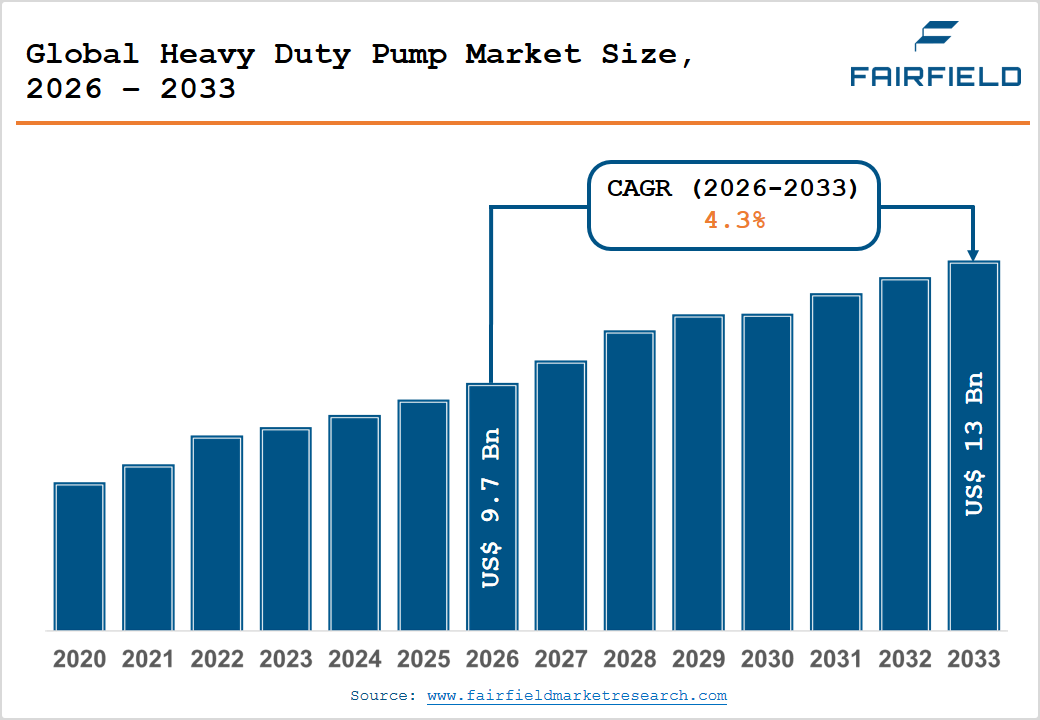
- The global Heavy Duty Pump market size is likely to be valued at US$ 9.7 Billion in 2026 and is expected to reach US$ 13 Billion by 2033, growing at a CAGR of 4.30% during the forecast period from 2026 to 2033.
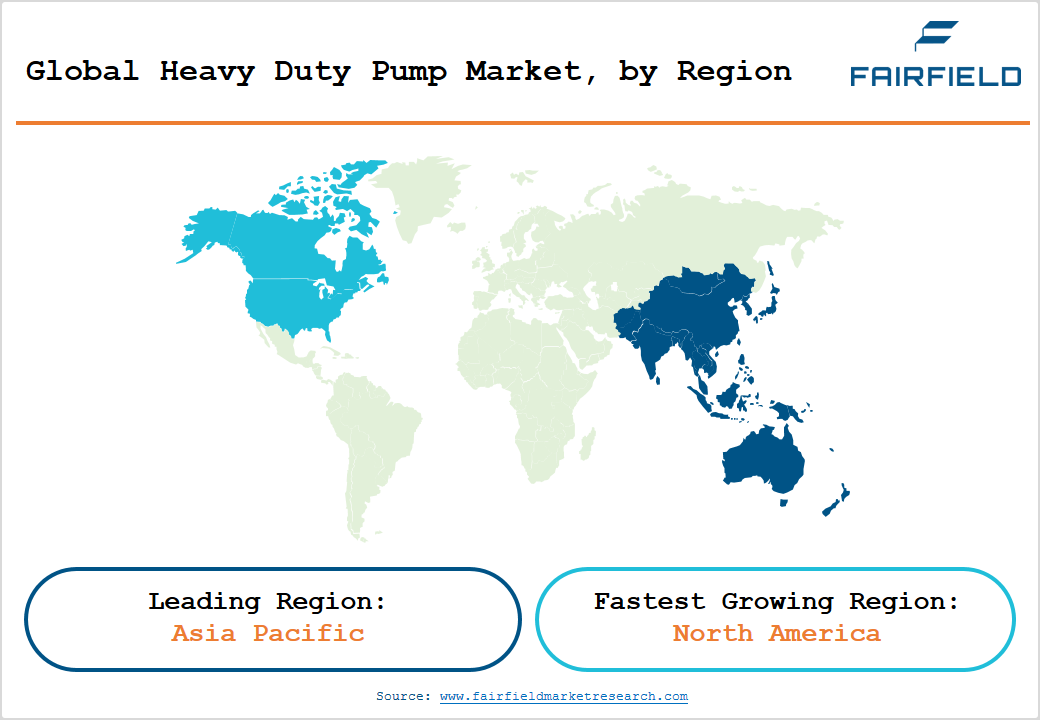
- Leading Region Market: Asia Pacific leads the global Heavy Duty Pump market with approximately 45% revenue share in 2026, supported by massive water infrastructure investments in China and India, and rapid industrial expansion across ASEAN
- Fastest Growing Region Market: North America is the fastest growing region for heavy duty pumps, driven by the US Infrastructure Investment and Jobs Act's US$ 55 billion water infrastructure allocation and accelerating replacement of aging municipal pumping systems.
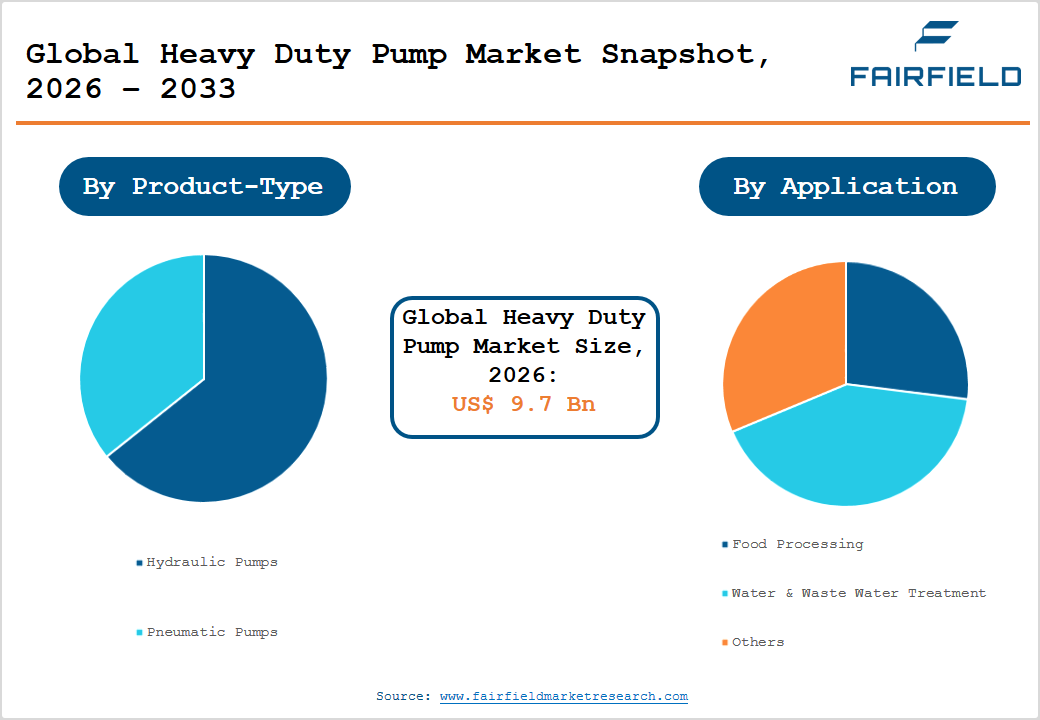
- Dominant Segment: Hydraulic Pumps dominate the product type segment with approximately 65% market share in 2026, driven by superior high-pressure performance and widespread deployment in water treatment, oil and gas, and industrial fluid management applications.
- Leading Application Segment: Water & Wastewater Treatment accounts for approximately 48% share in 2026 of application-level demand, propelled by global regulatory compliance mandates and rising water stress affecting over 2 billion people
- Key Market Opportunity: Integration of IIoT and smart monitoring in heavy duty pumps offers a transformational opportunity, enabling predictive maintenance that reduces unplanned downtime by 30-45% and cutting energy costs in infrastructure-intensive water and industrial end markets.
Market Dynamics
Market Growth Drivers
- Surging Global Infrastructure Development and Water Treatment Investments
Global public investments in water and sanitation infrastructure have witnessed a significant upswing, directly bolstering demand for heavy duty pumps. The World Bank allocated over US$ 28 billion toward water supply and sanitation projects in developing nations between 2020 and 2024, supporting large-scale pump deployments across municipal water systems. In the United States, The Infrastructure Investment and Jobs Act of 2021 allocated significant funding specifically for enhancing clean water infrastructure, Similarly, the European Union's Cohesion Fund and Structural Funds have directed billions toward water management upgrades across member states. These programs are creating robust demand for hydraulic and pneumatic heavy duty pumps used in water intake, distribution, and treatment processes. The consistent pipeline of government-backed projects ensures a durable, long-term demand trajectory for heavy duty pump manufacturers worldwide.
- Rapid Expansion of the Global Food and Beverage Processing Industry
The global food and beverage processing industry represents a critical demand source for heavy duty pumps, particularly for fluid transfer, ingredient mixing, and hygienic pumping applications. According to the Food and Agriculture Organization (FAO) of the United Nations, global food production must increase by approximately 70% by 2050 to meet the nutritional demands of a growing world population projected to reach 9.7 billion. This has spurred significant capacity expansion investments among food processors worldwide. The global food processing market exceeded US$ 3 trillion in 2023, with accelerating capacity additions across Asia Pacific, Latin America, and North America. Heavy duty pumps meeting FDA and EHEDG (European Hygienic Engineering & Design Group) standards are witnessing accelerated adoption across dairy, beverage, and confectionery processing plants, reinforcing this segment's contribution to overall market expansion.
Market Restraints
- High Capital Investment and Lifecycle Maintenance Costs
Heavy duty pumps, particularly hydraulic variants designed for high-pressure industrial applications, require substantial upfront capital expenditure. Premium centrifugal and positive displacement pumps used in water treatment and chemical processing can cost between US$ 10,000 and US$ 500,000 per unit depending on specifications, limiting adoption among small and medium-sized enterprises. Additionally, maintenance costs including seal replacements, impeller refurbishments, and bearing overhauls can account for 15-25% of a pump's total lifecycle cost, according to the Hydraulic Institute. These financial barriers are particularly pronounced in price-sensitive developing economies, where budget constraints frequently delay necessary infrastructure upgrades and slow the replacement of aging pump systems, thereby impeding market penetration in critical growth regions.
- Volatility in Raw Material Prices Impacting Profit Margins
Heavy duty pumps are manufactured using industrial materials including cast iron, stainless steel, duplex steel, and specialized alloys, all of which are subject to significant price volatility in global commodity markets. London Metal Exchange (LME) data indicates that stainless steel and nickel prices experienced fluctuations exceeding 30% between 2021 and 2024 owing to supply chain disruptions and geopolitical tensions. These fluctuations directly inflate the bill of materials for pump manufacturers, compressing profit margins and complicating long-term contract pricing. Manufacturers with limited hedging capabilities or those reliant on spot procurement are particularly vulnerable to input cost pressures, making operational planning and financial forecasting increasingly challenging across the industry.
Market Opportunities
- Growing Adoption of Smart Pump Technologies and IIoT Integration
The integration of Industrial Internet of Things (IIoT) technologies and smart monitoring capabilities into heavy duty pumping systems presents a transformative growth opportunity for market participants. According to the International Energy Agency (IEA), pumps and pumping systems account for approximately 20% of global industrial electricity consumption, making energy efficiency optimization a strategic priority. Smart pumps embedded with real-time vibration sensors, flow meters, and condition monitoring systems enable predictive maintenance, reducing unplanned downtime by up to 30-45%, as documented in analyses published by leading industrial consultancies. Leading manufacturers including Grundfos Holding A/S and Xylem Inc. have already commercialized smart pump platforms. Increasing adoption of Industry 4.0 frameworks in manufacturing and water utilities is expected to significantly accelerate demand for IoT-enabled heavy duty pump solutions through 2033, opening substantial new revenue streams for innovation-focused manufacturers.
- Water Infrastructure Expansion in Emerging Economies Driving New Demand
Emerging economies across Asia, Africa, and Latin America are increasingly investing in water supply, irrigation, and wastewater management infrastructure, creating compelling growth opportunities for heavy duty pump manufacturers. The African Development Bank (AfDB) has committed over US$ 12 billion toward water and sanitation programs across Africa through 2030, aimed at achieving UN Sustainable Development Goal 6 on Clean Water and Sanitation. In India, the government's Jal Jeevan Mission with an allocated budget of approximately US$ 43 billion aims to provide piped water connections to all rural households, necessitating large-scale deployment of pumps across thousands of water treatment and distribution installations. Additionally, Saudi Arabia's Vision 2030 includes significant investments in desalination and water recycling facilities, representing substantial procurement opportunities for heavy duty pump suppliers across the value chain.
Segmental Insights
- Product Type Analysis
The Hydraulic Pumps segment accounts for the dominant share of the Heavy Duty Pump market, commanding approximately 65% of total revenue in 2026. This dominance is attributable to the wide-ranging industrial utility of hydraulic pumps across sectors such as oil and gas, water treatment, construction, and mining. Hydraulic pumps offer superior pressure handling capabilities commonly rated between 100 bar and over 1,000 bar making them the preferred choice for heavy industrial fluid transfer applications. According to the Hydraulic Institute, hydraulic pumping systems represent the most widely deployed fluid management technology in industrial plants globally. Continuous innovation, including the development of variable speed drive (VSD)-integrated hydraulic pump units, is further enhancing their economic attractiveness. The strong alignment of hydraulic pumps with expanding municipal water infrastructure requirements continues to reinforce segment leadership through the forecast period.
- Application Analysis
The Water & Wastewater Treatment segment holds the largest share in the Heavy Duty Pump market by application, representing approximately 48% Share in 2026. This leadership is driven by expanding global investment in water infrastructure, with the Global Water Intelligence (GWI) estimating global water and wastewater capital expenditure exceeding US$ 130 billion annually. Pumps used in water treatment plants require high reliability under continuous operation at varying flow and pressure conditions, making heavy duty pumps an essential system component. Increasing government mandates around wastewater treatment compliance such as the EU Urban Wastewater Treatment Directive and equivalent regulations across North America and Asia Pacific are compelling municipalities and industries to upgrade aging pumping infrastructure. The rising incidence of water stress, affecting over 2 billion people globally according to the United Nations, further underpins this segment's sustained leadership position.
Regional Insights
- North America Heavy Duty Pump Market Trends
North America represents the fastest growing regional market for heavy duty pumps, propelled by regulatory mandates, aging infrastructure replacement needs, and significant federal funding commitments. The U.S. Environmental Protection Agency (EPA) estimates that the United States alone requires more than US$ 472 billion in drinking water infrastructure investment over the next 20 years, creating a substantial and durable demand pipeline for heavy duty pumps across municipal utilities and industrial facilities.
The Infrastructure Investment and Jobs Act of 2021 allocated US$ 55 billion specifically for water infrastructure, accelerating procurement of advanced pumping systems. Canada is also investing significantly in water infrastructure modernization under its Investing in Canada Infrastructure Program (ICIP), with notable funding earmarked through 2027-28. The region benefits from a strong innovation ecosystem, with companies such as Xylem Inc., ITT Inc., Flowserve Corporation, and Ingersoll Rand Inc. headquartered here, driving research and development in smart pump technologies and energy-efficient pumping solutions for municipal and industrial applications.
- Europe Heavy Duty Pump Market Trends
Europe represents a mature yet steadily evolving heavy duty pump market, shaped by stringent environmental regulations and large-scale infrastructure modernization programs. Germany, as Europe's largest industrial economy, is a significant consumer of heavy duty pumps across chemical processing, food and beverage, and water management sectors. The country's National Water Strategy 2023 underscores investment in water resilience infrastructure. The UK's Water Services Regulation Authority (Ofwat) mandated water companies to invest over £14 billion in infrastructure improvements under the 2020-2025 Asset Management Period (AMP7).
France and Spain are advancing water management upgrades under the EU Water Framework Directive. The EU Industrial Emissions Directive (IED) is compelling industries to adopt energy-efficient pump technologies to reduce industrial carbon footprints. Wilo SE and KSB SE & Co. KGaA, both headquartered in Germany, continue to be pivotal innovators in the European market, offering high-efficiency, regulatory-compliant pump solutions that are setting performance benchmarks across industrial and municipal water management applications in the region.
- Asia Pacific Heavy Duty Pump Market Trends
Asia Pacific stands as the leading regional market, holding approximately 45% of global heavy duty pump revenue in 2026, driven by rapid industrialization and strong government investments. China remains the largest country-level contributor, underpinned by its massive water infrastructure programs including the South-North Water Transfer Project, one of the world's largest hydraulic engineering initiatives. The Ministry of Water Resources of China increased water project investment to over CNY 1 trillion (approximately US$ 140 billion) in 2023 alone.
India's expanding urban water supply networks, industrial corridors, and food processing zones are generating sustained pump demand. Japan and South Korea continue to invest in energy-efficient pump replacements as part of industrial decarbonization strategies. ASEAN nations, particularly Vietnam, Indonesia, and Thailand, are rapidly scaling up water treatment and irrigation infrastructure, further broadening the regional demand base. The manufacturing cost advantages and growing domestic pump industry in Asia Pacific are also facilitating competitive supply to global markets.
Competitive Landscape
Market Structure Analysis
The global Heavy Duty Pump market exhibits a moderately consolidated competitive structure, with a handful of multinational corporations commanding significant market shares alongside a broad base of regional and specialty players. Flowserve Corporation, Grundfos Holding A/S, Xylem Inc., KSB SE & Co. KGaA, and Sulzer Ltd collectively represent a dominant share of global revenues. Leading companies are actively pursuing product portfolio expansion through R&D investment in energy-efficient and smart pump technologies, geographic diversification into high-growth emerging markets, and strategic mergers and acquisitions. A notable trend is the shift toward service contracts, pump-as-a-service (PaaS) business models, and long-term performance guarantees. Key competitive differentiators include application-specific engineering capabilities, digital integration certifications, and deep domain expertise in critical industries such as oil and gas, water utilities, and food processing.
Key Market Developments
- January 2025: Xylem Inc. announced the expansion of its smart pump portfolio with the launch of a next-generation IoT-enabled water management platform for municipal utilities across North America and Europe, enhancing remote monitoring and predictive maintenance capabilities.
- March 2024: Grundfos Holding A/S unveiled its upgraded iSOLUTIONS platform integrating advanced AI-driven pump optimization algorithms designed to reduce energy consumption by up to 30% in large-scale water treatment plant installations globally.
- September 2023: Flowserve Corporation completed the acquisition of a specialized industrial pump manufacturer, strengthening its market position in high-pressure hydraulic pump segments serving oil and gas and chemical processing end markets.
Companies Covered in Heavy Duty Pump Market
- Flowserve Corporation
- Grundfos Holding A/S
- KSB SE & Co. KGaA
- Sulzer Ltd
- Xylem Inc.
- The Weir Group PLC
- ITT Inc.
- Ebara Corporation
- Wilo SE
- Ingersoll Rand Inc.
- Gardner Denver Holdings, Inc.
- Alfa Laval AB
- Baker Hughes Company
- Metso Corporation
- Kirloskar Brothers Limited
- Dover Corporation
- Gorman-Rupp Company
- IDEX Corporation
- Verder Group
- SPX FLOW Inc.
Market Segmentation
By Product Type
- Hydraulic Pumps
- Pneumatic Pumps
By Application
- Food Processing
- Water & Wastewater Treatment
- Others
By Region
- North America
- Europe
- Asia Pacific
- Latin America
- Middle East & Africa
- Executive Summary
- Global Heavy Duty Pump Market Snapshot
- Future Projections
- Key Market Trends
- Regional Snapshot, by Value, 2026
- Analyst Recommendations
- Market Overview
- Market Definitions and Segmentations
- Market Dynamics
- Drivers
- Restraints
- Market Opportunities
- Value Chain Analysis
- COVID-19 Impact Analysis
- Porter's Five Forces Analysis
- Impact of Russia-Ukraine Conflict
- PESTLE Analysis
- Regulatory Analysis
- Price Trend Analysis
- Current Prices and Future Projections, 2025-2033
- Price Impact Factors
- Global Heavy Duty Pump Market Outlook, 2020 - 2033
- Global Heavy Duty Pump Market Outlook, by Product Type, Value (US$ Bn), 2020-2033
- Hydraulic Pumps
- Pneumatic Pumps
- Global Heavy Duty Pump Market Outlook, by Application, Value (US$ Bn), 2020-2033
- Food Processing
- Water & Waste Water Treatment
- Others
- Global Heavy Duty Pump Market Outlook, by Region, Value (US$ Bn), 2020-2033
- North America
- Europe
- Asia Pacific
- Latin America
- Middle East & Africa
- Global Heavy Duty Pump Market Outlook, by Product Type, Value (US$ Bn), 2020-2033
- North America Heavy Duty Pump Market Outlook, 2020 - 2033
- North America Heavy Duty Pump Market Outlook, by Product Type, Value (US$ Bn), 2020-2033
- Hydraulic Pumps
- Pneumatic Pumps
- North America Heavy Duty Pump Market Outlook, by Application, Value (US$ Bn), 2020-2033
- Food Processing
- Water & Waste Water Treatment
- Others
- North America Heavy Duty Pump Market Outlook, by Country, Value (US$ Bn), 2020-2033
- S. Heavy Duty Pump Market Outlook, by Product Type, 2020-2033
- S. Heavy Duty Pump Market Outlook, by Application, 2020-2033
- Canada Heavy Duty Pump Market Outlook, by Product Type, 2020-2033
- Canada Heavy Duty Pump Market Outlook, by Application, 2020-2033
- BPS Analysis/Market Attractiveness Analysis
- North America Heavy Duty Pump Market Outlook, by Product Type, Value (US$ Bn), 2020-2033
- Europe Heavy Duty Pump Market Outlook, 2020 - 2033
- Europe Heavy Duty Pump Market Outlook, by Product Type, Value (US$ Bn), 2020-2033
- Hydraulic Pumps
- Pneumatic Pumps
- Europe Heavy Duty Pump Market Outlook, by Application, Value (US$ Bn), 2020-2033
- Food Processing
- Water & Waste Water Treatment
- Others
- Europe Heavy Duty Pump Market Outlook, by Country, Value (US$ Bn), 2020-2033
- Germany Heavy Duty Pump Market Outlook, by Product Type, 2020-2033
- Germany Heavy Duty Pump Market Outlook, by Application, 2020-2033
- Italy Heavy Duty Pump Market Outlook, by Product Type, 2020-2033
- Italy Heavy Duty Pump Market Outlook, by Application, 2020-2033
- France Heavy Duty Pump Market Outlook, by Product Type, 2020-2033
- France Heavy Duty Pump Market Outlook, by Application, 2020-2033
- K. Heavy Duty Pump Market Outlook, by Product Type, 2020-2033
- K. Heavy Duty Pump Market Outlook, by Application, 2020-2033
- Spain Heavy Duty Pump Market Outlook, by Product Type, 2020-2033
- Spain Heavy Duty Pump Market Outlook, by Application, 2020-2033
- Russia Heavy Duty Pump Market Outlook, by Product Type, 2020-2033
- Russia Heavy Duty Pump Market Outlook, by Application, 2020-2033
- Rest of Europe Heavy Duty Pump Market Outlook, by Product Type, 2020-2033
- Rest of Europe Heavy Duty Pump Market Outlook, by Application, 2020-2033
- BPS Analysis/Market Attractiveness Analysis
- Europe Heavy Duty Pump Market Outlook, by Product Type, Value (US$ Bn), 2020-2033
- Asia Pacific Heavy Duty Pump Market Outlook, 2020 - 2033
- Asia Pacific Heavy Duty Pump Market Outlook, by Product Type, Value (US$ Bn), 2020-2033
- Hydraulic Pumps
- Pneumatic Pumps
- Asia Pacific Heavy Duty Pump Market Outlook, by Application, Value (US$ Bn), 2020-2033
- Food Processing
- Water & Waste Water Treatment
- Others
- Asia Pacific Heavy Duty Pump Market Outlook, by Country, Value (US$ Bn), 2020-2033
- China Heavy Duty Pump Market Outlook, by Product Type, 2020-2033
- China Heavy Duty Pump Market Outlook, by Application, 2020-2033
- Japan Heavy Duty Pump Market Outlook, by Product Type, 2020-2033
- Japan Heavy Duty Pump Market Outlook, by Application, 2020-2033
- South Korea Heavy Duty Pump Market Outlook, by Product Type, 2020-2033
- South Korea Heavy Duty Pump Market Outlook, by Application, 2020-2033
- India Heavy Duty Pump Market Outlook, by Product Type, 2020-2033
- India Heavy Duty Pump Market Outlook, by Application, 2020-2033
- Southeast Asia Heavy Duty Pump Market Outlook, by Product Type, 2020-2033
- Southeast Asia Heavy Duty Pump Market Outlook, by Application, 2020-2033
- Rest of SAO Heavy Duty Pump Market Outlook, by Product Type, 2020-2033
- Rest of SAO Heavy Duty Pump Market Outlook, by Application, 2020-2033
- BPS Analysis/Market Attractiveness Analysis
- Asia Pacific Heavy Duty Pump Market Outlook, by Product Type, Value (US$ Bn), 2020-2033
- Latin America Heavy Duty Pump Market Outlook, 2020 - 2033
- Latin America Heavy Duty Pump Market Outlook, by Product Type, Value (US$ Bn), 2020-2033
- Hydraulic Pumps
- Pneumatic Pumps
- Latin America Heavy Duty Pump Market Outlook, by Application, Value (US$ Bn), 2020-2033
- Food Processing
- Water & Waste Water Treatment
- Others
- Latin America Heavy Duty Pump Market Outlook, by Country, Value (US$ Bn), 2020-2033
- Brazil Heavy Duty Pump Market Outlook, by Product Type, 2020-2033
- Brazil Heavy Duty Pump Market Outlook, by Application, 2020-2033
- Mexico Heavy Duty Pump Market Outlook, by Product Type, 2020-2033
- Mexico Heavy Duty Pump Market Outlook, by Application, 2020-2033
- Argentina Heavy Duty Pump Market Outlook, by Product Type, 2020-2033
- Argentina Heavy Duty Pump Market Outlook, by Application, 2020-2033
- Rest of LATAM Heavy Duty Pump Market Outlook, by Product Type, 2020-2033
- Rest of LATAM Heavy Duty Pump Market Outlook, by Application, 2020-2033
- BPS Analysis/Market Attractiveness Analysis
- Latin America Heavy Duty Pump Market Outlook, by Product Type, Value (US$ Bn), 2020-2033
- Middle East & Africa Heavy Duty Pump Market Outlook, 2020 - 2033
- Middle East & Africa Heavy Duty Pump Market Outlook, by Product Type, Value (US$ Bn), 2020-2033
- Hydraulic Pumps
- Pneumatic Pumps
- Middle East & Africa Heavy Duty Pump Market Outlook, by Application, Value (US$ Bn), 2020-2033
- Food Processing
- Water & Waste Water Treatment
- Others
- Middle East & Africa Heavy Duty Pump Market Outlook, by Country, Value (US$ Bn), 2020-2033
- GCC Heavy Duty Pump Market Outlook, by Product Type, 2020-2033
- GCC Heavy Duty Pump Market Outlook, by Application, 2020-2033
- South Africa Heavy Duty Pump Market Outlook, by Product Type, 2020-2033
- South Africa Heavy Duty Pump Market Outlook, by Application, 2020-2033
- Egypt Heavy Duty Pump Market Outlook, by Product Type, 2020-2033
- Egypt Heavy Duty Pump Market Outlook, by Application, 2020-2033
- Nigeria Heavy Duty Pump Market Outlook, by Product Type, 2020-2033
- Nigeria Heavy Duty Pump Market Outlook, by Application, 2020-2033
- Rest of Middle East Heavy Duty Pump Market Outlook, by Product Type, 2020-2033
- Rest of Middle East Heavy Duty Pump Market Outlook, by Application, 2020-2033
- BPS Analysis/Market Attractiveness Analysis
- Middle East & Africa Heavy Duty Pump Market Outlook, by Product Type, Value (US$ Bn), 2020-2033
- Competitive Landscape
- Company Vs Segment Heatmap
- Company Market Share Analysis, 2025
- Competitive Dashboard
- Company Profiles
- Flowserve Corporation
- Company Overview
- Product Portfolio
- Financial Overview
- Business Strategies and Developments
- Grundfos Holding A/S
- KSB SE & Co. KGaA
- Sulzer Ltd
- Xylem Inc.
- The Weir Group PLC
- ITT Inc.
- Ebara Corporation
- Wilo SE
- Ingersoll Rand Inc.
- Gardner Denver Holdings, Inc.
- Alfa Laval AB
- Baker Hughes Company
- Metso Corporation
- Kirloskar Brothers Limited
- Flowserve Corporation
- Appendix
- Research Methodology
- Report Assumptions
- Acronyms and Abbreviations
|
BASE YEAR |
HISTORICAL DATA |
FORECAST PERIOD |
UNITS |
|||
 |
2025 |
 |
2019 - 2024 |
 |
2026 - 2033 |
Value: US$ Million |
|
REPORT FEATURES |
DETAILS |
|
By Product-Type Coverage |
|
|
By Application Coverage |
|
|
Geographical Coverage |
|
|
Leading Companies |
|
|
Report Highlights |
Key Market Indicators, Macro-micro economic impact analysis, Technological Roadmap, Key Trends, Driver, Restraints, and Future Opportunities & Revenue Pockets, Porter’s 5 Forces Analysis, Historical Trend (2019-2024), Market Estimates and Forecast, Market Dynamics, Industry Trends, Competition Landscape, Category, Region, Country-wise Trends & Analysis, COVID-19 Impact Analysis (Demand and Supply Chain) |
Our Research Methodology
Considering the volatility of business today, traditional approaches to strategizing a game plan can be unfruitful if not detrimental. True ambiguity is no way to determine a forecast. A myriad of predetermined factors must be accounted for such as the degree of risk involved, the magnitude of circumstances, as well as conditions or consequences that are not known or unpredictable. To circumvent binary views that cast uncertainty, the application of market research intelligence to strategically posture, move, and enable actionable outcomes is necessary.
View Methodology
Quality Assured
Rigorous Validation Process

Confidentiality Assured
End-to-end Data Security

Custom Research Services
Tailored To Your Objectives
FAQs
The Heavy Duty Pump market size is US$ 9.7 Billion in 2026.
The Heavy Duty Pump market is projected to grow at a CAGR of 4.30% by 2033.
The Heavy Duty Pump market growth drivers include rising water infrastructure investments, expanding food processing industry, and increasing industrialization.
Asia Pacific is the dominating region for the Heavy Duty Pump market.
Flowserve Corporation, Grundfos Holding A/S, Xylem Inc., KSB SE & Co. KGaA, and Sulzer Ltd are some leading industry players in the Heavy Duty Pump market.
Related Reports
Precision Engineering Machines Market Insights, Competitive Landscape, and Market Forecast 2033
Precision Engineering Machines Market to reach US$45.38 Bn by 2033, driven by automation, semiconductor expansion, and aerospace demand.
Machine Automation Controller Market Insights, Competitive Landscape, and Market Forecast 2033
Machine Automation Controller Market to reach US$77.17 Bn by 2033, growing at 10.2% CAGR, driven by smart manufacturing, and edge AI adoption.
Global HVAC Market Insights, Competitive Landscape, and Market Forecast 2033
HVAC Market to reach US$446.62 Bn by 2033, growing at 7.5% CAGR, driven by energy codes, electrification, smart HVAC, and retrofit demand.
CNC Milling Machines Market Insights, Competitive Landscape, and Market Forecast 2033
CNC Milling Machines Market to reach US$134.86 Bn by 2033, growing at 7.9% CAGR, driven by reshoring, aerospace, EVs, and automation.
Artificial Lift Systems Market Insights, Competitive Landscape, and Market Forecast 2026–2033
Artificial Lift Systems Market to reach US$39.77 billion by 2033, growing at 5.8% CAGR, driven by mature oil fields and advanced lift technologies.
HVAC Maintenance Services Market Insights, Competitive Landscape, and Market Forecast 2033
HVAC Maintenance Services Market is projected to reach US$143.60 billion by 2033, driven by energy efficiency, predictive maintenance, and data centers.