



Human Organoids Market
Human Organoids Market Insights, Competitive Landscape, and Market Forecast - 2033
Global Human Organoids Market Forecast
- The Human Organoids Market is valued at USD 1.8 Bn in 2026 and is projected to reach USD 3 Bn, growing at a CAGR of 5% by 2033.
Human Organoids Market Insights
Key Growth Determinants
- Rising Adoption in Drug Discovery and Personalized Medicine
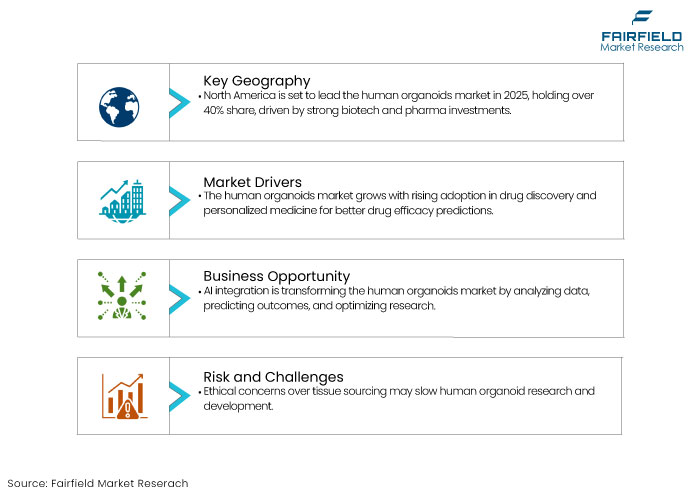
Surging adoption of human organoids in drug discovery and personalized medicine is a key growth driver for the human organoids market. Organoids provide a more accurate representation of human physiology compared to traditional 2D cell cultures or animal models, enabling better predictions of drug efficacy and toxicity.
Pharmaceutical companies and researchers are leveraging organoids to streamline preclinical trials, reducing costs and timelines for drug development. Studies suggest that organoid models can improve drug efficacy prediction rates by up to 80%, compared to the 30 to 40% accuracy of traditional 2D cell cultures.
- Increasing Support from Regulatory Bodies and Funding Agencies
Rising support from regulatory bodies and funding agencies is a critical driver for the human organoids market. Authorities like the FDA and EMA recognize organoids as innovative tools for preclinical studies and encourage their integration into drug development pipelines.
Global research initiatives and government grants provide financial backing for organoid research, especially in areas like cancer and neurological disorders. In the past five years, over US$ 500 Mn in funding has been directed globally to organoid research specific to cancer, emphasizing their use in improving drug discovery and treatment protocols.
Key Growth Barriers
- Ethical Concerns and Lack of Standardization
Despite their advantages, using human organoids raises ethical concerns, particularly around sourcing human-derived tissues and stem cells. These issues can create public and regulatory scrutiny, slowing research and development.
The lack of global standardization in organoid protocols presents another challenge for the human organoids market. Variations in the methodologies used to create organoids result in inconsistent outcomes, limiting their broader application in drug testing and disease modelling.
Human Organoids Market Trends and Opportunities
- Integration of Artificial Intelligence in Organoid Research
The integration of artificial intelligence (AI) is emerging as a transformative trend in the human organoids market. AI-powered tools are being increasingly used to analyze huge datasets generated from organoid experiments, enabling researchers to identify patterns, predict outcomes, and streamline processes.
AI algorithms can analyze cellular behavior in organoids to predict drug responses or disease progression more accurately. Studies show that AI tools improve accuracy in predicting cellular drug responses by up to 85%, surpassing the performance of conventional manual analyses.
- Rising Applications in Regenerative Medicine
The surging potential of organoids in regenerative medicine presents a significant human organoids market opportunity. Organoids are being explored as building blocks for repairing or replacing damaged tissues and organs, offering hope for patients with chronic diseases or organ failure.
For instance, liver organoids have shown promise in treating liver diseases by providing functional cells for transplantation. Similarly, brain organoids are being studied for repairing neurological damage caused by conditions like stroke or Alzheimer’s disease. The opportunity is further amplified by increasing investments in regenerative medicine research, valued at over US$ 35 Bn in 2023 and projected to rise rapidly.
Segments Covered in the Report
- Liver Models Dominate Amid Potential in Regenerative Medicine
Among the various human organoid models used in biomedical research, liver organoids have emerged as the dominant segment in the human organoids market. Liver models are becoming increasingly popular due to their potential in drug development, toxicity testing, and regenerative medicine.
Liver models closely mimic the functional and structural properties of the human liver, making them invaluable tools for studying liver diseases. One of the primary drivers of the liver model’s dominance is its ability to provide more accurate and reliable data for preclinical drug testing compared to traditional 2D cultures and animal models.
- Pharma-biotech Leads due to Rising Adoption in Preclinical Testing
The pharma-biotech industry is the dominant end user in the global human organoids market, accounting for approximately 45% of the total revenue share. Pharma and biotech companies are increasingly utilizing organoids as unique models for preclinical testing.
Organoids offer more realistic representations of human tissue and disease models than traditional methods. One of the primary reasons the pharma-biotech industry leads the market is its focus on developing targeted therapies and reducing the high failure rates in clinical trials.
Regional Analysis
- North America Dominates Owing to Presence of Biotech Companies
North America is projected to hold the largest share, accounting for over 40% of the global human organoids market in 2025. The region's dominance can be attributed to the strong presence of pharmaceutical and biotech companies, universities, and research institutions that are heavily investing in organoid technology.
The U.S. is home to few of the world's top pharmaceutical giants, which have increasingly adopted organoids for drug discovery, toxicity testing, and personalized medicine. Government agencies like the FDA and NIH support innovations in human organoids, providing research grants and regulatory frameworks to accelerate developments. North America's leading market position is also driven by its surging healthcare needs, with organoids offering solutions for complex diseases such as cancer, liver disease, and neurodegenerative disorders.
- Europe Follows Backed by Surging Investments in Novel Therapies
Europe holds the second-largest human organoids market share, with countries like Germany, France, and the U.K. making significant strides in research studies. The region’s strong emphasis on regenerative medicine, biotech innovation, and ethical research practices has propelled the demand for human organoids.
The European Union (EU) has also been a key player in funding cutting-edge research. Its projects mainly focus on organoid-based therapies for various diseases, including cystic fibrosis, Alzheimer’s, and liver failure. Europe’s commitment to reducing animal testing and improving drug efficacy has led to a rise in the adoption of organoid technologies.
Fairfield’s Competitive Landscape Analysis
The human organoids market is witnessing significant competition as leading players focus on innovation to gain a competitive edge. Key companies are bolstering research and development to enhance organoid models for drug discovery, disease modelling, and personalized medicine.
Strategic partnerships, mergers, and acquisitions are common as companies strive to broaden their portfolios and market reach. Emerging start-ups also contribute with niche technologies and solutions, intensifying the competition.
Key Market Companies
- BioIVT
- ZenBio
- Thermo Fisher Scientific
- CELLINK
- Biopredic International
- Hurel Corporation
- Emulate
- Kerafast
- InSphero
- MIMETAS
- Cyprio
- Corning
- Kirkstall
Recent Industry Developments
- In August 2024, BioIVT signed an acquisition deal with ZenBio, to produce an enhanced array of skin-related expertise, primary cell and exosome isolation, and blood products for the pharmaceutical and cosmetics sectors.
- In July 2024, Merck KGaA introduced the commencement of its first GMP-compliant cell culture media (CCM) manufacturing line.
Global Human Organoids Market is Segmented as-
By Product
- Pancreas
- Kidney
- Lung
- Liver Models
- GIT
By Usability
- Ready-to-use
- Customized
By Application
- Pathology
- Toxicity
- Personalized & Regenerative Drugs
By End User
- Academia
- Pharma-biotech
- CROs
By Region
- North America
- Europe
- Asia Pacific
- Latin America
- Middle East & Africa
- Executive Summary
- Global Human Organoids Market Snapshot
- Future Projections
- Key Market Trends
- Regional Snapshot, by Value, 2026
- Analyst Recommendations
- Market Overview
- Market Definitions and Segmentations
- Market Dynamics
- Drivers
- Restraints
- Market Opportunities
- Value Chain Analysis
- COVID-19 Impact Analysis
- Porter's Five Forces Analysis
- Impact of Russia-Ukraine Conflict
- PESTLE Analysis
- Regulatory Analysis
- Price Trend Analysis
- Current Prices and Future Projections, 2025-2033
- Price Impact Factors
- Global Human Organoids Market Outlook, 2020 - 2033
- Global Human Organoids Market Outlook, by Product, Value (US$ Mn), 2020-2033
- Pancreas
- Kidney
- Lung
- Liver Models
- GIT
- Global Human Organoids Market Outlook, by Usability, Value (US$ Mn), 2020-2033
- Ready-to-use
- Customized
- Global Human Organoids Market Outlook, by Application, Value (US$ Mn), 2020-2033
- Pathology
- Toxicity
- Personalized & Regenerative Drugs
- Global Human Organoids Market Outlook, by End User, Value (US$ Mn), 2020-2033
- Academia
- Pharma-biotech
- CROs
- Global Human Organoids Market Outlook, by Region, Value (US$ Mn), 2020-2033
- North America
- Europe
- Asia Pacific
- Latin America
- Middle East & Africa
- Global Human Organoids Market Outlook, by Product, Value (US$ Mn), 2020-2033
- North America Human Organoids Market Outlook, 2020 - 2033
- North America Human Organoids Market Outlook, by Product, Value (US$ Mn), 2020-2033
- Pancreas
- Kidney
- Lung
- Liver Models
- GIT
- North America Human Organoids Market Outlook, by Usability, Value (US$ Mn), 2020-2033
- Ready-to-use
- Customized
- North America Human Organoids Market Outlook, by Application, Value (US$ Mn), 2020-2033
- Pathology
- Toxicity
- Personalized & Regenerative Drugs
- North America Human Organoids Market Outlook, by End User, Value (US$ Mn), 2020-2033
- Academia
- Pharma-biotech
- CROs
- North America Human Organoids Market Outlook, by Country, Value (US$ Mn), 2020-2033
- S. Human Organoids Market Outlook, by Product, 2020-2033
- S. Human Organoids Market Outlook, by Usability, 2020-2033
- S. Human Organoids Market Outlook, by Application, 2020-2033
- S. Human Organoids Market Outlook, by End User, 2020-2033
- Canada Human Organoids Market Outlook, by Product, 2020-2033
- Canada Human Organoids Market Outlook, by Usability, 2020-2033
- Canada Human Organoids Market Outlook, by Application, 2020-2033
- Canada Human Organoids Market Outlook, by End User, 2020-2033
- BPS Analysis/Market Attractiveness Analysis
- North America Human Organoids Market Outlook, by Product, Value (US$ Mn), 2020-2033
- Europe Human Organoids Market Outlook, 2020 - 2033
- Europe Human Organoids Market Outlook, by Product, Value (US$ Mn), 2020-2033
- Pancreas
- Kidney
- Lung
- Liver Models
- GIT
- Europe Human Organoids Market Outlook, by Usability, Value (US$ Mn), 2020-2033
- Ready-to-use
- Customized
- Europe Human Organoids Market Outlook, by Application, Value (US$ Mn), 2020-2033
- Pathology
- Toxicity
- Personalized & Regenerative Drugs
- Europe Human Organoids Market Outlook, by End User, Value (US$ Mn), 2020-2033
- Academia
- Pharma-biotech
- CROs
- Europe Human Organoids Market Outlook, by Country, Value (US$ Mn), 2020-2033
- Germany Human Organoids Market Outlook, by Product, 2020-2033
- Germany Human Organoids Market Outlook, by Usability, 2020-2033
- Germany Human Organoids Market Outlook, by Application, 2020-2033
- Germany Human Organoids Market Outlook, by End User, 2020-2033
- Italy Human Organoids Market Outlook, by Product, 2020-2033
- Italy Human Organoids Market Outlook, by Usability, 2020-2033
- Italy Human Organoids Market Outlook, by Application, 2020-2033
- Italy Human Organoids Market Outlook, by End User, 2020-2033
- France Human Organoids Market Outlook, by Product, 2020-2033
- France Human Organoids Market Outlook, by Usability, 2020-2033
- France Human Organoids Market Outlook, by Application, 2020-2033
- France Human Organoids Market Outlook, by End User, 2020-2033
- K. Human Organoids Market Outlook, by Product, 2020-2033
- K. Human Organoids Market Outlook, by Usability, 2020-2033
- K. Human Organoids Market Outlook, by Application, 2020-2033
- K. Human Organoids Market Outlook, by End User, 2020-2033
- Spain Human Organoids Market Outlook, by Product, 2020-2033
- Spain Human Organoids Market Outlook, by Usability, 2020-2033
- Spain Human Organoids Market Outlook, by Application, 2020-2033
- Spain Human Organoids Market Outlook, by End User, 2020-2033
- Russia Human Organoids Market Outlook, by Product, 2020-2033
- Russia Human Organoids Market Outlook, by Usability, 2020-2033
- Russia Human Organoids Market Outlook, by Application, 2020-2033
- Russia Human Organoids Market Outlook, by End User, 2020-2033
- Rest of Europe Human Organoids Market Outlook, by Product, 2020-2033
- Rest of Europe Human Organoids Market Outlook, by Usability, 2020-2033
- Rest of Europe Human Organoids Market Outlook, by Application, 2020-2033
- Rest of Europe Human Organoids Market Outlook, by End User, 2020-2033
- BPS Analysis/Market Attractiveness Analysis
- Europe Human Organoids Market Outlook, by Product, Value (US$ Mn), 2020-2033
- Asia Pacific Human Organoids Market Outlook, 2020 - 2033
- Asia Pacific Human Organoids Market Outlook, by Product, Value (US$ Mn), 2020-2033
- Pancreas
- Kidney
- Lung
- Liver Models
- GIT
- Asia Pacific Human Organoids Market Outlook, by Usability, Value (US$ Mn), 2020-2033
- Ready-to-use
- Customized
- Asia Pacific Human Organoids Market Outlook, by Application, Value (US$ Mn), 2020-2033
- Pathology
- Toxicity
- Personalized & Regenerative Drugs
- Asia Pacific Human Organoids Market Outlook, by End User, Value (US$ Mn), 2020-2033
- Academia
- Pharma-biotech
- CROs
- Asia Pacific Human Organoids Market Outlook, by Country, Value (US$ Mn), 2020-2033
- China Human Organoids Market Outlook, by Product, 2020-2033
- China Human Organoids Market Outlook, by Usability, 2020-2033
- China Human Organoids Market Outlook, by Application, 2020-2033
- China Human Organoids Market Outlook, by End User, 2020-2033
- Japan Human Organoids Market Outlook, by Product, 2020-2033
- Japan Human Organoids Market Outlook, by Usability, 2020-2033
- Japan Human Organoids Market Outlook, by Application, 2020-2033
- Japan Human Organoids Market Outlook, by End User, 2020-2033
- South Korea Human Organoids Market Outlook, by Product, 2020-2033
- South Korea Human Organoids Market Outlook, by Usability, 2020-2033
- South Korea Human Organoids Market Outlook, by Application, 2020-2033
- South Korea Human Organoids Market Outlook, by End User, 2020-2033
- India Human Organoids Market Outlook, by Product, 2020-2033
- India Human Organoids Market Outlook, by Usability, 2020-2033
- India Human Organoids Market Outlook, by Application, 2020-2033
- India Human Organoids Market Outlook, by End User, 2020-2033
- Southeast Asia Human Organoids Market Outlook, by Product, 2020-2033
- Southeast Asia Human Organoids Market Outlook, by Usability, 2020-2033
- Southeast Asia Human Organoids Market Outlook, by Application, 2020-2033
- Southeast Asia Human Organoids Market Outlook, by End User, 2020-2033
- Rest of SAO Human Organoids Market Outlook, by Product, 2020-2033
- Rest of SAO Human Organoids Market Outlook, by Usability, 2020-2033
- Rest of SAO Human Organoids Market Outlook, by Application, 2020-2033
- Rest of SAO Human Organoids Market Outlook, by End User, 2020-2033
- BPS Analysis/Market Attractiveness Analysis
- Asia Pacific Human Organoids Market Outlook, by Product, Value (US$ Mn), 2020-2033
- Latin America Human Organoids Market Outlook, 2020 - 2033
- Latin America Human Organoids Market Outlook, by Product, Value (US$ Mn), 2020-2033
- Pancreas
- Kidney
- Lung
- Liver Models
- GIT
- Latin America Human Organoids Market Outlook, by Usability, Value (US$ Mn), 2020-2033
- Ready-to-use
- Customized
- Latin America Human Organoids Market Outlook, by Application, Value (US$ Mn), 2020-2033
- Pathology
- Toxicity
- Personalized & Regenerative Drugs
- Latin America Human Organoids Market Outlook, by End User, Value (US$ Mn), 2020-2033
- Academia
- Pharma-biotech
- CROs
- Latin America Human Organoids Market Outlook, by Country, Value (US$ Mn), 2020-2033
- Brazil Human Organoids Market Outlook, by Product, 2020-2033
- Brazil Human Organoids Market Outlook, by Usability, 2020-2033
- Brazil Human Organoids Market Outlook, by Application, 2020-2033
- Brazil Human Organoids Market Outlook, by End User, 2020-2033
- Mexico Human Organoids Market Outlook, by Product, 2020-2033
- Mexico Human Organoids Market Outlook, by Usability, 2020-2033
- Mexico Human Organoids Market Outlook, by Application, 2020-2033
- Mexico Human Organoids Market Outlook, by End User, 2020-2033
- Argentina Human Organoids Market Outlook, by Product, 2020-2033
- Argentina Human Organoids Market Outlook, by Usability, 2020-2033
- Argentina Human Organoids Market Outlook, by Application, 2020-2033
- Argentina Human Organoids Market Outlook, by End User, 2020-2033
- Rest of LATAM Human Organoids Market Outlook, by Product, 2020-2033
- Rest of LATAM Human Organoids Market Outlook, by Usability, 2020-2033
- Rest of LATAM Human Organoids Market Outlook, by Application, 2020-2033
- Rest of LATAM Human Organoids Market Outlook, by End User, 2020-2033
- BPS Analysis/Market Attractiveness Analysis
- Latin America Human Organoids Market Outlook, by Product, Value (US$ Mn), 2020-2033
- Middle East & Africa Human Organoids Market Outlook, 2020 - 2033
- Middle East & Africa Human Organoids Market Outlook, by Product, Value (US$ Mn), 2020-2033
- Pancreas
- Kidney
- Lung
- Liver Models
- GIT
- Middle East & Africa Human Organoids Market Outlook, by Usability, Value (US$ Mn), 2020-2033
- Ready-to-use
- Customized
- Middle East & Africa Human Organoids Market Outlook, by Application, Value (US$ Mn), 2020-2033
- Pathology
- Toxicity
- Personalized & Regenerative Drugs
- Middle East & Africa Human Organoids Market Outlook, by End User, Value (US$ Mn), 2020-2033
- Academia
- Pharma-biotech
- CROs
- Middle East & Africa Human Organoids Market Outlook, by Country, Value (US$ Mn), 2020-2033
- GCC Human Organoids Market Outlook, by Product, 2020-2033
- GCC Human Organoids Market Outlook, by Usability, 2020-2033
- GCC Human Organoids Market Outlook, by Application, 2020-2033
- GCC Human Organoids Market Outlook, by End User, 2020-2033
- South Africa Human Organoids Market Outlook, by Product, 2020-2033
- South Africa Human Organoids Market Outlook, by Usability, 2020-2033
- South Africa Human Organoids Market Outlook, by Application, 2020-2033
- South Africa Human Organoids Market Outlook, by End User, 2020-2033
- Egypt Human Organoids Market Outlook, by Product, 2020-2033
- Egypt Human Organoids Market Outlook, by Usability, 2020-2033
- Egypt Human Organoids Market Outlook, by Application, 2020-2033
- Egypt Human Organoids Market Outlook, by End User, 2020-2033
- Nigeria Human Organoids Market Outlook, by Product, 2020-2033
- Nigeria Human Organoids Market Outlook, by Usability, 2020-2033
- Nigeria Human Organoids Market Outlook, by Application, 2020-2033
- Nigeria Human Organoids Market Outlook, by End User, 2020-2033
- Rest of Middle East Human Organoids Market Outlook, by Product, 2020-2033
- Rest of Middle East Human Organoids Market Outlook, by Usability, 2020-2033
- Rest of Middle East Human Organoids Market Outlook, by Application, 2020-2033
- Rest of Middle East Human Organoids Market Outlook, by End User, 2020-2033
- BPS Analysis/Market Attractiveness Analysis
- Middle East & Africa Human Organoids Market Outlook, by Product, Value (US$ Mn), 2020-2033
- Competitive Landscape
- Company Vs Segment Heatmap
- Company Market Share Analysis, 2025
- Competitive Dashboard
- Company Profiles
- BioIVT
- Company Overview
- Product Portfolio
- Financial Overview
- Business Strategies and Developments
- ZenBio
- Thermo Fisher Scientific
- CELLINK
- Biopredic International
- Hurel Corporation
- Emulate
- Kerafast
- InSphero
- MIMETAS
- BioIVT
- Appendix
- Research Methodology
- Report Assumptions
- Acronyms and Abbreviations
|
BASE YEAR |
HISTORICAL DATA |
FORECAST PERIOD |
UNITS |
|||
 |
2025 |
 |
2019 - 2024 |
 |
2026 - 2033 |
Value: US$ Billion |
|
REPORT FEATURES |
DETAILS |
|
Product Coverage |
|
|
Usability Coverage |
|
|
Application Coverage |
|
|
End User Coverage |
|
|
Geographical Coverage |
|
|
Leading Companies |
|
|
Report Highlights |
Key Market Indicators, Macro-micro economic impact analysis, Technological Roadmap, Key Trends, Driver, Restraints, and Future Opportunities & Revenue Pockets, Porter’s 5 Forces Analysis, Historical Trend (2019-2023), Market Estimates and Forecast, Market Dynamics, Industry Trends, Competition Landscape, Category, Region, Country-wise Trends & Analysis, COVID-19 Impact Analysis (Demand and Supply Chain) |
Our Research Methodology
Considering the volatility of business today, traditional approaches to strategizing a game plan can be unfruitful if not detrimental. True ambiguity is no way to determine a forecast. A myriad of predetermined factors must be accounted for such as the degree of risk involved, the magnitude of circumstances, as well as conditions or consequences that are not known or unpredictable. To circumvent binary views that cast uncertainty, the application of market research intelligence to strategically posture, move, and enable actionable outcomes is necessary.
View Methodology
Quality Assured
Rigorous Validation Process

Confidentiality Assured
End-to-end Data Security

Custom Research Services
Tailored To Your Objectives
FAQs
The human organoids market size is USD 1.8 Bn in 2026.
The human organoids market is projected to grow at a CAGR of 5% by 2033.
The human organoids market growth drivers include rising adoption in drug discovery, increasing use in personalized medicine, and expanding applications in regenerative medicine.
North America is a dominating region for the human organoids market.
Thermo Fisher Scientific, Corning, Emulate, InSphero, and MIMETAS are some leading industry players in the human organoids market.
Related Reports
Genetically Modified Feed Insights, Competitive Landscape, and Market Forecast 2026 to 2033
Genetically Modified Feed Market is valued at US$38.4 billion in 2026 and projected to reach US$54.4 billion by 2033, growing at a 5.1% CAGR.
Enzyme Engineering Insights, Competitive Landscape, and Market Forecast 2026 to 2033
The global Enzyme Engineering Market is projected to grow from US$3.2 billion in 2026 to US$5.7 billion by 2033, expanding at a CAGR of 8.6%.
Enzymatic RNA Manufacturing Market Insights, Competitive Landscape, and Market Forecast - 2033
The enzymatic RNA manufacturing market, valued at USD 1.10 billion in 2026 and projected to reach USD 4.32 billion by 2033, at a 21.6% CAGR
Nephrology Drugs Market Insights, Competitive Landscape, and Market Forecast 2033
The nephrology drugs market is forecast to grow from USD 24.50 billion in 2026 to USD 40.39 billion by 2033, driven by novel disease-modifying treatments.
Active Pharmaceutical Ingredients Market Insights, Competitive Landscape, and Market Forecast 2033
Dementia Care Market Analysis Market Insights, Competitive Landscape, and Market Forecast 2033
Dementia Care Market to reach US$46.60 Mn by 2033, growing at 5.9% CAGR, driven by ageing populations, home care, and specialized dementia services.