



Identity and Access Management Market
Identity Access Management Market Insights, Competitive Landscape, and Market Forecast - 2033
Identity and Access Management Market Outlook
The Identity Access Management Market is expected to grow from USD 27.8 billion in 2026 to USD 57.4 billion by 2033, reflecting strong industry expansion and registering a CAGR of 10.9% during the forecast period from 2026 to 2033.
Growing Ubiquity of Security Breaches, and Rising Prevalence of Identity Frauds Create Tailwinds for Identity and Access Management Market
According to the Federal Trade Commission (FTC), identity fraud instances grew by 45 percent in 2020, resulting in significant financial losses, and this trend continued in 2021, resulting in a total loss of US$56 Bn for North America, according to Javelin Strategy. The FTC estimates that over one million minors were the victims of ID theft in 2020, with losses increasing from US$1.8 Bn in 2019 to US$3.3 Bn in 2020. According to Javelin Strategy's 2020 research on identity fraud, 40% of account takeovers occurred within 24 hours of a criminal gaining access to a victim's account. These figures show that cyberattacks, particularly identity-related frauds, have been on the rise in recent years. Identity and access management market has thus been witnessing strong growth. According to industry experts, there was a minor decrease in ID theft instances in 2019, but this trend was reversed in 2020 and 2021, owing to the pandemic's effects.
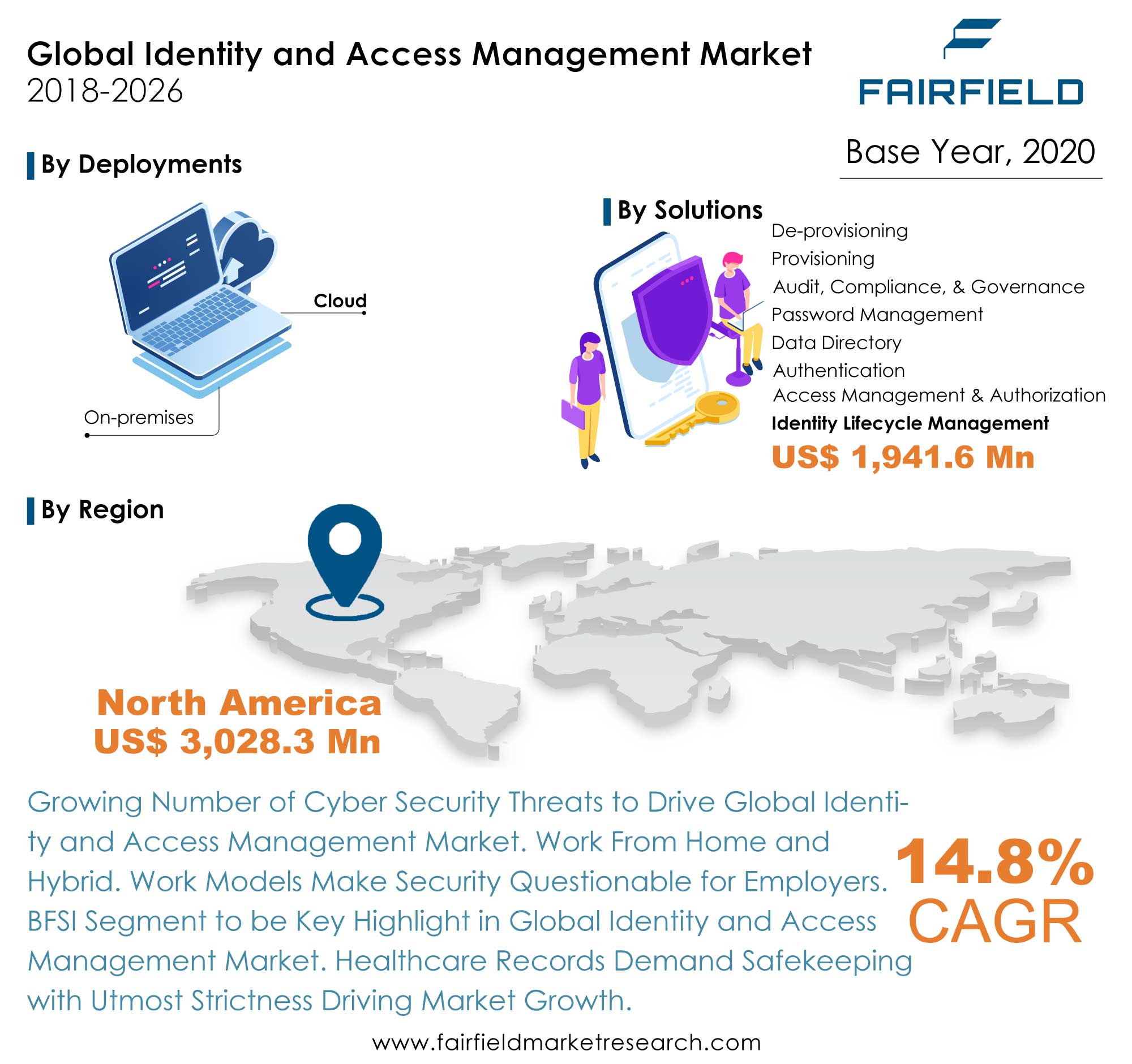
The rise in cyberattacks can be linked to technology like machine learning (ML), which allows attackers to build many copies of malicious malware every day. The data being uploaded to the web is becoming increasingly exposed as the globe continues its journey toward digitization. The personal information of each individual consumer is stored on hundreds of servers throughout the world, increasing the risk of identity theft. Companies' reputations are being harmed, their assets are being harmed, and financial losses are being incurred as a result of the constant introduction of new cyberattacks. Hence, safeguarding against cyberthreats has become essential for enterprises’ business growth, which prompts the growth of identity and access management market.
Inadequacy of Capable Cybersecurity Professionals Among Enterprises Continues to Challenge Identity and Access Management Market
Organizations do not spend enough on their security infrastructure due to a lack of awareness of modern cyber threats, resulting in enormous losses. Furthermore, businesses with critical cybersecurity needs have reported a severe shortage of competent personnel, making them even more vulnerable to cyberattacks. The cybersecurity shortfall has intensified as the world approaches 2022, again pointing toward the rising scope of growth for identity and access management market. According to eSecurityPlanet, the demand for competent cybersecurity specialists in the United States alone was at 435,000 in January 2022, up from around 314,000 in 2019.
The shift to remote work in response to the COVID-19 epidemic raised workloads for trained IT professionals, which, when combined with the rising prevalence of ransomware attacks, led to burnout among many security professionals. Recruiters and government officials are scrambling to find answers to the skills gap as the demand for experienced cybersecurity workers grows. Additionally, as the number of dispersed cloud-based applications grows, users will be able to access essential business applications from any location, at any time, and on any device. This will in turn create an incessant opportunity for identity and access management market. On the other hand, the complexity of managing user identities have increased as a result of these widespread cloud-based apps. Customers are increasingly downloading several programs to take advantage of the services provided by enterprises; as a result, they are finding it difficult to remember passwords for multiple applications.
North America’s Primacy Intact in Global Identity and Access Management Market
North America is the most affected region in the world in terms of cybersecurity incidents; North America dominates the global cybersecurity market and is regarded the most advanced region in terms of cyber technology adoption and infrastructure. The identity and access management market in APAC is the fastest growing. Many of the region's emerging economies, such as India, China, Singapore, and Japan, are concerned about cybersecurity. These countries have a considerable number of small and medium-sized businesses (SMEs), which employ more than 70% of the population. The requirement of high investments acts as a barrier for SMEs to adopt major IAM projects on their premises; however, factors such as increasing internet usage, compliance regulation, and adoption of smartphones are the major factors fueling the growth of identity and access management market.
key Players:
• Amazon Web Services, Inc.
• Broadcom
• One Identity LLC.
• ForgeRock
• HID Global Corp.
• IBM Corporation
• McAfee, LLC
• Microsoft
• Okta
• OneLogin
The Global Identity and Access Management Market is Segmented as Below:
By Component
• Audit, Compliance & Governance
• Directory Service
• Multifactor Authentication
• Provisioning
• Password Management
• Single Sign-On
By Deployment
• On-premises
• Cloud
• Hybrid
By End Use
• BFSI
• Energy, Oil & Gas
• Telecom & IT
• Education
• Healthcare
• Public Sector & Utilities
• Manufacturing
• Others
By Regional
• North America
• Europe
• Asia Pacific
• Latin America
• Middle East & Africa
- Executive Summary
1.1. Global Identity Access Management Market Snapshot
1.2. Future Projections
1.3. Key Market Trends
1.4. Regional Snapshot, by Value, 2026
1.5. Analyst Recommendations
2. Market Overview
2.1. Market Definitions and Segmentations
2.2. Market Dynamics
2.2.1. Drivers
2.2.2. Restraints
2.2.3. Market Opportunities
2.3. Value Chain Analysis
2.4. COVID-19 Impact Analysis
2.5. Porter's Five Forces Analysis
2.6. Impact of Russia-Ukraine Conflict
2.7. PESTLE Analysis
2.8. Regulatory Analysis
2.9. Price Trend Analysis
2.9.1. Current Prices and Future Projections, 2025-2033
2.9.2. Price Impact Factors
3. Global Identity Access Management Market Outlook, 2020 - 2033
3.1. Global Identity Access Management Market Outlook, by Component, Value (US$ Bn), 2020-2033
3.1.1. Audit, Compliance & Governance
3.1.2. Directory Service
3.1.3. Multifactor Authentication
3.1.4. Provisioning
3.1.5. Password Management
3.2. Global Identity Access Management Market Outlook, by Deployment, Value (US$ Bn), 2020-2033
3.2.1. On-premises
3.2.2. Cloud
3.2.3. Hybrid
3.3. Global Identity Access Management Market Outlook, by End Use, Value (US$ Bn), 2020-2033
3.3.1. BFSI
3.3.2. Energy, Oil & Gas
3.3.3. Telecom & IT
3.3.4. Education
3.3.5. Healthcare
3.3.6. Manufacturing
3.3.7. Others
3.4. Global Identity Access Management Market Outlook, by Region, Value (US$ Bn), 2020-2033
3.4.1. North America
3.4.2. Europe
3.4.3. Asia Pacific
3.4.4. Latin America
3.4.5. Middle East & Africa
4. North America Identity Access Management Market Outlook, 2020 - 2033
4.1. North America Identity Access Management Market Outlook, by Component, Value (US$ Bn), 2020-2033
4.1.1. Audit, Compliance & Governance
4.1.2. Directory Service
4.1.3. Multifactor Authentication
4.1.4. Provisioning
4.1.5. Password Management
4.2. North America Identity Access Management Market Outlook, by Deployment, Value (US$ Bn), 2020-2033
4.2.1. On-premises
4.2.2. Cloud
4.2.3. Hybrid
4.3. North America Identity Access Management Market Outlook, by End Use, Value (US$ Bn), 2020-2033
4.3.1. BFSI
4.3.2. Energy, Oil & Gas
4.3.3. Telecom & IT
4.3.4. Education
4.3.5. Healthcare
4.3.6. Manufacturing
4.3.7. Others
4.4. North America Identity Access Management Market Outlook, by Country, Value (US$ Bn), 2020-2033
4.4.1. U.S. Identity Access Management Market Outlook, by Component, 2020-2033
4.4.2. U.S. Identity Access Management Market Outlook, by Deployment, 2020-2033
4.4.3. U.S. Identity Access Management Market Outlook, by End Use, 2020-2033
4.4.4. Canada Identity Access Management Market Outlook, by Component, 2020-2033
4.4.5. Canada Identity Access Management Market Outlook, by Deployment, 2020-2033
4.4.6. Canada Identity Access Management Market Outlook, by End Use, 2020-2033
4.5. BPS Analysis/Market Attractiveness Analysis
5. Europe Identity Access Management Market Outlook, 2020 - 2033
5.1. Europe Identity Access Management Market Outlook, by Component, Value (US$ Bn), 2020-2033
5.1.1. Audit, Compliance & Governance
5.1.2. Directory Service
5.1.3. Multifactor Authentication
5.1.4. Provisioning
5.1.5. Password Management
5.2. Europe Identity Access Management Market Outlook, by Deployment, Value (US$ Bn), 2020-2033
5.2.1. On-premises
5.2.2. Cloud
5.2.3. Hybrid
5.3. Europe Identity Access Management Market Outlook, by End Use, Value (US$ Bn), 2020-2033
5.3.1. BFSI
5.3.2. Energy, Oil & Gas
5.3.3. Telecom & IT
5.3.4. Education
5.3.5. Healthcare
5.3.6. Manufacturing
5.3.7. Others
5.4. Europe Identity Access Management Market Outlook, by Country, Value (US$ Bn), 2020-2033
5.4.1. Germany Identity Access Management Market Outlook, by Component, 2020-2033
5.4.2. Germany Identity Access Management Market Outlook, by Deployment, 2020-2033
5.4.3. Germany Identity Access Management Market Outlook, by End Use, 2020-2033
5.4.4. Italy Identity Access Management Market Outlook, by Component, 2020-2033
5.4.5. Italy Identity Access Management Market Outlook, by Deployment, 2020-2033
5.4.6. Italy Identity Access Management Market Outlook, by End Use, 2020-2033
5.4.7. France Identity Access Management Market Outlook, by Component, 2020-2033
5.4.8. France Identity Access Management Market Outlook, by Deployment, 2020-2033
5.4.9. France Identity Access Management Market Outlook, by End Use, 2020-2033
5.4.10. U.K. Identity Access Management Market Outlook, by Component, 2020-2033
5.4.11. U.K. Identity Access Management Market Outlook, by Deployment, 2020-2033
5.4.12. U.K. Identity Access Management Market Outlook, by End Use, 2020-2033
5.4.13. Spain Identity Access Management Market Outlook, by Component, 2020-2033
5.4.14. Spain Identity Access Management Market Outlook, by Deployment, 2020-2033
5.4.15. Spain Identity Access Management Market Outlook, by End Use, 2020-2033
5.4.16. Russia Identity Access Management Market Outlook, by Component, 2020-2033
5.4.17. Russia Identity Access Management Market Outlook, by Deployment, 2020-2033
5.4.18. Russia Identity Access Management Market Outlook, by End Use, 2020-2033
5.4.19. Rest of Europe Identity Access Management Market Outlook, by Component, 2020-2033
5.4.20. Rest of Europe Identity Access Management Market Outlook, by Deployment, 2020-2033
5.4.21. Rest of Europe Identity Access Management Market Outlook, by End Use, 2020-2033
5.5. BPS Analysis/Market Attractiveness Analysis
6. Asia Pacific Identity Access Management Market Outlook, 2020 - 2033
6.1. Asia Pacific Identity Access Management Market Outlook, by Component, Value (US$ Bn), 2020-2033
6.1.1. Audit, Compliance & Governance
6.1.2. Directory Service
6.1.3. Multifactor Authentication
6.1.4. Provisioning
6.1.5. Password Management
6.2. Asia Pacific Identity Access Management Market Outlook, by Deployment, Value (US$ Bn), 2020-2033
6.2.1. On-premises
6.2.2. Cloud
6.2.3. Hybrid
6.3. Asia Pacific Identity Access Management Market Outlook, by End Use, Value (US$ Bn), 2020-2033
6.3.1. BFSI
6.3.2. Energy, Oil & Gas
6.3.3. Telecom & IT
6.3.4. Education
6.3.5. Healthcare
6.3.6. Manufacturing
6.3.7. Others
6.4. Asia Pacific Identity Access Management Market Outlook, by Country, Value (US$ Bn), 2020-2033
6.4.1. China Identity Access Management Market Outlook, by Component, 2020-2033
6.4.2. China Identity Access Management Market Outlook, by Deployment, 2020-2033
6.4.3. China Identity Access Management Market Outlook, by End Use, 2020-2033
6.4.4. Japan Identity Access Management Market Outlook, by Component, 2020-2033
6.4.5. Japan Identity Access Management Market Outlook, by Deployment, 2020-2033
6.4.6. Japan Identity Access Management Market Outlook, by End Use, 2020-2033
6.4.7. South Korea Identity Access Management Market Outlook, by Component, 2020-2033
6.4.8. South Korea Identity Access Management Market Outlook, by Deployment, 2020-2033
6.4.9. South Korea Identity Access Management Market Outlook, by End Use, 2020-2033
6.4.10. India Identity Access Management Market Outlook, by Component, 2020-2033
6.4.11. India Identity Access Management Market Outlook, by Deployment, 2020-2033
6.4.12. India Identity Access Management Market Outlook, by End Use, 2020-2033
6.4.13. Southeast Asia Identity Access Management Market Outlook, by Component, 2020-2033
6.4.14. Southeast Asia Identity Access Management Market Outlook, by Deployment, 2020-2033
6.4.15. Southeast Asia Identity Access Management Market Outlook, by End Use, 2020-2033
6.4.16. Rest of SAO Identity Access Management Market Outlook, by Component, 2020-2033
6.4.17. Rest of SAO Identity Access Management Market Outlook, by Deployment, 2020-2033
6.4.18. Rest of SAO Identity Access Management Market Outlook, by End Use, 2020-2033
6.5. BPS Analysis/Market Attractiveness Analysis
7. Latin America Identity Access Management Market Outlook, 2020 - 2033
7.1. Latin America Identity Access Management Market Outlook, by Component, Value (US$ Bn), 2020-2033
7.1.1. Audit, Compliance & Governance
7.1.2. Directory Service
7.1.3. Multifactor Authentication
7.1.4. Provisioning
7.1.5. Password Management
7.2. Latin America Identity Access Management Market Outlook, by Deployment, Value (US$ Bn), 2020-2033
7.2.1. On-premises
7.2.2. Cloud
7.2.3. Hybrid
7.3. Latin America Identity Access Management Market Outlook, by End Use, Value (US$ Bn), 2020-2033
7.3.1. BFSI
7.3.2. Energy, Oil & Gas
7.3.3. Telecom & IT
7.3.4. Education
7.3.5. Healthcare
7.3.6. Manufacturing
7.3.7. Others
7.4. Latin America Identity Access Management Market Outlook, by Country, Value (US$ Bn), 2020-2033
7.4.1. Brazil Identity Access Management Market Outlook, by Component, 2020-2033
7.4.2. Brazil Identity Access Management Market Outlook, by Deployment, 2020-2033
7.4.3. Brazil Identity Access Management Market Outlook, by End Use, 2020-2033
7.4.4. Mexico Identity Access Management Market Outlook, by Component, 2020-2033
7.4.5. Mexico Identity Access Management Market Outlook, by Deployment, 2020-2033
7.4.6. Mexico Identity Access Management Market Outlook, by End Use, 2020-2033
7.4.7. Argentina Identity Access Management Market Outlook, by Component, 2020-2033
7.4.8. Argentina Identity Access Management Market Outlook, by Deployment, 2020-2033
7.4.9. Argentina Identity Access Management Market Outlook, by End Use, 2020-2033
7.4.10. Rest of LATAM Identity Access Management Market Outlook, by Component, 2020-2033
7.4.11. Rest of LATAM Identity Access Management Market Outlook, by Deployment, 2020-2033
7.4.12. Rest of LATAM Identity Access Management Market Outlook, by End Use, 2020-2033
7.5. BPS Analysis/Market Attractiveness Analysis
8. Middle East & Africa Identity Access Management Market Outlook, 2020 - 2033
8.1. Middle East & Africa Identity Access Management Market Outlook, by Component, Value (US$ Bn), 2020-2033
8.1.1. Audit, Compliance & Governance
8.1.2. Directory Service
8.1.3. Multifactor Authentication
8.1.4. Provisioning
8.1.5. Password Management
8.2. Middle East & Africa Identity Access Management Market Outlook, by Deployment, Value (US$ Bn), 2020-2033
8.2.1. On-premises
8.2.2. Cloud
8.2.3. Hybrid
8.3. Middle East & Africa Identity Access Management Market Outlook, by End Use, Value (US$ Bn), 2020-2033
8.3.1. BFSI
8.3.2. Energy, Oil & Gas
8.3.3. Telecom & IT
8.3.4. Education
8.3.5. Healthcare
8.3.6. Manufacturing
8.3.7. Others
8.4. Middle East & Africa Identity Access Management Market Outlook, by Country, Value (US$ Bn), 2020-2033
8.4.1. GCC Identity Access Management Market Outlook, by Component, 2020-2033
8.4.2. GCC Identity Access Management Market Outlook, by Deployment, 2020-2033
8.4.3. GCC Identity Access Management Market Outlook, by End Use, 2020-2033
8.4.4. South Africa Identity Access Management Market Outlook, by Component, 2020-2033
8.4.5. South Africa Identity Access Management Market Outlook, by Deployment, 2020-2033
8.4.6. South Africa Identity Access Management Market Outlook, by End Use, 2020-2033
8.4.7. Egypt Identity Access Management Market Outlook, by Component, 2020-2033
8.4.8. Egypt Identity Access Management Market Outlook, by Deployment, 2020-2033
8.4.9. Egypt Identity Access Management Market Outlook, by End Use, 2020-2033
8.4.10. Nigeria Identity Access Management Market Outlook, by Component, 2020-2033
8.4.11. Nigeria Identity Access Management Market Outlook, by Deployment, 2020-2033
8.4.12. Nigeria Identity Access Management Market Outlook, by End Use, 2020-2033
8.4.13. Rest of Middle East Identity Access Management Market Outlook, by Component, 2020-2033
8.4.14. Rest of Middle East Identity Access Management Market Outlook, by Deployment, 2020-2033
8.4.15. Rest of Middle East Identity Access Management Market Outlook, by End Use, 2020-2033
8.5. BPS Analysis/Market Attractiveness Analysis
9. Competitive Landscape
9.1. Company Vs Segment Heatmap
9.2. Company Market Share Analysis, 2025
9.3. Competitive Dashboard
9.4. Company Profiles
9.4.1. Amazon Web Services, Inc.
9.4.1.1. Company Overview
9.4.1.2. Product Portfolio
9.4.1.3. Financial Overview
9.4.1.4. Business Strategies and Developments
9.4.2. Broadcom
9.4.3. One Identity LLC.
9.4.4. ForgeRock
9.4.5. HID Global Corp.
9.4.6. IBM Corporation
9.4.7. McAfee, LLC
9.4.8. Microsoft
9.4.9. Okta
9.4.10. OneLogin
10. Appendix
10.1. Research Methodology
10.2. Report Assumptions
10.3. Acronyms and Abbreviations
|
BASE YEAR |
HISTORICAL DATA |
FORECAST PERIOD |
UNITS |
|||
 |
2025 |
 |
2020 - 2025 |
 |
2026 - 2033 |
Value: US$ Million |
Our Research Methodology
Considering the volatility of business today, traditional approaches to strategizing a game plan can be unfruitful if not detrimental. True ambiguity is no way to determine a forecast. A myriad of predetermined factors must be accounted for such as the degree of risk involved, the magnitude of circumstances, as well as conditions or consequences that are not known or unpredictable. To circumvent binary views that cast uncertainty, the application of market research intelligence to strategically posture, move, and enable actionable outcomes is necessary.
View Methodology
Quality Assured
Rigorous Validation Process

Confidentiality Assured
End-to-end Data Security

Custom Research Services
Tailored To Your Objectives
FAQs
Global identity and access management market is expected to reach US$ 27.8 bn by 2026.
North America is the largest region for identity and access management market. The region is expected to register a value CAGR of 14.2% by 2026.
The global identity and access management market is divided into five regions:- North America, Latin America, Europe, APAC and the Middle East associated Countries. Further divided the region into key countries.
Growing number of cyber security threats, work from home and hybrid work models, and booming BFSI segment are some of the key factors driving the IAM market.
Microsoft Corporation, Sailpoint Technologies, Inc., Oracle Corporation, DELL, IBM, HITACHI, CA Technologies, Okta, Centrify Corp, and Micro Focus are some of the key players in the identity and access management market.
Related Reports
Power Quality Meter Insights, Competitive Landscape, and Market Forecast - 2033
Power Quality Meter Market is valued at USD 1.45 Billion in 2026 and projected to reach USD 2.39 Billion by 2033, growing at a 7.4% CAGR.
Rich Communication Services Market Insights, Competitive Landscape, and Market Forecast - 2033
Rich Communication Services (RCS) Market to reach USD 36.19 Bn by 2033, growing at 19.5% CAGR from USD 10.40 Bn in 2026 as adoption rises rapidly worldwide
Environmental Sensors Market Research Report Insights, Competitive Landscape, and Market Forecast 2033
The environmental sensors market is valued at USD 2.65 billion in 2026 and is projected to reach USD 5.03 billion by 2033, expanding at a CAGR of 9.6% during 2033
Motor Driver IC Market Insights, Competitive Landscape, and Market Forecast 2033
Motor Driver IC Market to grow from USD 5.20 Billion in 2026 to USD 9.15 Billion by 2033, expanding at an 8.4% CAGR during the forecast period.
Machine Safety Market Insights, Competitive Landscape, and Market Forecast 2033
Machine Safety Market to reach US$12.21 Bn by 2033, growing at 8.5% CAGR, driven by safety regulations, and demand for safer industrial systems.
Embedded System Market Insights, Competitive Landscape, and Market Forecast 2026–2033
Embedded System Market is projected to reach US$208.57 Bn by 2033, driven by AI-enabled systems, vehicle electrification, and advanced electronics.