



Memory Chip Market
Memory Chip Market Insights, Competitive Landscape, and Market Forecast - 2033
Global Memory Chip Market Forecast
The Memory Chip Market is expected to grow from USD 623.5 Billion in 2026 to USD 1007.8 Billion by 2033, reflecting strong industry expansion and registering a CAGR of 7.1% during the forecast period from 2026 to 2033.
Quick Report Digest
A Look Back and a Look Forward - Comparative Analysis
The market for memory chips has grown in popularity due to the growing need for memory and storage components in vehicle safety systems and next-generation connected autos. Since the systems use semiconductor memory to store digital data, semiconductor memory is necessary for every device with a processor or controller.
The market witnessed staggered growth during the historical period 2018 – 2022. Furthermore, the demand for semiconductor-based memory devices is driven by the growing number of data centres built, and the need for semiconductor memory is driven by colocation and hyperscale data centres, particularly in industrialised nations, to manage and store massive volumes of corporate data.
Developing smaller, more efficient, higher-capacity memory chips and ongoing advancements will propel the memory chip industry. Memory chips with higher performance and storage capacities may be produced due to manufacturing processes and miniaturisation innovation. The market is growing due to the smaller chips' uses in various devices, including data centres and smartphones. Furthermore, new non-volatile memory technologies and 3D stacking are reshaping the memory chip market.
Key Growth Determinants
- Rapid Increase in Mobile Devices and Data Usage in Recent Years
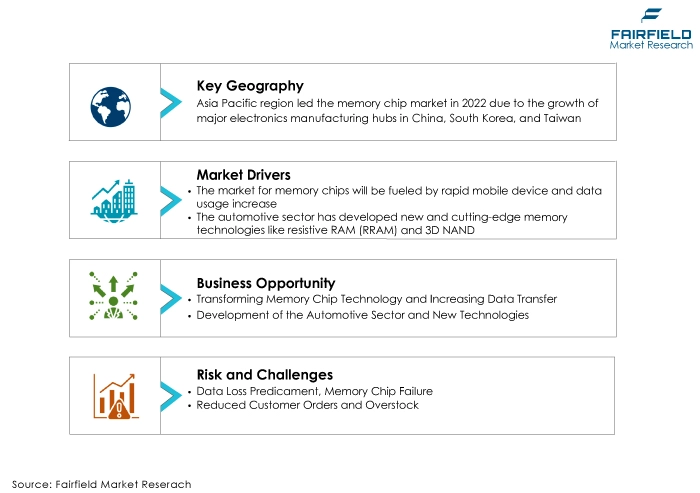
The market for memory chips will be driven by growing data consumption and increasing penetration of mobile, tablet, and other electronics. The growing demand for memory chips to store data is caused by a surge in the production and consumption of digital information, fueled by the sales of electronic devices like smartphones and tablets.
In November 2022, 73% of people aged ten and over are expected to have access to a smartphone, which is 7% more than the percentage of the population that currently uses the Internet, according to the International Telecommunication Union, a United Nations department based in Switzerland that oversees a wide range of issues, including communication and information technology. It is anticipated that as smartphones become more commonplace, the need to store data will also grow.
- The Massive Consumer Electronics Wave
In the upcoming years, the market for memory chips is anticipated to increase rapidly due to the widespread use of consumer devices like laptops, and tablets. Consumer electronics, sometimes called domestic appliances, are electrical devices designed for everyday use by individuals who live in their own houses.
The three main purposes of these devices are productivity, entertainment, and communication. In consumer electronics, memory chips are used to process and store data. The demand for memory chips is being fueled by the requirement for modern consumer electronics products to have larger storage capacities, and better processing speeds.
- Improvements in Memory Chips
The market for memory chips is anticipated to be driven by ongoing technological advancements and the creation of memory chips that are more compact, efficient, and have larger capacities. Memory chips with higher storage capacities and improved performance may now be produced thanks to miniaturisation and cutting-edge manufacturing processes.
The market is growing because smaller chips are used in more products, like data centres and smartphones. Developments like 3D stacking and other non-volatile memory technologies are also shaping the landscape of memory chips.
Major Growth Barriers
- Data Loss Predicament, and Memory Chip Failure
The market for memory chips is growing more slowly due to memory chip corruption. Data on the memory card is lost as a result of memory chip corruption. Memory card corruption is often caused by unexpected power surges, formatting, virus attacks, and too quickly removing the memory card from any device.
Furthermore, taking pictures with limited battery life or shooting and erasing files quickly after the card is full might cause memory card corruption, ultimately resulting in losing the data saved on the chip. As a result, the possibility of data loss due to memory chip corruption inhibits market expansion.
- Reduced Customer Orders, and Overstock
The memory chip business is severely constrained by an abundance of chips piled high in warehouses, a decline in customer orders, and a significant drop in product prices. Due to the difficulties, this is the most difficult time in the memory chip industry's history. As a result, big memory chip makers have experienced severe financial losses, which exacerbates the problem of excess inventory and draws attention to the stark lack of demand in the market.
Key Trends and Opportunities to Look for
Major technological advancements in memory chip development are being made by companies in the industry, which is driving up demand for memory chips. Researchers are developing memory chips that can store and process data to speed up computers, and decrease the time and energy needed to transfer data.
Samsung Electronics has announced the mass production of fifth-generation V-NAND memory chips, which have the fastest data write speed at 500 microseconds (µs), and quicker data transfer. This generation's read time has been drastically shortened to 50µs, while the write speed has increased by 30%. The market is expanding due to technological advancements that minimise the energy and time required for data transfer.
- Unprecedented Developments in Automotive Sector
- Cutting-edge Memory Technologies Like RRAM, and 3D NAND
The need for memory-intensive applications and the development of new technologies fuel the memory chip market's global expansion. The advancement of memory chip technology has resulted in a notable revolution in the automotive sector.
Non-volatile memory chips have proven essential for maintaining data integrity during power outages and improving car performance. Despite physical space limitations, high-density memory chips enable connected and autonomous vehicles to manage massive volumes of data efficiently.
The competitive dynamics are becoming more complex due to the emergence of novel memory technologies like resistive RAM (RRAM) and 3D NAND, as companies compete to take the lead in these cutting-edge markets.
Strategic alliances between original equipment manufacturers (OEMs), and end users become increasingly important as the demand for memory chips rises. These alliances allow market participants to customise their solutions to the various needs of the industry better and establish their positions in the always-changing memory chip market.
How Does the Regulatory Scenario Shape this Industry?
The memory chip industry is anticipated to be dynamic in the upcoming years due to shifting market dynamics, technical developments, and changing regulatory environments. Policymakers, business people, and consumers must keep up with these advancements to create a fair, competitive, and long-lasting market for memory chips.
Regulators from several nations, such as the US and EU, are looking into possible anti-competitive behavior by memory chip producers. Export restrictions on specific memory chips may be enforced by governments for strategic or national security purposes.
Trade conflicts between big economies like the US and China can disrupt supply chains and prices. More and more restrictions on the use of resources and the disposal of trash result from growing worries about the environmental impact of semiconductor manufacture.
Fairfield’s Ranking Board
Top Segments
The DRAM segment dominated the market in 2023. The market for memory chips is dominated by dynamic random access memory (DRAM), which is essential to modern computing. DRAM offers quick, volatile storage that is essential for several uses. Scaling down to and beyond the 10 nm process presents issues for DRAM makers as technology develops and demands increased performance and memory density rise. The main challenge is reducing cell capacitance without sacrificing memory density or data retention.
Furthermore, the NAND flash category is projected to experience the fastest market growth. Major players in the memory chip industry are concentrating on cutting-edge technologies like NAND flash technology to serve their current customer base better. An example of a memory chip is NAND flash technology. Compared to standard NAND flash memory, this non-volatile memory technology offers higher storage density and improved performance.
- Smartphone Surges Ahead, Laptop/PC Gears up for Substantial Growth
In 2022, the smartphone category dominated the industry. With their large consumption of DRAM and NAND flash memory chips, smartphones are one of the main drivers of the memory chip business. The capacity of a device to multitask and execute many applications at once is provided by DRAM chips.
At the same time, NAND flash memory stores data such as apps, movies, and images. More memory is required because smartphones with sophisticated cameras, potent processors, and high-resolution screens are becoming increasingly popular.
The laptop/PC category is anticipated to grow substantially throughout the projected period. Laptops mostly use memory chips, specifically NAND flash, for long-term storage, and dynamic random access memory (DRAM) for short-term data storage. The cost, performance, and availability of memory chips greatly impact laptops' features, production costs, and overall performance.
Regional Frontrunners
China, Taiwan, and South Korea Spearhead the Global Primacy of Asia Pacific
Asia Pacific holds the greatest proportion of the memory chip market, with its major electronics manufacturing hubs in China, South Korea, and Taiwan. The nations are major manufacturers of computers, smartphones, and other electronic gadgets, which at the same time is fueling the region's high need for memory chips.
India is quickly becoming a major hub for electronics production worldwide, with Invest India projecting that the sector will generate US$ 300 billion by 2025 and 2026. Government programs like the Production Linked Incentive Programme, which supports local electronics manufacturing, are the main drivers of the rise.
The US Data Centre Industry Boosts North America’s Market for Memory Chips
In recent years, US corporations have fully embraced extreme ultraviolet (EUV) technology, and the country has regained its competitiveness in memory chip manufacturing technology, particularly in DRAM and 3D-NAND. The US Department of Energy estimates that the country has roughly 3 million data centres. The modern computer unit is the data centre.
The key components of safe, contemporary accelerated data centres are DPUs (Data Processing Units), which allow GPUs, CPUs, and DPUs to merge into a single, completely programmable computing unit. According to Nvidia, data centres' primary processor cores might be depleted by up to 30% due to data management. Memory component demand is rising with the growing need for data centres.
Fairfield’s Competitive Landscape Analysis
The fact that there are numerous vendors offering memory chips to both domestic and foreign markets makes the memory chip business extremely competitive. The major vendors are using tactics for mergers and acquisitions and strategic partnerships, among other things, to increase their reach and maintain their competitiveness in the market, suggesting that the market is quite fragmented.
Who are the Leaders in the Global Memory Chip Space?
- Samsung Electronics
- SK Hynix
- Micron Technology
- Kioxia Holdings
- Western Digital
- Intel Corporation
- Nanya Technology
- Winbond Electronics
- Powerchip Technology
- Macronix International
Memory Chip Market Segmentation
By Memory Type
- DRAM
- SRAM
- Flash Memory
- ROM
- Others
By Technology
- Volatile Memory
- Non-Volatile Memory
By Application
- Consumer Electronics
- Automotive
- Industrial
- Telecommunications
- Healthcare
By End User
- OEMs
- Aftermarket
By Region
- North America
- Europe
- Asia Pacific
- Latin America
- Middle East & Africa
- Executive Summary
- Global Memory Chip Market Snapshot
- Future Projections
- Key Market Trends
- Regional Snapshot, by Value, 2026
- Analyst Recommendations
- Market Overview
- Market Definitions and Segmentations
- Market Dynamics
- Drivers
- Restraints
- Market Opportunities
- Value Chain Analysis
- COVID-19 Impact Analysis
- Porter's Five Forces Analysis
- Impact of Russia-Ukraine Conflict
- PESTLE Analysis
- Regulatory Analysis
- Price Trend Analysis
- Current Prices and Future Projections, 2025-2033
- Price Impact Factors
- Global Memory Chip Market Outlook, 2020 - 2033
- Global Memory Chip Market Outlook, by Memory Type, Value (US$ Bn), 2020-2033
- DRAM
- SRAM
- Flash Memory
- ROM
- Others
- Global Memory Chip Market Outlook, by Technology, Value (US$ Bn), 2020-2033
- Volatile Memory
- Non-Volatile Memory
- Global Memory Chip Market Outlook, by Application, Value (US$ Bn), 2020-2033
- Consumer Electronics
- Automotive
- Industrial
- Telecommunications
- Healthcare
- Global Memory Chip Market Outlook, by End User, Value (US$ Bn), 2020-2033
- OEMs
- Aftermarket
- Global Memory Chip Market Outlook, by Region, Value (US$ Bn), 2020-2033
- North America
- Europe
- Asia Pacific
- Latin America
- Middle East & Africa
- Global Memory Chip Market Outlook, by Memory Type, Value (US$ Bn), 2020-2033
- North America Memory Chip Market Outlook, 2020 - 2033
- North America Memory Chip Market Outlook, by Memory Type, Value (US$ Bn), 2020-2033
- DRAM
- SRAM
- Flash Memory
- ROM
- Others
- North America Memory Chip Market Outlook, by Technology, Value (US$ Bn), 2020-2033
- Volatile Memory
- Non-Volatile Memory
- North America Memory Chip Market Outlook, by Application, Value (US$ Bn), 2020-2033
- Consumer Electronics
- Automotive
- Industrial
- Telecommunications
- Healthcare
- North America Memory Chip Market Outlook, by End User, Value (US$ Bn), 2020-2033
- OEMs
- Aftermarket
- North America Memory Chip Market Outlook, by Country, Value (US$ Bn), 2020-2033
- U.S. Memory Chip Market Outlook, by Memory Type, 2020-2033
- U.S. Memory Chip Market Outlook, by Technology, 2020-2033
- U.S. Memory Chip Market Outlook, by Application, 2020-2033
- U.S. Memory Chip Market Outlook, by End User, 2020-2033
- Canada Memory Chip Market Outlook, by Memory Type, 2020-2033
- Canada Memory Chip Market Outlook, by Technology, 2020-2033
- Canada Memory Chip Market Outlook, by Application, 2020-2033
- Canada Memory Chip Market Outlook, by End User, 2020-2033
- BPS Analysis/Market Attractiveness Analysis
- North America Memory Chip Market Outlook, by Memory Type, Value (US$ Bn), 2020-2033
- Europe Memory Chip Market Outlook, 2020 - 2033
- Europe Memory Chip Market Outlook, by Memory Type, Value (US$ Bn), 2020-2033
- DRAM
- SRAM
- Flash Memory
- ROM
- Others
- Europe Memory Chip Market Outlook, by Technology, Value (US$ Bn), 2020-2033
- Volatile Memory
- Non-Volatile Memory
- Europe Memory Chip Market Outlook, by Application, Value (US$ Bn), 2020-2033
- Consumer Electronics
- Automotive
- Industrial
- Telecommunications
- Healthcare
- Europe Memory Chip Market Outlook, by End User, Value (US$ Bn), 2020-2033
- OEMs
- Aftermarket
- Europe Memory Chip Market Outlook, by Country, Value (US$ Bn), 2020-2033
- Germany Memory Chip Market Outlook, by Memory Type, 2020-2033
- Germany Memory Chip Market Outlook, by Technology, 2020-2033
- Germany Memory Chip Market Outlook, by Application, 2020-2033
- Germany Memory Chip Market Outlook, by End User, 2020-2033
- Italy Memory Chip Market Outlook, by Memory Type, 2020-2033
- Italy Memory Chip Market Outlook, by Technology, 2020-2033
- Italy Memory Chip Market Outlook, by Application, 2020-2033
- Italy Memory Chip Market Outlook, by End User, 2020-2033
- France Memory Chip Market Outlook, by Memory Type, 2020-2033
- France Memory Chip Market Outlook, by Technology, 2020-2033
- France Memory Chip Market Outlook, by Application, 2020-2033
- France Memory Chip Market Outlook, by End User, 2020-2033
- U.K. Memory Chip Market Outlook, by Memory Type, 2020-2033
- U.K. Memory Chip Market Outlook, by Technology, 2020-2033
- U.K. Memory Chip Market Outlook, by Application, 2020-2033
- U.K. Memory Chip Market Outlook, by End User, 2020-2033
- Spain Memory Chip Market Outlook, by Memory Type, 2020-2033
- Spain Memory Chip Market Outlook, by Technology, 2020-2033
- Spain Memory Chip Market Outlook, by Application, 2020-2033
- Spain Memory Chip Market Outlook, by End User, 2020-2033
- Russia Memory Chip Market Outlook, by Memory Type, 2020-2033
- Russia Memory Chip Market Outlook, by Technology, 2020-2033
- Russia Memory Chip Market Outlook, by Application, 2020-2033
- Russia Memory Chip Market Outlook, by End User, 2020-2033
- Rest of Europe Memory Chip Market Outlook, by Memory Type, 2020-2033
- Rest of Europe Memory Chip Market Outlook, by Technology, 2020-2033
- Rest of Europe Memory Chip Market Outlook, by Application, 2020-2033
- Rest of Europe Memory Chip Market Outlook, by End User, 2020-2033
- BPS Analysis/Market Attractiveness Analysis
- Europe Memory Chip Market Outlook, by Memory Type, Value (US$ Bn), 2020-2033
- Asia Pacific Memory Chip Market Outlook, 2020 - 2033
- Asia Pacific Memory Chip Market Outlook, by Memory Type, Value (US$ Bn), 2020-2033
- DRAM
- SRAM
- Flash Memory
- ROM
- Others
- Asia Pacific Memory Chip Market Outlook, by Technology, Value (US$ Bn), 2020-2033
- Volatile Memory
- Non-Volatile Memory
- Asia Pacific Memory Chip Market Outlook, by Application, Value (US$ Bn), 2020-2033
- Consumer Electronics
- Automotive
- Industrial
- Telecommunications
- Healthcare
- Asia Pacific Memory Chip Market Outlook, by End User, Value (US$ Bn), 2020-2033
- OEMs
- Aftermarket
- Asia Pacific Memory Chip Market Outlook, by Country, Value (US$ Bn), 2020-2033
- China Memory Chip Market Outlook, by Memory Type, 2020-2033
- China Memory Chip Market Outlook, by Technology, 2020-2033
- China Memory Chip Market Outlook, by Application, 2020-2033
- China Memory Chip Market Outlook, by End User, 2020-2033
- Japan Memory Chip Market Outlook, by Memory Type, 2020-2033
- Japan Memory Chip Market Outlook, by Technology, 2020-2033
- Japan Memory Chip Market Outlook, by Application, 2020-2033
- Japan Memory Chip Market Outlook, by End User, 2020-2033
- South Korea Memory Chip Market Outlook, by Memory Type, 2020-2033
- South Korea Memory Chip Market Outlook, by Technology, 2020-2033
- South Korea Memory Chip Market Outlook, by Application, 2020-2033
- South Korea Memory Chip Market Outlook, by End User, 2020-2033
- India Memory Chip Market Outlook, by Memory Type, 2020-2033
- India Memory Chip Market Outlook, by Technology, 2020-2033
- India Memory Chip Market Outlook, by Application, 2020-2033
- India Memory Chip Market Outlook, by End User, 2020-2033
- Southeast Asia Memory Chip Market Outlook, by Memory Type, 2020-2033
- Southeast Asia Memory Chip Market Outlook, by Technology, 2020-2033
- Southeast Asia Memory Chip Market Outlook, by Application, 2020-2033
- Southeast Asia Memory Chip Market Outlook, by End User, 2020-2033
- Rest of SAO Memory Chip Market Outlook, by Memory Type, 2020-2033
- Rest of SAO Memory Chip Market Outlook, by Technology, 2020-2033
- Rest of SAO Memory Chip Market Outlook, by Application, 2020-2033
- Rest of SAO Memory Chip Market Outlook, by End User, 2020-2033
- BPS Analysis/Market Attractiveness Analysis
- Asia Pacific Memory Chip Market Outlook, by Memory Type, Value (US$ Bn), 2020-2033
- Latin America Memory Chip Market Outlook, 2020 - 2033
- Latin America Memory Chip Market Outlook, by Memory Type, Value (US$ Bn), 2020-2033
- DRAM
- SRAM
- Flash Memory
- ROM
- Others
- Latin America Memory Chip Market Outlook, by Technology, Value (US$ Bn), 2020-2033
- Volatile Memory
- Non-Volatile Memory
- Latin America Memory Chip Market Outlook, by Application, Value (US$ Bn), 2020-2033
- Consumer Electronics
- Automotive
- Industrial
- Telecommunications
- Healthcare
- Latin America Memory Chip Market Outlook, by End User, Value (US$ Bn), 2020-2033
- OEMs
- Aftermarket
- Latin America Memory Chip Market Outlook, by Country, Value (US$ Bn), 2020-2033
- Brazil Memory Chip Market Outlook, by Memory Type, 2020-2033
- Brazil Memory Chip Market Outlook, by Technology, 2020-2033
- Brazil Memory Chip Market Outlook, by Application, 2020-2033
- Brazil Memory Chip Market Outlook, by End User, 2020-2033
- Mexico Memory Chip Market Outlook, by Memory Type, 2020-2033
- Mexico Memory Chip Market Outlook, by Technology, 2020-2033
- Mexico Memory Chip Market Outlook, by Application, 2020-2033
- Mexico Memory Chip Market Outlook, by End User, 2020-2033
- Argentina Memory Chip Market Outlook, by Memory Type, 2020-2033
- Argentina Memory Chip Market Outlook, by Technology, 2020-2033
- Argentina Memory Chip Market Outlook, by Application, 2020-2033
- Argentina Memory Chip Market Outlook, by End User, 2020-2033
- Rest of LATAM Memory Chip Market Outlook, by Memory Type, 2020-2033
- Rest of LATAM Memory Chip Market Outlook, by Technology, 2020-2033
- Rest of LATAM Memory Chip Market Outlook, by Application, 2020-2033
- Rest of LATAM Memory Chip Market Outlook, by End User, 2020-2033
- BPS Analysis/Market Attractiveness Analysis
- Latin America Memory Chip Market Outlook, by Memory Type, Value (US$ Bn), 2020-2033
- Middle East & Africa Memory Chip Market Outlook, 2020 - 2033
- Middle East & Africa Memory Chip Market Outlook, by Memory Type, Value (US$ Bn), 2020-2033
- DRAM
- SRAM
- Flash Memory
- ROM
- Others
- Middle East & Africa Memory Chip Market Outlook, by Technology, Value (US$ Bn), 2020-2033
- Volatile Memory
- Non-Volatile Memory
- Middle East & Africa Memory Chip Market Outlook, by Application, Value (US$ Bn), 2020-2033
- Consumer Electronics
- Automotive
- Industrial
- Telecommunications
- Healthcare
- Middle East & Africa Memory Chip Market Outlook, by End User, Value (US$ Bn), 2020-2033
- OEMs
- Aftermarket
- Middle East & Africa Memory Chip Market Outlook, by Country, Value (US$ Bn), 2020-2033
- GCC Memory Chip Market Outlook, by Memory Type, 2020-2033
- GCC Memory Chip Market Outlook, by Technology, 2020-2033
- GCC Memory Chip Market Outlook, by Application, 2020-2033
- GCC Memory Chip Market Outlook, by End User, 2020-2033
- South Africa Memory Chip Market Outlook, by Memory Type, 2020-2033
- South Africa Memory Chip Market Outlook, by Technology, 2020-2033
- South Africa Memory Chip Market Outlook, by Application, 2020-2033
- South Africa Memory Chip Market Outlook, by End User, 2020-2033
- Egypt Memory Chip Market Outlook, by Memory Type, 2020-2033
- Egypt Memory Chip Market Outlook, by Technology, 2020-2033
- Egypt Memory Chip Market Outlook, by Application, 2020-2033
- Egypt Memory Chip Market Outlook, by End User, 2020-2033
- Nigeria Memory Chip Market Outlook, by Memory Type, 2020-2033
- Nigeria Memory Chip Market Outlook, by Technology, 2020-2033
- Nigeria Memory Chip Market Outlook, by Application, 2020-2033
- Nigeria Memory Chip Market Outlook, by End User, 2020-2033
- Rest of Middle East Memory Chip Market Outlook, by Memory Type, 2020-2033
- Rest of Middle East Memory Chip Market Outlook, by Technology, 2020-2033
- Rest of Middle East Memory Chip Market Outlook, by Application, 2020-2033
- Rest of Middle East Memory Chip Market Outlook, by End User, 2020-2033
- BPS Analysis/Market Attractiveness Analysis
- Middle East & Africa Memory Chip Market Outlook, by Memory Type, Value (US$ Bn), 2020-2033
- Competitive Landscape
- Company Vs Segment Heatmap
- Company Market Share Analysis, 2025
- Competitive Dashboard
- Company Profiles
- Samsung Electronics
- Company Overview
- Product Portfolio
- Financial Overview
- Business Strategies and Developments
- SK Hynix
- Micron Technology
- Kioxia Holdings
- Western Digital
- Intel Corporation
- Nanya Technology
- Winbond Electronics
- Powerchip Technology
- Macronix International
- Samsung Electronics
- Appendix
- Research Methodology
- Report Assumptions
- Acronyms and Abbreviations
|
BASE YEAR |
HISTORICAL DATA |
FORECAST PERIOD |
UNITS |
|||
 |
2025 |
 |
2020 - 2025 |
 |
2026 - 2033 |
Value: US$ Million |
|
REPORT FEATURES |
DETAILS |
|
Type Coverage |
|
|
Application Coverage |
|
|
Geographical Coverage |
|
|
Leading Companies |
|
|
Report Highlights |
Key Market Indicators, Macro-micro economic impact analysis, Technological Roadmap, Key Trends, Driver, Restraints, and Future Opportunities & Revenue Pockets, Porter’s 5 Forces Analysis, Historical Trend (2019-2021), Market Estimates and Forecast, Market Dynamics, Industry Trends, Competition Landscape, Category, Region, Country-wise Trends & Analysis, COVID-19 Impact Analysis (Demand and Supply Chain) |
Our Research Methodology
Considering the volatility of business today, traditional approaches to strategizing a game plan can be unfruitful if not detrimental. True ambiguity is no way to determine a forecast. A myriad of predetermined factors must be accounted for such as the degree of risk involved, the magnitude of circumstances, as well as conditions or consequences that are not known or unpredictable. To circumvent binary views that cast uncertainty, the application of market research intelligence to strategically posture, move, and enable actionable outcomes is necessary.
View Methodology
Quality Assured
Rigorous Validation Process

Confidentiality Assured
End-to-end Data Security

Custom Research Services
Tailored To Your Objectives
FAQs
The Memory Chip market is expected to reach USD 623.5 Billion in 2026.
The Memory Chip market is projected to expand at a 7.1% CAGR through 2033.
The Memory Chip market growth is driven by rising adoption of smartphones and mobile devices, increasing demand for consumer electronics, and continuous advancements in memory chip technologies.
Asia Pacific is the dominant regional market for Memory Chip.
Samsung Electronics, SK Hynix, Micron Technology, Kioxia Holdings, and Western Digital are some leading industry players in the Memory Chip market.
Related Reports
Data Virtualization Cloud Market Insights, Competitive Landscape, and Market Forecast - 2033
The global data virtualization cloud market is valued at USD 2.30 billion in 2026 & is projected to reach USD 6.82 billion by 2033, growing at a CAGR of 16.8%.
STATCOM UPS Market Insights, Competitive Landscape, and Market Forecast 2033
The global STATCOM UPS market is valued at USD 2.60 billion in 2026 and is projected to reach USD 5.00 billion by 2033, growing at a 9.8% CAGR
Multi-axis Sensors Market Insights, Competitive Landscape, and Market Forecast 2033
The multi-axis sensors market is valued at USD 3.8 billion in 2026 and is projected to reach USD 7.6 billion by 2033, growing at a 10.4% CAGR
Enterprise AI Governance and Compliance Market Insights, Competitive Landscape, and Market Forecast 2033
The global enterprise AI governance and compliance market will grow from USD 2.10B in 2026 to USD 11.50B by 2033, expanding at a 27.5% CAGR fast
Superconducting Quantum Chip Market Insights, Competitive Landscape, and Market Forecast 2033
The superconducting quantum chip market is valued at USD 1.20 billion in 2026 and is projected to reach USD 6.76 billion by 2033, growing at 28% CAGR
Digital Elevation Model Market
Digital Elevation Model Market is valued at USD 2.30 Billion in 2026 and projected to reach USD 4.96 Billion by 2033, growing at 11.6% CAGR.