



Mining Robotics Market
Mining Robotics Market Insights, Competitive Landscape, and Market Forecast - 2033
Global Mining Robotics Market Forecast
- The global mining robotics market is expected to reach a size of US$3.3 Bn by 2033 from US$1.7 Bn in 2026, indicating strong growth with a 9.8% CAGR during this period.
- The mining robotics market is anticipated to benefit from strong demand due to increasing automation needs, safety concerns, and the push for operational efficiency in mining operations.
Mining Robotics Market Insights
- The need for autonomous and remote-controlled mining robots in dangerous work sites enhances worker safety, as workers are no longer at risk of injury or pulmonary disease.
- Autonomous trucks, loaders, and drilling machines are gaining adoption. They help reduce labor costs and improve precision in mining operations.
- AI and machine learning are used for predictive maintenance and real-time decision-making. Mining robots are becoming smarter, capable of adjusting to dynamic underground conditions. This integration significantly boosts operational efficiency.
- Robotics assists in precision mining, reducing waste and environmental damage. Electrically powered robots are replacing diesel-powered machinery.
- Drones are widely used for surveying, monitoring, and exploration tasks. They provide quick, accurate aerial data without endangering human operators. UAVs are becoming an essential part of modern mining fleets.
- Underground operations have more complex, hazardous conditions than open-pit mines.
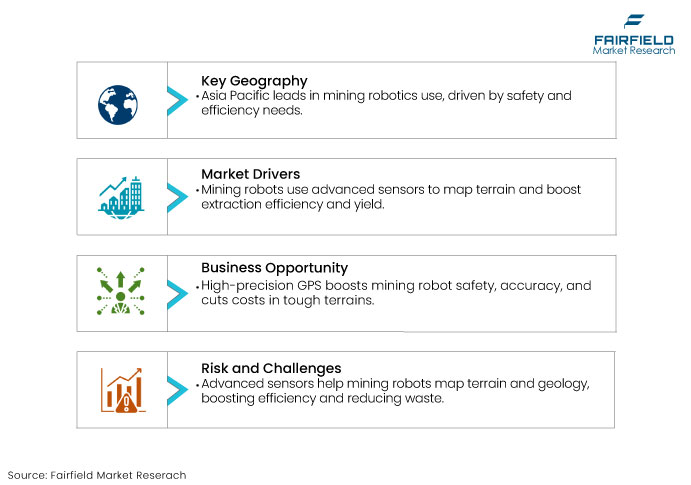
- Countries such as China, Australia, and India are witnessing increased mining automation. High mineral demand and large-scale mining projects drive robotics deployment. Investment in smart mining infrastructure is also growing in the region.
A Look Back and a Look Forward - Comparative Analysis
The historic growth has been largely driven by increasing emphasis on worker safety, operational efficiency, and automation. The adoption of robotics in mining operations expanded, particularly in tasks such as hauling, drilling, and maintenance, as companies sought to minimize human exposure to hazardous environments. Technological advancements, including the integration of artificial intelligence and remote sensing, have enhanced the capabilities of mining robots, making them more adaptable and efficient.
Looking ahead, the mining robotics market is expected to experience significant advancements driven by increased automation and the need for safer and more efficient operations. Innovations in autonomous vehicles, robotic drilling, and AI-driven systems will transform exploration, extraction, and site maintenance processes. The market will also benefit from growing environmental concerns and the push for sustainable mining practices.
Key Growth Determinants
- Advanced Sensor Technologies
Integrating advanced sensors such as LiDAR (Light Detection and Ranging), GPS (Global Positioning System), seismic sensors, and hyperspectral imaging, mining robots can gather precise and detailed data about the surrounding terrain, geology, and mineral composition. This information enables mining companies to make informed decisions on the most efficient methods for resource extraction, minimizing waste, and maximizing yield.
The real-time data from these sensors allows proactive responses to changes in geological conditions, such as shifts in rock formations or variations in ore quality. By continuously monitoring these parameters, mining robots can autonomously adjust their operations, optimizing efficiency and mitigating risks. For example, Beijing Soly Technology Co., Ltd., a leading provider of advanced sensor technology in China, offers innovative solutions designed to enhance operational efficiency, safety, and profitability in the mining industry.
Key Growth Barrier
- Limited Payload Capacity
Limited payload capacity is a major constraint in the mining robotics market, as it directly affects the efficiency and applicability of robotic systems in heavy-duty operations. Mining requires machinery capable of handling substantial volumes and weights of materials. Many existing robotic systems lack the necessary payload capacity, which limits their ability to move large amounts of ore or handle heavy equipment, resulting in operational delays and bottlenecks.
The restricted payload capacity of robotics systems limits the range of tasks they perform in mining operations. For instance, tasks such as transporting oversized equipment or hauling bulk materials over long distances may exceed the capabilities of these robots. Consequently, mining companies may need to rely on traditional machinery or manual labor, reducing the overall automation potential and diminishing the cost-saving benefits that robotics technology offers.
Mining Robotics Market Trends and Opportunities
- High-precision GPS
High-precision GPS technology is revolutionizing the mining robotics market by significantly improving efficiency and safety in challenging mining environments. With the ability to achieve positioning accuracy within a few centimeters, this technology allows autonomous mining robots to navigate rough terrain and complex underground networks with remarkable precision. It reduces the need for human presence in hazardous areas and minimizes deviations that results in operational inefficiencies or costly delays. By optimizing material handling, enhancing workflow, and reducing recalibration time, high-precision GPS contributes to better productivity and lower operational costs.
Safety is a key advantage, as high-precision GPS enables precise navigation near human-operated machinery and within confined spaces, minimizing the risk of accidents. This technology is often integrated with complementary systems such as LiDAR and inertial measurement units (IMUs) to maintain accuracy even in environments with obstructed satellite signals. For example, Sandvik has integrated high-precision GPS into their autonomous mining solutions, such as AutoMine and OptiMine, allowing optimal positioning, collision avoidance, and real-time tracking, which improve overall mine management and resource utilization.
- Impact of AI and Robotic Automation
Advanced digital technologies such as artificial intelligence (AI), machine learning, and automation are revolutionizing the mining robotics sector, enabling enhanced operational efficiency, safety, and real-time decision-making across the mining value chain. As mining operations become increasingly complex and data-driven, companies are making significant investments in robotic automation to improve performance and mitigate risks. This shift marks a broader trend towards the development of smarter mining ecosystems, where robotics plays a pivotal role in optimizing productivity.
For instance, in April 2025, Weir entered into a binding agreement to acquire Mining Software Holdings Pty Ltd (Micromine), for an enterprise value of £657 million (A$1,310 million). By integrating Micromine’s data analytics and mine planning solutions into its existing product offerings, Weir aims to strengthen its digital platform capabilities, particularly in areas such as exploration and mineral processing. This strategic move underscores the growing demand for AI-enabled, interoperable robotics solutions in the mining sector, with companies increasingly positioning themselves for long-term growth by adopting cutting-edge technology and automation in their operations.
Leading Segment Overview
- Dominance of Open-pit Mining
Open-pit mining holds the largest share, around 62.9% in 2025 in the mining robotics market due to its widespread use in large-scale mining operations, where robotics enhances efficiency, safety, and cost-effectiveness. The ability to automate tasks such as drilling, excavation, and material handling, reducing human risk in hazardous environments, improves precision, and boosts productivity. Open-pit mining often involves complex terrain, making robotic systems invaluable for navigating and optimizing operations.
Underground mining is expected to grow significantly due to the push towards sustainable mining practices and reduced environmental impact encourages the shift from open pit to underground mining in certain regions. As resource depletion of surface-level deposits continues, the need to access deeper mineral reserves further fuels this growth.
- Demand from the Hauling Sector Leads the Mining Robotics Market
Hauling dominates the mining robotics market due to its critical role in transporting materials efficiently across mining sites. Autonomous hauling systems, such as driverless trucks and shuttle trains, significantly enhance productivity by reducing human error, lowering labor costs, and ensuring continuous operation in hazardous conditions. The scalability and reliability of hauling robotics make them an essential component of modern mining operations.
Regional Analysis
- Asia Pacific is the largest market for Mining Robotics
Countries such as Australia, China, and India have vast mining industries, often involving deep underground and open-pit mining activities where human workers are exposed to hazardous conditions such as toxic gases, cave-ins, and extreme temperatures. For instance, Rio Tinto, a major mining company in Australia, has extensively deployed autonomous haul trucks and drilling systems across its iron ore operations in Pilbara, significantly reducing accident rates and operational downtime.
Robotics can perform repetitive, high-precision tasks such as drilling, excavation, and ore sorting more quickly and consistently than human workers, leading to lower operational costs over time. In China, where coal mining continues to be vital for energy production, state-owned enterprises are increasingly investing in robotic systems for underground mining to address labor shortages and rising wages, as well as to boost output efficiency.
- Robotics Transforming Mining Operations in the Middle East and Africa Amid Rising Demand for Efficiency and Safety
Mining operations in the Middle East and Africa are located in remote, harsh terrains like the deserts of Saudi Arabia and the mountainous areas of South Africa, where extreme temperatures and difficult ground conditions pose risks to human workers. Robotics solutions help to maintain production while reducing worker exposure to danger. In South Africa, mining firms are adopting automated drilling robots to safely extract minerals from deep underground shafts with high rock pressure and seismic activity.
Mining companies across the region are under pressure to improve margins amid fluctuating commodity prices, leading to increased use of robotics to streamline operations, reduce downtime, and minimize human error. Countries like Ghana are using robotic inspection drones to monitor large open-pit mines more efficiently. Saudi Arabia, under its Vision 2030 plan, is embracing robotics and Industry 4.0 technologies, with companies like Ma’aden deploying automated fleets. Meanwhile, Africa is projected to supply 10% of the world's critical minerals by 2030, driving further adoption of robotics for efficient extraction.
- North America's Workforce and Environmental Landscape
In North America, worker safety is a key factor driving the adoption of mining robotics. Robotic technologies, such as autonomous drilling rigs and robotic inspection drones, help minimize human exposure to hazardous underground environments, like tunnel collapses and toxic gas exposure. In Canada’s deep mining sectors, these technologies are increasingly used to access areas deemed too dangerous for human workers, ensuring safer mining operations.
Labor shortages in the mining industry are becoming more pronounced, particularly in the U.S., due to an aging workforce. With an increase of 1,894 employees in coal mines from 2022, the industry still struggles to meet growing demands, especially in regions such as Appalachia. Robotic technologies, including autonomous haul trucks and drilling systems are being adopted to address these labor gaps, supporting continuous operations while also aligning with increasing regulatory pressures focused on reducing environmental impacts.
Key Companies
• Sandvik AB
• ABB
• Komatsu Ltd.
• Caterpillar
• Epiroc
• Hitachi Construction Machinery Co., Ltd.
• Rockwell Automation
• HollySys
• Cognex Corporation
• KUKA AG
Global Mining Robotics Market is Segmented as-
By Mining Technique
• Open-Pit Mining
• Underground Mining
By Application
• Drilling and Blasting
• Hauling
• Exploration
• Excavation
• Inspection and Maintenance
• Others
By Region
• North America
• Europe
• Asia Pacific
• Latin America
• Middle East & Africa
- Executive Summary
- Global Mining Robotics Market Snapshot
- Future Projections
- Key Market Trends
- Regional Snapshot, by Value, 2026
- Analyst Recommendations
- Market Overview
- Market Definitions and Segmentations
- Market Dynamics
- Drivers
- Restraints
- Market Opportunities
- Value Chain Analysis
- COVID-19 Impact Analysis
- Porter's Five Forces Analysis
- Impact of Russia-Ukraine Conflict
- PESTLE Analysis
- Regulatory Analysis
- Price Trend Analysis
- Current Prices and Future Projections, 2025-2033
- Price Impact Factors
- Global Mining Robotics Market Outlook, 2020 - 2033
- Global Mining Robotics Market Outlook, by Mining Technique, Value (US$ Bn), 2020-2033
- Open-Pit Mining
- Underground Mining
- Global Mining Robotics Market Outlook, by Application, Value (US$ Bn), 2020-2033
- Drilling and Blasting
- Hauling
- Exploration
- Excavation
- Inspection and Maintenance
- Global Mining Robotics Market Outlook, by Region, Value (US$ Bn), 2020-2033
- North America
- Europe
- Asia Pacific
- Latin America
- Middle East & Africa
- Global Mining Robotics Market Outlook, by Mining Technique, Value (US$ Bn), 2020-2033
- North America Mining Robotics Market Outlook, 2020 - 2033
- North America Mining Robotics Market Outlook, by Mining Technique, Value (US$ Bn), 2020-2033
- Open-Pit Mining
- Underground Mining
- North America Mining Robotics Market Outlook, by Application, Value (US$ Bn), 2020-2033
- Drilling and Blasting
- Hauling
- Exploration
- Excavation
- Inspection and Maintenance
- North America Mining Robotics Market Outlook, by Country, Value (US$ Bn), 2020-2033
- U.S. Mining Robotics Market Outlook, by Mining Technique, 2020-2033
- U.S. Mining Robotics Market Outlook, by Application, 2020-2033
- Canada Mining Robotics Market Outlook, by Mining Technique, 2020-2033
- Canada Mining Robotics Market Outlook, by Application, 2020-2033
- BPS Analysis/Market Attractiveness Analysis
- North America Mining Robotics Market Outlook, by Mining Technique, Value (US$ Bn), 2020-2033
- Europe Mining Robotics Market Outlook, 2020 - 2033
- Europe Mining Robotics Market Outlook, by Mining Technique, Value (US$ Bn), 2020-2033
- Open-Pit Mining
- Underground Mining
- Europe Mining Robotics Market Outlook, by Application, Value (US$ Bn), 2020-2033
- Drilling and Blasting
- Hauling
- Exploration
- Excavation
- Inspection and Maintenance
- Europe Mining Robotics Market Outlook, by Country, Value (US$ Bn), 2020-2033
- Germany Mining Robotics Market Outlook, by Mining Technique, 2020-2033
- Germany Mining Robotics Market Outlook, by Application, 2020-2033
- Italy Mining Robotics Market Outlook, by Mining Technique, 2020-2033
- Italy Mining Robotics Market Outlook, by Application, 2020-2033
- France Mining Robotics Market Outlook, by Mining Technique, 2020-2033
- France Mining Robotics Market Outlook, by Application, 2020-2033
- U.K. Mining Robotics Market Outlook, by Mining Technique, 2020-2033
- U.K. Mining Robotics Market Outlook, by Application, 2020-2033
- Spain Mining Robotics Market Outlook, by Mining Technique, 2020-2033
- Spain Mining Robotics Market Outlook, by Application, 2020-2033
- Russia Mining Robotics Market Outlook, by Mining Technique, 2020-2033
- Russia Mining Robotics Market Outlook, by Application, 2020-2033
- Rest of Europe Mining Robotics Market Outlook, by Mining Technique, 2020-2033
- Rest of Europe Mining Robotics Market Outlook, by Application, 2020-2033
- BPS Analysis/Market Attractiveness Analysis
- Europe Mining Robotics Market Outlook, by Mining Technique, Value (US$ Bn), 2020-2033
- Asia Pacific Mining Robotics Market Outlook, 2020 - 2033
- Asia Pacific Mining Robotics Market Outlook, by Mining Technique, Value (US$ Bn), 2020-2033
- Open-Pit Mining
- Underground Mining
- Asia Pacific Mining Robotics Market Outlook, by Application, Value (US$ Bn), 2020-2033
- Drilling and Blasting
- Hauling
- Exploration
- Excavation
- Inspection and Maintenance
- Asia Pacific Mining Robotics Market Outlook, by Country, Value (US$ Bn), 2020-2033
- China Mining Robotics Market Outlook, by Mining Technique, 2020-2033
- China Mining Robotics Market Outlook, by Application, 2020-2033
- Japan Mining Robotics Market Outlook, by Mining Technique, 2020-2033
- Japan Mining Robotics Market Outlook, by Application, 2020-2033
- South Korea Mining Robotics Market Outlook, by Mining Technique, 2020-2033
- South Korea Mining Robotics Market Outlook, by Application, 2020-2033
- India Mining Robotics Market Outlook, by Mining Technique, 2020-2033
- India Mining Robotics Market Outlook, by Application, 2020-2033
- Southeast Asia Mining Robotics Market Outlook, by Mining Technique, 2020-2033
- Southeast Asia Mining Robotics Market Outlook, by Application, 2020-2033
- Rest of SAO Mining Robotics Market Outlook, by Mining Technique, 2020-2033
- Rest of SAO Mining Robotics Market Outlook, by Application, 2020-2033
- BPS Analysis/Market Attractiveness Analysis
- Asia Pacific Mining Robotics Market Outlook, by Mining Technique, Value (US$ Bn), 2020-2033
- Latin America Mining Robotics Market Outlook, 2020 - 2033
- Latin America Mining Robotics Market Outlook, by Mining Technique, Value (US$ Bn), 2020-2033
- Open-Pit Mining
- Underground Mining
- Latin America Mining Robotics Market Outlook, by Application, Value (US$ Bn), 2020-2033
- Drilling and Blasting
- Hauling
- Exploration
- Excavation
- Inspection and Maintenance
- Latin America Mining Robotics Market Outlook, by Country, Value (US$ Bn), 2020-2033
- Brazil Mining Robotics Market Outlook, by Mining Technique, 2020-2033
- Brazil Mining Robotics Market Outlook, by Application, 2020-2033
- Mexico Mining Robotics Market Outlook, by Mining Technique, 2020-2033
- Mexico Mining Robotics Market Outlook, by Application, 2020-2033
- Argentina Mining Robotics Market Outlook, by Mining Technique, 2020-2033
- Argentina Mining Robotics Market Outlook, by Application, 2020-2033
- Rest of LATAM Mining Robotics Market Outlook, by Mining Technique, 2020-2033
- Rest of LATAM Mining Robotics Market Outlook, by Application, 2020-2033
- BPS Analysis/Market Attractiveness Analysis
- Latin America Mining Robotics Market Outlook, by Mining Technique, Value (US$ Bn), 2020-2033
- Middle East & Africa Mining Robotics Market Outlook, 2020 - 2033
- Middle East & Africa Mining Robotics Market Outlook, by Mining Technique, Value (US$ Bn), 2020-2033
- Open-Pit Mining
- Underground Mining
- Middle East & Africa Mining Robotics Market Outlook, by Application, Value (US$ Bn), 2020-2033
- Drilling and Blasting
- Hauling
- Exploration
- Excavation
- Inspection and Maintenance
- Middle East & Africa Mining Robotics Market Outlook, by Country, Value (US$ Bn), 2020-2033
- GCC Mining Robotics Market Outlook, by Mining Technique, 2020-2033
- GCC Mining Robotics Market Outlook, by Application, 2020-2033
- South Africa Mining Robotics Market Outlook, by Mining Technique, 2020-2033
- South Africa Mining Robotics Market Outlook, by Application, 2020-2033
- Egypt Mining Robotics Market Outlook, by Mining Technique, 2020-2033
- Egypt Mining Robotics Market Outlook, by Application, 2020-2033
- Nigeria Mining Robotics Market Outlook, by Mining Technique, 2020-2033
- Nigeria Mining Robotics Market Outlook, by Application, 2020-2033
- Rest of Middle East Mining Robotics Market Outlook, by Mining Technique, 2020-2033
- Rest of Middle East Mining Robotics Market Outlook, by Application, 2020-2033
- BPS Analysis/Market Attractiveness Analysis
- Middle East & Africa Mining Robotics Market Outlook, by Mining Technique, Value (US$ Bn), 2020-2033
- Competitive Landscape
- Company Vs Segment Heatmap
- Company Market Share Analysis, 2025
- Competitive Dashboard
- Company Profiles
- Sandvik AB
- Company Overview
- Product Portfolio
- Financial Overview
- Business Strategies and Developments
- ABB
- Komatsu Ltd.
- Caterpillar
- Epiroc
- Hitachi Construction Machinery Co., Ltd.
- Rockwell Automation
- HollySys
- Cognex Corporation
- KUKA AG
- Sandvik AB
- Appendix
- Research Methodology
- Report Assumptions
- Acronyms and Abbreviations
|
BASE YEAR |
HISTORICAL DATA |
FORECAST PERIOD |
UNITS |
|||
 |
2025 |
 |
2020 - 2025 |
 |
2026 - 2033 |
Value: US$ Million |
Our Research Methodology
Considering the volatility of business today, traditional approaches to strategizing a game plan can be unfruitful if not detrimental. True ambiguity is no way to determine a forecast. A myriad of predetermined factors must be accounted for such as the degree of risk involved, the magnitude of circumstances, as well as conditions or consequences that are not known or unpredictable. To circumvent binary views that cast uncertainty, the application of market research intelligence to strategically posture, move, and enable actionable outcomes is necessary.
View Methodology
Quality Assured
Rigorous Validation Process

Confidentiality Assured
End-to-end Data Security

Custom Research Services
Tailored To Your Objectives
FAQs
The Mining Robotics market is expected to reach US$1.7 billion in 2026.
The Mining Robotics market is projected to grow at a 9.8% CAGR through 2033.
The Mining Robotics market growth is driven by increasing mining automation, rising worker safety concerns, and the adoption of AI-powered autonomous mining equipment.
Asia Pacific is the dominant regional market for Mining Robotics.
Sandvik AB, ABB, Komatsu Ltd., Caterpillar, and Epiroc are some of the leading industry players in the Mining Robotics market.
Related Reports
Ultralight & Light Aircraft Market Insights, Competitive Landscape, and Market Forecast 2026–2033
Ultralight & Light Aircraft Market is projected to reach US$29.05 billion by 2033, driven by flight training, recreational aviation, VTOL, and electric aircraft adoption.
Motor Soft Starter Market Insights, Competitive Landscape, and Market Forecast 2033
Motor Soft Starter Market to reach US$3.98 Bn by 2033 at 6.1% CAGR, driven by industrial automation, water infrastructure, and motor efficiency.
Global Sand Blasting Machines Market Insights, Competitive Landscape, and Market Forecast 2033
The global sand blasting machines market is valued at US$536.60 Mn in 2026 and is projected to reach US$725.36 Mn by 2033, growing at a 4.4% CAGR
Garage and Overhead Doors Market Insights, Competitive Landscape, and Market Forecast 2033
Garage and Overhead Doors Market to reach US$11.71 Bn by 2033 at 5.6% CAGR, driven by housing, smart connectivity, and energy efficiency.
Wafer Inspection Equipment Market Insights, Competitive Landscape, and Market Forecast 2026–2033
Wafer Inspection Equipment Market to reach US$12.5 Bn by 2033 at 8.2% CAGR, driven by AI defect detection, advanced fabs, and chip demand.
Super Precision Bearing Market Insights, Competitive Landscape, and Market Forecast 2026–2033
Super Precision Bearing Market to reach US$19.58 Bn by 2033 at 7.5% CAGR, driven by semiconductors, aerospace, EVs, and medical robotics.