



Mustard Flour Market
Mustard Flour Market Insights, Competitive Landscape, and Market Forecast - 2033
The Mustard Flour Market is valued at USD 885.9 Mn in 2026 and is projected to reach USD 1455.2 Mn, growing at a CAGR of 5% by 2033.
Quick Report Digest
- Increased health consciousness among consumers, expansion of food industry applications, and growing demand for ethnic and spicy flavours are key drivers propelling the mustard flour market forward.
- Limited awareness and education about mustard flour, price volatility due to fluctuating mustard seed prices, and competition from alternative ingredients pose challenges to market expansion.
- Rising demand for plant-based and clean label products, expansion of online retail channels, product diversification, and innovation offer significant opportunities for market growth.
- Regulations surrounding food safety, organic production, international trade, labelling, and traceability shape the industry landscape and influence production processes and market accessibility.
- The mustard flour market is segmented into the food industry, health and wellness, and culinary segments, each experiencing growth driven by consumer preferences and product innovation.
- Europe, North America, and Asia Pacific are highlighted as key regions driving market growth, each with unique consumer preferences and market characteristics.
- Leading players in the mustard flour market include Colman's, AB World Foods, Zatarain's, French's, and McCormick & Company, with strategies such as product innovation and sustainable sourcing practices driving competition.
- Significant industry developments include new product launches focusing on health foods, partnerships with health food retailers and gourmet suppliers, and a shift towards sustainable sourcing practices.
- The global mustard flour market is segmented by type (yellow, brown, oriental, blended), end use (food and beverages, foodservice, retail/household), distribution channel (B2B, B2C), and region (North America, Latin America, Europe, South Asia & Pacific, East Asia, Middle East & Africa).
- Increasing Health Consciousness
- Expansion of Food Industry Applications
- Growing Demand for Ethnic and Spicy Flavours
- Limited Awareness and Education
- Price Volatility
- Competition from Alternative Ingredients
- Rise in Plant-Based and Clean Label Products
- Expansion of Online Retail Channels
- Product Diversification and Innovation
- Expansion into Emerging Markets
- Food Industry Represents the Largest Revenue Contributing Segment
- Health and Wellness Sector Creates a Host of Opportunities
- Adoption Maximum Across the Culinary Segment
- Europe Extends the Legacy of Mustard Love
- North America Becomes a Hub Where Convenience Meets Versatility
- Asia Pacific Emerges as a Rising Star
- Ddev Spices Private Limited
- Factoria-Agro, Ltd.
- Great American Spice Company
- G.S. Dunn Dry Mustard Millers
- Divis Laboratories Ltd.
- ITC Limited
- Lanna Products Co., Ltd.
- McCormick & Company, Inc.
- Mincing Spice
- Minn-Dak Growers, Ltd.
- Minokyun Corporation
- S&B Foods Inc
- Sakai Spice Corporation
- Sujino Co., Ltd.
- Unilever PLC (Colman's)
- Virdhara International
- Wisconsin Spice, Inc.
- Woodland Foods
- Yellow
- Brown
- Oriental
- Blended
- Food and Beverages
- Dressings & Salads
- Sauces & Seasonings
- Processed Meat & Seafood Products
- Others
- Foodservice
- Retail/Household
- Business to Business
- Business to Consumer
- Hypermarkets/Supermarkets
- Convenience Stores
- Specialty Stores
- Online Retail
- North America
- Latin America
- Europe
- Asia Pacific
- Middle East & Africa
A Look Back and a Look Forward - Comparative Analysis
The mustard flour market has enjoyed a steady climb since 2019, fueled by a growing appetite from both home cooks and the food service industry. This surge in demand can be attributed to several factors. Health-conscious consumers are increasingly seeking out natural ingredients, and mustard flour fits the bill nicely.
The rising popularity of ethnic cuisines that feature mustard flour, along with a wider variety of product types like yellow, brown, and golden options catering to diverse palates, has further bolstered the market. Geographically, mustard flour consumption has transcended its traditional strongholds, with new markets emerging in Asia Pacific, and Latin America, driven by rising disposable incomes and a growing curiosity for international flavours.
However, the path has not been entirely smooth. Fluctuations in mustard seed prices due to weather patterns and supply chain disruptions can lead to price instability for mustard flour. Additionally, limited awareness in some regions acts as a hurdle for market expansion. Looking ahead to 2033, market analysts predict a continued upward trajectory. The industry is expected to witness consistent growth at a CAGR throughout the forecast period.
Consumers' growing interest in functional ingredients with health benefits is a key driver. Mustard flour's potential digestive and anti-inflammatory properties hold specific appeal. Furthermore, innovation in the form of organic and gluten-free options is likely to attract new consumer segments with specific dietary needs. While established markets in North America, and Europe are anticipated to see moderate expansion, the most significant growth is expected in Asia Pacific, and Latin America.
Key Growth Determinants
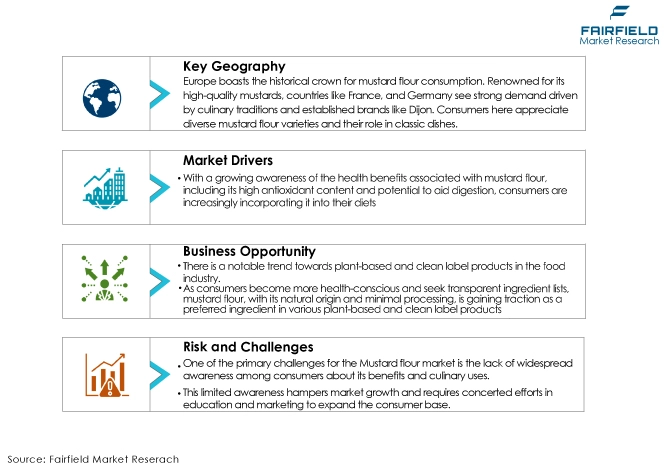
With a growing awareness of the health benefits associated with mustard flour, including its high antioxidant content and potential to aid digestion, consumers are increasingly incorporating it into their diets. Mustard flour is known for its ability to add flavour and depth to dishes without the need for unhealthy additives, making it a popular choice among health-conscious individuals seeking natural ingredients.
The food industry is continuously innovating to meet changing consumer preferences, leading to an expansion of applications for mustard flour. Food manufacturers are incorporating mustard flour into a wide range of products, including sauces, condiments, dressings, marinades, and baked goods, to enhance flavour profiles and cater to diverse consumer tastes. This increased utilisation of mustard flour across various food categories is driving market growth.
As global culinary preferences continue to evolve, there is a growing demand for ethnic and spicy flavours in both domestic and international cuisines. Mustard flour, with its distinct and pungent taste, is well-positioned to capitalise on this trend. Its versatility allows it to be used in traditional dishes from different cultures, as well as in fusion cuisine, contributing to its rising popularity and driving growth in the Mustard flour market.
Major Growth Barriers
One of the primary challenges for the Mustard flour market is the lack of widespread awareness among consumers about its benefits and culinary uses. Many potential consumers may be unfamiliar with mustard flour or may not understand how to incorporate it into their cooking. This limited awareness hampers market growth and requires concerted efforts in education and marketing to expand the consumer base.
Mustard flour production can be susceptible to fluctuations in mustard seed prices, which are influenced by factors such as weather conditions, crop yields, and market demand. Price volatility can impact the cost of production for manufacturers and may result in price fluctuations for consumers, potentially affecting purchasing decisions and market stability.
The Mustard flour market faces competition from alternative ingredients and substitutes that offer similar flavour profiles or functionality. Substitutes such as prepared mustard, other spice blends, or synthetic flavour enhancers may provide comparable taste experiences at lower costs or with greater convenience, posing a challenge to the growth of the Mustard flour market.
Key Trends and Opportunities to Look at
There is a notable trend towards plant-based and clean label products in the food industry. As consumers become more health-conscious and seek transparent ingredient lists, mustard flour, with its natural origin and minimal processing, is gaining traction as a preferred ingredient in various plant-based and clean label products.
The increasing popularity of eCommerce platforms has opened new distribution channels for food products, including mustard flour. Market players are leveraging online retail channels to reach a broader consumer base, offering convenience and accessibility to customers who prefer shopping online. This trend is reshaping the mustard flour market's distribution landscape and providing opportunities for market expansion.
There is significant potential for market players to capitalise on by diversifying their product offerings and innovating with new mustard flour-based products. This could include developing flavoured mustard flours, ready-to-use spice blends incorporating mustard flour or creating convenience-focused mustard flour products tailored to specific culinary applications.
Emerging markets present significant growth opportunities for mustard flour market players due to increasing urbanisation, changing dietary preferences, and a growing middle class with higher disposable incomes. By expanding into emerging markets and adapting products to local tastes and preferences, mustard flour manufacturers can tap into new consumer segments and drive market growth.
How Does the Regulatory Scenario Shape this Industry?
The world of regulations plays a vital role in shaping the mustard flour industry. Food safety standards are paramount, dictating everything from permissible microbial levels to allergen labelling. These ensure consumer safety and fair trade practices but can also increase production costs due to stricter quality control measures.
The growing demand for organic products has led to regulations for organic mustard flour production. These typically mandate organic farming practices for mustard seeds and limit processing methods and additives. While organic certification unlocks new markets, it also adds complexity to the production process.
International trade of mustard flour is subject to import and export regulations set by individual countries. These can involve inspections, tariffs, and quotas, impacting the cost and accessibility of mustard flour in different regions. For instance, a country with high import tariffs might see limited variety and higher prices compared to one with relaxed regulations.
Regulations also dictate the information displayed on mustard flour packaging, including ingredients, nutritional information, allergens, and expiry dates. This ensures consumer awareness about the product's contents and potential allergens, allowing for informed choices.
Finally, some regulations require companies to maintain traceability records for their mustard flour throughout the supply chain. This allows for faster identification and recall of products in case of contamination or other quality issues. Traceability regulations ultimately enhance consumer confidence in the product's safety and origin.
Fairfield’s Ranking Board
Mustard flour is extensively utilised in the food industry for its flavour-enhancing properties and versatility. Within this segment, the top-performing categories include sauces, condiments, dressings, and marinades. These products benefit from the unique pungency and flavour profile of mustard flour, which adds depth and complexity to dishes.
Additionally, the growing trend of clean label and natural ingredients in food products further drives the demand for mustard flour in this segment. Manufacturers are increasingly incorporating mustard flour into their formulations to meet consumer preferences for healthier and more authentic flavours.
The health and wellness segment encompasses products targeting consumers seeking functional foods and ingredients. Mustard flour is gaining traction in this segment due to its perceived health benefits, including its antioxidant properties and potential digestive health benefits. Products such as mustard flour supplements, health-focused snacks, and gluten-free baking mixes are seeing strong demand as consumers prioritise healthier alternatives.
The growing interest in natural remedies and preventive health measures further supports the growth of mustard flour in this segment. Manufacturers are innovating to develop products that cater to specific health concerns, driving further growth in this lucrative market segment.
The culinary segment includes home cooks, professional chefs, and food enthusiasts who utilise mustard flour in their cooking and recipe formulations. This segment is characterised by the growing popularity of ethnic cuisines and adventurous cooking styles, which often incorporate mustard flour for its distinctive flavour and aroma.
Mustard flour is commonly used in traditional dishes from various culinary traditions, including Indian, African, and European cuisines. Its versatility allows it to be used in a wide range of recipes, from spice rubs and coatings for meats to flavourings for stews, soups, and curries.
As culinary exploration continues to expand, driven by cooking shows, social media influencers, and food blogs, the demand for mustard flour among home cooks and professional chefs alike is expected to grow, making this segment a key driver of market performance.
Regional Frontrunners
Europe boasts the historical crown for mustard flour consumption. Renowned for its high-quality mustards, countries like France, and Germany see strong demand driven by culinary traditions and established brands like Dijon. Consumers here appreciate diverse mustard flour varieties and their role in classic dishes. However, the market is relatively mature, with growth coming from premiumisation and innovation in organic or specialty mustards.
North America, similar to Europe, has a well-developed mustard flour market. Here, the focus leans more towards convenience and versatility. The United States, with its large population and diverse food scene, drives significant demand from both households and the food service industry. Prepared mustards made with mustard flour are popular, along with using it in sauces, dressings, and dips. While established brands dominate, there's growing interest in regional specialties and artisanal products.
The Asia Pacific region is a rising star in the mustard flour market. Fueled by surging disposable incomes, a growing middle class, and a growing appetite for international flavours, countries like China, and India are witnessing significant growth. Mustard flour's affordability and potential health benefits add to its appeal. The market here is heavily influenced by local cuisines' spice preferences, with a growing demand for spicier mustard varieties. Innovation in pre-packaged spice blends using mustard flour is also gaining traction.
Fairfield’s Competitive Landscape Analysis
The competition landscape of the Mustard flour market is characterised by the presence of several key players competing for market share. Leading players in the industry include Colman's, AB World Foods (owned by Associated British Foods), Zatarain's, French's, and McCormick & Company. These companies often employ various growth strategies to maintain their competitive edge, including product innovation, strategic partnerships and collaborations, expansion into new markets, and marketing and advertising campaigns to increase brand visibility and consumer awareness.
Additionally, some players focus on sustainable sourcing practices and certifications to appeal to environmentally conscious consumers. Overall, the market's competitive nature drives continuous innovation and expansion efforts among key players to capture a larger market share and stay ahead in the industry.
Who are the Leaders in the Global Mustard Flour Space?
An Expert’s Eye
Rising Health Consciousness
With an increasing focus on healthy eating habits, consumers are actively seeking out natural and nutritious food ingredients. Mustard flour, known for its antioxidant properties and low-calorie profile, aligns well with this trend. As individuals become more health-conscious, there's a growing demand for products containing mustard flour, leading to its increased adoption in various food categories such as health foods, gluten-free products, and plant-based alternatives.
Diversification of Applications
The versatility of mustard flour is expanding its applications beyond traditional condiments, driving market growth. Culinary innovation is leading to the development of new products such as gourmet sauces, artisanal baked goods, and specialty snacks that incorporate mustard flour for its unique flavour profile and functional properties. This diversification appeals to consumers seeking novel culinary experiences and presents opportunities for manufacturers to tap into niche markets and cater to evolving consumer preferences.
The Global Mustard Flour Market is Segmented as Below:
By Type:
By End-Use Sector:
By Distribution Channel:
By Region:
- Executive Summary
- Global Mustard Flour Market Snapshot
- Future Projections
- Key Market Trends
- Regional Snapshot, by Value, 2026
- Analyst Recommendations
- Market Overview
- Market Definitions and Segmentations
- Market Dynamics
- Drivers
- Restraints
- Market Opportunities
- Value Chain Analysis
- COVID-19 Impact Analysis
- Porter's Five Forces Analysis
- Impact of Russia-Ukraine Conflict
- PESTLE Analysis
- Regulatory Analysis
- Price Trend Analysis
- Current Prices and Future Projections, 2025-2033
- Price Impact Factors
- Global Mustard Flour Market Outlook, 2020 - 2033
- Global Mustard Flour Market Outlook, by Type, Value (US$ Mn), 2020-2033
- Yellow
- Brown
- Oriental
- Blended
- Global Mustard Flour Market Outlook, by End-Use Sector, Value (US$ Mn), 2020-2033
- Food and Beverages
- Dressings & Salads
- Sauces & Seasonings
- Processed Meat & Seafood Products
- Others
- Foodservice
- Retail/Household
- Food and Beverages
- Global Mustard Flour Market Outlook, by Distribution Channel, Value (US$ Mn), 2020-2033
- Business to Business
- Business to Consumer
- Global Mustard Flour Market Outlook, by Region, Value (US$ Mn), 2020-2033
- North America
- Europe
- Asia Pacific
- Latin America
- Middle East & Africa
- Global Mustard Flour Market Outlook, by Type, Value (US$ Mn), 2020-2033
- North America Mustard Flour Market Outlook, 2020 - 2033
- North America Mustard Flour Market Outlook, by Type, Value (US$ Mn), 2020-2033
- Yellow
- Brown
- Oriental
- Blended
- North America Mustard Flour Market Outlook, by End-Use Sector, Value (US$ Mn), 2020-2033
- Food and Beverages
- Dressings & Salads
- Sauces & Seasonings
- Processed Meat & Seafood Products
- Others
- Foodservice
- Retail/Household
- Food and Beverages
- North America Mustard Flour Market Outlook, by Distribution Channel, Value (US$ Mn), 2020-2033
- Business to Business
- Business to Consumer
- North America Mustard Flour Market Outlook, by Country, Value (US$ Mn), 2020-2033
- U.S. Mustard Flour Market Outlook, by Type, 2020-2033
- U.S. Mustard Flour Market Outlook, by End-Use Sector, 2020-2033
- U.S. Mustard Flour Market Outlook, by Distribution Channel, 2020-2033
- Canada Mustard Flour Market Outlook, by Type, 2020-2033
- Canada Mustard Flour Market Outlook, by End-Use Sector, 2020-2033
- Canada Mustard Flour Market Outlook, by Distribution Channel, 2020-2033
- BPS Analysis/Market Attractiveness Analysis
- North America Mustard Flour Market Outlook, by Type, Value (US$ Mn), 2020-2033
- Europe Mustard Flour Market Outlook, 2020 - 2033
- Europe Mustard Flour Market Outlook, by Type, Value (US$ Mn), 2020-2033
- Yellow
- Brown
- Oriental
- Blended
- Europe Mustard Flour Market Outlook, by End-Use Sector, Value (US$ Mn), 2020-2033
- Food and Beverages
- Dressings & Salads
- Sauces & Seasonings
- Processed Meat & Seafood Products
- Others
- Foodservice
- Retail/Household
- Food and Beverages
- Europe Mustard Flour Market Outlook, by Distribution Channel, Value (US$ Mn), 2020-2033
- Business to Business
- Business to Consumer
- Europe Mustard Flour Market Outlook, by Country, Value (US$ Mn), 2020-2033
- Germany Mustard Flour Market Outlook, by Type, 2020-2033
- Germany Mustard Flour Market Outlook, by End-Use Sector, 2020-2033
- Germany Mustard Flour Market Outlook, by Distribution Channel, 2020-2033
- Italy Mustard Flour Market Outlook, by Type, 2020-2033
- Italy Mustard Flour Market Outlook, by End-Use Sector, 2020-2033
- Italy Mustard Flour Market Outlook, by Distribution Channel, 2020-2033
- France Mustard Flour Market Outlook, by Type, 2020-2033
- France Mustard Flour Market Outlook, by End-Use Sector, 2020-2033
- France Mustard Flour Market Outlook, by Distribution Channel, 2020-2033
- U.K. Mustard Flour Market Outlook, by Type, 2020-2033
- U.K. Mustard Flour Market Outlook, by End-Use Sector, 2020-2033
- U.K. Mustard Flour Market Outlook, by Distribution Channel, 2020-2033
- Spain Mustard Flour Market Outlook, by Type, 2020-2033
- Spain Mustard Flour Market Outlook, by End-Use Sector, 2020-2033
- Spain Mustard Flour Market Outlook, by Distribution Channel, 2020-2033
- Russia Mustard Flour Market Outlook, by Type, 2020-2033
- Russia Mustard Flour Market Outlook, by End-Use Sector, 2020-2033
- Russia Mustard Flour Market Outlook, by Distribution Channel, 2020-2033
- Rest of Europe Mustard Flour Market Outlook, by Type, 2020-2033
- Rest of Europe Mustard Flour Market Outlook, by End-Use Sector, 2020-2033
- Rest of Europe Mustard Flour Market Outlook, by Distribution Channel, 2020-2033
- BPS Analysis/Market Attractiveness Analysis
- Europe Mustard Flour Market Outlook, by Type, Value (US$ Mn), 2020-2033
- Asia Pacific Mustard Flour Market Outlook, 2020 - 2033
- Asia Pacific Mustard Flour Market Outlook, by Type, Value (US$ Mn), 2020-2033
- Yellow
- Brown
- Oriental
- Blended
- Asia Pacific Mustard Flour Market Outlook, by End-Use Sector, Value (US$ Mn), 2020-2033
- Food and Beverages
- Dressings & Salads
- Sauces & Seasonings
- Processed Meat & Seafood Products
- Others
- Foodservice
- Retail/Household
- Food and Beverages
- Asia Pacific Mustard Flour Market Outlook, by Distribution Channel, Value (US$ Mn), 2020-2033
- Business to Business
- Business to Consumer
- Asia Pacific Mustard Flour Market Outlook, by Country, Value (US$ Mn), 2020-2033
- China Mustard Flour Market Outlook, by Type, 2020-2033
- China Mustard Flour Market Outlook, by End-Use Sector, 2020-2033
- China Mustard Flour Market Outlook, by Distribution Channel, 2020-2033
- Japan Mustard Flour Market Outlook, by Type, 2020-2033
- Japan Mustard Flour Market Outlook, by End-Use Sector, 2020-2033
- Japan Mustard Flour Market Outlook, by Distribution Channel, 2020-2033
- South Korea Mustard Flour Market Outlook, by Type, 2020-2033
- South Korea Mustard Flour Market Outlook, by End-Use Sector, 2020-2033
- South Korea Mustard Flour Market Outlook, by Distribution Channel, 2020-2033
- India Mustard Flour Market Outlook, by Type, 2020-2033
- India Mustard Flour Market Outlook, by End-Use Sector, 2020-2033
- India Mustard Flour Market Outlook, by Distribution Channel, 2020-2033
- Southeast Asia Mustard Flour Market Outlook, by Type, 2020-2033
- Southeast Asia Mustard Flour Market Outlook, by End-Use Sector, 2020-2033
- Southeast Asia Mustard Flour Market Outlook, by Distribution Channel, 2020-2033
- Rest of SAO Mustard Flour Market Outlook, by Type, 2020-2033
- Rest of SAO Mustard Flour Market Outlook, by End-Use Sector, 2020-2033
- Rest of SAO Mustard Flour Market Outlook, by Distribution Channel, 2020-2033
- BPS Analysis/Market Attractiveness Analysis
- Asia Pacific Mustard Flour Market Outlook, by Type, Value (US$ Mn), 2020-2033
- Latin America Mustard Flour Market Outlook, 2020 - 2033
- Latin America Mustard Flour Market Outlook, by Type, Value (US$ Mn), 2020-2033
- Yellow
- Brown
- Oriental
- Blended
- Latin America Mustard Flour Market Outlook, by End-Use Sector, Value (US$ Mn), 2020-2033
- Food and Beverages
- Dressings & Salads
- Sauces & Seasonings
- Processed Meat & Seafood Products
- Others
- Foodservice
- Retail/Household
- Food and Beverages
- Latin America Mustard Flour Market Outlook, by Distribution Channel, Value (US$ Mn), 2020-2033
- Business to Business
- Business to Consumer
- Latin America Mustard Flour Market Outlook, by Country, Value (US$ Mn), 2020-2033
- Brazil Mustard Flour Market Outlook, by Type, 2020-2033
- Brazil Mustard Flour Market Outlook, by End-Use Sector, 2020-2033
- Brazil Mustard Flour Market Outlook, by Distribution Channel, 2020-2033
- Mexico Mustard Flour Market Outlook, by Type, 2020-2033
- Mexico Mustard Flour Market Outlook, by End-Use Sector, 2020-2033
- Mexico Mustard Flour Market Outlook, by Distribution Channel, 2020-2033
- Argentina Mustard Flour Market Outlook, by Type, 2020-2033
- Argentina Mustard Flour Market Outlook, by End-Use Sector, 2020-2033
- Argentina Mustard Flour Market Outlook, by Distribution Channel, 2020-2033
- Rest of LATAM Mustard Flour Market Outlook, by Type, 2020-2033
- Rest of LATAM Mustard Flour Market Outlook, by End-Use Sector, 2020-2033
- Rest of LATAM Mustard Flour Market Outlook, by Distribution Channel, 2020-2033
- BPS Analysis/Market Attractiveness Analysis
- Latin America Mustard Flour Market Outlook, by Type, Value (US$ Mn), 2020-2033
- Middle East & Africa Mustard Flour Market Outlook, 2020 - 2033
- Middle East & Africa Mustard Flour Market Outlook, by Type, Value (US$ Mn), 2020-2033
- Yellow
- Brown
- Oriental
- Blended
- Middle East & Africa Mustard Flour Market Outlook, by End-Use Sector, Value (US$ Mn), 2020-2033
- Food and Beverages
- Dressings & Salads
- Sauces & Seasonings
- Processed Meat & Seafood Products
- Others
- Foodservice
- Retail/Household
- Food and Beverages
- Middle East & Africa Mustard Flour Market Outlook, by Distribution Channel, Value (US$ Mn), 2020-2033
- Business to Business
- Business to Consumer
- Middle East & Africa Mustard Flour Market Outlook, by Country, Value (US$ Mn), 2020-2033
- GCC Mustard Flour Market Outlook, by Type, 2020-2033
- GCC Mustard Flour Market Outlook, by End-Use Sector, 2020-2033
- GCC Mustard Flour Market Outlook, by Distribution Channel, 2020-2033
- South Africa Mustard Flour Market Outlook, by Type, 2020-2033
- South Africa Mustard Flour Market Outlook, by End-Use Sector, 2020-2033
- South Africa Mustard Flour Market Outlook, by Distribution Channel, 2020-2033
- Egypt Mustard Flour Market Outlook, by Type, 2020-2033
- Egypt Mustard Flour Market Outlook, by End-Use Sector, 2020-2033
- Egypt Mustard Flour Market Outlook, by Distribution Channel, 2020-2033
- Nigeria Mustard Flour Market Outlook, by Type, 2020-2033
- Nigeria Mustard Flour Market Outlook, by End-Use Sector, 2020-2033
- Nigeria Mustard Flour Market Outlook, by Distribution Channel, 2020-2033
- Rest of Middle East Mustard Flour Market Outlook, by Type, 2020-2033
- Rest of Middle East Mustard Flour Market Outlook, by End-Use Sector, 2020-2033
- Rest of Middle East Mustard Flour Market Outlook, by Distribution Channel, 2020-2033
- BPS Analysis/Market Attractiveness Analysis
- Middle East & Africa Mustard Flour Market Outlook, by Type, Value (US$ Mn), 2020-2033
- Competitive Landscape
- Company Vs Segment Heatmap
- Company Market Share Analysis, 2025
- Competitive Dashboard
- Company Profiles
- Ddev Spices Private Limited
- Company Overview
- Product Portfolio
- Financial Overview
- Business Strategies and Developments
- Factoria-Agro, Ltd.
- Great American Spice Company
- S. Dunn Dry Mustard Millers
- Divis Laboratories Ltd.
- ITC Limited
- Lanna Products Co., Ltd.
- McCormick & Company, Inc.
- Mincing Spice
- Minn-Dak Growers, Ltd.
- Ddev Spices Private Limited
- Appendix
- Research Methodology
- Report Assumptions
- Acronyms and Abbreviations
|
BASE YEAR |
HISTORICAL DATA |
FORECAST PERIOD |
UNITS |
|||
 |
2025 |
 |
2019 - 2024 |
 |
2026 - 2033 |
Value: US$ Million Volume :Tons |
|
REPORT FEATURES |
DETAILS |
|
Type Coverage |
|
|
End Use Coverage |
|
|
Distribution Channel Coverage |
|
|
Geographical Coverage |
|
|
Leading Companies |
|
|
Report Highlights |
Key Market Indicators, Macro-micro economic impact analysis, Technological Roadmap, Key Trends, Driver, Restraints, and Future Opportunities & Revenue Pockets, Porter’s 5 Forces Analysis, Historical Trend (2019-2021), Market Estimates and Forecast, Market Dynamics, Industry Trends, Competition Landscape, Category, Region, Country-wise Trends & Analysis, COVID-19 Impact Analysis (Demand and Supply Chain) |
Our Research Methodology
Considering the volatility of business today, traditional approaches to strategizing a game plan can be unfruitful if not detrimental. True ambiguity is no way to determine a forecast. A myriad of predetermined factors must be accounted for such as the degree of risk involved, the magnitude of circumstances, as well as conditions or consequences that are not known or unpredictable. To circumvent binary views that cast uncertainty, the application of market research intelligence to strategically posture, move, and enable actionable outcomes is necessary.
View Methodology
Quality Assured
Rigorous Validation Process

Confidentiality Assured
End-to-end Data Security

Custom Research Services
Tailored To Your Objectives
FAQs
Mustard flour is a fine powder made from grinding mustard seeds, typically using either yellow, brown, or black mustard seeds.
What are the Primary Applications of Mustard Flour in Food Industry? Mustard flour is widely used as a flavoring agent, emulsifier, and thickening agent in various food products such as sauces, dressings, marinades, and condiments.
Yes, mustard flour contains compounds like glucosinolates and antioxidants which may offer potential health benefits including anti-inflammatory and antimicrobial properties, as well as aiding digestion.
Price fluctuations in the mustard flour market are influenced by factors such as mustard seed harvest yields, global demand for mustard-based products, and geopolitical factors affecting mustard seed production regions.
The quality of mustard seeds significantly affects the flavor, aroma, and nutritional content of mustard flour, with factors such as seed variety, purity, and freshness playing crucial roles in determining overall quality.
Related Reports
Pea Protein Ingredient Market Size, Share, Insights, Competitive Landscape, and Forecast 2026 to 2033
Explore the pea protein ingredient market, reaching US$ 5.4 billion by 2033 at 11.0% CAGR, with product, regional and competitive insights.
Curcumin Market Size, Share, Insights, Competitive Landscape, and Forecast 2026 to 2033
Curcumin market to reach US$ 1.5 billion by 2033 at 7.6% CAGR. Explore product types, applications, regional trends and key companies.
Whey Protein Market Size, Share, Insights, Competitive Landscape, and Forecast 2026 to 2033
Whey protein market to reach US$ 19.8 billion by 2033 at 6.4% CAGR. Explore product types, applications, regions and key companies.
Food Grade Gases Market Size, Share, Insights, Competitive Landscape, and Forecast 2026 to 2033
The global food grade gases market is valued at US$8.2 billion in 2026, reaching US$12.4 billion by 2033, growing at a 6.1% CAGR
Corn Flour Market Size, Share, Insights, Competitive Landscape, and Forecast 2026 to 2033
The global corn flour market is valued at US$18.5 billion in 2026, reaching US$26.5 billion by 2033, growing at a 5.3% CAGR
Wheat Starch Market Size, Share, Insights, Competitive Landscape, and Forecast 2026 to 2033
The global wheat starch market is valued at US$4.6 billion in 2026, reaching US$6.4 billion by 2033, growing at a 4.8% CAGR