



Nutraceuticals Market
Nutraceuticals Market Insights, Competitive Landscape, and Market Forecast - 2033
Nutraceuticals Market Growth and Industry Forecast
The Nutraceuticals Market is valued at USD 593.9 Mn in 2026 and is projected to reach USD 986.9 Mn, growing at a CAGR of 8% by 2033
Nutraceuticals Market Summary: Key Insights & Trends
- Dietary supplements lead the market with over 40% share, driven by daily use convenience and trust in vitamins, botanicals, and protein-based formulations.
- Functional beverages record the fastest growth, as consumers embrace low-sugar, probiotic, and fiber-enriched drinks for on-the-go wellness.
- Vitamins hold over 25% share, remaining the most consumed nutrient group, while omega fatty acids rapidly gain share for heart and brain health.
- Conventional stores dominate distribution with over 60% share, though specialty and online platforms rapidly expand through direct-to-consumer engagement.
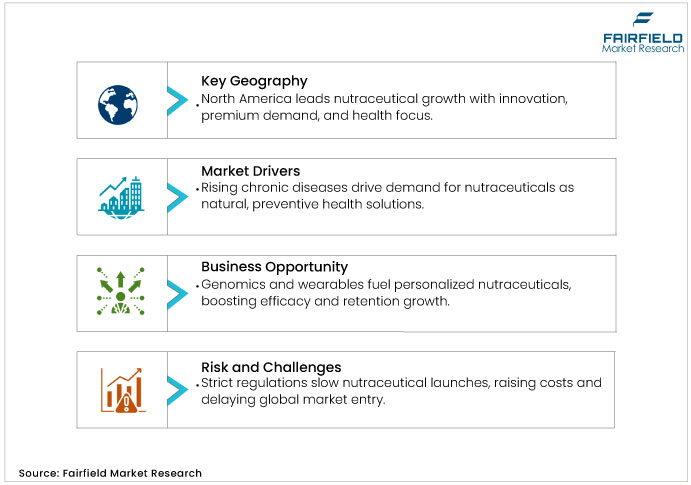
- Rising chronic diseases propel preventive health adoption, boosting demand for transparent, science-backed nutraceutical products across all diet categories.
- Asia Pacific leads with around 35% share, while North America emerges as the fastest-expanding region supported by strong health awareness and innovation.
Key Growth Drivers
- Chronic Disease Surge Drives Global Shift Toward Preventive Nutraceutical Solutions
Consumers increasingly turn to nutraceuticals to address chronic conditions such as cardiovascular diseases, diabetes, and obesity, which stem from sedentary lifestyles and poor dietary habits. According to World Health Organization data, non-communicable diseases account for 74% of global deaths, underscoring the need for proactive health interventions. Nutraceuticals, blending nutrition and pharmaceutical benefits, offer natural alternatives to traditional medicine, promoting gut health and immune support. This driver propels the industry by encouraging fortification in everyday foods, with theory suggesting that early adoption correlates with reduced healthcare burdens.
- Personalized and Functional Nutrition Gains Momentum Among Health-Focused Consumers Worldwide
Health-conscious individuals seek functional products that enhance immunity and overall vitality, particularly post-pandemic. The theory of personalized nutrition posits that tailored formulations based on genetic and lifestyle factors optimize efficacy, driving innovation in the nutraceuticals market. Council for Responsible Nutrition surveys reveal 77% of consumers prioritize preventive health, boosting segments such as omega fatty acids for cognitive benefits. This demand stems from busy urban lifestyles, where convenient supplements fill nutritional gaps without altering routines. Companies respond by integrating botanicals and probiotics, aligning with holistic wellness trends that emphasize long-term quality of life over symptomatic relief.
Key Restraints
- Complex Global Regulations and Compliance Delays Challenge Nutraceutical Market Expansion
Diverse global regulations create compliance hurdles with varying classifications between food and drugs delaying product launches by 6-12 months. Agencies such as the FDA and EFSA enforce rigorous efficacy claims, increasing validation costs by 15-20%. Theoretically, this restraint embodies regulatory capture theory, where bureaucratic layers stifle innovation without proportional safety gains. Businesses face higher entry barriers in emerging markets, limiting scalability.
- Rising Ingredient Costs and Counterfeit Products Threaten Nutraceutical Industry Profitability
Sourcing premium ingredients such as rare botanicals inflates costs by 25%, squeezing margins in the nutraceuticals market amid volatile supply chains. Counterfeits erode trust, with WHO estimating 10% of supplements as fake, deterring 30% of potential buyers. Theoretically, this reflects asymmetric information theory, where consumers undervalue genuine products due to market opacity. Mitigation requires blockchain traceability, yet initial investments burden SMEs.
Nutraceuticals Market Trends and Opportunities
- Evolving Global Compliance Norms Restrict Innovation and Market Entry for Nutraceuticals
The nutraceuticals industry is poised for growth as advancements in genomics and wearable technology pave the way for personalized formulations, catering to specialized needs like stress reduction through adaptogen-based blends. Drivers include various studies showcasing 18% efficacy gains in tailored omega supplements, justifying R&D spends. Businesses can partner with tech firms for scalable platforms, unlocking subscription models that boost retention by 40%. In emerging economies, affordable at-home kits democratize access, fostering inclusive growth. Safeguarding intellectual property is a strategic imperative for maintaining competitive advantage amid a highly fragmented market landscape in nutraceuticals sector.
- Escalating Raw Material Costs and Fake Products Undermine Nutraceutical Market Growth
Rapid urbanization in Asia and Latin America propels with middle-class expansion driving a sustainable CAGR in functional foods. Local preferences for herbal extracts offer localization opportunities, as seen in India's significant market surge tied to ayurvedic integrations. Demand conditions and related industries such as agriculture are expected to enhance competitiveness. Justifications stem from WHO reports on lifestyle diseases affecting 35% of urban populations, creating pull for affordable probiotics. Companies can invest in joint ventures for supply chain resilience, mitigating import duties while tapping 500 million new consumers.
Segment-wise Trends & Analysis
- Dietary Supplements Lead Nutraceuticals Market as Functional Beverages Gain Momentum
Dietary supplements dominate the nutraceuticals market with over 40% share in 2025, valued at approximately US$ 280.8 Bn, driven by their convenience and versatility in addressing nutrient deficiencies. This leadership stems from established consumer trust in pill formats for daily use, outpacing other types in retail penetration.
Functional beverages emerge as the fast-growing segment, projected to expand at a sustainable CAGR through 2032, fueled by on-the-go lifestyles and hydration-focused innovations. Underlying drivers include flavor advancements and low-sugar formulations appealing to millennials. Competitively, leaders such as DSM position via sustainable sourcing, while challengers disrupt with e-commerce exclusives, intensifying pricing wars but elevating overall category standards.
- Conventional Stores Dominate While Online Platforms Rapidly Transform Nutraceutical Sales
Conventional stores lead by capturing over 60% share in 2025 at US$ 421.2 Bn, benefiting from impulse buys and in-store consultations that build loyalty. Their dominance reflects traditional shopping habits in suburban areas, supported by wide shelf availability.
Specialty/online stores represent the emerging powerhouse, growing at a projected CAGR, propelled by digital natives seeking curated, subscription-based options. Drivers encompass algorithmic recommendations and direct-to-consumer models reducing intermediaries. In competitive positioning, giants such as Cargill fortify omnichannel strategies, whereas nimble online players such as iHerb gain, pressuring brick-and-mortar to hybridize for survival.
- Vitamins Retain Leadership as Omega Fatty Acids Drive Future Growth
Vitamins hold the top spot in the Nutraceuticals Market with over 25% share in 2025, equating to US$ 175.5 Bn, as foundational elements for immunity and energy. Their pre-eminence arises from broad applicability across age groups, backed by clinical endorsements.
Omega fatty acids surge as the fast-emerging ingredient, driven by cardiovascular health campaigns and sustainable algae sourcing. Key drivers involve anti-inflammatory benefits validated in NIH trials. Competitively, BASF excels through vertical integration, while entrants such as Corbion innovate with vegan variants, fragmenting the space but spurring quality benchmarks.
Regional Trends & Analysis
North America Emerges as Fastest-Growing Hub for Premium Nutraceutical Innovation
North America represents the fastest-growing regional market for nutraceuticals, driven by strong consumer health awareness, established regulatory frameworks, and innovation leadership. The region benefits from comprehensive healthcare provider integration, advanced research capabilities, and high consumer spending power. Premium product positioning, personalized nutrition solutions, and cutting-edge formulation technologies characterize the North American market landscape, creating opportunities for companies emphasizing quality, efficacy, and scientific validation.
U.S. Nutraceuticals Market – 2025 Snapshot & Outlook
The U.S. dominates North American nutraceutical consumption with projected market value of USD 51.7 billion in 2025. Consumer trends emphasize immunity support, digestive health, and personalized nutrition solutions, with 57.6% of adults using dietary supplements regularly. The market benefits from FDA regulatory clarity, extensive distribution networks, and strong e-commerce penetration. Millennial and Gen Z consumers drive demand for clean-label products, plant-based formulations, and transparency in ingredient sourcing. Government support for preventive healthcare initiatives and insurance coverage for certain nutritional supplements further supports market expansion.
Asia Pacific Dominates Global Nutraceutical Landscape with Rapid Urban Health Adoption
Asia Pacific holds approximately 35% market share in 2025, representing the largest regional market with projected CAGR through 2032. The region benefits from large population bases, rising disposable incomes, and integration of traditional medicine practices with modern nutraceutical approaches. Government healthcare initiatives, expanding middle-class populations, and increasing urbanization drive sustained demand growth across diverse market segments.
Japan Nutraceuticals Market – 2025 Snapshot & Outlook
Japan's market demonstrates projected growth driven by rapid population aging and established consumer trust in health-enhancing products. The market emphasizes omega-3 rich seafood-derived supplements, functional foods integrated into traditional dietary patterns, and premium positioning focused on quality and efficacy. Japanese consumers prioritize scientific research validation, natural ingredient sourcing, and products addressing age-related health concerns. Government initiatives supporting healthy aging and preventive healthcare create favorable market conditions for innovative nutraceutical solutions.
India Nutraceuticals Market – 2025 Snapshot & Outlook
India's market is projected to reach USD 18 billion by 2025, growing at robust CAGR driven by urbanization, lifestyle disease prevalence, and rising health consciousness. The market benefits from Production-Linked Incentive schemes, standardized trade codes, and favorable regulatory frameworks supporting domestic manufacturing and export capabilities. Urban millennials and Gen Z populations favor ayurvedic formulations, plant-based supplements, and natural alternatives to synthetic medications. E-commerce expansion and digital payment adoption enable market penetration in previously underserved geographic regions.
Europe Sustains Nutraceutical Growth Through Quality, Regulation, and Organic Preferences
Europe maintains steady nutraceutical market growth characterized by stringent quality standards, consumer preference for organic formulations, and aging population demographics. The region emphasizes natural ingredients, sustainable sourcing, and regulatory compliance through EFSA guidelines ensuring product safety and efficacy. Consumer awareness of lifestyle-related health issues drives demand for scientifically validated premium-positioned nutraceutical products.
Germany Nutraceuticals Market – 2025 Snapshot & Outlook
Germany demonstrates projected CAGR supported by heart health awareness, preference for sustainable marine oils, and consumer emphasis on evidence-based health solutions. The market benefits from strong pharmaceutical industry infrastructure, comprehensive healthcare integration, and consumer willingness to invest in preventive health solutions. German consumers prioritize product transparency, certified organic ingredients, and scientific research validation. Regulatory frameworks supporting health claims create opportunities for companies with robust clinical evidence supporting product efficacy.
U.K. Nutraceuticals Market – 2025 Snapshot & Outlook
The U.K. projects a sustainable growth driven by plant-based diet adoption and mental wellness supplement demand. Consumer preferences emphasize clean-label products, vegan formulations, and products supporting cognitive health and stress management. Brexit-related regulatory independence enables streamlined product approval processes while maintaining high quality standards. The market benefits from strong e-commerce penetration, direct-to-consumer brands, and subscription-based delivery models that enhance customer retention and lifetime value
Competitive Landscape Analysis
The players in the nutraceuticals market focus on strategic acquisitions to enhance supply chain resilience and innovation pipelines. This approach counters raw material volatility, as seen in a 2023 merger wave that consolidated 20% of botanical sourcing. Firms prioritize R&D alliances, evidenced by DSM's 2022 patent filings for personalized blends, aiming to capture premium segments. Such moves secure first-mover advantages in functional beverages, where differentiation drives 15% higher margins.
Regulatory evolutions, such as EU's 2025 sustainability mandates, will elevate compliance costs by 10%, while M&A activities expand capacity in Asia Pacific. nutraceuticals industry entrants must navigate these to scale efficiently. Early movers will benefit from established ecosystems, while latecomers may face premium pricing pressures.
Key Companies
- Danone S.A.
- Amway Corporation
- Herbalife Nutrition Ltd.
- Abbott Laboratories
- Archer-Daniels-Midland Company (ADM)
- General Mills, Inc.
- BASF SE
- Glanbia plc
- Yakult Honsha Co., Ltd.
- The Kraft Heinz Company
- The Hain Celestial Group, Inc.
- PepsiCo, Inc.
- Bayer AG
- Otsuka Pharmaceutical Co., Ltd.
Recent Developments:
- September 2025, BASF completed the sale of its Food and Health Performance Ingredients business to Louis Dreyfus Company (LDC), transferring around 300 employees and facilities in Germany and abroad. The move enables BASF to focus on vitamins and carotenoids, while LDC strengthens its presence in the fast-growing plant-based ingredients sector.
- January 2025, Cargill stated advancing of nutritional innovation and sustainability in 2025 by reformulating indulgent foods to be healthier and more eco-conscious. The company has developed brownies with Nutri-Score A and C ratings through major sugar reduction and added fiber, while expanding its Deventer coatings and fillings facility by 60% to support vegan, clean-label, and low-sugar chocolate solutions that align with global wellness and sustainability trends.
- September 2025, dsm-firmenich announced to unveil “The Longevity Shift” at SupplySide Global 2025, showcasing science-driven innovations that promote healthy aging and preventative wellness. Through its Healthy Longevity platform, the company aims to help supplement brands develop solutions targeting aging hallmarks such as inflammation and cellular senescence.
Global Nutraceuticals Market Segmentation-
By Product Type
• Dietary Supplements
• Functional Foods
• Functional Beverages
By End User
• Lifestyle users
• Athletes
• Geriatric Users
• Fitness enthusiasts
• Others
By Functional Claim
• High/Added Fiber
• Vitamin/Mineral Fortified
• Brain Health
• Bone Health/Added Calcium
• Weight Management
• Cardiovascular Health
• Skin/Hair/Nails
• Added Protein
• Others
By Distribution Channel
• Supermarkets/Hypermarkets
• Convenience Stores
• Online Retail
• Others
By Geography
• North America
• Europe
• Asia Pacific
• Latin America
• Middle East & Africa
- Executive Summary
- Global Nutraceuticals Market Snapshot
- Future Projections
- Key Market Trends
- Regional Snapshot, by Value, 2026
- Analyst Recommendations
- Market Overview
- Market Definitions and Segmentations
- Market Dynamics
- Drivers
- Restraints
- Market Opportunities
- Value Chain Analysis
- COVID-19 Impact Analysis
- Porter's Five Forces Analysis
- Impact of Russia-Ukraine Conflict
- PESTLE Analysis
- Regulatory Analysis
- Price Trend Analysis
- Current Prices and Future Projections, 2025-2033
- Price Impact Factors
- Global Nutraceuticals Market Outlook, 2020 - 2033
- Global Nutraceuticals Market Outlook, by Product Type, Value (US$ Mn), 2020-2033
- Dietary Supplements
- Vitamins
- Minerals
- Enzymes
- Fatty Acids
- Proteins
- Others
- Functional Foods
- Dairy Food
- Breakfast Cereals
- Snacks
- Baby Food
- Others
- Functional Beverages
- Fortified and functional hot drinks
- Functional Carbonates
- Fortified juices
- Herbal beverages
- Fortified and functional energy drinks
- Fortified Water
- Global Nutraceuticals Market Outlook, by End User, Value (US$ Mn), 2020-2033
- Lifestyle users
- Athletes
- Geriatric Users
- Fitness enthusiasts
- Others
- Global Nutraceuticals Market Outlook, by Functional Claim, Value (US$ Mn), 2020-2033
- High/Added Fiber
- Vitamin/Mineral Fortified
- Brain Health
- Bone Health/Added Calcium
- Weight Management
- Cardiovascular Health
- Skin/Hair/Nails
- Added Protein
- Others
- Global Nutraceuticals Market Outlook, by Distribution Channel, Value (US$ Mn), 2020-2033
- Supermarkets/Hypermarkets
- Convenience Stores
- Online Retail
- Others
- Global Nutraceuticals Market Outlook, by Region, Value (US$ Mn), 2020-2033
- North America
- Europe
- Asia Pacific
- Latin America
- Middle East & Africa
- Dietary Supplements
- Global Nutraceuticals Market Outlook, by Product Type, Value (US$ Mn), 2020-2033
- North America Nutraceuticals Market Outlook, 2020 - 2033
- North America Nutraceuticals Market Outlook, by Product Type, Value (US$ Mn), 2020-2033
- Dietary Supplements
- Vitamins
- Minerals
- Enzymes
- Fatty Acids
- Proteins
- Others
- Functional Foods
- Dairy Food
- Breakfast Cereals
- Snacks
- Baby Food
- Others
- Functional Beverages
- Fortified and functional hot drinks
- Functional Carbonates
- Fortified juices
- Herbal beverages
- Fortified and functional energy drinks
- Fortified Water
- North America Nutraceuticals Market Outlook, by End User, Value (US$ Mn), 2020-2033
- Lifestyle users
- Athletes
- Geriatric Users
- Fitness enthusiasts
- Others
- North America Nutraceuticals Market Outlook, by Functional Claim, Value (US$ Mn), 2020-2033
- High/Added Fiber
- Vitamin/Mineral Fortified
- Brain Health
- Bone Health/Added Calcium
- Weight Management
- Cardiovascular Health
- Skin/Hair/Nails
- Added Protein
- Others
- North America Nutraceuticals Market Outlook, by Distribution Channel, Value (US$ Mn), 2020-2033
- Supermarkets/Hypermarkets
- Convenience Stores
- Online Retail
- Others
- North America Nutraceuticals Market Outlook, by Country, Value (US$ Mn), 2020-2033
- U.S. Nutraceuticals Market Outlook, by Product Type, 2020-2033
- U.S. Nutraceuticals Market Outlook, by End User, 2020-2033
- U.S. Nutraceuticals Market Outlook, by Functional Claim, 2020-2033
- U.S. Nutraceuticals Market Outlook, by Distribution Channel, 2020-2033
- Canada Nutraceuticals Market Outlook, by Product Type, 2020-2033
- Canada Nutraceuticals Market Outlook, by End User, 2020-2033
- Canada Nutraceuticals Market Outlook, by Functional Claim, 2020-2033
- Canada Nutraceuticals Market Outlook, by Distribution Channel, 2020-2033
- BPS Analysis/Market Attractiveness Analysis
- Dietary Supplements
- North America Nutraceuticals Market Outlook, by Product Type, Value (US$ Mn), 2020-2033
- Europe Nutraceuticals Market Outlook, 2020 - 2033
- Europe Nutraceuticals Market Outlook, by Product Type, Value (US$ Mn), 2020-2033
- Dietary Supplements
- Vitamins
- Minerals
- Enzymes
- Fatty Acids
- Proteins
- Others
- Functional Foods
- Dairy Food
- Breakfast Cereals
- Snacks
- Baby Food
- Others
- Functional Beverages
- Fortified and functional hot drinks
- Functional Carbonates
- Fortified juices
- Herbal beverages
- Fortified and functional energy drinks
- Fortified Water
- Europe Nutraceuticals Market Outlook, by End User, Value (US$ Mn), 2020-2033
- Lifestyle users
- Athletes
- Geriatric Users
- Fitness enthusiasts
- Others
- Europe Nutraceuticals Market Outlook, by Functional Claim, Value (US$ Mn), 2020-2033
- High/Added Fiber
- Vitamin/Mineral Fortified
- Brain Health
- Bone Health/Added Calcium
- Weight Management
- Cardiovascular Health
- Skin/Hair/Nails
- Added Protein
- Others
- Europe Nutraceuticals Market Outlook, by Distribution Channel, Value (US$ Mn), 2020-2033
- Supermarkets/Hypermarkets
- Convenience Stores
- Online Retail
- Others
- Europe Nutraceuticals Market Outlook, by Country, Value (US$ Mn), 2020-2033
- Germany Nutraceuticals Market Outlook, by Product Type, 2020-2033
- Germany Nutraceuticals Market Outlook, by End User, 2020-2033
- Germany Nutraceuticals Market Outlook, by Functional Claim, 2020-2033
- Germany Nutraceuticals Market Outlook, by Distribution Channel, 2020-2033
- Italy Nutraceuticals Market Outlook, by Product Type, 2020-2033
- Italy Nutraceuticals Market Outlook, by End User, 2020-2033
- Italy Nutraceuticals Market Outlook, by Functional Claim, 2020-2033
- Italy Nutraceuticals Market Outlook, by Distribution Channel, 2020-2033
- France Nutraceuticals Market Outlook, by Product Type, 2020-2033
- France Nutraceuticals Market Outlook, by End User, 2020-2033
- France Nutraceuticals Market Outlook, by Functional Claim, 2020-2033
- France Nutraceuticals Market Outlook, by Distribution Channel, 2020-2033
- U.K. Nutraceuticals Market Outlook, by Product Type, 2020-2033
- U.K. Nutraceuticals Market Outlook, by End User, 2020-2033
- U.K. Nutraceuticals Market Outlook, by Functional Claim, 2020-2033
- U.K. Nutraceuticals Market Outlook, by Distribution Channel, 2020-2033
- Spain Nutraceuticals Market Outlook, by Product Type, 2020-2033
- Spain Nutraceuticals Market Outlook, by End User, 2020-2033
- Spain Nutraceuticals Market Outlook, by Functional Claim, 2020-2033
- Spain Nutraceuticals Market Outlook, by Distribution Channel, 2020-2033
- Russia Nutraceuticals Market Outlook, by Product Type, 2020-2033
- Russia Nutraceuticals Market Outlook, by End User, 2020-2033
- Russia Nutraceuticals Market Outlook, by Functional Claim, 2020-2033
- Russia Nutraceuticals Market Outlook, by Distribution Channel, 2020-2033
- Rest of Europe Nutraceuticals Market Outlook, by Product Type, 2020-2033
- Rest of Europe Nutraceuticals Market Outlook, by End User, 2020-2033
- Rest of Europe Nutraceuticals Market Outlook, by Functional Claim, 2020-2033
- Rest of Europe Nutraceuticals Market Outlook, by Distribution Channel, 2020-2033
- BPS Analysis/Market Attractiveness Analysis
- Dietary Supplements
- Europe Nutraceuticals Market Outlook, by Product Type, Value (US$ Mn), 2020-2033
- Asia Pacific Nutraceuticals Market Outlook, 2020 - 2033
- Asia Pacific Nutraceuticals Market Outlook, by Product Type, Value (US$ Mn), 2020-2033
- Dietary Supplements
- Vitamins
- Minerals
- Enzymes
- Fatty Acids
- Proteins
- Others
- Functional Foods
- Dairy Food
- Breakfast Cereals
- Snacks
- Baby Food
- Others
- Functional Beverages
- Fortified and functional hot drinks
- Functional Carbonates
- Fortified juices
- Herbal beverages
- Fortified and functional energy drinks
- Fortified Water
- Asia Pacific Nutraceuticals Market Outlook, by End User, Value (US$ Mn), 2020-2033
- Lifestyle users
- Athletes
- Geriatric Users
- Fitness enthusiasts
- Others
- Asia Pacific Nutraceuticals Market Outlook, by Functional Claim, Value (US$ Mn), 2020-2033
- High/Added Fiber
- Vitamin/Mineral Fortified
- Brain Health
- Bone Health/Added Calcium
- Weight Management
- Cardiovascular Health
- Skin/Hair/Nails
- Added Protein
- Others
- Asia Pacific Nutraceuticals Market Outlook, by Distribution Channel, Value (US$ Mn), 2020-2033
- Supermarkets/Hypermarkets
- Convenience Stores
- Online Retail
- Others
- Asia Pacific Nutraceuticals Market Outlook, by Country, Value (US$ Mn), 2020-2033
- China Nutraceuticals Market Outlook, by Product Type, 2020-2033
- China Nutraceuticals Market Outlook, by End User, 2020-2033
- China Nutraceuticals Market Outlook, by Functional Claim, 2020-2033
- China Nutraceuticals Market Outlook, by Distribution Channel, 2020-2033
- Japan Nutraceuticals Market Outlook, by Product Type, 2020-2033
- Japan Nutraceuticals Market Outlook, by End User, 2020-2033
- Japan Nutraceuticals Market Outlook, by Functional Claim, 2020-2033
- Japan Nutraceuticals Market Outlook, by Distribution Channel, 2020-2033
- South Korea Nutraceuticals Market Outlook, by Product Type, 2020-2033
- South Korea Nutraceuticals Market Outlook, by End User, 2020-2033
- South Korea Nutraceuticals Market Outlook, by Functional Claim, 2020-2033
- South Korea Nutraceuticals Market Outlook, by Distribution Channel, 2020-2033
- India Nutraceuticals Market Outlook, by Product Type, 2020-2033
- India Nutraceuticals Market Outlook, by End User, 2020-2033
- India Nutraceuticals Market Outlook, by Functional Claim, 2020-2033
- India Nutraceuticals Market Outlook, by Distribution Channel, 2020-2033
- Southeast Asia Nutraceuticals Market Outlook, by Product Type, 2020-2033
- Southeast Asia Nutraceuticals Market Outlook, by End User, 2020-2033
- Southeast Asia Nutraceuticals Market Outlook, by Functional Claim, 2020-2033
- Southeast Asia Nutraceuticals Market Outlook, by Distribution Channel, 2020-2033
- Rest of SAO Nutraceuticals Market Outlook, by Product Type, 2020-2033
- Rest of SAO Nutraceuticals Market Outlook, by End User, 2020-2033
- Rest of SAO Nutraceuticals Market Outlook, by Functional Claim, 2020-2033
- Rest of SAO Nutraceuticals Market Outlook, by Distribution Channel, 2020-2033
- BPS Analysis/Market Attractiveness Analysis
- Dietary Supplements
- Asia Pacific Nutraceuticals Market Outlook, by Product Type, Value (US$ Mn), 2020-2033
- Latin America Nutraceuticals Market Outlook, 2020 - 2033
- Latin America Nutraceuticals Market Outlook, by Product Type, Value (US$ Mn), 2020-2033
- Dietary Supplements
- Vitamins
- Minerals
- Enzymes
- Fatty Acids
- Proteins
- Others
- Functional Foods
- Dairy Food
- Breakfast Cereals
- Snacks
- Baby Food
- Others
- Functional Beverages
- Fortified and functional hot drinks
- Functional Carbonates
- Fortified juices
- Herbal beverages
- Fortified and functional energy drinks
- Fortified Water
- Latin America Nutraceuticals Market Outlook, by End User, Value (US$ Mn), 2020-2033
- Lifestyle users
- Athletes
- Geriatric Users
- Fitness enthusiasts
- Others
- Latin America Nutraceuticals Market Outlook, by Functional Claim, Value (US$ Mn), 2020-2033
- High/Added Fiber
- Vitamin/Mineral Fortified
- Brain Health
- Bone Health/Added Calcium
- Weight Management
- Cardiovascular Health
- Skin/Hair/Nails
- Added Protein
- Others
- Latin America Nutraceuticals Market Outlook, by Distribution Channel, Value (US$ Mn), 2020-2033
- Supermarkets/Hypermarkets
- Convenience Stores
- Online Retail
- Others
- Latin America Nutraceuticals Market Outlook, by Country, Value (US$ Mn), 2020-2033
- Brazil Nutraceuticals Market Outlook, by Product Type, 2020-2033
- Brazil Nutraceuticals Market Outlook, by End User, 2020-2033
- Brazil Nutraceuticals Market Outlook, by Functional Claim, 2020-2033
- Brazil Nutraceuticals Market Outlook, by Distribution Channel, 2020-2033
- Mexico Nutraceuticals Market Outlook, by Product Type, 2020-2033
- Mexico Nutraceuticals Market Outlook, by End User, 2020-2033
- Mexico Nutraceuticals Market Outlook, by Functional Claim, 2020-2033
- Mexico Nutraceuticals Market Outlook, by Distribution Channel, 2020-2033
- Argentina Nutraceuticals Market Outlook, by Product Type, 2020-2033
- Argentina Nutraceuticals Market Outlook, by End User, 2020-2033
- Argentina Nutraceuticals Market Outlook, by Functional Claim, 2020-2033
- Argentina Nutraceuticals Market Outlook, by Distribution Channel, 2020-2033
- Rest of LATAM Nutraceuticals Market Outlook, by Product Type, 2020-2033
- Rest of LATAM Nutraceuticals Market Outlook, by End User, 2020-2033
- Rest of LATAM Nutraceuticals Market Outlook, by Functional Claim, 2020-2033
- Rest of LATAM Nutraceuticals Market Outlook, by Distribution Channel, 2020-2033
- BPS Analysis/Market Attractiveness Analysis
- Dietary Supplements
- Latin America Nutraceuticals Market Outlook, by Product Type, Value (US$ Mn), 2020-2033
- Middle East & Africa Nutraceuticals Market Outlook, 2020 - 2033
- Middle East & Africa Nutraceuticals Market Outlook, by Product Type, Value (US$ Mn), 2020-2033
- Dietary Supplements
- Vitamins
- Minerals
- Enzymes
- Fatty Acids
- Proteins
- Others
- Functional Foods
- Dairy Food
- Breakfast Cereals
- Snacks
- Baby Food
- Others
- Functional Beverages
- Fortified and functional hot drinks
- Functional Carbonates
- Fortified juices
- Herbal beverages
- Fortified and functional energy drinks
- Fortified Water
- Middle East & Africa Nutraceuticals Market Outlook, by End User, Value (US$ Mn), 2020-2033
- Lifestyle users
- Athletes
- Geriatric Users
- Fitness enthusiasts
- Others
- Middle East & Africa Nutraceuticals Market Outlook, by Functional Claim, Value (US$ Mn), 2020-2033
- High/Added Fiber
- Vitamin/Mineral Fortified
- Brain Health
- Bone Health/Added Calcium
- Weight Management
- Cardiovascular Health
- Skin/Hair/Nails
- Added Protein
- Others
- Middle East & Africa Nutraceuticals Market Outlook, by Distribution Channel, Value (US$ Mn), 2020-2033
- Supermarkets/Hypermarkets
- Convenience Stores
- Online Retail
- Others
- Middle East & Africa Nutraceuticals Market Outlook, by Country, Value (US$ Mn), 2020-2033
- GCC Nutraceuticals Market Outlook, by Product Type, 2020-2033
- GCC Nutraceuticals Market Outlook, by End User, 2020-2033
- GCC Nutraceuticals Market Outlook, by Functional Claim, 2020-2033
- GCC Nutraceuticals Market Outlook, by Distribution Channel, 2020-2033
- South Africa Nutraceuticals Market Outlook, by Product Type, 2020-2033
- South Africa Nutraceuticals Market Outlook, by End User, 2020-2033
- South Africa Nutraceuticals Market Outlook, by Functional Claim, 2020-2033
- South Africa Nutraceuticals Market Outlook, by Distribution Channel, 2020-2033
- Egypt Nutraceuticals Market Outlook, by Product Type, 2020-2033
- Egypt Nutraceuticals Market Outlook, by End User, 2020-2033
- Egypt Nutraceuticals Market Outlook, by Functional Claim, 2020-2033
- Egypt Nutraceuticals Market Outlook, by Distribution Channel, 2020-2033
- Nigeria Nutraceuticals Market Outlook, by Product Type, 2020-2033
- Nigeria Nutraceuticals Market Outlook, by End User, 2020-2033
- Nigeria Nutraceuticals Market Outlook, by Functional Claim, 2020-2033
- Nigeria Nutraceuticals Market Outlook, by Distribution Channel, 2020-2033
- Rest of Middle East Nutraceuticals Market Outlook, by Product Type, 2020-2033
- Rest of Middle East Nutraceuticals Market Outlook, by End User, 2020-2033
- Rest of Middle East Nutraceuticals Market Outlook, by Functional Claim, 2020-2033
- Rest of Middle East Nutraceuticals Market Outlook, by Distribution Channel, 2020-2033
- BPS Analysis/Market Attractiveness Analysis
- Dietary Supplements
- Middle East & Africa Nutraceuticals Market Outlook, by Product Type, Value (US$ Mn), 2020-2033
- Competitive Landscape
- Company Vs Segment Heatmap
- Company Market Share Analysis, 2025
- Competitive Dashboard
- Company Profiles
- Nestlé S.A.
- Company Overview
- Product Portfolio
- Financial Overview
- Business Strategies and Developments
- Danone S.A.
- Amway Corporation
- Herbalife Nutrition Ltd.
- Abbott Laboratories
- Archer-Daniels-Midland Company (ADM)
- General Mills, Inc.
- BASF SE
- Glanbia plc
- Yakult Honsha Co., Ltd.
- Nestlé S.A.
- Appendix
- Research Methodology
- Report Assumptions
- Acronyms and Abbreviations
|
BASE YEAR |
HISTORICAL DATA |
FORECAST PERIOD |
UNITS |
|||
 |
2025 |
 |
2019 - 2024 |
 |
2026 - 2033 |
Value: US$ Billion |
|
REPORT FEATURES |
DETAILS |
|
Product Type Coverage |
|
|
Distribution Channel Coverage |
|
|
Diet Coverage |
|
|
Geographical Coverage |
|
|
Leading Companies |
|
|
Report Highlights |
Market Estimates and Forecast, Market Dynamics, Industry Trends, Competition Landscape, Product-, Application-, Region-, Country-wise Trends & Analysis, COVID-19 Impact Analysis, Key Trends |
Our Research Methodology
Considering the volatility of business today, traditional approaches to strategizing a game plan can be unfruitful if not detrimental. True ambiguity is no way to determine a forecast. A myriad of predetermined factors must be accounted for such as the degree of risk involved, the magnitude of circumstances, as well as conditions or consequences that are not known or unpredictable. To circumvent binary views that cast uncertainty, the application of market research intelligence to strategically posture, move, and enable actionable outcomes is necessary.
View Methodology
Quality Assured
Rigorous Validation Process

Confidentiality Assured
End-to-end Data Security

Custom Research Services
Tailored To Your Objectives
FAQs
The global Nutraceuticals Market size is valued at USD 593.9 Mn in 2026.
The Nutraceuticals Market is projected to grow at a CAGR of 8% through 2033.
The Nutraceuticals Market growth drivers include rising chronic diseases, increasing demand for preventive health solutions, and the growing popularity of personalized nutrition.
Asia Pacific is a dominating region for the Nutraceuticals Market.
BASF Corporation, DSM, Cargill Inc., Lonza, and Kerry PLC are some leading industry players in the Nutraceuticals Market.
Related Reports
Food Grade Gases Market Size, Share, Insights, Competitive Landscape, and Forecast 2026 to 2033
The global food grade gases market is valued at US$8.2 billion in 2026, reaching US$12.4 billion by 2033, growing at a 6.1% CAGR
Corn Flour Market Size, Share, Insights, Competitive Landscape, and Forecast 2026 to 2033
The global corn flour market is valued at US$18.5 billion in 2026, reaching US$26.5 billion by 2033, growing at a 5.3% CAGR
Wheat Starch Market Size, Share, Insights, Competitive Landscape, and Forecast 2026 to 2033
The global wheat starch market is valued at US$4.6 billion in 2026, reaching US$6.4 billion by 2033, growing at a 4.8% CAGR
Wheat Protein Market Size, Share, Insights, Competitive Landscape, and Forecast 2026 to 2033
The global wheat protein market is valued at US$3.2 billion in 2026, reaching US$4.9 billion by 2033, growing at a 6.3% CAGR
Wet Pet Food Market Size, Share, Insights, Competitive Landscape, and Forecast 2026 to 2033
The global wet pet food market is valued at US$47.5 billion in 2026, reaching US$66.8 billion by 2033, growing at a 5.0% CAGR
Rice Bran Oil Market Size, Share, Insights, Competitive Landscape, and Forecast 2026 to 2033
The global rice bran oil market is valued at US$2.47 billion in 2026, reaching US$4.75 billion by 2033, growing at a 9.8% CAGR