



Obesity Surgery Devices Market
Obesity Surgery Devices Market Insights, Competitive Landscape, and Market Forecast - 2033
Global Obesity Surgery Devices Market Forecast
- Obesity surgery devices market size poised to reach USD 3.6 Bn by 2033 from USD 2.44 Bn estimated in 2026
- Global obesity surgery devices market revenue predicted to rise at a CAGR of 6% between 2026 and 2033
Obesity Surgery Devices Market Insights
- The market growth is driven by the rising obesity rates, increasing obesity-related comorbidities, technological advancements
- The key market challenges include high costs, reimbursement issues, post-operative complications
- The most prominent trends in obesity surgery devices market are the growing focus on patient outcomes, increasing acceptance of obesity surgery, expansion into developing markets
- North America continues to lead the global market, whereas Asia Pacific is emerging as a high-growth region.
- Growing healthcare budgets are enabling greater access to surgical interventions.
- Changes in insurance coverage, and reimbursement policies impact market dynamics.
- Digital health solutions are influencing patient care and device usage.
- Collecting and analysing patient-reported data can enhance device development and marketing.
- Collaborative approaches involving healthcare providers, payers, and patients can improve outcomes and reduce costs.
- Targeting specific patient populations with tailored devices can create new growth opportunities.
Key Growth Determinants
Rising Prevalence of Obesity
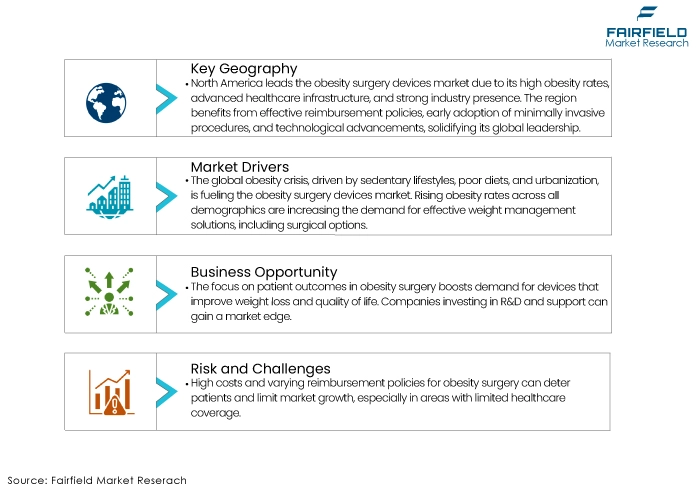
The escalating global obesity crisis is a primary driver for the obesity surgery devices market. The condition is becoming increasingly prevalent across all age groups and socioeconomic strata. This surge is attributed to factors such as sedentary lifestyles, unhealthy dietary habits, and rapid urbanization. As obesity rates continue to climb, the demand for effective weight management solutions, including surgical interventions, is expected to rise correspondingly.
Increasing Incidence of Obesity-Related Comorbidities
The association between obesity and chronic diseases is well-established. Conditions such as type 2 diabetes, cardiovascular diseases, sleep apnea, and certain types of cancer are closely linked to excessive weight. As the burden of these comorbidities grows, the need for surgical weight loss options to manage and prevent associated health complications is increasing. This trend is driving the demand in the obesity surgery devices market.
Advancements in Surgical Techniques and Device Technology
Technological innovations have significantly transformed the obesity surgery landscape. The development of minimally invasive procedures, such as laparoscopic and robotic surgery, has reduced surgical risks and recovery times. Moreover, the introduction of advanced devices, including staplers, trocars, and visualization systems, has enhanced surgical precision and efficiency. These advancements have expanded the scope of patient eligibility and contributed to the overall growth of the obesity surgery devices market.
Major Growth Barriers
High Costs, and Reimbursement Challenges
Obesity surgery and associated devices are often associated with high costs, including surgical fees, hospital stays, and device expenses. These financial burdens can deter patients from seeking treatment, particularly in regions with limited healthcare coverage. Additionally, reimbursement policies vary across different healthcare systems, with some insurers imposing restrictions on coverage for obesity surgery. These factors can hinder the growth of the obesity surgery devices market by limiting access to treatment.
Post-Operative Complications, and Long-Term Management
While obesity surgery can be highly effective, it is not without risks. Patients may experience complications such as infections, blood clots, and nutrient deficiencies. Moreover, long-term management, including dietary changes, physical activity, and regular medical follow-ups, is crucial for maintaining weight loss and overall health. The potential for complications and the requirement for ongoing care can influence patient decisions and impact market growth.
Obesity Surgery Devices Market Trends and Opportunities
Growing Emphasis on Patient Outcomes
There is a growing emphasis on patient-centered care and the long-term outcomes of obesity surgery. Healthcare providers and payers are increasingly focusing on the overall impact of treatment, including weight loss, improvement in quality of life, and reduction in comorbidities. This trend presents an opportunity for device manufacturers to develop products that contribute to better patient outcomes and demonstrate their value proposition. By investing in research and development to address specific patient needs and providing comprehensive support programs, companies can gain a competitive advantage in the obesity surgery devices market.
Acceptance and Normalization of Obesity Surgery
Obesity surgery is gradually shedding its stigma and becoming more accepted as a viable treatment option. This shift in societal perception is driven by increased awareness of the health risks associated with obesity, as well as the success stories of patients who have undergone the procedure. As a result, more individuals are considering obesity surgery as a potential solution, driving market growth.
Expansion into Developing Markets
Developing economies in regions like Latin America, the Middle East, and Africa present significant growth opportunities for the obesity surgery devices market. These regions are experiencing rapid urbanization, dietary changes, and rising obesity rates. By tailoring products and services to meet the specific needs of these markets and investing in local infrastructure and education, companies can capitalize on the growing demand for obesity care solutions.
Rise in Medical Tourism
Medical tourism is significantly impacting the obesity surgery devices market, particularly in regions with high procedure costs. Countries offering affordable yet high-quality bariatric surgeries are attracting patients from developed nations. This surge in medical tourism drives demand for obesity surgery devices in these destinations. However, it also presents challenges related to device standardization, supply chain management, and ensuring consistent postoperative care for patients traveling across borders.
Segments Covered in Obesity Surgery Devices Market Report
Minimally Invasive Surgical Devices Reign Supreme by Medical Devices/Implants
This segment dominates the market due to the growing preference for less invasive procedures. These devices, including laparoscopic instruments and staplers, are crucial for performing bariatric surgeries with reduced patient discomfort, shorter recovery times, and lower complication rates.
- Gastric Balloons
Gastric balloons are temporary weight management devices inserted into the stomach to reduce appetite. They are primarily used in patients with moderate obesity who are not candidates for surgery. Due to their minimally invasive nature and shorter treatment duration, these devices are gaining popularity. The market for gastric balloons is characterized by rapid growth and innovation, with a focus on improving balloon technology and patient comfort.
- Gastric Bands
Gastric bands are adjustable devices placed around the upper part of the stomach to create a smaller pouch. They are a less invasive option compared to gastric bypass surgery but require more postoperative adjustments. The market for gastric bands has seen a decline in recent years due to the emergence of more effective and durable alternatives like gastric sleeves and bypass surgeries. However, they still hold a niche market for specific patient populations.
Stapling Devices Eye a Growing Rate of Adoption
On the other side, the stapling devices, a subset of minimally invasive devices, hold a significant position. They are indispensable for creating precise tissue folds and incisions during various bariatric procedures, contributing to surgical efficiency and patient outcomes.
Stapling devices are essential instruments used in various bariatric surgeries, including gastric bypass, sleeve gastrectomy, and gastric banding. These devices create precise tissue folds and incisions, minimizing surgical time and complications. The stapling device market is dominated by a few key players offering a range of products for different surgical procedures. Advancements in stapler technology, such as improved tissue handling and sealing capabilities, are driving the obesity surgery devices market growth.
Hospitals to be the Primary End User Category
Hospitals remain the primary end users due to their comprehensive infrastructure, surgical expertise, and ability to handle complex procedures. The presence of specialized bariatric surgery units in larger hospitals further strengthens their dominance in this segment. On the other hand, specialty clinics are emerging as key players due to their focused approach to weight management. They offer specialized care, often in collaboration with hospitals, catering to a specific patient population and contributing towards the expansion of the obesity surgery devices market.
Hospitals are the primary end-users of obesity surgery devices, offering a comprehensive range of bariatric services. They have the necessary infrastructure, surgical expertise, and support staff to handle complex procedures. Large, tertiary care hospitals with dedicated bariatric surgery units tend to dominate the market. However, the trend towards minimally invasive procedures and shorter hospital stays is increasing the role of smaller hospitals.
Specialty clinics focused on weight management have emerged as significant end-users of obesity surgery devices. These clinics offer specialized care and personalized treatment plans for patients with obesity. They often collaborate with hospitals for surgical procedures but provide pre- and postoperative care, nutritional counseling, and behavior modification programs. The growth of specialty clinics is driven by the increasing demand for specialized weight management services.
Ambulatory surgical centers (ASCs) are playing a growing role in the obesity surgery device market. These facilities offer a cost-effective and convenient alternative to hospitals for minimally invasive procedures like gastric balloon placement and some types of bariatric surgery. The expansion of ASCs is driven by factors such as increasing healthcare costs, patient preference for outpatient settings, and the development of advanced minimally invasive techniques.
Regional Analysis
North America Holds a Dominant Market Revenue Share
North America, particularly the United States, is the dominant regional market for obesity surgery devices. The region has the highest prevalence of obesity and related comorbidities, driving the demand for effective weight management solutions. Advanced healthcare infrastructure, a strong presence of key industry players, and robust reimbursement policies contribute to the region's dominance in the obesity surgery devices market. Additionally, early adoption of minimally invasive procedures and technological advancements in obesity surgery devices have solidified North America's position as a global leader in this field.
Asia Pacific Emerges as a High-Growth Regional Market
The Asia Pacific region is emerging as a high-growth market for obesity surgery devices. Rapid urbanization, changing lifestyles, and increasing disposable incomes have led to a surge in obesity rates. While still in its early stages compared to North America, the region is witnessing a growing demand for bariatric surgeries. Factors such as increasing healthcare expenditure, government initiatives to address obesity, and the development of medical tourism are driving the growth of the obesity surgery devices market. Countries like India, China, and South Korea are expected to be major contributors to the region's expansion.
Fairfield’s Competitive Landscape Analysis
The obesity surgery devices market is characterized by a mix of established medical device companies and specialized bariatric surgery device manufacturers. Key players often possess strong research and development capabilities, extensive distribution networks, and a robust portfolio of products.
However, the market is also witnessing increased competition from emerging players focusing on innovative device technologies and patient-centric solutions. Strategic partnerships, mergers, and acquisitions are common strategies employed by companies to expand their market share and product offerings.
Key Market Players
- Johnson & Johnson
- Medtronic, Plc.
- Apollo Endosurgery Inc.
- Aspire Bariatrics Inc.
- Spatz FGIA Inc.
- MetaCure
- IntraPace Inc.
- TransEnterrix Inc
- Allergenc, Inc
- ReShape Medical, Inc
- Entero Medica, Inc
Global Obesity Surgery Devices Market is Segmented as-
By Medical Devices/ Implants
- Gastric Balloons
- Gastric Bands
- Stapling Devices
By End User
- Hospitals
- Specialty Clinics
- Ambulatory Surgical Centers
By Region
- North America
- Latin America
- Europe
- East Asia
- South Asia & Pacific
- Middle East & Africa
- Executive Summary
- Global Obesity Surgery Devices Market Snapshot
- Future Projections
- Key Market Trends
- Regional Snapshot, by Value, 2026
- Analyst Recommendations
- Market Overview
- Market Definitions and Segmentations
- Market Dynamics
- Drivers
- Restraints
- Market Opportunities
- Value Chain Analysis
- COVID-19 Impact Analysis
- Porter's Five Forces Analysis
- Impact of Russia-Ukraine Conflict
- PESTLE Analysis
- Regulatory Analysis
- Price Trend Analysis
- Current Prices and Future Projections, 2025-2033
- Price Impact Factors
- Global Obesity Surgery Devices Market Outlook, 2020 - 2033
- Global Obesity Surgery Devices Market Outlook, by Medical Devices/ Implants, Value (US$ Mn), 2020-2033
- Gastric Balloons
- Gastric Bands
- Stapling Devices
- Global Obesity Surgery Devices Market Outlook, by End User, Value (US$ Mn), 2020-2033
- Hospitals
- Specialty Clinics
- Ambulatory Surgical Centers
- Global Obesity Surgery Devices Market Outlook, by Region, Value (US$ Mn), 2020-2033
- North America
- Europe
- Asia Pacific
- Latin America
- Middle East & Africa
- Global Obesity Surgery Devices Market Outlook, by Medical Devices/ Implants, Value (US$ Mn), 2020-2033
- North America Obesity Surgery Devices Market Outlook, 2020 - 2033
- North America Obesity Surgery Devices Market Outlook, by Medical Devices/ Implants, Value (US$ Mn), 2020-2033
- Gastric Balloons
- Gastric Bands
- Stapling Devices
- North America Obesity Surgery Devices Market Outlook, by End User, Value (US$ Mn), 2020-2033
- Hospitals
- Specialty Clinics
- Ambulatory Surgical Centers
- North America Obesity Surgery Devices Market Outlook, by Country, Value (US$ Mn), 2020-2033
- S. Obesity Surgery Devices Market Outlook, by Medical Devices/ Implants, 2020-2033
- S. Obesity Surgery Devices Market Outlook, by End User, 2020-2033
- Canada Obesity Surgery Devices Market Outlook, by Medical Devices/ Implants, 2020-2033
- Canada Obesity Surgery Devices Market Outlook, by End User, 2020-2033
- BPS Analysis/Market Attractiveness Analysis
- North America Obesity Surgery Devices Market Outlook, by Medical Devices/ Implants, Value (US$ Mn), 2020-2033
- Europe Obesity Surgery Devices Market Outlook, 2020 - 2033
- Europe Obesity Surgery Devices Market Outlook, by Medical Devices/ Implants, Value (US$ Mn), 2020-2033
- Gastric Balloons
- Gastric Bands
- Stapling Devices
- Europe Obesity Surgery Devices Market Outlook, by End User, Value (US$ Mn), 2020-2033
- Hospitals
- Specialty Clinics
- Ambulatory Surgical Centers
- Europe Obesity Surgery Devices Market Outlook, by Country, Value (US$ Mn), 2020-2033
- Germany Obesity Surgery Devices Market Outlook, by Medical Devices/ Implants, 2020-2033
- Germany Obesity Surgery Devices Market Outlook, by End User, 2020-2033
- Italy Obesity Surgery Devices Market Outlook, by Medical Devices/ Implants, 2020-2033
- Italy Obesity Surgery Devices Market Outlook, by End User, 2020-2033
- France Obesity Surgery Devices Market Outlook, by Medical Devices/ Implants, 2020-2033
- France Obesity Surgery Devices Market Outlook, by End User, 2020-2033
- K. Obesity Surgery Devices Market Outlook, by Medical Devices/ Implants, 2020-2033
- K. Obesity Surgery Devices Market Outlook, by End User, 2020-2033
- Spain Obesity Surgery Devices Market Outlook, by Medical Devices/ Implants, 2020-2033
- Spain Obesity Surgery Devices Market Outlook, by End User, 2020-2033
- Russia Obesity Surgery Devices Market Outlook, by Medical Devices/ Implants, 2020-2033
- Russia Obesity Surgery Devices Market Outlook, by End User, 2020-2033
- Rest of Europe Obesity Surgery Devices Market Outlook, by Medical Devices/ Implants, 2020-2033
- Rest of Europe Obesity Surgery Devices Market Outlook, by End User, 2020-2033
- BPS Analysis/Market Attractiveness Analysis
- Europe Obesity Surgery Devices Market Outlook, by Medical Devices/ Implants, Value (US$ Mn), 2020-2033
- Asia Pacific Obesity Surgery Devices Market Outlook, 2020 - 2033
- Asia Pacific Obesity Surgery Devices Market Outlook, by Medical Devices/ Implants, Value (US$ Mn), 2020-2033
- Gastric Balloons
- Gastric Bands
- Stapling Devices
- Asia Pacific Obesity Surgery Devices Market Outlook, by End User, Value (US$ Mn), 2020-2033
- Hospitals
- Specialty Clinics
- Ambulatory Surgical Centers
- Asia Pacific Obesity Surgery Devices Market Outlook, by Country, Value (US$ Mn), 2020-2033
- China Obesity Surgery Devices Market Outlook, by Medical Devices/ Implants, 2020-2033
- China Obesity Surgery Devices Market Outlook, by End User, 2020-2033
- Japan Obesity Surgery Devices Market Outlook, by Medical Devices/ Implants, 2020-2033
- Japan Obesity Surgery Devices Market Outlook, by End User, 2020-2033
- South Korea Obesity Surgery Devices Market Outlook, by Medical Devices/ Implants, 2020-2033
- South Korea Obesity Surgery Devices Market Outlook, by End User, 2020-2033
- India Obesity Surgery Devices Market Outlook, by Medical Devices/ Implants, 2020-2033
- India Obesity Surgery Devices Market Outlook, by End User, 2020-2033
- Southeast Asia Obesity Surgery Devices Market Outlook, by Medical Devices/ Implants, 2020-2033
- Southeast Asia Obesity Surgery Devices Market Outlook, by End User, 2020-2033
- Rest of SAO Obesity Surgery Devices Market Outlook, by Medical Devices/ Implants, 2020-2033
- Rest of SAO Obesity Surgery Devices Market Outlook, by End User, 2020-2033
- BPS Analysis/Market Attractiveness Analysis
- Asia Pacific Obesity Surgery Devices Market Outlook, by Medical Devices/ Implants, Value (US$ Mn), 2020-2033
- Latin America Obesity Surgery Devices Market Outlook, 2020 - 2033
- Latin America Obesity Surgery Devices Market Outlook, by Medical Devices/ Implants, Value (US$ Mn), 2020-2033
- Gastric Balloons
- Gastric Bands
- Stapling Devices
- Latin America Obesity Surgery Devices Market Outlook, by End User, Value (US$ Mn), 2020-2033
- Hospitals
- Specialty Clinics
- Ambulatory Surgical Centers
- Latin America Obesity Surgery Devices Market Outlook, by Country, Value (US$ Mn), 2020-2033
- Brazil Obesity Surgery Devices Market Outlook, by Medical Devices/ Implants, 2020-2033
- Brazil Obesity Surgery Devices Market Outlook, by End User, 2020-2033
- Mexico Obesity Surgery Devices Market Outlook, by Medical Devices/ Implants, 2020-2033
- Mexico Obesity Surgery Devices Market Outlook, by End User, 2020-2033
- Argentina Obesity Surgery Devices Market Outlook, by Medical Devices/ Implants, 2020-2033
- Argentina Obesity Surgery Devices Market Outlook, by End User, 2020-2033
- Rest of LATAM Obesity Surgery Devices Market Outlook, by Medical Devices/ Implants, 2020-2033
- Rest of LATAM Obesity Surgery Devices Market Outlook, by End User, 2020-2033
- BPS Analysis/Market Attractiveness Analysis
- Latin America Obesity Surgery Devices Market Outlook, by Medical Devices/ Implants, Value (US$ Mn), 2020-2033
- Middle East & Africa Obesity Surgery Devices Market Outlook, 2020 - 2033
- Middle East & Africa Obesity Surgery Devices Market Outlook, by Medical Devices/ Implants, Value (US$ Mn), 2020-2033
- Gastric Balloons
- Gastric Bands
- Stapling Devices
- Middle East & Africa Obesity Surgery Devices Market Outlook, by End User, Value (US$ Mn), 2020-2033
- Hospitals
- Specialty Clinics
- Ambulatory Surgical Centers
- Middle East & Africa Obesity Surgery Devices Market Outlook, by Country, Value (US$ Mn), 2020-2033
- GCC Obesity Surgery Devices Market Outlook, by Medical Devices/ Implants, 2020-2033
- GCC Obesity Surgery Devices Market Outlook, by End User, 2020-2033
- South Africa Obesity Surgery Devices Market Outlook, by Medical Devices/ Implants, 2020-2033
- South Africa Obesity Surgery Devices Market Outlook, by End User, 2020-2033
- Egypt Obesity Surgery Devices Market Outlook, by Medical Devices/ Implants, 2020-2033
- Egypt Obesity Surgery Devices Market Outlook, by End User, 2020-2033
- Nigeria Obesity Surgery Devices Market Outlook, by Medical Devices/ Implants, 2020-2033
- Nigeria Obesity Surgery Devices Market Outlook, by End User, 2020-2033
- Rest of Middle East Obesity Surgery Devices Market Outlook, by Medical Devices/ Implants, 2020-2033
- Rest of Middle East Obesity Surgery Devices Market Outlook, by End User, 2020-2033
- BPS Analysis/Market Attractiveness Analysis
- Middle East & Africa Obesity Surgery Devices Market Outlook, by Medical Devices/ Implants, Value (US$ Mn), 2020-2033
- Competitive Landscape
- Company Vs Segment Heatmap
- Company Market Share Analysis, 2025
- Competitive Dashboard
- Company Profiles
- Johnson & Johnson
- Company Overview
- Product Portfolio
- Financial Overview
- Business Strategies and Developments
- Medtronic, Plc.
- Apollo Endosurgery Inc.
- Aspire Bariatrics Inc.
- Spatz FGIA Inc.
- MetaCure
- IntraPace Inc.
- TransEnterrix Inc
- Allergenc, Inc
- ReShape Medical, Inc
- Johnson & Johnson
- Appendix
- Research Methodology
- Report Assumptions
- Acronyms and Abbreviations
|
BASE YEAR |
HISTORICAL DATA |
FORECAST PERIOD |
UNITS |
|||
 |
2025 |
 |
2019 - 2024 |
 |
2026 - 2033 |
Value: US$ Billion |
|
REPORT FEATURES |
DETAILS |
|
Medical Devices/Implants Coverage |
|
|
End User Coverage |
|
|
Geographical Coverage |
|
|
Leading Companies |
|
|
Report Highlights |
Key Market Indicators, Macro-micro economic impact analysis, Technological Roadmap, Key Trends, Driver, Restraints, and Future Opportunities & Revenue Pockets, Porter’s 5 Forces Analysis, Historical Trend (2019-2021), Market Estimates and Forecast, Market Dynamics, Industry Trends, Competition Landscape, Category, Region, Country-wise Trends & Analysis, COVID-19 Impact Analysis (Demand and Supply Chain) |
Our Research Methodology
Considering the volatility of business today, traditional approaches to strategizing a game plan can be unfruitful if not detrimental. True ambiguity is no way to determine a forecast. A myriad of predetermined factors must be accounted for such as the degree of risk involved, the magnitude of circumstances, as well as conditions or consequences that are not known or unpredictable. To circumvent binary views that cast uncertainty, the application of market research intelligence to strategically posture, move, and enable actionable outcomes is necessary.
View Methodology
Quality Assured
Rigorous Validation Process

Confidentiality Assured
End-to-end Data Security

Custom Research Services
Tailored To Your Objectives
FAQs
It involves the production and sale of medical devices used in surgical procedures to treat obesity, such as gastric bands, staplers, and bypass devices.
Growth is driven by the rising prevalence of obesity, increasing awareness of surgical treatment options, and advancements in minimally invasive surgical techniques.
North America and Europe dominate due to high obesity rates and advanced healthcare infrastructure.
Popular devices include gastric bands, intragastric balloons, and bariatric surgical staplers.
Challenges include high costs of surgery, potential complications, and the need for long-term patient follow-up and support.
Related Reports
Global Infant Incubator Insights, Competitive Landscape, and Market Forecast 2033
Infant Incubator Market to reach US$1,306.72 Mn by 2033, growing at 5.3% CAGR, driven by preterm births, NICU expansion and transport incubators care.
Pulse Electromagnetic Field Therapy Devices Market Insights, Competitive Landscape, and Market Forecast 2026–2033
Pulse Electromagnetic Field Therapy Devices Market to reach US$930.86 Mn by 2033, driven by pain management and wearable devices.
Vaginal Rejuvenation Market Insights, Competitive Landscape, and Market Forecast 2026–2033
Vaginal Rejuvenation Market to Reach US$26.75 Billion by 2033, Driven by Rising Demand for Minimally Invasive Women's Health Solutions.
Red Light Therapy Market Insights, Competitive Landscape, and Market Forecast 2033
The red light therapy market will grow from US$587.50 Mn in 2026 to US$1,130.38 Mn by 2033 at a 9.8% CAGR, driven by clinical adoption & FDA clearances.
Sterilization Equipment Market Insights, Competitive Landscape, and Market Forecast 2033
Sterilization Equipment Market is projected to reach US$31.56 billion by 2033, driven by infection control, hospital expansion, and advanced technologies.
Dental Crowns and Bridges Market Insights, Competitive Landscape, and Market Forecast 2026–2033
The dental crowns and bridges market will grow from US$3.90 billion in 2026 to US$6.77 billion by 2033, driven by aging populations and dental care demand.