



Power Transformer Market
Power Transformer Market Insights, Competitive Landscape, and Market Forecast - 2033
Global Power Transformers Market: Strategic Analysis 2026-2033
Key Market Highlights
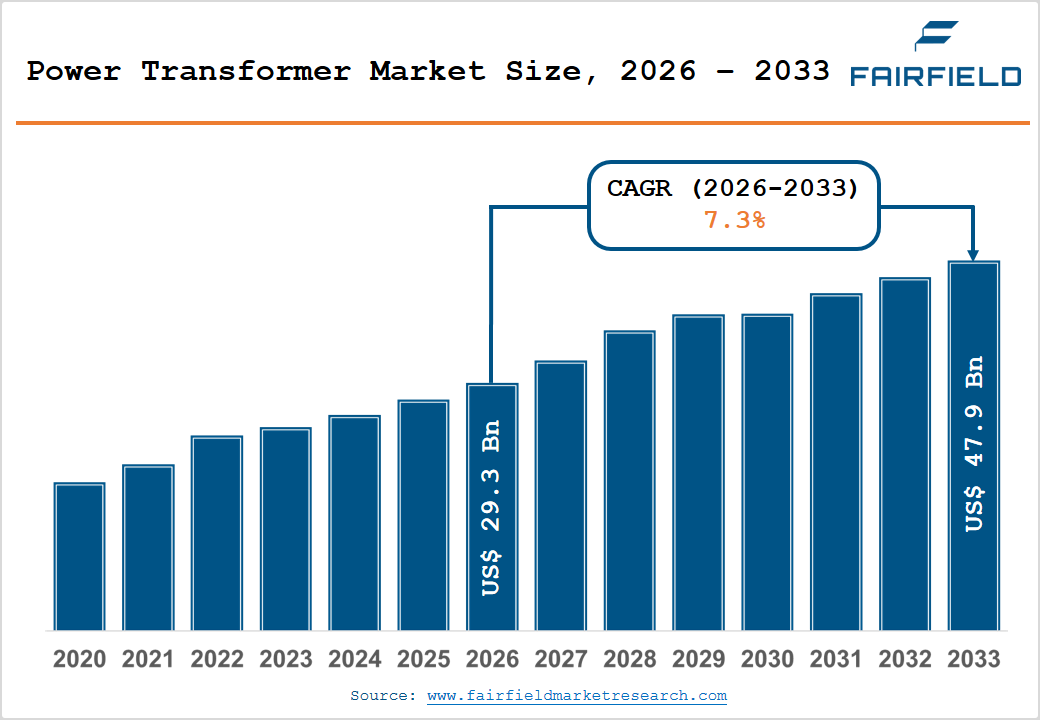
- The global Power Transformer Market size is likely to be valued at US$29.3 billion in 2026 and is expected to reach US$47.9 billion by 2033, growing at a CAGR of 7.30% during the forecast period from 2026 to 2033.
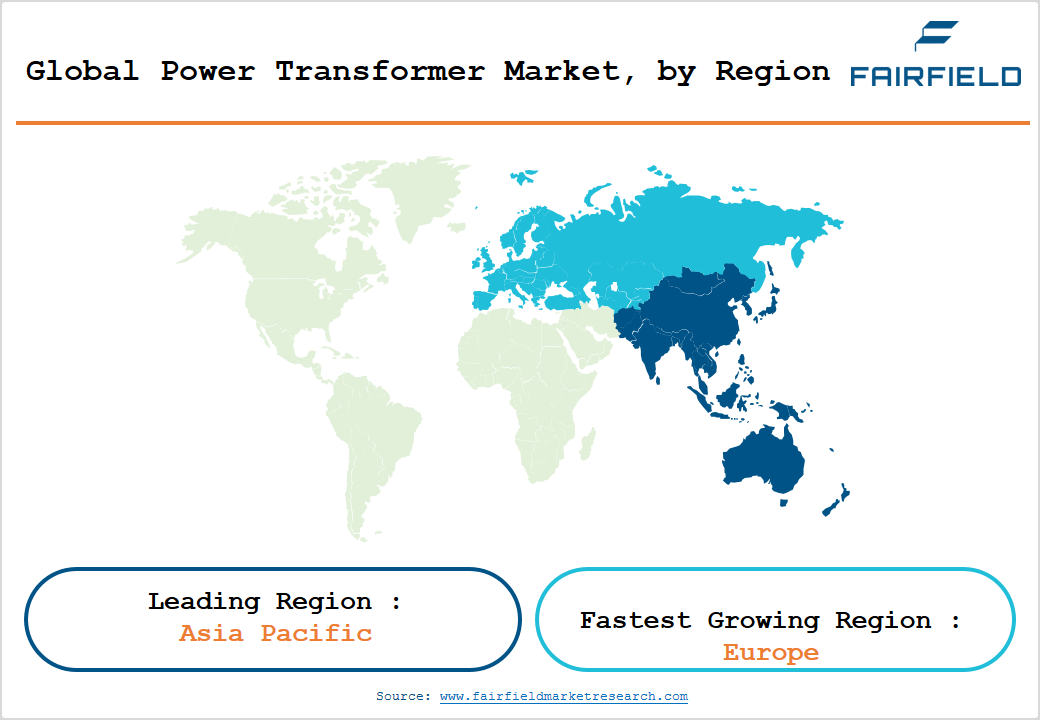
- North America leads the global power transformer market, supported by the S. Bipartisan Infrastructure Law's over US$65 billion grid modernization commitment and aging transformer replacement cycles driven by NERC grid reliability mandates.
- Asia Pacific is the fastest-growing region, led by China's UHV grid investments, India's ₹3 Trillion RDSS modernization program, and accelerating electrification across ASEAN economies, driving sustained transformer procurement demand.
- The Utilities application segment commands approximately 55% of market share, driven by TSO and DSO procurement for grid expansion, renewable energy integration, and aging infrastructure replacement mandated by FERC and the European Commission
- The 801 MVA to 1200 MVA high-rating category is the fastest-growing segment, fueled by escalating UHV and HVDC transmission projects in China, India, and Europe requiring large-format, high-capacity transmission transformers.
- HVDC and UHV transformer systems represent the most significant high-value opportunity, with the IEA projecting fivefold HVDC investment growth by 2030, creating premium demand for specialized converter and power transformer solutions globally.
Market Dynamics: Drivers, Restraints, and Opportunities
Market Growth Drivers
- Accelerating Renewable Energy Integration and Grid Expansion
The global push to decarbonize electricity systems is one of the most powerful structural drivers of power transformer demand. As solar, wind, and other renewable energy sources scale rapidly, the International Renewable Energy Agency (IRENA) reports that renewable capacity additions reached a record 295 GW in 2022 and continue to accelerate. Power grids require substantial transformer infrastructure to step up and transmit variable generation to load centers. The U.S. Bipartisan Infrastructure Law has allocated over US$65 billion for grid modernization, including transformer procurement and installation. Similarly, the European Union's REPowerEU plan targets 45% renewable energy by 2030, requiring an estimated 584 GW of additional grid-connected renewable capacity. These mandates directly translate into sustained demand for high-voltage power transformers across the 100 MVA to 1200 MVA rating range.
- Aging Grid Infrastructure Replacement Cycle in Developed Economies
A significant portion of the installed power transformer base in North America and Europe is approaching or has exceeded its operational design life of 25-40 years. The U.S. Department of Energy (DOE) estimates that over 70% of the United States' large power transformers are more than 25 years old, creating an urgent and large-scale replacement demand. In Europe, the European Network of Transmission System Operators for Electricity (ENTSO-E) has documented significant grid infrastructure aging across member state networks. The financial and grid reliability risks associated with transformer failures, including costly outages and economic losses, are compelling utilities to accelerate procurement cycles, benefiting established manufacturers such as ABB Ltd., Siemens Energy, and GE Co.
Market Restraints
- Extended Lead Times and Supply Chain Constraints for Large Power Transformers
Large power transformers (LPTs), particularly those rated above 100 MVA face severe supply chain constraints driven by limited global manufacturing capacity and complex, customized production requirements. Lead times for high-rating transformers currently range from 12 to 24 months or more, as reported by the U.S. DOE's Office of Electricity. Specialized raw material dependencies, including grain-oriented electrical steel (GOES) and high-purity copper windings, further compound supply bottlenecks, constraining the market's ability to respond rapidly to surging demand from utilities and renewable energy developers.
- High Capital Cost and Financing Barriers in Emerging Markets
Power transformers, particularly high-voltage and high-rating units, represent significant capital expenditures that can present financing barriers in cost-sensitive emerging markets. The upfront procurement cost of an ultra-high-voltage transformer can exceed US$10 million per unit. In many Latin American and Sub-Saharan African markets, constrained public utility budgets and limited access to long-term infrastructure financing inhibit procurement timelines, slowing market penetration and grid electrification progress despite strong underlying demand fundamentals.
Market Opportunities
- HVDC and UHV Transmission Infrastructure for Long-Distance Renewable Energy Transport
The deployment of High Voltage Direct Current (HVDC) and Ultra-High Voltage (UHV) transmission systems represents one of the most technically advanced and commercially significant growth frontiers in the power transformer market. HVDC technology enables low-loss transmission of renewable electricity over distances exceeding 1,000 km, making it essential for connecting offshore wind farms, remote solar installations, and cross-border electricity grids. China's State Grid Corporation has commissioned multiple 1,000 kV UHV AC and 800 kV UHV DC transmission projects requiring specialized converter and power transformers. The IEA projects that HVDC grid investment must grow fivefold by 2030 to meet net-zero targets. Manufacturers with UHV transformer capabilities including ABB Ltd., Siemens Energy, and Mitsubishi Electric Corporation are exceptionally well-positioned to capture this high-value segment.
- HVDC and UHV Transmission Infrastructure for Long-Distance Renewable Energy Transport
The convergence of power electronics and digital technologies is spawning a new generation of smart power transformers and digital substations that offer real-time monitoring, predictive maintenance, and enhanced grid control capabilities. Governments and utilities globally are investing in digital grid modernization: the European Commission's Smart Grids Task Force estimates that Europe requires investment of up to €584 Billion in grid infrastructure by 2030. Smart transformers equipped with Internet of Things (IoT) sensors, condition monitoring systems, and advanced insulation monitoring reduce unplanned outages and extend asset lifespans. This digital transformation represents a premium revenue opportunity for manufacturers, enabling differentiated, higher-margin product offerings to utilities seeking to optimize asset management within constrained capital budgets. Companies such as ABB Ltd., Siemens Energy, and Toshiba Corp. are actively developing and commercializing smart transformer solutions.
Segmentation Analysis: Category-Wise Strategic Assessment
- By Core Analysis
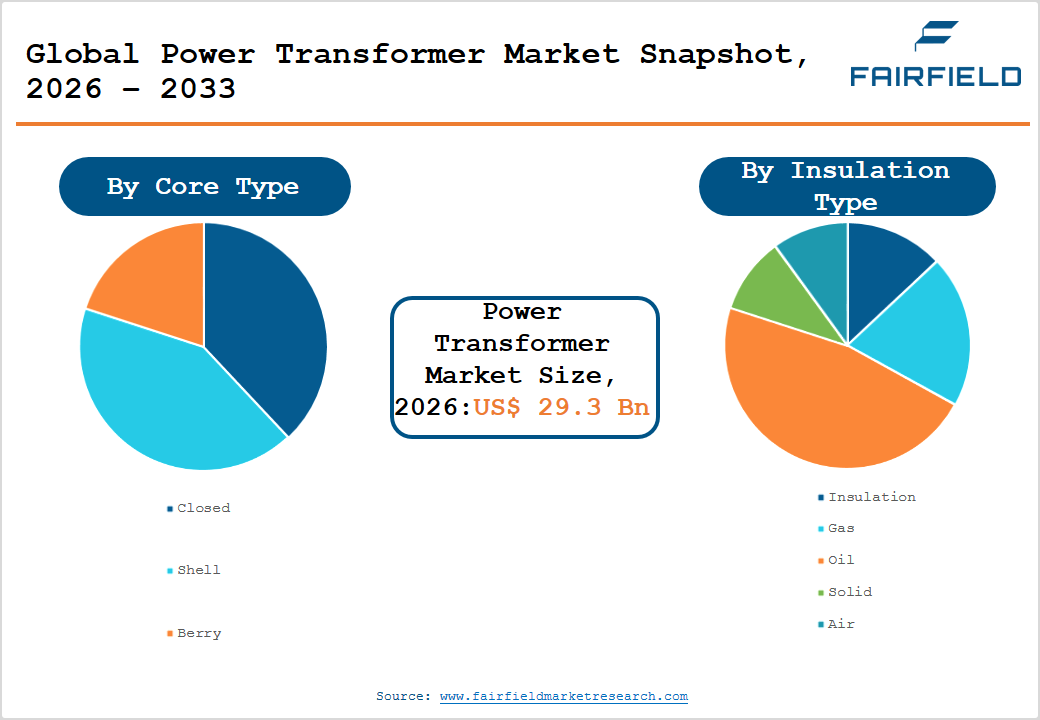
The Shell Core type holds the dominant position in the global power transformer market by core construction, accounting for approximately 52% of total market share. Shell-type transformers are preferred in high-power utility and industrial applications due to their superior short-circuit withstand capability, better magnetic shielding, and lower leakage inductance. These characteristics make them particularly suited for large transmission-class transformers rated above 100 MVA. The IEEE and IEC standards bodies recognize shell-form transformers as a preferred design for very high-power applications. Their robust construction also supports enhanced overload capacity, a critical requirement for utilities managing variable renewable generation and peak demand events. Key manufacturers including ABB Ltd. and Siemens Energy offer advanced shell-type designs in their high-voltage portfolios.
- By Insulation Analysis
The Oil-Insulated segment dominates the insulation category, representing approximately 65% of total power transformer deployments globally. Mineral oil insulation has been the industry standard for over a century due to its excellent dielectric properties, superior heat dissipation, self-healing capability, and cost effectiveness. The IEC 60296 standard governs the quality requirements for transformer insulating oils. Despite growing interest in environmentally friendly ester-based and silicone oils, mineral oil transformers continue to dominate utility-scale installations particularly in the 100 MVA to 1200 MVA rating band given their proven reliability and the established global maintenance ecosystem. Regulatory pressure in the EU regarding biodegradable alternatives is, however, beginning to stimulate gradual adoption of natural ester alternatives.
- By Phase Analysis
The Three-Phase transformer segment accounts for the dominant share of the global power transformer market, representing approximately 78% of total volume. Three-phase transformers are the standard for all utility-scale transmission and distribution applications due to their inherent efficiency advantages they require less copper and core material than an equivalent bank of three single-phase units and compact footprint. IEC 60076, the international standard for power transformers, is predominantly written around three-phase designs, reflecting their universal adoption in grid infrastructure. High-voltage transmission projects across China, India, and North America are virtually entirely based on three-phase transformer configurations, cementing this segment's market leadership throughout the forecast period.
- By Rating Analysis
The 100 MVA to 500 MVA rating band leads the power transformer market by capacity, accounting for approximately 48% of total deployments. This rating range represents the workhorse of national transmission grids, applicable to subtransmission substations, large industrial facilities, and utility-scale renewable energy interconnections. The broad applicability of this rating class across generation tie-ins, regional transmission networks, and distribution substations ensures consistently high procurement volumes from both utilities and independent power producers (IPPs). The U.S. DOE and ENTSO-E both classify this capacity range as a priority procurement tier in their grid infrastructure investment frameworks, supporting robust demand visibility for transformer manufacturers throughout the 2026–2033 forecast window.
- By Application Analysis
The Utilities application segment holds the dominant position, accounting for approximately 55% of total market share. Electric utilities including both transmission system operators (TSOs) and distribution system operators (DSOs) represent the single largest and most consistent source of power transformer demand globally. Grid expansion, renewable energy integration, and aging infrastructure replacement all converge within the utilities segment to create multi-year procurement pipelines. The U.S. Federal Energy Regulatory Commission (FERC) and the European Commission have both issued directives and investment mandates that directly stimulate utility transformer procurement. Major utility customers of leading manufacturers such as Bharat Heavy Electricals Limited (BHEL) and Crompton Greaves Ltd. include national grid operators across India, Europe, and Southeast Asia.
Regional Market Assessment: Strategic Geography
- North America Power Transformer Market Trends
North America is the leading regional market for power transformers, driven by the United States' urgent grid modernization agenda and landmark federal infrastructure investments. The U.S. Bipartisan Infrastructure Law has committed over US$ 65 Billion for electricity grid upgrades, including transformer procurement, while the Inflation Reduction Act (IRA) provides clean energy tax incentives that are accelerating renewable generation buildout and with it, associated transformer demand. The U.S. DOE has also initiated the Grid Resilience and Innovation Partnerships (GRIP) program to address transformer supply chain vulnerabilities.
Canada's grid expansion including inter-provincial transmission links and hydropower infrastructure further contributes to North American demand. The North American Electric Reliability Corporation (NERC) has flagged transformer availability as a critical grid reliability risk in its annual assessments, prompting both government procurement initiatives and domestic manufacturing incentives. Companies such as GE Co. and ABB Ltd. maintain significant North American manufacturing and service footprints to address this demand.
- Europe Power Transformer Market Trends
Europe represents a major power transformer market, underpinned by the region's ambitious European Green Deal and REPowerEU energy transition targets. Germany as Europe's largest economy and a leader in renewable energy is investing heavily in Energiewende grid upgrades, requiring extensive transmission transformer procurement. The U.K. is driving demand through its offshore wind expansion program and interconnector projects, while France and Spain are modernizing aging nuclear and hydro-linked grid infrastructure.
The ENTSO-E Ten-Year Network Development Plan (TYNDP) identifies over €100 Billion in required cross-border grid investment by 2030. Regulatory harmonization under EU grid codes and the Network Codes Regulation is standardizing transformer performance requirements across member states. Manufacturers like Siemens Energy and ABB Ltd. are well-positioned to serve this demand, with European production facilities aligned to IEC and CENELEC standards.
- Asia Pacific Power Transformer Market Trends
Asia Pacific is the fastest-growing region in the global power transformer market, led by China's massive UHV grid expansion, India's National Electricity Plan, and rapid electrification across ASEAN nations. China's State Grid Corporation is the world's single largest power transformer procurer, driving demand for both domestic manufacturers and global suppliers through its multi-billion dollar annual capital expenditure programs. China's investment in 1,000 kV UHV AC and 800 kV UHV DC projects positions it as the global benchmark for high-voltage transformer technology.
India's Ministry of Power is implementing the Revamped Distribution Sector Scheme (RDSS) with an outlay of over ₹3 Trillion to modernize electricity distribution infrastructure, including extensive transformer replacements. ASEAN economies particularly Vietnam, Indonesia, and Philippines are experiencing rapid industrial and urban load growth. Regional manufacturers such as Hyundai Heavy Industries Co. Ltd., Bharat Heavy Electricals Limited (BHEL), and Toshiba Corp. leverage competitive cost structures and regional proximity to serve this dynamic market.
Competitive Landscape: Market Structure and strategic Positioning
The global power transformer market is moderately consolidated at the high-end (>100 MVA) segment, with a limited number of technically capable global players including ABB Ltd., Siemens Energy, GE Co., Mitsubishi Electric, and Toshiba Corp. dominating the market. The lower-rating distribution transformer segment is more fragmented, with numerous regional manufacturers competing on price. Market leaders differentiate through proprietary insulation technologies, IEC/IEEE certifications, digital monitoring capabilities, and service network breadth. Vertical integration, strategic acquisitions, and R&D investment in HVDC and smart transformer technologies are the primary competitive strategies employed by leading participants.
Key Players
- Alstom SA
- ABB Ltd.
- Crompton Greaves Ltd.
- Bharat Heavy Electricals Limited (BHEL)
- GE Co.
- Hyosung Power & Industrial Systems Performance Group
- Hyundai Heavy Industries Co. Ltd.
- Toshiba Corp.
- Siemens Energy
- Mitsubishi Electric Corporation
- Schneider Electric SE
- Eaton Corporation PLC
- SPX Transformer Solutions, Inc.
- WEG S.A.
- TBEA Co., Ltd.
Key Industry Developments
- January, 2025: Siemens Energy announced a major order for HVDC transformer systems supporting a cross-border renewable energy interconnection project in Europe, reinforcing its leadership in ultra-high-voltage transformer technology.
- September, 2024: ABB Ltd. launched its next-generation TXpert™ digital power transformer series featuring integrated IoT-based condition monitoring and AI-driven predictive maintenance capabilities for utility customers.
- March, 2024: Bharat Heavy Electricals Limited (BHEL) secured a large order from India's national grid operator for 765 kV power transformers as part of the country's inter-state transmission system expansion under the National Electricity Plan.
Global Power Transformer Market Segmentation-
By Core
- Closed
- Shell
- Berry
By Insulation
- Gas
- Oil
- Solid
- Air
By Phase
- Single
- Three
By Rating
- 100 MVA to 500 MVA
- 501 MVA to 800 MVA
- 801 MVA to 1200 MVA
By Application
- Residential & Commercial
- Utilities
- Industrial
By Region
- North America
- Europe
- Asia Pacific
- Latin America
- Middle East & Africa
- Executive Summary
- Global Power Transformer Market Snapshot
- Future Projections
- Key Market Trends
- Regional Snapshot, by Value, 2026
- Analyst Recommendations
- Market Overview
- Market Definitions and Segmentations
- Market Dynamics
- Drivers
- Restraints
- Market Opportunities
- Value Chain Analysis
- COVID-19 Impact Analysis
- Porter's Five Forces Analysis
- Impact of Russia-Ukraine Conflict
- PESTLE Analysis
- Regulatory Analysis
- Price Trend Analysis
- Current Prices and Future Projections, 2025-2033
- Price Impact Factors
- Global Power Transformer Market Outlook, 2020 - 2033
- Global Power Transformer Market Outlook, by Core, Value (US$ Bn), 2020-2033
- Closed
- Shell
- Berry
- Global Power Transformer Market Outlook, by Insulation, Value (US$ Bn), 2020-2033
- Gas
- Oil
- Solid
- Air
- Global Power Transformer Market Outlook, by Phase, Value (US$ Bn), 2020-2033
- Single
- Three
- Global Power Transformer Market Outlook, by Rating, Value (US$ Bn), 2020-2033
- 100 MVA to 500 MVA
- 501 MVA to 800 MVA
- 801 MVA to 1200 MVA
- Global Power Transformer Market Outlook, by Application, Value (US$ Bn), 2020-2033
- Residential & Commercial
- Utilities
- Industrial
- Global Power Transformer Market Outlook, by Region, Value (US$ Bn), 2020-2033
- North America
- Europe
- Asia Pacific
- Latin America
- Middle East & Africa
- Global Power Transformer Market Outlook, by Core, Value (US$ Bn), 2020-2033
- North America Power Transformer Market Outlook, 2020 - 2033
- North America Power Transformer Market Outlook, by Core, Value (US$ Bn), 2020-2033
- Closed
- Shell
- Berry
- North America Power Transformer Market Outlook, by Insulation, Value (US$ Bn), 2020-2033
- Gas
- Oil
- Solid
- Air
- North America Power Transformer Market Outlook, by Phase, Value (US$ Bn), 2020-2033
- Single
- Three
- North America Power Transformer Market Outlook, by Rating, Value (US$ Bn), 2020-2033
- 100 MVA to 500 MVA
- 501 MVA to 800 MVA
- 801 MVA to 1200 MVA
- North America Power Transformer Market Outlook, by Application, Value (US$ Bn), 2020-2033
- Residential & Commercial
- Utilities
- Industrial
- North America Power Transformer Market Outlook, by Country, Value (US$ Bn), 2020-2033
- U.S. Power Transformer Market Outlook, by Core, 2020-2033
- U.S. Power Transformer Market Outlook, by Insulation, 2020-2033
- U.S. Power Transformer Market Outlook, by Phase, 2020-2033
- U.S. Power Transformer Market Outlook, by Rating, 2020-2033
- U.S. Power Transformer Market Outlook, by Application, 2020-2033
- Canada Power Transformer Market Outlook, by Core, 2020-2033
- Canada Power Transformer Market Outlook, by Insulation, 2020-2033
- Canada Power Transformer Market Outlook, by Phase, 2020-2033
- Canada Power Transformer Market Outlook, by Rating, 2020-2033
- Canada Power Transformer Market Outlook, by Application, 2020-2033
- BPS Analysis/Market Attractiveness Analysis
- North America Power Transformer Market Outlook, by Core, Value (US$ Bn), 2020-2033
- Europe Power Transformer Market Outlook, 2020 - 2033
- Europe Power Transformer Market Outlook, by Core, Value (US$ Bn), 2020-2033
- Closed
- Shell
- Berry
- Europe Power Transformer Market Outlook, by Insulation, Value (US$ Bn), 2020-2033
- Gas
- Oil
- Solid
- Air
- Europe Power Transformer Market Outlook, by Phase, Value (US$ Bn), 2020-2033
- Single
- Three
- Europe Power Transformer Market Outlook, by Rating, Value (US$ Bn), 2020-2033
- 100 MVA to 500 MVA
- 501 MVA to 800 MVA
- 801 MVA to 1200 MVA
- Europe Power Transformer Market Outlook, by Application, Value (US$ Bn), 2020-2033
- Residential & Commercial
- Utilities
- Industrial
- Europe Power Transformer Market Outlook, by Country, Value (US$ Bn), 2020-2033
- Germany Power Transformer Market Outlook, by Core, 2020-2033
- Germany Power Transformer Market Outlook, by Insulation, 2020-2033
- Germany Power Transformer Market Outlook, by Phase, 2020-2033
- Germany Power Transformer Market Outlook, by Rating, 2020-2033
- Germany Power Transformer Market Outlook, by Application, 2020-2033
- Italy Power Transformer Market Outlook, by Core, 2020-2033
- Italy Power Transformer Market Outlook, by Insulation, 2020-2033
- Italy Power Transformer Market Outlook, by Phase, 2020-2033
- Italy Power Transformer Market Outlook, by Rating, 2020-2033
- Italy Power Transformer Market Outlook, by Application, 2020-2033
- France Power Transformer Market Outlook, by Core, 2020-2033
- France Power Transformer Market Outlook, by Insulation, 2020-2033
- France Power Transformer Market Outlook, by Phase, 2020-2033
- France Power Transformer Market Outlook, by Rating, 2020-2033
- France Power Transformer Market Outlook, by Application, 2020-2033
- U.K. Power Transformer Market Outlook, by Core, 2020-2033
- U.K. Power Transformer Market Outlook, by Insulation, 2020-2033
- U.K. Power Transformer Market Outlook, by Phase, 2020-2033
- U.K. Power Transformer Market Outlook, by Rating, 2020-2033
- U.K. Power Transformer Market Outlook, by Application, 2020-2033
- Spain Power Transformer Market Outlook, by Core, 2020-2033
- Spain Power Transformer Market Outlook, by Insulation, 2020-2033
- Spain Power Transformer Market Outlook, by Phase, 2020-2033
- Spain Power Transformer Market Outlook, by Rating, 2020-2033
- Spain Power Transformer Market Outlook, by Application, 2020-2033
- Russia Power Transformer Market Outlook, by Core, 2020-2033
- Russia Power Transformer Market Outlook, by Insulation, 2020-2033
- Russia Power Transformer Market Outlook, by Phase, 2020-2033
- Russia Power Transformer Market Outlook, by Rating, 2020-2033
- Russia Power Transformer Market Outlook, by Application, 2020-2033
- Rest of Europe Power Transformer Market Outlook, by Core, 2020-2033
- Rest of Europe Power Transformer Market Outlook, by Insulation, 2020-2033
- Rest of Europe Power Transformer Market Outlook, by Phase, 2020-2033
- Rest of Europe Power Transformer Market Outlook, by Rating, 2020-2033
- Rest of Europe Power Transformer Market Outlook, by Application, 2020-2033
- BPS Analysis/Market Attractiveness Analysis
- Europe Power Transformer Market Outlook, by Core, Value (US$ Bn), 2020-2033
- Asia Pacific Power Transformer Market Outlook, 2020 - 2033
- Asia Pacific Power Transformer Market Outlook, by Core, Value (US$ Bn), 2020-2033
- Closed
- Shell
- Berry
- Asia Pacific Power Transformer Market Outlook, by Insulation, Value (US$ Bn), 2020-2033
- Gas
- Oil
- Solid
- Air
- Asia Pacific Power Transformer Market Outlook, by Phase, Value (US$ Bn), 2020-2033
- Single
- Three
- Asia Pacific Power Transformer Market Outlook, by Rating, Value (US$ Bn), 2020-2033
- 100 MVA to 500 MVA
- 501 MVA to 800 MVA
- 801 MVA to 1200 MVA
- Asia Pacific Power Transformer Market Outlook, by Application, Value (US$ Bn), 2020-2033
- Residential & Commercial
- Utilities
- Industrial
- Asia Pacific Power Transformer Market Outlook, by Country, Value (US$ Bn), 2020-2033
- China Power Transformer Market Outlook, by Core, 2020-2033
- China Power Transformer Market Outlook, by Insulation, 2020-2033
- China Power Transformer Market Outlook, by Phase, 2020-2033
- China Power Transformer Market Outlook, by Rating, 2020-2033
- China Power Transformer Market Outlook, by Application, 2020-2033
- Japan Power Transformer Market Outlook, by Core, 2020-2033
- Japan Power Transformer Market Outlook, by Insulation, 2020-2033
- Japan Power Transformer Market Outlook, by Phase, 2020-2033
- Japan Power Transformer Market Outlook, by Rating, 2020-2033
- Japan Power Transformer Market Outlook, by Application, 2020-2033
- South Korea Power Transformer Market Outlook, by Core, 2020-2033
- South Korea Power Transformer Market Outlook, by Insulation, 2020-2033
- South Korea Power Transformer Market Outlook, by Phase, 2020-2033
- South Korea Power Transformer Market Outlook, by Rating, 2020-2033
- South Korea Power Transformer Market Outlook, by Application, 2020-2033
- India Power Transformer Market Outlook, by Core, 2020-2033
- India Power Transformer Market Outlook, by Insulation, 2020-2033
- India Power Transformer Market Outlook, by Phase, 2020-2033
- India Power Transformer Market Outlook, by Rating, 2020-2033
- India Power Transformer Market Outlook, by Application, 2020-2033
- Southeast Asia Power Transformer Market Outlook, by Core, 2020-2033
- Southeast Asia Power Transformer Market Outlook, by Insulation, 2020-2033
- Southeast Asia Power Transformer Market Outlook, by Phase, 2020-2033
- Southeast Asia Power Transformer Market Outlook, by Rating, 2020-2033
- Southeast Asia Power Transformer Market Outlook, by Application, 2020-2033
- Rest of SAO Power Transformer Market Outlook, by Core, 2020-2033
- Rest of SAO Power Transformer Market Outlook, by Insulation, 2020-2033
- Rest of SAO Power Transformer Market Outlook, by Phase, 2020-2033
- Rest of SAO Power Transformer Market Outlook, by Rating, 2020-2033
- Rest of SAO Power Transformer Market Outlook, by Application, 2020-2033
- BPS Analysis/Market Attractiveness Analysis
- Asia Pacific Power Transformer Market Outlook, by Core, Value (US$ Bn), 2020-2033
- Latin America Power Transformer Market Outlook, 2020 - 2033
- Latin America Power Transformer Market Outlook, by Core, Value (US$ Bn), 2020-2033
- Closed
- Shell
- Berry
- Latin America Power Transformer Market Outlook, by Insulation, Value (US$ Bn), 2020-2033
- Gas
- Oil
- Solid
- Air
- Latin America Power Transformer Market Outlook, by Phase, Value (US$ Bn), 2020-2033
- Single
- Three
- Latin America Power Transformer Market Outlook, by Rating, Value (US$ Bn), 2020-2033
- 100 MVA to 500 MVA
- 501 MVA to 800 MVA
- 801 MVA to 1200 MVA
- Latin America Power Transformer Market Outlook, by Application, Value (US$ Bn), 2020-2033
- Residential & Commercial
- Utilities
- Industrial
- Latin America Power Transformer Market Outlook, by Country, Value (US$ Bn), 2020-2033
- Brazil Power Transformer Market Outlook, by Core, 2020-2033
- Brazil Power Transformer Market Outlook, by Insulation, 2020-2033
- Brazil Power Transformer Market Outlook, by Phase, 2020-2033
- Brazil Power Transformer Market Outlook, by Rating, 2020-2033
- Brazil Power Transformer Market Outlook, by Application, 2020-2033
- Mexico Power Transformer Market Outlook, by Core, 2020-2033
- Mexico Power Transformer Market Outlook, by Insulation, 2020-2033
- Mexico Power Transformer Market Outlook, by Phase, 2020-2033
- Mexico Power Transformer Market Outlook, by Rating, 2020-2033
- Mexico Power Transformer Market Outlook, by Application, 2020-2033
- Argentina Power Transformer Market Outlook, by Core, 2020-2033
- Argentina Power Transformer Market Outlook, by Insulation, 2020-2033
- Argentina Power Transformer Market Outlook, by Phase, 2020-2033
- Argentina Power Transformer Market Outlook, by Rating, 2020-2033
- Argentina Power Transformer Market Outlook, by Application, 2020-2033
- Rest of LATAM Power Transformer Market Outlook, by Core, 2020-2033
- Rest of LATAM Power Transformer Market Outlook, by Insulation, 2020-2033
- Rest of LATAM Power Transformer Market Outlook, by Phase, 2020-2033
- Rest of LATAM Power Transformer Market Outlook, by Rating, 2020-2033
- Rest of LATAM Power Transformer Market Outlook, by Application, 2020-2033
- BPS Analysis/Market Attractiveness Analysis
- Latin America Power Transformer Market Outlook, by Core, Value (US$ Bn), 2020-2033
- Middle East & Africa Power Transformer Market Outlook, 2020 - 2033
- Middle East & Africa Power Transformer Market Outlook, by Core, Value (US$ Bn), 2020-2033
- Closed
- Shell
- Berry
- Middle East & Africa Power Transformer Market Outlook, by Insulation, Value (US$ Bn), 2020-2033
- Gas
- Oil
- Solid
- Air
- Middle East & Africa Power Transformer Market Outlook, by Phase, Value (US$ Bn), 2020-2033
- Single
- Three
- Middle East & Africa Power Transformer Market Outlook, by Rating, Value (US$ Bn), 2020-2033
- 100 MVA to 500 MVA
- 501 MVA to 800 MVA
- 801 MVA to 1200 MVA
- Middle East & Africa Power Transformer Market Outlook, by Application, Value (US$ Bn), 2020-2033
- Residential & Commercial
- Utilities
- Industrial
- Middle East & Africa Power Transformer Market Outlook, by Country, Value (US$ Bn), 2020-2033
- GCC Power Transformer Market Outlook, by Core, 2020-2033
- GCC Power Transformer Market Outlook, by Insulation, 2020-2033
- GCC Power Transformer Market Outlook, by Phase, 2020-2033
- GCC Power Transformer Market Outlook, by Rating, 2020-2033
- GCC Power Transformer Market Outlook, by Application, 2020-2033
- South Africa Power Transformer Market Outlook, by Core, 2020-2033
- South Africa Power Transformer Market Outlook, by Insulation, 2020-2033
- South Africa Power Transformer Market Outlook, by Phase, 2020-2033
- South Africa Power Transformer Market Outlook, by Rating, 2020-2033
- South Africa Power Transformer Market Outlook, by Application, 2020-2033
- Egypt Power Transformer Market Outlook, by Core, 2020-2033
- Egypt Power Transformer Market Outlook, by Insulation, 2020-2033
- Egypt Power Transformer Market Outlook, by Phase, 2020-2033
- Egypt Power Transformer Market Outlook, by Rating, 2020-2033
- Egypt Power Transformer Market Outlook, by Application, 2020-2033
- Nigeria Power Transformer Market Outlook, by Core, 2020-2033
- Nigeria Power Transformer Market Outlook, by Insulation, 2020-2033
- Nigeria Power Transformer Market Outlook, by Phase, 2020-2033
- Nigeria Power Transformer Market Outlook, by Rating, 2020-2033
- Nigeria Power Transformer Market Outlook, by Application, 2020-2033
- Rest of Middle East Power Transformer Market Outlook, by Core, 2020-2033
- Rest of Middle East Power Transformer Market Outlook, by Insulation, 2020-2033
- Rest of Middle East Power Transformer Market Outlook, by Phase, 2020-2033
- Rest of Middle East Power Transformer Market Outlook, by Rating, 2020-2033
- Rest of Middle East Power Transformer Market Outlook, by Application, 2020-2033
- BPS Analysis/Market Attractiveness Analysis
- Middle East & Africa Power Transformer Market Outlook, by Core, Value (US$ Bn), 2020-2033
- Competitive Landscape
- Company Vs Segment Heatmap
- Company Market Share Analysis, 2025
- Competitive Dashboard
- Company Profiles
- Alstom SA
- Company Overview
- Product Portfolio
- Financial Overview
- Business Strategies and Developments
- ABB Ltd.
- Crompton Greaves Ltd.
- Bharat Heavy Electricals Limited
- GE Co.
- Hyosung Power & Industrial Systems Performance Group
- Hyundai Heavy Industries Co. Ltd.
- Toshiba Corp.
- Siemens Energy
- Mitsubishi Electric Corporation
- Alstom SA
- Appendix
- Research Methodology
- Report Assumptions
- Acronyms and Abbreviations
|
BASE YEAR |
HISTORICAL DATA |
FORECAST PERIOD |
UNITS |
|||
 |
2025 |
 |
2019 - 2025 |
 |
2026 - 2033 |
Value: US$ Million |
|
REPORT FEATURES |
DETAILS |
|
By Core Coverage |
|
|
By Insulation Coverage |
|
|
Geographical Coverage |
|
|
Leading Companies |
|
|
Report Highlights |
Key Market Indicators, Macro-micro economic impact analysis, Technological Roadmap, Key Trends, Driver, Restraints, and Future Opportunities & Revenue Pockets, Porter’s 5 Forces Analysis, Historical Trend (2019-2024), Market Estimates and Forecast, Market Dynamics, Industry Trends, Competition Landscape, Category, Region, Country-wise Trends & Analysis, COVID-19 Impact Analysis (Demand and Supply Chain) |
Our Research Methodology
Considering the volatility of business today, traditional approaches to strategizing a game plan can be unfruitful if not detrimental. True ambiguity is no way to determine a forecast. A myriad of predetermined factors must be accounted for such as the degree of risk involved, the magnitude of circumstances, as well as conditions or consequences that are not known or unpredictable. To circumvent binary views that cast uncertainty, the application of market research intelligence to strategically posture, move, and enable actionable outcomes is necessary.
View Methodology
Quality Assured
Rigorous Validation Process

Confidentiality Assured
End-to-end Data Security

Custom Research Services
Tailored To Your Objectives
FAQs
The Power Transformer market size is US$29.3 billion in 2026.
The Power Transformer market is projected 7.3% CAGR by 2033.
The Power Transformer market growth drivers include grid modernization, renewable energy integration, and urbanization/industrialization.
Asia-Pacific is a dominating region for Power Transformer market.
ABB, Siemens, GE, Toshiba, Mitsubishi Electric are some leading industry players in the Power Transformer market.
Related Reports
Ultralight & Light Aircraft Market Insights, Competitive Landscape, and Market Forecast 2026–2033
Ultralight & Light Aircraft Market is projected to reach US$29.05 billion by 2033, driven by flight training, recreational aviation, VTOL, and electric aircraft adoption.
Motor Soft Starter Market Insights, Competitive Landscape, and Market Forecast 2033
Motor Soft Starter Market to reach US$3.98 Bn by 2033 at 6.1% CAGR, driven by industrial automation, water infrastructure, and motor efficiency.
Global Sand Blasting Machines Market Insights, Competitive Landscape, and Market Forecast 2033
The global sand blasting machines market is valued at US$536.60 Mn in 2026 and is projected to reach US$725.36 Mn by 2033, growing at a 4.4% CAGR
Garage and Overhead Doors Market Insights, Competitive Landscape, and Market Forecast 2033
Garage and Overhead Doors Market to reach US$11.71 Bn by 2033 at 5.6% CAGR, driven by housing, smart connectivity, and energy efficiency.
Wafer Inspection Equipment Market Insights, Competitive Landscape, and Market Forecast 2026–2033
Wafer Inspection Equipment Market to reach US$12.5 Bn by 2033 at 8.2% CAGR, driven by AI defect detection, advanced fabs, and chip demand.
Super Precision Bearing Market Insights, Competitive Landscape, and Market Forecast 2026–2033
Super Precision Bearing Market to reach US$19.58 Bn by 2033 at 7.5% CAGR, driven by semiconductors, aerospace, EVs, and medical robotics.