



Permanent Magnet Motor Market
Permanent Magnet Motor Market
Permanent Magnet Motor Market Size, Share, and Growth Forecast 2026 - 2033
Key Market Highlights
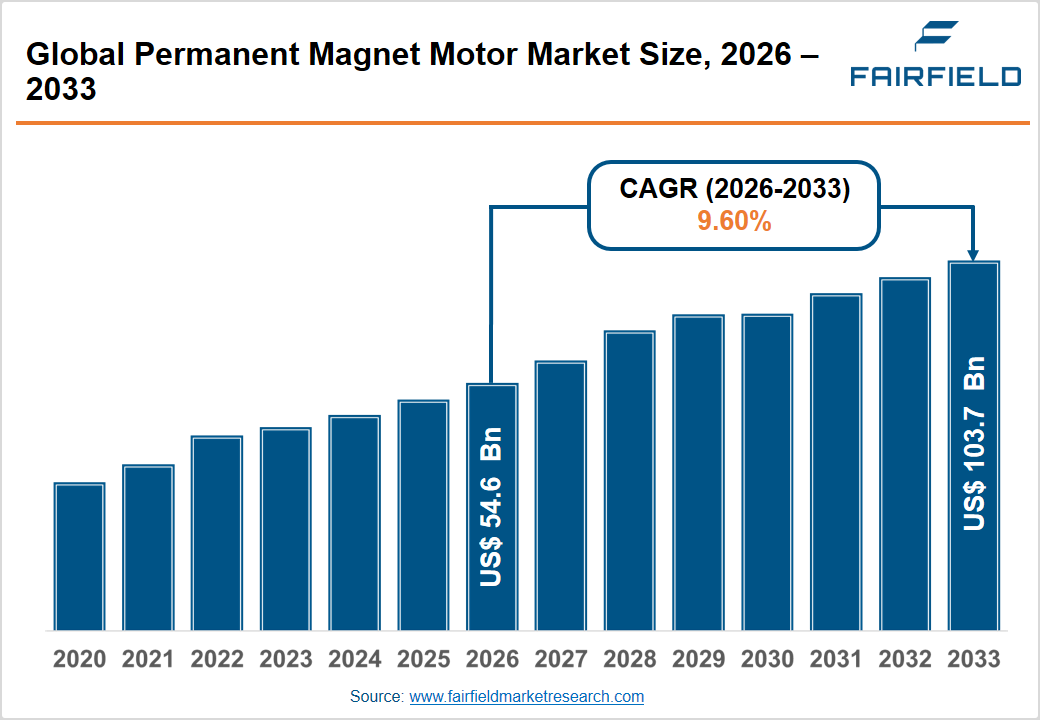
- The global Permanent Magnet Motor Market size is likely to be valued at USD 54.6 billion in 2026 and is expected to reach USD 103.7 billion by 2033, growing at a CAGR of 9.60% during the forecast period from 2026 to 2033.
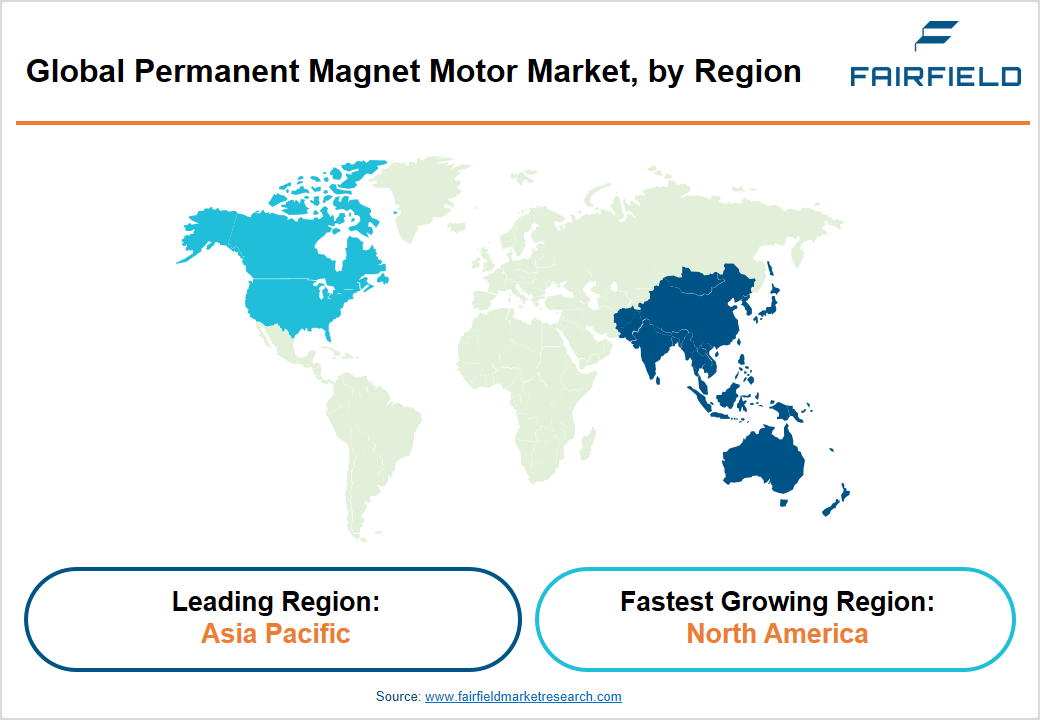
- Asia Pacific dominates the global Permanent Magnet Motor market with approximately 36% share, led by China's expansive EV manufacturing sector, rare earth supply advantages, and government-mandated energy-efficiency motor adoption programs under the 14th Five-Year Plan.
- North America is the fastest-growing regional market, fueled by the Inflation Reduction Act, domestic EV drivetrain manufacturing investments, record industrial robot deployments, and accelerating policy-driven demand for energy-efficient permanent magnet motors across transportation and industrial sectors.
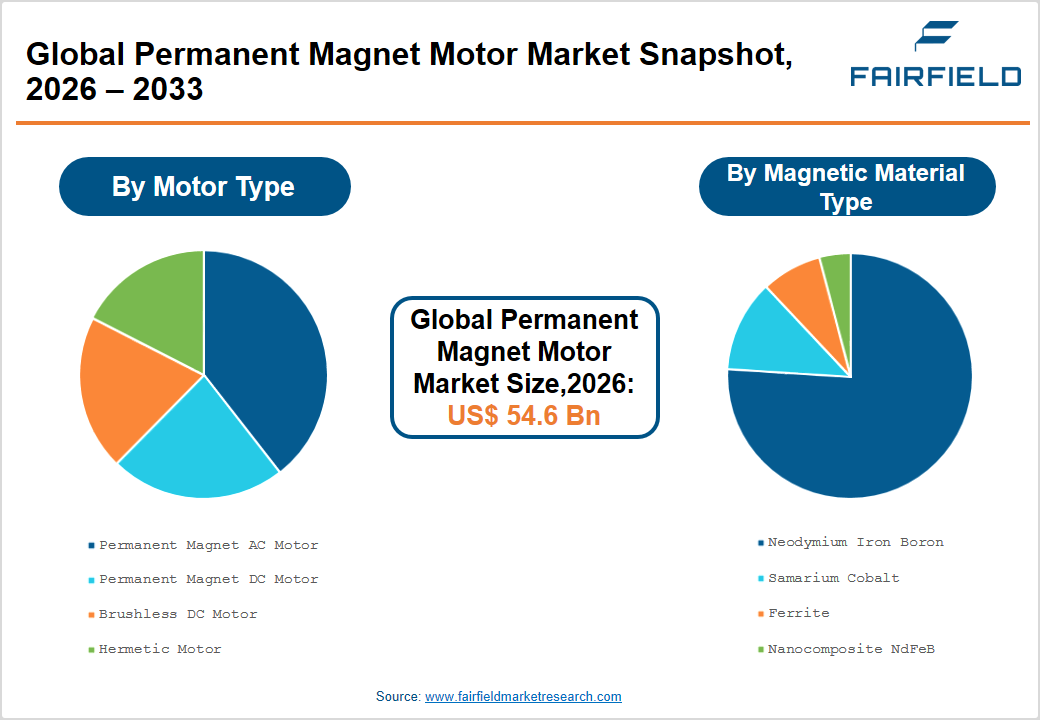
- Brushless DC Motors (BLDC) represent the dominant motor type segment with approximately 38% market share, preferred for high efficiency, low maintenance, and broad deployment across EV auxiliary systems, HVAC applications, and industrial automation platforms.
- Neodymium Iron Boron (NdFeB) is the leading and fastest-growing magnetic material segment commanding over 56% share, driven by unmatched energy density, expanding EV traction motor adoption, and continued advances in grain boundary diffusion technology enhancing high-temperature performance.
- Renewable energy expansion, particularly offshore and onshore wind power represents the key market opportunity, with 117 GW of global wind capacity added in 2023 and the EU's REPowerEU plan targeting 1,236 GW of renewable capacity by 2030, driving significant PMSG adoption.
Market Dynamics
Market Growth Drivers
- Accelerating Electric Vehicle Adoption
The global electric vehicle market stands as a defining catalyst for permanent magnet motor demand. According to the International Energy Agency (IEA), global EV sales surpassed 14 million units in 2023, representing over 18% of total new car sales worldwide. Permanent magnet synchronous motors (PMSMs) are the preferred drivetrain technology in EV platforms due to efficiency ratings exceeding and superior torque-to-weight characteristics. Leading automakers including Tesla, BYD, and Volkswagen have standardized on PMSM architectures across their latest vehicle platforms. As governments accelerate zero-emission vehicle mandates with the European Union targeting a complete phase-out of new internal combustion engine vehicles by 2035 and the U.S. targeting 50% EV sales share by 2030 demand for high-performance permanent magnet motors in traction and auxiliary applications is set to intensify substantially.
- Stringent Energy Efficiency Regulations in Industrial Applications
Global regulatory frameworks are compelling industrial operators to replace conventional motors with energy-efficient permanent magnet alternatives. The International Electrotechnical Commission (IEC) classifies motors into efficiency tiers, with IE4 (Super Premium) and IE5 (Ultra Premium) classes increasingly mandated across Europe, China, and parts of North America. The U.S. Department of Energy (DOE) enforces minimum efficiency standards for general-purpose motors, while the European Commission's Ecodesign Regulation (EU) 2019/1781 mandated IE3 compliance for most motor categories from July 2021. Permanent magnet motors inherently achieve IE4 and IE5 efficiency thresholds. Given that industrial motors account for approximately 45% of global electricity consumption according to the IEA, large-scale adoption of permanent magnet motor technology can deliver substantial energy and carbon reduction benefits.
Market Restraints
- Volatile and Constrained Rare Earth Supply Chains
The manufacturing of permanent magnet motors is critically dependent on rare earth elements, particularly neodymium, dysprosium, and praseodymium. According to the U.S. Geological Survey (USGS), China accounts for approximately 60% of global rare earth mining output and over 85% of rare earth refining capacity. This geographic concentration creates supply chain vulnerability, as evidenced during the 2010-2011 rare earth crisis when China's export quota restrictions triggered price spikes of up to 2,000% for key materials. Ongoing geopolitical tensions and evolving export control policies continue to pose a systemic risk for motor manufacturers globally, potentially driving sharp raw material cost increases that erode profit margins and disrupt production continuity across the permanent magnet motor industry.
- High Initial Capital Investment
Permanent magnet motors command a substantial price premium over conventional induction motors. The incorporation of rare earth magnets particularly neodymium iron boron (NdFeB) compounds significantly elevates bill-of-materials costs. Industry assessments indicate that permanent magnet motors typically cost 30-50% more upfront than comparable induction motor alternatives of equivalent power ratings. This elevated capital expenditure presents a meaningful adoption barrier, particularly for price-sensitive small and medium-sized enterprises (SMEs) and end-users in developing economies. While lifecycle cost analysis favors permanent magnet motors through superior energy savings, the higher initial investment discourages rapid replacement of legacy systems in cost-constrained markets across Latin America, sub-Saharan Africa, and parts of Southeast Asia.
Market Opportunities
- Expanding Applications in Renewable Energy Systems
The global transition toward clean energy generation presents a significant and sustained growth opportunity for permanent magnet motor manufacturers. Wind turbine technology is increasingly adopting permanent magnet synchronous generator (PMSG) designs for their reliability, efficiency, and reduced maintenance requirements. Offshore wind projects which demand extreme reliability in remote environments are strongly accelerating this transition. Beyond wind, permanent magnet motors are essential in solar tracking systems, hydropower generation equipment, and tidal energy converters. The European Union's REPowerEU plan targets 1,236 GW of total renewable capacity by 2030, representing a transformative expansion of the addressable market for permanent magnet motor and generator solutions.
- Robotics and Industrial Automation Boom
The rapid expansion of industrial robotics and collaborative automation presents a compelling long-term growth opportunity for the permanent magnet motor market. According to the International Federation of Robotics (IFR), global industrial robot installations reached a record 553,052 units in 2022, with compound growth expected to continue through the decade. Permanent magnet servo motors characterized by precise speed and position control, high torque-to-inertia ratios, and compact architectures are the preferred actuator technology in articulated robots, CNC machining centers, automated guided vehicles (AGVs), and semiconductor handling equipment. The IFR projects robot density in manufacturing will approximately double within the next five years, especially across China, South Korea, Germany, Japan, and the United States. This Industry 4.0 and smart manufacturing megatrend positions brushless DC and permanent magnet AC motor manufacturers favorably for significant demand growth.
Segmental Insights
- Motor Type Analysis
The Brushless DC Motor (BLDC) segment holds the leading position in the permanent magnet motor market by motor type, accounting for approximately 38% of total market share. BLDC motors are widely favored for their superior operational efficiency, minimal maintenance requirements stemming from the absence of physical brush-commutator contact and extended operational lifespans. These characteristics make them the preferred motor technology for consumer electronics, HVAC systems, industrial automation, and electric vehicle auxiliary systems. According to the U.S. Department of Energy, brushless DC motors can achieve efficiency levels of 85-90% compared to approximately 70-75% for conventional brushed motor designs, making them highly competitive across energy-sensitive applications. The widespread adoption of variable-speed drives (VSDs) and inverter-based control architectures has further enabled BLDC motors to deliver optimized performance across diverse load profiles and operating conditions.
- Magnetic Material Type Analysis
The Neodymium Iron Boron (NdFeB) segment dominates the permanent magnet motor market by magnetic material type, commanding approximately 56% of total market share. NdFeB magnets offer the highest energy density and coercivity among all commercially available permanent magnet materials, enabling motor designers to achieve compact, lightweight configurations without compromising power output. The Magnetic Materials Producers Association (MMPA) recognizes NdFeB as the industry standard for high-performance motor applications, with maximum energy products ranging from 35 MGOe to 52 MGOe. These superior magnetic properties are especially valued in EV traction motors, wind turbine generators, and precision industrial servo systems. Ongoing advances in grain boundary diffusion (GBD) processing have further enhanced NdFeB temperature stability, broadening applicability in demanding high-temperature operating environments.
- Power Rating Analysis
The 75 kW and Above power rating segment leads the permanent magnet motor market, capturing approximately 34% of total market share. High-power permanent magnet motors are extensively deployed in heavy industry applications including mining operations, oil and gas extraction, marine propulsion, large-scale HVAC and refrigeration systems, and traction drives for electric locomotives and heavy commercial vehicles. The progressive electrification of heavy transport and industrial infrastructure supported by the U.S. Bipartisan Infrastructure Law which allocated over billions for EV charging infrastructure and electrification initiatives continues to drive demand in this power segment. Additionally, offshore wind turbine drivetrains increasingly require multi-megawatt-class permanent magnet generators, further reinforcing demand for high-power permanent magnet motor configurations.
- Cooling Method Analysis
The Liquid-Cooled segment leads the permanent magnet motor market by cooling method, accounting for an estimated 42% of total market share. Liquid cooling enables significantly higher continuous power densities compared to conventional air-cooled designs, making it the preferred thermal management approach for EV traction motors, high-power industrial drives, and aerospace applications. Prominent manufacturers including Tesla, BMW, and Bosch prominently utilize liquid-cooled permanent magnet motor architectures in their electric drivetrain systems to maintain optimal thermal performance under sustained high-torque, high-speed conditions. The Society of Automotive Engineers (SAE) has formulated thermal management standards that increasingly favor liquid cooling for motor systems exceeding 50 kW continuous output, further reinforcing liquid cooling's leading position in the market.
Regional Insights
- North America Permanent Magnet Motor Market Trends
North America, led by the United States, represents one of the most dynamic regional markets for permanent magnet motor adoption, supported by a robust regulatory framework and a vibrant innovation ecosystem. The U.S. Department of Energy's Industrial Efficiency and Decarbonization Office actively funds research into next-generation motor technologies, while the Inflation Reduction Act (IRA) of 2022 established substantial production tax credits and manufacturing incentives for energy-efficient motors and EV drivetrain components. General Motors, Ford, and numerous Tier-1 automotive suppliers have announced multi-billion-dollar investments in EV drivetrain manufacturing facilities concentrated across the Midwest, generating significant near-term demand for high-performance permanent magnet motors.
Beyond automotive, North America benefits from a thriving industrial automation ecosystem. The Association for Advancing Automation (A3) reported that North American robot orders reached 44,196 units in 2022 an all-time record. This expanding automation footprint, reinforced by domestic manufacturing reshoring initiatives supported by the CHIPS and Science Act, is generating sustained demand for high-precision permanent magnet servo motors and BLDC motors across electronics manufacturing, semiconductor fabrication, and advanced industrial processes.
- Europe Permanent Magnet Motor Market Trends
Europe represents a mature yet rapidly evolving permanent magnet motor market, with Germany, the United Kingdom, France, and Spain serving as primary demand centers. Germany's leadership in industrial automation, mechanical engineering, and precision manufacturing home to global motor majors including Siemens and Faulhaber makes it the region's largest national market. The European Commission's Ecodesign Regulation (EU), which mandated IE3 minimum motor efficiency from July 2021 and established roadmaps toward IE4 compliance, has substantially accelerated permanent magnet motor adoption across industrial and commercial applications throughout the EU.
The UK's Net Zero Strategy and France's France Relance industrial recovery plan have both channeled funding toward energy-efficient manufacturing upgrades, including motor replacement programs. Spain is emerging as a growth market supported by surging renewable energy investment the country added over 4 GW of wind capacity in 2023, according to Red Eléctrica de España. Collectively, the European Green Deal target of 55% net greenhouse gas reductions by 2030 continues to drive sustained demand for high-efficiency permanent magnet motor solutions across the continent's industrial and transportation sectors.
- Asia Pacific Permanent Magnet Motor Market Trends
Asia Pacific holds the leading position in the global permanent magnet motor market, accounting for approximately 36% of global market share. China is the region's dominant contributor, underpinned by its world-leading EV manufacturing industry, vast industrial production base, and inherent domestic rare earth material supply advantages. China's 14th Five-Year Plan (2021-2025) explicitly targets the transition to high-efficiency motors across heavy industries, while the Ministry of Industry and Information Technology (MIIT) has mandated phased adoption of IE3 and IE4 motors across key industrial sectors, creating substantial domestic demand.
Japan and South Korea contribute significantly to regional demand through their advanced robotics, precision manufacturing, and semiconductor fabrication ecosystems. India is emerging as a high-growth market, driven by the Production Linked Incentive (PLI) scheme for electric mobility and advanced chemistry cell batteries, alongside rapidly expanding wind energy installations. ASEAN markets particularly Vietnam, Thailand, and Indonesia are attracting growing motor manufacturing investments as global supply chains diversify beyond sole China dependence, further strengthening the Asia Pacific region's dominant market position.
Competitive Landscape
The global permanent magnet motor market exhibits a moderately consolidated competitive structure, with leading players including ABB, Siemens, NIDEC Corporation, and Yaskawa collectively accounting for a significant portion of global revenues. Market leaders differentiate through proprietary magnet design technologies, vertically integrated manufacturing capabilities, advanced inverter-integrated motor systems, and comprehensive aftermarket service networks. Key strategic activities include targeted acquisitions to secure rare earth supply chain access, capacity expansion investments in high-growth geographies, and accelerated R&D in next-generation motor topologies such as axial flux motors and fully integrated motor-drive units. China-based manufacturers including Wolong Electric are increasingly competitive through cost-efficient manufacturing and strong domestic policy support.
Key Developments
- In January 2025, ABB launched its next-generation IE5 Ultra-Premium Efficiency permanent magnet motor series targeting industrial pump and fan applications, claiming up to 50% lower energy losses versus standard IE3 motors reinforcing its leadership position in the industrial energy-efficiency segment.
- In September 2024, NIDEC Corporation announced a USD 600 million investment in a new EV traction motor manufacturing facility in Mexico, strategically positioned to serve North American automotive OEM customers ahead of anticipated electric vehicle production ramp-ups.
- In March 2024, Siemens and Valeo announced a strategic partnership to co-develop high-voltage permanent magnet traction motors for next-generation commercial electric vehicles, targeting a combined addressable market projected to exceed USD 10 billion by 2030.
Companies Covered in the Permanent Magnet Motor Market
- Wolong Electric
- ABB
- Siemens
- NIDEC Corporation
- WEG
- Rockwell Automation
- Toshiba
- Johnson Electric
- Allied Motion
- AMETEK
- Regal Beloit
- Yaskawa
- Faulhaber
- Franklin Electric
- Bosch Rexroth
- Danfoss
- Mitsubishi Electric
- Moog Inc.
- Maxon Motor
Market Segmentation
By Motor Type
- Permanent Magnet AC Motor
- Permanent Magnet DC Motor
- Brushless DC Motor
- Hermetic Motor
By Magnetic Material Type
- Neodymium Iron Boron
- Samarium Cobalt
- Ferrite
- Nanocomposite NdFeB
By Power Rating
- Up to 4 kW
- 4-22 kW
- 22-75 kW
- 75 kW and Above
By Cooling Method
- Air-Cooled
- Liquid-Cooled
- Oil-Cooled
- Hybrid Cooling
By Region
- North America
- Europe
- Asia Pacific
- Latin America
- Middle East & Africa
- Executive Summary
- Global Permanent Magnet Motor Market Snapshot
- Future Projections
- Key Market Trends
- Regional Snapshot, by Value, 2026
- Analyst Recommendations
- Market Overview
- Market Definitions and Segmentations
- Market Dynamics
- Drivers
- Restraints
- Market Opportunities
- Value Chain Analysis
- COVID-19 Impact Analysis
- Porter's Five Forces Analysis
- Impact of Russia-Ukraine Conflict
- PESTLE Analysis
- Regulatory Analysis
- Price Trend Analysis
- Current Prices and Future Projections, 2025-2033
- Price Impact Factors
- Global Permanent Magnet Motor Market Outlook, 2020 - 2033
- Global Permanent Magnet Motor Market Outlook, by Motor Type, Value (US$ Bn), 2020-2033
- Permanent Magnet AC Motor
- Permanent Magnet DC Motor
- Brushless DC Motor
- Hermetic Motor
- Global Permanent Magnet Motor Market Outlook, by Magnetic Material Type , Value (US$ Bn), 2020-2033
- Neodymium Iron Boron
- Samarium Cobalt
- Detergents
- Ferrite
- Nanocomposite NdFeB
- Global Permanent Magnet Motor Market Outlook, by Power Rating, Value (US$ Bn), 2020-2033
- Up to 4 kW
- 4-22 kW
- 22-75 kW
- 75 kW and Above
- Global Permanent Magnet Motor Market Outlook, by Cooling Method, Value (US$ Bn), 2020-2033
- Air-Cooled
- Liquid-Cooled
- Oil-Cooled
- Hybrid Cooling
- Global Permanent Magnet Motor Market Outlook, by Region, Value (US$ Bn), 2020-2033
- North America
- Europe
- Asia Pacific
- Latin America
- Middle East & Africa
- Global Permanent Magnet Motor Market Outlook, by Motor Type, Value (US$ Bn), 2020-2033
- North America Permanent Magnet Motor Market Outlook, 2020 - 2033
- North America Permanent Magnet Motor Market Outlook, by Motor Type, Value (US$ Bn), 2020-2033
- Permanent Magnet AC Motor
- Permanent Magnet DC Motor
- Brushless DC Motor
- Hermetic Motor
- North America Permanent Magnet Motor Market Outlook, by Magnetic Material Type , Value (US$ Bn), 2020-2033
- Neodymium Iron Boron
- Samarium Cobalt
- Detergents
- Ferrite
- Nanocomposite NdFeB
- North America Permanent Magnet Motor Market Outlook, by Power Rating, Value (US$ Bn), 2020-2033
- Up to 4 kW
- 4-22 kW
- 22-75 kW
- 75 kW and Above
- North America Permanent Magnet Motor Market Outlook, by Cooling Method, Value (US$ Bn), 2020-2033
- Air-Cooled
- Liquid-Cooled
- Oil-Cooled
- Hybrid Cooling
- North America Permanent Magnet Motor Market Outlook, by Country, Value (US$ Bn), 2020-2033
- U.S. Permanent Magnet Motor Market Outlook, by Motor Type, 2020-2033
- U.S. Permanent Magnet Motor Market Outlook, by Magnetic Material Type , 2020-2033
- U.S. Permanent Magnet Motor Market Outlook, by Power Rating, 2020-2033
- U.S. Permanent Magnet Motor Market Outlook, by Cooling Method, 2020-2033
- Canada Permanent Magnet Motor Market Outlook, by Motor Type, 2020-2033
- Canada Permanent Magnet Motor Market Outlook, by Magnetic Material Type , 2020-2033
- Canada Permanent Magnet Motor Market Outlook, by Power Rating, 2020-2033
- Canada Permanent Magnet Motor Market Outlook, by Cooling Method, 2020-2033
- BPS Analysis/Market Attractiveness Analysis
- North America Permanent Magnet Motor Market Outlook, by Motor Type, Value (US$ Bn), 2020-2033
- Europe Permanent Magnet Motor Market Outlook, 2020 - 2033
- Europe Permanent Magnet Motor Market Outlook, by Motor Type, Value (US$ Bn), 2020-2033
- Permanent Magnet AC Motor
- Permanent Magnet DC Motor
- Brushless DC Motor
- Hermetic Motor
- Europe Permanent Magnet Motor Market Outlook, by Magnetic Material Type , Value (US$ Bn), 2020-2033
- Neodymium Iron Boron
- Samarium Cobalt
- Detergents
- Ferrite
- Nanocomposite NdFeB
- Europe Permanent Magnet Motor Market Outlook, by Power Rating, Value (US$ Bn), 2020-2033
- Up to 4 kW
- 4-22 kW
- 22-75 kW
- 75 kW and Above
- Europe Permanent Magnet Motor Market Outlook, by Cooling Method, Value (US$ Bn), 2020-2033
- Air-Cooled
- Liquid-Cooled
- Oil-Cooled
- Hybrid Cooling
- Europe Permanent Magnet Motor Market Outlook, by Country, Value (US$ Bn), 2020-2033
- Germany Permanent Magnet Motor Market Outlook, by Motor Type, 2020-2033
- Germany Permanent Magnet Motor Market Outlook, by Magnetic Material Type , 2020-2033
- Germany Permanent Magnet Motor Market Outlook, by Power Rating, 2020-2033
- Germany Permanent Magnet Motor Market Outlook, by Cooling Method, 2020-2033
- Italy Permanent Magnet Motor Market Outlook, by Motor Type, 2020-2033
- Italy Permanent Magnet Motor Market Outlook, by Magnetic Material Type , 2020-2033
- Italy Permanent Magnet Motor Market Outlook, by Power Rating, 2020-2033
- Italy Permanent Magnet Motor Market Outlook, by Cooling Method, 2020-2033
- France Permanent Magnet Motor Market Outlook, by Motor Type, 2020-2033
- France Permanent Magnet Motor Market Outlook, by Magnetic Material Type , 2020-2033
- France Permanent Magnet Motor Market Outlook, by Power Rating, 2020-2033
- France Permanent Magnet Motor Market Outlook, by Cooling Method, 2020-2033
- U.K. Permanent Magnet Motor Market Outlook, by Motor Type, 2020-2033
- U.K. Permanent Magnet Motor Market Outlook, by Magnetic Material Type , 2020-2033
- U.K. Permanent Magnet Motor Market Outlook, by Power Rating, 2020-2033
- U.K. Permanent Magnet Motor Market Outlook, by Cooling Method, 2020-2033
- Spain Permanent Magnet Motor Market Outlook, by Motor Type, 2020-2033
- Spain Permanent Magnet Motor Market Outlook, by Magnetic Material Type , 2020-2033
- Spain Permanent Magnet Motor Market Outlook, by Power Rating, 2020-2033
- Spain Permanent Magnet Motor Market Outlook, by Cooling Method, 2020-2033
- Russia Permanent Magnet Motor Market Outlook, by Motor Type, 2020-2033
- Russia Permanent Magnet Motor Market Outlook, by Magnetic Material Type , 2020-2033
- Russia Permanent Magnet Motor Market Outlook, by Power Rating, 2020-2033
- Russia Permanent Magnet Motor Market Outlook, by Cooling Method, 2020-2033
- Rest of Europe Permanent Magnet Motor Market Outlook, by Motor Type, 2020-2033
- Rest of Europe Permanent Magnet Motor Market Outlook, by Magnetic Material Type , 2020-2033
- Rest of Europe Permanent Magnet Motor Market Outlook, by Power Rating, 2020-2033
- Rest of Europe Permanent Magnet Motor Market Outlook, by Cooling Method, 2020-2033
- BPS Analysis/Market Attractiveness Analysis
- Europe Permanent Magnet Motor Market Outlook, by Motor Type, Value (US$ Bn), 2020-2033
- Asia Pacific Permanent Magnet Motor Market Outlook, 2020 - 2033
- Asia Pacific Permanent Magnet Motor Market Outlook, by Motor Type, Value (US$ Bn), 2020-2033
- Permanent Magnet AC Motor
- Permanent Magnet DC Motor
- Brushless DC Motor
- Hermetic Motor
- Asia Pacific Permanent Magnet Motor Market Outlook, by Magnetic Material Type , Value (US$ Bn), 2020-2033
- Neodymium Iron Boron
- Samarium Cobalt
- Detergents
- Ferrite
- Nanocomposite NdFeB
- Asia Pacific Permanent Magnet Motor Market Outlook, by Power Rating, Value (US$ Bn), 2020-2033
- Up to 4 kW
- 4-22 kW
- 22-75 kW
- 75 kW and Above
- Asia Pacific Permanent Magnet Motor Market Outlook, by Cooling Method, Value (US$ Bn), 2020-2033
- Air-Cooled
- Liquid-Cooled
- Oil-Cooled
- Hybrid Cooling
- Asia Pacific Permanent Magnet Motor Market Outlook, by Country, Value (US$ Bn), 2020-2033
- China Permanent Magnet Motor Market Outlook, by Motor Type, 2020-2033
- China Permanent Magnet Motor Market Outlook, by Magnetic Material Type , 2020-2033
- China Permanent Magnet Motor Market Outlook, by Power Rating, 2020-2033
- China Permanent Magnet Motor Market Outlook, by Cooling Method, 2020-2033
- Japan Permanent Magnet Motor Market Outlook, by Motor Type, 2020-2033
- Japan Permanent Magnet Motor Market Outlook, by Magnetic Material Type , 2020-2033
- Japan Permanent Magnet Motor Market Outlook, by Power Rating, 2020-2033
- Japan Permanent Magnet Motor Market Outlook, by Cooling Method, 2020-2033
- South Korea Permanent Magnet Motor Market Outlook, by Motor Type, 2020-2033
- South Korea Permanent Magnet Motor Market Outlook, by Magnetic Material Type , 2020-2033
- South Korea Permanent Magnet Motor Market Outlook, by Power Rating, 2020-2033
- South Korea Permanent Magnet Motor Market Outlook, by Cooling Method, 2020-2033
- India Permanent Magnet Motor Market Outlook, by Motor Type, 2020-2033
- India Permanent Magnet Motor Market Outlook, by Magnetic Material Type , 2020-2033
- India Permanent Magnet Motor Market Outlook, by Power Rating, 2020-2033
- India Permanent Magnet Motor Market Outlook, by Cooling Method, 2020-2033
- Southeast Asia Permanent Magnet Motor Market Outlook, by Motor Type, 2020-2033
- Southeast Asia Permanent Magnet Motor Market Outlook, by Magnetic Material Type , 2020-2033
- Southeast Asia Permanent Magnet Motor Market Outlook, by Power Rating, 2020-2033
- Southeast Asia Permanent Magnet Motor Market Outlook, by Cooling Method, 2020-2033
- Rest of SAO Permanent Magnet Motor Market Outlook, by Motor Type, 2020-2033
- Rest of SAO Permanent Magnet Motor Market Outlook, by Magnetic Material Type , 2020-2033
- Rest of SAO Permanent Magnet Motor Market Outlook, by Power Rating, 2020-2033
- Rest of SAO Permanent Magnet Motor Market Outlook, by Cooling Method, 2020-2033
- BPS Analysis/Market Attractiveness Analysis
- Asia Pacific Permanent Magnet Motor Market Outlook, by Motor Type, Value (US$ Bn), 2020-2033
- Latin America Permanent Magnet Motor Market Outlook, 2020 - 2033
- Latin America Permanent Magnet Motor Market Outlook, by Motor Type, Value (US$ Bn), 2020-2033
- Permanent Magnet AC Motor
- Permanent Magnet DC Motor
- Brushless DC Motor
- Hermetic Motor
- Latin America Permanent Magnet Motor Market Outlook, by Magnetic Material Type , Value (US$ Bn), 2020-2033
- Neodymium Iron Boron
- Samarium Cobalt
- Detergents
- Ferrite
- Nanocomposite NdFeB
- Latin America Permanent Magnet Motor Market Outlook, by Power Rating, Value (US$ Bn), 2020-2033
- Up to 4 kW
- 4-22 kW
- 22-75 kW
- 75 kW and Above
- Latin America Permanent Magnet Motor Market Outlook, by Cooling Method, Value (US$ Bn), 2020-2033
- Air-Cooled
- Liquid-Cooled
- Oil-Cooled
- Hybrid Cooling
- Latin America Permanent Magnet Motor Market Outlook, by Country, Value (US$ Bn), 2020-2033
- Brazil Permanent Magnet Motor Market Outlook, by Motor Type, 2020-2033
- Brazil Permanent Magnet Motor Market Outlook, by Magnetic Material Type , 2020-2033
- Brazil Permanent Magnet Motor Market Outlook, by Power Rating, 2020-2033
- Brazil Permanent Magnet Motor Market Outlook, by Cooling Method, 2020-2033
- Mexico Permanent Magnet Motor Market Outlook, by Motor Type, 2020-2033
- Mexico Permanent Magnet Motor Market Outlook, by Magnetic Material Type , 2020-2033
- Mexico Permanent Magnet Motor Market Outlook, by Power Rating, 2020-2033
- Mexico Permanent Magnet Motor Market Outlook, by Cooling Method, 2020-2033
- Argentina Permanent Magnet Motor Market Outlook, by Motor Type, 2020-2033
- Argentina Permanent Magnet Motor Market Outlook, by Magnetic Material Type , 2020-2033
- Argentina Permanent Magnet Motor Market Outlook, by Power Rating, 2020-2033
- Argentina Permanent Magnet Motor Market Outlook, by Cooling Method, 2020-2033
- Rest of LATAM Permanent Magnet Motor Market Outlook, by Motor Type, 2020-2033
- Rest of LATAM Permanent Magnet Motor Market Outlook, by Magnetic Material Type , 2020-2033
- Rest of LATAM Permanent Magnet Motor Market Outlook, by Power Rating, 2020-2033
- Rest of LATAM Permanent Magnet Motor Market Outlook, by Cooling Method, 2020-2033
- BPS Analysis/Market Attractiveness Analysis
- Latin America Permanent Magnet Motor Market Outlook, by Motor Type, Value (US$ Bn), 2020-2033
- Middle East & Africa Permanent Magnet Motor Market Outlook, 2020 - 2033
- Middle East & Africa Permanent Magnet Motor Market Outlook, by Motor Type, Value (US$ Bn), 2020-2033
- Permanent Magnet AC Motor
- Permanent Magnet DC Motor
- Brushless DC Motor
- Hermetic Motor
- Middle East & Africa Permanent Magnet Motor Market Outlook, by Magnetic Material Type , Value (US$ Bn), 2020-2033
- Neodymium Iron Boron
- Samarium Cobalt
- Detergents
- Ferrite
- Nanocomposite NdFeB
- Middle East & Africa Permanent Magnet Motor Market Outlook, by Power Rating, Value (US$ Bn), 2020-2033
- Up to 4 kW
- 4-22 kW
- 22-75 kW
- 75 kW and Above
- Middle East & Africa Permanent Magnet Motor Market Outlook, by Cooling Method, Value (US$ Bn), 2020-2033
- Air-Cooled
- Liquid-Cooled
- Oil-Cooled
- Hybrid Cooling
- Middle East & Africa Permanent Magnet Motor Market Outlook, by Country, Value (US$ Bn), 2020-2033
- GCC Permanent Magnet Motor Market Outlook, by Motor Type, 2020-2033
- GCC Permanent Magnet Motor Market Outlook, by Magnetic Material Type , 2020-2033
- GCC Permanent Magnet Motor Market Outlook, by Power Rating, 2020-2033
- GCC Permanent Magnet Motor Market Outlook, by Cooling Method, 2020-2033
- South Africa Permanent Magnet Motor Market Outlook, by Motor Type, 2020-2033
- South Africa Permanent Magnet Motor Market Outlook, by Magnetic Material Type , 2020-2033
- South Africa Permanent Magnet Motor Market Outlook, by Power Rating, 2020-2033
- South Africa Permanent Magnet Motor Market Outlook, by Cooling Method, 2020-2033
- Egypt Permanent Magnet Motor Market Outlook, by Motor Type, 2020-2033
- Egypt Permanent Magnet Motor Market Outlook, by Magnetic Material Type , 2020-2033
- Egypt Permanent Magnet Motor Market Outlook, by Power Rating, 2020-2033
- Egypt Permanent Magnet Motor Market Outlook, by Cooling Method, 2020-2033
- Nigeria Permanent Magnet Motor Market Outlook, by Motor Type, 2020-2033
- Nigeria Permanent Magnet Motor Market Outlook, by Magnetic Material Type , 2020-2033
- Nigeria Permanent Magnet Motor Market Outlook, by Power Rating, 2020-2033
- Nigeria Permanent Magnet Motor Market Outlook, by Cooling Method, 2020-2033
- Rest of Middle East Permanent Magnet Motor Market Outlook, by Motor Type, 2020-2033
- Rest of Middle East Permanent Magnet Motor Market Outlook, by Magnetic Material Type , 2020-2033
- Rest of Middle East Permanent Magnet Motor Market Outlook, by Power Rating, 2020-2033
- Rest of Middle East Permanent Magnet Motor Market Outlook, by Cooling Method, 2020-2033
- BPS Analysis/Market Attractiveness Analysis
- Middle East & Africa Permanent Magnet Motor Market Outlook, by Motor Type, Value (US$ Bn), 2020-2033
- Competitive Landscape
- Company Vs Segment Heatmap
- Company Market Share Analysis, 2025
- Competitive Dashboard
- Company Profiles
- Dow
- Company Overview
- Product Portfolio
- Financial Overview
- Business Strategies and Developments
- Ashland
- Arkema
- BASF
- INEOS
- Zschimmer & Schwarz
- Interpolymer Corporation
- Croda International
- Indulor Chemie
- Visen Industries
- Junneng Chemicals
- Dow
- Appendix
- Research Methodology
- Report Assumptions
- Acronyms and Abbreviations
|
BASE YEAR |
HISTORICAL DATA |
FORECAST PERIOD |
UNITS |
|||
 |
2025 |
 |
2020 - 2025 |
 |
2026 - 2033 |
Value: US$ Million |
|
REPORT FEATURES |
DETAILS |
|
By Motor Type Coverage |
|
|
By Magnetic Material Type Coverage |
|
|
Geographical Coverage |
|
|
Leading Companies |
|
|
Report Highlights |
Key Market Indicators, Macro-micro economic impact analysis, Technological Roadmap, Key Trends, Driver, Restraints, and Future Opportunities & Revenue Pockets, Porter’s 5 Forces Analysis, Historical Trend (2019-2024), Market Estimates and Forecast, Market Dynamics, Industry Trends, Competition Landscape, Category, Region, Country-wise Trends & Analysis, COVID-19 Impact Analysis (Demand and Supply Chain) |
Our Research Methodology
Considering the volatility of business today, traditional approaches to strategizing a game plan can be unfruitful if not detrimental. True ambiguity is no way to determine a forecast. A myriad of predetermined factors must be accounted for such as the degree of risk involved, the magnitude of circumstances, as well as conditions or consequences that are not known or unpredictable. To circumvent binary views that cast uncertainty, the application of market research intelligence to strategically posture, move, and enable actionable outcomes is necessary.
View Methodology
Quality Assured
Rigorous Validation Process

Confidentiality Assured
End-to-end Data Security

Custom Research Services
Tailored To Your Objectives
FAQs
The Permanent Magnet Motor Market size is US$54.6 billion in 2026.
The Permanent Magnet Motor Market is projected 9.6% CAGR by 2033.
The Permanent Magnet Motor Market growth drivers include electrification mandates, EV/automation surge, and material performance advances.
Asia Pacific is the dominating region for Permanent Magnet Motor Market.
Wolong Electric, ABB, Siemens, NIDEC Corporation, and WEG are some leading industry players in the Permanent Magnet Motor Market.
Related Reports
Ultralight & Light Aircraft Market Insights, Competitive Landscape, and Market Forecast 2026–2033
Ultralight & Light Aircraft Market is projected to reach US$29.05 billion by 2033, driven by flight training, recreational aviation, VTOL, and electric aircraft adoption.
Motor Soft Starter Market Insights, Competitive Landscape, and Market Forecast 2033
Motor Soft Starter Market to reach US$3.98 Bn by 2033 at 6.1% CAGR, driven by industrial automation, water infrastructure, and motor efficiency.
Global Sand Blasting Machines Market Insights, Competitive Landscape, and Market Forecast 2033
The global sand blasting machines market is valued at US$536.60 Mn in 2026 and is projected to reach US$725.36 Mn by 2033, growing at a 4.4% CAGR
Garage and Overhead Doors Market Insights, Competitive Landscape, and Market Forecast 2033
Garage and Overhead Doors Market to reach US$11.71 Bn by 2033 at 5.6% CAGR, driven by housing, smart connectivity, and energy efficiency.
Wafer Inspection Equipment Market Insights, Competitive Landscape, and Market Forecast 2026–2033
Wafer Inspection Equipment Market to reach US$12.5 Bn by 2033 at 8.2% CAGR, driven by AI defect detection, advanced fabs, and chip demand.
Super Precision Bearing Market Insights, Competitive Landscape, and Market Forecast 2026–2033
Super Precision Bearing Market to reach US$19.58 Bn by 2033 at 7.5% CAGR, driven by semiconductors, aerospace, EVs, and medical robotics.