



Recombinant Cell Culture Supplements Market
Recombinant Cell Culture Supplements Market Insights, Competitive Landscape, and Market Forecast - 2033
Global Recombinant Cell Culture Supplements Market Forecast
- The Recombinant Cell Culture Supplements Market is valued at USD 592.8 Bn in 2026 and is projected to reach USD 973.8 Bn, growing at a CAGR of 6% by 2033.
Quick Report Digest
A Look Back and a Look Forward - Comparative Analysis
The recombinant cell culture supplements market has shown notable growth leading up to 2023 and is poised for accelerated expansion post-2024. Pre-2023, the market's growth was driven by the increasing demand for biologics and biosimilars, advancements in biopharmaceutical production, and the need for consistent, high-quality cell culture media. Recombinant cell culture supplements, derived from genetically engineered organisms, offer superior consistency and reduced risk of contamination compared to traditional animal-derived supplements. This quality advantage significantly fueled market adoption, especially as regulatory agencies imposed stricter guidelines on the use of animal-derived components in pharmaceutical production.
During this period, the biopharmaceutical industry's focus on producing vaccines, monoclonal antibodies, and regenerative medicines contributed significantly to the demand for recombinant supplements. The growth in personalized medicine and cell and gene therapy also played a crucial role in driving market expansion. Post-2024, the market is expected to accelerate further due to several factors. The increasing prevalence of chronic diseases and the advancements in biologics and biosimilar will continue to drive demand for high-quality cell culture supplements.
Technological advancements in recombinant protein production and the expansion of bio manufacturing capacities globally will further boost market growth. Additionally, the rising adoption of animal-free, sustainable, and ethically produced supplements will align with the growing emphasis on ethical sourcing and environmental sustainability in the biopharmaceutical industry. Strategic collaborations and investments in R&D will likely bring innovative products to market, enhancing growth prospects. The continuous evolution of the biopharmaceutical sector, with an emphasis on precision medicine and novel therapeutic approaches, will ensure sustained growth for the recombinant cell culture supplements market.
Key Growth Determinants
- Increasing Demand for Biopharmaceuticals
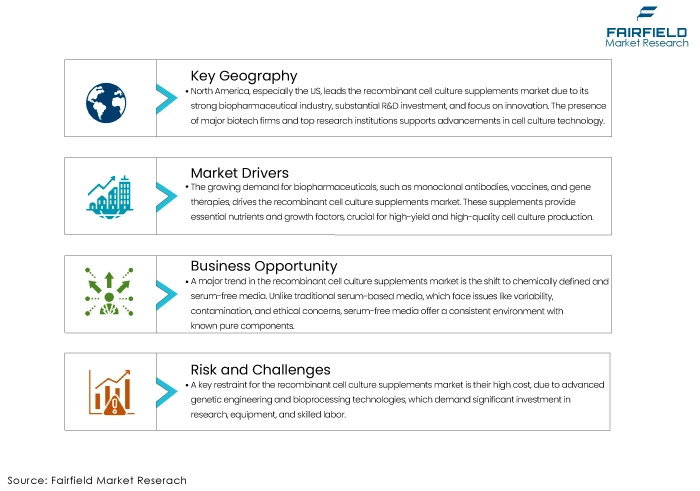
One of the primary growth drivers for the recombinant cell culture supplements market is the escalating demand for biopharmaceuticals. Biopharmaceuticals, including monoclonal antibodies, vaccines, and gene therapies, require sophisticated cell culture techniques for production. Recombinant cell culture supplements are essential in this process as they provide the necessary nutrients and growth factors for cell cultures, ensuring high yield and quality of the final product.
The biopharmaceutical industry has been growing rapidly due to the rising prevalence of chronic diseases such as cancer, diabetes, and autoimmune disorders. This growth has created a substantial demand for reliable and efficient cell culture supplements. Recombinant supplements, being animal-free and consistent in quality, are preferred over traditional supplements, thus driving market growth. As the biopharmaceutical sector continues to expand and innovate, the demand for high-quality cell culture supplements is expected to increase, further propelling the market.
- Advancements in Biotechnology and Cell Culture Techniques
Advancements in biotechnology and cell culture techniques are significantly driving the growth of the recombinant cell culture supplements market. Innovations in genetic engineering and recombinant DNA technology have enabled the production of more precise and efficient cell culture supplements. These advancements allow for the creation of supplements tailored to specific cell lines and applications, enhancing the productivity and efficacy of biopharmaceutical manufacturing processes.
Additionally, improvements in cell culture techniques, such as the development of serum-free and chemically defined media, have increased the reliance on recombinant supplements. These modern techniques reduce the risk of contamination and variability associated with animal-derived components, making recombinant supplements a more attractive option. As biotechnological research progresses and new cell culture methods are developed, the demand for advanced, high-quality recombinant cell culture supplements is expected to rise, driving market growth.
Key Growth Barriers
- High Cost of Development and Production
A significant restraint for the recombinant cell culture supplements market is the high cost associated with the development and production of these supplements. Recombinant supplements are produced using advanced genetic engineering techniques and sophisticated bioprocessing technologies, which require substantial investment in research, equipment, and skilled labour.
The complexity of ensuring consistent quality and scalability of production further adds to the costs. These high production costs translate into higher prices for recombinant supplements, making them less affordable for smaller biopharmaceutical companies and research institutions. This financial barrier can limit market adoption, particularly in emerging markets where cost constraints are more pronounced. Additionally, the ongoing need for innovation and improvement in recombinant technologies to stay competitive adds to the financial burden, potentially slowing market growth.
- Technical Challenges, and Limited Expertise
Technical challenges and limited expertise in recombinant technology and cell culture processes also restrain the growth of the recombinant cell culture supplements market. Producing high-quality recombinant supplements requires specialized knowledge and expertise in genetic engineering, molecular biology, and bioprocessing. However, there is a shortage of skilled professionals with experience in these areas, which can hinder the development and optimization of recombinant supplements.
Technical issues such as maintaining product stability, ensuring batch-to-batch consistency, and scaling up production without compromising quality are significant challenges. These technical complexities can lead to delays in product development and commercialization. Moreover, smaller companies and research institutions may lack the necessary resources and expertise to effectively utilize recombinant supplements, limiting their adoption and contributing to slower market growth. Addressing these technical challenges requires ongoing investment in education, training, and technological advancements, which can be both time-consuming and costly.
Recombinant Cell Culture Supplements Market Trends and Opportunities
- Shift Towards Chemically Defined and Serum-Free Media
One of the most significant trends in the recombinant cell culture supplements market is the shift toward chemically defined and serum-free media. Traditional cell culture methods often relied on serum, such as fetal bovine serum (FBS), which contains a complex mix of growth factors, hormones, and nutrients.
However, serum-based media pose several challenges, including batch-to-batch variability, risk of contamination, ethical concerns, and supply chain issues.
In response, the biopharmaceutical industry is increasingly adopting chemically defined and serum-free media, which provide a controlled and consistent environment for cell growth. Chemically defined media are composed of known quantities of pure components, eliminating the variability and ethical issues associated with animal-derived products. This trend is driven by the need for reproducible and high-quality biopharmaceutical production processes and regulatory pressures to minimize the use of animal-derived components.
Recombinant cell culture supplements play a crucial role in this transition by providing essential nutrients and growth factors in a defined and consistent manner. As the industry continues to move towards more standardized and ethical production methods, the demand for recombinant supplements is expected to grow, further driving market expansion.
- Expansion Opportunity in Developing Regional Markets
The recombinant cell culture supplements market has a significant opportunity for expansion into emerging markets. Countries in regions such as Asia Pacific, Latin America, and the Middle East are experiencing rapid growth in their biopharmaceutical sectors, driven by increasing healthcare investments, growing prevalence of chronic diseases, and rising demand for advanced medical treatments. These regions are also witnessing improvements in healthcare infrastructure and regulatory frameworks, creating a conducive environment for the adoption of innovative biopharmaceutical technologies. Developing markets present a substantial opportunity for companies to expand their presence and tap into a large and underserved patient population. Pharmaceutical and biotechnology companies can leverage this opportunity by forming strategic partnerships with local players, conducting region-specific clinical trials, and tailoring their product offerings to meet the unique needs and regulatory requirements of these markets.
Additionally, efforts to make recombinant supplements more affordable and accessible through differential pricing strategies, local manufacturing, and distribution networks can enhance market penetration. By capitalizing on the growth potential of developing and emerging markets, companies can not only increase their market share but also contribute to improving healthcare outcomes in these regions. This opportunity aligns with the broader goal of achieving global health equity and ensuring that advanced biopharmaceutical technologies are accessible to all patients, regardless of geographic location.
How is Regulatory Scenario Shaping this Industry?
The regulatory landscape significantly shapes the growth of the recombinant cell culture supplements market. Bodies like the FDA, EMA, and other regional authorities impose stringent standards for product safety, efficacy, and manufacturing processes. Compliance with these regulations is crucial for market entry and commercial success.
While these regulations ensure product quality and patient safety, they can also increase development costs and time-to-market. However, robust regulatory oversight can boost industry credibility and consumer confidence, ultimately driving market growth. Additionally, harmonization of regulatory standards across different regions can facilitate global market expansion for these supplements.
Segments Covered in Recombinant Cell Culture Supplements Market Report
- Recombinant Growth Factors to be the Leading Product Category
Recombinant growth factors represent the dominant segment within the product category. These proteins play a pivotal role in regulating cell growth, differentiation, and proliferation. Their consistent and defined composition, compared to growth factors derived from animal or human sources, makes them highly desirable for cell culture applications. The demand for recombinant growth factors in the recombinant cell culture supplements market is particularly robust in research, drug discovery, and cell therapy.
- Stem Cell Therapy Spearheads by Application
Stem cell therapy is the leading application segment for recombinant cell culture supplements. Stem cells require a specific microenvironment to maintain their pluripotency or differentiate into desired cell types. Recombinant growth factors, cytokines, and other supplements are essential for creating optimal culture conditions. The growing interest in regenerative medicine and cell-based therapies is directly driving the demand for these products in this segment of the recombinant cell culture supplements market.
Recombinant cell culture supplements are increasingly employed in stem cell therapy due to their ability to provide essential cytokines, growth factors, and nutrients that enhance the growth, specialization, and maintenance of stem cells.
These supplements play a significant role in creating optimal conditions for the growth and cultivation of stem cells, thus enhancing the effectiveness and success rate of stem cell treatment. The demand for high-quality recombinant cell culture supplements is rising due to the expansion of stem cell treatment research and clinical applications.
- Microorganisms Remain the Top-Sought Source for Cell Culture
Microorganisms are the predominant source of recombinant cell culture supplements. Microorganisms offer several advantages, including rapid growth, high productivity, and ease of genetic manipulation. They are commonly used to produce a wide range of recombinant proteins, including growth factors, enzymes, and antibodies. Additionally, the production process using microorganisms is generally more cost-effective compared to other sources.
Increasing utilization in bioreactors and cell culture systems for enhanced cell growth and productivity will drive the dominance of this segment in the recombinant cell culture supplements market. Because of the significant role that they play in a wide variety of biotechnological and medical applications, recombinant cell culture supplements that are generated from microorganisms are experiencing a surge in demand. To supply essential nutrients, growth factors, and other biomolecules that promote the development, maintenance, and production of various cell lines, these supplements are utilized in bioreactors and cell culture systems.
Regional Analysis
- North America Retains the Largest Revenue Share in Global Market
North America, particularly the US, is the dominant region in the recombinant cell culture supplements market for recombinant cell culture supplements. The region's leadership is driven by a well-established biopharmaceutical industry, significant investment in research and development, and a strong focus on innovation. The presence of numerous leading biotechnology and pharmaceutical companies, coupled with top-tier research institutions and universities, fosters a conducive environment for advancements in cell culture technology.
Additionally, North America has a robust regulatory framework that supports the adoption of high-quality, animal-free, and sustainable cell culture supplements. The region's commitment to ethical and sustainable bio-manufacturing practices further drives demand for recombinant supplements. Government initiatives and funding for biomedical research, especially in personalized medicine and regenerative therapies, also contribute to the market's growth. Higher prevalence of chronic diseases in the region creates a continuous need for biopharmaceuticals, thereby sustaining the demand for recombinant cell culture supplements.
Fairfield’s Competitive Landscape Analysis
The recombinant cell culture supplements market is competitive, featuring key players such as Thermo Fisher Scientific, Merck KGaA, Corning Inc., and Sartorius AG. These companies dominate the market through extensive product portfolios and significant investments in R&D to develop advanced, high-quality supplements. The competitive landscape is characterized by a focus on innovation, with companies introducing new formulations and technologies to meet evolving industry needs.
Strategic partnerships, acquisitions, and collaborations are common as firms seek to expand their market presence and enhance their offerings. Smaller biotech firms and start-ups also contribute to the dynamic market, often specializing in niche applications or novel technologies. The competition drives continuous improvement and differentiation, fuelling market growth and advancement.
Key Market Companies
- Lonza Group AG
- Abcam PLC.
- BBI Solutions
- Biocon
- STEMCELL Technologies Inc.
- Thermo Fisher Scientific
- Hi-Media Laboratories
- Merck KGaA
- Fujifilm Corporation
- InVitria
- Novozymes
Recent Industry Developments
- In September 2022, Sino Biological Inc. unveiled a novel selection of animal-free cell culture media.
- In March 2022, FUJIFILM Irvine Scientific, Inc. bought Shenandoah Biotechnology, Inc. to enhance its expertise in bioprocessing and cell culture solutions.
- In January 2022, Cytiva, a subsidiary of Danaher Corporation, announced a partnership with Nucleus Biologics to provide tailored culture medium solutions for gene and cell therapy.
An Expert’s Eye
- The increasing emphasis on biopharmaceutical development, coupled with advancements in cell culture technologies, is driving significant growth in the recombinant cell culture supplements market.
- The market is expected to benefit from the expanding applications of cell-based therapies, such as regenerative medicine and immunotherapy.
- Challenges related to regulatory hurdles, high production costs, and the need for specialized expertise may temper growth rates in the short term.
- The long-term outlook remains positive due to the critical role of these supplements in modern biotechnology.
Global Recombinant Cell Culture Supplements Market is Segmented as Below -
By Product
- Recombinant Growth Factors
- Recombinant Insulin
- Recombinant Albumin
By Application
- Stem Cell Therapy
- Gene Therapy
- Vaccine Development
By Source
- Animals
- Microorganisms
- Humans
By Region
- North America
- Europe
- Asia Pacific
- Latin America
- Middle East & Africa
- Executive Summary
- Global Recombinant Cell Culture Supplements Market Snapshot
- Future Projections
- Key Market Trends
- Regional Snapshot, by Value, 2026
- Analyst Recommendations
- Market Overview
- Market Definitions and Segmentations
- Market Dynamics
- Drivers
- Restraints
- Market Opportunities
- Value Chain Analysis
- COVID-19 Impact Analysis
- Porter's Five Forces Analysis
- Impact of Russia-Ukraine Conflict
- PESTLE Analysis
- Regulatory Analysis
- Price Trend Analysis
- Current Prices and Future Projections, 2025-2033
- Price Impact Factors
- Global Recombinant Cell Culture Supplements Market Outlook, 2020 - 2033
- Global Recombinant Cell Culture Supplements Market Outlook, by Product, Value (US$ Mn), 2020-2033
- Recombinant Growth Factors
- Recombinant Insulin
- Recombinant Albumin
- Global Recombinant Cell Culture Supplements Market Outlook, by Application, Value (US$ Mn), 2020-2033
- Stem Cell Therapy
- Gene Therapy
- Vaccine Development
- Global Recombinant Cell Culture Supplements Market Outlook, by Source, Value (US$ Mn), 2020-2033
- Animals
- Microorganisms
- Humans
- Global Recombinant Cell Culture Supplements Market Outlook, by Region, Value (US$ Mn), 2020-2033
- North America
- Europe
- Asia Pacific
- Latin America
- Middle East & Africa
- Global Recombinant Cell Culture Supplements Market Outlook, by Product, Value (US$ Mn), 2020-2033
- North America Recombinant Cell Culture Supplements Market Outlook, 2020 - 2033
- North America Recombinant Cell Culture Supplements Market Outlook, by Product, Value (US$ Mn), 2020-2033
- Recombinant Growth Factors
- Recombinant Insulin
- Recombinant Albumin
- North America Recombinant Cell Culture Supplements Market Outlook, by Application, Value (US$ Mn), 2020-2033
- Stem Cell Therapy
- Gene Therapy
- Vaccine Development
- North America Recombinant Cell Culture Supplements Market Outlook, by Source, Value (US$ Mn), 2020-2033
- Animals
- Microorganisms
- Humans
- North America Recombinant Cell Culture Supplements Market Outlook, by Country, Value (US$ Mn), 2020-2033
- S. Recombinant Cell Culture Supplements Market Outlook, by Product, 2020-2033
- S. Recombinant Cell Culture Supplements Market Outlook, by Application, 2020-2033
- S. Recombinant Cell Culture Supplements Market Outlook, by Source, 2020-2033
- Canada Recombinant Cell Culture Supplements Market Outlook, by Product, 2020-2033
- Canada Recombinant Cell Culture Supplements Market Outlook, by Application, 2020-2033
- Canada Recombinant Cell Culture Supplements Market Outlook, by Source, 2020-2033
- BPS Analysis/Market Attractiveness Analysis
- North America Recombinant Cell Culture Supplements Market Outlook, by Product, Value (US$ Mn), 2020-2033
- Europe Recombinant Cell Culture Supplements Market Outlook, 2020 - 2033
- Europe Recombinant Cell Culture Supplements Market Outlook, by Product, Value (US$ Mn), 2020-2033
- Recombinant Growth Factors
- Recombinant Insulin
- Recombinant Albumin
- Europe Recombinant Cell Culture Supplements Market Outlook, by Application, Value (US$ Mn), 2020-2033
- Stem Cell Therapy
- Gene Therapy
- Vaccine Development
- Europe Recombinant Cell Culture Supplements Market Outlook, by Source, Value (US$ Mn), 2020-2033
- Animals
- Microorganisms
- Humans
- Europe Recombinant Cell Culture Supplements Market Outlook, by Country, Value (US$ Mn), 2020-2033
- Germany Recombinant Cell Culture Supplements Market Outlook, by Product, 2020-2033
- Germany Recombinant Cell Culture Supplements Market Outlook, by Application, 2020-2033
- Germany Recombinant Cell Culture Supplements Market Outlook, by Source, 2020-2033
- Italy Recombinant Cell Culture Supplements Market Outlook, by Product, 2020-2033
- Italy Recombinant Cell Culture Supplements Market Outlook, by Application, 2020-2033
- Italy Recombinant Cell Culture Supplements Market Outlook, by Source, 2020-2033
- France Recombinant Cell Culture Supplements Market Outlook, by Product, 2020-2033
- France Recombinant Cell Culture Supplements Market Outlook, by Application, 2020-2033
- France Recombinant Cell Culture Supplements Market Outlook, by Source, 2020-2033
- K. Recombinant Cell Culture Supplements Market Outlook, by Product, 2020-2033
- K. Recombinant Cell Culture Supplements Market Outlook, by Application, 2020-2033
- K. Recombinant Cell Culture Supplements Market Outlook, by Source, 2020-2033
- Spain Recombinant Cell Culture Supplements Market Outlook, by Product, 2020-2033
- Spain Recombinant Cell Culture Supplements Market Outlook, by Application, 2020-2033
- Spain Recombinant Cell Culture Supplements Market Outlook, by Source, 2020-2033
- Russia Recombinant Cell Culture Supplements Market Outlook, by Product, 2020-2033
- Russia Recombinant Cell Culture Supplements Market Outlook, by Application, 2020-2033
- Russia Recombinant Cell Culture Supplements Market Outlook, by Source, 2020-2033
- Rest of Europe Recombinant Cell Culture Supplements Market Outlook, by Product, 2020-2033
- Rest of Europe Recombinant Cell Culture Supplements Market Outlook, by Application, 2020-2033
- Rest of Europe Recombinant Cell Culture Supplements Market Outlook, by Source, 2020-2033
- BPS Analysis/Market Attractiveness Analysis
- Europe Recombinant Cell Culture Supplements Market Outlook, by Product, Value (US$ Mn), 2020-2033
- Asia Pacific Recombinant Cell Culture Supplements Market Outlook, 2020 - 2033
- Asia Pacific Recombinant Cell Culture Supplements Market Outlook, by Product, Value (US$ Mn), 2020-2033
- Recombinant Growth Factors
- Recombinant Insulin
- Recombinant Albumin
- Asia Pacific Recombinant Cell Culture Supplements Market Outlook, by Application, Value (US$ Mn), 2020-2033
- Stem Cell Therapy
- Gene Therapy
- Vaccine Development
- Asia Pacific Recombinant Cell Culture Supplements Market Outlook, by Source, Value (US$ Mn), 2020-2033
- Animals
- Microorganisms
- Humans
- Asia Pacific Recombinant Cell Culture Supplements Market Outlook, by Country, Value (US$ Mn), 2020-2033
- China Recombinant Cell Culture Supplements Market Outlook, by Product, 2020-2033
- China Recombinant Cell Culture Supplements Market Outlook, by Application, 2020-2033
- China Recombinant Cell Culture Supplements Market Outlook, by Source, 2020-2033
- Japan Recombinant Cell Culture Supplements Market Outlook, by Product, 2020-2033
- Japan Recombinant Cell Culture Supplements Market Outlook, by Application, 2020-2033
- Japan Recombinant Cell Culture Supplements Market Outlook, by Source, 2020-2033
- South Korea Recombinant Cell Culture Supplements Market Outlook, by Product, 2020-2033
- South Korea Recombinant Cell Culture Supplements Market Outlook, by Application, 2020-2033
- South Korea Recombinant Cell Culture Supplements Market Outlook, by Source, 2020-2033
- India Recombinant Cell Culture Supplements Market Outlook, by Product, 2020-2033
- India Recombinant Cell Culture Supplements Market Outlook, by Application, 2020-2033
- India Recombinant Cell Culture Supplements Market Outlook, by Source, 2020-2033
- Southeast Asia Recombinant Cell Culture Supplements Market Outlook, by Product, 2020-2033
- Southeast Asia Recombinant Cell Culture Supplements Market Outlook, by Application, 2020-2033
- Southeast Asia Recombinant Cell Culture Supplements Market Outlook, by Source, 2020-2033
- Rest of SAO Recombinant Cell Culture Supplements Market Outlook, by Product, 2020-2033
- Rest of SAO Recombinant Cell Culture Supplements Market Outlook, by Application, 2020-2033
- Rest of SAO Recombinant Cell Culture Supplements Market Outlook, by Source, 2020-2033
- BPS Analysis/Market Attractiveness Analysis
- Asia Pacific Recombinant Cell Culture Supplements Market Outlook, by Product, Value (US$ Mn), 2020-2033
- Latin America Recombinant Cell Culture Supplements Market Outlook, 2020 - 2033
- Latin America Recombinant Cell Culture Supplements Market Outlook, by Product, Value (US$ Mn), 2020-2033
- Recombinant Growth Factors
- Recombinant Insulin
- Recombinant Albumin
- Latin America Recombinant Cell Culture Supplements Market Outlook, by Application, Value (US$ Mn), 2020-2033
- Stem Cell Therapy
- Gene Therapy
- Vaccine Development
- Latin America Recombinant Cell Culture Supplements Market Outlook, by Source, Value (US$ Mn), 2020-2033
- Animals
- Microorganisms
- Humans
- Latin America Recombinant Cell Culture Supplements Market Outlook, by Country, Value (US$ Mn), 2020-2033
- Brazil Recombinant Cell Culture Supplements Market Outlook, by Product, 2020-2033
- Brazil Recombinant Cell Culture Supplements Market Outlook, by Application, 2020-2033
- Brazil Recombinant Cell Culture Supplements Market Outlook, by Source, 2020-2033
- Mexico Recombinant Cell Culture Supplements Market Outlook, by Product, 2020-2033
- Mexico Recombinant Cell Culture Supplements Market Outlook, by Application, 2020-2033
- Mexico Recombinant Cell Culture Supplements Market Outlook, by Source, 2020-2033
- Argentina Recombinant Cell Culture Supplements Market Outlook, by Product, 2020-2033
- Argentina Recombinant Cell Culture Supplements Market Outlook, by Application, 2020-2033
- Argentina Recombinant Cell Culture Supplements Market Outlook, by Source, 2020-2033
- Rest of LATAM Recombinant Cell Culture Supplements Market Outlook, by Product, 2020-2033
- Rest of LATAM Recombinant Cell Culture Supplements Market Outlook, by Application, 2020-2033
- Rest of LATAM Recombinant Cell Culture Supplements Market Outlook, by Source, 2020-2033
- BPS Analysis/Market Attractiveness Analysis
- Latin America Recombinant Cell Culture Supplements Market Outlook, by Product, Value (US$ Mn), 2020-2033
- Middle East & Africa Recombinant Cell Culture Supplements Market Outlook, 2020 - 2033
- Middle East & Africa Recombinant Cell Culture Supplements Market Outlook, by Product, Value (US$ Mn), 2020-2033
- Recombinant Growth Factors
- Recombinant Insulin
- Recombinant Albumin
- Middle East & Africa Recombinant Cell Culture Supplements Market Outlook, by Application, Value (US$ Mn), 2020-2033
- Stem Cell Therapy
- Gene Therapy
- Vaccine Development
- Middle East & Africa Recombinant Cell Culture Supplements Market Outlook, by Source, Value (US$ Mn), 2020-2033
- Animals
- Microorganisms
- Humans
- Middle East & Africa Recombinant Cell Culture Supplements Market Outlook, by Country, Value (US$ Mn), 2020-2033
- GCC Recombinant Cell Culture Supplements Market Outlook, by Product, 2020-2033
- GCC Recombinant Cell Culture Supplements Market Outlook, by Application, 2020-2033
- GCC Recombinant Cell Culture Supplements Market Outlook, by Source, 2020-2033
- South Africa Recombinant Cell Culture Supplements Market Outlook, by Product, 2020-2033
- South Africa Recombinant Cell Culture Supplements Market Outlook, by Application, 2020-2033
- South Africa Recombinant Cell Culture Supplements Market Outlook, by Source, 2020-2033
- Egypt Recombinant Cell Culture Supplements Market Outlook, by Product, 2020-2033
- Egypt Recombinant Cell Culture Supplements Market Outlook, by Application, 2020-2033
- Egypt Recombinant Cell Culture Supplements Market Outlook, by Source, 2020-2033
- Nigeria Recombinant Cell Culture Supplements Market Outlook, by Product, 2020-2033
- Nigeria Recombinant Cell Culture Supplements Market Outlook, by Application, 2020-2033
- Nigeria Recombinant Cell Culture Supplements Market Outlook, by Source, 2020-2033
- Rest of Middle East Recombinant Cell Culture Supplements Market Outlook, by Product, 2020-2033
- Rest of Middle East Recombinant Cell Culture Supplements Market Outlook, by Application, 2020-2033
- Rest of Middle East Recombinant Cell Culture Supplements Market Outlook, by Source, 2020-2033
- BPS Analysis/Market Attractiveness Analysis
- Middle East & Africa Recombinant Cell Culture Supplements Market Outlook, by Product, Value (US$ Mn), 2020-2033
- Competitive Landscape
- Company Vs Segment Heatmap
- Company Market Share Analysis, 2025
- Competitive Dashboard
- Company Profiles
- Lonza Group AG
- Company Overview
- Product Portfolio
- Financial Overview
- Business Strategies and Developments
- Abcam PLC.
- BBI Solutions
- Biocon
- STEMCELL Technologies Inc.
- Thermo Fisher Scientific
- Hi-Media Laboratories
- Merck KGaA
- Fujifilm Corporation
- InVitria
- Lonza Group AG
- Appendix
- Research Methodology
- Report Assumptions
- Acronyms and Abbreviations
|
BASE YEAR |
HISTORICAL DATA |
FORECAST PERIOD |
UNITS |
|||
 |
2025 |
 |
2019 - 2024 |
 |
2026 - 2033 |
Value: US$ Billion |
|
REPORT FEATURES |
DETAILS |
|
Product Coverage |
|
|
Application Coverage |
|
|
Source Coverage |
|
|
Geographical Coverage |
|
|
Leading Companies |
|
|
Report Highlights |
Key Market Indicators, Macro-micro economic impact analysis, Technological Roadmap, Key Trends, Driver, Restraints, and Future Opportunities & Revenue Pockets, Porter’s 5 Forces Analysis, Historical Trend (2019-2021), Market Estimates and Forecast, Market Dynamics, Industry Trends, Competition Landscape, Category, Region, Country-wise Trends & Analysis, COVID-19 Impact Analysis (Demand and Supply Chain) |
Our Research Methodology
Considering the volatility of business today, traditional approaches to strategizing a game plan can be unfruitful if not detrimental. True ambiguity is no way to determine a forecast. A myriad of predetermined factors must be accounted for such as the degree of risk involved, the magnitude of circumstances, as well as conditions or consequences that are not known or unpredictable. To circumvent binary views that cast uncertainty, the application of market research intelligence to strategically posture, move, and enable actionable outcomes is necessary.
View Methodology
Quality Assured
Rigorous Validation Process

Confidentiality Assured
End-to-end Data Security

Custom Research Services
Tailored To Your Objectives
FAQs
It involves the production and sale of supplements derived from recombinant DNA technology, used to enhance cell growth and productivity in biopharmaceutical manufacturing.
Growth is driven by increasing demand for biologics, advancements in cell culture technologies, and the need for animal-free supplements in cell culture.
North America and Europe dominate due to their robust biopharmaceutical industries and advanced biotechnology research facilities.
Popular products include recombinant growth factors, cytokines, hormones, and albumin supplements.
Challenges include high production costs, stringent regulatory requirements, and the need for consistent quality and performance in biomanufacturing processes.
Related Reports
Nephrology Drugs Market Insights, Competitive Landscape, and Market Forecast 2033
The nephrology drugs market is forecast to grow from USD 24.50 billion in 2026 to USD 40.39 billion by 2033, driven by novel disease-modifying treatments.
Active Pharmaceutical Ingredients Market Insights, Competitive Landscape, and Market Forecast 2033
Dementia Care Market Analysis Market Insights, Competitive Landscape, and Market Forecast 2033
Dementia Care Market to reach US$46.60 Mn by 2033, growing at 5.9% CAGR, driven by ageing populations, home care, and specialized dementia services.
Drug Repurposing Market Insights, Competitive Landscape, and Market Forecast 2026–2033
Drug Repurposing Market to reach US$47.75 billion by 2033, growing at 4.2% CAGR, driven by AI-assisted screening, R&D investment, and clinical trials.
Precision Medicine Market Insights, Competitive Landscape, and Market Forecast 2033
Precision Medicine Market is projected to reach US$405.17 billion by 2033, driven by genomics, companion diagnostics, oncology, and personalized therapies.
Hollow Fiber Filtration Market Insights, Competitive Landscape, and Market Forecast 2026–2033
The hollow fiber filtration market will grow from US$1.10 Bn in 2026 to US$2.80 Bn by 2033 at a 14.3% CAGR, driven by biologics & single-use bioprocessing.