



Rupture Disc Market
Rupture Disc Market Insights, Competitive Landscape, and Market Forecast - 2033
Global Rupture Disc Market Forecast
The Rupture Disc Market is expected to grow from USD 703.3 Million in 2026 to USD 907 Million by 2033, reflecting strong industry expansion and registering a CAGR of 3.7% during the forecast period from 2026 to 2033.
Rupture Disc Market Insights
A Look Back and a Look Forward - Comparative Analysis
The rupture disc market saw steady growth from 2019 to 2023, driven by increasing demand across industries such as oil & gas, chemicals, pharmaceuticals, and food processing. These sectors required enhanced pressure relief systems to maintain safety and regulatory compliance, especially in high-pressure environments.
The rising focus on worker safety and equipment protection also fueled market demand, as rupture discs provide reliable, immediate pressure relief without the risk of mechanical failure. Technological advancements led to developing rupture discs with long lifespans and higher accuracy, enhancing market growth.
The rupture disc market is expected to expand further due to advancements in manufacturing technologies and the integration of IoT-enabled systems. These smart rupture discs can offer real-time pressure monitoring and predictive maintenance alerts, which enhance safety and operational efficiency in industrial applications.
The push for green energy solutions is likely to drive demand for rupture discs in renewable energy sectors, such as hydrogen fuel and biofuel production, where high-pressure systems are common.
Emerging markets in Asia Pacific are anticipated to show strong growth due to rapid industrialization, while strict regulatory standards on environmental safety and hazard prevention in North America and Europe will support the market's upward trajectory.
Key Growth Determinants
- Increased Demand from the Oil and Gas Sector
Technological advancements in pressure control have evolved significantly since the early days of the oil and gas sector, which relied on rudimentary rupture discs. An enhanced version of these safety devices has been developed to ensure a secure operating pressure regime.
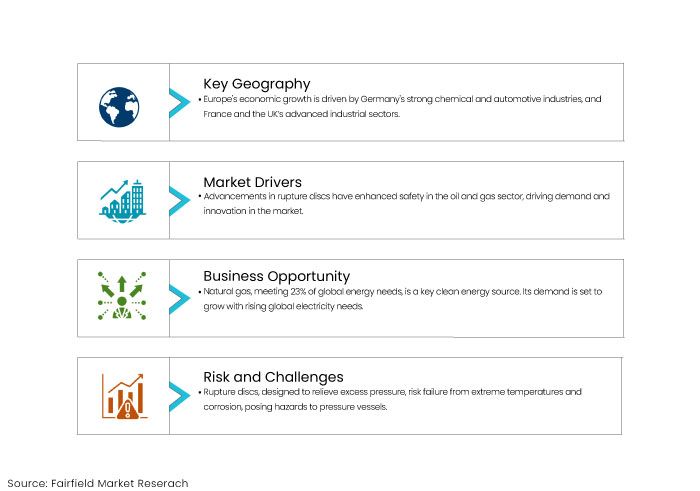
The safety level has risen due to various advancements, leading many design and plant personnel to pay attention to using the facility's essential safety equipment. The rupture disc market is propelled by continuous advancements in rupture devices and their applications within the oil and gas sector.
- Water and Wastewater Infrastructure Aging Drives Demand for Rupture Discs
The deterioration of public infrastructure is a significant issue for numerous countries. In older building infrastructure, pressure-reducing valves require replacement as they have concluded their life cycles. Replacing these valves is crucial to prevent degradation, extend the operating lifespan of industrial infrastructure, and maintain optimal levels of safety and functionality.
In recent years, public awareness of the necessity for improved sanitation and hygiene has intensified, which has resulted in a greater need for advanced safety measures, prolonged service life, and enhanced water supply and sanitation infrastructure in numerous countries globally.
In response to the increasing demand, governments have redirected their efforts towards substantial investments in advanced technology and infrastructures to ensure citizens have access to clean water and improved sanitary facilities.
New investments encompass several initiatives, including the construction of sewage treatment facilities, the implementation of advanced rainwater collecting systems, the establishment of efficient drainage networks, and the provision of sustainable wastewater treatment solutions. These measures are essential for providing access to safe drinking water and mitigating environmental damage from inappropriate garbage disposal.
Key Growth Barriers
- Absence of Oversight and Regulatory Frameworks Remains a Crucial Barrier
Rupture discs, consisting of an external metal shell and an internal membrane, are vulnerable to severe temperatures and corrosion, resulting in undesired occurrences. The principal function of a rupture disc is to serve as a relief device when the confined fluid or chemical attains a predetermined pressure. The disc ceases to fulfill its designated function upon rupture, presenting possible hazards to pressure vessels and other infrastructure.
In essential operations, including fluid control applications, hygiene and cleanliness protocols, safety systems, sewage treatment facilities, rainwater harvesting systems, drainage networks, wastewater treatment solutions, power generation sectors, natural gas, electricity, mining endeavors, and diverse industries such as food processing, pharmaceuticals, brewing, synthetic materials, rubber, pulp and paper, public infrastructure, aerospace, aviation, railway, trucking, and shipping, the integration of a monitoring and control system is imperative.
The device can swiftly detect a blown disc and alert the process system operator, allowing for timely intervention and successful process management. The significance of such a system is especially pronounced in businesses that encounter harsh conditions, such as high temperatures, corrosive fluids, or toxic chemicals.
- Limited Reusability and System Downtime
Another significant restraint is the limited reusability of rupture discs, as they function as single-use devices, unlike some other pressure relief options that can be reset and reused. When a rupture disc activates, it typically requires immediate replacement, leading to unexpected downtime and disruption in production processes.
For industries reliant on continuous operations, such as petrochemicals, oil and gas, and pharmaceuticals, this limitation can significantly impact productivity and profitability.
Additionally, the process of replacing a rupture disc can be complex, sometimes necessitating skilled labour or specialized tools, particularly in high-temperature or high-pressure environments. Consequently, industries that cannot afford frequent shutdowns might consider alternative relief systems, posing a restraint to the market expansion of rupture discs.
Rupture Disc Market Trends and Opportunities
- Increasing Demand from the Power Generation Spurs the Market Demand
Natural gas is widely utilized for electricity generation due to its clean combustion properties. The utilization of natural gas as an energy source is gaining significance in contemporary society.
Natural gas accounts for 23% of the global energy requirements, positioning it as one of the predominant energy sources worldwide. This percentage is anticipated to rise as nations globally acknowledge its numerous benefits. By 2040, the IEA anticipates that electricity demand will grow at an annual rate of 2.1%, double the rate of primary energy demand.
Energy demand is anticipated to expand owing to heightened household earnings, transportation and home heating electrification, and a growing necessity for air conditioning and digitally connected devices. An enhanced infrastructure for facilitating these activities is expected to stimulate the market for rupture discs indirectly.
- Growing Mining Initiatives to Generate Opportunities for Rupture Discs
Rupture discs have become a safety measure in the mining industry to protect miners. A rupture disc is engineered to offer a reliable pressure release mechanism for pipelines, vessels, and equipment, which is particularly advantageous in regions where mining operations include hazardous substances.
The demand for equipment and safety relief devices in fluid control applications for mining operations is expected to increase due to the necessity of various types of equipment, including valves, pumps, and additional components when executing such projects.
Safety relief mechanisms are employed to avert the probable occurrence of mishaps at such places. Consequently, manufacturers have addressed this demand by augmenting output and including new products in their catalogues to meet customer needs.
The predicted increase of mining operations in countries such as Australia, Brazil, China, India, Russia, and South Africa is expected to influence the global rupture disc market positively.
How Does Regulatory Scenario Shape this Industry?
The regulatory environment plays a crucial role in shaping the rupture disc market, as stringent safety standards across industries drive demand for high-quality, and reliable pressure relief solutions.
Regulatory bodies such as the American Society of Mechanical Engineers (ASME), the Occupational Safety and Health Administration (OSHA), and the European Pressure Equipment Directive (PED) set strict guidelines for equipment used in high-pressure environments to prevent hazardous incidents. Such regulations mandate that industries, including oil and gas, pharmaceuticals, chemicals, and food processing, adopt certified rupture discs that meet specific safety and performance standards.
As regulatory requirements evolve, particularly concerning environmental and workplace safety, there is an increased emphasis on ensuring that equipment can withstand higher pressure thresholds without risking failure. This trend encourages the adoption of advanced rupture disc technologies with longer lifespans, higher precision, and greater resilience to extreme conditions.
The rise of environmental regulations is expected to increase the use of rupture discs in eco-conscious industries like hydrogen fuel and biofuels, where reliable pressure management is critical. The regulatory landscape positively influences the rupture disc market by driving consistent demand for high-quality and compliant pressure relief solutions.
Segments Covered in the Report
- Metallic Rupture Discs Gain Traction
In the global rupture disc market, metallic rupture discs hold a dominant position over graphite rupture discs, primarily due to their versatility, durability, and widespread application across industries. Metallic rupture discs are generally preferred in applications where higher pressures and extreme temperature resistance are required, such as in oil and gas, petrochemicals, and pharmaceuticals.
These discs are typically made from materials like stainless steel, Hastelloy, or Inconel, which provide high durability and precision. As a result, metallic rupture discs account for around 65% of the market share, reflecting their broad adoption and suitability for high-stress environments.
- Positive Arch Rupture Discs Take the Lead
Positive arch rupture discs are the dominant product type, primarily due to their high reliability and versatility in various industrial applications, including oil and gas, chemical processing, and pharmaceuticals.
Positive arch rupture discs are designed to open quickly at a specified pressure, efficiently venting excess pressure and protecting equipment. Their arched structure provides enhanced durability and better control over burst pressure, making them suitable for high-pressure applications.
Consequently, positive arch rupture discs hold a market share of approximately 55%, reflecting their wide adoption in sectors that demand high-performance pressure relief.
Regional Analysis
- Europe Influences the Rupture Disc Market with Robust End Market
Europe region has experienced significant economic growth recently, with certain countries continually exhibiting robust end markets. Germany has a flourishing chemical and automotive sector, while France and the UK possess one of the most developed industrial sectors globally, supplying vital resources for regional growth.
France and the UK have pioneered innovation and technological advancements, creating new products and services for home and global markets. Other profitable end users, such as the food and beverage sector, have demonstrated substantial demand for rupture discs and are expected to maintain this demand.
Germany is among the leading markets in the European region for rupture discs, attributed to the significant presence of numerous small and medium-sized manufacturers and their after-sales services. Germany is projected to represent approximately 5% of the global market share, while the UK is expected to experience a steady compound annual growth rate (CAGR) over the forecast period.
GCC Nations to Experience Significant Demand for Rupture Discs
The utilization of rupture discs has significantly surged in GCC nations recently. Due to an increase in oil and gas revenue, along with a construction and investment surge fueled by decades of petroleum revenue reserves, the region has some of the fastest-growing economies globally.
Saudi Arabia, the United Arab Emirates, Kuwait, and Qatar, the principal GCC states, are the foremost producers of oil and gas; thus, sales in this sector are expected to see a robust value CAGR during the forecast period.
Rupture disc manufacturers in the Middle East and Africa are anticipated to witness significant expansion owing to their extensive utilization in the mining, power generation, and oil and gas sectors.
Fairfield’s Competitive Landscape Analysis
The rupture disc market is anticipated to be quite fragmented, with a limited number of participants. Market participants are strategically concentrating on the creation of innovative, high-performance products and customized solutions to broaden their client bases and enhance their market shares.
To enhance market penetration, several unorganized enterprises are focusing on creating personalized and cost-effective products. Key industry stakeholders are strategically enhancing their market position through collaborations and partnerships with suppliers and distributors.
Leading organizations focus on substantial research and development investment to deliver cost-effective solutions. Parker, Hannifin Corp, Emerson Electric Co, Halma Plc, Mersen Group, and V-TEX Corp are prominent global brands and major manufacturers seeking to establish market positions while safeguarding their unique identities.
Key Market Companies
- Emerson Electric Co
- BS&B Safety Systems, L.L.C
- Fike Corporation
- Parker Hannifin Corp
- Halma Plc
- Graco Inc.
- V-TEX Corp.
- Continental Disc Corporation LLC
- Mersen Group
- WOLFF GROUP
Global Rupture Disc Market is Segmented as-
By Material Type
- Graphite Rupture Discs
- Metallic Rupture Discs
By Product Type
- Positive Arch Rupture Discs
- Anti-Arch Rupture Discs
- Flat Type Rupture Discs
By Application
- Standalone Rupture Discs
- Rupture Discs with Relief Valves
By Region
- North America
- Europe
- Asia Pacific
- Latin America
- The Middle East & Africa
- Executive Summary
- Global Rupture Disc Market Snapshot
- Future Projections
- Key Market Trends
- Regional Snapshot, by Value, 2026
- Analyst Recommendations
- Market Overview
- Market Definitions and Segmentations
- Market Dynamics
- Drivers
- Restraints
- Market Opportunities
- Value Chain Analysis
- COVID-19 Impact Analysis
- Porter's Five Forces Analysis
- Impact of Russia-Ukraine Conflict
- PESTLE Analysis
- Regulatory Analysis
- Price Trend Analysis
- Current Prices and Future Projections, 2025-2033
- Price Impact Factors
- Global Rupture Disc Market Outlook, 2020 - 2033
- Global Rupture Disc Market Outlook, by Material Type, Value (US$ Mn), 2020-2033
- Graphite Rupture Discs
- Metallic Rupture Discs
- Global Rupture Disc Market Outlook, by Product Type, Value (US$ Mn), 2020-2033
- Positive Arch Rupture Discs
- Anti-Arch Rupture Discs
- Flat Type Rupture Discs
- Global Rupture Disc Market Outlook, by Application, Value (US$ Mn), 2020-2033
- Standalone Rupture Discs
- Rupture Discs with Relief Valves
- Global Rupture Disc Market Outlook, by Region, Value (US$ Mn), 2020-2033
- North America
- Europe
- Asia Pacific
- Latin America
- Middle East & Africa
- Global Rupture Disc Market Outlook, by Material Type, Value (US$ Mn), 2020-2033
- North America Rupture Disc Market Outlook, 2020 - 2033
- North America Rupture Disc Market Outlook, by Material Type, Value (US$ Mn), 2020-2033
- Graphite Rupture Discs
- Metallic Rupture Discs
- North America Rupture Disc Market Outlook, by Product Type, Value (US$ Mn), 2020-2033
- Positive Arch Rupture Discs
- Anti-Arch Rupture Discs
- Flat Type Rupture Discs
- North America Rupture Disc Market Outlook, by Application, Value (US$ Mn), 2020-2033
- Standalone Rupture Discs
- Rupture Discs with Relief Valves
- North America Rupture Disc Market Outlook, by Country, Value (US$ Mn), 2020-2033
- U.S. Rupture Disc Market Outlook, by Material Type, 2020-2033
- U.S. Rupture Disc Market Outlook, by Product Type, 2020-2033
- U.S. Rupture Disc Market Outlook, by Application, 2020-2033
- Canada Rupture Disc Market Outlook, by Material Type, 2020-2033
- Canada Rupture Disc Market Outlook, by Product Type, 2020-2033
- Canada Rupture Disc Market Outlook, by Application, 2020-2033
- BPS Analysis/Market Attractiveness Analysis
- North America Rupture Disc Market Outlook, by Material Type, Value (US$ Mn), 2020-2033
- Europe Rupture Disc Market Outlook, 2020 - 2033
- Europe Rupture Disc Market Outlook, by Material Type, Value (US$ Mn), 2020-2033
- Graphite Rupture Discs
- Metallic Rupture Discs
- Europe Rupture Disc Market Outlook, by Product Type, Value (US$ Mn), 2020-2033
- Positive Arch Rupture Discs
- Anti-Arch Rupture Discs
- Flat Type Rupture Discs
- Europe Rupture Disc Market Outlook, by Application, Value (US$ Mn), 2020-2033
- Standalone Rupture Discs
- Rupture Discs with Relief Valves
- Europe Rupture Disc Market Outlook, by Country, Value (US$ Mn), 2020-2033
- Germany Rupture Disc Market Outlook, by Material Type, 2020-2033
- Germany Rupture Disc Market Outlook, by Product Type, 2020-2033
- Germany Rupture Disc Market Outlook, by Application, 2020-2033
- Italy Rupture Disc Market Outlook, by Material Type, 2020-2033
- Italy Rupture Disc Market Outlook, by Product Type, 2020-2033
- Italy Rupture Disc Market Outlook, by Application, 2020-2033
- France Rupture Disc Market Outlook, by Material Type, 2020-2033
- France Rupture Disc Market Outlook, by Product Type, 2020-2033
- France Rupture Disc Market Outlook, by Application, 2020-2033
- U.K. Rupture Disc Market Outlook, by Material Type, 2020-2033
- U.K. Rupture Disc Market Outlook, by Product Type, 2020-2033
- U.K. Rupture Disc Market Outlook, by Application, 2020-2033
- Spain Rupture Disc Market Outlook, by Material Type, 2020-2033
- Spain Rupture Disc Market Outlook, by Product Type, 2020-2033
- Spain Rupture Disc Market Outlook, by Application, 2020-2033
- Russia Rupture Disc Market Outlook, by Material Type, 2020-2033
- Russia Rupture Disc Market Outlook, by Product Type, 2020-2033
- Russia Rupture Disc Market Outlook, by Application, 2020-2033
- Rest of Europe Rupture Disc Market Outlook, by Material Type, 2020-2033
- Rest of Europe Rupture Disc Market Outlook, by Product Type, 2020-2033
- Rest of Europe Rupture Disc Market Outlook, by Application, 2020-2033
- BPS Analysis/Market Attractiveness Analysis
- Europe Rupture Disc Market Outlook, by Material Type, Value (US$ Mn), 2020-2033
- Asia Pacific Rupture Disc Market Outlook, 2020 - 2033
- Asia Pacific Rupture Disc Market Outlook, by Material Type, Value (US$ Mn), 2020-2033
- Graphite Rupture Discs
- Metallic Rupture Discs
- Asia Pacific Rupture Disc Market Outlook, by Product Type, Value (US$ Mn), 2020-2033
- Positive Arch Rupture Discs
- Anti-Arch Rupture Discs
- Flat Type Rupture Discs
- Asia Pacific Rupture Disc Market Outlook, by Application, Value (US$ Mn), 2020-2033
- Standalone Rupture Discs
- Rupture Discs with Relief Valves
- Asia Pacific Rupture Disc Market Outlook, by Country, Value (US$ Mn), 2020-2033
- China Rupture Disc Market Outlook, by Material Type, 2020-2033
- China Rupture Disc Market Outlook, by Product Type, 2020-2033
- China Rupture Disc Market Outlook, by Application, 2020-2033
- Japan Rupture Disc Market Outlook, by Material Type, 2020-2033
- Japan Rupture Disc Market Outlook, by Product Type, 2020-2033
- Japan Rupture Disc Market Outlook, by Application, 2020-2033
- South Korea Rupture Disc Market Outlook, by Material Type, 2020-2033
- South Korea Rupture Disc Market Outlook, by Product Type, 2020-2033
- South Korea Rupture Disc Market Outlook, by Application, 2020-2033
- India Rupture Disc Market Outlook, by Material Type, 2020-2033
- India Rupture Disc Market Outlook, by Product Type, 2020-2033
- India Rupture Disc Market Outlook, by Application, 2020-2033
- Southeast Asia Rupture Disc Market Outlook, by Material Type, 2020-2033
- Southeast Asia Rupture Disc Market Outlook, by Product Type, 2020-2033
- Southeast Asia Rupture Disc Market Outlook, by Application, 2020-2033
- Rest of SAO Rupture Disc Market Outlook, by Material Type, 2020-2033
- Rest of SAO Rupture Disc Market Outlook, by Product Type, 2020-2033
- Rest of SAO Rupture Disc Market Outlook, by Application, 2020-2033
- BPS Analysis/Market Attractiveness Analysis
- Asia Pacific Rupture Disc Market Outlook, by Material Type, Value (US$ Mn), 2020-2033
- Latin America Rupture Disc Market Outlook, 2020 - 2033
- Latin America Rupture Disc Market Outlook, by Material Type, Value (US$ Mn), 2020-2033
- Graphite Rupture Discs
- Metallic Rupture Discs
- Latin America Rupture Disc Market Outlook, by Product Type, Value (US$ Mn), 2020-2033
- Positive Arch Rupture Discs
- Anti-Arch Rupture Discs
- Flat Type Rupture Discs
- Latin America Rupture Disc Market Outlook, by Application, Value (US$ Mn), 2020-2033
- Standalone Rupture Discs
- Rupture Discs with Relief Valves
- Latin America Rupture Disc Market Outlook, by Country, Value (US$ Mn), 2020-2033
- Brazil Rupture Disc Market Outlook, by Material Type, 2020-2033
- Brazil Rupture Disc Market Outlook, by Product Type, 2020-2033
- Brazil Rupture Disc Market Outlook, by Application, 2020-2033
- Mexico Rupture Disc Market Outlook, by Material Type, 2020-2033
- Mexico Rupture Disc Market Outlook, by Product Type, 2020-2033
- Mexico Rupture Disc Market Outlook, by Application, 2020-2033
- Argentina Rupture Disc Market Outlook, by Material Type, 2020-2033
- Argentina Rupture Disc Market Outlook, by Product Type, 2020-2033
- Argentina Rupture Disc Market Outlook, by Application, 2020-2033
- Rest of LATAM Rupture Disc Market Outlook, by Material Type, 2020-2033
- Rest of LATAM Rupture Disc Market Outlook, by Product Type, 2020-2033
- Rest of LATAM Rupture Disc Market Outlook, by Application, 2020-2033
- BPS Analysis/Market Attractiveness Analysis
- Latin America Rupture Disc Market Outlook, by Material Type, Value (US$ Mn), 2020-2033
- Middle East & Africa Rupture Disc Market Outlook, 2020 - 2033
- Middle East & Africa Rupture Disc Market Outlook, by Material Type, Value (US$ Mn), 2020-2033
- Graphite Rupture Discs
- Metallic Rupture Discs
- Middle East & Africa Rupture Disc Market Outlook, by Product Type, Value (US$ Mn), 2020-2033
- Positive Arch Rupture Discs
- Anti-Arch Rupture Discs
- Flat Type Rupture Discs
- Middle East & Africa Rupture Disc Market Outlook, by Application, Value (US$ Mn), 2020-2033
- Standalone Rupture Discs
- Rupture Discs with Relief Valves
- Middle East & Africa Rupture Disc Market Outlook, by Country, Value (US$ Mn), 2020-2033
- GCC Rupture Disc Market Outlook, by Material Type, 2020-2033
- GCC Rupture Disc Market Outlook, by Product Type, 2020-2033
- GCC Rupture Disc Market Outlook, by Application, 2020-2033
- South Africa Rupture Disc Market Outlook, by Material Type, 2020-2033
- South Africa Rupture Disc Market Outlook, by Product Type, 2020-2033
- South Africa Rupture Disc Market Outlook, by Application, 2020-2033
- Egypt Rupture Disc Market Outlook, by Material Type, 2020-2033
- Egypt Rupture Disc Market Outlook, by Product Type, 2020-2033
- Egypt Rupture Disc Market Outlook, by Application, 2020-2033
- Nigeria Rupture Disc Market Outlook, by Material Type, 2020-2033
- Nigeria Rupture Disc Market Outlook, by Product Type, 2020-2033
- Nigeria Rupture Disc Market Outlook, by Application, 2020-2033
- Rest of Middle East Rupture Disc Market Outlook, by Material Type, 2020-2033
- Rest of Middle East Rupture Disc Market Outlook, by Product Type, 2020-2033
- Rest of Middle East Rupture Disc Market Outlook, by Application, 2020-2033
- BPS Analysis/Market Attractiveness Analysis
- Middle East & Africa Rupture Disc Market Outlook, by Material Type, Value (US$ Mn), 2020-2033
- Competitive Landscape
- Company Vs Segment Heatmap
- Company Market Share Analysis, 2025
- Competitive Dashboard
- Company Profiles
- Emerson Electric Co
- Company Overview
- Product Portfolio
- Financial Overview
- Business Strategies and Developments
- BS&B Safety Systems, L.L.C
- Fike Corporation
- Parker Hannifin Corp
- Halma Plc
- Graco Inc.
- V-TEX Corp.
- Continental Disc Corporation LLC
- Mersen Group
- WOLFF GROUP
- Emerson Electric Co
- Appendix
- Research Methodology
- Report Assumptions
- Acronyms and Abbreviations
|
BASE YEAR |
HISTORICAL DATA |
FORECAST PERIOD |
UNITS |
|||
 |
2025 |
 |
2020 - 2025 |
 |
2026 - 2033 |
Value: US$ Million |
|
REPORT FEATURES |
DETAILS |
|
Material Type Coverage |
|
|
Product Type Coverage |
|
|
Application Coverage |
|
|
Geographical Coverage |
|
|
Leading Companies |
|
|
Report Highlights |
Key Market Indicators, Macro-micro economic impact analysis, Technological Roadmap, Key Trends, Driver, Restraints, and Future Opportunities & Revenue Pockets, Porter’s 5 Forces Analysis, Historical Trend (2019-2021), Market Estimates and Forecast, Market Dynamics, Industry Trends, Competition Landscape, Category, Region, Country-wise Trends & Analysis, COVID-19 Impact Analysis (Demand and Supply Chain) |
Our Research Methodology
Considering the volatility of business today, traditional approaches to strategizing a game plan can be unfruitful if not detrimental. True ambiguity is no way to determine a forecast. A myriad of predetermined factors must be accounted for such as the degree of risk involved, the magnitude of circumstances, as well as conditions or consequences that are not known or unpredictable. To circumvent binary views that cast uncertainty, the application of market research intelligence to strategically posture, move, and enable actionable outcomes is necessary.
View Methodology
Quality Assured
Rigorous Validation Process

Confidentiality Assured
End-to-end Data Security

Custom Research Services
Tailored To Your Objectives
FAQs
The Rupture Disc Market size is valued at USD 703.3 million in 2026.
The Rupture Disc Market is projected to grow at a CAGR of 3.7% by 2033, reaching USD 907 million.
The Rupture Disc Market growth is driven by increasing industrial safety regulations, rising demand from process industries, and growing investments in pressure relief systems.
North America is the dominant region in the Rupture Disc Market.
Emerson Electric Co., BS&B Safety Systems, L.L.C., Fike Corporation, Parker Hannifin Corp., and Halma Plc are some of the leading industry players in the Rupture Disc Market.
Related Reports
Built To Rent Residential Market Insights, Competitive Landscape, and Market Forecast 2033
Built to Rent Residential Market to reach USD 76.26 Bn by 2033, growing at 8.9% CAGR, driven by rental demand, housing affordability, and institutional investment.
Building Inspection Services Market Insights, Competitive Landscape, and Market Forecast 2033
Building Inspection Services Market to reach USD 23.93 Bn by 2033, growing at 6.7% CAGR, driven by aging buildings, safety regulations, and real estate demand.
Transformer Protection Equipment Market Forecast - 2033
The global transformer protection equipment market is set to reach US$ 8.66 billion by 2033, growing at a 6.4% CAGR from 2026-2033
Industrial Demand Response Management Systems Market Forecast - 2033
The global industrial demand response management systems market is set to reach US$ 6.81 billion by 2033, growing at an 11.4% CAGR from 2026-2033
Embroidery Machine Market Insights, Competitive Landscape, and Market Forecast 2033
The embroidery machines market will grow from USD 1.85 billion in 2026 to USD 2.64 billion by 2033, driven by customized and branded apparel demand.
Electric Vehicle CNC Turning Centers Market Insights, Competitive Landscape, and Market Forecast 2033
The electric vehicle CNC turning centers market is projected to rise from USD 1.35 billion in 2026 to USD 2.60 billion by 2033, driven by rising EV production.