Global Small Molecule CMO CDMO Market Growth and Industry Forecast
Executive Summary & Key Highlights
- The Small Molecule CMO/CDMO Market is valued at USD 79.9 billion in 2026 and is projected to reach USD 131.2 billion, growing at a CAGR of 5% by 2033.
- Standard API remains the leading product segment with over 65% share, driven by strong generic drug demand and wide commercial-scale manufacturing capacity.
- GMP Manufacturing leads all service segments with more than 40% share, reflecting the essential need for globally compliant commercial production.
- Process Development is the fastest-expanding service area, fueled by increasing complexity in small molecule development and strong biotech outsourcing demand.
- Large Pharmaceutical Companies dominate customer share with over 55%, driven by extensive pipelines and long-term commercial outsourcing strategies.
- Commercial-Scale Manufacturing accounts for over 60% of total activity, driven by high-volume supply needs across both branded and generic portfolios.
- Asia Pacific remains the leading region, while North America leads in high-value outsourcing demand and Europe strengthens through advanced quality and HPAPI capabilities.
Market Dynamics: Drivers, Restraints, and Opportunities Analysis
Market Drivers
- Pharmaceutical Industry Outsourcing Acceleration
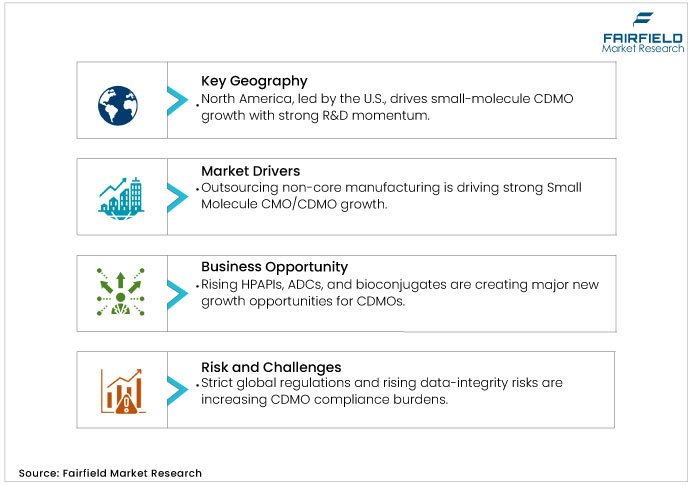
The shift toward outsourcing non-core manufacturing is the main driver of Small Molecule CMO/CDMO growth, with outsourced small molecule manufacturing projected to rise 6–7% annually through 2029. The global pharmaceutical contract manufacturing market recorded significant expansion in 2024, highlighting strong adoption across both small-molecule and biologic therapies. This model enables pharma companies to focus on R&D and clinical development while leveraging CDMOs’ infrastructure and regulatory expertise.
Small and emerging biotechs gain crucial advantages from CDMO partnerships due to limited in-house capacity and the need for scalable production solutions. Large pharmaceutical companies also benefit by maintaining operational flexibility amid demand fluctuations, patent cliffs, and portfolio restructuring. CDMOs offering integrated development-to-commercial services gain competitive edge, though long-term sustainability depends on R&D productivity, regulatory consistency, and reliable quality performance.
- Rising Demand for Complex Small Molecule Therapeutics
Growing complexity in small molecule drug development—especially high-potency APIs for oncology and targeted therapies—is sharply increasing demand for specialized CDMO capabilities. Specialty medicines now drive global manufacturing growth, with small molecules accounting for over half of specialty pharmaceutical sales and HPAPIs representing over 50% of FDA approvals in 2022. With over 1,000 HPAPIs in development, the sector is rapidly expanding due to advanced containment needs and premium pricing dynamics.
High-potency manufacturing requires facilities capable of handling exposure limits as low as 10 nanograms per cubic meter, prompting pharma companies to outsource rather than invest internally. For oncology portfolios, this trend is projected to add multiple percentage points to outsourcing growth through 2030, favoring CDMOs with advanced containment and regulatory-strength capabilities. Sustainability remains strong, supported by robust oncology approval rates, targeted therapy success, and momentum in antibody-drug conjugate development.
Market Restraints
- Stringent Regulatory Compliance Requirements
The pharmaceutical manufacturing sector faces extremely rigorous regulatory requirements from the FDA, EMA, and WHO, with 21 CFR Parts 210–211 and EudraLex Volume 4 imposing stringent standards on facilities, quality systems, and documentation. Data integrity has become the top source of FDA warning letters in API manufacturing, while over 50% of CDMO facilities report challenges keeping pace with evolving regulations. This substantial compliance burden suppresses market growth by raising operational costs, limiting new entrants, and elevating risks of warning letters, manufacturing suspensions, and product recalls.
Regulated market expansion in regions such as India and China is hindered by the need for significant investments to meet FDA and EMA inspection expectations. CDMOs are mitigating these pressures through digital quality management systems, predictive analytics for deviation prevention, regulatory consulting partnerships, and proactive agency engagement including pre-approval inspections and continuous process verification. The restraint’s long-term impact will depend on regulatory policy evolution, with programs such as the FDA’s Emerging Technology Program offering potential relief through accelerated approval pathways for advanced manufacturing technologies.
- Supply Chain Complexity and Disruption Risks
Global pharmaceutical supply chains—spanning multiple regions for raw materials, intermediates, and final drug distribution—remain highly vulnerable to disruptions that directly affect contract manufacturing operations. Events such as COVID-19, geopolitical tensions, and logistics bottlenecks have exposed fragility, while the 2018 nitrosamine impurity crisis highlighted visibility gaps across supplier networks. In small molecule manufacturing, reliance on chemical intermediates, solvents, and region-concentrated raw materials amplifies risks of production delays, cost inflation, and regulatory complications.
Supply chain disruptions also threaten pharmaceutical companies with clinical trial delays and commercial supply interruptions if their CDMO partners face material shortages or process changes. To counter these risks, manufacturers are adopting supplier diversification, strategic inventory buffering, regionalized production networks, and digital tracking systems for improved transparency. The long-term impact of this restraint will depend on geopolitical risk evolution and the effectiveness of these mitigation strategies in stabilizing supply continuity.
Market Opportunities
- Expansion of High-Potency API and Bioconjugate Manufacturing
The rapid growth of high-potency APIs, antibody-drug conjugates, and complex bioconjugates represents a major opportunity for CDMOs with specialized capabilities. The high-potency API industry is expected to see substantial growth through 2030–2032, supported by expanding oncology pipelines, rising adoption of antibody–drug conjugates, and increasing demand for potent therapies targeting hormonal, autoimmune, and rare diseases. The addressable opportunity in this segment is expected to expand significantly over the forecast period.
CDMOs with advanced containment facilities, occupational hygiene expertise, and cytotoxic analytical capabilities are positioned to capture outsized share of this high-value segment. However, realizing this opportunity requires capital investments of tens of millions of dollars, along with specialized technical personnel and strict HPAPI regulatory compliance. Competitive intensity and customer preference for experienced oncology manufacturers mean the strongest gains will favor well-capitalized CDMOs with proven high-potency track records.
- Digital Technology Integration and Continuous Manufacturing Adoption
Digitalization, AI integration, and continuous manufacturing technologies are creating major differentiation opportunities for CDMOs, with continuous systems delivering 70% smaller facility footprints, up to 50% operating cost savings, and faster time-to-market through real-time release testing. The FDA’s ICH Q13 guidance and Emerging Technology Program further reduce regulatory uncertainty and accelerate approvals for continuous manufacturing. CDMOs implementing advanced digital capabilities can capture 10–15% pricing premiums and improve customer retention, especially in early-stage and high-value therapeutic areas such as oncology.
Realizing this opportunity requires substantial capital investment in continuous manufacturing equipment, PAT tools, and digital infrastructure, along with workforce retraining and complex regulatory submissions. Barriers include customer conservatism toward process changes, validation challenges, and increasing competitive investment from established players. As a result, the opportunity is most favorable for well-resourced CDMOs capable of sustained technology adoption and long-term innovation.
Regional Market Assessment: Strategic Geography Analysis
- North America Small Molecule CMO/CDMO Market
North America, led by the U.S., holds over 30% of the global small molecule CMO/CDMO market in 2025 and expected to maintain leadership through the forecast period. Growth is supported by the U.S. accounting for approximately 45% of global pharmaceutical R&D, strong clinical trial activity, and strategic outsourcing by major pharma and biotech clusters in Boston-Cambridge, the Bay Area, and Research Triangle Park. Innovation in oncology, rare diseases, and advanced manufacturing—including continuous processing and digital quality systems—further strengthens regional momentum.
The FDA’s stringent cGMP enforcement, data integrity expectations, and rigorous inspection protocols create high entry barriers but offer competitive advantages for established North American CDMOs with proven compliance. Despite higher cost structures compared to Asia, customers favor North American manufacturing for supply security, regulatory familiarity, and IP protection, especially for early-stage and high-value commercial products. Market strategies must address premium pricing sustainability, excellence in regulatory compliance, and investment in technology platforms to differentiate in this mature, highly competitive region.
- Europe Small Molecule CMO/CDMO Market
Europe represents a large and advanced small molecule CMO/CDMO market, with Germany contributing 20–25% and the U.K. 15–20% of regional value. EMA-driven harmonization, EudraLex Volume 4 quality expectations, and mutual recognition agreements shape a regulatory environment emphasizing quality risk management and system-level compliance. Germany excels in precision and complex molecule manufacturing, while the U.K. leverages Cambridge–London innovation clusters and strong scientific talent.
Sustainability mandates under the European Green Deal and Industry 4.0 are reshaping competition by requiring energy-efficient technologies and transparent environmental reporting to support Scope 3 emission goals. France leads in complex molecule manufacturing, while Switzerland, Ireland, and Belgium offer strengths in HPAPIs and biologics. European growth strategies require country-specific analysis amid consolidation trends driven by global CDMOs expanding footprint and pharma companies concentrating suppliers across pan-European manufacturing networks.
- Asia Pacific Small Molecule CMO/CDMO Market
Asia Pacific is the leading region, projected to capture ~40% global small molecule CMO/CDMO market share, driven by rapid capacity expansion and strong cost advantages. China accounts for 45–50% of regional value, supported by 1,200+ GMP-certified facilities, 20–30% lower costs, and government-backed modernization enabling advanced small molecule and HPAPI manufacturing. India’s CDMO industry is expected to witness substantial expansion by 2028, supported by strong chemistry capabilities, a notable cost advantage over competing regions, and improving regulatory compliance with global standards.
Japan maintains a mature, high-quality small molecule CMO/CDMO market with slower growth but strong demand for specialized manufacturing services, while ASEAN countries—Singapore, South Korea, and emerging Southeast Asian hubs—are accelerating through government initiatives and multinational manufacturing expansions. Asia Pacific ’s cost structures, proximity to raw materials, and increasing technological sophistication are reshaping global competition, allowing regional CDMOs to compete on capability as well as cost. Strategic considerations for pharma companies include balancing cost savings with supply chain risk, regulatory variability, and intellectual property protection when outsourcing to Asian markets.
Segmentation Analysis: Category-Wise Strategic Assessment
- By Product: Standard API and High-Potency API Analysis
Standard API products dominate the Small Molecule CMO/CDMO Market with over 60% share in 2025. This leadership is driven by the large installed base of conventional pharmaceuticals, mature technical requirements enabling broad capacity, and strong demand from the global generic drug sector. Growth is supported by rising pharmaceutical consumption, patent expirations, and outsourcing trends favoring cost-competitive manufacturing hubs.
The high-potency API segment, though smaller, is expanding rapidly at a sustainable CAGR, outpacing overall market growth due to increasing oncology pipelines, ADC-related cytotoxic payload needs, and precision medicine requiring potent low-dose compounds. This segment requires advanced containment, specialized analytics, and stringent regulatory compliance, creating high entry barriers and sustained advantages for experienced HPAPI manufacturers, with partnership-based expansion favored over greenfield projects.
- By Service: Process Development, Analytical Method Development, GMP Manufacturing, Scale-up, Regulatory Assistance, and Fill-Finish Services Analysis
GMP Manufacturing Services lead the small molecule CMO/CDMO market with over 40% share in 2025, driven by the non-negotiable requirement for FDA, EMA, and global regulatory compliance in commercial drug production. Demand is fueled by rising R&D output, generic drug expansion, and pharmaceutical companies’ preference for outsourcing scalable, compliant manufacturing. Competitive positioning depends on regulatory track record, advanced processing technologies, and geographically diversified manufacturing networks.
Process Development Services are the fastest-growing segment, expanding rapidly as complex small-molecule therapeutics require advanced process chemistry, analytical development, and scale-up expertise. This segment acts as a strategic entry point for long-term manufacturing partnerships, with successful development-to-commercial transfer increasing contract value and duration. Integrated providers offering seamless technology transfer and full lifecycle support gain stronger margins and sustained customer relationships.
- By Company Size: Small, Mid-sized, and Large Pharmaceutical Company Analysis
Large pharmaceutical companies dominate the customer landscape with over 55% of small molecule CMO/CDMO market demand in 2025, reflecting their extensive pipelines, high-volume commercial manufacturing needs, and strategic outsourcing models designed to optimize capital efficiency. Their preference centers on partners with global manufacturing networks, strong regulatory compliance, and long-term capacity-sharing partnerships. This segment is further shaped by patent expirations, portfolio rationalization, and a focus on core competencies such as discovery and commercialization rather than in-house manufacturing.
Mid-sized pharmaceutical companies, growing at a robust CAGR, represent a rapidly expanding but smaller segment, driven by limited internal capacity, capital constraints, and greater agility in outsourcing adoption. Their key needs include competitive pricing, flexible scale-up support from clinical to commercial stages, and partners open to risk-sharing models such as milestone-based structures. Contract manufacturers with integrated development-to-manufacturing capabilities and strong regulatory compliance are best positioned to serve this segment effectively.
- By Scale of Operation: Clinical-Scale and Commercial-Scale Manufacturing Analysis
Commercial-scale manufacturing leads the small molecule CMO/CDMO market with over 60% activity in 2025, driven by high-volume production needs once drugs receive regulatory approval. Its dominance is supported by multi-year contracts, large batch efficiencies, and pharmaceutical companies’ preference for reliable partners for supply-critical products. Strong performance depends on regulatory excellence, large-scale capacity, and proven delivery reliability across product life cycles, including post-patent generic production.
Clinical-scale manufacturing is growing rapidly due to expanding development pipelines and rising demand for trial-ready material across more than 9,000 active compounds globally. This segment acts as a key entry point for long-term customer relationships, requiring high flexibility, fast turnaround, and strong technical support for evolving formulations. Opportunities are significant in small-batch, rare disease, personalized medicine, and Phase I manufacturing, where speed and quality create competitive differentiation.
Competitive Landscape: Market Structure and Strategic Positioning
The small molecule CMO/CDMO market is moderately fragmented, with major players such as Lonza, Catalent, WuXi AppTec, Thermo Fisher Scientific (Patheon), and Piramal Pharma Solutions holding significant but not dominant positions. Top-tier manufacturers typically capture mid-single-digit percentage shares, while numerous regional and niche providers compete through technology leadership, cost advantages in Asian markets, geographic specialization, and tailored customer focus.
Barriers to entry remain high due to capital-intensive GMP facilities costing tens of millions of dollars, strict regulatory compliance demands, and specialized technology requirements such as high-potency containment and continuous manufacturing. Consolidation continues to reshape the landscape, highlighted by major strategic acquisitions in recent years, as firms pursue capability expansion, broader geographic reach, and integrated global service models while niche specialists maintain strong positions in focused therapeutic and technology domains.
Key Players
- Lonza
- Thermo Fisher Scientific (Patheon)
- Catalent, Inc.
- WuXi AppTec
- Siegfried Holding AG
- Recipharm AB
- Piramal Pharma Solutions
- Pfizer CentreOne
- Eurofins Scientific
- Cambrex Corporation
- Almac Group
- Ajinomoto Bio-Pharma Services
- AGC Inc. (AGC Pharma Chemicals)
- CordenPharma
- Aenova Group
- Others
Global Small Molecule CMO/CDMO Market Segmentation-
By Product
- Standard API
- HP API
By Service
- Process Development
- Analytical Method Development
- GMP Manufacturing Service
- Scale-up and Tech Transfer
- Regulatory Assistance
- Fill-finish Services
By Company Size
- Small
- Mid-sized
- Large
By Scale of Operation
- Clinical
- Commercial
By Region
- North America
- Europe
- Asia Pacific
- Latin America
- Middle East & Africa
- Executive Summary
- Global Small Molecule CMO/CDMO Market Snapshot
- Future Projections
- Key Market Trends
- Regional Snapshot, by Value, 2026
- Analyst Recommendations
- Market Overview
- Market Definitions and Segmentations
- Market Dynamics
- Drivers
- Restraints
- Market Opportunities
- Value Chain Analysis
- COVID-19 Impact Analysis
- Porter's Five Forces Analysis
- Impact of Russia-Ukraine Conflict
- PESTLE Analysis
- Regulatory Analysis
- Price Trend Analysis
- Current Prices and Future Projections, 2025-2033
- Price Impact Factors
- Global Small Molecule CMO/CDMO Market Outlook, 2020 - 2033
- Global Small Molecule CMO/CDMO Market Outlook, by Product, Value (US$ Mn), 2020-2033
- Standard API
- HP API
- Global Small Molecule CMO/CDMO Market Outlook, by Company Size, Value (US$ Mn), 2020-2033
- Small
- Mid-sized
- Large
- Global Small Molecule CMO/CDMO Market Outlook, by Scale of Operation, Value (US$ Mn), 2020-2033
- Clinical
- Commercial
- Global Small Molecule CMO/CDMO Market Outlook, by Service, Value (US$ Mn), 2020-2033
- Process Development
- Analytical Method Development
- GMP Manufacturing Service
- Scale-up and Tech Transfer
- Regulatory Assistance
- Fill-finish Services
- Global Small Molecule CMO/CDMO Market Outlook, by Region, Value (US$ Mn), 2020-2033
- North America
- Europe
- Asia Pacific
- Latin America
- Middle East & Africa
- Global Small Molecule CMO/CDMO Market Outlook, by Product, Value (US$ Mn), 2020-2033
- North America Small Molecule CMO/CDMO Market Outlook, 2020 - 2033
- North America Small Molecule CMO/CDMO Market Outlook, by Product, Value (US$ Mn), 2020-2033
- Standard API
- HP API
- North America Small Molecule CMO/CDMO Market Outlook, by Company Size, Value (US$ Mn), 2020-2033
- Small
- Mid-sized
- Large
- North America Small Molecule CMO/CDMO Market Outlook, by Scale of Operation, Value (US$ Mn), 2020-2033
- Clinical
- Commercial
- North America Small Molecule CMO/CDMO Market Outlook, by Service, Value (US$ Mn), 2020-2033
- Process Development
- Analytical Method Development
- GMP Manufacturing Service
- Scale-up and Tech Transfer
- Regulatory Assistance
- Fill-finish Services
- North America Small Molecule CMO/CDMO Market Outlook, by Country, Value (US$ Mn), 2020-2033
- U.S. Small Molecule CMO/CDMO Market Outlook, by Product, 2020-2033
- U.S. Small Molecule CMO/CDMO Market Outlook, by Company Size, 2020-2033
- U.S. Small Molecule CMO/CDMO Market Outlook, by Scale of Operation, 2020-2033
- U.S. Small Molecule CMO/CDMO Market Outlook, by Service, 2020-2033
- Canada Small Molecule CMO/CDMO Market Outlook, by Product, 2020-2033
- Canada Small Molecule CMO/CDMO Market Outlook, by Company Size, 2020-2033
- Canada Small Molecule CMO/CDMO Market Outlook, by Scale of Operation, 2020-2033
- Canada Small Molecule CMO/CDMO Market Outlook, by Service, 2020-2033
- BPS Analysis/Market Attractiveness Analysis
- North America Small Molecule CMO/CDMO Market Outlook, by Product, Value (US$ Mn), 2020-2033
- Europe Small Molecule CMO/CDMO Market Outlook, 2020 - 2033
- Europe Small Molecule CMO/CDMO Market Outlook, by Product, Value (US$ Mn), 2020-2033
- Standard API
- HP API
- Europe Small Molecule CMO/CDMO Market Outlook, by Company Size, Value (US$ Mn), 2020-2033
- Small
- Mid-sized
- Large
- Europe Small Molecule CMO/CDMO Market Outlook, by Scale of Operation, Value (US$ Mn), 2020-2033
- Clinical
- Commercial
- Europe Small Molecule CMO/CDMO Market Outlook, by Service, Value (US$ Mn), 2020-2033
- Process Development
- Analytical Method Development
- GMP Manufacturing Service
- Scale-up and Tech Transfer
- Regulatory Assistance
- Fill-finish Services
- Europe Small Molecule CMO/CDMO Market Outlook, by Country, Value (US$ Mn), 2020-2033
- Germany Small Molecule CMO/CDMO Market Outlook, by Product, 2020-2033
- Germany Small Molecule CMO/CDMO Market Outlook, by Company Size, 2020-2033
- Germany Small Molecule CMO/CDMO Market Outlook, by Scale of Operation, 2020-2033
- Germany Small Molecule CMO/CDMO Market Outlook, by Service, 2020-2033
- Italy Small Molecule CMO/CDMO Market Outlook, by Product, 2020-2033
- Italy Small Molecule CMO/CDMO Market Outlook, by Company Size, 2020-2033
- Italy Small Molecule CMO/CDMO Market Outlook, by Scale of Operation, 2020-2033
- Italy Small Molecule CMO/CDMO Market Outlook, by Service, 2020-2033
- France Small Molecule CMO/CDMO Market Outlook, by Product, 2020-2033
- France Small Molecule CMO/CDMO Market Outlook, by Company Size, 2020-2033
- France Small Molecule CMO/CDMO Market Outlook, by Scale of Operation, 2020-2033
- France Small Molecule CMO/CDMO Market Outlook, by Service, 2020-2033
- U.K. Small Molecule CMO/CDMO Market Outlook, by Product, 2020-2033
- U.K. Small Molecule CMO/CDMO Market Outlook, by Company Size, 2020-2033
- U.K. Small Molecule CMO/CDMO Market Outlook, by Scale of Operation, 2020-2033
- U.K. Small Molecule CMO/CDMO Market Outlook, by Service, 2020-2033
- Spain Small Molecule CMO/CDMO Market Outlook, by Product, 2020-2033
- Spain Small Molecule CMO/CDMO Market Outlook, by Company Size, 2020-2033
- Spain Small Molecule CMO/CDMO Market Outlook, by Scale of Operation, 2020-2033
- Spain Small Molecule CMO/CDMO Market Outlook, by Service, 2020-2033
- Russia Small Molecule CMO/CDMO Market Outlook, by Product, 2020-2033
- Russia Small Molecule CMO/CDMO Market Outlook, by Company Size, 2020-2033
- Russia Small Molecule CMO/CDMO Market Outlook, by Scale of Operation, 2020-2033
- Russia Small Molecule CMO/CDMO Market Outlook, by Service, 2020-2033
- Rest of Europe Small Molecule CMO/CDMO Market Outlook, by Product, 2020-2033
- Rest of Europe Small Molecule CMO/CDMO Market Outlook, by Company Size, 2020-2033
- Rest of Europe Small Molecule CMO/CDMO Market Outlook, by Scale of Operation, 2020-2033
- Rest of Europe Small Molecule CMO/CDMO Market Outlook, by Service, 2020-2033
- BPS Analysis/Market Attractiveness Analysis
- Europe Small Molecule CMO/CDMO Market Outlook, by Product, Value (US$ Mn), 2020-2033
- Asia Pacific Small Molecule CMO/CDMO Market Outlook, 2020 - 2033
- Asia Pacific Small Molecule CMO/CDMO Market Outlook, by Product, Value (US$ Mn), 2020-2033
- Standard API
- HP API
- Asia Pacific Small Molecule CMO/CDMO Market Outlook, by Company Size, Value (US$ Mn), 2020-2033
- Small
- Mid-sized
- Large
- Asia Pacific Small Molecule CMO/CDMO Market Outlook, by Scale of Operation, Value (US$ Mn), 2020-2033
- Clinical
- Commercial
- Asia Pacific Small Molecule CMO/CDMO Market Outlook, by Service, Value (US$ Mn), 2020-2033
- Process Development
- Analytical Method Development
- GMP Manufacturing Service
- Scale-up and Tech Transfer
- Regulatory Assistance
- Fill-finish Services
- Asia Pacific Small Molecule CMO/CDMO Market Outlook, by Country, Value (US$ Mn), 2020-2033
- China Small Molecule CMO/CDMO Market Outlook, by Product, 2020-2033
- China Small Molecule CMO/CDMO Market Outlook, by Company Size, 2020-2033
- China Small Molecule CMO/CDMO Market Outlook, by Scale of Operation, 2020-2033
- China Small Molecule CMO/CDMO Market Outlook, by Service, 2020-2033
- Japan Small Molecule CMO/CDMO Market Outlook, by Product, 2020-2033
- Japan Small Molecule CMO/CDMO Market Outlook, by Company Size, 2020-2033
- Japan Small Molecule CMO/CDMO Market Outlook, by Scale of Operation, 2020-2033
- Japan Small Molecule CMO/CDMO Market Outlook, by Service, 2020-2033
- South Korea Small Molecule CMO/CDMO Market Outlook, by Product, 2020-2033
- South Korea Small Molecule CMO/CDMO Market Outlook, by Company Size, 2020-2033
- South Korea Small Molecule CMO/CDMO Market Outlook, by Scale of Operation, 2020-2033
- South Korea Small Molecule CMO/CDMO Market Outlook, by Service, 2020-2033
- India Small Molecule CMO/CDMO Market Outlook, by Product, 2020-2033
- India Small Molecule CMO/CDMO Market Outlook, by Company Size, 2020-2033
- India Small Molecule CMO/CDMO Market Outlook, by Scale of Operation, 2020-2033
- India Small Molecule CMO/CDMO Market Outlook, by Service, 2020-2033
- Southeast Asia Small Molecule CMO/CDMO Market Outlook, by Product, 2020-2033
- Southeast Asia Small Molecule CMO/CDMO Market Outlook, by Company Size, 2020-2033
- Southeast Asia Small Molecule CMO/CDMO Market Outlook, by Scale of Operation, 2020-2033
- Southeast Asia Small Molecule CMO/CDMO Market Outlook, by Service, 2020-2033
- Rest of SAO Small Molecule CMO/CDMO Market Outlook, by Product, 2020-2033
- Rest of SAO Small Molecule CMO/CDMO Market Outlook, by Company Size, 2020-2033
- Rest of SAO Small Molecule CMO/CDMO Market Outlook, by Scale of Operation, 2020-2033
- Rest of SAO Small Molecule CMO/CDMO Market Outlook, by Service, 2020-2033
- BPS Analysis/Market Attractiveness Analysis
- Asia Pacific Small Molecule CMO/CDMO Market Outlook, by Product, Value (US$ Mn), 2020-2033
- Latin America Small Molecule CMO/CDMO Market Outlook, 2020 - 2033
- Latin America Small Molecule CMO/CDMO Market Outlook, by Product, Value (US$ Mn), 2020-2033
- Standard API
- HP API
- Latin America Small Molecule CMO/CDMO Market Outlook, by Company Size, Value (US$ Mn), 2020-2033
- Small
- Mid-sized
- Large
- Latin America Small Molecule CMO/CDMO Market Outlook, by Scale of Operation, Value (US$ Mn), 2020-2033
- Clinical
- Commercial
- Latin America Small Molecule CMO/CDMO Market Outlook, by Service, Value (US$ Mn), 2020-2033
- Process Development
- Analytical Method Development
- GMP Manufacturing Service
- Scale-up and Tech Transfer
- Regulatory Assistance
- Fill-finish Services
- Latin America Small Molecule CMO/CDMO Market Outlook, by Country, Value (US$ Mn), 2020-2033
- Brazil Small Molecule CMO/CDMO Market Outlook, by Product, 2020-2033
- Brazil Small Molecule CMO/CDMO Market Outlook, by Company Size, 2020-2033
- Brazil Small Molecule CMO/CDMO Market Outlook, by Scale of Operation, 2020-2033
- Brazil Small Molecule CMO/CDMO Market Outlook, by Service, 2020-2033
- Mexico Small Molecule CMO/CDMO Market Outlook, by Product, 2020-2033
- Mexico Small Molecule CMO/CDMO Market Outlook, by Company Size, 2020-2033
- Mexico Small Molecule CMO/CDMO Market Outlook, by Scale of Operation, 2020-2033
- Mexico Small Molecule CMO/CDMO Market Outlook, by Service, 2020-2033
- Argentina Small Molecule CMO/CDMO Market Outlook, by Product, 2020-2033
- Argentina Small Molecule CMO/CDMO Market Outlook, by Company Size, 2020-2033
- Argentina Small Molecule CMO/CDMO Market Outlook, by Scale of Operation, 2020-2033
- Argentina Small Molecule CMO/CDMO Market Outlook, by Service, 2020-2033
- Rest of LATAM Small Molecule CMO/CDMO Market Outlook, by Product, 2020-2033
- Rest of LATAM Small Molecule CMO/CDMO Market Outlook, by Company Size, 2020-2033
- Rest of LATAM Small Molecule CMO/CDMO Market Outlook, by Scale of Operation, 2020-2033
- Rest of LATAM Small Molecule CMO/CDMO Market Outlook, by Service, 2020-2033
- BPS Analysis/Market Attractiveness Analysis
- Latin America Small Molecule CMO/CDMO Market Outlook, by Product, Value (US$ Mn), 2020-2033
- Middle East & Africa Small Molecule CMO/CDMO Market Outlook, 2020 - 2033
- Middle East & Africa Small Molecule CMO/CDMO Market Outlook, by Product, Value (US$ Mn), 2020-2033
- Standard API
- HP API
- Middle East & Africa Small Molecule CMO/CDMO Market Outlook, by Company Size, Value (US$ Mn), 2020-2033
- Small
- Mid-sized
- Large
- Middle East & Africa Small Molecule CMO/CDMO Market Outlook, by Scale of Operation, Value (US$ Mn), 2020-2033
- Clinical
- Commercial
- Middle East & Africa Small Molecule CMO/CDMO Market Outlook, by Service, Value (US$ Mn), 2020-2033
- Process Development
- Analytical Method Development
- GMP Manufacturing Service
- Scale-up and Tech Transfer
- Regulatory Assistance
- Fill-finish Services
- Middle East & Africa Small Molecule CMO/CDMO Market Outlook, by Country, Value (US$ Mn), 2020-2033
- GCC Small Molecule CMO/CDMO Market Outlook, by Product, 2020-2033
- GCC Small Molecule CMO/CDMO Market Outlook, by Company Size, 2020-2033
- GCC Small Molecule CMO/CDMO Market Outlook, by Scale of Operation, 2020-2033
- GCC Small Molecule CMO/CDMO Market Outlook, by Service, 2020-2033
- South Africa Small Molecule CMO/CDMO Market Outlook, by Product, 2020-2033
- South Africa Small Molecule CMO/CDMO Market Outlook, by Company Size, 2020-2033
- South Africa Small Molecule CMO/CDMO Market Outlook, by Scale of Operation, 2020-2033
- South Africa Small Molecule CMO/CDMO Market Outlook, by Service, 2020-2033
- Egypt Small Molecule CMO/CDMO Market Outlook, by Product, 2020-2033
- Egypt Small Molecule CMO/CDMO Market Outlook, by Company Size, 2020-2033
- Egypt Small Molecule CMO/CDMO Market Outlook, by Scale of Operation, 2020-2033
- Egypt Small Molecule CMO/CDMO Market Outlook, by Service, 2020-2033
- Nigeria Small Molecule CMO/CDMO Market Outlook, by Product, 2020-2033
- Nigeria Small Molecule CMO/CDMO Market Outlook, by Company Size, 2020-2033
- Nigeria Small Molecule CMO/CDMO Market Outlook, by Scale of Operation, 2020-2033
- Nigeria Small Molecule CMO/CDMO Market Outlook, by Service, 2020-2033
- Rest of Middle East Small Molecule CMO/CDMO Market Outlook, by Product, 2020-2033
- Rest of Middle East Small Molecule CMO/CDMO Market Outlook, by Company Size, 2020-2033
- Rest of Middle East Small Molecule CMO/CDMO Market Outlook, by Scale of Operation, 2020-2033
- Rest of Middle East Small Molecule CMO/CDMO Market Outlook, by Service, 2020-2033
- BPS Analysis/Market Attractiveness Analysis
- Middle East & Africa Small Molecule CMO/CDMO Market Outlook, by Product, Value (US$ Mn), 2020-2033
- Competitive Landscape
- Company Vs Segment Heatmap
- Company Market Share Analysis, 2025
- Competitive Dashboard
- Company Profiles
- Lonza
- Company Overview
- Product Portfolio
- Financial Overview
- Business Strategies and Developments
- Thermo Fisher Scientific (Patheon)
- Catalent, Inc.
- WuXi AppTec
- Siegfried Holding AG
- Recipharm AB
- Piramal Pharma Solutions
- Pfizer CentreOne
- Eurofins Scientific
- Cambrex Corporation
- Lonza
- Appendix
- Research Methodology
- Report Assumptions
- Acronyms and Abbreviations
|
BASE YEAR |
HISTORICAL DATA |
FORECAST PERIOD |
UNITS |
|||
 |
2025 |
 |
2019 - 2025 |
 |
2026 - 2033 |
Value: US$ Billion |
|
REPORT FEATURES |
DETAILS |
|
By Product Coverage |
|
|
By Service Coverage |
|
|
By Company Size Coverage |
|
|
By Scale of Operation Coverage |
|
|
Geographical Coverage |
|
|
Leading Companies |
|
|
Report Highlights |
Key Market Indicators, Macro-micro economic impact analysis, Technological Roadmap, Key Trends, Driver, Restraints, and Future Opportunities & Revenue Pockets, Porter’s 5 Forces Analysis, Historical Trend (2019-2024), Market Estimates and Forecast, Market Dynamics, Industry Trends, Competition Landscape, Category, Region, Country-wise Trends & Analysis, COVID-19 Impact Analysis (Demand and Supply Chain) |
 Quality assured