



Thermos Drinkware Market
Thermos Drinkware Market Insights, Competitive Landscape, and Market Forecast - 2033
The Thermos Drinkware Market is valued at USD 3.5 Bn in 2026 and is projected to reach USD 5.6 Bn, growing at a CAGR of 7% by 2033.
Executive Summary & Key Highlights
- Mugs and Tumblers lead the Type segment with the highest ~45% share, driven by strong commuting and workplace usage.
- Everyday Use dominates the Application landscape with ~55% share supported by daily hydration routines at home, offices, and campuses.
- The 500 ml–1000 ml size range leads the Size segment with ~50% share owing to its balance of portability and capacity.
- Asia-Pacific commands the largest regional share at ~45% supported by high e-commerce penetration and manufacturing scale.
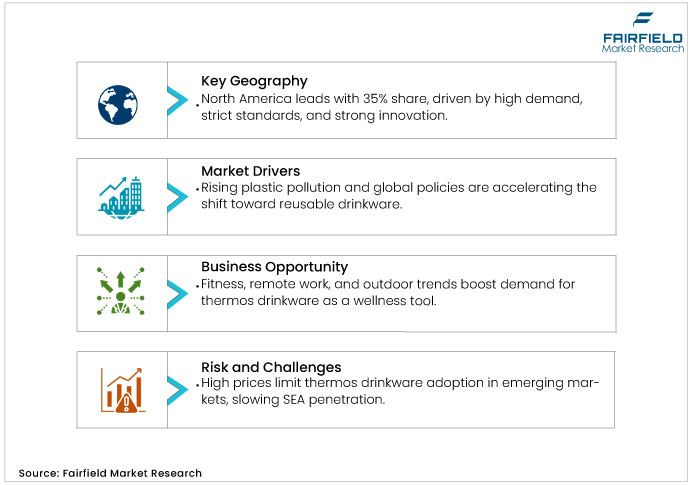
- North America captures ~35% share backed by premium insulated drinkware adoption and growing smart hydration trends.
Market Dynamics: Drivers, Restraints, and Opportunities Analysis
Market Drivers
- Sustainability and Environmental Regulation:
Heightened awareness of plastic pollution is reshaping consumer purchasing behavior and regulatory frameworks, with U.S. Environmental Protection Agency data showing single-use beverage containers account for approximately 12% of municipal solid waste. The European Union’s Single-Use Plastics Directive, along with similar policies in Canada, India, and Japan, is accelerating a shift toward reusable formats such as thermos drinkware.
This regulatory and behavioral shift contributes an estimated 2.1 percentage points to the overall CAGR, particularly benefiting premium stainless-steel segments. Companies offering recyclable material certifications and lifecycle transparency secure notable price premiums, while brands without sustainability credentials face margin pressure as competition intensifies.
- Active Lifestyle and Wellness Trends:
The convergence of fitness culture, remote work lifestyles, and experiential travel is driving lasting demand for portable temperature-retention solutions, supported by rising outdoor recreation participation. With a growing majority of consumers actively tracking daily hydration, thermos drinkware is increasingly viewed as a functional wellness accessory, especially among users of mid-to-large-capacity bottles aligned with hiking and cycling trends.
This shift fuels strong demand for premium products, with enhanced features such as temperature displays, infusers, and ergonomic designs influencing purchase decisions. In Asia-Pacific, this trend is expected to notably strengthen regional momentum through 2032, led by urban millennials in China and a rapidly health-conscious middle class in India. Companies slow to respond risk losing competitive ground to fitness-driven brands offering smart hydration tracking and lifestyle-centric design.
Market Restraints
- Price Sensitivity in Developing Markets
Despite rising environmental consciousness, thermos drinkware adoption remains constrained in emerging economies where price sensitivity remains high. In thermos drinkware markets such as Indonesia, Vietnam, and the Philippines, premium insulated options still represent a sizable portion of monthly discretionary income, limiting consumer willingness to upgrade from conventional products. As a result, penetration growth is slower in Southeast Asia, where more affordable plastic alternatives continue to dominate purchasing decisions.
This restraint is most pronounced in smaller-capacity youth segments, where significant price differences between premium stainless-steel bottles and basic options discourage adoption. Mitigation strategies include localized manufacturing to improve cost competitiveness and introducing tiered stainless-steel product lines positioned toward entry-level budgets, although such moves require substantial regional production investment and long-term demand confidence.
- Raw Material Cost Volatility
Stainless steel represents a significant portion of overall product cost, and volatility in nickel and chromium pricing continues to exert margin pressure influenced by mining dynamics and geopolitical conditions. Even moderate fluctuations in raw material costs can immediately tighten profitability, while competitive retail environments make it difficult for manufacturers to adjust pricing quickly. Mid-sized producers face greater exposure due to limited economies of scale and weaker procurement leverage.
This challenge strengthens the position of large, consolidated players with stronger supplier relationships and negotiated cost buffers, with the impact becoming evident in financial cycles and overall market momentum. Mitigation strategies include long-term supplier agreements, increased use of recycled steel to reduce dependency on virgin inputs, and proactive inventory management, though these approaches may require higher working capital commitments and more robust operational planning.
Market Opportunities
- Smart Technology Integration:
The convergence of IoT technology with insulated drinkware is creating a growing emerging opportunity as smart hydration becomes more mainstream. Early adopters are gravitating toward vacuum-insulated bottles equipped with features such as temperature displays, hydration tracking, and UV sterilization—positioning these products at the intersection of wellness, convenience, and connected living. These enhanced capabilities are particularly appealing to tech-forward consumers in North America and East Asia.
Demand is strongest among health-focused professionals and parents seeking reliable hydration monitoring, although technical challenges remain. Battery performance in extreme temperatures, waterproofing requirements, and added component complexity continue to limit scalability and affordability. Future success will be shaped by ecosystem integration with fitness and health platforms, improvements in battery life, and the development of durable, sealed hardware capable of long-term use without frequent servicing. Companies that refine these capabilities early are positioned to secure recurring revenue streams tied to accessories and component replacement, supported by accelerating innovation and rising intellectual property activity in the space.
- Premium and Luxury Segment Expansion:
Fashion collaborations and material innovation are emerging as powerful growth catalysts in the premium insulated drinkware space, particularly within higher-priced lifestyle and luxury tiers that are outperforming mass-market momentum. Luxury validation from high-end fashion houses and designer partnerships has accelerated interest, while limited-edition drops have demonstrated strong resale momentum, signaling elevated consumer demand across trend-led markets in Europe and North America.
The opportunity extends beyond direct revenue contribution, creating halo effects that elevate broader product portfolios and strengthen brand desirability. However, execution in this space requires elevated craftsmanship, premium sourcing, and high-visibility placement within fashion and cultural moments to maintain exclusivity. Long-term success hinges on scarcity-driven release strategies and disciplined brand governance, as overexpansion risks diluting perceived value and eroding the premium positioning over time.
Segmentation Analysis: Category-Wise Strategic Assessment
- Segment 1: By Type Analysis
Mugs and Tumblers account for ~45% of the thermos drinkware market, supported by commuter lifestyles and workplace usage where 68% of employed consumers use personal drinkware. Stainless steel comprises a dominant portion of sales, while customization demand remains strong, with design-focused competition and seasonal launches helping maintain 6–8-month replacement cycles.
Water Bottles hold ~40% share and are expanding faster than the overall category, driven by hydration tracking, rising outdoor recreation participation, and growing health-oriented consumption patterns encouraging 2–3-liter daily intake. Growth strategies should prioritize BPA-free certification, wide-mouth cleaning accessibility, and compatibility with filters and infusers to meet evolving expectations.
- Segment 2: By Application Analysis
Everyday Use applications hold the dominant position with 55% share, driven by established consumer behavior anchored in morning coffee routines and workplace hydration habits. This lead is sustained by broad retail availability and accessible price positioning, reinforced by commuter culture growth and sustainability motivations as consumers replace multiple disposable cups daily. Competitive advantage favors brands offering dishwasher-safe certification and ergonomic grip design.
The Outdoor Enthusiasts segment accounts for 25% share and is the fastest-growing application category, fueled by rising adventure tourism participation, fitness-linked hydration tracking, and social media influence promoting outdoor lifestyle identity. Success in this segment depends on durability certifications, carabiner clip compatibility, and camouflage or earth-tone aesthetics, enabling brands to capture premium positioning aligned with rugged performance expectations.
- Segment 3: By Size Analysis
500 ml – 1000 ml capacity represents the leading segment at 50% of thermos drinkware market share, reflecting optimal volume balance between portability and sufficient hydration for 2–4 hour activities. This positioning is reinforced by universal bottle holder compatibility in vehicles and fitness equipment, along with thermal efficiency advantages—larger volumes maintain temperature stability 30–40% longer than smaller capacities. Performance drivers include office worker preferences for single-fill daily use, athletes’ mid-range hydration needs, and material cost efficiencies where this size range minimizes steel-to-volume ratios.
The Less than 500 ml segment is the fastest growing, capturing 30% market share. Growth is supported by children’s school use, urban minimalist lifestyles favoring lightweight designs, and the rise of flavor infuser bottles that promote fresh preparation. However, segment-specific challenges persist, such as perceived price-per-ounce value gaps. Manufacturers are increasingly addressing these barriers with youth-oriented designs, character licensing, and compact ergonomic features that justify 10–15% price premiums over standard models.
- Segment 4: By Distribution Channel Analysis
Supermarkets and Hypermarkets maintain channel leadership, driven by impulse purchase capture and broad market accessibility. This dominance reflects consumer preference for tactile product evaluation, immediate gratification, and bundle purchasing alongside grocery categories. Performance is reinforced by prominent in-store positioning during peak retail seasons and by private label expansion that provides significant price advantages over national brands. Competitive dynamics in this channel demand consistent promotional investments and trade marketing support to sustain visibility and shelf share.
The Online channel is expanding at the fastest rate among distribution methods, supported by direct-to-consumer brand building through social media influencer partnerships, subscription models that enhance repeat purchases, and customization platforms offering personalization options. Strategic implications include rising digital advertising costs, the need for customer lifetime value optimization through loyalty programs, and fulfillment investments to manage product returns and maintain delivery efficiency.
Regional Market Assessment: Strategic Geography Analysis
- North America: Maturity and Premium Innovation
North America, led by the U.S., holds the largest 35% share of the global thermos drinkware market, valued at approximately US$1.12 billion in 2025. The region exhibits high market maturity with strong per capita ownership, premium pricing, and strict regulatory oversight under FDA 21 CFR and Consumer Product Safety Commission standards. Corporate ESG mandates influence procurement among major enterprises, while design innovation hubs in the Pacific Northwest drive a significant share of patent activity.
Growth is supported by sustainability compliance and smart technology integration, though competitive barriers remain steep due to high certification costs per product line. E-commerce and D2C channels continue to shape regional expansion, as brands work to balance premium positioning against aggressive competition from lower-priced Asian entrants in online marketplaces.
- Europe: Regulatory Harmonization and Sustainability Leadership
The European Thermos Drinkware Market is regionally diverse, with Germany and the UK accounting for 22% and 18% of the value, while France and Spain contribute 20% combine. The EU’s Circular Economy Action Plan and Extended Producer Responsibility schemes mandate 25% recycled content by 2030, reshaping sourcing strategies and boosting demand for sustainable materials.
Ecodesign and Green Public Procurement policies have created significant price premiums for certified products, driving local competitiveness as import duties safeguard EU producers. Strategic growth depends on navigating Germany’s consolidated retail structure—where a few major chains control most distribution—versus the UK’s fragmented network of numerous independent outdoor retailers.
- Asia-Pacific: Differential Growth and Manufacturing Dominance
The Asia-Pacific region leads the market with 45% share, with China contributing 45–50% of regional demand. Growth is driven by manufacturing scale advantages, strong domestic demand from 400 million millennials, and 65% e-commerce penetration on platforms such as Tmall and JD.com. India is the fastest-growing thermos drinkware market, fueled by urbanization, 25 million new middle-class households, and government Swachh Bharat campaigns.
Manufacturing hubs in Shenzhen, Guangzhou, and Maharashtra strengthen global competitiveness through vertical integration, enabling shorter lead times than Western markets. Companies must navigate country-specific regulations, such as India’s BIS standards and China’s GB testing, while differentiating in crowded low-cost segments through design innovation and influencer partnerships.
Competitive Landscape: Market Structure and Strategic Positioning
The thermos drinkware market is moderately fragmented, with the top five players—YETI, Thermos, Hydro Flask, Contigo, and Stanley—holding 35% of global share, while over 200 regional and private-label brands make up the remainder. Competitive strategies focus on innovation-led premium positioning, cost leadership via scale manufacturing, and geographic specialization to capture dominant domestic shares.
Barriers to entry include significant capital requirements, regulatory compliance, and brand-building expenditures to achieve visibility in saturated markets. Consolidation has accelerated post-2022, with multiple M&A transactions targeting smart technology and D2C capabilities, indicating a market trend toward scale economies over niche positioning.
Key Players
- Thermos L.L.C.
- SIGG Switzerland Bottles AG
- Tiger Corporation
- CamelBak Products, LLC
- Zojirushi America Corporation
- Stanley PMI
- Klean Kanteen
- Hydro Flask
- KINTO Co., Ltd.
- Contigo Brands
- YETI Holdings, Inc.
- Miir
- Mizu Life
- Igloo Products Corp.
- Tupperware Brands Corporation
Global Thermos Drinkware Market Segmentation-
By Type
- Mugs and Tumblers
- Water Bottle
- Beverage Bottle
By Application
- Outdoor Enthusiasts
- Everyday Use
- Specialized
By Size
- Less than 500 ml
- 500 ml - 1000 ml
- 1000 ml and above
By Distribution Channel
- Supermarkets & Hypermarkets
- Specialty Stores
- Convenience Stores
- Online
By Region
- North America
- Latin America
- Europe
- Asia Pacific
- Middle East and Africa
- Executive Summary
- Global Thermos Drinkware Market Snapshot
- Future Projections
- Key Market Trends
- Regional Snapshot, by Value, 2026
- Analyst Recommendations
- Market Overview
- Market Definitions and Segmentations
- Market Dynamics
- Drivers
- Restraints
- Market Opportunities
- Value Chain Analysis
- COVID-19 Impact Analysis
- Porter's Five Forces Analysis
- Impact of Russia-Ukraine Conflict
- PESTLE Analysis
- Regulatory Analysis
- Price Trend Analysis
- Current Prices and Future Projections, 2025-2033
- Price Impact Factors
- Global Thermos Drinkware Market Outlook, 2020 - 2033
- Global Thermos Drinkware Market Outlook, by Type, Value (US$ Mn), 2020-2033
- Mugs and Tumblers
- Water Bottle
- Beverage Bottle
- Global Thermos Drinkware Market Outlook, by Application, Value (US$ Mn), 2020-2033
- Outdoor Enthusiasts
- Everyday Use
- Specialized
- Global Thermos Drinkware Market Outlook, by Size, Value (US$ Mn), 2020-2033
- Less than 500 ml
- 500 ml - 1000 ml
- 1000 ml and above
- Global Thermos Drinkware Market Outlook, by Distribution Channel, Value (US$ Mn), 2020-2033
- Supermarkets & Hypermarkets
- Specialty Stores
- Convenience Stores
- Online
- Global Thermos Drinkware Market Outlook, by Region, Value (US$ Mn), 2020-2033
- North America
- Europe
- Asia Pacific
- Latin America
- Middle East & Africa
- Global Thermos Drinkware Market Outlook, by Type, Value (US$ Mn), 2020-2033
- North America Thermos Drinkware Market Outlook, 2020 - 2033
- North America Thermos Drinkware Market Outlook, by Type, Value (US$ Mn), 2020-2033
- Mugs and Tumblers
- Water Bottle
- Beverage Bottle
- North America Thermos Drinkware Market Outlook, by Application, Value (US$ Mn), 2020-2033
- Outdoor Enthusiasts
- Everyday Use
- Specialized
- North America Thermos Drinkware Market Outlook, by Size, Value (US$ Mn), 2020-2033
- Less than 500 ml
- 500 ml - 1000 ml
- 1000 ml and above
- North America Thermos Drinkware Market Outlook, by Distribution Channel, Value (US$ Mn), 2020-2033
- Supermarkets & Hypermarkets
- Specialty Stores
- Convenience Stores
- Online
- North America Thermos Drinkware Market Outlook, by Country, Value (US$ Mn), 2020-2033
- U.S. Thermos Drinkware Market Outlook, by Type, 2020-2033
- U.S. Thermos Drinkware Market Outlook, by Application, 2020-2033
- U.S. Thermos Drinkware Market Outlook, by Size, 2020-2033
- U.S. Thermos Drinkware Market Outlook, by Distribution Channel, 2020-2033
- Canada Thermos Drinkware Market Outlook, by Type, 2020-2033
- Canada Thermos Drinkware Market Outlook, by Application, 2020-2033
- Canada Thermos Drinkware Market Outlook, by Size, 2020-2033
- Canada Thermos Drinkware Market Outlook, by Distribution Channel, 2020-2033
- BPS Analysis/Market Attractiveness Analysis
- North America Thermos Drinkware Market Outlook, by Type, Value (US$ Mn), 2020-2033
- Europe Thermos Drinkware Market Outlook, 2020 - 2033
- Europe Thermos Drinkware Market Outlook, by Type, Value (US$ Mn), 2020-2033
- Mugs and Tumblers
- Water Bottle
- Beverage Bottle
- Europe Thermos Drinkware Market Outlook, by Application, Value (US$ Mn), 2020-2033
- Outdoor Enthusiasts
- Everyday Use
- Specialized
- Europe Thermos Drinkware Market Outlook, by Size, Value (US$ Mn), 2020-2033
- Less than 500 ml
- 500 ml - 1000 ml
- 1000 ml and above
- Europe Thermos Drinkware Market Outlook, by Distribution Channel, Value (US$ Mn), 2020-2033
- Supermarkets & Hypermarkets
- Specialty Stores
- Convenience Stores
- Online
- Europe Thermos Drinkware Market Outlook, by Country, Value (US$ Mn), 2020-2033
- Germany Thermos Drinkware Market Outlook, by Type, 2020-2033
- Germany Thermos Drinkware Market Outlook, by Application, 2020-2033
- Germany Thermos Drinkware Market Outlook, by Size, 2020-2033
- Germany Thermos Drinkware Market Outlook, by Distribution Channel, 2020-2033
- Italy Thermos Drinkware Market Outlook, by Type, 2020-2033
- Italy Thermos Drinkware Market Outlook, by Application, 2020-2033
- Italy Thermos Drinkware Market Outlook, by Size, 2020-2033
- Italy Thermos Drinkware Market Outlook, by Distribution Channel, 2020-2033
- France Thermos Drinkware Market Outlook, by Type, 2020-2033
- France Thermos Drinkware Market Outlook, by Application, 2020-2033
- France Thermos Drinkware Market Outlook, by Size, 2020-2033
- France Thermos Drinkware Market Outlook, by Distribution Channel, 2020-2033
- U.K. Thermos Drinkware Market Outlook, by Type, 2020-2033
- U.K. Thermos Drinkware Market Outlook, by Application, 2020-2033
- U.K. Thermos Drinkware Market Outlook, by Size, 2020-2033
- U.K. Thermos Drinkware Market Outlook, by Distribution Channel, 2020-2033
- Spain Thermos Drinkware Market Outlook, by Type, 2020-2033
- Spain Thermos Drinkware Market Outlook, by Application, 2020-2033
- Spain Thermos Drinkware Market Outlook, by Size, 2020-2033
- Spain Thermos Drinkware Market Outlook, by Distribution Channel, 2020-2033
- Russia Thermos Drinkware Market Outlook, by Type, 2020-2033
- Russia Thermos Drinkware Market Outlook, by Application, 2020-2033
- Russia Thermos Drinkware Market Outlook, by Size, 2020-2033
- Russia Thermos Drinkware Market Outlook, by Distribution Channel, 2020-2033
- Rest of Europe Thermos Drinkware Market Outlook, by Type, 2020-2033
- Rest of Europe Thermos Drinkware Market Outlook, by Application, 2020-2033
- Rest of Europe Thermos Drinkware Market Outlook, by Size, 2020-2033
- Rest of Europe Thermos Drinkware Market Outlook, by Distribution Channel, 2020-2033
- BPS Analysis/Market Attractiveness Analysis
- Europe Thermos Drinkware Market Outlook, by Type, Value (US$ Mn), 2020-2033
- Asia Pacific Thermos Drinkware Market Outlook, 2020 - 2033
- Asia Pacific Thermos Drinkware Market Outlook, by Type, Value (US$ Mn), 2020-2033
- Mugs and Tumblers
- Water Bottle
- Beverage Bottle
- Asia Pacific Thermos Drinkware Market Outlook, by Application, Value (US$ Mn), 2020-2033
- Outdoor Enthusiasts
- Everyday Use
- Specialized
- Asia Pacific Thermos Drinkware Market Outlook, by Size, Value (US$ Mn), 2020-2033
- Less than 500 ml
- 500 ml - 1000 ml
- 1000 ml and above
- Asia Pacific Thermos Drinkware Market Outlook, by Distribution Channel, Value (US$ Mn), 2020-2033
- Supermarkets & Hypermarkets
- Specialty Stores
- Convenience Stores
- Online
- Asia Pacific Thermos Drinkware Market Outlook, by Country, Value (US$ Mn), 2020-2033
- China Thermos Drinkware Market Outlook, by Type, 2020-2033
- China Thermos Drinkware Market Outlook, by Application, 2020-2033
- China Thermos Drinkware Market Outlook, by Size, 2020-2033
- China Thermos Drinkware Market Outlook, by Distribution Channel, 2020-2033
- Japan Thermos Drinkware Market Outlook, by Type, 2020-2033
- Japan Thermos Drinkware Market Outlook, by Application, 2020-2033
- Japan Thermos Drinkware Market Outlook, by Size, 2020-2033
- Japan Thermos Drinkware Market Outlook, by Distribution Channel, 2020-2033
- South Korea Thermos Drinkware Market Outlook, by Type, 2020-2033
- South Korea Thermos Drinkware Market Outlook, by Application, 2020-2033
- South Korea Thermos Drinkware Market Outlook, by Size, 2020-2033
- South Korea Thermos Drinkware Market Outlook, by Distribution Channel, 2020-2033
- India Thermos Drinkware Market Outlook, by Type, 2020-2033
- India Thermos Drinkware Market Outlook, by Application, 2020-2033
- India Thermos Drinkware Market Outlook, by Size, 2020-2033
- India Thermos Drinkware Market Outlook, by Distribution Channel, 2020-2033
- Southeast Asia Thermos Drinkware Market Outlook, by Type, 2020-2033
- Southeast Asia Thermos Drinkware Market Outlook, by Application, 2020-2033
- Southeast Asia Thermos Drinkware Market Outlook, by Size, 2020-2033
- Southeast Asia Thermos Drinkware Market Outlook, by Distribution Channel, 2020-2033
- Rest of SAO Thermos Drinkware Market Outlook, by Type, 2020-2033
- Rest of SAO Thermos Drinkware Market Outlook, by Application, 2020-2033
- Rest of SAO Thermos Drinkware Market Outlook, by Size, 2020-2033
- Rest of SAO Thermos Drinkware Market Outlook, by Distribution Channel, 2020-2033
- BPS Analysis/Market Attractiveness Analysis
- Asia Pacific Thermos Drinkware Market Outlook, by Type, Value (US$ Mn), 2020-2033
- Latin America Thermos Drinkware Market Outlook, 2020 - 2033
- Latin America Thermos Drinkware Market Outlook, by Type, Value (US$ Mn), 2020-2033
- Mugs and Tumblers
- Water Bottle
- Beverage Bottle
- Latin America Thermos Drinkware Market Outlook, by Application, Value (US$ Mn), 2020-2033
- Outdoor Enthusiasts
- Everyday Use
- Specialized
- Latin America Thermos Drinkware Market Outlook, by Size, Value (US$ Mn), 2020-2033
- Less than 500 ml
- 500 ml - 1000 ml
- 1000 ml and above
- Latin America Thermos Drinkware Market Outlook, by Distribution Channel, Value (US$ Mn), 2020-2033
- Supermarkets & Hypermarkets
- Specialty Stores
- Convenience Stores
- Online
- Latin America Thermos Drinkware Market Outlook, by Country, Value (US$ Mn), 2020-2033
- Brazil Thermos Drinkware Market Outlook, by Type, 2020-2033
- Brazil Thermos Drinkware Market Outlook, by Application, 2020-2033
- Brazil Thermos Drinkware Market Outlook, by Size, 2020-2033
- Brazil Thermos Drinkware Market Outlook, by Distribution Channel, 2020-2033
- Mexico Thermos Drinkware Market Outlook, by Type, 2020-2033
- Mexico Thermos Drinkware Market Outlook, by Application, 2020-2033
- Mexico Thermos Drinkware Market Outlook, by Size, 2020-2033
- Mexico Thermos Drinkware Market Outlook, by Distribution Channel, 2020-2033
- Argentina Thermos Drinkware Market Outlook, by Type, 2020-2033
- Argentina Thermos Drinkware Market Outlook, by Application, 2020-2033
- Argentina Thermos Drinkware Market Outlook, by Size, 2020-2033
- Argentina Thermos Drinkware Market Outlook, by Distribution Channel, 2020-2033
- Rest of LATAM Thermos Drinkware Market Outlook, by Type, 2020-2033
- Rest of LATAM Thermos Drinkware Market Outlook, by Application, 2020-2033
- Rest of LATAM Thermos Drinkware Market Outlook, by Size, 2020-2033
- Rest of LATAM Thermos Drinkware Market Outlook, by Distribution Channel, 2020-2033
- BPS Analysis/Market Attractiveness Analysis
- Latin America Thermos Drinkware Market Outlook, by Type, Value (US$ Mn), 2020-2033
- Middle East & Africa Thermos Drinkware Market Outlook, 2020 - 2033
- Middle East & Africa Thermos Drinkware Market Outlook, by Type, Value (US$ Mn), 2020-2033
- Mugs and Tumblers
- Water Bottle
- Beverage Bottle
- Middle East & Africa Thermos Drinkware Market Outlook, by Application, Value (US$ Mn), 2020-2033
- Outdoor Enthusiasts
- Everyday Use
- Specialized
- Middle East & Africa Thermos Drinkware Market Outlook, by Size, Value (US$ Mn), 2020-2033
- Less than 500 ml
- 500 ml - 1000 ml
- 1000 ml and above
- Middle East & Africa Thermos Drinkware Market Outlook, by Distribution Channel, Value (US$ Mn), 2020-2033
- Supermarkets & Hypermarkets
- Specialty Stores
- Convenience Stores
- Online
- Middle East & Africa Thermos Drinkware Market Outlook, by Country, Value (US$ Mn), 2020-2033
- GCC Thermos Drinkware Market Outlook, by Type, 2020-2033
- GCC Thermos Drinkware Market Outlook, by Application, 2020-2033
- GCC Thermos Drinkware Market Outlook, by Size, 2020-2033
- GCC Thermos Drinkware Market Outlook, by Distribution Channel, 2020-2033
- South Africa Thermos Drinkware Market Outlook, by Type, 2020-2033
- South Africa Thermos Drinkware Market Outlook, by Application, 2020-2033
- South Africa Thermos Drinkware Market Outlook, by Size, 2020-2033
- South Africa Thermos Drinkware Market Outlook, by Distribution Channel, 2020-2033
- Egypt Thermos Drinkware Market Outlook, by Type, 2020-2033
- Egypt Thermos Drinkware Market Outlook, by Application, 2020-2033
- Egypt Thermos Drinkware Market Outlook, by Size, 2020-2033
- Egypt Thermos Drinkware Market Outlook, by Distribution Channel, 2020-2033
- Nigeria Thermos Drinkware Market Outlook, by Type, 2020-2033
- Nigeria Thermos Drinkware Market Outlook, by Application, 2020-2033
- Nigeria Thermos Drinkware Market Outlook, by Size, 2020-2033
- Nigeria Thermos Drinkware Market Outlook, by Distribution Channel, 2020-2033
- Rest of Middle East Thermos Drinkware Market Outlook, by Type, 2020-2033
- Rest of Middle East Thermos Drinkware Market Outlook, by Application, 2020-2033
- Rest of Middle East Thermos Drinkware Market Outlook, by Size, 2020-2033
- Rest of Middle East Thermos Drinkware Market Outlook, by Distribution Channel, 2020-2033
- BPS Analysis/Market Attractiveness Analysis
- Middle East & Africa Thermos Drinkware Market Outlook, by Type, Value (US$ Mn), 2020-2033
- Competitive Landscape
- Company Vs Segment Heatmap
- Company Market Share Analysis, 2025
- Competitive Dashboard
- Company Profiles
- Thermos L.L.C.
- Company Overview
- Product Portfolio
- Financial Overview
- Business Strategies and Developments
- SIGG Switzerland Bottles AG
- Tiger Corporation
- CamelBak Products, LLC
- Zojirushi America Corporation
- Stanley PMI
- Klean Kanteen
- Hydro Flask
- KINTO Co., Ltd.
- Contigo Brands
- Thermos L.L.C.
- Appendix
- Research Methodology
- Report Assumptions
- Acronyms and Abbreviations
|
BASE YEAR |
HISTORICAL DATA |
FORECAST PERIOD |
UNITS |
|||
 |
2025 |
 |
2019 - 2024 |
 |
2026 - 2033 |
Value: US$ Billion |
|
REPORT FEATURES |
DETAILS |
|
By Type Coverage |
|
|
By Application Coverage |
|
|
By Size Coverage |
|
|
By Distribution Channel Coverage |
|
|
Geographical Coverage |
|
|
Leading Companies |
|
|
Report Highlights |
Key Market Indicators, Macro-micro economic impact analysis, Technological Roadmap, Key Trends, Driver, Restraints, and Future Opportunities & Revenue Pockets, Porter’s 5 Forces Analysis, Historical Trend (2019-2024), Market Estimates and Forecast, Market Dynamics, Industry Trends, Competition Landscape, Category, Region, Country-wise Trends & Analysis, COVID-19 Impact Analysis (Demand and Supply Chain) |
Our Research Methodology
Considering the volatility of business today, traditional approaches to strategizing a game plan can be unfruitful if not detrimental. True ambiguity is no way to determine a forecast. A myriad of predetermined factors must be accounted for such as the degree of risk involved, the magnitude of circumstances, as well as conditions or consequences that are not known or unpredictable. To circumvent binary views that cast uncertainty, the application of market research intelligence to strategically posture, move, and enable actionable outcomes is necessary.
View Methodology
Quality Assured
Rigorous Validation Process

Confidentiality Assured
End-to-end Data Security

Custom Research Services
Tailored To Your Objectives
FAQs
The Thermos Drinkware market size is USD 3.5 Bn in 2026.
The Thermos Drinkware market is projected 7% CAGR by 2033.
The Thermos Drinkware market growth drivers include sustainability and environmental regulation, active lifestyle and wellness trends, and smart technology integration.
Asia Pacific is a dominating region for the Thermos Drinkware market.
YETI, Thermos, Hydro Flask, Contigo, and Stanley are some leading industry players in the Thermos Drinkware market.
Related Reports
Heritage Tourism Market Insights, Competitive Landscape, and Market Forecast 2026–2033
The heritage tourism market is expected to grow from US$648.50 billion in 2026 to US$937.12 billion by 2033, growing at a 5.4% CAGR over the forecast period.
Cooling Fabrics Market Insights, Competitive Landscape, and Market Forecast 2026–2033
The cooling fabrics market is projected to rise from US$2.30 billion in 2026 to US$3.99 billion by 2033, expanding at an 8.2% CAGR over the forecast period.
Wood and Timber Products Market Insights, Competitive Landscape, and Market Forecast 2026–2033
Wood and Timber Products Market is projected to reach US$1.52 billion by 2033, driven by construction, furniture, packaging, and sustainable timber demand.
Pet Travel Services Market Insights, Competitive Landscape, and Market Forecast 2026–2033
Pet Travel Services Market is projected to reach US$5.09 billion by 2033, driven by rising pet ownership, travel, and specialized relocation services.
Natural Hair Care Products Market Insights, Competitive Landscape, and Market Forecast 2026–2033
Natural Hair Care Products Market is set for strong growth, driven by clean beauty trends, ingredient regulations, and rising demand for textured-hair care
Decorated Apparel Market Insights, Competitive Landscape, and Market Forecast 2026–2033
Decorated Apparel Market is projected to reach US$98 billion by 2033, driven by e-commerce, on-demand printing, customization and digital printing