



Turboprop Engine Market
Turboprop Engine Market Size, Share, Insights, Competitive Landscape, and Forecast 2026 to 2033
How Fast Is the Turboprop Engine Market Growing?
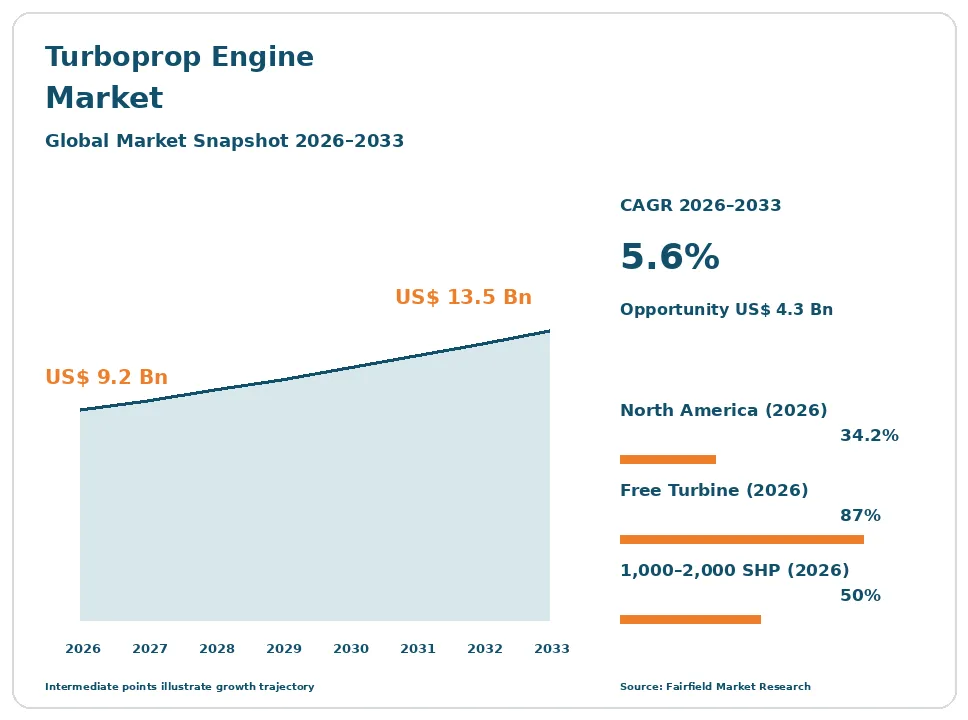
The global turboprop engine market size is expected to be valued at US$ 9.2 billion in 2026 and projected to reach US$ 13.5 billion by 2033, growing at a CAGR of 5.6% between 2026 and 2033.
Between 2020 and 2025, the market grew at a CAGR of about 3.5%, falling sharply in 2020 when regional air travel collapsed, then recovering as airlines restored routes, cargo demand rose, and military and special mission programs continued. Turboprop engines are gas turbines that drive a propeller through a reduction gearbox, offering excellent fuel efficiency at lower speeds and altitudes. They power regional airliners such as the ATR 72 and Dash 8, business and utility aircraft such as the King Air and Cessna Caravan, trainers, agricultural planes, and military transports. Turboprops can use short, unpaved runways and burn less fuel than jets on short routes. Growth comes from regional connectivity, cargo and special mission demand, military fleet modernization, and replacement of older engines. The market is shifting toward more efficient engines, sustainable aviation fuel compatibility, and hybrid-electric research. In February 2025, GE Aerospace’s Catalyst became the first clean-sheet turboprop certified under the latest FAA standards.
Key Report Takeaways
- By Power Output: 1,000-2,000 SHP held 50.0% share in 2026, while Above 2,000 SHP is projected to expand at a 6.3% CAGR through 2033, driven by regional airliners, military transports, and larger special mission aircraft that need more power.
- By Aircraft Type: Regional Passenger Aircraft held 42.0% share in 2026, while Special Mission Aircraft are projected to expand at a 6.4% CAGR through 2033, driven by surveillance, maritime patrol, medical evacuation, and firefighting fleet growth.
- By Engine Type: Free Turbine held 87.0% share in 2026 and is projected to expand at the fastest 5.8% CAGR through 2033, driven by flexible design, easy maintenance, and wide use in modern regional and business turboprops.
- By Region: North America held 34.2% share in 2026, while Asia Pacific is projected to expand at a 6.5% CAGR through 2033, driven by regional route expansion, island connectivity, and fleet growth in India, Indonesia, and China.
Global Turboprop Engine Market Trends and Insights
Drivers Impact Analysis
Two drivers carry the strongest influence on turboprop engine demand during the forecast period.
Regional Connectivity Is Driving the Turboprop Engine Market
Regional connectivity and short-haul air travel are the strongest driver of the turboprop engine market. Turboprops are the most efficient way to fly short routes.
The mechanism is the economics of short flights. On routes under about 500 kilometers, turboprops burn far less fuel per seat than regional jets, and they can land on short runways at small airports that jets cannot use. Governments in India, Indonesia, the Philippines, Brazil, and many countries in Middle East & Africa support regional connectivity schemes that subsidize flights to underserved towns and islands. Airlines operating ATR and De Havilland aircraft order new planes and re-engine older ones. Each new aircraft needs two engines plus spares. Pratt & Whitney Canada and ATR announced a collaboration on next-generation regional propulsion in June 2025. These trends keep regional aircraft engines in steady demand.
Military and Special Mission Demand Is Expanding the Turboprop Engine Market
Military, special mission, and cargo demand is expanding the turboprop engine market. Turboprops are ideal for many government missions.
The cause is the versatility of turboprop aircraft. Military transports such as the C-130 Hercules and A400M, maritime patrol aircraft, surveillance aircraft, trainers, and large drones use turboprop engines for long endurance and rough-field operations. Rising defense budgets in Europe, Asia Pacific, and North America fund new aircraft, engine upgrades, and life extension programs. Medical evacuation, firefighting, border patrol, and survey aircraft are growing fleets. Growing e-commerce supports small cargo aircraft such as the Cessna SkyCourier and converted regional airliners. Military buyers often order engines in large batches with long-term support contracts, which brings stable revenue to engine makers. These uses add steady demand beyond airlines.
| Driver | Impact on CAGR Forecast | Geographic Relevance | Impact Timeline |
| Regional connectivity and short-haul air travel | High | Asia Pacific, Latin America, Middle East & Africa | Long term (≥4 years) |
| Military, special mission, and cargo demand | Medium | North America, Europe, Asia Pacific | Medium term (2-4 years) |
Restraints Impact Analysis
Two restraints limit how quickly the turboprop engine market grows.
Supply Chain Constraints Slow the Turboprop Engine Market
Supply chain constraints and certification delays slow the turboprop engine market. Engine makers struggle to deliver on time.
The specific causes are parts shortages, labor gaps, and long approval processes. Castings, forgings, bearings, and electronic parts have faced long lead times since 2021, limiting engine production and spare parts supply. Skilled machinists and maintenance technicians are scarce. New engines need years of testing and certification, and aircraft programs can slip. The Beechcraft Denali, powered by the GE Aerospace Catalyst, saw its entry into service move to 2027. Aircraft makers cannot deliver planes without engines, so delays ripple through the industry. Engine makers are investing in new factories, automation, and supplier development, but these steps take years to pay off. These constraints limit growth even when demand is strong.
Competition from Jets Restricts the Turboprop Engine Market
Competition from regional jets and emerging electric aircraft restricts the turboprop engine market. Some passengers and airlines prefer jets.
The underlying causes are passenger perception and new technology. Many travelers see jets as faster, quieter, and more comfortable, and in North America airlines have favored regional jets on many routes. Turboprops are slower on longer routes. In the long term, hybrid-electric and hydrogen-powered aircraft could replace some turboprops on short routes. Pilot shortages have also cut regional flying in some markets. Some airlines in North America have retired turboprop fleets because of pilot pay rules and passenger preferences, and the used aircraft market can reduce demand for new engines. Turboprop noise inside the cabin, though improved, still concerns some travelers. These factors limit growth in parts of the market.
| Restraint | Impact on CAGR Forecast | Geographic Relevance | Impact Timeline |
| Supply chain constraints and certification delays | High | Global | Medium term (2-4 years) |
| Competition from regional jets and emerging electric aircraft | Medium | North America, Europe | Long term (≥4 years) |
Market Opportunities
Next-Generation and Hybrid-Electric Engines Open a Fast-Growth Revenue Pool
Next-generation and hybrid-electric engines open a fast-growth revenue pool in the turboprop engine market. Airlines want lower fuel burn and emissions.
Engine makers can capture this opportunity. New designs such as the GE Aerospace Catalyst, with up to 18% better fuel consumption than competitors in its class, and the Pratt & Whitney Canada PW127XT series, with longer time on wing and lower maintenance costs, attract buyers. Engines certified for 100% sustainable aviation fuel help airlines cut emissions. Hybrid-electric demonstrators are testing electric motors alongside turbines. Government research programs in Europe and North America fund cleaner propulsion technology. New engines also need fewer maintenance visits, which lowers operating costs for airlines. Companies that lead in efficiency and new propulsion can win future aircraft programs and long service contracts.
Aftermarket Services Create a Recurring Revenue Pool
Aftermarket services create a recurring revenue pool in the turboprop engine market. Engines need regular maintenance for decades after sale.
Engine makers and maintenance providers can capture this opportunity. Tens of thousands of turboprop engines are in service worldwide on airliners, business aircraft, trainers, crop sprayers, and military planes, and each needs regular inspections, hot section repairs, full overhauls, and a steady supply of spare parts throughout a working life of thirty years or more. Pay-per-hour service programs give operators predictable costs and give engine makers long-term income. Engine leasing helps airlines keep flying during overhauls. Digital engine health monitoring uses sensor data to predict problems and plan maintenance before failures. Older aircraft are flying longer because new aircraft deliveries are slow, which raises maintenance demand. Companies with global service networks, parts availability, and strong data tools can earn steady, high-margin revenue for many years.
Segment Analysis
By Power Output: 1,000-2,000 SHP Leads While Above 2,000 SHP Grows Fastest
1,000-2,000 SHP held 50.0% share in 2026. Known as the business and utility class, this power range covers popular business and utility aircraft such as the King Air family, Pilatus PC-12, Cessna Caravan and SkyCourier, trainers, and many special mission platforms. The PT6 family from Pratt & Whitney Canada dominates this class, with tens of thousands of engines delivered over decades. Large installed fleets also generate strong aftermarket revenue in this segment.
Above 2,000 SHP is the fastest-growing power class, expanding at a 6.3% CAGR through 2033. Regional airliners such as the ATR 72 and Dash 8-400, military transports such as the C-130J and A400M, and maritime patrol aircraft use these larger engines. Fleet expansion in Asia Pacific and higher defense budgets drive demand. Engines below 1,000 SHP serve light utility, agricultural, and basic training aircraft. For the market, high-power growth reflects larger aircraft and military programs.
By Aircraft Type: Regional Passenger Aircraft Lead While Special Mission Aircraft Grow Fastest
Regional Passenger Aircraft held 42.0% share in 2026. ATR and De Havilland Dash 8 fleets are the largest users of turboprop engines, flying short routes in Europe, Asia Pacific, Latin America, and island regions, and they need two engines per aircraft plus spares.
Special Mission Aircraft are the fastest-growing type, expanding at a 6.4% CAGR through 2033. Governments are buying aircraft for maritime patrol, border surveillance, search and rescue, medical evacuation, firefighting, and intelligence missions, often based on business turboprop or regional airliner designs. Business and general aviation, military transports, trainers, and cargo aircraft form other segments, with cargo turboprops benefiting from parcel growth. For the market, this reflects rising government and security demand.
By Engine Type: Free Turbine Leads and Grows Fastest
Free Turbine held 87.0% share in 2026 and is the fastest-growing engine type, expanding at a 5.8% CAGR through 2033. In a free turbine engine, a separate power turbine drives the propeller, which allows easier starting, flexible propeller speeds, and simpler maintenance. Most modern engines, including the PT6, PW100, and Catalyst, use this design.
Single-shaft engines, where one shaft drives both the compressor and propeller, offer fast power response and are used in some aircraft such as certain utility and military designs. They are expected to grow more slowly because few new aircraft use them. Engine makers also offer upgrades that add power to existing free turbine models. For the market, free turbine growth reflects the dominance of modern engine designs.
Geography Analysis
Which Region Is Leading the Turboprop Engine Market?
North America is leading the turboprop engine market with a 34.2% share in 2026. The United States and Canada have the world’s largest fleets of business turboprops, utility aircraft, agricultural sprayers, trainers, and military transports such as the C-130. Pratt & Whitney Canada, GE Aerospace, Honeywell Aerospace, Rolls-Royce North America, and Lycoming are major engine suppliers, and Textron Aviation and De Havilland Canada build turboprop aircraft. Cargo operators fly large fleets of Cessna Caravans. Key barriers include supply chain delays. One change shaping the region is the arrival of new engines such as the Catalyst.
Europe Advances the Turboprop Engine Market Through Regional Aviation
Europe is a major turboprop engine market. France, Italy, Germany, the United Kingdom, and Switzerland host ATR, Safran, Rolls-Royce, MTU Aero Engines, Pilatus, and Avio Aero, which helped develop the Catalyst. Regional airlines fly turboprops on short routes, and rising defense spending funds A400M and maritime patrol programs. Carbon rules favor fuel-efficient turboprops on short flights, and some governments discourage short jet flights where rail options exist. Key barriers include strict emission targets that encourage alternative propulsion. One opportunity is hybrid-electric turboprop development for future regional aircraft.
Which Region Is Growing Fastest in the Turboprop Engine Market?
Asia Pacific is growing fastest in the turboprop engine market at a 6.5% CAGR through 2033. India’s regional connectivity scheme supports new routes to small airports, and Indonesia and the Philippines rely on turboprops to connect thousands of islands. China is developing domestic turboprop aircraft and engines through AVIC, while Japan and Australia operate maritime patrol and regional fleets. Hindustan Aeronautics Limited builds military aircraft in India. Airlines in the region have placed large orders for new ATR aircraft. Key barriers include airport infrastructure gaps. One change shaping the region is regional route expansion to smaller cities.
Latin America Grows the Turboprop Engine Market Through Remote Connectivity
Latin America is a growing turboprop engine market. Brazil, Mexico, Colombia, Peru, and Argentina use turboprops to reach remote towns, mining sites, and Amazon communities where runways are short or unpaved. Regional airlines operate ATR fleets, and agricultural aviation is strong in Brazil. Militaries use turboprop trainers and light attack aircraft such as the Embraer Super Tucano, which is exported widely. Engine overhaul shops in Brazil serve the wider region, and air taxi and charter operators use small turboprops for business travel. Key barriers include financing costs and currency swings. One opportunity is regional fleet renewal.
Middle East & Africa Develops the Turboprop Engine Market Through Regional Links
Middle East & Africa is a developing turboprop engine market. Airlines in Kenya, Ethiopia, Nigeria, and South Africa use turboprops for domestic and regional flights where traffic is too thin for jets, and humanitarian and medical flights rely on rugged turboprop aircraft. Saudi Arabia and the United Arab Emirates operate special mission, surveillance, and training aircraft, and invest in local maintenance facilities. Tourism flights to safari lodges and island resorts also depend on small turboprops. Key barriers include financing and maintenance capacity. One change shaping the region is the steady growth of regional air links between neighboring countries.
Competitive Landscape
The turboprop engine market is highly consolidated. Pratt & Whitney Canada, GE Aerospace, Rolls-Royce, Safran, and Honeywell Aerospace are leading players, with Pratt & Whitney Canada holding a dominant position through its PT6 and PW100 families, while MTU Aero Engines, Lycoming Engines, Williams International, AVIC, Hindustan Aeronautics Limited, ITP Aero, and PBS Aerospace compete in specific segments.
Companies compete on fuel efficiency, reliability, time between overhauls, maintenance cost, power range, certification, and global service support. Because aircraft are certified with specific engines, winning a position on a new aircraft program secures decades of sales and aftermarket revenue. Strong service networks and parts availability are key buying factors for operators. High entry barriers, including certification costs and the need for decades of support, keep new competitors few, although Chinese engine makers are developing domestic alternatives for their own aircraft programs.
Strategic moves show how competition is changing. In February 2025, GE Aerospace certified its clean-sheet Catalyst turboprop. In June 2025, Pratt & Whitney Canada and ATR announced work on next-generation regional propulsion. In July 2026, the Catalyst-powered Beechcraft Denali’s service entry moved to 2027. These moves show competition shifting toward new, more efficient engine designs and longer-term partnerships with aircraft makers.
Three themes shape vendor strategy. First, companies are developing more fuel-efficient and sustainable fuel-ready engines. Second, they are researching hybrid-electric propulsion. Third, they are expanding aftermarket services and digital engine monitoring.
Turboprop Engine Market Industry Leaders
- Pratt & Whitney Canada
- GE Aerospace
- Rolls-Royce
- Safran
- Honeywell Aerospace
Recent Industry Developments
- July 2026: Textron Aviation said entry into service of the Beechcraft Denali, powered by the GE Aerospace Catalyst engine, had moved to 2027 as flight testing continued - shows certification timelines for new turboprop engines.
- June 2025: Pratt & Whitney Canada and ATR announced a collaboration on next-generation regional turboprop propulsion focused on fuel efficiency, durability, and lower emissions - supports future regional aircraft engines.
- February 2025: GE Aerospace’s Catalyst turboprop received FAA certification as the first clean-sheet turboprop certified to the latest standards, with up to 18% better fuel consumption than competitors in its class - advances aircraft propulsion efficiency.
Companies Covered in the Report
- Pratt & Whitney Canada
- GE Aerospace
- Rolls-Royce
- Safran
- Honeywell Aerospace
- MTU Aero Engines
- Lycoming Engines
- Williams International
- AVIC
- Hindustan Aeronautics Limited
- ITP Aero
- PBS Aerospace
Turboprop Engine Market Report Scope
This report covers turboprop engines, including free turbine and single-shaft designs in power classes below 1,000 SHP, 1,000 to 2,000 SHP, and above 2,000 SHP, for regional passenger, business and general aviation, military, cargo, and special mission aircraft, sold to OEMs and through the aftermarket. The base year is 2025, and the forecast period runs from 2026 to 2033. All values are expressed in US$ Billion.
Power Output
- Below 1,000 SHP
- 1,000-2,000 SHP
- Above 2,000 SHP
Aircraft Type
- Regional Passenger Aircraft
- Business & General Aviation
- Military Aircraft
- Cargo Aircraft
- Special Mission Aircraft
Engine Type
- Free Turbine
- Single Shaft
Regions
- North America
- Europe
- Asia Pacific
- Latin America
- Middle East & Africa
- 1. Executive Summary
- 1.1. Global Turboprop Engine Market Snapshot
- 1.2. Future Projections, 2026-2033
- 1.3. Key Market Trends
- 1.4. Regional Snapshot
- 2. Market Overview
- 2.1. Market Definition and Report Scope
- 2.2. Historical Market Trends, 2020-2025
- 2.3. Market Dynamics
- 2.3.1. Drivers Impact Analysis
- 2.3.1.1. Regional Connectivity Is Driving the Turboprop Engine Market
- 2.3.1.2. Military and Special Mission Demand Is Expanding the Turboprop Engine Market
- 2.3.2. Restraints Impact Analysis
- 2.3.2.1. Supply Chain Constraints Slow the Turboprop Engine Market
- 2.3.2.2. Competition from Jets Restricts the Turboprop Engine Market
- 2.3.3. Market Opportunities
- 2.3.3.1. Next-Generation and Hybrid-Electric Engines Open a Fast-Growth Revenue Pool
- 2.3.3.2. Aftermarket Services Create a Recurring Revenue Pool
- 2.3.1. Drivers Impact Analysis
- 3. Global Turboprop Engine Market Outlook, 2020-2033
- 3.1. Global Turboprop Engine Market Outlook, by Power Output, Value (US$ Billion), 2020-2033
- 3.1.1. Below 1,000 SHP
- 3.1.2. 1,000-2,000 SHP
- 3.1.3. Above 2,000 SHP
- 3.2. Global Turboprop Engine Market Outlook, by Aircraft Type, Value (US$ Billion), 2020-2033
- 3.2.1. Regional Passenger Aircraft
- 3.2.2. Business & General Aviation
- 3.2.3. Military Aircraft
- 3.2.4. Cargo Aircraft
- 3.2.5. Special Mission Aircraft
- 3.3. Global Turboprop Engine Market Outlook, by Engine Type, Value (US$ Billion), 2020-2033
- 3.3.1. Free Turbine
- 3.3.2. Single Shaft
- 3.4. Global Turboprop Engine Market Outlook, by Region, Value (US$ Billion), 2020-2033
- 3.4.1. North America
- 3.4.2. Europe
- 3.4.3. Asia Pacific
- 3.4.4. Latin America
- 3.4.5. Middle East & Africa
- 3.1. Global Turboprop Engine Market Outlook, by Power Output, Value (US$ Billion), 2020-2033
- 4. North America Turboprop Engine Market Outlook, 2020-2033
- 4.1. North America Turboprop Engine Market Outlook, by Power Output, Value (US$ Billion), 2020-2033
- 4.1.1. Below 1,000 SHP
- 4.1.2. 1,000-2,000 SHP
- 4.1.3. Above 2,000 SHP
- 4.2. North America Turboprop Engine Market Outlook, by Aircraft Type, Value (US$ Billion), 2020-2033
- 4.2.1. Regional Passenger Aircraft
- 4.2.2. Business & General Aviation
- 4.2.3. Military Aircraft
- 4.2.4. Cargo Aircraft
- 4.2.5. Special Mission Aircraft
- 4.3. North America Turboprop Engine Market Outlook, by Engine Type, Value (US$ Billion), 2020-2033
- 4.3.1. Free Turbine
- 4.3.2. Single Shaft
- 4.4. North America Turboprop Engine Market Outlook, by Country, Value (US$ Billion), 2020-2033
- 4.4.1. United States Turboprop Engine Market Outlook, by Power Output, 2020-2033
- 4.4.2. United States Turboprop Engine Market Outlook, by Aircraft Type, 2020-2033
- 4.4.3. United States Turboprop Engine Market Outlook, by Engine Type, 2020-2033
- 4.4.4. Canada Turboprop Engine Market Outlook, by Power Output, 2020-2033
- 4.4.5. Canada Turboprop Engine Market Outlook, by Aircraft Type, 2020-2033
- 4.4.6. Canada Turboprop Engine Market Outlook, by Engine Type, 2020-2033
- 4.1. North America Turboprop Engine Market Outlook, by Power Output, Value (US$ Billion), 2020-2033
- 5. Europe Turboprop Engine Market Outlook, 2020-2033
- 5.1. Europe Turboprop Engine Market Outlook, by Power Output, Value (US$ Billion), 2020-2033
- 5.1.1. Below 1,000 SHP
- 5.1.2. 1,000-2,000 SHP
- 5.1.3. Above 2,000 SHP
- 5.2. Europe Turboprop Engine Market Outlook, by Aircraft Type, Value (US$ Billion), 2020-2033
- 5.2.1. Regional Passenger Aircraft
- 5.2.2. Business & General Aviation
- 5.2.3. Military Aircraft
- 5.2.4. Cargo Aircraft
- 5.2.5. Special Mission Aircraft
- 5.3. Europe Turboprop Engine Market Outlook, by Engine Type, Value (US$ Billion), 2020-2033
- 5.3.1. Free Turbine
- 5.3.2. Single Shaft
- 5.4. Europe Turboprop Engine Market Outlook, by Country, Value (US$ Billion), 2020-2033
- 5.4.1. France Turboprop Engine Market Outlook, by Power Output, 2020-2033
- 5.4.2. France Turboprop Engine Market Outlook, by Aircraft Type, 2020-2033
- 5.4.3. France Turboprop Engine Market Outlook, by Engine Type, 2020-2033
- 5.4.4. Italy Turboprop Engine Market Outlook, by Power Output, 2020-2033
- 5.4.5. Italy Turboprop Engine Market Outlook, by Aircraft Type, 2020-2033
- 5.4.6. Italy Turboprop Engine Market Outlook, by Engine Type, 2020-2033
- 5.4.7. Germany Turboprop Engine Market Outlook, by Power Output, 2020-2033
- 5.4.8. Germany Turboprop Engine Market Outlook, by Aircraft Type, 2020-2033
- 5.4.9. Germany Turboprop Engine Market Outlook, by Engine Type, 2020-2033
- 5.4.10. United Kingdom Turboprop Engine Market Outlook, by Power Output, 2020-2033
- 5.4.11. United Kingdom Turboprop Engine Market Outlook, by Aircraft Type, 2020-2033
- 5.4.12. United Kingdom Turboprop Engine Market Outlook, by Engine Type, 2020-2033
- 5.4.13. Switzerland Turboprop Engine Market Outlook, by Power Output, 2020-2033
- 5.4.14. Switzerland Turboprop Engine Market Outlook, by Aircraft Type, 2020-2033
- 5.4.15. Switzerland Turboprop Engine Market Outlook, by Engine Type, 2020-2033
- 5.1. Europe Turboprop Engine Market Outlook, by Power Output, Value (US$ Billion), 2020-2033
- 6. Asia Pacific Turboprop Engine Market Outlook, 2020-2033
- 6.1. Asia Pacific Turboprop Engine Market Outlook, by Power Output, Value (US$ Billion), 2020-2033
- 6.1.1. Below 1,000 SHP
- 6.1.2. 1,000-2,000 SHP
- 6.1.3. Above 2,000 SHP
- 6.2. Asia Pacific Turboprop Engine Market Outlook, by Aircraft Type, Value (US$ Billion), 2020-2033
- 6.2.1. Regional Passenger Aircraft
- 6.2.2. Business & General Aviation
- 6.2.3. Military Aircraft
- 6.2.4. Cargo Aircraft
- 6.2.5. Special Mission Aircraft
- 6.3. Asia Pacific Turboprop Engine Market Outlook, by Engine Type, Value (US$ Billion), 2020-2033
- 6.3.1. Free Turbine
- 6.3.2. Single Shaft
- 6.4. Asia Pacific Turboprop Engine Market Outlook, by Country, Value (US$ Billion), 2020-2033
- 6.4.1. India Turboprop Engine Market Outlook, by Power Output, 2020-2033
- 6.4.2. India Turboprop Engine Market Outlook, by Aircraft Type, 2020-2033
- 6.4.3. India Turboprop Engine Market Outlook, by Engine Type, 2020-2033
- 6.4.4. Indonesia Turboprop Engine Market Outlook, by Power Output, 2020-2033
- 6.4.5. Indonesia Turboprop Engine Market Outlook, by Aircraft Type, 2020-2033
- 6.4.6. Indonesia Turboprop Engine Market Outlook, by Engine Type, 2020-2033
- 6.4.7. Philippines Turboprop Engine Market Outlook, by Power Output, 2020-2033
- 6.4.8. Philippines Turboprop Engine Market Outlook, by Aircraft Type, 2020-2033
- 6.4.9. Philippines Turboprop Engine Market Outlook, by Engine Type, 2020-2033
- 6.4.10. China Turboprop Engine Market Outlook, by Power Output, 2020-2033
- 6.4.11. China Turboprop Engine Market Outlook, by Aircraft Type, 2020-2033
- 6.4.12. China Turboprop Engine Market Outlook, by Engine Type, 2020-2033
- 6.4.13. Japan Turboprop Engine Market Outlook, by Power Output, 2020-2033
- 6.4.14. Japan Turboprop Engine Market Outlook, by Aircraft Type, 2020-2033
- 6.4.15. Japan Turboprop Engine Market Outlook, by Engine Type, 2020-2033
- 6.4.16. Australia Turboprop Engine Market Outlook, by Power Output, 2020-2033
- 6.4.17. Australia Turboprop Engine Market Outlook, by Aircraft Type, 2020-2033
- 6.4.18. Australia Turboprop Engine Market Outlook, by Engine Type, 2020-2033
- 6.1. Asia Pacific Turboprop Engine Market Outlook, by Power Output, Value (US$ Billion), 2020-2033
- 7. Latin America Turboprop Engine Market Outlook, 2020-2033
- 7.1. Latin America Turboprop Engine Market Outlook, by Power Output, Value (US$ Billion), 2020-2033
- 7.1.1. Below 1,000 SHP
- 7.1.2. 1,000-2,000 SHP
- 7.1.3. Above 2,000 SHP
- 7.2. Latin America Turboprop Engine Market Outlook, by Aircraft Type, Value (US$ Billion), 2020-2033
- 7.2.1. Regional Passenger Aircraft
- 7.2.2. Business & General Aviation
- 7.2.3. Military Aircraft
- 7.2.4. Cargo Aircraft
- 7.2.5. Special Mission Aircraft
- 7.3. Latin America Turboprop Engine Market Outlook, by Engine Type, Value (US$ Billion), 2020-2033
- 7.3.1. Free Turbine
- 7.3.2. Single Shaft
- 7.4. Latin America Turboprop Engine Market Outlook, by Country, Value (US$ Billion), 2020-2033
- 7.4.1. Brazil Turboprop Engine Market Outlook, by Power Output, 2020-2033
- 7.4.2. Brazil Turboprop Engine Market Outlook, by Aircraft Type, 2020-2033
- 7.4.3. Brazil Turboprop Engine Market Outlook, by Engine Type, 2020-2033
- 7.4.4. Mexico Turboprop Engine Market Outlook, by Power Output, 2020-2033
- 7.4.5. Mexico Turboprop Engine Market Outlook, by Aircraft Type, 2020-2033
- 7.4.6. Mexico Turboprop Engine Market Outlook, by Engine Type, 2020-2033
- 7.4.7. Colombia Turboprop Engine Market Outlook, by Power Output, 2020-2033
- 7.4.8. Colombia Turboprop Engine Market Outlook, by Aircraft Type, 2020-2033
- 7.4.9. Colombia Turboprop Engine Market Outlook, by Engine Type, 2020-2033
- 7.4.10. Peru Turboprop Engine Market Outlook, by Power Output, 2020-2033
- 7.4.11. Peru Turboprop Engine Market Outlook, by Aircraft Type, 2020-2033
- 7.4.12. Peru Turboprop Engine Market Outlook, by Engine Type, 2020-2033
- 7.4.13. Argentina Turboprop Engine Market Outlook, by Power Output, 2020-2033
- 7.4.14. Argentina Turboprop Engine Market Outlook, by Aircraft Type, 2020-2033
- 7.4.15. Argentina Turboprop Engine Market Outlook, by Engine Type, 2020-2033
- 7.1. Latin America Turboprop Engine Market Outlook, by Power Output, Value (US$ Billion), 2020-2033
- 8. Middle East & Africa Turboprop Engine Market Outlook, 2020-2033
- 8.1. Middle East & Africa Turboprop Engine Market Outlook, by Power Output, Value (US$ Billion), 2020-2033
- 8.1.1. Below 1,000 SHP
- 8.1.2. 1,000-2,000 SHP
- 8.1.3. Above 2,000 SHP
- 8.2. Middle East & Africa Turboprop Engine Market Outlook, by Aircraft Type, Value (US$ Billion), 2020-2033
- 8.2.1. Regional Passenger Aircraft
- 8.2.2. Business & General Aviation
- 8.2.3. Military Aircraft
- 8.2.4. Cargo Aircraft
- 8.2.5. Special Mission Aircraft
- 8.3. Middle East & Africa Turboprop Engine Market Outlook, by Engine Type, Value (US$ Billion), 2020-2033
- 8.3.1. Free Turbine
- 8.3.2. Single Shaft
- 8.4. Middle East & Africa Turboprop Engine Market Outlook, by Country, Value (US$ Billion), 2020-2033
- 8.4.1. Kenya Turboprop Engine Market Outlook, by Power Output, 2020-2033
- 8.4.2. Kenya Turboprop Engine Market Outlook, by Aircraft Type, 2020-2033
- 8.4.3. Kenya Turboprop Engine Market Outlook, by Engine Type, 2020-2033
- 8.4.4. Ethiopia Turboprop Engine Market Outlook, by Power Output, 2020-2033
- 8.4.5. Ethiopia Turboprop Engine Market Outlook, by Aircraft Type, 2020-2033
- 8.4.6. Ethiopia Turboprop Engine Market Outlook, by Engine Type, 2020-2033
- 8.4.7. Nigeria Turboprop Engine Market Outlook, by Power Output, 2020-2033
- 8.4.8. Nigeria Turboprop Engine Market Outlook, by Aircraft Type, 2020-2033
- 8.4.9. Nigeria Turboprop Engine Market Outlook, by Engine Type, 2020-2033
- 8.4.10. South Africa Turboprop Engine Market Outlook, by Power Output, 2020-2033
- 8.4.11. South Africa Turboprop Engine Market Outlook, by Aircraft Type, 2020-2033
- 8.4.12. South Africa Turboprop Engine Market Outlook, by Engine Type, 2020-2033
- 8.4.13. Saudi Arabia Turboprop Engine Market Outlook, by Power Output, 2020-2033
- 8.4.14. Saudi Arabia Turboprop Engine Market Outlook, by Aircraft Type, 2020-2033
- 8.4.15. Saudi Arabia Turboprop Engine Market Outlook, by Engine Type, 2020-2033
- 8.4.16. United Arab Emirates Turboprop Engine Market Outlook, by Power Output, 2020-2033
- 8.4.17. United Arab Emirates Turboprop Engine Market Outlook, by Aircraft Type, 2020-2033
- 8.4.18. United Arab Emirates Turboprop Engine Market Outlook, by Engine Type, 2020-2033
- 8.1. Middle East & Africa Turboprop Engine Market Outlook, by Power Output, Value (US$ Billion), 2020-2033
- 9. Competitive Landscape
- 9.1. Market Concentration and Industry Leaders
- 9.2. Competitive Differentiation
- 9.3. Strategic Initiatives
- 9.4. Recent Industry Developments
- 9.5. Company Profiles
- 9.5.1. Pratt & Whitney Canada
- 9.5.2. GE Aerospace
- 9.5.3. Rolls-Royce
- 9.5.4. Safran
- 9.5.5. Honeywell Aerospace
- 9.5.6. MTU Aero Engines
- 9.5.7. Lycoming Engines
- 9.5.8. Williams International
- 9.5.9. AVIC
- 9.5.10. Hindustan Aeronautics Limited
- 9.5.11. ITP Aero
- 9.5.12. PBS Aerospace
- 10. Appendix
- 10.1. Research Methodology
- 10.2. Report Assumptions
- 10.3. Acronyms and Abbreviations
| Power Output | Below 1,000 SHP, 1,000-2,000 SHP, Above 2,000 SHP |
| Aircraft Type | Regional Passenger Aircraft, Business & General Aviation, Military Aircraft, Cargo Aircraft, Special Mission Aircraft |
| Engine Type | Free Turbine, Single Shaft |
| Regions | North America, Europe, Asia Pacific, Latin America, Middle East & Africa |
Our Research Methodology
Considering the volatility of business today, traditional approaches to strategizing a game plan can be unfruitful if not detrimental. True ambiguity is no way to determine a forecast. A myriad of predetermined factors must be accounted for such as the degree of risk involved, the magnitude of circumstances, as well as conditions or consequences that are not known or unpredictable. To circumvent binary views that cast uncertainty, the application of market research intelligence to strategically posture, move, and enable actionable outcomes is necessary.
View Methodology
Quality Assured
Rigorous Validation Process

Confidentiality Assured
End-to-end Data Security

Custom Research Services
Tailored To Your Objectives
FAQs
The turboprop engine market is valued at US$ 9.2 billion in 2026, led by free turbine engines and North America.
The market is projected to reach US$ 13.5 billion by 2033, growing at a 5.6% CAGR and adding US$ 4.3 billion.
Special mission aircraft are growing fastest at a 6.4% CAGR through 2033, driven by surveillance, patrol, and medical evacuation fleets.
Asia Pacific is growing fastest at a 6.5% CAGR through 2033, driven by regional route expansion and island connectivity in India and Indonesia.
North America holds the largest share at 34.2% in 2026, supported by large business, utility, and military turboprop fleets.
Related Reports
Used Vehicle Market Size, Share, Insights, Competitive Landscape, and Forecast 2026 to 2033
The global used vehicle market is valued at US$1.7 trillion in 2026, reaching US$2.6 trillion by 2033, growing at a 6.3% CAGR
Logistics Market Size, Share, Insights, Competitive Landscape, and Forecast 2026 to 2033
The global logistics market is valued at US$3.7 trillion in 2026, reaching US$6.1 trillion by 2033, growing at a 7.4% CAGR
Hypercar Market Size, Share, Insights, Competitive Landscape, and Forecast 2026 to 2033
The global hypercar market is valued at US$18.1 billion in 2026, reaching US$60.8 billion by 2033, growing at an 18.9% CAGR
High Speed Rail Market Size, Share, Insights, Competitive Landscape, and Forecast 2026 to 2033
The global high speed rail market is valued at US$185.0 billion in 2026, reaching US$268.0 billion by 2033, growing at a 5.4% CAGR
Farm Tire Market Size, Share, Insights, Competitive Landscape, and Forecast 2026 to 2033
The global farm tire market is valued at US$5.9 billion in 2026, reaching US$9.4 billion by 2033, growing at a 6.9% CAGR
Cold Chain Logistics Market Size, Share, Insights, Competitive Landscape, and Forecast 2026 to 2033
The Cold Chain Logistics Market is set to grow from US$ 412.3 billion in 2026 to US$ 976.0 billion by 2033 at a 13.1% CAGR. Explore key segments.