



Farm Tire Market
Farm Tire Market Size, Share, Insights, Competitive Landscape, and Forecast 2026 to 2033
Farm Tire Market Size and Trend Analysis
How Fast Is the Farm Tire Market Growing?
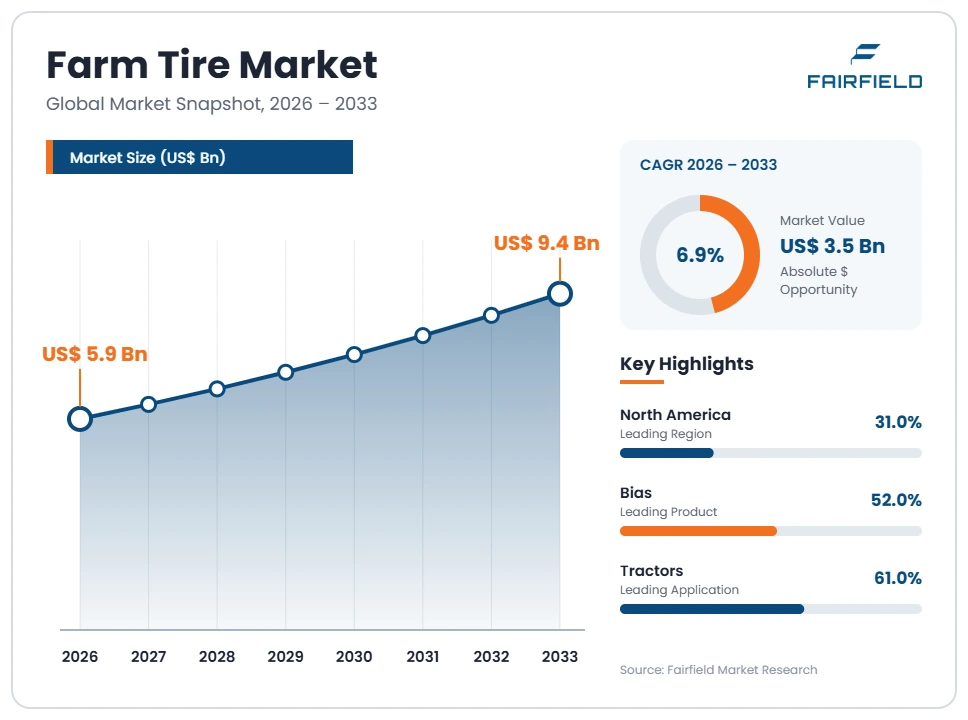
The global farm tire market size is expected to be valued at US$ 5.9 billion in 2026 and projected to reach US$ 9.4 billion by 2033, growing at a CAGR of 6.9% between 2026 and 2033.
Between 2020 and 2025, the market grew at a CAGR of about 5.2%, as high crop prices in 2021 and 2022 lifted tractor and combine sales, followed by a slowdown in farm machinery demand in 2024 as grain prices fell and interest rates rose. The farm tire market covers bias and radial tires for tractors, combine harvesters, sprayers, implements, trailers, irrigation systems, and forestry machines, sold to equipment makers and to farmers through dealers. Agricultural tires must carry heavy loads, provide traction in mud and soil, and limit soil compaction that reduces crop yields. Growth comes from farm mechanization in India, China, Brazil, and Kenya, larger and more powerful machines, and the replacement needs of a large installed fleet. The market is shifting toward radial farm tires, increased flexion and very high flexion designs, central tire inflation systems, and sensor-equipped smart tires. In May 2026, Bridgestone added six XXL sizes to its VT-TRACTOR range.
Key Report Takeaways
- By Product: Bias held about 52% share in 2025, while Radial is projected to expand at a 8.1% CAGR through 2033, driven by better fuel efficiency, lower soil compaction, longer tread life, and growing use of high-horsepower tractors worldwide.
- By Application: Tractors held about 61% share in 2025, while Sprayers are projected to expand at a 8.0% CAGR through 2033, driven by precision farming, self-propelled sprayer adoption, and narrow row-crop tires that limit crop damage.
- By Distribution Channel: Aftermarket held about 63% share in 2025, while OEM is projected to expand at a 7.2% CAGR through 2033, driven by rising tractor production in India and China and larger, higher-value tire fitments on new machines.
- By Region: North America held about 31% share in 2025, while Asia Pacific is projected to expand at a 8.4% CAGR through 2033, driven by farm mechanization, government tractor subsidies, rising farm incomes, and large tractor production in India and China.
Global Farm Tire Market Trends and Insights
Drivers Impact Analysis
Two drivers carry the strongest influence on farm tire market demand during the forecast period.
| Driver | Impact on CAGR Forecast | Geographic Relevance | Impact Timeline |
| Farm mechanization and larger machines | High | Asia Pacific, Latin America, Middle East & Africa | Long term (≥4 years) |
| Soil protection and precision farming adoption | Medium | North America, Europe | Medium term (2–4 years) |
Farm Mechanization Is Driving the Farm Tire Market
Farm mechanization and larger machines are the strongest driver of the farm tire market. More tractors need more tires.
The mechanism is the shift from manual labor and animals to machines. Labor shortages in rural areas, rising wages, and the need to raise yields are pushing farmers in India, China, Brazil, Indonesia, and Kenya to buy tractors, harvesters, and sprayers. India is the world’s largest tractor market by units, selling around 900,000 tractors a year, and government subsidy programs help small farmers buy equipment. Large farms in North America, Brazil, Argentina, and Australia use bigger, more powerful tractors and combines that need larger, more expensive tires. Contract farming services and equipment rental spread machines to smaller farms. Each machine needs replacement tires every few years. These factors support steady growth in tire demand and value across the forecast period.
Soil Protection Is Expanding the Farm Tire Market
Soil protection and precision farming adoption are expanding the farm tire market. Farmers want tires that protect soil.
The cause is growing awareness that heavy machines compact soil and cut yields. Radial tires with increased flexion and very high flexion technology carry heavy loads at lower pressure, spreading weight over a larger footprint. Central tire inflation systems let farmers lower pressure in the field and raise it on roads. Precision farming and controlled traffic farming need consistent tire performance. Studies show compaction can cut yields by several percent and last for years in deep soil layers. Sustainability programs and regenerative agriculture encourage soil health, and some food companies reward farmers for it. Larger tires and tracks also improve traction, reducing wheel slip and fuel use. Farmers in North America and Europe are adopting VF tires on new tractors and combines. These trends raise demand for premium, higher-value tires.
Restraints Impact Analysis
Two restraints limit how quickly the farm tire market grows.
| Restraint | Impact on CAGR Forecast | Geographic Relevance | Impact Timeline |
| Cyclical farm incomes and machinery sales | High | North America, Europe, Latin America | Medium term (2–4 years) |
| Volatile raw material costs | Medium | Global | Long term (≥4 years) |
Cyclical Demand Slows the Farm Tire Market
Cyclical farm incomes and machinery sales slow the farm tire market. Farmers delay purchases when prices fall.
The specific causes are crop prices, weather, interest rates, and trade policy. When grain prices drop, farmers postpone buying new tractors and stretch tire life. Tractor and combine sales in North America and Europe fell in 2024 and 2025. Tariffs on farm exports can cut incomes. Droughts and floods hurt harvests. Higher interest rates make machinery financing more expensive, and used equipment prices affect new sales. Dealers hold large inventories during downturns, delaying orders from tire makers. Farmers may choose cheaper imported tires or retreads to save money, and some repair damaged tires instead of replacing them. These factors make demand uneven from year to year and complicate production planning for tire makers.
Raw Material Costs Restrict the Farm Tire Market
Volatile raw material costs restrict the farm tire market. Rubber and steel prices swing widely.
The underlying causes are commodity markets. Natural rubber, synthetic rubber, carbon black, and steel make up much of tire cost. Prices rose sharply in 2021 and 2022, and supply disruptions in Thailand, Indonesia, and Malaysia, the main natural rubber producers, can raise costs further. Energy-intensive production in Europe faced high gas prices. European Union deforestation rules require traceable natural rubber, adding compliance costs. Shipping large farm tires is expensive because of their size and weight, and freight rates spiked during the pandemic. Tire makers must also invest in recycling programs for end-of-life tires in Europe. Higher wages in plants add cost. Farmers resist price increases during weak markets. These factors squeeze margins for tire makers and dealers.
Market Opportunities
VF and IF Radial Tires Open a Fast-Growth Revenue Pool
VF and IF radial tires open a fast-growth revenue pool in the farm tire market. Premium tires protect soil and save fuel.
Tire makers can capture this opportunity. Very high flexion tires carry heavy loads at low pressure. BKT launched the AGRIMAX PROHARVEST VF tire for combines. IF and VF tires reduce soil compaction, improve traction, and cut fuel use, and large farms in North America, Europe, Brazil, and Australia are switching to them. Equipment makers fit them on high-horsepower tractors and combines. Michelin, Bridgestone, Yokohama TWS, and Titan International offer wide ranges, and prices are higher than standard radials. Lower pressures also extend tread life and improve ride comfort on roads. Companies with premium ranges and strong dealer support can win.
Smart Tires and Inflation Systems Create a Growth Revenue Pool
Smart tires and inflation systems create a growth revenue pool in the farm tire market. Sensors help farmers manage pressure.
Suppliers can capture this opportunity. Tire sensors track pressure, temperature, and load, alerting farmers to problems before failures and helping keep tires at the right pressure for field and road use. Central tire inflation systems adjust pressure from the cab. Michelin and Yokohama TWS have launched connected tire systems, and equipment makers are integrating them with farm management software. Precision farming adoption supports demand, and correct pressure can cut fuel use and soil damage noticeably. Large farms and contractors that run fleets of machines benefit most from monitoring. Retrofit sensor kits allow older tractors to join. Data from tires can feed into machine telematics and maintenance planning, and insurers may reward safe tire management. Companies offering connected solutions and data services can grow.
Segment Analysis
- By Product: Bias Leads While Radial Grows Fastest
Bias held about 52% share in 2025. Bias tires are cheaper, tough, and resistant to sidewall damage, making them popular on small tractors, implements, and trailers. They dominate in India, China, Middle East & Africa, and much of Latin America, where price is the main buying factor and small tractors are common. Bias tires are also easier to repair in rural areas and suit rough, stony fields.
Radial is the fastest-growing product, expanding at a 8.1% CAGR through 2033. Radials save fuel, protect soil, give a smoother ride, and last longer, and they are standard on high-horsepower tractors and combines. Adoption is rising in India and Brazil. For the market, radial growth raises value.
- By Application: Tractors Lead While Sprayers Grow Fastest
Tractors held about 61% share in 2025. Tractors are the main farm machine, used for tillage, planting, hauling, and powering implements, and they need large rear and front tires. Tractor fleets in India, China, the United States, and Europe are large, supporting steady replacement demand. Larger tractors in North America and Europe use high-value radial tires, and front-wheel-drive tractors need four drive tires.
Sprayers are the fastest-growing application, expanding at a 8.0% CAGR through 2033. Self-propelled sprayers and precision spraying are growing, and they need tall, narrow tires that limit crop damage and carry heavy tanks at speed. Harvesters, implements, forestry, and irrigation form other applications. For the market, sprayer growth adds premium tires.
- By Distribution Channel: Aftermarket Leads While OEM Grows Fastest
Aftermarket held about 63% share in 2025. Replacement drives most sales through tire dealers, equipment dealers, and farm stores, because farm tires wear out or get damaged while machines last for decades. Strong service networks and fast delivery during busy seasons matter, because a flat tire can stop work during planting or harvest. Aftermarket buyers often switch brands to save money, and value brands such as BKT and Chinese makers have gained share. Online tire sales are growing for smaller sizes.
OEM is the fastest-growing channel, expanding at a 7.2% CAGR through 2033. New machines need tires fitted at the factory, and rising tractor production in India, China, and Brazil adds volume. Equipment makers increasingly fit premium radial tires. For the market, OEM growth adds volume.
Geography Analysis
- Which Region Is Leading the Farm Tire Market?
North America is leading the farm tire market with about 31% share in 2025. The United States has large farms that use high-horsepower tractors, combines, and sprayers with large, premium radial tires. Titan International and many dealers are based there, and John Deere, CNH, and AGCO build machines in the region. Canada adds demand from large grain farms in Saskatchewan and Alberta. Farmers are adopting VF tires and central inflation systems to protect soil and cut fuel use, and tracks compete with tires on the largest machines. Key barriers include cyclical demand. One change shaping the region is VF tire adoption.
- Europe Shapes the Farm Tire Market Through Soil Protection
Europe is a major farm tire market. France, Germany, the United Kingdom, Italy, Spain, and Poland have large farm sectors and strong interest in soil protection. Michelin, Continental, and Yokohama TWS have major plants and research centers in the region, and CLAAS and Fendt build high-end machines. Strict road rules limit machine width, favoring low-pressure tires that are narrower, and soil protection policies encourage VF technology. Farm machinery sales fell in 2024 and 2025, but replacement demand stayed steady. Key barriers include falling machinery sales. One opportunity is soil protection.
- Which Region Is Growing Fastest in the Farm Tire Market?
Asia Pacific is growing fastest in the farm tire market, expanding at a 8.4% CAGR through 2033. India and China lead, with Japan, Australia, Indonesia, and Thailand adding demand. India is the largest tractor market by units and home to BKT, Apollo Tyres, CEAT, JK Tyre, and MRF, while China has many tire makers. Government subsidies support mechanization, and custom hiring centers in India spread tractor use to small farms. Radial adoption is rising slowly as farm sizes grow, and Australia uses large machines on big grain farms. Key barriers include price sensitivity. One change shaping the region is mechanization.
- Latin America Grows the Farm Tire Market Through Large-Scale Agriculture
Latin America is a growing farm tire market. Brazil and Argentina lead, with Mexico, Paraguay, and Colombia adding demand. Large soybean, corn, sugarcane, and cotton farms in Brazil use high-horsepower tractors, combines, and sprayers, and tire makers run plants in the region. Farm exports are growing strongly, and farmers are expanding into new land in central Brazil, increasing demand for machinery. Michelin, Pirelli, Titan International, and BKT supply the region, and equipment makers John Deere, CNH, and AGCO build tractors and combines in Brazil. Sugarcane harvesting uses heavy machines that wear tires quickly. Key barriers include currency swings. One opportunity is large machinery.
- Middle East & Africa Develops the Farm Tire Market Through Mechanization
Middle East & Africa is a developing farm tire market. South Africa and Kenya lead, with Egypt, Nigeria, Morocco, and Saudi Arabia adding demand. Governments and development banks support farm mechanization, tractor hire services, and irrigation, and large commercial farms in South Africa use modern machines. Most small farmers still use hand tools or animals, so the potential for growth is large. Tractors and tires are mostly imported from India, China, and Europe. Mahindra and other brands sell low-cost tractors in the region. Key barriers include low incomes. One change shaping the region is mechanization.
Competitive Landscape
The farm tire market is moderately consolidated. Michelin, Bridgestone, Balkrishna Industries, known as BKT, Yokohama TWS, and Titan International are leading players, while Continental, Apollo Tyres, Sumitomo Rubber Industries, Prometeon Tyre Group, CEAT, JK Tyre & Industries, and MRF compete strongly. Yokohama TWS owns the Trelleborg, Mitas, and Alliance brands, while Titan International makes Goodyear Farm Tires under license in North America. Many Chinese makers supply low-cost bias and radial tires.
Companies compete on load capacity, traction, soil protection, durability, fuel efficiency, price, dealer networks, and relationships with equipment makers such as John Deere, CNH, AGCO, Kubota, CLAAS, and Mahindra & Mahindra. Premium brands lead in VF and IF radial tires for high-horsepower tractors and combines, while BKT, CEAT, and Chinese makers compete strongly on value in the aftermarket. Field service and quick delivery during planting and harvest seasons are important.
Strategic moves show how competition is changing. In May 2026, Bridgestone launched six XXL VT-TRACTOR sizes made at its upgraded plant in Spain. In May 2026, Goodyear Farm Tires gained ECE approval for its LSW1400/30R46 super-wide tire in Europe. In August 2026, BKT unveiled the AGRIMAX PROHARVEST VF combine tire for North America. These moves show competition shifting toward larger, low-pressure radial tires for big machines.
Three themes shape vendor strategy. First, companies are expanding VF and IF radial ranges for high-horsepower tractors and harvesters. Second, they are investing in sensors, central inflation compatibility, and sustainable materials. Third, they are growing in Asia Pacific and Latin America through local plants and dealer networks.
Recent Industry Developments
- August 2026: BKT unveiled AGRIMAX PROHARVEST, a VF tire for combines and harvesting equipment, for the U.S. market ahead of the Farm Progress Show – expands premium radial farm tires for harvesters.
- May 2026: Bridgestone expanded its VT-TRACTOR range with six new XXL sizes for 38- to 46-inch rims, produced at its upgraded Puente San Miguel plant in Spain – targets high-horsepower tractors.
- May 2026: Goodyear Farm Tires, part of Titan International, announced that its LSW1400/30R46, described as the world’s largest commercially available agricultural tire, received ECE accreditation for use in Europe – widens access to super-wide agricultural tires.
Companies Covered in the Report
- Michelin
- Bridgestone
- Balkrishna Industries (BKT)
- Yokohama TWS
- Titan International
- Continental
- Apollo Tyres
- Sumitomo Rubber Industries
- Prometeon Tyre Group
- CEAT
- JK Tyre & Industries
- MRF
Farm Tire Market Report Scope
| Metric | Value |
| Study Period | 2020–2033 |
| Market Size 2026 | US$ 5.9 Billion |
| Market Size 2033 | US$ 9.4 Billion |
| CAGR 2026–2033 | 6.9% |
| Absolute Dollar Opportunity | US$ 3.5 Billion |
| Largest Market | North America |
| Fastest-Growing Market | Asia Pacific |
| Market Concentration | Moderately Consolidated |
| Major Players | Michelin, Bridgestone, Balkrishna Industries (BKT), Yokohama TWS, Titan International |
Farm Tire Market Segmentation
Product
- Bias
- Radial
Application
- Tractors
- Harvesters
- Forestry
- Irrigation
- Implements
- Sprayers
Distribution Channel
- OEM
- Aftermarket
Regions
- North America
- Europe
- Asia Pacific
- Latin America
- Middle East & Africa
- Executive Summary
- Global Farm Tire Market Snapshot
- Future Projections, 2026-2033
- Key Market Trends
- Regional Snapshot
- Market Overview
- Market Definition and Report Scope
- Historical Market Trends, 2020-2025
- Market Dynamics
- Drivers Impact Analysis
- Farm Mechanization Is Driving the Farm Tire Market
- Soil Protection Is Expanding the Farm Tire Market
- Restraints Impact Analysis
- Cyclical Demand Slows the Farm Tire Market
- Raw Material Costs Restrict the Farm Tire Market
- Market Opportunities
- VF and IF Radial Tires Open a Fast-Growth Revenue Pool
- Smart Tires and Inflation Systems Create a Growth Revenue Pool
- Drivers Impact Analysis
- Global Farm Tire Market Outlook, 2020-2033
- Global Farm Tire Market Outlook, by Product, Value (US$ Billion), 2020-2033
- Bias
- Radial
- Global Farm Tire Market Outlook, by Application, Value (US$ Billion), 2020-2033
- Tractors
- Harvesters
- Forestry
- Irrigation
- Implements
- Sprayers
- Global Farm Tire Market Outlook, by Distribution Channel, Value (US$ Billion), 2020-2033
- OEM
- Aftermarket
- Global Farm Tire Market Outlook, by Region, Value (US$ Billion), 2020-2033
- North America
- Europe
- Asia Pacific
- Latin America
- Middle East & Africa
- Global Farm Tire Market Outlook, by Product, Value (US$ Billion), 2020-2033
- North America Farm Tire Market Outlook, 2020-2033
- North America Farm Tire Market Outlook, by Product, Value (US$ Billion), 2020-2033
- Bias
- Radial
- North America Farm Tire Market Outlook, by Application, Value (US$ Billion), 2020-2033
- Tractors
- Harvesters
- Forestry
- Irrigation
- Implements
- Sprayers
- North America Farm Tire Market Outlook, by Distribution Channel, Value (US$ Billion), 2020-2033
- OEM
- Aftermarket
- North America Farm Tire Market Outlook, by Country, Value (US$ Billion), 2020-2033
- United States Farm Tire Market Outlook, by Product, 2020-2033
- United States Farm Tire Market Outlook, by Application, 2020-2033
- United States Farm Tire Market Outlook, by Distribution Channel, 2020-2033
- Canada Farm Tire Market Outlook, by Product, 2020-2033
- Canada Farm Tire Market Outlook, by Application, 2020-2033
- Canada Farm Tire Market Outlook, by Distribution Channel, 2020-2033
- North America Farm Tire Market Outlook, by Product, Value (US$ Billion), 2020-2033
- Europe Farm Tire Market Outlook, 2020-2033
- Europe Farm Tire Market Outlook, by Product, Value (US$ Billion), 2020-2033
- Bias
- Radial
- Europe Farm Tire Market Outlook, by Application, Value (US$ Billion), 2020-2033
- Tractors
- Harvesters
- Forestry
- Irrigation
- Implements
- Sprayers
- Europe Farm Tire Market Outlook, by Distribution Channel, Value (US$ Billion), 2020-2033
- OEM
- Aftermarket
- Europe Farm Tire Market Outlook, by Country, Value (US$ Billion), 2020-2033
- France Farm Tire Market Outlook, by Product, 2020-2033
- France Farm Tire Market Outlook, by Application, 2020-2033
- France Farm Tire Market Outlook, by Distribution Channel, 2020-2033
- Germany Farm Tire Market Outlook, by Product, 2020-2033
- Germany Farm Tire Market Outlook, by Application, 2020-2033
- Germany Farm Tire Market Outlook, by Distribution Channel, 2020-2033
- United Kingdom Farm Tire Market Outlook, by Product, 2020-2033
- United Kingdom Farm Tire Market Outlook, by Application, 2020-2033
- United Kingdom Farm Tire Market Outlook, by Distribution Channel, 2020-2033
- Italy Farm Tire Market Outlook, by Product, 2020-2033
- Italy Farm Tire Market Outlook, by Application, 2020-2033
- Italy Farm Tire Market Outlook, by Distribution Channel, 2020-2033
- Spain Farm Tire Market Outlook, by Product, 2020-2033
- Spain Farm Tire Market Outlook, by Application, 2020-2033
- Spain Farm Tire Market Outlook, by Distribution Channel, 2020-2033
- Poland Farm Tire Market Outlook, by Product, 2020-2033
- Poland Farm Tire Market Outlook, by Application, 2020-2033
- Poland Farm Tire Market Outlook, by Distribution Channel, 2020-2033
- Europe Farm Tire Market Outlook, by Product, Value (US$ Billion), 2020-2033
- Asia Pacific Farm Tire Market Outlook, 2020-2033
- Asia Pacific Farm Tire Market Outlook, by Product, Value (US$ Billion), 2020-2033
- Bias
- Radial
- Asia Pacific Farm Tire Market Outlook, by Application, Value (US$ Billion), 2020-2033
- Tractors
- Harvesters
- Forestry
- Irrigation
- Implements
- Sprayers
- Asia Pacific Farm Tire Market Outlook, by Distribution Channel, Value (US$ Billion), 2020-2033
- OEM
- Aftermarket
- Asia Pacific Farm Tire Market Outlook, by Country, Value (US$ Billion), 2020-2033
- India Farm Tire Market Outlook, by Product, 2020-2033
- India Farm Tire Market Outlook, by Application, 2020-2033
- India Farm Tire Market Outlook, by Distribution Channel, 2020-2033
- China Farm Tire Market Outlook, by Product, 2020-2033
- China Farm Tire Market Outlook, by Application, 2020-2033
- China Farm Tire Market Outlook, by Distribution Channel, 2020-2033
- Japan Farm Tire Market Outlook, by Product, 2020-2033
- Japan Farm Tire Market Outlook, by Application, 2020-2033
- Japan Farm Tire Market Outlook, by Distribution Channel, 2020-2033
- Australia Farm Tire Market Outlook, by Product, 2020-2033
- Australia Farm Tire Market Outlook, by Application, 2020-2033
- Australia Farm Tire Market Outlook, by Distribution Channel, 2020-2033
- Indonesia Farm Tire Market Outlook, by Product, 2020-2033
- Indonesia Farm Tire Market Outlook, by Application, 2020-2033
- Indonesia Farm Tire Market Outlook, by Distribution Channel, 2020-2033
- Thailand Farm Tire Market Outlook, by Product, 2020-2033
- Thailand Farm Tire Market Outlook, by Application, 2020-2033
- Thailand Farm Tire Market Outlook, by Distribution Channel, 2020-2033
- Asia Pacific Farm Tire Market Outlook, by Product, Value (US$ Billion), 2020-2033
- Latin America Farm Tire Market Outlook, 2020-2033
- Latin America Farm Tire Market Outlook, by Product, Value (US$ Billion), 2020-2033
- Bias
- Radial
- Latin America Farm Tire Market Outlook, by Application, Value (US$ Billion), 2020-2033
- Tractors
- Harvesters
- Forestry
- Irrigation
- Implements
- Sprayers
- Latin America Farm Tire Market Outlook, by Distribution Channel, Value (US$ Billion), 2020-2033
- OEM
- Aftermarket
- Latin America Farm Tire Market Outlook, by Country, Value (US$ Billion), 2020-2033
- Brazil Farm Tire Market Outlook, by Product, 2020-2033
- Brazil Farm Tire Market Outlook, by Application, 2020-2033
- Brazil Farm Tire Market Outlook, by Distribution Channel, 2020-2033
- Argentina Farm Tire Market Outlook, by Product, 2020-2033
- Argentina Farm Tire Market Outlook, by Application, 2020-2033
- Argentina Farm Tire Market Outlook, by Distribution Channel, 2020-2033
- Mexico Farm Tire Market Outlook, by Product, 2020-2033
- Mexico Farm Tire Market Outlook, by Application, 2020-2033
- Mexico Farm Tire Market Outlook, by Distribution Channel, 2020-2033
- Paraguay Farm Tire Market Outlook, by Product, 2020-2033
- Paraguay Farm Tire Market Outlook, by Application, 2020-2033
- Paraguay Farm Tire Market Outlook, by Distribution Channel, 2020-2033
- Colombia Farm Tire Market Outlook, by Product, 2020-2033
- Colombia Farm Tire Market Outlook, by Application, 2020-2033
- Colombia Farm Tire Market Outlook, by Distribution Channel, 2020-2033
- Latin America Farm Tire Market Outlook, by Product, Value (US$ Billion), 2020-2033
- Middle East & Africa Farm Tire Market Outlook, 2020-2033
- Middle East & Africa Farm Tire Market Outlook, by Product, Value (US$ Billion), 2020-2033
- Bias
- Radial
- Middle East & Africa Farm Tire Market Outlook, by Application, Value (US$ Billion), 2020-2033
- Tractors
- Harvesters
- Forestry
- Irrigation
- Implements
- Sprayers
- Middle East & Africa Farm Tire Market Outlook, by Distribution Channel, Value (US$ Billion), 2020-2033
- OEM
- Aftermarket
- Middle East & Africa Farm Tire Market Outlook, by Country, Value (US$ Billion), 2020-2033
- South Africa Farm Tire Market Outlook, by Product, 2020-2033
- South Africa Farm Tire Market Outlook, by Application, 2020-2033
- South Africa Farm Tire Market Outlook, by Distribution Channel, 2020-2033
- Kenya Farm Tire Market Outlook, by Product, 2020-2033
- Kenya Farm Tire Market Outlook, by Application, 2020-2033
- Kenya Farm Tire Market Outlook, by Distribution Channel, 2020-2033
- Egypt Farm Tire Market Outlook, by Product, 2020-2033
- Egypt Farm Tire Market Outlook, by Application, 2020-2033
- Egypt Farm Tire Market Outlook, by Distribution Channel, 2020-2033
- Nigeria Farm Tire Market Outlook, by Product, 2020-2033
- Nigeria Farm Tire Market Outlook, by Application, 2020-2033
- Nigeria Farm Tire Market Outlook, by Distribution Channel, 2020-2033
- Morocco Farm Tire Market Outlook, by Product, 2020-2033
- Morocco Farm Tire Market Outlook, by Application, 2020-2033
- Morocco Farm Tire Market Outlook, by Distribution Channel, 2020-2033
- Saudi Arabia Farm Tire Market Outlook, by Product, 2020-2033
- Saudi Arabia Farm Tire Market Outlook, by Application, 2020-2033
- Saudi Arabia Farm Tire Market Outlook, by Distribution Channel, 2020-2033
- Middle East & Africa Farm Tire Market Outlook, by Product, Value (US$ Billion), 2020-2033
- Competitive Landscape
- Market Concentration and Industry Leaders
- Competitive Differentiation
- Strategic Initiatives
- Recent Industry Developments
- Company Profiles
- Michelin
- Bridgestone
- Balkrishna Industries (BKT)
- Yokohama TWS
- Titan International
- Continental
- Apollo Tyres
- Sumitomo Rubber Industries
- Prometeon Tyre Group
- CEAT
- JK Tyre & Industries
- MRF
- Appendix
- Research Methodology
- Report Assumptions
- Acronyms and Abbreviations
Product
- Bias
- Radial
Application
- Tractors
- Harvesters
- Forestry
- Irrigation
- Implements
- Sprayers
Distribution Channel
- OEM
- Aftermarket
Regions
- North America
- Europe
- Asia Pacific
- Latin America
- Middle East & Africa
Our Research Methodology
Considering the volatility of business today, traditional approaches to strategizing a game plan can be unfruitful if not detrimental. True ambiguity is no way to determine a forecast. A myriad of predetermined factors must be accounted for such as the degree of risk involved, the magnitude of circumstances, as well as conditions or consequences that are not known or unpredictable. To circumvent binary views that cast uncertainty, the application of market research intelligence to strategically posture, move, and enable actionable outcomes is necessary.
View Methodology
Quality Assured
Rigorous Validation Process

Confidentiality Assured
End-to-end Data Security

Custom Research Services
Tailored To Your Objectives
FAQs
The farm tire market is valued at US$ 5.9 billion in 2026, led by tractor tires and North America.
The market is projected to reach US$ 9.4 billion by 2033, growing at a 6.9% CAGR and adding US$ 3.5 billion.
Radial tires are growing fastest at an 8.1% CAGR through 2033, driven by fuel savings, lower soil compaction, and longer tread life.
Asia Pacific is growing fastest at an 8.4% CAGR through 2033, driven by farm mechanization, tractor subsidies, and rising farm incomes.
North America holds the largest share at about 31% in 2025, supported by large farms and high-horsepower tractor use.
Related Reports
EV Contactor Relay Market Size, Share, Insights, Competitive Landscape, and Forecast 2026 to 2033
The global EV contactor relay market is valued at US$2.4 billion in 2026, reaching US$6.3 billion by 2033, growing at a 14.8% CAGR
Locomotive Market Size, Share, Insights, Competitive Landscape, and Forecast 2026 to 2033
The locomotive market is projected to reach US$29.5 billion by 2033. Explore propulsion trends, freight and passenger demand, and regional growth.
Li-ion Battery Management Systems Market Size, Share, Insights, Competitive Landscape, and Forecast 2026 to 2033
The Li-ion battery management systems market is projected to reach US$30.2 billion by 2033. Explore trends by topology, pack voltage, and application.
In-Vehicle Payment Services Market Size, Share, Insights, Competitive Landscape, and Forecast 2026 to 2033
The in-vehicle payment services market is forecast to reach US$30.86 billion by 2033 at a 17.3% CAGR as connected cars expand access to in-car payments.
Automotive TIC Services Market Size, Share, Insights, Competitive Landscape, and Forecast 2026 to 2033
The global automotive TIC services market is valued at US$25.30 billion in 2026, reaching US$37.79 billion by 2033, growing at a 5.9% CAGR
Recreational Vehicle Market Size, Share, Insights, Competitive Landscape, and Forecast 2026 to 2033
The global recreational vehicle market is valued at US$78.3 billion in 2026, reaching US$168.3 billion by 2033, growing at an 11.6% CAGR