



Uterine Cancer Diagnostic Testing Market
Uterine Cancer Diagnostic Testing Market Insights, Competitive Landscape, and Market Forecast - 2033
Uterine Cancer Diagnostic Testing Market Forecast
- Uterine cancer diagnostic testing market size projected to reach USD 5.2 Bn by 2033, showing significant growth from USD 3.2 Bn estimated in 2026
- Global uterine cancer diagnostic testing market revenue poised to exhibit a notable CAGR of 7% during 2026-2033
Uterine Cancer Diagnostic Testing Market Insights
Key Growth Determinants
Increasing Incidence of Uterine Cancer
The increasing incidence of uterine cancer is a significant driver for the uterine cancer diagnostic testing market expansion. Uterine cancer is one of the most common gynecological cancers, and its prevalence has been rising globally. Factors such as hormonal imbalances, obesity, and a sedentary lifestyle contribute to the increasing incidence.
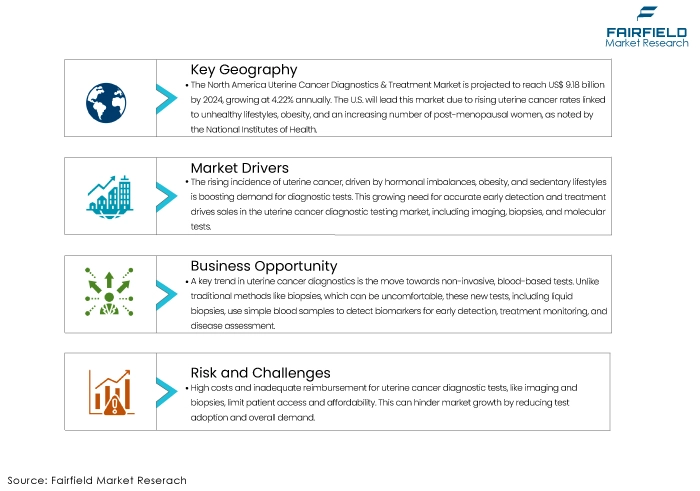
As the number of cases continues to rise, there is a growing need for accurate and efficient diagnostic tests for early detection and effective treatment planning. This drives uterine cancer diagnostic testing sales, including imaging tests, biopsies, and molecular testing, leading to market growth.
Advancements in Diagnostic Technologies
Advancements in diagnostic technologies play a crucial role in boosting the uterine cancer diagnostic testing market revenue. The development of innovative diagnostic tools and techniques enhances the accuracy, sensitivity, and specificity of uterine cancer detection. For instance, imaging techniques such as transvaginal ultrasound, magnetic resonance imaging (MRI), and positron emission tomography (PET) provide detailed visualization of the uterus, aiding in the identification of tumors and metastasis.
Molecular testing, including genetic and genomic profiling, helps assess risk factors and determine personalized treatment strategies. These technological advancements not only improve diagnostic accuracy but also enable early detection, leading to improved patient outcomes and driving industry growth.
Increasing Awareness and Screening Initiatives
Growing awareness about uterine cancer and the importance of early detection is another significant driver for boosting uterine cancer diagnostic testing market shares. Efforts by healthcare organizations, government bodies, and advocacy groups to raise awareness about the risk factors, symptoms, and screening options for uterine cancer have led to increased screening rates.
Screening initiatives, such as Pap smears, endometrial biopsies, and HPV testing, help in the early detection of uterine cancer, enabling timely intervention and improved survival rates. The emphasis on regular check-ups and preventive healthcare measures has resulted in a higher demand for uterine cancer diagnostic testing. As awareness continues to grow, more individuals are likely to undergo screening, driving the market for uterine cancer testing.
Key Growth Barriers
High Costs and Inadequate Reimbursement
One of the key restraints for the uterine cancer diagnostic testing market value is the high costs associated with diagnostic tests and inadequate reimbursement policies. Diagnostic tests for uterine cancer, such as imaging tests, biopsies, and molecular testing, can be expensive, making them less accessible to certain patient populations.
Additionally, the lack of adequate reimbursement for these tests can further limit patient access and affordability. High costs and inadequate reimbursement can hinder market growth by limiting the adoption of diagnostic tests and reducing the overall demand for uterine cancer diagnostic testing.
Limited Awareness and Screening Programs
As per the uterine cancer diagnostic testing market research report, limited awareness and screening programs pose another challenge to the growth of the market. Uterine cancer may not receive the same level of attention and awareness as some other types of cancer, leading to lower screening rates and delayed diagnoses.
Lack of awareness about the risk factors, symptoms, and importance of early detection can result in missed opportunities for timely diagnosis and treatment. Insufficient screening programs and initiatives can further contribute to under diagnosis and hinder the growth of opportunities for industry players. Increasing awareness among healthcare providers and the general population about the importance of uterine cancer screening and early detection is crucial to overcome this restraint and drive market growth.
Uterine Cancer Diagnostic Testing Market Trends and Opportunities
- Non-Invasive and Blood-Based Diagnostic Tests
One notable industry trend in the diagnostic testing industry for uterine cancer is the shift towards non-invasive and blood-based diagnostic tests. Traditional diagnostic methods for uterine cancer, such as biopsies and imaging tests, can be invasive and uncomfortable for patients. However, advancements in technology have led to the development of non-invasive alternatives that offer convenience and reduce patient discomfort.
As per Fairfield's uterine cancer diagnostic testing market update, blood-based tests, such as liquid biopsies, are gaining prominence as they allow for the detection of specific biomarkers associated with uterine cancer through a simple blood sample. These tests offer the potential for early detection, monitoring treatment response, and assessing disease progression.
- Precision Medicine and Digital Health Solutions
An opportunity for the uterine cancer diagnostic testing industry lies in the integration of precision medicine and digital health solutions. Precision medicine aims to tailor medical treatment to individual patients based on their genetic makeup, lifestyle, and environmental factors. In the context of uterine cancer, precision medicine approaches can help identify specific genetic mutations or biomarkers that influence disease progression and treatment response.
By integrating precision medicine with digital health solutions, such as electronic health records, telemedicine, and data analytics, healthcare providers can enhance the efficiency and effectiveness of uterine cancer diagnostic testing. This integration enables seamless data sharing, real-time monitoring, and personalized treatment decision-making.
Furthermore, it facilitates the collection and analysis of large-scale patient data, contributing to research and the development of innovative diagnostic tools and therapies. The integration of precision medicine and digital health solutions presents various uterine cancer diagnostic testing market opportunities to improve patient outcomes, optimize resource utilization, and drive advancements in the market.
Segments Covered in Uterine Cancer Diagnostic Testing Market Report
- Endometrial Carcinoma Dominates on the Back of Greater Accuracy and Accessibility
The uterine cancer diagnostic testing market forecast shows significant growth, with a focus on categorizing cancer types into endometrial carcinoma and uterine sarcoma, with endometrial carcinoma expected to hold a dominant market share of 91.2% in 2024. This category focuses on improving the accuracy and accessibility of diagnostic techniques to enhance patient outcomes and drive further advancements in uterine cancer diagnostics.
Additionally, biopsy procedures are projected to hold a substantial market share of 56.1%. Biopsies play a crucial role in diagnosing uterine cancer by extracting tissue samples for examination and analysis.
- Diagnostic Laboratories Lead with Specialized Equipment and Skilled Physicians
The uterine cancer diagnostic testing market is characterized by different end users, including hospitals, ambulatory surgical centers, cancer research centers, specialized clinics, and diagnostic laboratories. Among these, diagnostic laboratories are expected to dominate the market, holding a substantial market share of 41.3% in 2024.
Diagnostic laboratories play a vital role in the uterine cancer diagnostic testing process. They are equipped with specialized equipment and skilled personnel who perform various tests and analyses to accurately diagnose uterine cancer. These laboratories offer a range of diagnostic services, including ultrasound scanning, biopsies, and blood tests, providing comprehensive and reliable results to healthcare professionals.
Regional Frontrunners
- US Dominates with Growing Incidence and Cost-effective Solutions
The North America Uterine Cancer Diagnostics & Treatment Market was estimated to reach US$9.18 billion in 2024, with a projected growth rate of 4.22%. The U.S. is set to lead the uterine cancer diagnostic testing market in North America, driven by a rising incidence of uterine cancer. Unhealthy lifestyles and the growing obese population contribute to the high incidence of uterine cancer, as highlighted by the National Institutes of Health. Additionally, the increasing number of post-menopausal women further contributes to the prevalence of this disease.According to the U.S. Census Bureau, women aged 65 and above accounted for a significant portion of the elderly population, while a substantial percentage of women between 25 and 99 years belonged to the age group of 50-99 years, according to 2017 world population statistics.
- China Emerges as the Key Market in Asia Pacific
China is the second dominant market for uterine cancer diagnostic testing in the Asia Pacific region. The growth is driven by increased healthcare expenditure and government funding in the country. The government's reimbursement policies for women's health screenings and treatment further contribute to the market's expansion.
China's large population, coupled with a growing number of post-menopausal women, creates a higher demand for comprehensive diagnostic services. According to data from the National Central Cancer Registry of China (NCCR), the incidence and mortality rates of cancer have been rapidly increasing, with uterine cancer ranking as the second most common type of gynecologic cancer in the country.
- Rising Uterine Cancer Cases Drive Market Growth in Europe
The increasing number of uterine cancer cases in Europe is expected to fuel the growth of the market for uterine cancer diagnostic testing in the region. According to the European Society for Medical Oncology, the U.K. registers approximately 7,400 new cases annually, while the European Union sees 88,068 new cases each year. Additionally, the Cancer Registry of Norway reveals that more than one in 20 gynecologic cancer cases are of endometrial cancer. These analysis and studies indicate that the uterine cancer diagnostic testing market shares are expected to reach notable growth.
Competitive Landscape Analysis
The competitive landscape of the uterine cancer diagnostic testing market is characterized by the presence of several key players striving to develop innovative diagnostic solutions. These companies have a strong market presence and are actively involved in research and development efforts to introduce novel diagnostic procedures and expand their product lines. The market is moderately competitive, with global players dominating the market. The adoption of novel diagnostic products and significant research and development efforts have helped these companies maintain a strong position in the market.
Key Market Companies
- Sysmex Corporation
- AbbVie Inc.
- Merck & Co. Ltd
- Pfizer Inc.
- Becton Dickinson and Company
- Bristol-Myers Squibb Company
- Hoffmann-La Roche Ltd
- Thermo Fisher Scientific Inc.
- Abbott Laboratories Inc.
- Illumina Inc
- bioMrieux SA
- Takeda Pharmaceutical Company Limited
Uterine Cancer Diagnostic Testing Market Segmentation :
By Type
- Blood test
- Endometrial biopsy
- Imaging
- Others
By End User
- Hospitals
- Diagnostic centers
- Cancer research centers
- Others
By Region
- North America
- Latin America
- Europe
- East Asia
- South Asia & Oceania
- Executive Summary
- Global Uterine Cancer Diagnostic Testing Market Snapshot
- Future Projections
- Key Market Trends
- Regional Snapshot, by Value, 2026
- Analyst Recommendations
- Market Overview
- Market Definitions and Segmentations
- Market Dynamics
- Drivers
- Restraints
- Market Opportunities
- Value Chain Analysis
- COVID-19 Impact Analysis
- Porter's Five Forces Analysis
- Impact of Russia-Ukraine Conflict
- PESTLE Analysis
- Regulatory Analysis
- Price Trend Analysis
- Current Prices and Future Projections, 2025-2033
- Price Impact Factors
- Global Uterine Cancer Diagnostic Testing Market Outlook, 2020 - 2033
- Global Uterine Cancer Diagnostic Testing Market Outlook, by Type, Value (US$ Mn), 2020-2033
- Blood test
- Endometrial biopsy
- Imaging
- Others
- Global Uterine Cancer Diagnostic Testing Market Outlook, by End User, Value (US$ Mn), 2020-2033
- Hospitals
- Diagnostic centers
- Cancer research centers
- Others
- Global Uterine Cancer Diagnostic Testing Market Outlook, by Region, Value (US$ Mn), 2020-2033
- North America
- Europe
- Asia Pacific
- Latin America
- Middle East & Africa
- Global Uterine Cancer Diagnostic Testing Market Outlook, by Type, Value (US$ Mn), 2020-2033
- North America Uterine Cancer Diagnostic Testing Market Outlook, 2020 - 2033
- North America Uterine Cancer Diagnostic Testing Market Outlook, by Type, Value (US$ Mn), 2020-2033
- Blood test
- Endometrial biopsy
- Imaging
- Others
- North America Uterine Cancer Diagnostic Testing Market Outlook, by End User, Value (US$ Mn), 2020-2033
- Hospitals
- Diagnostic centers
- Cancer research centers
- Others
- North America Uterine Cancer Diagnostic Testing Market Outlook, by Country, Value (US$ Mn), 2020-2033
- U.S. Uterine Cancer Diagnostic Testing Market Outlook, by Type, 2020-2033
- U.S. Uterine Cancer Diagnostic Testing Market Outlook, by End User, 2020-2033
- Canada Uterine Cancer Diagnostic Testing Market Outlook, by Type, 2020-2033
- Canada Uterine Cancer Diagnostic Testing Market Outlook, by End User, 2020-2033
- BPS Analysis/Market Attractiveness Analysis
- North America Uterine Cancer Diagnostic Testing Market Outlook, by Type, Value (US$ Mn), 2020-2033
- Europe Uterine Cancer Diagnostic Testing Market Outlook, 2020 - 2033
- Europe Uterine Cancer Diagnostic Testing Market Outlook, by Type, Value (US$ Mn), 2020-2033
- Blood test
- Endometrial biopsy
- Imaging
- Others
- Europe Uterine Cancer Diagnostic Testing Market Outlook, by End User, Value (US$ Mn), 2020-2033
- Hospitals
- Diagnostic centers
- Cancer research centers
- Others
- Europe Uterine Cancer Diagnostic Testing Market Outlook, by Country, Value (US$ Mn), 2020-2033
- Germany Uterine Cancer Diagnostic Testing Market Outlook, by Type, 2020-2033
- Germany Uterine Cancer Diagnostic Testing Market Outlook, by End User, 2020-2033
- Italy Uterine Cancer Diagnostic Testing Market Outlook, by Type, 2020-2033
- Italy Uterine Cancer Diagnostic Testing Market Outlook, by End User, 2020-2033
- France Uterine Cancer Diagnostic Testing Market Outlook, by Type, 2020-2033
- France Uterine Cancer Diagnostic Testing Market Outlook, by End User, 2020-2033
- U.K. Uterine Cancer Diagnostic Testing Market Outlook, by Type, 2020-2033
- U.K. Uterine Cancer Diagnostic Testing Market Outlook, by End User, 2020-2033
- Spain Uterine Cancer Diagnostic Testing Market Outlook, by Type, 2020-2033
- Spain Uterine Cancer Diagnostic Testing Market Outlook, by End User, 2020-2033
- Russia Uterine Cancer Diagnostic Testing Market Outlook, by Type, 2020-2033
- Russia Uterine Cancer Diagnostic Testing Market Outlook, by End User, 2020-2033
- Rest of Europe Uterine Cancer Diagnostic Testing Market Outlook, by Type, 2020-2033
- Rest of Europe Uterine Cancer Diagnostic Testing Market Outlook, by End User, 2020-2033
- BPS Analysis/Market Attractiveness Analysis
- Europe Uterine Cancer Diagnostic Testing Market Outlook, by Type, Value (US$ Mn), 2020-2033
- Asia Pacific Uterine Cancer Diagnostic Testing Market Outlook, 2020 - 2033
- Asia Pacific Uterine Cancer Diagnostic Testing Market Outlook, by Type, Value (US$ Mn), 2020-2033
- Blood test
- Endometrial biopsy
- Imaging
- Others
- Asia Pacific Uterine Cancer Diagnostic Testing Market Outlook, by End User, Value (US$ Mn), 2020-2033
- Hospitals
- Diagnostic centers
- Cancer research centers
- Others
- Asia Pacific Uterine Cancer Diagnostic Testing Market Outlook, by Country, Value (US$ Mn), 2020-2033
- China Uterine Cancer Diagnostic Testing Market Outlook, by Type, 2020-2033
- China Uterine Cancer Diagnostic Testing Market Outlook, by End User, 2020-2033
- Japan Uterine Cancer Diagnostic Testing Market Outlook, by Type, 2020-2033
- Japan Uterine Cancer Diagnostic Testing Market Outlook, by End User, 2020-2033
- South Korea Uterine Cancer Diagnostic Testing Market Outlook, by Type, 2020-2033
- South Korea Uterine Cancer Diagnostic Testing Market Outlook, by End User, 2020-2033
- India Uterine Cancer Diagnostic Testing Market Outlook, by Type, 2020-2033
- India Uterine Cancer Diagnostic Testing Market Outlook, by End User, 2020-2033
- Southeast Asia Uterine Cancer Diagnostic Testing Market Outlook, by Type, 2020-2033
- Southeast Asia Uterine Cancer Diagnostic Testing Market Outlook, by End User, 2020-2033
- Rest of SAO Uterine Cancer Diagnostic Testing Market Outlook, by Type, 2020-2033
- Rest of SAO Uterine Cancer Diagnostic Testing Market Outlook, by End User, 2020-2033
- BPS Analysis/Market Attractiveness Analysis
- Asia Pacific Uterine Cancer Diagnostic Testing Market Outlook, by Type, Value (US$ Mn), 2020-2033
- Latin America Uterine Cancer Diagnostic Testing Market Outlook, 2020 - 2033
- Latin America Uterine Cancer Diagnostic Testing Market Outlook, by Type, Value (US$ Mn), 2020-2033
- Blood test
- Endometrial biopsy
- Imaging
- Others
- Latin America Uterine Cancer Diagnostic Testing Market Outlook, by End User, Value (US$ Mn), 2020-2033
- Hospitals
- Diagnostic centers
- Cancer research centers
- Others
- Latin America Uterine Cancer Diagnostic Testing Market Outlook, by Country, Value (US$ Mn), 2020-2033
- Brazil Uterine Cancer Diagnostic Testing Market Outlook, by Type, 2020-2033
- Brazil Uterine Cancer Diagnostic Testing Market Outlook, by End User, 2020-2033
- Mexico Uterine Cancer Diagnostic Testing Market Outlook, by Type, 2020-2033
- Mexico Uterine Cancer Diagnostic Testing Market Outlook, by End User, 2020-2033
- Argentina Uterine Cancer Diagnostic Testing Market Outlook, by Type, 2020-2033
- Argentina Uterine Cancer Diagnostic Testing Market Outlook, by End User, 2020-2033
- Rest of LATAM Uterine Cancer Diagnostic Testing Market Outlook, by Type, 2020-2033
- Rest of LATAM Uterine Cancer Diagnostic Testing Market Outlook, by End User, 2020-2033
- BPS Analysis/Market Attractiveness Analysis
- Latin America Uterine Cancer Diagnostic Testing Market Outlook, by Type, Value (US$ Mn), 2020-2033
- Middle East & Africa Uterine Cancer Diagnostic Testing Market Outlook, 2020 - 2033
- Middle East & Africa Uterine Cancer Diagnostic Testing Market Outlook, by Type, Value (US$ Mn), 2020-2033
- Blood test
- Endometrial biopsy
- Imaging
- Others
- Middle East & Africa Uterine Cancer Diagnostic Testing Market Outlook, by End User, Value (US$ Mn), 2020-2033
- Hospitals
- Diagnostic centers
- Cancer research centers
- Others
- Middle East & Africa Uterine Cancer Diagnostic Testing Market Outlook, by Country, Value (US$ Mn), 2020-2033
- GCC Uterine Cancer Diagnostic Testing Market Outlook, by Type, 2020-2033
- GCC Uterine Cancer Diagnostic Testing Market Outlook, by End User, 2020-2033
- South Africa Uterine Cancer Diagnostic Testing Market Outlook, by Type, 2020-2033
- South Africa Uterine Cancer Diagnostic Testing Market Outlook, by End User, 2020-2033
- Egypt Uterine Cancer Diagnostic Testing Market Outlook, by Type, 2020-2033
- Egypt Uterine Cancer Diagnostic Testing Market Outlook, by End User, 2020-2033
- Nigeria Uterine Cancer Diagnostic Testing Market Outlook, by Type, 2020-2033
- Nigeria Uterine Cancer Diagnostic Testing Market Outlook, by End User, 2020-2033
- Rest of Middle East Uterine Cancer Diagnostic Testing Market Outlook, by Type, 2020-2033
- Rest of Middle East Uterine Cancer Diagnostic Testing Market Outlook, by End User, 2020-2033
- BPS Analysis/Market Attractiveness Analysis
- Middle East & Africa Uterine Cancer Diagnostic Testing Market Outlook, by Type, Value (US$ Mn), 2020-2033
- Competitive Landscape
- Company Vs Segment Heatmap
- Company Market Share Analysis, 2025
- Competitive Dashboard
- Company Profiles
- Sysmex Corporation
- Company Overview
- Product Portfolio
- Financial Overview
- Business Strategies and Developments
- AbbVie Inc.
- Merck & Co. Ltd
- Pfizer Inc.
- Becton Dickinson and Company
- Bristol-Myers Squibb Company
- Hoffmann-La Roche Ltd
- Thermo Fisher Scientific Inc.
- Abbott Laboratories Inc.
- Illumina Inc
- Sysmex Corporation
- Appendix
- Research Methodology
- Report Assumptions
- Acronyms and Abbreviations
|
BASE YEAR |
HISTORICAL DATA |
FORECAST PERIOD |
UNITS |
|||
 |
2025 |
 |
2019 - 2024 |
 |
2026 - 2033 |
Value: US$ Billion |
|
REPORT FEATURES |
DETAILS |
|
Type Coverage |
|
|
End User Coverage |
|
|
Geographical Coverage |
|
|
Leading Companies |
|
|
Report Highlights |
Key Market Indicators, Macro-micro economic impact analysis, Technological Roadmap, Key Trends, Driver, Restraints, and Future Opportunities & Revenue Pockets, Porter’s 5 Forces Analysis, Historical Trend (2019-2021), Market Estimates and Forecast, Market Dynamics, Industry Trends, Competition Landscape, Category, Region, Country-wise Trends & Analysis, COVID-19 Impact Analysis (Demand and Supply Chain) |
Our Research Methodology
Considering the volatility of business today, traditional approaches to strategizing a game plan can be unfruitful if not detrimental. True ambiguity is no way to determine a forecast. A myriad of predetermined factors must be accounted for such as the degree of risk involved, the magnitude of circumstances, as well as conditions or consequences that are not known or unpredictable. To circumvent binary views that cast uncertainty, the application of market research intelligence to strategically posture, move, and enable actionable outcomes is necessary.
View Methodology
Quality Assured
Rigorous Validation Process

Confidentiality Assured
End-to-end Data Security

Custom Research Services
Tailored To Your Objectives
FAQs
The market is predicted to rise from USD 3.2 Bn in 2026 to USD 5.2 Bn by 2033.
The rising obesity, diabetes, Cowden syndrome, tamoxifen consumption, a sedentary lifestyle, and technological advancements in this field are propelling industry growth.
Key companies profiled in the market include Ariad Pharmaceuticals, Abbott Laboratories, Becton, Dickinson & Co., GlaxoSmithKline Plc, Merck & Co., Inc., Novartis AG, Sanofi, Siemens Healthcare Inc., Roche Ltd., and MiMARK Diagnostics.
Challenges like limited awareness and screening programs and high diagnostic test costs are restraining market expansion.
The shift towards non-invasive and blood-based diagnostic tests and the integration of precision medicine and digital health solutions are significant factors creating opportunities in the market.
Related Reports
Vaginal Rejuvenation Market Insights, Competitive Landscape, and Market Forecast 2026–2033
Vaginal Rejuvenation Market to Reach US$26.75 Billion by 2033, Driven by Rising Demand for Minimally Invasive Women's Health Solutions.
Red Light Therapy Market Insights, Competitive Landscape, and Market Forecast 2033
The red light therapy market will grow from US$587.50 Mn in 2026 to US$1,130.38 Mn by 2033 at a 9.8% CAGR, driven by clinical adoption & FDA clearances.
Sterilization Equipment Market Insights, Competitive Landscape, and Market Forecast 2033
Sterilization Equipment Market is projected to reach US$31.56 billion by 2033, driven by infection control, hospital expansion, and advanced technologies.
Dental Crowns and Bridges Market Insights, Competitive Landscape, and Market Forecast 2026–2033
The dental crowns and bridges market will grow from US$3.90 billion in 2026 to US$6.77 billion by 2033, driven by aging populations and dental care demand.
Flow Imaging Microscopy Market Insights, Competitive Landscape, and Market Forecast 2033
Flow Imaging Microscopy Market is projected to reach US$86.32 million by 2033, driven by biologics, particle analysis, and advanced life sciences research.
Remote Neurological Monitoring Market Insights, Competitive Landscape, and Market Forecast 2033
Remote Neurological Monitoring Market to reach US$3.74 Bn by 2033, driven by wearable devices, EEG monitoring, telehealth, and neurological care needs.