



Wet Pet Food Market
Wet Pet Food Market Size, Share, Insights, Competitive Landscape, and Forecast 2026 to 2033
Wet Pet Food Market Size and Trend Analysis
How Big Is the Wet Pet Food Market in 2026?
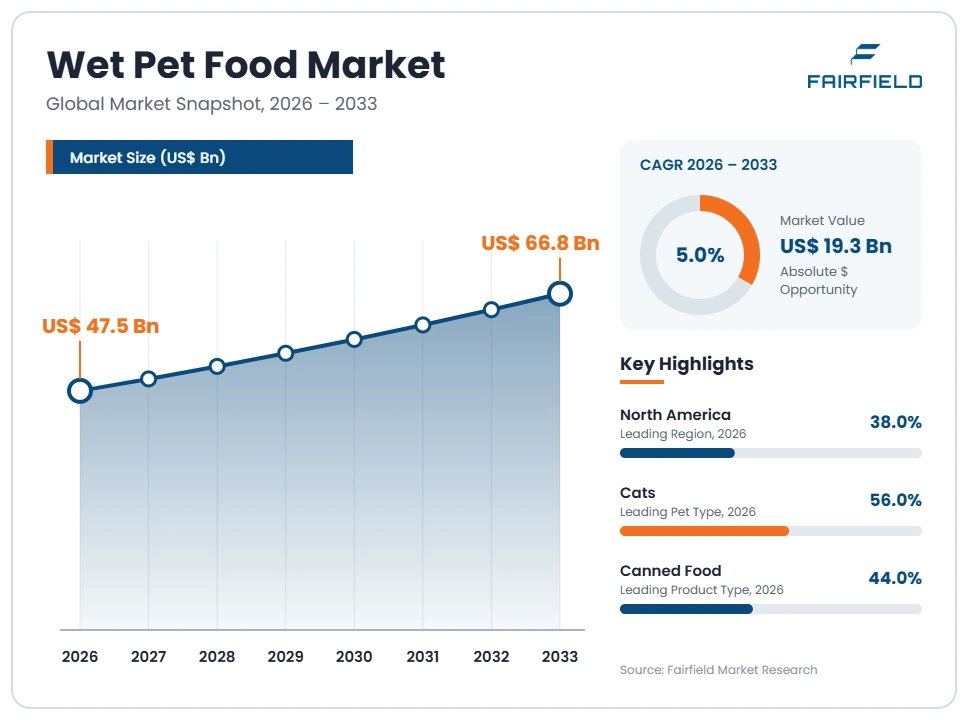
The global Wet Pet Food market size is expected to be valued at US$ 47.5 billion in 2026 and projected to reach US$ 66.8 billion by 2033, growing at a CAGR of 5.0% between 2026 and 2033.
Between 2020 and 2025 the category advanced at roughly 4.3% a year, closing 2025 near US$ 45.5 billion. Three forces explain the steadier outlook ahead. Cat ownership keeps rising in dense urban housing, and cats take far more of their calories from canned, pouched and tray formats than dogs do. Humanisation has pushed owners toward recognisable meat pieces, gravies and broths that dry kibble cannot imitate. Veterinary therapeutic diets, prescribed for renal, urinary and weight conditions, are moving steadily into wet formats because moisture intake is part of the clinical rationale. This study counts complete and complementary moist and semi-moist dog and cat food sold in cans, pouches, trays and tubs, and excludes dry kibble, treats, chews and fresh refrigerated meals.
Key Report Takeaways
- By Product Type: Canned Food held 44% share in 2026, while Pouched Food is projected to expand at a 6.4% CAGR through 2033, driven by single-serve portioning that removes refrigeration waste in single-cat and single-dog households.
- By Pet Type: Cats held 56% share in 2026, while Dogs are projected to expand at a 5.6% CAGR through 2033, driven by wet toppers and mixers that owners add over kibble for small and senior breeds.
- By Price Tier: Mainstream held 42% share in 2026, while Veterinary Therapeutic is projected to expand at a 7.3% CAGR through 2033, driven by clinic-directed renal and urinary diets that rely on high moisture intake.
- By Distribution Channel: Supermarkets and Hypermarkets held 38% share in 2026, while Online Retail is projected to expand at an 8.2% CAGR through 2033, driven by subscription autoship that absorbs the freight penalty of heavy cases.
- By Geography: North America held 38% share in 2026, while Asia Pacific is projected to expand at a 7.6% CAGR through 2033, driven by first-generation urban pet owners who start with wet feeding rather than dry.
Global Wet Pet Food Market Trends and Insights
Drivers Impact Analysis
Two demand forces account for most of the forecast growth in moist pet food consumption.
| Driver | Impact on CAGR Forecast | Geographic Relevance | Impact Timeline |
| Rising cat ownership in urban housing, where wet feeding penetration is highest | High | Global | Medium term 2–4 years |
| Clinic-directed veterinary therapeutic diets moving into moist formats | Medium | North America, Europe | Long term ≥4 years |
Urban Cat Ownership Lifts Wet Pet Food Volumes Faster Than Dog Ownership Does
Cats are the structural engine of this category. Wet feeding penetration among cats is far higher than among dogs, because cats evolved from desert ancestors with a weak thirst drive and owners are routinely advised to raise dietary moisture. Apartment living also favours cats, so urbanisation converts directly into canned and pouched volume rather than bagged kibble volume.
The mechanism is veterinary and practical at once. Clinicians link low water intake to feline lower urinary tract disease, which pushes moisture-rich diets into everyday feeding advice rather than prescription use alone. Portion size helps too: a cat eats a small daily ration, so a single-serve pouch or tray fits the meal without leftovers. FEDIAF nutritional guidelines set the complete-food composition that brands formulate against, and labelling rules separating complete from complementary feeding let brands sell gravies and broths alongside main meals.
Veterinary Therapeutic Diets Push Prescription Wet Pet Food Into Clinic Channels
Therapeutic nutrition is the highest-value pull on moist formats. Diets for chronic kidney disease, urinary stone management, weight reduction and gastrointestinal recovery are commonly dispensed as canned or pouched food, because moisture, palatability and controlled mineral levels all matter clinically. These products carry premium pricing, repeat for the life of the animal, and are recommended by a professional rather than chosen on shelf.
Veterinary infrastructure explains the growth. Corporate clinic groups and referral hospitals have expanded in the United States and Western Europe, raising diagnosis rates for conditions that are managed by diet. Pet insurance penetration makes long-term dietary management affordable for more households. Formulation sits inside the complete-feed rules of Regulation (EC) No 767/2009 in the European Union and the model feed regulations published by the Association of American Feed Control Officials, which define how dietetic claims may be presented.
Restraints Impact Analysis
Two structural constraints hold back margin capture even as moist pet food volumes expand.
| Restraint | Impact on CAGR Forecast | Geographic Relevance | Impact Timeline |
| Water weight making freight and packaging a disproportionate share of delivered cost | High | Global | Short term ≤2 years |
| Tinplate and aluminium can cost and availability | Medium | Europe, North America | Medium term 2–4 years |
Water Weight Makes Freight and Packaging the Dominant Cost in Wet Pet Food
Logistics, not ingredients, decide profitability here. A can of cat food is roughly three-quarters water, so manufacturers ship and store a product whose heaviest component has no nutritional cost and no sale value. Delivered cost per kilogram of dry matter is several times that of kibble, which caps how far wet food can travel from the plant and how cheaply it can reach rural or low-density markets.
The cause is physical and fixed. Retort processing requires a rigid or semi-rigid sterilisable container, and the container plus the water routinely exceeds the ingredient cost of the recipe. Pallet economics suffer because trucks reach weight limits long before they fill cube. Retailers absorb the same penalty in shelf space and handling. The practical result is regional manufacturing footprints, co-packing agreements near demand centres, and limited scope for cross-border price arbitrage.
Tinplate and Aluminium Supply Volatility Squeezes Wet Pet Food Packaging Budgets
Packaging inflation hits this category harder than any other pet food format. Cans, trays and foil lidding are metal-intensive, and metal prices move with energy markets and trade policy rather than with agricultural cycles. When steel or aluminium costs rise, manufacturers cannot easily reformulate away from the container, because retort sterilisation is what gives wet food its ambient shelf life.
Supply concentration deepens the exposure. Relatively few converters supply three-piece tinplate cans and shallow aluminium trays at the volumes major brands require, and tooling is format-specific, so switching suppliers takes months. Tariffs and anti-dumping measures on steel and aluminium in the United States and the European Union add a policy layer that buyers cannot hedge. The response has been a gradual shift toward flexible retort pouches, which use less metal but require new filling lines and capital commitment.
Market Opportunities
Single-Serve Pouch and Tray Formats Open a Premium Wet Pet Food Revenue Pool
Flexible single-serve packaging is the clearest route to higher realised price per kilogram. Pouches and small trays let brands sell recipe variety, shredded and flaked textures, and named protein cuts that a large can cannot present credibly. Multipack variety boxes raise basket value, and because each unit is consumed at one meal, owners accept a materially higher price per hundred grams.
Capture favours manufacturers willing to invest in horizontal form-fill-seal retort lines and the quality systems that go with them. Premium and super-premium brand owners, private-label specialists serving grocery chains, and veterinary ranges all want the format. Lighter packaging also eases the freight penalty that defines wet food economics, and it aligns with recyclability pressure on metal and multilayer films. Co-manufacturers with spare pouch capacity are therefore unusually well placed to win contract volume.
Lower-Footprint Protein Sourcing Creates a Differentiated Wet Pet Food Segment
Protein footprint is becoming a commercial variable rather than a reputational one. Wet food is built on meat and fish, so its land, water and carbon intensity is high, and a growing group of owners now reads sourcing claims the way they read human food labels. Brands that can substantiate lower-footprint sourcing are opening a distinct shelf position rather than merely defending the one they hold.
The practical routes are already permitted feed materials. Animal by-products that are fit for purpose under Regulation (EC) No 1069/2009, under-utilised fish species and trimmings certified by the Marine Stewardship Council, and insect protein approved for pet food in the European Union all qualify. Premium urban buyers and younger owners drive the demand, while retailers increasingly ask suppliers for category-level emissions data, which turns sourcing evidence into a listing requirement.
Segment Analysis
- By Product Type: Canned Food Leads While Pouched Food Gains Momentum
Canned Food holds 44% of wet pet food revenue in 2026, reflecting a century of installed retort capacity, the lowest cost per kilogram of any sterilised format, and strong acceptance in multi-pet and dog-feeding households that need larger portions. Pouched Food is the fastest-growing type at a 6.4% CAGR, because single-serve portions suit cats, eliminate part-used refrigerated tins, and allow texture presentation such as shreds in gravy or fillets in jelly. Tray and Tub Food occupies the premium middle, offering visible meat chunks and a resealable, microwave-friendly shape favoured by gifting and treating occasions. Semi-Moist Food remains a small niche, limited by humectant use and consumer scepticism about soft shelf-stable formats. The business implication is capital-led: brands that control pouch and tray filling capacity set the pace of premiumisation, while can lines increasingly serve value tiers and private label.
- By Pet Type: Cats Dominate Consumption as Dog Formats Accelerate From a Smaller Base
Cats account for 56% of wet pet food demand in 2026, the single clearest structural fact in this category. Feline diets lean on moisture because cats drink little voluntarily, and veterinary advice on urinary health reinforces the habit. Small ration sizes also make single-serve wet feeding affordable as a complete diet rather than an occasional extra. Dogs are the fastest-growing pet type at a 5.6% CAGR, driven not by full wet feeding but by toppers, mixers and mealtime enhancers poured over kibble, a behaviour that has spread quickly among small-breed and senior dog owners. Other Pets, principally ferrets and small carnivores, remain marginal. The commercial implication is that dog growth arrives in small-format, high-margin units rather than bulk cans, so brands need separate pack architecture for each species instead of scaling one recipe set across both.
- By Price Tier: Mainstream Holds the Volume Base While Veterinary Therapeutic Expands Quickest
Mainstream products represent 42% of wet pet food sales in 2026, anchored by grocery distribution, familiar brands and promotional pricing that keeps weekly basket cost predictable. Premium and super-premium tiers together take most of the remainder, selling named proteins, grain-free recipes and human-grade sourcing language. Veterinary Therapeutic is the fastest-growing tier at a 7.3% CAGR, because renal, urinary, gastrointestinal and weight-management diets are clinically indicated in moist form and are recommended for the remaining life of the animal. Growth here is driven by clinic consolidation, higher diagnosis rates and wider pet insurance coverage rather than by advertising. Private label sits beneath the mainstream tier and exerts constant price pressure in European grocery. For manufacturers the implication is a barbell: value volume defends plant utilisation, while therapeutic and super-premium lines carry the margin that funds new capacity.
- By Distribution Channel: Supermarkets Lead Sales While Online Retail Scales Fastest
Supermarkets and Hypermarkets deliver 38% of wet pet food revenue in 2026, because heavy, frequently replenished cases fit naturally into weekly grocery trips and because grocers use pet food as a traffic and private-label category. Pet Specialty Stores follow, offering premium ranges, staff advice and brand exclusives. Online Retail is the fastest-growing channel at an 8.2% CAGR, as subscription autoship spreads the freight cost of bulky cases across predictable repeat orders and removes the inconvenience of carrying them home. Veterinary Clinics remain the controlled route for therapeutic diets, increasingly supported by clinic-linked online dispensaries. Convenience and independent stores serve top-up purchases. The implication is that channel mix now shapes pack design directly, with multipacks and shipper-ready cases built for e-commerce and shelf-ready trays built for grocery, rather than one case format serving every outlet.
Geography Analysis
- Which Region Is Leading the Wet Pet Food Market?
North America leads the wet pet food market with 38% share in 2026, worth close to US$ 18 billion. The United States accounts for most of it, supported by very high pet ownership, large average spend per animal, and the widest veterinary network in the world. Oversight sits with the Food and Drug Administration Center for Veterinary Medicine, while nutrient profiles and feeding trial protocols follow the model regulations of the Association of American Feed Control Officials, giving manufacturers a settled formulation and labelling framework. Canada adds a smaller but similarly premium demand base. Manufacturing is domestic and regional, because water weight makes long-distance shipment uneconomic. The main regional change underway is channel migration, as subscription e-commerce and clinic-linked dispensaries take share from grocery shelves and reshape how brands plan pack sizes and promotional calendars.
- Europe Turns Complete-Feed Rules and Private Label Into a Mature Wet Pet Food Base
Europe holds 31% of wet pet food revenue in 2026, the second-largest position and the most regulated. Germany, France, the United Kingdom, Italy and Spain form the core, and cat populations in those countries are large relative to dog populations, which lifts moist feeding penetration. Regulation (EC) No 767/2009 governs the placing on the market and use of feed, Regulation (EC) No 1069/2009 controls which animal by-products may enter pet food, and the FEDIAF nutritional guidelines define complete and complementary compositions. Retail structure is the distinguishing feature: grocery chains run deep private-label ranges, so branded manufacturers compete against their own co-packers. Metal packaging cost and recyclability targets weigh heavily on the regional cost base. The clearest opportunity is premium pouch and tray innovation, where value growth is outpacing can volumes.
- Which Region Is Growing Fastest in the Wet Pet Food Market?
Asia Pacific is growing fastest in the wet pet food market at a 7.6% CAGR between 2026 and 2033, from a 21% share in 2026. China, Japan, South Korea, Thailand and Australia lead the expansion. Japan is already a mature, pouch-dominated market with very high cat wet-feeding rates, while China supplies the volume growth, as first-generation urban owners often begin with wet food rather than treating it as an upgrade from kibble. Thailand is central on the supply side, because its tuna canning industry converted spare capacity into contract wet pet food manufacturing for global brands. E-commerce platforms are the primary route to market, which suits a category that is heavy to carry. The structural change underway is domestic premiumisation, with local brands building their own retort capacity instead of importing finished cases.
- Latin America Builds Wet Pet Food Demand From a Dry-Dominated Feeding Culture
Latin America accounts for 7% of wet pet food consumption in 2026, with Brazil, Mexico, Argentina, Chile and Colombia providing nearly all of it. Pet ownership is very high, but feeding culture is overwhelmingly dry, so wet food is still purchased as a treat, a topper or an occasional indulgence rather than a complete diet. Brazil has the deepest local manufacturing base and the strongest cat segment. The barriers are familiar and stubborn: price sensitivity against a format that costs far more per calorie, currency volatility that raises imported tinplate and aluminium costs, and long domestic distances that punish heavy freight. Veterinary channel development is uneven outside major cities. The regional opportunity lies in small, low-priced sachets, which give households an affordable entry point and build the wet feeding habit without a full dietary switch.
- Middle East & Africa Emerges on Gulf Premium Demand and Imported Wet Pet Food
Middle East & Africa represents 3% of wet pet food demand in 2026, the smallest share and the least developed supply base. The Gulf states, led by the United Arab Emirates, Saudi Arabia and Qatar, generate most of the value through expatriate and affluent local households buying imported premium cans, pouches and trays. South Africa has the region’s only meaningful domestic pet food manufacturing and a structured veterinary retail channel. Barriers are significant: almost all wet food is imported at high freight cost, halal and import certification requirements add documentation time, ambient warehousing quality varies, and organised pet retail is thin outside major cities. Rising companion animal ownership among younger urban households is the main growth signal. The opportunity sits in regional distribution hubs that consolidate imports and shorten replenishment cycles for specialist retailers.
Competitive Landscape
The wet pet food market is highly concentrated at the top and fragmented beneath it. A small group of diversified consumer groups controls the majority of branded value, led by Mars, Incorporated and Nestlé Purina PetCare, with Colgate-Palmolive Company holding a distinctive position through veterinary and therapeutic nutrition. The J. M. Smucker Company and General Mills, Inc. anchor large mainstream and premium portfolios in North America. Below them sits a long tail of regional canners, private-label specialists and co-manufacturers, including Simmons Pet Food Inc., Partner in Pet Food, Monge & C. S.p.A., Affinity Petcare S.A. and Heristo AG. Concentration is reinforced by capital intensity, because retort lines are expensive and format-specific.
Competition runs on four practical axes. Palatability and texture come first, since refusal at the bowl ends a purchase cycle immediately. Veterinary endorsement is second, and it is the hardest advantage to copy because it rests on clinical evidence and clinic relationships. Packaging format is third, with pouch and tray capacity determining who can serve premiumisation. Cost to serve is fourth, driven by plant location relative to demand and by metal packaging contracts. New entrants are mostly digital-native premium brands using contract manufacturers, alongside canners in Thailand that moved from seafood into pet food.
Strategic activity concentrates on capacity and format rather than on recipes. Established manufacturers have added flexible retort pouch and tray lines, extended therapeutic ranges into moist presentations, and deepened co-packing relationships with grocery private label. Several have regionalised production specifically to shorten the freight distances that dominate delivered cost.
Strategic direction across the vendor base points toward moisture-led feline nutrition, clinically substantiated therapeutic claims, recyclable packaging formats, and measurable sourcing data for the meat and fish protein that defines the category.
Recent Industry Developments
- July 2009: The European Union adopted Regulation (EC) No 767/2009 on the placing on the market and use of feed – it set the labelling framework that separates complete from complementary pet food and still governs every wet recipe sold in Europe.
- October 2009: The European Union adopted Regulation (EC) No 1069/2009 on animal by-products not intended for human consumption – it defines which category of material may lawfully enter pet food, shaping sourcing options for canned and pouched recipes.
- January 2011: The United States Congress enacted the Food Safety Modernization Act – it extended preventive food safety obligations to animal food manufacturers for the first time.
- September 2015: The Food and Drug Administration published the preventive controls final rule for food for animals – it required hazard analysis and written preventive controls at pet food plants, raising the compliance cost of operating retort lines.
- March 2017: The European Union adopted Regulation (EU) 2017/625 on official controls – it consolidated inspection and enforcement across the feed and food chain, including pet food manufacturing sites.
Companies Covered in the Report
- Mars, Incorporated
- Nestlé Purina PetCare
- Colgate-Palmolive Company
- The J. M. Smucker Company
- General Mills, Inc.
- Simmons Pet Food Inc.
- Monge & C. S.p.A.
- Affinity Petcare S.A.
- Heristo AG
- Partner in Pet Food
- Thai Union Group PCL
- Wellness Pet Company LLC
Wet Pet Food Market Report Scope
| Metric | Value |
| Study Period | 2020–2033 |
| Market Size 2026 | US$ 47.5 Billion |
| Market Size 2033 | US$ 66.8 Billion |
| CAGR 2026–2033 | 5.0% |
| Absolute Dollar Opportunity | US$ 19.3 Billion |
| Largest Market | North America |
| Fastest-Growing Market | Asia Pacific |
| Market Concentration | High |
| Major Players | Mars, Incorporated, Nestlé Purina PetCare, Colgate-Palmolive Company, The J. M. Smucker Company, General Mills, Inc. |
Wet Pet Food Market Segmentation
Product Type
- Canned Food
- Pouched Food
- Tray and Tub Food
- Semi-Moist Food
Pet Type
- Cats
- Dogs
- Other Pets
Price Tier
- Mainstream
- Premium
- Super-Premium
- Veterinary Therapeutic
Distribution Channel
- Supermarkets and Hypermarkets
- Pet Specialty Stores
- Online Retail
- Veterinary Clinics
- Convenience and Independent Stores
Regions
- North America
- Europe
- Asia Pacific
- Latin America
- Middle East & Africa
- Executive Summary
- Global Wet Pet Food Market Snapshot
- Future Projections
- Key Report Takeaways
- Regional Snapshot
- Market Overview
- Market Definition and Report Scope
- Historical Trends 2020–2025
- Market Dynamics
- Drivers
- Urban Cat Ownership Lifts Wet Pet Food Volumes Faster Than Dog Ownership Does
- Veterinary Therapeutic Diets Push Prescription Wet Pet Food Into Clinic Channels
- Restraints
- Water Weight Makes Freight and Packaging the Dominant Cost in Wet Pet Food
- Tinplate and Aluminium Supply Volatility Squeezes Wet Pet Food Packaging Budgets
- Market Opportunities
- Single-Serve Pouch and Tray Formats Open a Premium Wet Pet Food Revenue Pool
- Lower-Footprint Protein Sourcing Creates a Differentiated Wet Pet Food Segment
- Drivers
- Global Wet Pet Food Market Outlook, 2020–2033
- Global Wet Pet Food Market Outlook, by Product Type, Value (US$ Billion), 2020–2033
- Canned Food
- Pouched Food
- Tray and Tub Food
- Semi-Moist Food
- Global Wet Pet Food Market Outlook, by Pet Type, Value (US$ Billion), 2020–2033
- Cats
- Dogs
- Other Pets
- Global Wet Pet Food Market Outlook, by Price Tier, Value (US$ Billion), 2020–2033
- Mainstream
- Premium
- Super-Premium
- Veterinary Therapeutic
- Global Wet Pet Food Market Outlook, by Distribution Channel, Value (US$ Billion), 2020–2033
- Supermarkets and Hypermarkets
- Pet Specialty Stores
- Online Retail
- Veterinary Clinics
- Convenience and Independent Stores
- Global Wet Pet Food Market Outlook, by Region, Value (US$ Billion), 2020–2033
- North America
- Europe
- Asia Pacific
- Latin America
- Middle East & Africa
- Global Wet Pet Food Market Outlook, by Product Type, Value (US$ Billion), 2020–2033
- North America Wet Pet Food Market Outlook, 2020–2033
- North America Wet Pet Food Market Outlook, by Product Type, Value (US$ Billion), 2020–2033
- Canned Food
- Pouched Food
- Tray and Tub Food
- Semi-Moist Food
- North America Wet Pet Food Market Outlook, by Pet Type, Value (US$ Billion), 2020–2033
- Cats
- Dogs
- Other Pets
- North America Wet Pet Food Market Outlook, by Price Tier, Value (US$ Billion), 2020–2033
- Mainstream
- Premium
- Super-Premium
- Veterinary Therapeutic
- North America Wet Pet Food Market Outlook, by Distribution Channel, Value (US$ Billion), 2020–2033
- Supermarkets and Hypermarkets
- Pet Specialty Stores
- Online Retail
- Veterinary Clinics
- Convenience and Independent Stores
- North America Wet Pet Food Market Outlook, by Country, Value (US$ Billion), 2020–2033
- United States Wet Pet Food Market Outlook, by Product Type, 2020–2033
- United States Wet Pet Food Market Outlook, by Pet Type, 2020–2033
- United States Wet Pet Food Market Outlook, by Price Tier, 2020–2033
- United States Wet Pet Food Market Outlook, by Distribution Channel, 2020–2033
- Canada Wet Pet Food Market Outlook, by Product Type, 2020–2033
- Canada Wet Pet Food Market Outlook, by Pet Type, 2020–2033
- Canada Wet Pet Food Market Outlook, by Price Tier, 2020–2033
- Canada Wet Pet Food Market Outlook, by Distribution Channel, 2020–2033
- North America Wet Pet Food Market Outlook, by Product Type, Value (US$ Billion), 2020–2033
- Europe Wet Pet Food Market Outlook, 2020–2033
- Europe Wet Pet Food Market Outlook, by Product Type, Value (US$ Billion), 2020–2033
- Canned Food
- Pouched Food
- Tray and Tub Food
- Semi-Moist Food
- Europe Wet Pet Food Market Outlook, by Pet Type, Value (US$ Billion), 2020–2033
- Cats
- Dogs
- Other Pets
- Europe Wet Pet Food Market Outlook, by Price Tier, Value (US$ Billion), 2020–2033
- Mainstream
- Premium
- Super-Premium
- Veterinary Therapeutic
- Europe Wet Pet Food Market Outlook, by Distribution Channel, Value (US$ Billion), 2020–2033
- Supermarkets and Hypermarkets
- Pet Specialty Stores
- Online Retail
- Veterinary Clinics
- Convenience and Independent Stores
- Europe Wet Pet Food Market Outlook, by Country, Value (US$ Billion), 2020–2033
- Germany Wet Pet Food Market Outlook, by Product Type, 2020–2033
- Germany Wet Pet Food Market Outlook, by Pet Type, 2020–2033
- Germany Wet Pet Food Market Outlook, by Price Tier, 2020–2033
- Germany Wet Pet Food Market Outlook, by Distribution Channel, 2020–2033
- France Wet Pet Food Market Outlook, by Product Type, 2020–2033
- France Wet Pet Food Market Outlook, by Pet Type, 2020–2033
- France Wet Pet Food Market Outlook, by Price Tier, 2020–2033
- France Wet Pet Food Market Outlook, by Distribution Channel, 2020–2033
- United Kingdom Wet Pet Food Market Outlook, by Product Type, 2020–2033
- United Kingdom Wet Pet Food Market Outlook, by Pet Type, 2020–2033
- United Kingdom Wet Pet Food Market Outlook, by Price Tier, 2020–2033
- United Kingdom Wet Pet Food Market Outlook, by Distribution Channel, 2020–2033
- Italy Wet Pet Food Market Outlook, by Product Type, 2020–2033
- Italy Wet Pet Food Market Outlook, by Pet Type, 2020–2033
- Italy Wet Pet Food Market Outlook, by Price Tier, 2020–2033
- Italy Wet Pet Food Market Outlook, by Distribution Channel, 2020–2033
- Spain Wet Pet Food Market Outlook, by Product Type, 2020–2033
- Spain Wet Pet Food Market Outlook, by Pet Type, 2020–2033
- Spain Wet Pet Food Market Outlook, by Price Tier, 2020–2033
- Spain Wet Pet Food Market Outlook, by Distribution Channel, 2020–2033
- Europe Wet Pet Food Market Outlook, by Product Type, Value (US$ Billion), 2020–2033
- Asia Pacific Wet Pet Food Market Outlook, 2020–2033
- Asia Pacific Wet Pet Food Market Outlook, by Product Type, Value (US$ Billion), 2020–2033
- Canned Food
- Pouched Food
- Tray and Tub Food
- Semi-Moist Food
- Asia Pacific Wet Pet Food Market Outlook, by Pet Type, Value (US$ Billion), 2020–2033
- Cats
- Dogs
- Other Pets
- Asia Pacific Wet Pet Food Market Outlook, by Price Tier, Value (US$ Billion), 2020–2033
- Mainstream
- Premium
- Super-Premium
- Veterinary Therapeutic
- Asia Pacific Wet Pet Food Market Outlook, by Distribution Channel, Value (US$ Billion), 2020–2033
- Supermarkets and Hypermarkets
- Pet Specialty Stores
- Online Retail
- Veterinary Clinics
- Convenience and Independent Stores
- Asia Pacific Wet Pet Food Market Outlook, by Country, Value (US$ Billion), 2020–2033
- China Wet Pet Food Market Outlook, by Product Type, 2020–2033
- China Wet Pet Food Market Outlook, by Pet Type, 2020–2033
- China Wet Pet Food Market Outlook, by Price Tier, 2020–2033
- China Wet Pet Food Market Outlook, by Distribution Channel, 2020–2033
- Japan Wet Pet Food Market Outlook, by Product Type, 2020–2033
- Japan Wet Pet Food Market Outlook, by Pet Type, 2020–2033
- Japan Wet Pet Food Market Outlook, by Price Tier, 2020–2033
- Japan Wet Pet Food Market Outlook, by Distribution Channel, 2020–2033
- South Korea Wet Pet Food Market Outlook, by Product Type, 2020–2033
- South Korea Wet Pet Food Market Outlook, by Pet Type, 2020–2033
- South Korea Wet Pet Food Market Outlook, by Price Tier, 2020–2033
- South Korea Wet Pet Food Market Outlook, by Distribution Channel, 2020–2033
- Thailand Wet Pet Food Market Outlook, by Product Type, 2020–2033
- Thailand Wet Pet Food Market Outlook, by Pet Type, 2020–2033
- Thailand Wet Pet Food Market Outlook, by Price Tier, 2020–2033
- Thailand Wet Pet Food Market Outlook, by Distribution Channel, 2020–2033
- Australia Wet Pet Food Market Outlook, by Product Type, 2020–2033
- Australia Wet Pet Food Market Outlook, by Pet Type, 2020–2033
- Australia Wet Pet Food Market Outlook, by Price Tier, 2020–2033
- Australia Wet Pet Food Market Outlook, by Distribution Channel, 2020–2033
- Asia Pacific Wet Pet Food Market Outlook, by Product Type, Value (US$ Billion), 2020–2033
- Latin America Wet Pet Food Market Outlook, 2020–2033
- Latin America Wet Pet Food Market Outlook, by Product Type, Value (US$ Billion), 2020–2033
- Canned Food
- Pouched Food
- Tray and Tub Food
- Semi-Moist Food
- Latin America Wet Pet Food Market Outlook, by Pet Type, Value (US$ Billion), 2020–2033
- Cats
- Dogs
- Other Pets
- Latin America Wet Pet Food Market Outlook, by Price Tier, Value (US$ Billion), 2020–2033
- Mainstream
- Premium
- Super-Premium
- Veterinary Therapeutic
- Latin America Wet Pet Food Market Outlook, by Distribution Channel, Value (US$ Billion), 2020–2033
- Supermarkets and Hypermarkets
- Pet Specialty Stores
- Online Retail
- Veterinary Clinics
- Convenience and Independent Stores
- Latin America Wet Pet Food Market Outlook, by Country, Value (US$ Billion), 2020–2033
- Brazil Wet Pet Food Market Outlook, by Product Type, 2020–2033
- Brazil Wet Pet Food Market Outlook, by Pet Type, 2020–2033
- Brazil Wet Pet Food Market Outlook, by Price Tier, 2020–2033
- Brazil Wet Pet Food Market Outlook, by Distribution Channel, 2020–2033
- Mexico Wet Pet Food Market Outlook, by Product Type, 2020–2033
- Mexico Wet Pet Food Market Outlook, by Pet Type, 2020–2033
- Mexico Wet Pet Food Market Outlook, by Price Tier, 2020–2033
- Mexico Wet Pet Food Market Outlook, by Distribution Channel, 2020–2033
- Argentina Wet Pet Food Market Outlook, by Product Type, 2020–2033
- Argentina Wet Pet Food Market Outlook, by Pet Type, 2020–2033
- Argentina Wet Pet Food Market Outlook, by Price Tier, 2020–2033
- Argentina Wet Pet Food Market Outlook, by Distribution Channel, 2020–2033
- Chile Wet Pet Food Market Outlook, by Product Type, 2020–2033
- Chile Wet Pet Food Market Outlook, by Pet Type, 2020–2033
- Chile Wet Pet Food Market Outlook, by Price Tier, 2020–2033
- Chile Wet Pet Food Market Outlook, by Distribution Channel, 2020–2033
- Colombia Wet Pet Food Market Outlook, by Product Type, 2020–2033
- Colombia Wet Pet Food Market Outlook, by Pet Type, 2020–2033
- Colombia Wet Pet Food Market Outlook, by Price Tier, 2020–2033
- Colombia Wet Pet Food Market Outlook, by Distribution Channel, 2020–2033
- Latin America Wet Pet Food Market Outlook, by Product Type, Value (US$ Billion), 2020–2033
- Middle East & Africa Wet Pet Food Market Outlook, 2020–2033
- Middle East & Africa Wet Pet Food Market Outlook, by Product Type, Value (US$ Billion), 2020–2033
- Canned Food
- Pouched Food
- Tray and Tub Food
- Semi-Moist Food
- Middle East & Africa Wet Pet Food Market Outlook, by Pet Type, Value (US$ Billion), 2020–2033
- Cats
- Dogs
- Other Pets
- Middle East & Africa Wet Pet Food Market Outlook, by Price Tier, Value (US$ Billion), 2020–2033
- Mainstream
- Premium
- Super-Premium
- Veterinary Therapeutic
- Middle East & Africa Wet Pet Food Market Outlook, by Distribution Channel, Value (US$ Billion), 2020–2033
- Supermarkets and Hypermarkets
- Pet Specialty Stores
- Online Retail
- Veterinary Clinics
- Convenience and Independent Stores
- Middle East & Africa Wet Pet Food Market Outlook, by Country, Value (US$ Billion), 2020–2033
- United Arab Emirates Wet Pet Food Market Outlook, by Product Type, 2020–2033
- United Arab Emirates Wet Pet Food Market Outlook, by Pet Type, 2020–2033
- United Arab Emirates Wet Pet Food Market Outlook, by Price Tier, 2020–2033
- United Arab Emirates Wet Pet Food Market Outlook, by Distribution Channel, 2020–2033
- Saudi Arabia Wet Pet Food Market Outlook, by Product Type, 2020–2033
- Saudi Arabia Wet Pet Food Market Outlook, by Pet Type, 2020–2033
- Saudi Arabia Wet Pet Food Market Outlook, by Price Tier, 2020–2033
- Saudi Arabia Wet Pet Food Market Outlook, by Distribution Channel, 2020–2033
- Qatar Wet Pet Food Market Outlook, by Product Type, 2020–2033
- Qatar Wet Pet Food Market Outlook, by Pet Type, 2020–2033
- Qatar Wet Pet Food Market Outlook, by Price Tier, 2020–2033
- Qatar Wet Pet Food Market Outlook, by Distribution Channel, 2020–2033
- South Africa Wet Pet Food Market Outlook, by Product Type, 2020–2033
- South Africa Wet Pet Food Market Outlook, by Pet Type, 2020–2033
- South Africa Wet Pet Food Market Outlook, by Price Tier, 2020–2033
- South Africa Wet Pet Food Market Outlook, by Distribution Channel, 2020–2033
- Middle East & Africa Wet Pet Food Market Outlook, by Product Type, Value (US$ Billion), 2020–2033
- Competitive Landscape
- Market Concentration and Industry Leaders
- Competitive Differentiation
- Strategic Moves and Market Direction
- Recent Industry Developments
- Company Profiles
- Mars, Incorporated
- Nestlé Purina PetCare
- Colgate-Palmolive Company
- The J. M. Smucker Company
- General Mills, Inc.
- Simmons Pet Food Inc.
- Monge & C. S.p.A.
- Affinity Petcare S.A.
- Heristo AG
- Partner in Pet Food
- Thai Union Group PCL
- Wellness Pet Company LLC
- Appendix
- Research Methodology
- Report Assumptions
- Acronyms and Abbreviations
Product Type
- Canned Food
- Pouched Food
- Tray and Tub Food
- Semi-Moist Food
Pet Type
- Cats
- Dogs
- Other Pets
Price Tier
- Mainstream
- Premium
- Super-Premium
- Veterinary Therapeutic
Distribution Channel
- Supermarkets and Hypermarkets
- Pet Specialty Stores
- Online Retail
- Veterinary Clinics
- Convenience and Independent Stores
Regions
- North America
- Europe
- Asia Pacific
- Latin America
- Middle East & Africa
Our Research Methodology
Considering the volatility of business today, traditional approaches to strategizing a game plan can be unfruitful if not detrimental. True ambiguity is no way to determine a forecast. A myriad of predetermined factors must be accounted for such as the degree of risk involved, the magnitude of circumstances, as well as conditions or consequences that are not known or unpredictable. To circumvent binary views that cast uncertainty, the application of market research intelligence to strategically posture, move, and enable actionable outcomes is necessary.
View Methodology
Quality Assured
Rigorous Validation Process

Confidentiality Assured
End-to-end Data Security

Custom Research Services
Tailored To Your Objectives
FAQs
The wet pet food market is valued at about US$ 47.5 billion in 2026, covering canned, pouched, tray, tub and semi-moist dog and cat food worldwide.
Revenue is projected to reach US$ 66.8 billion by 2033, expanding at a 5.0% CAGR and adding US$ 19.3 billion of absolute dollar opportunity.
Canned Food leads with 44% share in 2026, supported by installed retort capacity and the lowest cost per kilogram among sterilised formats.
Veterinary Therapeutic is growing fastest at a 7.3% CAGR, as clinic-directed renal, urinary and weight diets rely on high dietary moisture.
North America holds the largest share at 38% in 2026, supported by high pet ownership, premium spend and the widest veterinary network globally.
Related Reports
Wheat Starch Market Size, Share, Insights, Competitive Landscape, and Forecast 2026 to 2033
The global wheat starch market is valued at US$4.6 billion in 2026, reaching US$6.4 billion by 2033, growing at a 4.8% CAGR
Wheat Protein Market Size, Share, Insights, Competitive Landscape, and Forecast 2026 to 2033
The global wheat protein market is valued at US$3.2 billion in 2026, reaching US$4.9 billion by 2033, growing at a 6.3% CAGR
Rice Bran Oil Market Size, Share, Insights, Competitive Landscape, and Forecast 2026 to 2033
The global rice bran oil market is valued at US$2.47 billion in 2026, reaching US$4.75 billion by 2033, growing at a 9.8% CAGR
Gum Arabic Market Size, Share, Insights, Competitive Landscape, and Forecast 2026 to 2033
The global gum arabic market is valued at US$0.516 billion in 2026, reaching US$0.791 billion by 2033, growing at a 6.3% CAGR
Guar Gum Market Size, Share, Insights, Competitive Landscape, and Forecast 2026 to 2033
The global guar gum market is valued at US$1.49 billion in 2026, reaching US$2.33 billion by 2033, growing at a 6.6% CAGR
Cheddar Cheese Market Size, Share, Insights, Competitive Landscape, and Forecast 2026 to 2033
The global cheddar cheese market is valued at US$17.33 billion in 2026, reaching US$24.70 billion by 2033, growing at a 5.2% CAGR