



Wheat Protein Market
Wheat Protein Market Size, Share, Insights, Competitive Landscape, and Forecast 2026 to 2033
Wheat Protein Market Size and Trend Analysis
How Fast Is the Wheat Protein Market Expected to Grow?
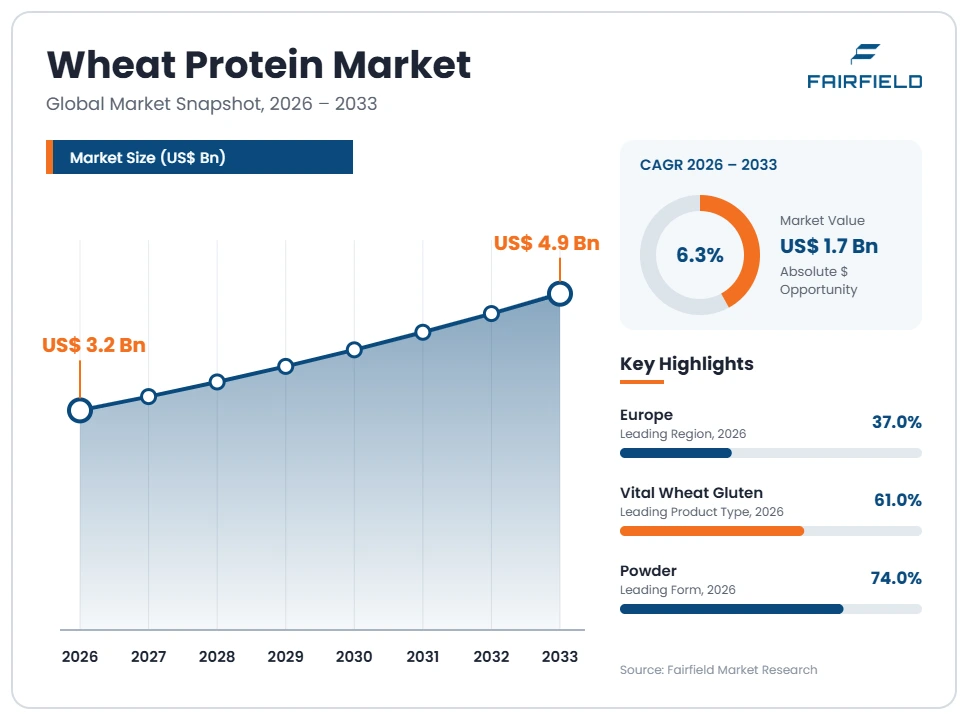
The global Wheat Protein market size is expected to be valued at US$ 3.2 billion in 2026 and projected to reach US$ 4.9 billion by 2033, growing at a CAGR of 6.3% between 2026 and 2033.
Between 2020 and 2025 the sector advanced at roughly 5.7% a year, closing 2025 near US$ 3.0 billion. Two demand engines explain the outlook. Industrial bakery continues to buy vital wheat gluten as the cheapest way to raise flour strength, and extrusion-based meat analogues rely on gluten viscoelasticity to build fibrous texture. A third factor is supply economics: wheat protein and wheat starch leave the same wet mill, so gluten value and starch value jointly set mill margin and therefore available capacity. This study counts vital wheat gluten, hydrolysed wheat protein, wheat protein isolate and textured wheat protein sold as ingredients, and excludes wheat flour, wheat starch and finished consumer foods.
Key Report Takeaways
- By Product Type: Vital Wheat Gluten held 61% share in 2026, while Textured Wheat Protein is projected to expand at an 8.4% CAGR through 2033, driven by twin-screw extrusion lines producing fibrous analogue structures at industrial scale.
- By Application: Bakery and Confectionery held 39% share in 2026, while Meat Analogues and Plant-Based Foods are projected to expand at a 9.2% CAGR through 2033, driven by formulators seeking chewiness that globular proteins cannot deliver alone.
- By Form: Powder held 74% share in 2026, while Granules are projected to expand at a 7.4% CAGR through 2033, driven by dust control and dosing accuracy on automated bakery premix handling systems.
- By Nature: Conventional held 95% share in 2026, while Organic is projected to expand at a 9.6% CAGR through 2033, driven by certified bakery and plant-based brands needing an organic-compliant protein that still builds dough strength.
- By Geography: Europe held 37% share in 2026, while Asia Pacific is projected to expand at an 8.1% CAGR through 2033, driven by new wheat milling capacity and fast-growing bakery consumption in China and India.
Global Wheat Protein Market Trends and Insights
Drivers Impact Analysis
Two demand forces account for most of the forecast growth in wheat gluten and related protein fractions.
| Driver | Impact on CAGR Forecast | Geographic Relevance | Impact Timeline |
| Industrial bakery dependence on vital wheat gluten for flour strength and frozen dough | High | Global | Short term ≤2 years |
| Extrusion of textured wheat protein for fibrous meat analogue structures | High | Europe, North America, Asia Pacific | Medium term 2–4 years |
Industrial Bakery Buys Vital Wheat Gluten to Correct Flour Strength at Lowest Cost
Bakery remains the reliable base of wheat protein demand. Millers and industrial bakers add vital wheat gluten to lift the protein content of weaker wheat lots, so a plant can hold a consistent dough specification regardless of harvest quality. No alternative ingredient delivers the same gas retention and extensibility at a comparable cost per unit of functional protein, which makes the purchase routine rather than discretionary.
The mechanism is mechanical. High-speed mixing, sheeting and proofing lines need dough that tolerates stress without tearing, and gluten supplies the elastic network that holds carbon dioxide during proof and oven spring. Frozen dough and par-baked bread amplify the need, because ice crystal damage weakens the protein matrix during storage. As retail bake-off cabinets spread through supermarkets and convenience chains, bakers compensate by raising gluten addition rates rather than by sourcing stronger and costlier wheat.
Extruded Textured Wheat Protein Builds the Fibrous Structure Meat Analogues Require
Meat analogue formulation is the fastest-moving pull on wheat protein. Gluten is the ingredient that converts a soft protein paste into something that tears and chews like muscle fibre, because its viscoelastic network aligns under shear in an extruder barrel. Formulators therefore keep wheat protein in recipes even when the headline protein on the label is pea or soy.
Processing technology explains why demand keeps rising. High-moisture extrusion and shear-cell equipment have moved from pilot plants into commercial lines across the European Union, North America and Asia Pacific, and each new line consumes texturising protein continuously. Wheat gluten also costs far less per unit of protein than isolated pea or faba fractions, so it improves the cost structure of a category under constant price pressure. Co-extruded hybrid products combining meat and plant protein widen the same demand pool.
Restraints Impact Analysis
Two structural constraints limit how far wheat protein can expand into consumer-facing categories.
| Restraint | Impact on CAGR Forecast | Geographic Relevance | Impact Timeline |
| Allergen labelling and gluten avoidance closing several consumer food categories | High | Europe, North America | Long term ≥4 years |
| Mill margin exposure to joint gluten and starch co-product values | Medium | Europe | Short term ≤2 years |
Gluten Avoidance and Allergen Labelling Close Categories to Wheat Protein
Labelling is the hardest boundary this ingredient faces. Cereals containing gluten are listed in Annex II of Regulation (EU) No 1169/2011, so any wheat protein addition must be declared and emphasised on pack in the European Union. Coeliac disease affects a small share of the population, but a far larger group avoids gluten by choice, and brands read that combined audience as a reason to keep recipes gluten-free.
The commercial consequence is substitution rather than shrinkage. Formulators building free-from, sports nutrition or digestive-positioned products reach for pea, soy, faba or rice protein, because only those allow a gluten-free claim. The Codex Alimentarius standard for foods for special dietary use sets gluten-free at 20 mg/kg, and the Food and Drug Administration uses the same threshold, so there is no partial-use workaround. Wheat protein consequently concentrates in categories where gluten is expected anyway.
Joint Gluten and Starch Economics Expose Wheat Protein Supply to Mill Margin Swings
Supply, not demand, creates the second constraint. Vital wheat gluten is separated in the same wet mill that produces wheat starch, so the two are co-products of one process and cannot be made independently. A mill runs when the combined value of the protein stream and the starch stream covers wheat and energy cost, which means gluten availability depends on conditions in a market most gluten buyers never watch.
The cost structure makes this acute in Europe. Wet milling is energy-intensive through separation, washing and flash drying, and European energy prices have been structurally higher and more volatile than those of competing origins. When starch realisations fall or gas costs spike, mills cut run rates and gluten supply tightens quickly, because inventory is thin. Buyers therefore face price swings driven by starch demand and utility tariffs rather than by bakery or analogue consumption.
Market Opportunities
Hydrolysed Wheat Protein Opens a Higher-Value Cosmetics and Personal Care Revenue Pool
Hydrolysed fractions escape commodity pricing entirely. Cosmetic chemists use hydrolysed wheat protein as a film-forming, conditioning and substantivity agent in shampoos, conditioners, styling products and skin care, where it is valued for measurable hair strength and moisture retention. Prices per tonne in this channel are multiples of bakery-grade gluten, and order volumes are small enough to serve from dedicated hydrolysis capacity.
Capture favours producers who can control molecular weight distribution and document it. Personal care formulators and contract manufacturers specify narrow peptide ranges, low residual salts and consistent colour and odour, since the ingredient appears in clear formulations. Established cosmetic ingredient suppliers already hold the customer relationships, so wheat processors typically enter through partnerships or by adding enzymatic hydrolysis downstream of existing gluten lines. Plant-derived positioning in personal care marketing supports continued reformulation toward cereal protein hydrolysates.
Aquafeed and Pet Food Formulation Creates a Binder-Led Wheat Protein Volume Pool
Animal nutrition is the largest under-exploited volume outlet. Extruded aquafeed pellets need a binder that survives conditioning, extrusion and water immersion, and wheat gluten performs that role while contributing digestible protein. Salmon, trout, shrimp and marine finfish diets all use it, and demand rises as aquaculture producers reduce fishmeal inclusion for cost and sourcing reasons.
Feed compounders and integrated aquaculture groups are the buying centre, supported by premium pet food manufacturers who use gluten for kibble structure and moist-food texture. Capture depends on feed-grade quality systems rather than food-grade ones, including documented hygiene controls, mycotoxin monitoring and traceability consistent with European Union feed hygiene rules. Suppliers able to place gluten into both aquafeed and pet food gain a stable volume floor that balances the seasonality of bakery and the volatility of plant-based food launches.
Segment Analysis
- By Product Type: Vital Wheat Gluten Dominates While Textured Wheat Protein Advances Quickest
Vital Wheat Gluten holds 61% of wheat protein revenue in 2026, because it is the direct output of wet milling, needs no further fractionation, and delivers the viscoelasticity that bakery and analogue processors actually buy. Its cost per unit of functional protein is unmatched among plant proteins. Textured Wheat Protein is the fastest-growing type at an 8.4% CAGR, as twin-screw and high-moisture extrusion capacity expands and converts gluten into fibrous, meat-like structures at industrial scale. Hydrolysed Wheat Protein serves cosmetics, specialised nutrition and flavour applications, trading volume for margin. Wheat Protein Isolate remains the smallest type, limited by processing cost and by the fact that higher purity does not improve dough performance. The implication for producers is that growth sits downstream of the mill, so investment in extrusion and hydrolysis rather than in additional separation capacity determines who captures value.
- By Application: Bakery Anchors Demand as Meat Analogues Set the Growth Pace
Bakery and Confectionery takes 39% of wheat protein consumption in 2026, reflecting decades of standard practice in bread, buns, pizza bases, frozen dough and par-baked products where gluten corrects flour strength. Volume is large, specification-driven and relatively insensitive to consumer trends. Meat Analogues and Plant-Based Foods grow fastest at a 9.2% CAGR, because gluten supplies the chew and fibre alignment that pea and soy isolates cannot build alone, and because it lowers formulation cost in a category fighting price resistance. Pet Food uses gluten for kibble binding and moist-food texture, while Animal Feed and Aquafeed value pellet water stability. Cosmetics and Personal Care absorb hydrolysed grades, and Industrial Adhesives and Films form a small legacy outlet. The business implication is that bakery funds the asset base while analogues decide the growth rate.
- By Form: Powder Leads Handling Volumes While Granules Gain Ground in Automated Plants
Powder represents 74% of wheat protein shipments in 2026, the default output of flash drying and the form most easily dispersed into flour blends, premixes and extruder feeds. It is cheap to produce, simple to package and universally accepted in bakery specifications. Granules are the fastest-growing form at a 7.4% CAGR, because large bakeries and feed mills increasingly use enclosed pneumatic conveying and automated dosing, where fine powder causes dust losses, bridging in hoppers and inconsistent weighing. Granulated gluten flows reliably and reduces airborne allergen exposure in shared facilities, which matters under allergen management plans. Liquid and Paste forms remain niche, serving specific cosmetic and industrial users. For suppliers the implication is that physical engineering now differentiates otherwise identical chemistry, and agglomeration capacity has become a practical reason for buyers to consolidate purchases with one producer.
- By Nature: Conventional Supplies Nearly All Volume While Organic Grows From a Small Base
Conventional wheat protein accounts for 95% of the market in 2026, a share that reflects the scale and cost structure of commercial wet milling. Industrial bakery and feed buyers purchase on functionality and price, and organic certification adds cost without changing dough performance. Organic is the fastest-growing category at a 9.6% CAGR, driven by certified bakery brands, organic plant-based ranges and premium pet food lines that need an organic-compliant protein capable of building structure. Supply is the binding constraint rather than demand, because organic wheat volumes are limited and mills must segregate production runs, clean lines and maintain separate documentation. That segregation cost keeps a persistent price premium in place. The commercial implication is that organic capacity is allocated rather than freely traded, so buyers increasingly contract volume a season ahead instead of purchasing on the spot market.
Geography Analysis
- North America Converts Frozen Dough and Analogue Production Into Steady Wheat Protein Demand
North America accounts for 25% of wheat protein revenue in 2026, the third-largest position but among the most technically demanding. The United States hosts large industrial bakery groups, a substantial frozen and par-baked dough sector, and a concentrated base of plant-based food manufacturers that run extrusion lines continuously. Domestic wheat processing supplies part of the gluten used, while the balance arrives from importers, which makes the region a visible price-setter in international trade. The Food and Drug Administration gluten-free labelling rule, with its 20 mg/kg threshold, draws a clear commercial line between products that may use wheat protein and those that must avoid it. Canada contributes through durum and hard wheat milling. The regional change underway is reformulation toward hybrid meat-and-plant products, which uses gluten without relying on a free-from claim.
- Which Region Is Leading the Wheat Protein Market?
Europe leads the wheat protein market with 37% share in 2026, worth close to US$ 1.2 billion. France, Germany, Belgium, the Netherlands, Poland and the United Kingdom form the core, supported by the densest concentration of wheat wet milling capacity anywhere. Abundant soft wheat supply, deep inland waterway logistics and long-established processing groups explain the position. Regulation shapes commercial behaviour directly: Annex II of Regulation (EU) No 1169/2011 requires wheat to be declared as an allergen, while Regulation (EU) 2015/2283 governs how novel protein fractions reach the market. The region also hosts the largest cluster of plant-based food manufacturers buying texturising protein. Energy cost is the principal vulnerability, since wet milling is power-intensive and European tariffs have been volatile. Export demand from feed and bakery buyers abroad underpins regional utilisation.
- Which Region Is Growing Fastest in the Wheat Protein Market?
Asia Pacific is growing fastest in the wheat protein market at an 8.1% CAGR between 2026 and 2033, from a 26% share in 2026. China is the decisive market, holding very large wheat starch and gluten capacity that supplies both domestic users and export buyers. India is adding industrial bakery volume quickly as packaged bread, buns and pizza consumption spreads through urban retail. Australia processes hard wheat into gluten for regional and export customers, and Japan and South Korea buy higher-specification grades for premium bakery and processed foods. Aquaculture is the distinctive regional pull, because shrimp and marine finfish feed mills across the region use gluten as a water-stable binder. The structural change underway is quality upgrading, as producers invest in consistent vitality testing and documentation to serve exacting bakery and pet food customers.
- Latin America Builds Wheat Protein Demand on Imported Gluten and Expanding Industrial Bakery
Latin America represents 7% of wheat protein consumption in 2026, with Brazil, Mexico, Argentina, Chile and Colombia providing most of it. Bread is a dietary staple across the region, and the shift from artisanal bakeries to industrial plants supplying supermarkets has raised gluten use sharply, because mechanised lines need predictable dough strength. Argentina is a significant wheat producer, yet regional wet milling capacity for gluten separation remains limited. The barriers are therefore trade-related: most gluten is imported, dollar-denominated pricing collides with currency volatility, and port and customs delays force buyers to carry expensive safety stock. Import duties vary by country, complicating regional sourcing strategies. The clearest opportunity is local wet milling investment near wheat-producing provinces, which would shorten supply chains and give bakery customers contract pricing in local currency.
- Middle East & Africa Depends on Imported Wheat Protein for Flat Bread and Feed Production
Middle East & Africa accounts for 5% of wheat protein demand in 2026, the smallest share but a structurally wheat-dependent region. Egypt, Türkiye, Saudi Arabia, the United Arab Emirates, Nigeria and South Africa generate most of the consumption, largely through flat bread, pan bread and biscuit manufacturing operating at industrial scale. Türkiye also runs significant milling and export-oriented bakery production. Barriers are considerable: almost no local gluten separation capacity exists, foreign currency availability constrains ingredient imports in several markets, and bread is frequently subsidised, which caps what bakers can pay for functional additives. Storage conditions in hot climates add quality risk for a hygroscopic powder. Aquaculture and poultry feed growth in Egypt and Nigeria provides the most promising new outlet, and regional blending hubs in the Gulf could shorten lead times for inland buyers.
Competitive Landscape
The wheat protein market is moderately concentrated, with a medium concentration profile that reflects high capital barriers and a limited number of wet milling sites worldwide. Roquette Frères and Tereos anchor European capacity, Cargill, Incorporated and MGP Ingredients, Inc. hold strong positions in North America, and Manildra Group operates one of the largest integrated wheat processing complexes serving Asia Pacific and export markets. Agrana Beteiligungs-AG, Kröner-Stärke GmbH, Crespel & Deiters GmbH & Co. KG, Sedamyl S.p.A. and Amilina AB occupy specialist European positions. Chinese producers supply very large volumes into export trade, which caps pricing power for everyone else.
Competition runs on four axes rather than on branding. Gluten vitality, measured by water absorption and extensibility, is the first and most closely specified attribute. Consistency across lots is second, because bakery and extrusion plants cannot retune processes for variable raw material. Documentation is third, covering allergen management, mycotoxin control, feed hygiene compliance and organic certification. Delivered cost is fourth, and it is heavily influenced by wheat origin, energy tariffs and freight. New entrants are mostly integrated millers in Asia Pacific moving downstream from flour into protein and starch separation.
Strategic activity concentrates on downstream capability rather than on raw separation capacity. Producers have added texturisation and extrusion assets, enzymatic hydrolysis for cosmetic and nutritional peptides, and agglomeration lines that improve powder handling. Several have built application laboratories so bakery and analogue customers can trial formulations before committing to supply contracts.
Strategic direction across the vendor base points toward balancing the gluten and starch streams for best combined mill margin, deepening plant-protein application support, and improving energy efficiency in drying and separation.
Recent Industry Developments
- July 2008: The Codex Alimentarius Commission adopted the revised standard for foods for special dietary use for persons intolerant to gluten – it fixed gluten-free at 20 mg/kg and set the global reference that separates wheat protein from the free-from category.
- October 2011: The European Union adopted Regulation (EU) No 1169/2011 on food information to consumers – its Annex II lists cereals containing gluten, making emphasised allergen declaration mandatory wherever wheat protein is used.
- August 2013: The Food and Drug Administration issued its final rule on gluten-free labelling of food – it aligned the United States with the 20 mg/kg threshold and standardised how formulators treat wheat-derived ingredients.
- November 2015: The European Union adopted Regulation (EU) 2015/2283 on novel foods – it set the authorisation pathway that applies when protein fractions are produced by new processes or lack a significant consumption history.
- August 2020: The Food and Drug Administration issued its final rule on gluten-free labelling of fermented and hydrolysed foods – it clarified compliance for hydrolysed protein ingredients, a point of direct commercial relevance to wheat peptide suppliers.
Companies Covered in the Report
- Roquette Frères
- Cargill, Incorporated
- MGP Ingredients, Inc.
- Manildra Group
- Tereos
- Archer Daniels Midland Company
- Agrana Beteiligungs-AG
- Kröner-Stärke GmbH
- Sedamyl S.p.A.
- Jäckering Mühlen- und Nährmittelwerke GmbH
- Amilina AB
- Crespel & Deiters GmbH & Co. KG
Wheat Protein Market Report Scope
| Metric | Value |
| Study Period | 2020–2033 |
| Market Size 2026 | US$ 3.2 Billion |
| Market Size 2033 | US$ 4.9 Billion |
| CAGR 2026–2033 | 6.3% |
| Absolute Dollar Opportunity | US$ 1.7 Billion |
| Largest Market | Europe |
| Fastest-Growing Market | Asia Pacific |
| Market Concentration | Medium |
| Major Players | Roquette Frères, Cargill, Incorporated, MGP Ingredients, Inc., Manildra Group, Tereos |
Wheat Protein Market Segmentation
Product Type
- Vital Wheat Gluten
- Hydrolysed Wheat Protein
- Wheat Protein Isolate
- Textured Wheat Protein
Application
- Bakery and Confectionery
- Meat Analogues and Plant-Based Foods
- Pet Food
- Animal Feed and Aquafeed
- Cosmetics and Personal Care
- Industrial Adhesives and Films
Form
- Powder
- Granules
- Liquid and Paste
Nature
- Conventional
- Organic
Regions
- North America
- Europe
- Asia Pacific
- Latin America
- Middle East & Africa
- Executive Summary
- Global Wheat Protein Market Snapshot
- Future Projections
- Key Report Takeaways
- Regional Snapshot
- Market Overview
- Market Definition and Report Scope
- Historical Trends 2020–2025
- Market Dynamics
- Drivers
- Industrial Bakery Buys Vital Wheat Gluten to Correct Flour Strength at Lowest Cost
- Extruded Textured Wheat Protein Builds the Fibrous Structure Meat Analogues Require
- Restraints
- Gluten Avoidance and Allergen Labelling Close Categories to Wheat Protein
- Joint Gluten and Starch Economics Expose Wheat Protein Supply to Mill Margin Swings
- Market Opportunities
- Hydrolysed Wheat Protein Opens a Higher-Value Cosmetics and Personal Care Revenue Pool
- Aquafeed and Pet Food Formulation Creates a Binder-Led Wheat Protein Volume Pool
- Drivers
- Global Wheat Protein Market Outlook, 2020–2033
- Global Wheat Protein Market Outlook, by Product Type, Value (US$ Billion), 2020–2033
- Vital Wheat Gluten
- Hydrolysed Wheat Protein
- Wheat Protein Isolate
- Textured Wheat Protein
- Global Wheat Protein Market Outlook, by Application, Value (US$ Billion), 2020–2033
- Bakery and Confectionery
- Meat Analogues and Plant-Based Foods
- Pet Food
- Animal Feed and Aquafeed
- Cosmetics and Personal Care
- Industrial Adhesives and Films
- Global Wheat Protein Market Outlook, by Form, Value (US$ Billion), 2020–2033
- Powder
- Granules
- Liquid and Paste
- Global Wheat Protein Market Outlook, by Nature, Value (US$ Billion), 2020–2033
- Conventional
- Organic
- Global Wheat Protein Market Outlook, by Region, Value (US$ Billion), 2020–2033
- North America
- Europe
- Asia Pacific
- Latin America
- Middle East & Africa
- Global Wheat Protein Market Outlook, by Product Type, Value (US$ Billion), 2020–2033
- North America Wheat Protein Market Outlook, 2020–2033
- North America Wheat Protein Market Outlook, by Product Type, Value (US$ Billion), 2020–2033
- Vital Wheat Gluten
- Hydrolysed Wheat Protein
- Wheat Protein Isolate
- Textured Wheat Protein
- North America Wheat Protein Market Outlook, by Application, Value (US$ Billion), 2020–2033
- Bakery and Confectionery
- Meat Analogues and Plant-Based Foods
- Pet Food
- Animal Feed and Aquafeed
- Cosmetics and Personal Care
- Industrial Adhesives and Films
- North America Wheat Protein Market Outlook, by Form, Value (US$ Billion), 2020–2033
- Powder
- Granules
- Liquid and Paste
- North America Wheat Protein Market Outlook, by Nature, Value (US$ Billion), 2020–2033
- Conventional
- Organic
- North America Wheat Protein Market Outlook, by Country, Value (US$ Billion), 2020–2033
- United States Wheat Protein Market Outlook, by Product Type, 2020–2033
- United States Wheat Protein Market Outlook, by Application, 2020–2033
- United States Wheat Protein Market Outlook, by Form, 2020–2033
- United States Wheat Protein Market Outlook, by Nature, 2020–2033
- Canada Wheat Protein Market Outlook, by Product Type, 2020–2033
- Canada Wheat Protein Market Outlook, by Application, 2020–2033
- Canada Wheat Protein Market Outlook, by Form, 2020–2033
- Canada Wheat Protein Market Outlook, by Nature, 2020–2033
- North America Wheat Protein Market Outlook, by Product Type, Value (US$ Billion), 2020–2033
- Europe Wheat Protein Market Outlook, 2020–2033
- Europe Wheat Protein Market Outlook, by Product Type, Value (US$ Billion), 2020–2033
- Vital Wheat Gluten
- Hydrolysed Wheat Protein
- Wheat Protein Isolate
- Textured Wheat Protein
- Europe Wheat Protein Market Outlook, by Application, Value (US$ Billion), 2020–2033
- Bakery and Confectionery
- Meat Analogues and Plant-Based Foods
- Pet Food
- Animal Feed and Aquafeed
- Cosmetics and Personal Care
- Industrial Adhesives and Films
- Europe Wheat Protein Market Outlook, by Form, Value (US$ Billion), 2020–2033
- Powder
- Granules
- Liquid and Paste
- Europe Wheat Protein Market Outlook, by Nature, Value (US$ Billion), 2020–2033
- Conventional
- Organic
- Europe Wheat Protein Market Outlook, by Country, Value (US$ Billion), 2020–2033
- France Wheat Protein Market Outlook, by Product Type, 2020–2033
- France Wheat Protein Market Outlook, by Application, 2020–2033
- France Wheat Protein Market Outlook, by Form, 2020–2033
- France Wheat Protein Market Outlook, by Nature, 2020–2033
- Germany Wheat Protein Market Outlook, by Product Type, 2020–2033
- Germany Wheat Protein Market Outlook, by Application, 2020–2033
- Germany Wheat Protein Market Outlook, by Form, 2020–2033
- Germany Wheat Protein Market Outlook, by Nature, 2020–2033
- Belgium Wheat Protein Market Outlook, by Product Type, 2020–2033
- Belgium Wheat Protein Market Outlook, by Application, 2020–2033
- Belgium Wheat Protein Market Outlook, by Form, 2020–2033
- Belgium Wheat Protein Market Outlook, by Nature, 2020–2033
- Netherlands Wheat Protein Market Outlook, by Product Type, 2020–2033
- Netherlands Wheat Protein Market Outlook, by Application, 2020–2033
- Netherlands Wheat Protein Market Outlook, by Form, 2020–2033
- Netherlands Wheat Protein Market Outlook, by Nature, 2020–2033
- Poland Wheat Protein Market Outlook, by Product Type, 2020–2033
- Poland Wheat Protein Market Outlook, by Application, 2020–2033
- Poland Wheat Protein Market Outlook, by Form, 2020–2033
- Poland Wheat Protein Market Outlook, by Nature, 2020–2033
- United Kingdom Wheat Protein Market Outlook, by Product Type, 2020–2033
- United Kingdom Wheat Protein Market Outlook, by Application, 2020–2033
- United Kingdom Wheat Protein Market Outlook, by Form, 2020–2033
- United Kingdom Wheat Protein Market Outlook, by Nature, 2020–2033
- Europe Wheat Protein Market Outlook, by Product Type, Value (US$ Billion), 2020–2033
- Asia Pacific Wheat Protein Market Outlook, 2020–2033
- Asia Pacific Wheat Protein Market Outlook, by Product Type, Value (US$ Billion), 2020–2033
- Vital Wheat Gluten
- Hydrolysed Wheat Protein
- Wheat Protein Isolate
- Textured Wheat Protein
- Asia Pacific Wheat Protein Market Outlook, by Application, Value (US$ Billion), 2020–2033
- Bakery and Confectionery
- Meat Analogues and Plant-Based Foods
- Pet Food
- Animal Feed and Aquafeed
- Cosmetics and Personal Care
- Industrial Adhesives and Films
- Asia Pacific Wheat Protein Market Outlook, by Form, Value (US$ Billion), 2020–2033
- Powder
- Granules
- Liquid and Paste
- Asia Pacific Wheat Protein Market Outlook, by Nature, Value (US$ Billion), 2020–2033
- Conventional
- Organic
- Asia Pacific Wheat Protein Market Outlook, by Country, Value (US$ Billion), 2020–2033
- China Wheat Protein Market Outlook, by Product Type, 2020–2033
- China Wheat Protein Market Outlook, by Application, 2020–2033
- China Wheat Protein Market Outlook, by Form, 2020–2033
- China Wheat Protein Market Outlook, by Nature, 2020–2033
- India Wheat Protein Market Outlook, by Product Type, 2020–2033
- India Wheat Protein Market Outlook, by Application, 2020–2033
- India Wheat Protein Market Outlook, by Form, 2020–2033
- India Wheat Protein Market Outlook, by Nature, 2020–2033
- Australia Wheat Protein Market Outlook, by Product Type, 2020–2033
- Australia Wheat Protein Market Outlook, by Application, 2020–2033
- Australia Wheat Protein Market Outlook, by Form, 2020–2033
- Australia Wheat Protein Market Outlook, by Nature, 2020–2033
- Japan Wheat Protein Market Outlook, by Product Type, 2020–2033
- Japan Wheat Protein Market Outlook, by Application, 2020–2033
- Japan Wheat Protein Market Outlook, by Form, 2020–2033
- Japan Wheat Protein Market Outlook, by Nature, 2020–2033
- South Korea Wheat Protein Market Outlook, by Product Type, 2020–2033
- South Korea Wheat Protein Market Outlook, by Application, 2020–2033
- South Korea Wheat Protein Market Outlook, by Form, 2020–2033
- South Korea Wheat Protein Market Outlook, by Nature, 2020–2033
- Asia Pacific Wheat Protein Market Outlook, by Product Type, Value (US$ Billion), 2020–2033
- Latin America Wheat Protein Market Outlook, 2020–2033
- Latin America Wheat Protein Market Outlook, by Product Type, Value (US$ Billion), 2020–2033
- Vital Wheat Gluten
- Hydrolysed Wheat Protein
- Wheat Protein Isolate
- Textured Wheat Protein
- Latin America Wheat Protein Market Outlook, by Application, Value (US$ Billion), 2020–2033
- Bakery and Confectionery
- Meat Analogues and Plant-Based Foods
- Pet Food
- Animal Feed and Aquafeed
- Cosmetics and Personal Care
- Industrial Adhesives and Films
- Latin America Wheat Protein Market Outlook, by Form, Value (US$ Billion), 2020–2033
- Powder
- Granules
- Liquid and Paste
- Latin America Wheat Protein Market Outlook, by Nature, Value (US$ Billion), 2020–2033
- Conventional
- Organic
- Latin America Wheat Protein Market Outlook, by Country, Value (US$ Billion), 2020–2033
- Brazil Wheat Protein Market Outlook, by Product Type, 2020–2033
- Brazil Wheat Protein Market Outlook, by Application, 2020–2033
- Brazil Wheat Protein Market Outlook, by Form, 2020–2033
- Brazil Wheat Protein Market Outlook, by Nature, 2020–2033
- Mexico Wheat Protein Market Outlook, by Product Type, 2020–2033
- Mexico Wheat Protein Market Outlook, by Application, 2020–2033
- Mexico Wheat Protein Market Outlook, by Form, 2020–2033
- Mexico Wheat Protein Market Outlook, by Nature, 2020–2033
- Argentina Wheat Protein Market Outlook, by Product Type, 2020–2033
- Argentina Wheat Protein Market Outlook, by Application, 2020–2033
- Argentina Wheat Protein Market Outlook, by Form, 2020–2033
- Argentina Wheat Protein Market Outlook, by Nature, 2020–2033
- Chile Wheat Protein Market Outlook, by Product Type, 2020–2033
- Chile Wheat Protein Market Outlook, by Application, 2020–2033
- Chile Wheat Protein Market Outlook, by Form, 2020–2033
- Chile Wheat Protein Market Outlook, by Nature, 2020–2033
- Colombia Wheat Protein Market Outlook, by Product Type, 2020–2033
- Colombia Wheat Protein Market Outlook, by Application, 2020–2033
- Colombia Wheat Protein Market Outlook, by Form, 2020–2033
- Colombia Wheat Protein Market Outlook, by Nature, 2020–2033
- Latin America Wheat Protein Market Outlook, by Product Type, Value (US$ Billion), 2020–2033
- Middle East & Africa Wheat Protein Market Outlook, 2020–2033
- Middle East & Africa Wheat Protein Market Outlook, by Product Type, Value (US$ Billion), 2020–2033
- Vital Wheat Gluten
- Hydrolysed Wheat Protein
- Wheat Protein Isolate
- Textured Wheat Protein
- Middle East & Africa Wheat Protein Market Outlook, by Application, Value (US$ Billion), 2020–2033
- Bakery and Confectionery
- Meat Analogues and Plant-Based Foods
- Pet Food
- Animal Feed and Aquafeed
- Cosmetics and Personal Care
- Industrial Adhesives and Films
- Middle East & Africa Wheat Protein Market Outlook, by Form, Value (US$ Billion), 2020–2033
- Powder
- Granules
- Liquid and Paste
- Middle East & Africa Wheat Protein Market Outlook, by Nature, Value (US$ Billion), 2020–2033
- Conventional
- Organic
- Middle East & Africa Wheat Protein Market Outlook, by Country, Value (US$ Billion), 2020–2033
- Egypt Wheat Protein Market Outlook, by Product Type, 2020–2033
- Egypt Wheat Protein Market Outlook, by Application, 2020–2033
- Egypt Wheat Protein Market Outlook, by Form, 2020–2033
- Egypt Wheat Protein Market Outlook, by Nature, 2020–2033
- Türkiye Wheat Protein Market Outlook, by Product Type, 2020–2033
- Türkiye Wheat Protein Market Outlook, by Application, 2020–2033
- Türkiye Wheat Protein Market Outlook, by Form, 2020–2033
- Türkiye Wheat Protein Market Outlook, by Nature, 2020–2033
- Saudi Arabia Wheat Protein Market Outlook, by Product Type, 2020–2033
- Saudi Arabia Wheat Protein Market Outlook, by Application, 2020–2033
- Saudi Arabia Wheat Protein Market Outlook, by Form, 2020–2033
- Saudi Arabia Wheat Protein Market Outlook, by Nature, 2020–2033
- United Arab Emirates Wheat Protein Market Outlook, by Product Type, 2020–2033
- United Arab Emirates Wheat Protein Market Outlook, by Application, 2020–2033
- United Arab Emirates Wheat Protein Market Outlook, by Form, 2020–2033
- United Arab Emirates Wheat Protein Market Outlook, by Nature, 2020–2033
- Nigeria Wheat Protein Market Outlook, by Product Type, 2020–2033
- Nigeria Wheat Protein Market Outlook, by Application, 2020–2033
- Nigeria Wheat Protein Market Outlook, by Form, 2020–2033
- Nigeria Wheat Protein Market Outlook, by Nature, 2020–2033
- South Africa Wheat Protein Market Outlook, by Product Type, 2020–2033
- South Africa Wheat Protein Market Outlook, by Application, 2020–2033
- South Africa Wheat Protein Market Outlook, by Form, 2020–2033
- South Africa Wheat Protein Market Outlook, by Nature, 2020–2033
- Middle East & Africa Wheat Protein Market Outlook, by Product Type, Value (US$ Billion), 2020–2033
- Competitive Landscape
- Market Concentration and Industry Leaders
- Competitive Differentiation
- Strategic Moves and Market Direction
- Recent Industry Developments
- Company Profiles
- Roquette Frères
- Cargill, Incorporated
- MGP Ingredients, Inc.
- Manildra Group
- Tereos
- Archer Daniels Midland Company
- Agrana Beteiligungs-AG
- Kröner-Stärke GmbH
- Sedamyl S.p.A.
- Jäckering Mühlen- und Nährmittelwerke GmbH
- Amilina AB
- Crespel & Deiters GmbH & Co. KG
- Appendix
- Research Methodology
- Report Assumptions
- Acronyms and Abbreviations
Product Type
- Vital Wheat Gluten
- Hydrolysed Wheat Protein
- Wheat Protein Isolate
- Textured Wheat Protein
Application
- Bakery and Confectionery
- Meat Analogues and Plant-Based Foods
- Pet Food
- Animal Feed and Aquafeed
- Cosmetics and Personal Care
- Industrial Adhesives and Films
Form
- Powder
- Granules
- Liquid and Paste
Nature
- Conventional
- Organic
Regions
- North America
- Europe
- Asia Pacific
- Latin America
- Middle East & Africa
Our Research Methodology
Considering the volatility of business today, traditional approaches to strategizing a game plan can be unfruitful if not detrimental. True ambiguity is no way to determine a forecast. A myriad of predetermined factors must be accounted for such as the degree of risk involved, the magnitude of circumstances, as well as conditions or consequences that are not known or unpredictable. To circumvent binary views that cast uncertainty, the application of market research intelligence to strategically posture, move, and enable actionable outcomes is necessary.
View Methodology
Quality Assured
Rigorous Validation Process

Confidentiality Assured
End-to-end Data Security

Custom Research Services
Tailored To Your Objectives
FAQs
The wheat protein market is valued at about US$ 3.2 billion in 2026, covering vital, hydrolysed, isolated and textured wheat protein ingredients worldwide.
Revenue is projected to reach US$ 4.9 billion by 2033, expanding at a 6.3% CAGR and adding US$ 1.7 billion of absolute dollar opportunity.
Vital Wheat Gluten leads with 61% share in 2026, because it is the direct wet milling output and the cheapest functional plant protein available.
Meat Analogues and Plant-Based Foods grow fastest at a 9.2% CAGR, since gluten builds the fibrous chew that other plant proteins cannot.
Europe holds the largest share at 37% in 2026, supported by the world’s densest concentration of wheat wet milling and plant-based manufacturing.
Related Reports
Wheat Starch Market Size, Share, Insights, Competitive Landscape, and Forecast 2026 to 2033
The global wheat starch market is valued at US$4.6 billion in 2026, reaching US$6.4 billion by 2033, growing at a 4.8% CAGR
Wet Pet Food Market Size, Share, Insights, Competitive Landscape, and Forecast 2026 to 2033
The global wet pet food market is valued at US$47.5 billion in 2026, reaching US$66.8 billion by 2033, growing at a 5.0% CAGR
Rice Bran Oil Market Size, Share, Insights, Competitive Landscape, and Forecast 2026 to 2033
The global rice bran oil market is valued at US$2.47 billion in 2026, reaching US$4.75 billion by 2033, growing at a 9.8% CAGR
Gum Arabic Market Size, Share, Insights, Competitive Landscape, and Forecast 2026 to 2033
The global gum arabic market is valued at US$0.516 billion in 2026, reaching US$0.791 billion by 2033, growing at a 6.3% CAGR
Guar Gum Market Size, Share, Insights, Competitive Landscape, and Forecast 2026 to 2033
The global guar gum market is valued at US$1.49 billion in 2026, reaching US$2.33 billion by 2033, growing at a 6.6% CAGR
Cheddar Cheese Market Size, Share, Insights, Competitive Landscape, and Forecast 2026 to 2033
The global cheddar cheese market is valued at US$17.33 billion in 2026, reaching US$24.70 billion by 2033, growing at a 5.2% CAGR