



Wheat Starch Market
Wheat Starch Market Size, Share, Insights, Competitive Landscape, and Forecast 2026 to 2033
Wheat Starch Market Size and Trend Analysis
What Is the Growth Outlook for Wheat Starch to 2033?
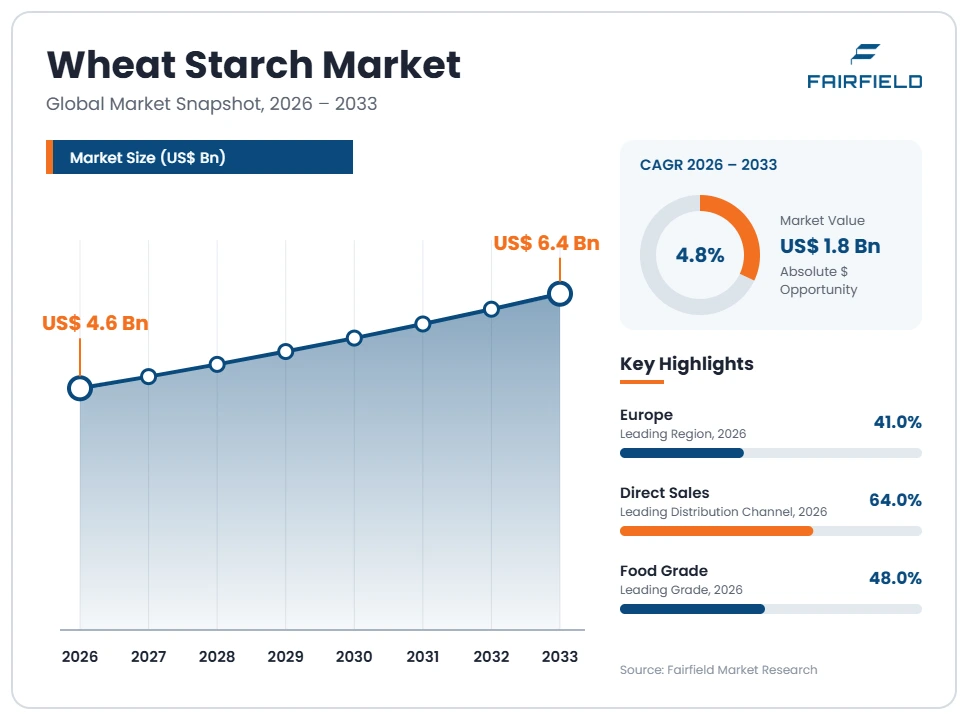
The global Wheat Starch market size is expected to be valued at US$ 4.6 billion in 2026 and projected to reach US$ 6.4 billion by 2033, growing at a CAGR of 4.8% between 2026 and 2033.
Between 2020 and 2025 the sector advanced at roughly 4.2% a year, closing 2025 near US$ 4.4 billion. Volumes are large and value per tonne is modest, so growth comes from mix rather than tonnage alone. Paper and board mills keep buying starch for surface sizing as fibre-based packaging replaces plastic, and food processors continue shifting toward modified grades with specific texture and freeze-thaw behaviour. Because starch and vital wheat gluten leave the same wet mill, the two co-product streams jointly determine mill margin and therefore how much capacity runs. This study counts native and modified wheat starch plus wheat-based glucose syrups and maltodextrin, and excludes maize, potato, tapioca and rice starches.
Key Report Takeaways
- By Product Type: Native Wheat Starch held 46% share in 2026, while Modified Wheat Starch is projected to expand at a 6.3% CAGR through 2033, driven by processors needing freeze-thaw stability and acid tolerance that unmodified granules cannot provide.
- By Grade: Food Grade held 48% share in 2026, while Pharmaceutical Grade is projected to expand at a 7.4% CAGR through 2033, driven by tablet manufacturers qualifying monograph-compliant diluent and disintegrant supply.
- By Application: Food and Beverages held 41% share in 2026, while Bioplastics and Barrier Coatings are projected to expand at an 8.3% CAGR through 2033, driven by packaging converters replacing polymer layers with starch-based coatings.
- By Distribution Channel: Direct Sales held 64% share in 2026, while Online B2B Platforms are projected to expand at a 7.6% CAGR through 2033, driven by smaller converters and formulators sourcing pallet quantities without distributor intermediaries.
- By Geography: Europe held 41% share in 2026, while Asia Pacific is projected to expand at a 6.9% CAGR through 2033, driven by packaging board capacity additions and noodle and processed food manufacturing in China.
Global Wheat Starch Market Trends and Insights
Drivers Impact Analysis
Two demand forces account for most of the forecast growth in wheat starch consumption.
| Driver | Impact on CAGR Forecast | Geographic Relevance | Impact Timeline |
| Paper and board surface sizing demand as fibre-based packaging replaces plastic | High | Europe, Asia Pacific | Medium term 2–4 years |
| Allergen-exempt wheat glucose syrups and maltodextrin opening sensitive food categories | Medium | Europe | Long term ≥4 years |
Fibre-Based Packaging Growth Raises Wheat Starch Use in Surface Sizing and Coating
Paper and board is the largest industrial pull on wheat starch. Mills apply starch at the size press to bind surface fibres, improve printability and raise burst and tensile strength, which lets converters use less fibre per square metre. As brand owners replace plastic trays, films and shrink wrap with moulded fibre and coated board, every additional tonne of packaging board carries starch with it.
The mechanism is mill economics rather than fashion. Starch is the cheapest way to lift strength properties without adding fibre, and recycled furnishes need more of it because repeated pulping shortens fibres. Wheat starch suits the application because its small granule fraction and film-forming behaviour give smooth, uniform surface coverage. Extended producer responsibility schemes across the European Union keep pushing converters toward recyclable paper formats, which sustains a long demand runway for size press starch.
Allergen-Exempt Wheat Glucose Syrups Widen the Addressable Food Formulation Base
A specific labelling carve-out gives wheat-derived sweeteners commercial reach that wheat protein never has. Wheat-based glucose syrups including dextrose, and wheat-based maltodextrins, are exempt from allergen declaration in the European Union because processing removes protein to negligible levels. Formulators can therefore use them in confectionery, beverages, infant and clinical nutrition, and free-from ranges without an allergen statement on pack.
The cause is technical and verified. Acid or enzymatic hydrolysis followed by refining strips residual gluten peptides below detection, and the exemption in Annex II of Regulation (EU) No 1169/2011 reflects that evidence. For a European wet miller this matters commercially, because the sweetener stream can be sold into categories closed to gluten-containing fractions. It also lets mills shift output between native starch, modified starch and hydrolysed sweeteners according to which stream is earning best.
Restraints Impact Analysis
Two structural constraints limit pricing power across the wheat starch value chain.
| Restraint | Impact on CAGR Forecast | Geographic Relevance | Impact Timeline |
| Direct substitution by maize and potato starch on price and functionality | High | Global | Short term ≤2 years |
| Energy and wheat input cost volatility in European wet milling | High | Europe | Medium term 2–4 years |
Maize and Potato Starch Substitution Caps Wheat Starch Pricing Power
Interchangeability is the hardest commercial ceiling here. For most paper, adhesive, textile and many food uses, maize, potato, tapioca and wheat starches perform similar roles, and buyers switch on landed price and availability. Maize starch benefits from enormous global wet milling scale, while potato starch offers higher viscosity and clearer pastes. Wheat starch must therefore be priced into a contested position rather than specified outright.
The cost mechanism is structural. Maize delivers more starch per tonne of grain than wheat does, so the raw material conversion ratio favours maize processors before any other factor is considered. Potato starch benefits from support arrangements and dedicated contract growing in parts of Europe. Only a few applications genuinely require wheat, such as certain noodle textures and specific size press performance profiles, which limits how much differentiation suppliers can translate into price.
Energy and Wheat Cost Swings Compress European Wheat Starch Mill Margins
Input volatility hits European producers hardest, and it is the clearest brake on investment. Wet milling runs steeping, separation, washing, dewatering and drying steps that consume substantial electricity and process heat, so a gas or power price shock moves unit conversion cost immediately. Wheat procurement adds a second variable, because milling wheat prices respond to harvest conditions, export policy and freight rates.
Co-product dependence magnifies the swing. A wheat starch plant simultaneously produces vital wheat gluten, and mill margin is the combined realisation of the starch stream and the gluten stream against wheat and utility cost. When gluten prices weaken, starch alone rarely covers the full conversion cost, so run rates fall even if starch demand is healthy. Operators consequently hedge grain and energy together and treat the two output streams as a single commercial decision.
Market Opportunities
Pharmaceutical Excipient Grades Open a Documented, Higher-Margin Wheat Starch Revenue Pool
Excipient supply is the clearest escape from commodity pricing. Tablet manufacturers use starch as a diluent, binder and disintegrant, and they buy to pharmacopoeial specification rather than to a commercial datasheet. Volumes are modest against industrial tonnage, but realised prices and contract stability are far better, and qualified suppliers are rarely displaced once a dossier references them.
Capture requires investment in documentation and controlled manufacturing rather than in new capacity. Wheat starch monographs in the European Pharmacopoeia and the United States Pharmacopeia define identity, microbial limits, loss on drying and residue specifications, and customers additionally expect excipient good manufacturing practice evidence and change-control commitments. Generic tablet manufacturers and contract development and manufacturing organisations are the demand centre. Producers already running food-grade lines can dedicate a suite, add stability and bioburden testing, and move selected customers up the grade ladder.
Starch-Based Barrier Coatings Create a Packaging Revenue Pool Under Recyclability Rules
Packaging reformulation is opening a genuinely new outlet. Converters are replacing polyethylene extrusion coatings on paper cups, food board and flexible papers with aqueous dispersion coatings, and starch derivatives contribute film formation, grease resistance and recyclability in the fibre stream. This is incremental demand rather than substitution within starch, because the volume previously belonged to polymer suppliers.
Regulation is doing the pulling. Regulation (EU) 2025/40 on packaging and packaging waste tightens recyclability and recycled content expectations across the European Union, which penalises multi-material laminates that complicate fibre recovery. Coating formulators, board mills and quick-service restaurant supply chains are the buyers, and they need consistent viscosity, film continuity and food contact compliance. Starch producers able to supply tailored modified grades alongside application support are positioned to convert this regulatory shift into contracted volume.
Segment Analysis
- By Product Type: Native Wheat Starch Leads Volume While Modified Grades Grow Faster
Native Wheat Starch holds 46% of market value in 2026, because it is the direct output of separation and serves high-tonnage paper, adhesive and basic food uses where unmodified performance is sufficient. Its low processing cost makes it the default where specification allows. Modified Wheat Starch grows fastest at a 6.3% CAGR, as food processors need freeze-thaw stability, acid and shear tolerance, and controlled gelatinisation that native granules cannot deliver in sauces, ready meals, bakery fillings and dairy desserts. Wheat-Based Glucose Syrup supplies confectionery, beverages and fermentation substrates, while Wheat-Based Maltodextrin serves bulking, encapsulation and clinical nutrition. The implication for producers is that derivatisation capacity determines margin far more than separation capacity does, so investment in chemical and physical modification lines, rather than additional milling throughput, is the decisive commercial choice.
- By Grade: Food Grade Anchors Revenue While Pharmaceutical Grade Expands Quickest
Food Grade accounts for 48% of wheat starch revenue in 2026, reflecting broad use across noodles, sauces, bakery, processed meat, confectionery and beverages, where starch provides texture, bulk and water binding at low cost. Specification requirements are moderate and approvals are widely established. Pharmaceutical Grade is the fastest-growing category at a 7.4% CAGR, because tablet manufacturers require starch that meets European Pharmacopoeia and United States Pharmacopeia monographs for identity, microbial limits and residues, and they pay for audited supply rather than tonnage. Industrial Grade supplies paper, board, adhesives and textiles at the lowest price point and the largest volume. Feed Grade absorbs side streams into compound feed. The business consequence is that grade mix, not output, now separates profitable mills from marginal ones, because pharmaceutical and specialty food grades carry several times the margin of industrial tonnage.
- By Application: Food and Beverages Lead Consumption as Bioplastics Set the Growth Pace
Food and Beverages take 41% of wheat starch demand in 2026, with noodles, sauces, soups, bakery, processed meat and confectionery forming the core. Wheat starch is particularly valued in noodle manufacturing, where it delivers the bite and surface characteristics processors specify. Paper and Board follows closely, using starch for surface sizing, coating binders and corrugating adhesive. Bioplastics and Barrier Coatings grow fastest at an 8.3% CAGR, as converters replace polymer coatings with starch-based aqueous dispersions to keep fibre packaging recyclable under tightening European rules. Adhesives serve corrugated board, bag and label manufacturing, while Textiles use starch for warp sizing in weaving. Pharmaceuticals and Personal Care consume small, highly specified volumes. The implication is that packaging reformulation, not food reformulation, now offers the steepest incremental growth available to starch producers.
- By Distribution Channel: Direct Sales Dominate While Online B2B Platforms Scale Quickly
Direct Sales represent 64% of wheat starch revenue in 2026, because paper mills, large food processors and pharmaceutical manufacturers buy in bulk tanker or full-container quantities, negotiate annual contracts and require technical service, plant audits and documented change control. Volume concentration makes direct supply economic for both parties. Online B2B Platforms grow fastest at a 7.6% CAGR, as small converters, specialty food producers, laboratory buyers and regional blenders source pallet quantities with transparent pricing and no distributor intermediary. Distributors and Traders retain an essential role in regional coverage, local-language regulatory support, warehousing and currency handling in markets where producers hold no inventory. The commercial consequence is a widening split, with strategic accounts moving deeper into multi-year direct supply while the long tail migrates to digital procurement, leaving distributors to defend mid-sized accounts that value short lead times and technical advice.
Geography Analysis
- North America Anchors Wheat Starch Demand in Paper Mills and Pharmaceutical Excipient Supply
North America accounts for 19% of wheat starch revenue in 2026, a smaller position than its economy suggests, because maize starch dominates the domestic market. The United States has enormous corn wet milling capacity, so wheat starch is used where specific functionality or an existing gluten-driven mill economics justify it. Paper and board mills are the largest industrial buyers, while pharmaceutical excipient users value wheat starch that complies with United States Pharmacopeia monographs. Food use is governed by the food starch-modified provisions at 21 CFR 172.892, which define permitted treatments and residual limits for modified grades. Canada contributes through wheat processing tied to its hard wheat supply. The clearest regional change is packaging reformulation, as quick-service and retail brands move toward coated fibre and raise demand for specialty starch coating grades.
- Which Region Is Leading the Wheat Starch Market?
Europe leads the wheat starch market with 41% share in 2026, worth close to US$ 1.9 billion. France, Germany, Belgium, the Netherlands, Poland, Italy and the United Kingdom host the densest cluster of wheat wet milling capacity in the world, supported by abundant soft wheat, inland waterway logistics and long-established processing groups. Regulation is unusually influential. Regulation (EC) No 1333/2008 governs food additives and assigns the E14xx numbers used for modified starches, while the allergen exemption for wheat-based glucose syrups and maltodextrin under Regulation (EU) No 1169/2011 gives European mills a commercially valuable sweetener outlet. Paper and board demand is deep, and packaging recyclability rules are accelerating starch-based coating adoption. Energy cost remains the principal vulnerability, since wet milling is power-intensive and regional tariffs have proved volatile.
- Which Region Is Growing Fastest in the Wheat Starch Market?
Asia Pacific is growing fastest in the wheat starch market at a 6.9% CAGR between 2026 and 2033, from a 28% share in 2026. China dominates both production and consumption, operating very large wheat starch and gluten separation capacity concentrated in its wheat-growing provinces. Noodle manufacturing is the distinctive regional demand driver, because wheat starch delivers the specific bite and surface quality that instant and fresh noodle processors require. Packaging board capacity additions across China, India, Indonesia and Vietnam add steady size press demand, while Japan and South Korea buy higher-specification food and pharmaceutical grades. India is building processed food and bakery volume quickly. The structural change underway is quality upgrading, as regional producers invest in monograph-compliant excipient lines and modified starch assets to serve customers previously supplied by established overseas producers.
- Latin America Builds Wheat Starch Demand Around Packaging Board and Processed Foods
Latin America represents 7% of wheat starch consumption in 2026, led by Brazil, Mexico, Argentina, Chile and Colombia. Demand is split between corrugated packaging adhesive, paper mill sizing and processed food manufacturing serving large urban populations. Argentina is a significant wheat producer, and Brazil has the region’s deepest packaging and food processing industries. The barriers are structural: wheat starch wet milling capacity in the region is limited, cassava and maize starch are locally abundant and cheaper, and imported material faces currency volatility plus port and customs delays that force costly safety stock. Import duties differ by country, complicating regional sourcing. The clearest opportunity lies in specialty modified grades that local cassava and maize producers cannot easily match, particularly for pharmaceutical excipients and high-performance coating applications.
- Middle East & Africa Relies on Imported Wheat Starch for Packaging and Food Processing
Middle East & Africa accounts for 5% of wheat starch demand in 2026, the smallest share and the least industrially developed. Türkiye, Egypt, Saudi Arabia, the United Arab Emirates, Nigeria and South Africa generate most consumption, principally through corrugated packaging adhesive, paper converting, biscuit and pasta manufacturing, and textile warp sizing. Türkiye has the strongest local starch processing base and exports into neighbouring markets. Barriers are considerable: wheat wet milling capacity is scarce, foreign currency availability constrains ingredient imports in several countries, humid and hot storage conditions raise quality risk, and price sensitivity favours the cheapest available starch regardless of origin. Packaging demand growth tied to e-commerce and organised retail is the most reliable signal. Regional blending and warehousing hubs in the Gulf offer the practical route to shorter lead times.
Competitive Landscape
The wheat starch market is moderately concentrated, shaped by the capital intensity of wet milling and the small number of sites capable of economic separation. Roquette Frères, Tereos, Agrana Beteiligungs-AG, Sedamyl S.p.A., Kröner-Stärke GmbH, Crespel & Deiters GmbH & Co. KG and Amilina AB form the European core, while Cargill, Incorporated and Archer Daniels Midland Company operate across multiple starch feedstocks. Manildra Group anchors supply into Asia Pacific and export markets. Chinese producers hold very large capacity and influence international pricing. Vertical integration is common, since the same asset yields starch, gluten and sweetener streams, and ownership of all three is what makes a site defensible.
Competition runs on four practical axes. Delivered cost comes first, because many applications treat starch as interchangeable with maize or potato grades. Derivative breadth is second, covering modified starches, glucose syrups and maltodextrin, since a broad portfolio lets a producer redirect output toward the best-earning stream. Technical service is third, especially in paper coating and food texture work where application laboratories decide trials. Documentation is fourth, spanning food additive specifications, pharmacopoeial compliance and food contact evidence for coating grades.
Strategic activity concentrates on efficiency and derivatives rather than on new greenfield capacity. Producers have debottlenecked separation, invested in heat recovery and drying efficiency to blunt energy exposure, and added modification and specialty coating assets. Several have expanded excipient-grade suites to reach regulated pharmaceutical customers.
Strategic direction across the vendor base points toward optimising the combined starch and gluten margin, developing coating and biopolymer grades for recyclable packaging, and reducing the energy intensity of drying.
Recent Industry Developments
- November 2007: The European Commission adopted Directive 2007/68/EC – it made permanent the allergen labelling exemption for wheat-based glucose syrups including dextrose and wheat-based maltodextrins, opening sensitive food categories to wheat-derived sweeteners.
- December 2008: The European Union adopted Regulation (EC) No 1333/2008 on food additives – it established the E-number framework under which modified starches carry the E14xx designations used in food labelling today.
- March 2012: The European Commission adopted Regulation (EU) No 231/2012 laying down specifications for permitted food additives – it fixed purity and identity criteria for each modified starch, standardising what food customers may specify.
- January 2025: The European Union published Regulation (EU) 2025/40 on packaging and packaging waste – its recyclability and recycled content requirements favour fibre-based packaging and starch-based coatings over multi-material plastic laminates.
Companies Covered in the Report
- Roquette Frères
- Tereos
- Cargill, Incorporated
- Agrana Beteiligungs-AG
- Manildra Group
- Archer Daniels Midland Company
- Südzucker AG
- Sedamyl S.p.A.
- Kröner-Stärke GmbH
- Amilina AB
- Interstarch GmbH
- Crespel & Deiters GmbH & Co. KG
Wheat Starch Market Report Scope
| Metric | Value |
| Study Period | 2020–2033 |
| Market Size 2026 | US$ 4.6 Billion |
| Market Size 2033 | US$ 6.4 Billion |
| CAGR 2026–2033 | 4.8% |
| Absolute Dollar Opportunity | US$ 1.8 Billion |
| Largest Market | Europe |
| Fastest-Growing Market | Asia Pacific |
| Market Concentration | Medium |
| Major Players | Roquette Frères, Tereos, Cargill, Incorporated, Agrana Beteiligungs-AG, Manildra Group |
Wheat Starch Market Segmentation
Product Type
- Native Wheat Starch
- Modified Wheat Starch
- Wheat-Based Glucose Syrup
- Wheat-Based Maltodextrin
Grade
- Food Grade
- Industrial Grade
- Pharmaceutical Grade
- Feed Grade
Application
- Food and Beverages
- Paper and Board
- Adhesives
- Textiles
- Pharmaceuticals and Personal Care
- Bioplastics and Barrier Coatings
Distribution Channel
- Direct Sales
- Distributors and Traders
- Online B2B Platforms
Regions
- North America
- Europe
- Asia Pacific
- Latin America
- Middle East & Africa
- Executive Summary
- Global Wheat Starch Market Snapshot
- Future Projections
- Key Report Takeaways
- Regional Snapshot
- Market Overview
- Market Definition and Report Scope
- Historical Trends 2020–2025
- Market Dynamics
- Drivers
- Fibre-Based Packaging Growth Raises Wheat Starch Use in Surface Sizing and Coating
- Allergen-Exempt Wheat Glucose Syrups Widen the Addressable Food Formulation Base
- Restraints
- Maize and Potato Starch Substitution Caps Wheat Starch Pricing Power
- Energy and Wheat Cost Swings Compress European Wheat Starch Mill Margins
- Market Opportunities
- Pharmaceutical Excipient Grades Open a Documented, Higher-Margin Wheat Starch Revenue Pool
- Starch-Based Barrier Coatings Create a Packaging Revenue Pool Under Recyclability Rules
- Drivers
- Global Wheat Starch Market Outlook, 2020–2033
- Global Wheat Starch Market Outlook, by Product Type, Value (US$ Billion), 2020–2033
- Native Wheat Starch
- Modified Wheat Starch
- Wheat-Based Glucose Syrup
- Wheat-Based Maltodextrin
- Global Wheat Starch Market Outlook, by Grade, Value (US$ Billion), 2020–2033
- Food Grade
- Industrial Grade
- Pharmaceutical Grade
- Feed Grade
- Global Wheat Starch Market Outlook, by Application, Value (US$ Billion), 2020–2033
- Food and Beverages
- Paper and Board
- Adhesives
- Textiles
- Pharmaceuticals and Personal Care
- Bioplastics and Barrier Coatings
- Global Wheat Starch Market Outlook, by Distribution Channel, Value (US$ Billion), 2020–2033
- Direct Sales
- Distributors and Traders
- Online B2B Platforms
- Global Wheat Starch Market Outlook, by Region, Value (US$ Billion), 2020–2033
- North America
- Europe
- Asia Pacific
- Latin America
- Middle East & Africa
- Global Wheat Starch Market Outlook, by Product Type, Value (US$ Billion), 2020–2033
- North America Wheat Starch Market Outlook, 2020–2033
- North America Wheat Starch Market Outlook, by Product Type, Value (US$ Billion), 2020–2033
- Native Wheat Starch
- Modified Wheat Starch
- Wheat-Based Glucose Syrup
- Wheat-Based Maltodextrin
- North America Wheat Starch Market Outlook, by Grade, Value (US$ Billion), 2020–2033
- Food Grade
- Industrial Grade
- Pharmaceutical Grade
- Feed Grade
- North America Wheat Starch Market Outlook, by Application, Value (US$ Billion), 2020–2033
- Food and Beverages
- Paper and Board
- Adhesives
- Textiles
- Pharmaceuticals and Personal Care
- Bioplastics and Barrier Coatings
- North America Wheat Starch Market Outlook, by Distribution Channel, Value (US$ Billion), 2020–2033
- Direct Sales
- Distributors and Traders
- Online B2B Platforms
- North America Wheat Starch Market Outlook, by Country, Value (US$ Billion), 2020–2033
- United States Wheat Starch Market Outlook, by Product Type, 2020–2033
- United States Wheat Starch Market Outlook, by Grade, 2020–2033
- United States Wheat Starch Market Outlook, by Application, 2020–2033
- United States Wheat Starch Market Outlook, by Distribution Channel, 2020–2033
- Canada Wheat Starch Market Outlook, by Product Type, 2020–2033
- Canada Wheat Starch Market Outlook, by Grade, 2020–2033
- Canada Wheat Starch Market Outlook, by Application, 2020–2033
- Canada Wheat Starch Market Outlook, by Distribution Channel, 2020–2033
- North America Wheat Starch Market Outlook, by Product Type, Value (US$ Billion), 2020–2033
- Europe Wheat Starch Market Outlook, 2020–2033
- Europe Wheat Starch Market Outlook, by Product Type, Value (US$ Billion), 2020–2033
- Native Wheat Starch
- Modified Wheat Starch
- Wheat-Based Glucose Syrup
- Wheat-Based Maltodextrin
- Europe Wheat Starch Market Outlook, by Grade, Value (US$ Billion), 2020–2033
- Food Grade
- Industrial Grade
- Pharmaceutical Grade
- Feed Grade
- Europe Wheat Starch Market Outlook, by Application, Value (US$ Billion), 2020–2033
- Food and Beverages
- Paper and Board
- Adhesives
- Textiles
- Pharmaceuticals and Personal Care
- Bioplastics and Barrier Coatings
- Europe Wheat Starch Market Outlook, by Distribution Channel, Value (US$ Billion), 2020–2033
- Direct Sales
- Distributors and Traders
- Online B2B Platforms
- Europe Wheat Starch Market Outlook, by Country, Value (US$ Billion), 2020–2033
- France Wheat Starch Market Outlook, by Product Type, 2020–2033
- France Wheat Starch Market Outlook, by Grade, 2020–2033
- France Wheat Starch Market Outlook, by Application, 2020–2033
- France Wheat Starch Market Outlook, by Distribution Channel, 2020–2033
- Germany Wheat Starch Market Outlook, by Product Type, 2020–2033
- Germany Wheat Starch Market Outlook, by Grade, 2020–2033
- Germany Wheat Starch Market Outlook, by Application, 2020–2033
- Germany Wheat Starch Market Outlook, by Distribution Channel, 2020–2033
- Belgium Wheat Starch Market Outlook, by Product Type, 2020–2033
- Belgium Wheat Starch Market Outlook, by Grade, 2020–2033
- Belgium Wheat Starch Market Outlook, by Application, 2020–2033
- Belgium Wheat Starch Market Outlook, by Distribution Channel, 2020–2033
- Netherlands Wheat Starch Market Outlook, by Product Type, 2020–2033
- Netherlands Wheat Starch Market Outlook, by Grade, 2020–2033
- Netherlands Wheat Starch Market Outlook, by Application, 2020–2033
- Netherlands Wheat Starch Market Outlook, by Distribution Channel, 2020–2033
- Poland Wheat Starch Market Outlook, by Product Type, 2020–2033
- Poland Wheat Starch Market Outlook, by Grade, 2020–2033
- Poland Wheat Starch Market Outlook, by Application, 2020–2033
- Poland Wheat Starch Market Outlook, by Distribution Channel, 2020–2033
- Italy Wheat Starch Market Outlook, by Product Type, 2020–2033
- Italy Wheat Starch Market Outlook, by Grade, 2020–2033
- Italy Wheat Starch Market Outlook, by Application, 2020–2033
- Italy Wheat Starch Market Outlook, by Distribution Channel, 2020–2033
- United Kingdom Wheat Starch Market Outlook, by Product Type, 2020–2033
- United Kingdom Wheat Starch Market Outlook, by Grade, 2020–2033
- United Kingdom Wheat Starch Market Outlook, by Application, 2020–2033
- United Kingdom Wheat Starch Market Outlook, by Distribution Channel, 2020–2033
- Europe Wheat Starch Market Outlook, by Product Type, Value (US$ Billion), 2020–2033
- Asia Pacific Wheat Starch Market Outlook, 2020–2033
- Asia Pacific Wheat Starch Market Outlook, by Product Type, Value (US$ Billion), 2020–2033
- Native Wheat Starch
- Modified Wheat Starch
- Wheat-Based Glucose Syrup
- Wheat-Based Maltodextrin
- Asia Pacific Wheat Starch Market Outlook, by Grade, Value (US$ Billion), 2020–2033
- Food Grade
- Industrial Grade
- Pharmaceutical Grade
- Feed Grade
- Asia Pacific Wheat Starch Market Outlook, by Application, Value (US$ Billion), 2020–2033
- Food and Beverages
- Paper and Board
- Adhesives
- Textiles
- Pharmaceuticals and Personal Care
- Bioplastics and Barrier Coatings
- Asia Pacific Wheat Starch Market Outlook, by Distribution Channel, Value (US$ Billion), 2020–2033
- Direct Sales
- Distributors and Traders
- Online B2B Platforms
- Asia Pacific Wheat Starch Market Outlook, by Country, Value (US$ Billion), 2020–2033
- China Wheat Starch Market Outlook, by Product Type, 2020–2033
- China Wheat Starch Market Outlook, by Grade, 2020–2033
- China Wheat Starch Market Outlook, by Application, 2020–2033
- China Wheat Starch Market Outlook, by Distribution Channel, 2020–2033
- India Wheat Starch Market Outlook, by Product Type, 2020–2033
- India Wheat Starch Market Outlook, by Grade, 2020–2033
- India Wheat Starch Market Outlook, by Application, 2020–2033
- India Wheat Starch Market Outlook, by Distribution Channel, 2020–2033
- Indonesia Wheat Starch Market Outlook, by Product Type, 2020–2033
- Indonesia Wheat Starch Market Outlook, by Grade, 2020–2033
- Indonesia Wheat Starch Market Outlook, by Application, 2020–2033
- Indonesia Wheat Starch Market Outlook, by Distribution Channel, 2020–2033
- Vietnam Wheat Starch Market Outlook, by Product Type, 2020–2033
- Vietnam Wheat Starch Market Outlook, by Grade, 2020–2033
- Vietnam Wheat Starch Market Outlook, by Application, 2020–2033
- Vietnam Wheat Starch Market Outlook, by Distribution Channel, 2020–2033
- Japan Wheat Starch Market Outlook, by Product Type, 2020–2033
- Japan Wheat Starch Market Outlook, by Grade, 2020–2033
- Japan Wheat Starch Market Outlook, by Application, 2020–2033
- Japan Wheat Starch Market Outlook, by Distribution Channel, 2020–2033
- South Korea Wheat Starch Market Outlook, by Product Type, 2020–2033
- South Korea Wheat Starch Market Outlook, by Grade, 2020–2033
- South Korea Wheat Starch Market Outlook, by Application, 2020–2033
- South Korea Wheat Starch Market Outlook, by Distribution Channel, 2020–2033
- Asia Pacific Wheat Starch Market Outlook, by Product Type, Value (US$ Billion), 2020–2033
- Latin America Wheat Starch Market Outlook, 2020–2033
- Latin America Wheat Starch Market Outlook, by Product Type, Value (US$ Billion), 2020–2033
- Native Wheat Starch
- Modified Wheat Starch
- Wheat-Based Glucose Syrup
- Wheat-Based Maltodextrin
- Latin America Wheat Starch Market Outlook, by Grade, Value (US$ Billion), 2020–2033
- Food Grade
- Industrial Grade
- Pharmaceutical Grade
- Feed Grade
- Latin America Wheat Starch Market Outlook, by Application, Value (US$ Billion), 2020–2033
- Food and Beverages
- Paper and Board
- Adhesives
- Textiles
- Pharmaceuticals and Personal Care
- Bioplastics and Barrier Coatings
- Latin America Wheat Starch Market Outlook, by Distribution Channel, Value (US$ Billion), 2020–2033
- Direct Sales
- Distributors and Traders
- Online B2B Platforms
- Latin America Wheat Starch Market Outlook, by Country, Value (US$ Billion), 2020–2033
- Brazil Wheat Starch Market Outlook, by Product Type, 2020–2033
- Brazil Wheat Starch Market Outlook, by Grade, 2020–2033
- Brazil Wheat Starch Market Outlook, by Application, 2020–2033
- Brazil Wheat Starch Market Outlook, by Distribution Channel, 2020–2033
- Mexico Wheat Starch Market Outlook, by Product Type, 2020–2033
- Mexico Wheat Starch Market Outlook, by Grade, 2020–2033
- Mexico Wheat Starch Market Outlook, by Application, 2020–2033
- Mexico Wheat Starch Market Outlook, by Distribution Channel, 2020–2033
- Argentina Wheat Starch Market Outlook, by Product Type, 2020–2033
- Argentina Wheat Starch Market Outlook, by Grade, 2020–2033
- Argentina Wheat Starch Market Outlook, by Application, 2020–2033
- Argentina Wheat Starch Market Outlook, by Distribution Channel, 2020–2033
- Chile Wheat Starch Market Outlook, by Product Type, 2020–2033
- Chile Wheat Starch Market Outlook, by Grade, 2020–2033
- Chile Wheat Starch Market Outlook, by Application, 2020–2033
- Chile Wheat Starch Market Outlook, by Distribution Channel, 2020–2033
- Colombia Wheat Starch Market Outlook, by Product Type, 2020–2033
- Colombia Wheat Starch Market Outlook, by Grade, 2020–2033
- Colombia Wheat Starch Market Outlook, by Application, 2020–2033
- Colombia Wheat Starch Market Outlook, by Distribution Channel, 2020–2033
- Latin America Wheat Starch Market Outlook, by Product Type, Value (US$ Billion), 2020–2033
- Middle East & Africa Wheat Starch Market Outlook, 2020–2033
- Middle East & Africa Wheat Starch Market Outlook, by Product Type, Value (US$ Billion), 2020–2033
- Native Wheat Starch
- Modified Wheat Starch
- Wheat-Based Glucose Syrup
- Wheat-Based Maltodextrin
- Middle East & Africa Wheat Starch Market Outlook, by Grade, Value (US$ Billion), 2020–2033
- Food Grade
- Industrial Grade
- Pharmaceutical Grade
- Feed Grade
- Middle East & Africa Wheat Starch Market Outlook, by Application, Value (US$ Billion), 2020–2033
- Food and Beverages
- Paper and Board
- Adhesives
- Textiles
- Pharmaceuticals and Personal Care
- Bioplastics and Barrier Coatings
- Middle East & Africa Wheat Starch Market Outlook, by Distribution Channel, Value (US$ Billion), 2020–2033
- Direct Sales
- Distributors and Traders
- Online B2B Platforms
- Middle East & Africa Wheat Starch Market Outlook, by Country, Value (US$ Billion), 2020–2033
- Türkiye Wheat Starch Market Outlook, by Product Type, 2020–2033
- Türkiye Wheat Starch Market Outlook, by Grade, 2020–2033
- Türkiye Wheat Starch Market Outlook, by Application, 2020–2033
- Türkiye Wheat Starch Market Outlook, by Distribution Channel, 2020–2033
- Egypt Wheat Starch Market Outlook, by Product Type, 2020–2033
- Egypt Wheat Starch Market Outlook, by Grade, 2020–2033
- Egypt Wheat Starch Market Outlook, by Application, 2020–2033
- Egypt Wheat Starch Market Outlook, by Distribution Channel, 2020–2033
- Saudi Arabia Wheat Starch Market Outlook, by Product Type, 2020–2033
- Saudi Arabia Wheat Starch Market Outlook, by Grade, 2020–2033
- Saudi Arabia Wheat Starch Market Outlook, by Application, 2020–2033
- Saudi Arabia Wheat Starch Market Outlook, by Distribution Channel, 2020–2033
- United Arab Emirates Wheat Starch Market Outlook, by Product Type, 2020–2033
- United Arab Emirates Wheat Starch Market Outlook, by Grade, 2020–2033
- United Arab Emirates Wheat Starch Market Outlook, by Application, 2020–2033
- United Arab Emirates Wheat Starch Market Outlook, by Distribution Channel, 2020–2033
- Nigeria Wheat Starch Market Outlook, by Product Type, 2020–2033
- Nigeria Wheat Starch Market Outlook, by Grade, 2020–2033
- Nigeria Wheat Starch Market Outlook, by Application, 2020–2033
- Nigeria Wheat Starch Market Outlook, by Distribution Channel, 2020–2033
- South Africa Wheat Starch Market Outlook, by Product Type, 2020–2033
- South Africa Wheat Starch Market Outlook, by Grade, 2020–2033
- South Africa Wheat Starch Market Outlook, by Application, 2020–2033
- South Africa Wheat Starch Market Outlook, by Distribution Channel, 2020–2033
- Middle East & Africa Wheat Starch Market Outlook, by Product Type, Value (US$ Billion), 2020–2033
- Competitive Landscape
- Market Concentration and Industry Leaders
- Competitive Differentiation
- Strategic Moves and Market Direction
- Recent Industry Developments
- Company Profiles
- Roquette Frères
- Tereos
- Cargill, Incorporated
- Agrana Beteiligungs-AG
- Manildra Group
- Archer Daniels Midland Company
- Südzucker AG
- Sedamyl S.p.A.
- Kröner-Stärke GmbH
- Amilina AB
- Interstarch GmbH
- Crespel & Deiters GmbH & Co. KG
- Appendix
- Research Methodology
- Report Assumptions
- Acronyms and Abbreviations
Product Type
- Native Wheat Starch
- Modified Wheat Starch
- Wheat-Based Glucose Syrup
- Wheat-Based Maltodextrin
Grade
- Food Grade
- Industrial Grade
- Pharmaceutical Grade
- Feed Grade
Application
- Food and Beverages
- Paper and Board
- Adhesives
- Textiles
- Pharmaceuticals and Personal Care
- Bioplastics and Barrier Coatings
Distribution Channel
- Direct Sales
- Distributors and Traders
- Online B2B Platforms
Regions
- North America
- Europe
- Asia Pacific
- Latin America
- Middle East & Africa
Our Research Methodology
Considering the volatility of business today, traditional approaches to strategizing a game plan can be unfruitful if not detrimental. True ambiguity is no way to determine a forecast. A myriad of predetermined factors must be accounted for such as the degree of risk involved, the magnitude of circumstances, as well as conditions or consequences that are not known or unpredictable. To circumvent binary views that cast uncertainty, the application of market research intelligence to strategically posture, move, and enable actionable outcomes is necessary.
View Methodology
Quality Assured
Rigorous Validation Process

Confidentiality Assured
End-to-end Data Security

Custom Research Services
Tailored To Your Objectives
FAQs
The wheat starch market is valued at about US$ 4.6 billion in 2026, covering native and modified starch plus wheat-based glucose syrups and maltodextrin.
Revenue is projected to reach US$ 6.4 billion by 2033, expanding at a 4.8% CAGR and adding US$ 1.8 billion of absolute dollar opportunity.
Native Wheat Starch leads with 46% share in 2026, as it is the direct separation output serving high-tonnage paper, adhesive and food uses.
Bioplastics and Barrier Coatings grow fastest at an 8.3% CAGR, as converters replace polymer coatings to keep fibre packaging recyclable.
Europe holds the largest share at 41% in 2026, supported by the densest concentration of wheat wet milling capacity in the world.
Related Reports
Wheat Protein Market Size, Share, Insights, Competitive Landscape, and Forecast 2026 to 2033
The global wheat protein market is valued at US$3.2 billion in 2026, reaching US$4.9 billion by 2033, growing at a 6.3% CAGR
Wet Pet Food Market Size, Share, Insights, Competitive Landscape, and Forecast 2026 to 2033
The global wet pet food market is valued at US$47.5 billion in 2026, reaching US$66.8 billion by 2033, growing at a 5.0% CAGR
Rice Bran Oil Market Size, Share, Insights, Competitive Landscape, and Forecast 2026 to 2033
The global rice bran oil market is valued at US$2.47 billion in 2026, reaching US$4.75 billion by 2033, growing at a 9.8% CAGR
Gum Arabic Market Size, Share, Insights, Competitive Landscape, and Forecast 2026 to 2033
The global gum arabic market is valued at US$0.516 billion in 2026, reaching US$0.791 billion by 2033, growing at a 6.3% CAGR
Guar Gum Market Size, Share, Insights, Competitive Landscape, and Forecast 2026 to 2033
The global guar gum market is valued at US$1.49 billion in 2026, reaching US$2.33 billion by 2033, growing at a 6.6% CAGR
Cheddar Cheese Market Size, Share, Insights, Competitive Landscape, and Forecast 2026 to 2033
The global cheddar cheese market is valued at US$17.33 billion in 2026, reaching US$24.70 billion by 2033, growing at a 5.2% CAGR