



Wireless Neurostimulators Market
Wireless Neurostimulators Market Size, Share, Insights, Competitive Landscape, and Forecast 2026 to 2033
Wireless Neurostimulators Market Size and Trend Analysis
How Large Is the Wireless Neurostimulators Market Today?
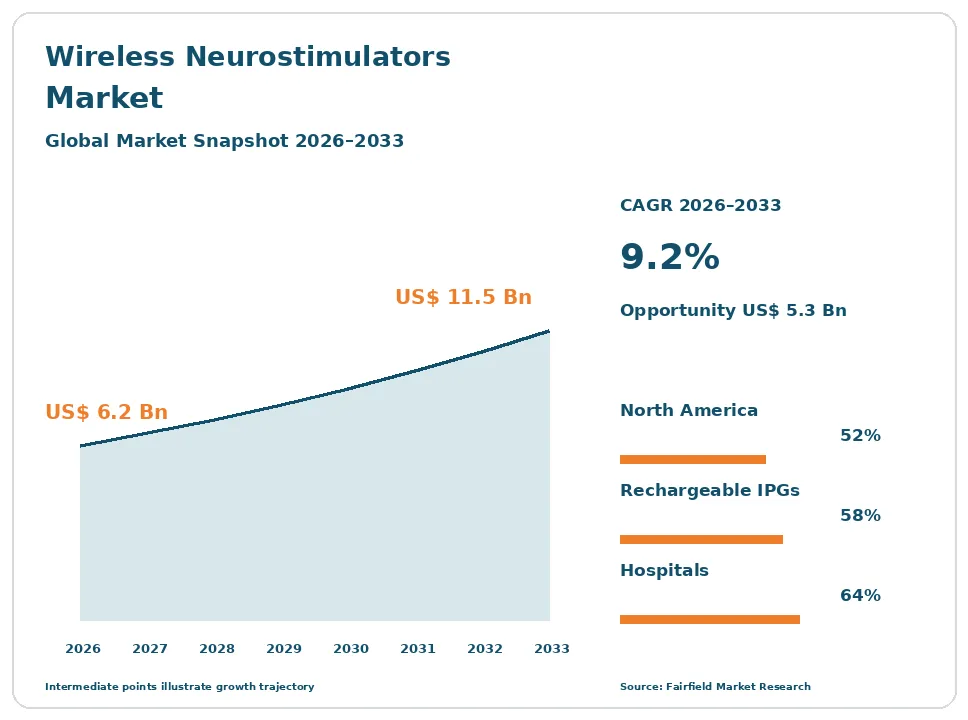
The global wireless neurostimulators market size is expected to be valued at US$ 6.2 billion in 2026 and projected to reach US$ 11.5 billion by 2033, growing at a CAGR of 9.2% between 2026 and 2033.
The segment grew at close to an 8.3% CAGR between 2020 and 2025, as rechargeable and externally powered designs displaced primary-cell implants across several therapy areas. Three structural factors set the forecast. Device service life economics favour systems that avoid replacement surgery when a battery is exhausted. Wireless telemetry allows programming and follow-up outside the clinic in therapies that require repeated adjustment. Indication expansion in sacral, hypoglossal and peripheral nerve stimulation widens the implanting base. Growth is bounded by premarket approval timelines and by coverage decisions, which gate procedure volume more tightly than manufacturing capacity does. The market remains concentrated among a small group of established device manufacturers.
Key Report Takeaways
- By Product Type: Rechargeable implantable pulse generators held 58% share in 2026, while microstimulators and leadless stimulators are projected to expand at a 13.1% CAGR through 2033, as implant volume reduction widens the range of procedure settings.
- By Application: Spinal cord stimulation held 42% share in 2026, while occipital and hypoglossal stimulation is projected to expand at a 12.6% CAGR through 2033, following indication expansion and new implanting specialties entering the field.
- By End User: Hospitals held 64% share in 2026, while ambulatory surgical centres are projected to expand at an 11.4% CAGR through 2033, as smaller implants and shorter procedure times shift sites of service.
- By Connectivity Technology: Inductive near-field links held 38% share in 2026, while Bluetooth Low Energy links are projected to expand at a 12.9% CAGR through 2033, driven by smartphone-based patient controllers replacing dedicated hardware.
- By Geography: North America held 52% share in 2026, while Asia Pacific is projected to expand at an 11.8% CAGR through 2033, supported by hospital capacity additions and reimbursement listings in Japan, China and Australia.
Global Wireless Neurostimulators Market Trends and Insights
Drivers Impact Analysis
| Driver | Impact on CAGR Forecast | Geographic Relevance | Impact Timeline |
| Rechargeable and externally powered designs removing battery replacement surgery | High | North America, Europe, Japan | Long term (≥4 years) |
| Wireless telemetry enabling programming and follow-up without a clinic visit | Medium | Global | Medium term (2–4 years) |
Two engineering problems explain why the wireless element carries the growth in this device class.
Battery Replacement Surgery Economics Push Wireless Neurostimulators Toward Rechargeable Designs
Device service life is the central commercial variable in this class. A primary-cell implantable pulse generator reaches end of service and must be explanted and replaced, which means another operation, another theatre slot and another device purchase. Rechargeable and externally powered designs change that arithmetic by extending the interval between surgical events, which alters the total cost a hospital or payer books across a patient’s device history.
The mechanism is power delivery. Inductive transcutaneous charging allows a smaller cell to be recharged in situ, while externally powered implants carry no internal battery at all and draw energy from a worn transmitter. Both approaches reduce implant volume, which in turn affects incision size and procedure setting. Component suppliers and manufacturers have concentrated development on charging efficiency, coil alignment tolerance and thermal limits, because those parameters determine whether the design is practical.
Wireless Telemetry Reduces Clinic Visits in Wireless Neurostimulators Follow-Up Programmes
Programming burden is the second engineering problem the wireless link solves. Neurostimulation therapies require repeated parameter adjustment after implantation, and each adjustment has historically needed a clinician programmer in a clinic. Wireless telemetry allows parameter review and change outside that setting, which reduces the per-patient service load on specialist centres and makes larger implanting programmes operationally feasible.
The causal chain runs through centre capacity rather than device price. A neuromodulation centre’s throughput is limited by the clinician hours available for follow-up, not by implant supply. Remote programming and telemetry-enabled patient controllers free those hours. The same link carries device diagnostics and usage data back to the manufacturer and the centre. Regulatory obligations follow it: wireless connectivity brings the device within cybersecurity requirements that now apply across its whole lifecycle.
Restraints Impact Analysis
| Restraint | Impact on CAGR Forecast | Geographic Relevance | Impact Timeline |
| Premarket approval and clinical evidence requirements for class III devices | High | United States, European Union | Long term (≥4 years) |
| Variable reimbursement and coverage policy gating procedure volume | High | Global | Medium term (2–4 years) |
Approval burden and coverage decisions limit volume more than demand or capacity does.
Class III Approval Requirements Slow Entry Into the Wireless Neurostimulators Market
Approval burden is the hardest barrier in this market. Implantable neurostimulation systems sit among the highest-risk device classes and require premarket approval supported by clinical investigation, which adds years and substantial expense before any revenue. In the European Union the Medical Device Regulation applies comparable classification and clinical evidence requirements, and notified body capacity has lengthened review timelines. Small entrants predictably reach market slowly or not at all.
The cost source is clinical evidence generation, not manufacturing. A pivotal study in an implanted population requires multi-centre recruitment, long follow-up and independent adjudication, and a design change to the wireless power or telemetry subsystem can trigger additional submission work. Standards compliance adds to this: ISO 14708 for active implantable devices, IEC 60601-1-2 for electromagnetic compatibility and IEC 62304 for software lifecycle processes all require documented conformity before approval.
Coverage Decisions and MRI Conditionality Constrain Wireless Neurostimulators Procedure Volume
Reimbursement is the gate on volume. Payers set coverage criteria, prior authorisation requirements and procedure codes, and these vary widely between national systems and between private payers in the same country. A manufacturer can hold approval in a market and still face flat volume because coverage criteria restrict the eligible population. Hospitals will not build implanting capacity against uncertain payment, so coverage decisions, not approvals, determine installed base growth.
Magnetic resonance imaging conditionality is a second practical constraint. Implanted patients require imaging over their lifetimes, and labelling that restricts scanner field strength, coil type or scan region limits where the device can be used. Conformity with ASTM F2503 marking requirements and ISO 14117 electromagnetic compatibility testing for active implantable devices governs what a manufacturer may state. Labelling differences between systems are a documented purchasing consideration for imaging-heavy centres.
Market Opportunities
Two revenue pools sit beyond the established high-volume indications.
Closed-Loop and Sensing-Enabled Systems Open a Premium Wireless Neurostimulators Revenue Pool
Sensing-enabled devices represent the clearest premium pool in this market. A system that records neural or physiological signals alongside stimulation generates data the wireless link must carry, which increases telemetry requirements and supports higher device pricing than open-loop systems. The revenue is not only hardware: data management, analytics and programming services attach to it and create recurring revenue in a market that has been purely capital-equipment in character.
Established manufacturers with approval infrastructure are positioned to capture this, because sensing claims require clinical evidence and the submission burden favours incumbents. Specialist neuromodulation centres create the demand, since they manage the most complex cases and carry the follow-up load that automated adjustment would reduce. The US Food and Drug Administration breakthrough device designation programme provides a route for novel systems to obtain earlier interactive review, which shortens the path for sensing-enabled designs.
Smaller Implants and Remote Programming Extend Wireless Neurostimulators Into New Procedure Settings
Volume reduction opens a site-of-service revenue pool. Microstimulators and leadless designs implanted through minimally invasive routes shorten procedure time and reduce the theatre resource each case consumes, which makes ambulatory surgical centres viable implanting sites. That shift expands the number of facilities able to buy these systems beyond the tertiary hospitals that dominate today, and it changes the commercial model from a small number of large accounts to a broader installed base.
Device manufacturers with compact power architectures and ambulatory centre operators both stand to gain. Peripheral nerve and tibial stimulation create most of this demand, because the anatomical targets suit smaller implants. Remote programming supports the same shift by removing the assumption that follow-up occurs where the implant was placed. Indication expansion, where approval and coverage follow together, determines how quickly the pool converts to revenue.
Segment Analysis
By Product Type: Rechargeable Pulse Generators Lead While Leadless Designs Advance Fastest
Rechargeable implantable pulse generators held 58% of 2026 revenue, the dominant product type, because they serve the high-energy spinal cord and deep brain indications where primary-cell service life would be short. Externally powered implants with no internal battery hold a smaller specialist position concentrated in peripheral nerve applications. Wireless programming, telemetry and patient controller systems are counted here and contribute a growing share of system value. Microstimulators and leadless stimulators are the fastest-growing type at a 13.1% CAGR to 2033, because reduced implant volume supports less invasive placement and shorter procedures. This report counts the pulse generator, the leads and extensions and the associated accessories together as one system for sizing purposes, since hospitals purchase them as a single configured order. Non-implantable consumer wellness stimulation devices are excluded from the market definition entirely.
By Application: Spinal Cord Stimulation Dominates as Hypoglossal and Occipital Targets Scale
Spinal cord stimulation accounted for 42% of 2026 revenue, the largest application, supported by the longest reimbursement history and the widest implanting base across pain specialties. Deep brain stimulation follows with high device value per case and a concentrated set of implanting centres. Sacral and tibial neuromodulation and vagus nerve stimulation hold established positions with distinct specialist channels. Occipital and hypoglossal stimulation together form the fastest-growing application at a 12.6% CAGR through 2033, as indication coverage widens and ear, nose and throat specialists enter a field previously limited to neurosurgery and pain medicine. Peripheral nerve stimulation grows alongside it from a smaller base. Application mix determines sales channel structure more than product design does, because each target specialty requires a separate clinical support organisation, its own training programme and its own reimbursement dossier in every national market.
By End User: Hospitals Carry Implant Volume While Ambulatory Centres Expand Quickest
Hospitals held 64% of 2026 revenue, reflecting the surgical infrastructure, imaging access and specialist staffing that implantation of class III devices requires. Specialty clinics and dedicated neuromodulation centres hold the balance and concentrate the complex programming workload rather than the implant procedure itself. Ambulatory surgical centres are the fastest-growing end user at an 11.4% CAGR to 2033, as smaller implants and shorter procedure times make day-case placement practical for peripheral nerve and tibial applications. The shift matters commercially because purchasing behaviour differs sharply between the two settings. Hospitals buy through capital committees and group purchasing organisations on multi-year agreements, while ambulatory centres are more price-sensitive and far more sensitive to procedure time, which changes how manufacturers configure, bundle and price complete systems for each account type.
By Connectivity Technology: Inductive Links Hold Share While Bluetooth Low Energy Grows Rapidly
Inductive near-field links held 38% of 2026 revenue, the leading connectivity approach, because they carry both power and data for rechargeable and externally powered implants and tolerate the attenuation of implanted placement. Links in the medical implant communication service band support longer-range telemetry under allocations that regulators reserved for implanted devices. Proprietary radiofrequency links remain in installed legacy systems. Bluetooth Low Energy is the fastest-growing connectivity technology at a 12.9% CAGR through 2033, as smartphone-based patient controllers replace dedicated handheld hardware and reduce accessory cost. The trade-off is regulatory rather than technical. Standard, widely documented wireless protocols bring the device squarely within cybersecurity premarket obligations, including software bill of materials documentation, threat modelling and lifecycle vulnerability management that continues for as long as the implant remains in service.
Geography Analysis
Which Region Is Leading the Wireless Neurostimulators Market?
North America leads with 52% share in 2026, overwhelmingly the United States with Canada contributing a small addition. Three conditions explain the position. The US Food and Drug Administration premarket approval pathway, while demanding, provides a predictable route for class III devices, and the breakthrough device designation programme gives novel systems earlier review interaction. Reimbursement through established procedure codes supports a large implanting base in pain medicine, functional neurosurgery, urology and sleep medicine. The major manufacturers are headquartered or heavily invested there, which concentrates clinical trial activity and physician training. The regional change worth tracking is cybersecurity: section 524B obligations on cyber devices now apply to wireless neurostimulation submissions as a standing premarket requirement.
Europe Combines Strong Implanting Centres With a Heavier Conformity Burden
Europe holds 24% of 2026 revenue, led by Germany, France, the United Kingdom, Italy and Spain. The region has a dense network of academic neurosurgical and pain centres, and public health systems that fund implantation under defined criteria. The constraint is conformity assessment. The Medical Device Regulation raised classification and clinical evidence requirements and notified body capacity has not kept pace, so certification timelines are longer and some legacy products have been withdrawn rather than recertified. Health technology assessment bodies apply separate cost-effectiveness tests before funding. The effect is a market with high clinical capability and slower product introduction, which favours manufacturers holding broad existing certificates over new entrants seeking first approval.
Which Region Is Growing Fastest in the Wireless Neurostimulators Market?
Asia Pacific is the fastest-growing region at an 11.8% CAGR between 2026 and 2033, led by Japan, China, Australia and South Korea. Japan has the most established reimbursement listings for neuromodulation and a mature implanting community. China is expanding tertiary hospital neurosurgical capacity and has developed domestic manufacturing of implantable stimulation systems, supported by national registration pathways and volume-based procurement that pressures pricing. Australia funds several indications through its prostheses arrangements. Growth comes from procedure volume rather than price, since procurement reform tends to lower unit values. Physician training capacity is the practical limit, because implantation and programming require skills that take years to build across a large hospital network.
Latin America Adds Neuromodulation Capacity Through Private Hospital Networks
Latin America accounts for 4% of 2026 revenue, concentrated in Brazil, Mexico, Argentina and Chile. Demand sits almost entirely in private hospital networks and a small number of public academic centres in the largest cities. Barriers are financial and administrative. Device registration with national health authorities adds lead time, import duties and currency movement raise landed cost, and public reimbursement for neuromodulation is limited, so many procedures are funded privately or through court-ordered individual coverage. Follow-up programming capacity is thin outside major cities. The change shaping the region is the spread of remote programming, which lets a small number of trained specialists support patients implanted at distant centres without routine travel.
Middle East & Africa Neurostimulation Demand Sits in Gulf Referral Hospitals
Middle East & Africa holds 3% of 2026 revenue, the smallest regional block. Activity concentrates in the United Arab Emirates, Saudi Arabia, Israel, Qatar and South Africa. Gulf states have funded advanced tertiary hospitals and recruited international neurosurgical teams, and government health insurance covers implantation in several of them. Israel contributes both implanting centres and device engineering capability. Barriers across the rest of the region are severe: limited neurosurgical capacity, scarce magnetic resonance imaging access for follow-up, and device registration systems that differ between countries. The opportunity is referral consolidation, as Gulf hospitals position themselves as regional centres for procedures unavailable in neighbouring markets, concentrating volume in a small number of high-specification sites.
Competitive Landscape
The wireless neurostimulators market is highly concentrated. A small group of large device manufacturers holds the majority of revenue, led by Medtronic, Abbott Laboratories and Boston Scientific, with LivaNova, Nevro, Inspire Medical Systems and Axonics holding strong positions in specific indications. Concentration follows directly from the approval burden: premarket approval with clinical evidence, plus the standards conformity work required for an active implantable device, creates an entry cost that few companies can carry. Hospital relationships reinforce it, because implanting centres rely on manufacturer field support for programming and are slow to add a second supplier.
Competition runs on clinical evidence, device service life, programming experience and field support rather than on unit price in most markets. Manufacturers differentiate on charging convenience, implant volume, magnetic resonance imaging labelling breadth and the capability of patient controllers. A smaller group of specialist entrants, including Saluda Medical, Nalu Medical, Curonix and NeuroPace, competes by targeting a single indication or a distinct power architecture, which narrows the evidence requirement to a manageable scope. Component and contract manufacturers such as Integer Holdings supply the hermetic packaging, feedthroughs and battery systems that underpin most of these designs.
Strategic direction is consistent across the group. Manufacturers are investing in sensing and closed-loop capability, broadening magnetic resonance imaging labelling, reducing implant volume and building remote programming into their service models. Cybersecurity and software lifecycle obligations have become a permanent engineering cost rather than a project, since wireless devices must be maintained against disclosed vulnerabilities after launch. Indication expansion through staged clinical programmes remains the main route to new revenue, and large manufacturers continue to add specialist capability to reach targets outside their existing implanting channels.
Wireless Neurostimulators Industry Leaders
- Medtronic
- Abbott Laboratories
- Boston Scientific
- LivaNova
- Nevro
Recent Industry Developments
- 2009: The United States Federal Communications Commission established the Medical Device Radiocommunications Service in the 401–406 MHz band, widening the spectrum available for implant telemetry beyond the earlier implant communications allocation – it gave implant designers a protected band for longer-range wireless links.
- December 2016: The 21st Century Cures Act created the breakthrough devices programme in the United States, providing priority interactive review for devices addressing conditions with limited alternatives – it shortened the practical development path for novel neurostimulation architectures.
- May 2021: The European Union Medical Device Regulation became applicable, raising classification, clinical evidence and post-market surveillance requirements for implantable devices – it lengthened certification timelines and raised the cost of maintaining a European portfolio.
- March 2023: Section 524B of the Federal Food, Drug, and Cosmetic Act took effect in the United States, requiring cyber device submissions to include a software bill of materials and a plan for monitoring and addressing vulnerabilities – wireless neurostimulation systems fall squarely within its scope.
- September 2023: The US Food and Drug Administration issued final guidance on cybersecurity in medical devices covering quality system considerations and premarket submission content – it set the documentation expectations manufacturers of connected implants now design against.
Companies Covered in the Report
- Medtronic
- Abbott Laboratories
- Boston Scientific
- LivaNova
- Nevro
- Inspire Medical Systems
- Axonics
- Saluda Medical
- Curonix
- Nalu Medical
- NeuroPace
- electroCore
- Integer Holdings
Wireless Neurostimulators Market Report Scope
This report covers implantable and wearable neurostimulation devices whose power or data link is wireless: rechargeable and inductively powered pulse generators, externally powered implants with no internal battery, microstimulators and leadless stimulators, and the wireless programming, telemetry and remote-management systems supporting them. Pulse generators, leads and accessories are counted together; non-implantable consumer wellness stimulation devices are excluded. The base year is 2025 and the forecast period runs from 2026 to 2033 in US$ Billion.
Product Type
- Rechargeable Implantable Pulse Generators
- Externally Powered Implants
- Microstimulators and Leadless Stimulators
- Wireless Programming and Telemetry Systems
Application
- Spinal Cord Stimulation
- Deep Brain Stimulation
- Sacral and Tibial Neuromodulation
- Vagus Nerve Stimulation
- Peripheral Nerve Stimulation
- Occipital and Hypoglossal Stimulation
End User
- Hospitals
- Ambulatory Surgical Centres
- Specialty Clinics and Neuromodulation Centres
Connectivity Technology
- Inductive Near-Field Links
- Medical Implant Communication Service Band Links
- Bluetooth Low Energy Links
- Proprietary Radiofrequency Links
Regions
- North America
- Europe
- Asia Pacific
- Latin America
- Middle East & Africa
Key Questions Answered in the Report
How big is the wireless neurostimulators market in 2026?
The wireless neurostimulators market is valued at US$ 6.2 billion in 2026, a mid-sized, high-value segment within the wider implantable device industry.
What is the wireless neurostimulators market forecast to 2033?
The market is projected to reach US$ 11.5 billion by 2033 at a 9.2% CAGR, representing US$ 5.3 billion of absolute dollar opportunity.
Which application leads the wireless neurostimulators market?
Spinal cord stimulation leads with 42% share in 2026, supported by the longest reimbursement history and the widest implanting base across pain specialties.
Which product type is growing fastest in wireless neurostimulators?
Microstimulators and leadless stimulators grow fastest at a 13.1% CAGR through 2033, because smaller implant volume supports less invasive placement and shorter procedures.
How concentrated is the wireless neurostimulators market?
Concentration is high. A few large manufacturers hold most revenue, protected by premarket approval costs, standards conformity work and entrenched hospital relationships.
1. Executive Summary
1.1. Global Wireless Neurostimulators Market Snapshot
1.2. Future Projections
1.3. Key Report Takeaways
1.4. Regional Snapshot
2. Market Overview
2.1. Market Definition and Report Scope
2.2. Historical Trends 2020–2025
2.3. Market Dynamics
2.3.1. Drivers
2.3.1.1. Battery Replacement Surgery Economics Push Wireless Neurostimulators Toward Rechargeable Designs
2.3.1.2. Wireless Telemetry Reduces Clinic Visits in Wireless Neurostimulators Follow-Up Programmes
2.3.2. Restraints
2.3.2.1. Class III Approval Requirements Slow Entry Into the Wireless Neurostimulators Market
2.3.2.2. Coverage Decisions and MRI Conditionality Constrain Wireless Neurostimulators Procedure Volume
2.3.3. Market Opportunities
2.3.3.1. Closed-Loop and Sensing-Enabled Systems Open a Premium Wireless Neurostimulators Revenue Pool
2.3.3.2. Smaller Implants and Remote Programming Extend Wireless Neurostimulators Into New Procedure Settings
3. Global Wireless Neurostimulators Market Outlook, 2020–2033
3.1. Global Wireless Neurostimulators Market Outlook, by Product Type, Value (US$ Billion), 2020–2033
3.1.1. Rechargeable Implantable Pulse Generators
3.1.2. Externally Powered Implants
3.1.3. Microstimulators and Leadless Stimulators
3.1.4. Wireless Programming and Telemetry Systems
3.2. Global Wireless Neurostimulators Market Outlook, by Application, Value (US$ Billion), 2020–2033
3.2.1. Spinal Cord Stimulation
3.2.2. Deep Brain Stimulation
3.2.3. Sacral and Tibial Neuromodulation
3.2.4. Vagus Nerve Stimulation
3.2.5. Peripheral Nerve Stimulation
3.2.6. Occipital and Hypoglossal Stimulation
3.3. Global Wireless Neurostimulators Market Outlook, by End User, Value (US$ Billion), 2020–2033
3.3.1. Hospitals
3.3.2. Ambulatory Surgical Centres
3.3.3. Specialty Clinics and Neuromodulation Centres
3.4. Global Wireless Neurostimulators Market Outlook, by Connectivity Technology, Value (US$ Billion), 2020–2033
3.4.1. Inductive Near-Field Links
3.4.2. Medical Implant Communication Service Band Links
3.4.3. Bluetooth Low Energy Links
3.4.4. Proprietary Radiofrequency Links
3.5. Global Wireless Neurostimulators Market Outlook, by Region, Value (US$ Billion), 2020–2033
3.5.1. North America
3.5.2. Europe
3.5.3. Asia Pacific
3.5.4. Latin America
3.5.5. Middle East & Africa
4. North America Wireless Neurostimulators Market Outlook, 2020–2033
4.1. North America Wireless Neurostimulators Market Outlook, by Product Type, Value (US$ Billion), 2020–2033
4.1.1. Rechargeable Implantable Pulse Generators
4.1.2. Externally Powered Implants
4.1.3. Microstimulators and Leadless Stimulators
4.1.4. Wireless Programming and Telemetry Systems
4.2. North America Wireless Neurostimulators Market Outlook, by Application, Value (US$ Billion), 2020–2033
4.2.1. Spinal Cord Stimulation
4.2.2. Deep Brain Stimulation
4.2.3. Sacral and Tibial Neuromodulation
4.2.4. Vagus Nerve Stimulation
4.2.5. Peripheral Nerve Stimulation
4.2.6. Occipital and Hypoglossal Stimulation
4.3. North America Wireless Neurostimulators Market Outlook, by End User, Value (US$ Billion), 2020–2033
4.3.1. Hospitals
4.3.2. Ambulatory Surgical Centres
4.3.3. Specialty Clinics and Neuromodulation Centres
4.4. North America Wireless Neurostimulators Market Outlook, by Connectivity Technology, Value (US$ Billion), 2020–2033
4.4.1. Inductive Near-Field Links
4.4.2. Medical Implant Communication Service Band Links
4.4.3. Bluetooth Low Energy Links
4.4.4. Proprietary Radiofrequency Links
4.5. North America Wireless Neurostimulators Market Outlook, by Country, Value (US$ Billion), 2020–2033
4.5.1. United States Wireless Neurostimulators Market Outlook, by Product Type, 2020–2033
4.5.2. United States Wireless Neurostimulators Market Outlook, by Application, 2020–2033
4.5.3. United States Wireless Neurostimulators Market Outlook, by End User, 2020–2033
4.5.4. United States Wireless Neurostimulators Market Outlook, by Connectivity Technology, 2020–2033
4.5.5. Canada Wireless Neurostimulators Market Outlook, by Product Type, 2020–2033
4.5.6. Canada Wireless Neurostimulators Market Outlook, by Application, 2020–2033
4.5.7. Canada Wireless Neurostimulators Market Outlook, by End User, 2020–2033
4.5.8. Canada Wireless Neurostimulators Market Outlook, by Connectivity Technology, 2020–2033
5. Europe Wireless Neurostimulators Market Outlook, 2020–2033
5.1. Europe Wireless Neurostimulators Market Outlook, by Product Type, Value (US$ Billion), 2020–2033
5.1.1. Rechargeable Implantable Pulse Generators
5.1.2. Externally Powered Implants
5.1.3. Microstimulators and Leadless Stimulators
5.1.4. Wireless Programming and Telemetry Systems
5.2. Europe Wireless Neurostimulators Market Outlook, by Application, Value (US$ Billion), 2020–2033
5.2.1. Spinal Cord Stimulation
5.2.2. Deep Brain Stimulation
5.2.3. Sacral and Tibial Neuromodulation
5.2.4. Vagus Nerve Stimulation
5.2.5. Peripheral Nerve Stimulation
5.2.6. Occipital and Hypoglossal Stimulation
5.3. Europe Wireless Neurostimulators Market Outlook, by End User, Value (US$ Billion), 2020–2033
5.3.1. Hospitals
5.3.2. Ambulatory Surgical Centres
5.3.3. Specialty Clinics and Neuromodulation Centres
5.4. Europe Wireless Neurostimulators Market Outlook, by Connectivity Technology, Value (US$ Billion), 2020–2033
5.4.1. Inductive Near-Field Links
5.4.2. Medical Implant Communication Service Band Links
5.4.3. Bluetooth Low Energy Links
5.4.4. Proprietary Radiofrequency Links
5.5. Europe Wireless Neurostimulators Market Outlook, by Country, Value (US$ Billion), 2020–2033
5.5.1. Germany Wireless Neurostimulators Market Outlook, by Product Type, 2020–2033
5.5.2. Germany Wireless Neurostimulators Market Outlook, by Application, 2020–2033
5.5.3. Germany Wireless Neurostimulators Market Outlook, by End User, 2020–2033
5.5.4. Germany Wireless Neurostimulators Market Outlook, by Connectivity Technology, 2020–2033
5.5.5. France Wireless Neurostimulators Market Outlook, by Product Type, 2020–2033
5.5.6. France Wireless Neurostimulators Market Outlook, by Application, 2020–2033
5.5.7. France Wireless Neurostimulators Market Outlook, by End User, 2020–2033
5.5.8. France Wireless Neurostimulators Market Outlook, by Connectivity Technology, 2020–2033
5.5.9. United Kingdom Wireless Neurostimulators Market Outlook, by Product Type, 2020–2033
5.5.10. United Kingdom Wireless Neurostimulators Market Outlook, by Application, 2020–2033
5.5.11. United Kingdom Wireless Neurostimulators Market Outlook, by End User, 2020–2033
5.5.12. United Kingdom Wireless Neurostimulators Market Outlook, by Connectivity Technology, 2020–2033
5.5.13. Italy Wireless Neurostimulators Market Outlook, by Product Type, 2020–2033
5.5.14. Italy Wireless Neurostimulators Market Outlook, by Application, 2020–2033
5.5.15. Italy Wireless Neurostimulators Market Outlook, by End User, 2020–2033
5.5.16. Italy Wireless Neurostimulators Market Outlook, by Connectivity Technology, 2020–2033
5.5.17. Spain Wireless Neurostimulators Market Outlook, by Product Type, 2020–2033
5.5.18. Spain Wireless Neurostimulators Market Outlook, by Application, 2020–2033
5.5.19. Spain Wireless Neurostimulators Market Outlook, by End User, 2020–2033
5.5.20. Spain Wireless Neurostimulators Market Outlook, by Connectivity Technology, 2020–2033
6. Asia Pacific Wireless Neurostimulators Market Outlook, 2020–2033
6.1. Asia Pacific Wireless Neurostimulators Market Outlook, by Product Type, Value (US$ Billion), 2020–2033
6.1.1. Rechargeable Implantable Pulse Generators
6.1.2. Externally Powered Implants
6.1.3. Microstimulators and Leadless Stimulators
6.1.4. Wireless Programming and Telemetry Systems
6.2. Asia Pacific Wireless Neurostimulators Market Outlook, by Application, Value (US$ Billion), 2020–2033
6.2.1. Spinal Cord Stimulation
6.2.2. Deep Brain Stimulation
6.2.3. Sacral and Tibial Neuromodulation
6.2.4. Vagus Nerve Stimulation
6.2.5. Peripheral Nerve Stimulation
6.2.6. Occipital and Hypoglossal Stimulation
6.3. Asia Pacific Wireless Neurostimulators Market Outlook, by End User, Value (US$ Billion), 2020–2033
6.3.1. Hospitals
6.3.2. Ambulatory Surgical Centres
6.3.3. Specialty Clinics and Neuromodulation Centres
6.4. Asia Pacific Wireless Neurostimulators Market Outlook, by Connectivity Technology, Value (US$ Billion), 2020–2033
6.4.1. Inductive Near-Field Links
6.4.2. Medical Implant Communication Service Band Links
6.4.3. Bluetooth Low Energy Links
6.4.4. Proprietary Radiofrequency Links
6.5. Asia Pacific Wireless Neurostimulators Market Outlook, by Country, Value (US$ Billion), 2020–2033
6.5.1. Japan Wireless Neurostimulators Market Outlook, by Product Type, 2020–2033
6.5.2. Japan Wireless Neurostimulators Market Outlook, by Application, 2020–2033
6.5.3. Japan Wireless Neurostimulators Market Outlook, by End User, 2020–2033
6.5.4. Japan Wireless Neurostimulators Market Outlook, by Connectivity Technology, 2020–2033
6.5.5. China Wireless Neurostimulators Market Outlook, by Product Type, 2020–2033
6.5.6. China Wireless Neurostimulators Market Outlook, by Application, 2020–2033
6.5.7. China Wireless Neurostimulators Market Outlook, by End User, 2020–2033
6.5.8. China Wireless Neurostimulators Market Outlook, by Connectivity Technology, 2020–2033
6.5.9. Australia Wireless Neurostimulators Market Outlook, by Product Type, 2020–2033
6.5.10. Australia Wireless Neurostimulators Market Outlook, by Application, 2020–2033
6.5.11. Australia Wireless Neurostimulators Market Outlook, by End User, 2020–2033
6.5.12. Australia Wireless Neurostimulators Market Outlook, by Connectivity Technology, 2020–2033
6.5.13. South Korea Wireless Neurostimulators Market Outlook, by Product Type, 2020–2033
6.5.14. South Korea Wireless Neurostimulators Market Outlook, by Application, 2020–2033
6.5.15. South Korea Wireless Neurostimulators Market Outlook, by End User, 2020–2033
6.5.16. South Korea Wireless Neurostimulators Market Outlook, by Connectivity Technology, 2020–2033
7. Latin America Wireless Neurostimulators Market Outlook, 2020–2033
7.1. Latin America Wireless Neurostimulators Market Outlook, by Product Type, Value (US$ Billion), 2020–2033
7.1.1. Rechargeable Implantable Pulse Generators
7.1.2. Externally Powered Implants
7.1.3. Microstimulators and Leadless Stimulators
7.1.4. Wireless Programming and Telemetry Systems
7.2. Latin America Wireless Neurostimulators Market Outlook, by Application, Value (US$ Billion), 2020–2033
7.2.1. Spinal Cord Stimulation
7.2.2. Deep Brain Stimulation
7.2.3. Sacral and Tibial Neuromodulation
7.2.4. Vagus Nerve Stimulation
7.2.5. Peripheral Nerve Stimulation
7.2.6. Occipital and Hypoglossal Stimulation
7.3. Latin America Wireless Neurostimulators Market Outlook, by End User, Value (US$ Billion), 2020–2033
7.3.1. Hospitals
7.3.2. Ambulatory Surgical Centres
7.3.3. Specialty Clinics and Neuromodulation Centres
7.4. Latin America Wireless Neurostimulators Market Outlook, by Connectivity Technology, Value (US$ Billion), 2020–2033
7.4.1. Inductive Near-Field Links
7.4.2. Medical Implant Communication Service Band Links
7.4.3. Bluetooth Low Energy Links
7.4.4. Proprietary Radiofrequency Links
7.5. Latin America Wireless Neurostimulators Market Outlook, by Country, Value (US$ Billion), 2020–2033
7.5.1. Brazil Wireless Neurostimulators Market Outlook, by Product Type, 2020–2033
7.5.2. Brazil Wireless Neurostimulators Market Outlook, by Application, 2020–2033
7.5.3. Brazil Wireless Neurostimulators Market Outlook, by End User, 2020–2033
7.5.4. Brazil Wireless Neurostimulators Market Outlook, by Connectivity Technology, 2020–2033
7.5.5. Mexico Wireless Neurostimulators Market Outlook, by Product Type, 2020–2033
7.5.6. Mexico Wireless Neurostimulators Market Outlook, by Application, 2020–2033
7.5.7. Mexico Wireless Neurostimulators Market Outlook, by End User, 2020–2033
7.5.8. Mexico Wireless Neurostimulators Market Outlook, by Connectivity Technology, 2020–2033
7.5.9. Argentina Wireless Neurostimulators Market Outlook, by Product Type, 2020–2033
7.5.10. Argentina Wireless Neurostimulators Market Outlook, by Application, 2020–2033
7.5.11. Argentina Wireless Neurostimulators Market Outlook, by End User, 2020–2033
7.5.12. Argentina Wireless Neurostimulators Market Outlook, by Connectivity Technology, 2020–2033
7.5.13. Chile Wireless Neurostimulators Market Outlook, by Product Type, 2020–2033
7.5.14. Chile Wireless Neurostimulators Market Outlook, by Application, 2020–2033
7.5.15. Chile Wireless Neurostimulators Market Outlook, by End User, 2020–2033
7.5.16. Chile Wireless Neurostimulators Market Outlook, by Connectivity Technology, 2020–2033
8. Middle East & Africa Wireless Neurostimulators Market Outlook, 2020–2033
8.1. Middle East & Africa Wireless Neurostimulators Market Outlook, by Product Type, Value (US$ Billion), 2020–2033
8.1.1. Rechargeable Implantable Pulse Generators
8.1.2. Externally Powered Implants
8.1.3. Microstimulators and Leadless Stimulators
8.1.4. Wireless Programming and Telemetry Systems
8.2. Middle East & Africa Wireless Neurostimulators Market Outlook, by Application, Value (US$ Billion), 2020–2033
8.2.1. Spinal Cord Stimulation
8.2.2. Deep Brain Stimulation
8.2.3. Sacral and Tibial Neuromodulation
8.2.4. Vagus Nerve Stimulation
8.2.5. Peripheral Nerve Stimulation
8.2.6. Occipital and Hypoglossal Stimulation
8.3. Middle East & Africa Wireless Neurostimulators Market Outlook, by End User, Value (US$ Billion), 2020–2033
8.3.1. Hospitals
8.3.2. Ambulatory Surgical Centres
8.3.3. Specialty Clinics and Neuromodulation Centres
8.4. Middle East & Africa Wireless Neurostimulators Market Outlook, by Connectivity Technology, Value (US$ Billion), 2020–2033
8.4.1. Inductive Near-Field Links
8.4.2. Medical Implant Communication Service Band Links
8.4.3. Bluetooth Low Energy Links
8.4.4. Proprietary Radiofrequency Links
8.5. Middle East & Africa Wireless Neurostimulators Market Outlook, by Country, Value (US$ Billion), 2020–2033
8.5.1. United Arab Emirates Wireless Neurostimulators Market Outlook, by Product Type, 2020–2033
8.5.2. United Arab Emirates Wireless Neurostimulators Market Outlook, by Application, 2020–2033
8.5.3. United Arab Emirates Wireless Neurostimulators Market Outlook, by End User, 2020–2033
8.5.4. United Arab Emirates Wireless Neurostimulators Market Outlook, by Connectivity Technology, 2020–2033
8.5.5. Saudi Arabia Wireless Neurostimulators Market Outlook, by Product Type, 2020–2033
8.5.6. Saudi Arabia Wireless Neurostimulators Market Outlook, by Application, 2020–2033
8.5.7. Saudi Arabia Wireless Neurostimulators Market Outlook, by End User, 2020–2033
8.5.8. Saudi Arabia Wireless Neurostimulators Market Outlook, by Connectivity Technology, 2020–2033
8.5.9. Israel Wireless Neurostimulators Market Outlook, by Product Type, 2020–2033
8.5.10. Israel Wireless Neurostimulators Market Outlook, by Application, 2020–2033
8.5.11. Israel Wireless Neurostimulators Market Outlook, by End User, 2020–2033
8.5.12. Israel Wireless Neurostimulators Market Outlook, by Connectivity Technology, 2020–2033
8.5.13. Qatar Wireless Neurostimulators Market Outlook, by Product Type, 2020–2033
8.5.14. Qatar Wireless Neurostimulators Market Outlook, by Application, 2020–2033
8.5.15. Qatar Wireless Neurostimulators Market Outlook, by End User, 2020–2033
8.5.16. Qatar Wireless Neurostimulators Market Outlook, by Connectivity Technology, 2020–2033
8.5.17. South Africa Wireless Neurostimulators Market Outlook, by Product Type, 2020–2033
8.5.18. South Africa Wireless Neurostimulators Market Outlook, by Application, 2020–2033
8.5.19. South Africa Wireless Neurostimulators Market Outlook, by End User, 2020–2033
8.5.20. South Africa Wireless Neurostimulators Market Outlook, by Connectivity Technology, 2020–2033
9. Competitive Landscape
9.1. Market Concentration and Industry Leaders
9.2. Competitive Differentiation
9.3. Strategic Moves and Market Direction
9.4. Recent Industry Developments
9.5. Company Profiles
9.5.1. Medtronic
9.5.2. Abbott Laboratories
9.5.3. Boston Scientific
9.5.4. LivaNova
9.5.5. Nevro
9.5.6. Inspire Medical Systems
9.5.7. Axonics
9.5.8. Saluda Medical
9.5.9. Curonix
9.5.10. Nalu Medical
9.5.11. NeuroPace
9.5.12. electroCore
9.5.13. Integer Holdings
10. Appendix
10.1. Research Methodology
10.2. Report Assumptions
10.3. Acronyms and Abbreviations
| Product Type | Rechargeable Implantable Pulse Generators, Externally Powered Implants, Microstimulators and Leadless Stimulators, Wireless Programming and Telemetry Systems |
| Application | Spinal Cord Stimulation, Deep Brain Stimulation, Sacral and Tibial Neuromodulation, Vagus Nerve Stimulation, Peripheral Nerve Stimulation, Occipital and Hypoglossal Stimulation |
| End User | Hospitals, Ambulatory Surgical Centres, Specialty Clinics and Neuromodulation Centres |
| Connectivity Technology | Inductive Near-Field Links, Medical Implant Communication Service Band Links, Bluetooth Low Energy Links, Proprietary Radiofrequency Links |
| Regions | North America, Europe, Asia Pacific, Latin America, Middle East & Africa |
Our Research Methodology
Considering the volatility of business today, traditional approaches to strategizing a game plan can be unfruitful if not detrimental. True ambiguity is no way to determine a forecast. A myriad of predetermined factors must be accounted for such as the degree of risk involved, the magnitude of circumstances, as well as conditions or consequences that are not known or unpredictable. To circumvent binary views that cast uncertainty, the application of market research intelligence to strategically posture, move, and enable actionable outcomes is necessary.
View Methodology
Quality Assured
Rigorous Validation Process

Confidentiality Assured
End-to-end Data Security

Custom Research Services
Tailored To Your Objectives
FAQs
The wireless neurostimulators market is valued at US$ 6.2 billion in 2026, a mid-sized, high-value segment within the wider implantable device industry.
The market is projected to reach US$ 11.5 billion by 2033 at a 9.2% CAGR, representing US$ 5.3 billion of absolute dollar opportunity.
Spinal cord stimulation leads with 42% share in 2026, supported by the longest reimbursement history and the widest implanting base across pain specialties.
Microstimulators and leadless stimulators grow fastest at a 13.1% CAGR through 2033, because smaller implant volume supports less invasive placement and shorter procedures.
Concentration is high. A few large manufacturers hold most revenue, protected by premarket approval costs, standards conformity work and entrenched hospital relationships.
Related Reports
Ultrasound Needle Guides Market Size, Share, Insights, Competitive Landscape, and Forecast 2026 to 2033
Explore the ultrasound needle guides market, projected to reach US$0.7 billion by 2033 at 8.3% CAGR, with product, application and regional insights.
Oncology Molecular Diagnostic Market Size, Share, Insights, Competitive Landscape, and Forecast 2026 to 2033
The oncology molecular diagnostic market is projected to grow from US$12.4 billion in 2026 to US$24.6 billion by 2033, at a 10.3% CAGR. Explore trends.
Mechanical Ventilators Market Size, Share, Insights, Competitive Landscape, and Forecast 2026 to 2033
The global mechanical ventilators market is valued at US$4.80 billion in 2026, reaching US$6.58 billion by 2033, growing at a 4.6% CAGR
Drugs of Abuse Testing Market Size, Share, Insights, Competitive Landscape, and Forecast 2026 to 2033
The global drugs of abuse testing market is valued at US$6.80 billion in 2026, reaching US$14.60 billion by 2033, growing at an 11.5% CAGR
Brain Health Devices Market Size, Share, Insights, Competitive Landscape, and Forecast 2026 to 2033
The global brain health devices market is valued at US$8.60 billion in 2026, reaching US$13.10 billion by 2033, growing at a 6.2% CAGR
Biohazard Bags Market Size, Share, Insights, Competitive Landscape, and Forecast 2026 to 2033
The global biohazard bags market is valued at US$380.4 million in 2026, reaching US$660.4 million by 2033, growing at an 8.2% CAGR