



Wiring Devices Market
Wiring Devices Market Insights, Competitive Landscape, and Market Forecast - 2033
Global Wiring Devices Market Forecast
- The Wiring Devices Market is expected to grow from USD 64.7 Billion in 2026 to USD 97.9 Billion by 2033, reflecting strong industry expansion and registering a CAGR of 6.1% during the forecast period from 2026 to 2033.
- The wiring devices market is anticipated to benefit from strong demand due to the increasing adoption of advanced electrical systems, growing construction activities, and the rise in smart homes and infrastructure projects.
Wiring Devices Market Insights
- With growing concerns about electrical hazards, there is an increasing demand for wiring devices with safety features such as surge protection, circuit breakers, and grounding options.
- Current carrying devices are projected to hold 45.1% market share in 2025 due to their essential role in electrical systems for safely conducting electricity in various applications.
- Smart wiring devices integrated with IoT technology are gaining traction, offering energy efficiency, automation, and enhanced control over electrical systems.
- A shift towards sustainable and energy-efficient wiring devices is emerging as environmental concerns prompt the demand for energy-saving solutions, such as low-energy switches and recyclable materials.
- The residential sector is one of the largest application with homeowners seeking more advanced electrical systems and greater convenience.
- The growing adoption of electric vehicles (EVs) contributes to the demand for wiring devices, including EV charging stations, requiring specialized electrical equipment.
- The adoption of wiring devices with a reduced environmental impact is increasingly favored in green building initiatives and projects seeking LEED certification.
A Look Back and a Look Forward - Comparative Analysis
The historical growth of the Wiring Devices Market experienced steady growth, driven by advances in smart home technology, along with a focus on energy efficiency, which led to the adoption of more innovative wiring solutions. Rapid urbanization and construction activities increased demand for wiring devices in both new buildings and renovations. Safety and energy conservation regulations further boosted the market, while improvements in wiring materials made devices more durable and efficient.
Looking ahead, the market is poised for significant growth, propelled by the ongoing digital transformation in homes, businesses, and industries. The rise of smart grids, smart homes, and energy-efficient solutions will boost demand for advanced wiring devices. Innovations in eco-friendly materials and the growth of electric vehicles and renewable energy will create new opportunities for specialized wiring systems. As industries embrace automation, the market is expected to expand in both developed and developing regions.
Key Growth Determinant
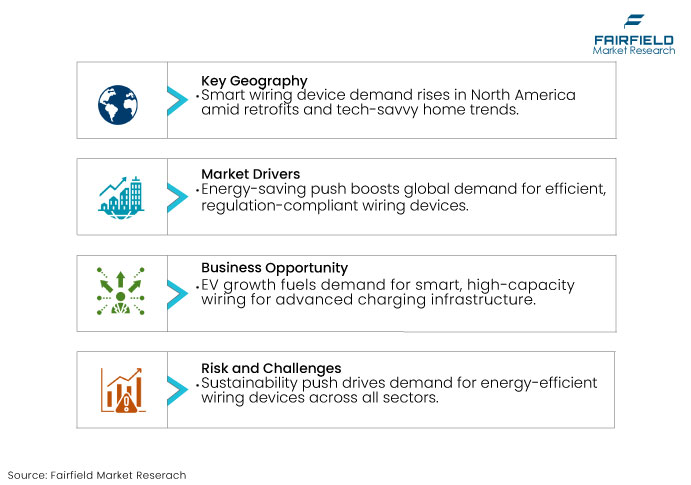
- Rising Demand for Energy-Saving Electrical Solutions
The global shift toward energy conservation and sustainability is significantly influencing the wiring devices market. Governments and organizations are introducing stricter regulations and offering incentives to promote energy-efficient technologies across residential, commercial, and industrial sectors. This drives demand for wiring devices that optimize energy use and reduce electricity waste.
Smart switches, energy-saving outlets, and advanced circuit protection devices are playing a key role in modernizing electrical systems. These products support smart home and building automation by enabling real-time monitoring and control of energy consumption. According to the Bureau of Energy Efficiency's (BEE) India Energy Scenario 2024 report, the implementation of various energy efficiency schemes resulted in total energy savings of 53.60 million tonnes of oil equivalent (Mtoe) in 2023-24, accounting for approximately 6% of the country's total primary energy supply. This includes savings of 25.96 Mtoe in thermal energy and 321.39 billion units (BU) of electricity, leading to significant cost reductions of nearly US$ 20 billion.
Key Growth Barrier
- Technological Complexity and Compatibility
The technological complexity and compatibility challenges posed by advanced wiring devices, such as smart technologies, IoT capabilities, and energy-efficient features, present notable barriers to market growth. As these devices evolve, their increased design and functionality, and complexity often lead to compatibility issues with older infrastructure. Integrating modern systems like smart switches and energy-efficient outlets into pre-existing electrical setups often requires costly and time-consuming modifications.
Many consumers hesitate to adopt these advanced systems due to the potential hassle of upgrading their entire electrical infrastructure. Specialized installation requirements and retrofitting needs further limit adoption, particularly in residential and commercial sectors with older systems. The rapid pace of technological innovation results in reluctance to invest in devices that quickly become outdated, slowing market penetration, especially in regions where customers are more conservative about embracing new technologies.
Wiring Devices Market Trends and Opportunities
- Electrical Vehicle Charging Infrastructure
The expansion of the electric vehicle (EV) market has significantly increased the demand for robust and reliable charging infrastructure. From residential charging points to large-scale commercial stations, high-quality electrical wiring solutions are necessary to handle varying voltages and power loads, especially at fast-charging stations that require higher-capacity wiring. With the integration of EV chargers into smart grids and digital platforms, there is a growing demand for sophisticated wiring solutions capable of supporting features such as load management, remote monitoring, and dynamic pricing. Companies such as Tesla and ChargePoint have led the way in this integration and as this continues the market for specialized wiring solutions compatible with current and future technologies is poised to expand.
For example, in the U.S., an estimated 28 million EV charging ports will be needed by 2030 to support 33 million EVs. In China, where home charging access is limited and public charging is widespread the government continues to enhance high-quality charging infrastructure. The country accounted for 70% of global public LDV charging in 2023 and is projected to maintain this share through 2035, reflecting strong demand for reliable wiring systems. According to the U.S. Department of Energy, the US will need 28 million EV charging ports to support 33 million EVs by 2030.
- Increased Focus on Safety Standards and Compliance
Governments worldwide are tightening safety regulations, prompting manufacturers and consumers to adopt safer, compliant wiring solutions. This is evident in the enforcement of updated standards that emphasize electrical safety across residential, commercial, and industrial sectors. In the UK, the BS 7671:2018/A3:2024 (IET Wiring Regulations) reflects a strong commitment to safety and, while non-statutory, is often legally binding through its reference in statutory instruments.
In the U.S., the updated UL 2610 standard, released in January 2023, governs the safety of security alarm systems in commercial premises. Recognized by OSHA’s NRTL Program, it consolidates key safety requirements for systems such as central station burglar alarms. As a result, manufacturers are increasingly developing wiring devices with enhanced insulation, fire resistance, and durability to comply with such evolving standards, driving innovation and market growth.
Leading Segment Overview
- Current Carrying Devices Segment Leads the Wiring Devices Market
Current carrying devices are anticipated to account for 45.1% share of the wiring devices market in 2025, due to increasing demand for efficient power distribution systems across all sectors. The rise in smart homes and automation technologies is driving the adoption of advanced switches, sockets, and circuit breakers. Urbanization and infrastructure development, especially in emerging economies, are also contributing to this growth.
Circuit protection devices are expected to grow at a significant rate as the demand for safety and reliability in electrical systems increases. As the use of complex electrical installations rises across industries such as construction, automotive, and electronics, the need for circuit breakers, fuses, and surge protectors grows. These devices help prevent damage caused by overloads, short circuits, and electrical faults, thereby enhancing system longevity.
- Commercial Sector Expansion Fueled by Renovations, Safety Standards, and Smart Wiring Solutions
The commercial segment is anticipated to account for 39.2% of the market share in 2025, driven by the rise in renovation and construction projects, along with stricter regulations for safety and energy standards, which are boosting the demand for wiring devices. The need for energy-efficient wiring solutions, along with the integration of smart technologies such as IoT and automation in commercial properties, further accelerates market expansion.
The residential sector is rapidly growing due to the rising demand for smart homes and energy-efficient solutions. The shift toward home automation, IoT-enabled devices, and smart home ecosystems is driving the need for advanced wiring devices such as smart switches and sensors. As new homes are built and older ones are renovated with modern technologies, the market is experiencing significant expansion, fueled by increasing consumer awareness and affordability of smart devices.
Regional Analysis
- Smart Wiring Devices Surge as North American Consumers Prioritize Convenience, Efficiency, and Security
Consumers in North America are increasingly prioritizing convenience, energy efficiency, and security, and driving demand for smart wiring devices such as voice-controlled switches and app-enabled outlets. These devices have gained mainstream traction due to their affordability and ease of installation, particularly in tech-savvy suburban homes and upscale apartment complexes. Additionally, renovation and retrofitting of aging infrastructure, especially in the Northeastern U.S. and Central Canada, have spurred demand for modern wiring systems such as USB-integrated sockets, tamper-resistant receptacles, and GFCI devices.
The surge in data center development, driven by AI and cloud computing has significantly impacted wiring device needs with the U.S. Department of Energy reporting that data centers accounted for 4.4% of national electricity use in 2023 and may reach between 6.7% to 12% by 2028. Residential construction also plays a major role, with March 2025 housing completions rising 3.9% year-over-year to a rate of 1,549,000, according to the U.S. census for new residential construction. Furthermore, the U.S. Census Bureau reported that construction spending in the first two months of 2025 reached $311.1 billion, a 2.1% increase from 2024, supporting further growth in demand for wiring devices.
- Asia Pacific Leads the Wiring Devices Market
Asia Pacific is projected to account for more than 35% market share by 2025, driven by rapid urbanization, industrialization, and growing infrastructure development in emerging economies such as China, India, and Southeast Asia. With over 60% of the world’s urban population residing in Asia, urban expansion is fueling demand for new residential, commercial, and industrial infrastructure, each requiring extensive wiring systems. Government investments in smart city initiatives further amplify this demand.
For instance, China’s Smart City Development Plan aims to integrate advanced information technologies with urban infrastructure, while India’s Smart Cities Mission is driving the creation of 100 smart cities, necessitating modern wiring solutions. Japan’s commitment to net-zero emissions by 2050 is spurring investments in renewable energy infrastructure, and South Korea’s Green New Deal supports eco-friendly infrastructure development, contributing to increased demand for advanced wiring devices.
- Renewable Energy and Smart Grid Developments Accelerating Advanced Wiring Device Market Growth in Europe
In Europe, the growing emphasis on energy efficiency and renewable energy is driving the demand for advanced wiring devices. Countries like Germany are adopting smart switches and energy-efficient outlets to meet stringent energy standards set by the government and the EU. With renewable sources accounting for 59.0% of Germany's electricity generation in 2024, up from 56.0% in 2023, the country's relatively low levels of large-scale electricity storage (1.7 GW with 2.2 GWh in January 2025) highlight the need for improved grid management and flexibility services, further boosting demand for sophisticated wiring devices.
The UK is experiencing growth in its electricity network sector due to substantial investments, with Ofgem approving a £4 billion allocation for grid equipment. This proactive strategy aligns with the country’s green energy objectives and stimulates increased demand for advanced wiring devices. Spain's urbanization and smart city growth are significantly impacting wiring device demand. Cities like Barcelona and Madrid are adopting smart technologies to optimize energy usage and reduce environmental impacts, particularly through smart homes and renewable energy integration.
Key Companies
• Schneider Electric
• Legrand
• TE Connectivity
• Eaton Corporation Inc.
• Honeywell International Inc.
• Leviton Manufacturing Co.
• Panasonic Corporation
• Lutron Electronics Co., Inc.
• ABB
• Hubbell Incorporated
Global Wiring Devices Market is segmented as-
By Product
• Current Carrying Devices
• Non-current Carrying Devices
• Circuit Protection Devices
By Application
• Commercial
• Industrial
• Residential
By Region:
• North America
• Europe
• Asia Pacific
• Latin America
• Middle East & Africa
- Executive Summary
- Global Wiring Devices Market Snapshot
- Future Projections
- Key Market Trends
- Regional Snapshot, by Value, 2026
- Analyst Recommendations
- Market Overview
- Market Definitions and Segmentations
- Market Dynamics
- Drivers
- Restraints
- Market Opportunities
- Value Chain Analysis
- COVID-19 Impact Analysis
- Porter's Five Forces Analysis
- Impact of Russia-Ukraine Conflict
- PESTLE Analysis
- Regulatory Analysis
- Price Trend Analysis
- Current Prices and Future Projections, 2025-2033
- Price Impact Factors
- Global Wiring Devices Market Outlook, 2020 - 2033
- Global Wiring Devices Market Outlook, by Product, Value (US$ Bn), 2020-2033
- Current Carrying Devices
- Non-current Carrying Devices
- Circuit Protection Devices
- Global Wiring Devices Market Outlook, by Application, Value (US$ Bn), 2020-2033
- Commercial
- Industrial
- Residential
- Global Wiring Devices Market Outlook, by Region, Value (US$ Bn), 2020-2033
- North America
- Europe
- Asia Pacific
- Latin America
- Middle East & Africa
- Global Wiring Devices Market Outlook, by Product, Value (US$ Bn), 2020-2033
- North America Wiring Devices Market Outlook, 2020 - 2033
- North America Wiring Devices Market Outlook, by Product, Value (US$ Bn), 2020-2033
- Current Carrying Devices
- Non-current Carrying Devices
- Circuit Protection Devices
- North America Wiring Devices Market Outlook, by Application, Value (US$ Bn), 2020-2033
- Commercial
- Industrial
- Residential
- North America Wiring Devices Market Outlook, by Country, Value (US$ Bn), 2020-2033
- U.S. Wiring Devices Market Outlook, by Product, 2020-2033
- U.S. Wiring Devices Market Outlook, by Application, 2020-2033
- Canada Wiring Devices Market Outlook, by Product, 2020-2033
- Canada Wiring Devices Market Outlook, by Application, 2020-2033
- BPS Analysis/Market Attractiveness Analysis
- North America Wiring Devices Market Outlook, by Product, Value (US$ Bn), 2020-2033
- Europe Wiring Devices Market Outlook, 2020 - 2033
- Europe Wiring Devices Market Outlook, by Product, Value (US$ Bn), 2020-2033
- Current Carrying Devices
- Non-current Carrying Devices
- Circuit Protection Devices
- Europe Wiring Devices Market Outlook, by Application, Value (US$ Bn), 2020-2033
- Commercial
- Industrial
- Residential
- Europe Wiring Devices Market Outlook, by Country, Value (US$ Bn), 2020-2033
- Germany Wiring Devices Market Outlook, by Product, 2020-2033
- Germany Wiring Devices Market Outlook, by Application, 2020-2033
- Italy Wiring Devices Market Outlook, by Product, 2020-2033
- Italy Wiring Devices Market Outlook, by Application, 2020-2033
- France Wiring Devices Market Outlook, by Product, 2020-2033
- France Wiring Devices Market Outlook, by Application, 2020-2033
- U.K. Wiring Devices Market Outlook, by Product, 2020-2033
- U.K. Wiring Devices Market Outlook, by Application, 2020-2033
- Spain Wiring Devices Market Outlook, by Product, 2020-2033
- Spain Wiring Devices Market Outlook, by Application, 2020-2033
- Russia Wiring Devices Market Outlook, by Product, 2020-2033
- Russia Wiring Devices Market Outlook, by Application, 2020-2033
- Rest of Europe Wiring Devices Market Outlook, by Product, 2020-2033
- Rest of Europe Wiring Devices Market Outlook, by Application, 2020-2033
- BPS Analysis/Market Attractiveness Analysis
- Europe Wiring Devices Market Outlook, by Product, Value (US$ Bn), 2020-2033
- Asia Pacific Wiring Devices Market Outlook, 2020 - 2033
- Asia Pacific Wiring Devices Market Outlook, by Product, Value (US$ Bn), 2020-2033
- Current Carrying Devices
- Non-current Carrying Devices
- Circuit Protection Devices
- Asia Pacific Wiring Devices Market Outlook, by Application, Value (US$ Bn), 2020-2033
- Commercial
- Industrial
- Residential
- Asia Pacific Wiring Devices Market Outlook, by Country, Value (US$ Bn), 2020-2033
- China Wiring Devices Market Outlook, by Product, 2020-2033
- China Wiring Devices Market Outlook, by Application, 2020-2033
- Japan Wiring Devices Market Outlook, by Product, 2020-2033
- Japan Wiring Devices Market Outlook, by Application, 2020-2033
- South Korea Wiring Devices Market Outlook, by Product, 2020-2033
- South Korea Wiring Devices Market Outlook, by Application, 2020-2033
- India Wiring Devices Market Outlook, by Product, 2020-2033
- India Wiring Devices Market Outlook, by Application, 2020-2033
- Southeast Asia Wiring Devices Market Outlook, by Product, 2020-2033
- Southeast Asia Wiring Devices Market Outlook, by Application, 2020-2033
- Rest of SAO Wiring Devices Market Outlook, by Product, 2020-2033
- Rest of SAO Wiring Devices Market Outlook, by Application, 2020-2033
- BPS Analysis/Market Attractiveness Analysis
- Asia Pacific Wiring Devices Market Outlook, by Product, Value (US$ Bn), 2020-2033
- Latin America Wiring Devices Market Outlook, 2020 - 2033
- Latin America Wiring Devices Market Outlook, by Product, Value (US$ Bn), 2020-2033
- Current Carrying Devices
- Non-current Carrying Devices
- Circuit Protection Devices
- Latin America Wiring Devices Market Outlook, by Application, Value (US$ Bn), 2020-2033
- Commercial
- Industrial
- Residential
- Latin America Wiring Devices Market Outlook, by Country, Value (US$ Bn), 2020-2033
- Brazil Wiring Devices Market Outlook, by Product, 2020-2033
- Brazil Wiring Devices Market Outlook, by Application, 2020-2033
- Mexico Wiring Devices Market Outlook, by Product, 2020-2033
- Mexico Wiring Devices Market Outlook, by Application, 2020-2033
- Argentina Wiring Devices Market Outlook, by Product, 2020-2033
- Argentina Wiring Devices Market Outlook, by Application, 2020-2033
- Rest of LATAM Wiring Devices Market Outlook, by Product, 2020-2033
- Rest of LATAM Wiring Devices Market Outlook, by Application, 2020-2033
- BPS Analysis/Market Attractiveness Analysis
- Latin America Wiring Devices Market Outlook, by Product, Value (US$ Bn), 2020-2033
- Middle East & Africa Wiring Devices Market Outlook, 2020 - 2033
- Middle East & Africa Wiring Devices Market Outlook, by Product, Value (US$ Bn), 2020-2033
- Current Carrying Devices
- Non-current Carrying Devices
- Circuit Protection Devices
- Middle East & Africa Wiring Devices Market Outlook, by Application, Value (US$ Bn), 2020-2033
- Commercial
- Industrial
- Residential
- Middle East & Africa Wiring Devices Market Outlook, by Country, Value (US$ Bn), 2020-2033
- GCC Wiring Devices Market Outlook, by Product, 2020-2033
- GCC Wiring Devices Market Outlook, by Application, 2020-2033
- South Africa Wiring Devices Market Outlook, by Product, 2020-2033
- South Africa Wiring Devices Market Outlook, by Application, 2020-2033
- Egypt Wiring Devices Market Outlook, by Product, 2020-2033
- Egypt Wiring Devices Market Outlook, by Application, 2020-2033
- Nigeria Wiring Devices Market Outlook, by Product, 2020-2033
- Nigeria Wiring Devices Market Outlook, by Application, 2020-2033
- Rest of Middle East Wiring Devices Market Outlook, by Product, 2020-2033
- Rest of Middle East Wiring Devices Market Outlook, by Application, 2020-2033
- BPS Analysis/Market Attractiveness Analysis
- Middle East & Africa Wiring Devices Market Outlook, by Product, Value (US$ Bn), 2020-2033
- Competitive Landscape
- Company Vs Segment Heatmap
- Company Market Share Analysis, 2025
- Competitive Dashboard
- Company Profiles
- Schneider Electric
- Company Overview
- Product Portfolio
- Financial Overview
- Business Strategies and Developments
- Legrand
- TE Connectivity
- Eaton Corporation Inc.
- Honeywell International Inc.
- Leviton Manufacturing Co.
- Panasonic Corporation
- Lutron Electronics Co., Inc.
- ABB
- Hubbell Incorporated
- Schneider Electric
- Appendix
- Research Methodology
- Report Assumptions
- Acronyms and Abbreviations
|
BASE YEAR |
HISTORICAL DATA |
FORECAST PERIOD |
UNITS |
|||
 |
2025 |
 |
2020 - 2025 |
 |
2026 - 2033 |
Value: US$ Million |
Our Research Methodology
Considering the volatility of business today, traditional approaches to strategizing a game plan can be unfruitful if not detrimental. True ambiguity is no way to determine a forecast. A myriad of predetermined factors must be accounted for such as the degree of risk involved, the magnitude of circumstances, as well as conditions or consequences that are not known or unpredictable. To circumvent binary views that cast uncertainty, the application of market research intelligence to strategically posture, move, and enable actionable outcomes is necessary.
View Methodology
Quality Assured
Rigorous Validation Process

Confidentiality Assured
End-to-end Data Security

Custom Research Services
Tailored To Your Objectives
FAQs
The Wiring Devices market is expected to reach USD 64.7 billion in 2026.
The Wiring Devices market is projected to grow at a 6.1% CAGR through 2033.
The Wiring Devices market growth is driven by rising adoption of smart wiring devices, increasing construction and infrastructure development, and growing demand for energy-efficient electrical solutions.
Asia Pacific is the dominant regional market for the Wiring Devices market.
Schneider Electric, Legrand, TE Connectivity, Eaton Corporation Inc., and ABB are some of the leading industry players in the Wiring Devices market.
Related Reports
Ultralight & Light Aircraft Market Insights, Competitive Landscape, and Market Forecast 2026–2033
Ultralight & Light Aircraft Market is projected to reach US$29.05 billion by 2033, driven by flight training, recreational aviation, VTOL, and electric aircraft adoption.
Motor Soft Starter Market Insights, Competitive Landscape, and Market Forecast 2033
Motor Soft Starter Market to reach US$3.98 Bn by 2033 at 6.1% CAGR, driven by industrial automation, water infrastructure, and motor efficiency.
Global Sand Blasting Machines Market Insights, Competitive Landscape, and Market Forecast 2033
The global sand blasting machines market is valued at US$536.60 Mn in 2026 and is projected to reach US$725.36 Mn by 2033, growing at a 4.4% CAGR
Garage and Overhead Doors Market Insights, Competitive Landscape, and Market Forecast 2033
Garage and Overhead Doors Market to reach US$11.71 Bn by 2033 at 5.6% CAGR, driven by housing, smart connectivity, and energy efficiency.
Wafer Inspection Equipment Market Insights, Competitive Landscape, and Market Forecast 2026–2033
Wafer Inspection Equipment Market to reach US$12.5 Bn by 2033 at 8.2% CAGR, driven by AI defect detection, advanced fabs, and chip demand.
Super Precision Bearing Market Insights, Competitive Landscape, and Market Forecast 2026–2033
Super Precision Bearing Market to reach US$19.58 Bn by 2033 at 7.5% CAGR, driven by semiconductors, aerospace, EVs, and medical robotics.