



Zero Liquid Discharge (ZLD) Systems Market
Zero Liquid Discharge (ZLD) Systems Market Insights, Competitive Landscape, and Market Forecast - 2033
Market Overview
Zero liquid discharge systems are integrated wastewater treatment solutions designed to eliminate liquid waste discharge from industrial facilities by recovering nearly all water for reuse while concentrating remaining contaminants into a solid or highly concentrated residual for disposal or further processing. These systems typically combine pre-treatment, membrane concentration, and thermal evaporation and crystallization stages to achieve near-total water recovery, allowing facilities to meet stringent discharge regulations while reducing freshwater intake requirements.
Demand growth through the 2026-2033 window is closely tied to tightening industrial wastewater discharge regulations in water-stressed regions, growing corporate water stewardship commitments among industrial manufacturers, and rising freshwater scarcity that is increasing the economic value of water recovery and reuse. Regulatory mandates requiring zero discharge status for specific industry sectors in several major manufacturing economies have been a particularly significant catalyst for market expansion.
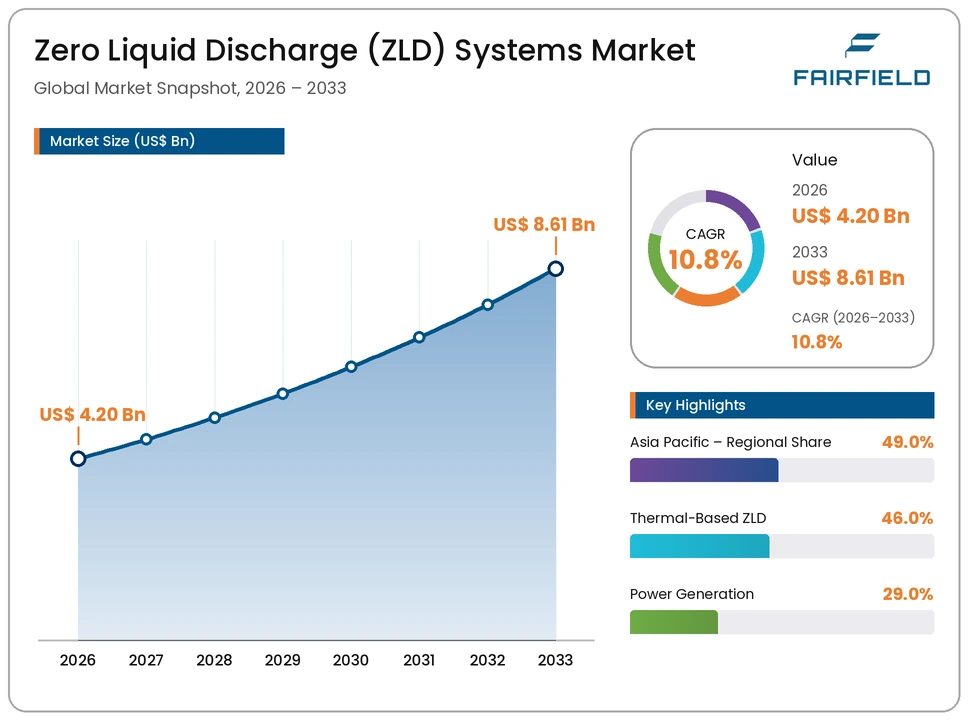
The market is valued at USD 4.20 Billion in 2026, with technology providers directing investment toward hybrid system designs that combine membrane pre-concentration with thermal finishing to reduce the energy intensity traditionally associated with fully thermal ZLD approaches. By 2033, the market is forecast to reach USD 8.61 Billion, reflecting accelerating regulatory adoption and expanding industrial applications beyond the sector's traditional power and textile industry base.
Key Highlights
- The global zero liquid discharge (ZLD) systems market is valued at USD 4.20 Billion in 2026 and is projected to reach USD 8.61 Billion by 2033, expanding at a CAGR of 10.8% across the 2026-2033 forecast period.
- Thermal-Based ZLD systems lead the technology segment with a 46.0% share in 2026, equivalent to USD 1.93 Billion.
- Power Generation remains the dominant end-use industry, accounting for 29.0% of global demand, or USD 1.22 Billion, in 2026.
- Asia Pacific commands the largest regional share at 49.0% of the global market in 2026.
- Textile and dyeing applications are emerging as the fastest-growing end-use segment through 2033.
Key Growth Drivers
Growth in the zero liquid discharge systems market is driven primarily by tightening industrial wastewater discharge regulations across water-stressed regions, where regulators are increasingly mandating zero discharge status for specific high-pollution industry sectors such as textile dyeing, pharmaceuticals, and certain chemical manufacturing operations. These regulatory mandates create direct compliance-driven demand for ZLD system installation.
A second driver is rising corporate water stewardship commitments among large industrial manufacturers, who are increasingly pursuing water recovery and reuse initiatives as part of broader sustainability programs, particularly in water-stressed operating regions where freshwater access carries growing operational and reputational risk.
Key Restraints
The substantial capital and energy costs associated with thermal-based ZLD systems create a significant barrier for smaller industrial facilities, since evaporation and crystallization processes are energy-intensive, requiring facilities to carefully weigh compliance benefits against the ongoing operating cost burden of full ZLD implementation.
Additionally, the technical complexity of designing and operating ZLD systems tailored to facility-specific wastewater characteristics requires specialized engineering expertise, adding project development time and cost relative to conventional wastewater treatment approaches that do not target complete liquid elimination.
Market Opportunities
The development of hybrid ZLD system designs that combine membrane-based pre-concentration with thermal finishing presents a substantial opportunity, as these configurations can meaningfully reduce the energy consumption associated with fully thermal approaches while still achieving zero discharge compliance, improving project economics for a broader range of facilities.
A second opportunity lies in expanding regulatory mandates across additional industry sectors and geographies, as governments in water-stressed regions continue to extend zero discharge requirements beyond the textile and power sectors that have historically been primary adopters, opening new addressable demand for system providers.
Segmentation Analysis
- By Technology
Thermal-Based ZLD systems lead the technology segment, accounting for 46.0% of global market value in 2026, equivalent to USD 1.93 Billion. Their leadership reflects their proven ability to handle high-salinity waste streams and achieve near-complete water recovery across established industrial applications. Membrane-Based ZLD systems hold a growing secondary share, valued for lower energy consumption in applications with less challenging waste stream characteristics. Hybrid ZLD Systems represent the fastest-growing technology category through 2033, combining membrane pre-concentration with thermal finishing to improve overall system energy efficiency.
- By End-Use Industry
Power Generation forms the leading end-use segment, representing 29.0% of global demand in 2026, or USD 1.22 Billion, reflecting the sector's early and extensive adoption of ZLD technology to manage cooling tower blowdown and flue gas desulfurization wastewater. Chemical & Petrochemical forms the second-largest segment, supported by increasingly stringent effluent regulations. Textile & Dyeing represents the fastest-growing end-use category, propelled by regulatory crackdowns on discharge from dyeing operations in major textile-producing countries.
Regional Insights
- Asia Pacific
Asia Pacific holds the largest regional share, at 49.0% of the global market in 2026, equivalent to USD 2.06 Billion. The region's dominance reflects aggressive zero discharge regulatory mandates in China and India targeting textile, chemical, and power generation sectors, alongside significant water scarcity concerns driving industrial water reuse investment.
- North America
North America accounts for 19.0% of the global market in 2026, valued at USD 0.80 Billion. Demand is supported by water scarcity concerns in certain regions of the United States alongside corporate sustainability commitments driving voluntary water reuse investment among large industrial manufacturers.
- Europe
Europe represents 18.0% of the global market in 2026, or USD 0.76 Billion. The region's stringent industrial wastewater discharge standards and strong corporate sustainability focus sustain steady demand for advanced water treatment and recovery systems.
- Latin America
Latin America contributes 8.0% of the global market in 2026, equivalent to USD 0.34 Billion. Growth is linked to expanding mining and industrial manufacturing activity in Chile and Brazil, sectors increasingly focused on water recovery given regional water scarcity concerns.
- Middle East & Africa
Middle East & Africa holds 6.0% of the global market in 2026, valued at USD 0.25 Billion. Demand is concentrated in Gulf Cooperation Council countries, where acute water scarcity is driving significant investment in industrial water recovery and reuse infrastructure.
Competitive Landscape
The global zero liquid discharge systems market is moderately concentrated, with a limited number of established water technology and engineering firms holding strong positions through proven system integration capability and extensive project execution track records across power, chemical, and textile sectors. A broader base of specialized engineering firms competes in regional project delivery and system component supply. Competition centers on system energy efficiency, project engineering expertise, and the ability to design solutions tailored to facility-specific wastewater characteristics, with providers increasingly differentiating through hybrid system designs and long-term operational service agreements.
Key Market Players
- Veolia Environnement S.A.
- SUEZ Group
- Aquatech International LLC
- GEA Group AG
- Praj Industries Limited
- Thermax Limited
- Saltworks Technologies Inc.
- Doosan Enerbility Co., Ltd.
- IDE Technologies Ltd.
- Veralto Corporation
Market Segmentation
By Technology
- Thermal-Based ZLD
- Membrane-Based ZLD
- Hybrid ZLD Systems
By End-Use Industry
- Power Generation
- Textile & Dyeing
- Chemical & Petrochemical
- Pharmaceuticals
- Others
By Component
- Pre-Treatment Systems
- Evaporators & Crystallizers
- Membrane Systems
By Geography
- North America
- Europe
- Asia Pacific
- Latin America
- Middle East & Africa
- Executive Summary
- Global Zero Liquid Discharge (ZLD) Systems Market Snapshot
- Future Projections
- Key Market Trends
- Regional Snapshot, by Value, 2026
- Analyst Recommendations
- Market Overview
- Market Definitions and Segmentations
- Market Dynamics
- Drivers
- Restraints
- Market Opportunities
- Value Chain Analysis
- COVID-19 Impact Analysis
- Porter's Five Forces Analysis
- Impact of Russia-Ukraine Conflict
- PESTLE Analysis
- Regulatory Analysis
- Price Trend Analysis
- Current Prices and Future Projections, 2025-2033
- Price Impact Factors
- Global Zero Liquid Discharge (ZLD) Systems Market Outlook, 2020 - 2033
- Global Zero Liquid Discharge (ZLD) Systems Market Outlook, by Technology, Value (US$ Bn), 2020-2033
- Thermal-Based ZLD
- Membrane-Based ZLD
- Hybrid ZLD Systems
- Global Zero Liquid Discharge (ZLD) Systems Market Outlook, by End-Use Industry, Value (US$ Bn), 2020-2033
- Power Generation
- Textile & Dyeing
- Chemical & Petrochemical
- Pharmaceuticals
- Others
- Global Zero Liquid Discharge (ZLD) Systems Market Outlook, by Component, Value (US$ Bn), 2020-2033
- Pre-Treatment Systems
- Evaporators & Crystallizers
- Membrane Systems
- Global Zero Liquid Discharge (ZLD) Systems Market Outlook, by Region, Value (US$ Bn), 2020-2033
- North America
- Europe
- Asia Pacific
- Latin America
- Middle East & Africa
- Global Zero Liquid Discharge (ZLD) Systems Market Outlook, by Technology, Value (US$ Bn), 2020-2033
- North America Zero Liquid Discharge (ZLD) Systems Market Outlook, 2020 - 2033
- North America Zero Liquid Discharge (ZLD) Systems Market Outlook, by Technology, Value (US$ Bn), 2020-2033
- Thermal-Based ZLD
- Membrane-Based ZLD
- Hybrid ZLD Systems
- North America Zero Liquid Discharge (ZLD) Systems Market Outlook, by End-Use Industry, Value (US$ Bn), 2020-2033
- Power Generation
- Textile & Dyeing
- Chemical & Petrochemical
- Pharmaceuticals
- Others
- North America Zero Liquid Discharge (ZLD) Systems Market Outlook, by Component, Value (US$ Bn), 2020-2033
- Pre-Treatment Systems
- Evaporators & Crystallizers
- Membrane Systems
- North America Zero Liquid Discharge (ZLD) Systems Market Outlook, by Country, Value (US$ Bn), 2020-2033
- U.S. Zero Liquid Discharge (ZLD) Systems Market Outlook, by Technology, 2020-2033
- U.S. Zero Liquid Discharge (ZLD) Systems Market Outlook, by End-Use Industry, 2020-2033
- U.S. Zero Liquid Discharge (ZLD) Systems Market Outlook, by Component, 2020-2033
- Canada Zero Liquid Discharge (ZLD) Systems Market Outlook, by Technology, 2020-2033
- Canada Zero Liquid Discharge (ZLD) Systems Market Outlook, by End-Use Industry, 2020-2033
- Canada Zero Liquid Discharge (ZLD) Systems Market Outlook, by Component, 2020-2033
- BPS Analysis/Market Attractiveness Analysis
- North America Zero Liquid Discharge (ZLD) Systems Market Outlook, by Technology, Value (US$ Bn), 2020-2033
- Europe Zero Liquid Discharge (ZLD) Systems Market Outlook, 2020 - 2033
- Europe Zero Liquid Discharge (ZLD) Systems Market Outlook, by Technology, Value (US$ Bn), 2020-2033
- Thermal-Based ZLD
- Membrane-Based ZLD
- Hybrid ZLD Systems
- Europe Zero Liquid Discharge (ZLD) Systems Market Outlook, by End-Use Industry, Value (US$ Bn), 2020-2033
- Power Generation
- Textile & Dyeing
- Chemical & Petrochemical
- Pharmaceuticals
- Others
- Europe Zero Liquid Discharge (ZLD) Systems Market Outlook, by Component, Value (US$ Bn), 2020-2033
- Pre-Treatment Systems
- Evaporators & Crystallizers
- Membrane Systems
- Europe Zero Liquid Discharge (ZLD) Systems Market Outlook, by Country, Value (US$ Bn), 2020-2033
- Germany Zero Liquid Discharge (ZLD) Systems Market Outlook, by Technology, 2020-2033
- Germany Zero Liquid Discharge (ZLD) Systems Market Outlook, by End-Use Industry, 2020-2033
- Germany Zero Liquid Discharge (ZLD) Systems Market Outlook, by Component, 2020-2033
- Italy Zero Liquid Discharge (ZLD) Systems Market Outlook, by Technology, 2020-2033
- Italy Zero Liquid Discharge (ZLD) Systems Market Outlook, by End-Use Industry, 2020-2033
- Italy Zero Liquid Discharge (ZLD) Systems Market Outlook, by Component, 2020-2033
- France Zero Liquid Discharge (ZLD) Systems Market Outlook, by Technology, 2020-2033
- France Zero Liquid Discharge (ZLD) Systems Market Outlook, by End-Use Industry, 2020-2033
- France Zero Liquid Discharge (ZLD) Systems Market Outlook, by Component, 2020-2033
- U.K. Zero Liquid Discharge (ZLD) Systems Market Outlook, by Technology, 2020-2033
- U.K. Zero Liquid Discharge (ZLD) Systems Market Outlook, by End-Use Industry, 2020-2033
- U.K. Zero Liquid Discharge (ZLD) Systems Market Outlook, by Component, 2020-2033
- Spain Zero Liquid Discharge (ZLD) Systems Market Outlook, by Technology, 2020-2033
- Spain Zero Liquid Discharge (ZLD) Systems Market Outlook, by End-Use Industry, 2020-2033
- Spain Zero Liquid Discharge (ZLD) Systems Market Outlook, by Component, 2020-2033
- Russia Zero Liquid Discharge (ZLD) Systems Market Outlook, by Technology, 2020-2033
- Russia Zero Liquid Discharge (ZLD) Systems Market Outlook, by End-Use Industry, 2020-2033
- Russia Zero Liquid Discharge (ZLD) Systems Market Outlook, by Component, 2020-2033
- Rest of Europe Zero Liquid Discharge (ZLD) Systems Market Outlook, by Technology, 2020-2033
- Rest of Europe Zero Liquid Discharge (ZLD) Systems Market Outlook, by End-Use Industry, 2020-2033
- Rest of Europe Zero Liquid Discharge (ZLD) Systems Market Outlook, by Component, 2020-2033
- BPS Analysis/Market Attractiveness Analysis
- Europe Zero Liquid Discharge (ZLD) Systems Market Outlook, by Technology, Value (US$ Bn), 2020-2033
- Asia Pacific Zero Liquid Discharge (ZLD) Systems Market Outlook, 2020 - 2033
- Asia Pacific Zero Liquid Discharge (ZLD) Systems Market Outlook, by Technology, Value (US$ Bn), 2020-2033
- Thermal-Based ZLD
- Membrane-Based ZLD
- Hybrid ZLD Systems
- Asia Pacific Zero Liquid Discharge (ZLD) Systems Market Outlook, by End-Use Industry, Value (US$ Bn), 2020-2033
- Power Generation
- Textile & Dyeing
- Chemical & Petrochemical
- Pharmaceuticals
- Others
- Asia Pacific Zero Liquid Discharge (ZLD) Systems Market Outlook, by Component, Value (US$ Bn), 2020-2033
- Pre-Treatment Systems
- Evaporators & Crystallizers
- Membrane Systems
- Asia Pacific Zero Liquid Discharge (ZLD) Systems Market Outlook, by Country, Value (US$ Bn), 2020-2033
- China Zero Liquid Discharge (ZLD) Systems Market Outlook, by Technology, 2020-2033
- China Zero Liquid Discharge (ZLD) Systems Market Outlook, by End-Use Industry, 2020-2033
- China Zero Liquid Discharge (ZLD) Systems Market Outlook, by Component, 2020-2033
- Japan Zero Liquid Discharge (ZLD) Systems Market Outlook, by Technology, 2020-2033
- Japan Zero Liquid Discharge (ZLD) Systems Market Outlook, by End-Use Industry, 2020-2033
- Japan Zero Liquid Discharge (ZLD) Systems Market Outlook, by Component, 2020-2033
- South Korea Zero Liquid Discharge (ZLD) Systems Market Outlook, by Technology, 2020-2033
- South Korea Zero Liquid Discharge (ZLD) Systems Market Outlook, by End-Use Industry, 2020-2033
- South Korea Zero Liquid Discharge (ZLD) Systems Market Outlook, by Component, 2020-2033
- India Zero Liquid Discharge (ZLD) Systems Market Outlook, by Technology, 2020-2033
- India Zero Liquid Discharge (ZLD) Systems Market Outlook, by End-Use Industry, 2020-2033
- India Zero Liquid Discharge (ZLD) Systems Market Outlook, by Component, 2020-2033
- Southeast Asia Zero Liquid Discharge (ZLD) Systems Market Outlook, by Technology, 2020-2033
- Southeast Asia Zero Liquid Discharge (ZLD) Systems Market Outlook, by End-Use Industry, 2020-2033
- Southeast Asia Zero Liquid Discharge (ZLD) Systems Market Outlook, by Component, 2020-2033
- Rest of SAO Zero Liquid Discharge (ZLD) Systems Market Outlook, by Technology, 2020-2033
- Rest of SAO Zero Liquid Discharge (ZLD) Systems Market Outlook, by End-Use Industry, 2020-2033
- Rest of SAO Zero Liquid Discharge (ZLD) Systems Market Outlook, by Component, 2020-2033
- BPS Analysis/Market Attractiveness Analysis
- Asia Pacific Zero Liquid Discharge (ZLD) Systems Market Outlook, by Technology, Value (US$ Bn), 2020-2033
- Latin America Zero Liquid Discharge (ZLD) Systems Market Outlook, 2020 - 2033
- Latin America Zero Liquid Discharge (ZLD) Systems Market Outlook, by Technology, Value (US$ Bn), 2020-2033
- Thermal-Based ZLD
- Membrane-Based ZLD
- Hybrid ZLD Systems
- Latin America Zero Liquid Discharge (ZLD) Systems Market Outlook, by End-Use Industry, Value (US$ Bn), 2020-2033
- Power Generation
- Textile & Dyeing
- Chemical & Petrochemical
- Pharmaceuticals
- Others
- Latin America Zero Liquid Discharge (ZLD) Systems Market Outlook, by Component, Value (US$ Bn), 2020-2033
- Pre-Treatment Systems
- Evaporators & Crystallizers
- Membrane Systems
- Latin America Zero Liquid Discharge (ZLD) Systems Market Outlook, by Country, Value (US$ Bn), 2020-2033
- Brazil Zero Liquid Discharge (ZLD) Systems Market Outlook, by Technology, 2020-2033
- Brazil Zero Liquid Discharge (ZLD) Systems Market Outlook, by End-Use Industry, 2020-2033
- Brazil Zero Liquid Discharge (ZLD) Systems Market Outlook, by Component, 2020-2033
- Mexico Zero Liquid Discharge (ZLD) Systems Market Outlook, by Technology, 2020-2033
- Mexico Zero Liquid Discharge (ZLD) Systems Market Outlook, by End-Use Industry, 2020-2033
- Mexico Zero Liquid Discharge (ZLD) Systems Market Outlook, by Component, 2020-2033
- Argentina Zero Liquid Discharge (ZLD) Systems Market Outlook, by Technology, 2020-2033
- Argentina Zero Liquid Discharge (ZLD) Systems Market Outlook, by End-Use Industry, 2020-2033
- Argentina Zero Liquid Discharge (ZLD) Systems Market Outlook, by Component, 2020-2033
- Rest of LATAM Zero Liquid Discharge (ZLD) Systems Market Outlook, by Technology, 2020-2033
- Rest of LATAM Zero Liquid Discharge (ZLD) Systems Market Outlook, by End-Use Industry, 2020-2033
- Rest of LATAM Zero Liquid Discharge (ZLD) Systems Market Outlook, by Component, 2020-2033
- BPS Analysis/Market Attractiveness Analysis
- Latin America Zero Liquid Discharge (ZLD) Systems Market Outlook, by Technology, Value (US$ Bn), 2020-2033
- Middle East & Africa Zero Liquid Discharge (ZLD) Systems Market Outlook, 2020 - 2033
- Middle East & Africa Zero Liquid Discharge (ZLD) Systems Market Outlook, by Technology, Value (US$ Bn), 2020-2033
- Thermal-Based ZLD
- Membrane-Based ZLD
- Hybrid ZLD Systems
- Middle East & Africa Zero Liquid Discharge (ZLD) Systems Market Outlook, by End-Use Industry, Value (US$ Bn), 2020-2033
- Power Generation
- Textile & Dyeing
- Chemical & Petrochemical
- Pharmaceuticals
- Others
- Middle East & Africa Zero Liquid Discharge (ZLD) Systems Market Outlook, by Component, Value (US$ Bn), 2020-2033
- Pre-Treatment Systems
- Evaporators & Crystallizers
- Membrane Systems
- Middle East & Africa Zero Liquid Discharge (ZLD) Systems Market Outlook, by Country, Value (US$ Bn), 2020-2033
- GCC Zero Liquid Discharge (ZLD) Systems Market Outlook, by Technology, 2020-2033
- GCC Zero Liquid Discharge (ZLD) Systems Market Outlook, by End-Use Industry, 2020-2033
- GCC Zero Liquid Discharge (ZLD) Systems Market Outlook, by Component, 2020-2033
- South Africa Zero Liquid Discharge (ZLD) Systems Market Outlook, by Technology, 2020-2033
- South Africa Zero Liquid Discharge (ZLD) Systems Market Outlook, by End-Use Industry, 2020-2033
- South Africa Zero Liquid Discharge (ZLD) Systems Market Outlook, by Component, 2020-2033
- Egypt Zero Liquid Discharge (ZLD) Systems Market Outlook, by Technology, 2020-2033
- Egypt Zero Liquid Discharge (ZLD) Systems Market Outlook, by End-Use Industry, 2020-2033
- Egypt Zero Liquid Discharge (ZLD) Systems Market Outlook, by Component, 2020-2033
- Nigeria Zero Liquid Discharge (ZLD) Systems Market Outlook, by Technology, 2020-2033
- Nigeria Zero Liquid Discharge (ZLD) Systems Market Outlook, by End-Use Industry, 2020-2033
- Nigeria Zero Liquid Discharge (ZLD) Systems Market Outlook, by Component, 2020-2033
- Rest of Middle East Zero Liquid Discharge (ZLD) Systems Market Outlook, by Technology, 2020-2033
- Rest of Middle East Zero Liquid Discharge (ZLD) Systems Market Outlook, by End-Use Industry, 2020-2033
- Rest of Middle East Zero Liquid Discharge (ZLD) Systems Market Outlook, by Component, 2020-2033
- BPS Analysis/Market Attractiveness Analysis
- Middle East & Africa Zero Liquid Discharge (ZLD) Systems Market Outlook, by Technology, Value (US$ Bn), 2020-2033
- Competitive Landscape
- Company Vs Segment Heatmap
- Company Market Share Analysis, 2025
- Competitive Dashboard
- Company Profiles
- Veolia Environnement S.A.
- Company Overview
- Product Portfolio
- Financial Overview
- Business Strategies and Developments
- SUEZ Group
- Aquatech International LLC
- GEA Group AG
- Praj Industries Limited
- Thermax Limited
- Saltworks Technologies Inc.
- Doosan Enerbility Co., Ltd.
- IDE Technologies Ltd.
- Veralto Corporation
- Veolia Environnement S.A.
- Appendix
- Research Methodology
- Report Assumptions
- Acronyms and Abbreviations
By Technology
- Thermal-Based ZLD
- Membrane-Based ZLD
- Hybrid ZLD Systems
By End-Use Industry
- Power Generation
- Textile & Dyeing
- Chemical & Petrochemical
- Pharmaceuticals
- Others
By Component
- Pre-Treatment Systems
- Evaporators & Crystallizers
- Membrane Systems
By Geography
- North America
- Europe
- Asia Pacific
- Latin America
- Middle East & Africa
Our Research Methodology
Considering the volatility of business today, traditional approaches to strategizing a game plan can be unfruitful if not detrimental. True ambiguity is no way to determine a forecast. A myriad of predetermined factors must be accounted for such as the degree of risk involved, the magnitude of circumstances, as well as conditions or consequences that are not known or unpredictable. To circumvent binary views that cast uncertainty, the application of market research intelligence to strategically posture, move, and enable actionable outcomes is necessary.
View Methodology
Quality Assured
Rigorous Validation Process

Confidentiality Assured
End-to-end Data Security

Custom Research Services
Tailored To Your Objectives
FAQs
The global zero liquid discharge systems market is valued at USD 4.20 Billion in 2026, reflecting growing regulatory and sustainability-driven adoption of industrial water recovery.
The market is projected to grow at a CAGR of 10.8%, reaching USD 8.61 Billion by 2033, driven by tightening discharge regulations and expanding water reuse mandates.
Thermal-Based ZLD systems lead with a 46.0% share in 2026, valued for their ability to handle high-salinity waste streams reliably.
Asia Pacific leads with a 49.0% share in 2026, driven by aggressive regulatory mandates in China and India across multiple industry sectors.
The largest opportunity lies in hybrid system designs that reduce energy consumption while achieving full zero discharge compliance, improving project economics for a wider range of facilities.
Related Reports
2D Materials Market Size, Share, Insights, Competitive Landscape, and Forecast 2026 to 2033
The global 2D materials market is valued at US$3.65 billion in 2026, reaching US$10.20 billion by 2033, growing at a 15.8% CAGR
2,4-Dichloro-5-Fluorobenzoic Acid Market Size, Share, Insights, Competitive Landscape, and Forecast 2026 to 2033
The global 2,4-dichloro-5-fluorobenzoic acid market is valued at US$0.09 billion in 2026, reaching US$0.12 billion by 2033, at a 4.2% CAGR
1,5-Hexadiene Market Size, Share, Insights, Competitive Landscape, and Forecast 2026 to 2033
The global 1,5-hexadiene market is valued at US$0.14 billion in 2026, reaching US$0.22 billion by 2033, growing at a 6.7% CAGR
Automotive NVH Materials Market Size, Share, Insights, Competitive Landscape, and Forecast 2026 to 2033
The global automotive NVH materials market is valued at US$13.8 billion in 2026, reaching US$20.5 billion by 2033, growing at a 5.82% CAGR
Acrylonitrile Butadiene Styrene Market Size, Share, Insights, Competitive Landscape, and Forecast 2026 to 2033
The global acrylonitrile butadiene styrene market is valued at US$27.4 billion in 2026, reaching US$38.6 billion by 2033, growing at a 5.02% CAGR
Tank Mix Adjuvants Market Size, Share, Insights, Competitive Landscape, and Forecast 2026 to 2033
The global tank mix adjuvants market is valued at US$4.3 billion in 2026, reaching US$6.6 billion by 2033, growing at a 6.3% CAGR