



Agentic AI in Pharmaceuticals Market
Agentic AI in Pharmaceuticals Market Size, Share, Insights, Competitive Landscape, and Forecast 2026 to 2033
Agentic AI in Pharmaceuticals Market Size and Trend Analysis
How Fast Will Agentic AI Spending in Pharma Grow?
The global Agentic AI in Pharmaceuticals market size is expected to be valued at US$ 1.3 billion in 2026 and projected to reach US$ 13.0 billion by 2033, growing at a CAGR of 38.95% between 2026 and 2033.
The category barely existed before 2023, so the estimated 62.0% CAGR recorded between 2020 and 2025 reflects a negligible starting base rather than mature demand. Three forces drive the forecast. Document-heavy processes in regulatory writing, safety case handling and trial operations are labour-bound and well suited to agents that plan and execute multi-step tasks. Patent expiries and cost-per-approval pressure push sponsors to cut cycle time rather than headcount alone. Enterprise software vendors are embedding agent frameworks into systems pharmaceutical companies already validate. Growth will be real but uneven, because validation and regulatory acceptance, not model capability, set the adoption pace.
Key Report Takeaways
- By Component: Agent Platforms and Orchestration Software held 38.0% share in 2026, while Domain-Specific Agent Applications are projected to expand at a 43.5% CAGR through 2033, as buyers shift from building agents to purchasing validated task-specific products.
- By Application: Drug Discovery and Preclinical Research held 29.0% share in 2026, while Regulatory Affairs and Medical Writing is projected to expand at a 44.8% CAGR through 2033, driven by structured, template-governed documents that agents can draft and check reliably.
- By Deployment Model: Private Cloud held 39.0% share in 2026, while Public Cloud GxP-Qualified SaaS is projected to expand at a 43.8% CAGR through 2033, as hyperscalers publish qualification evidence that shortens customer validation work.
- By End User: Large Pharmaceutical Companies held 54.0% share in 2026, while Contract Research Organizations are projected to expand at a 42.5% CAGR through 2033, because service margins depend directly on automating repeatable delivery work.
- By Region: North America held 48.0% share in 2026, while Asia Pacific is projected to expand at a 45.0% CAGR through 2033, supported by clinical development capacity in China, Japan, India and South Korea.
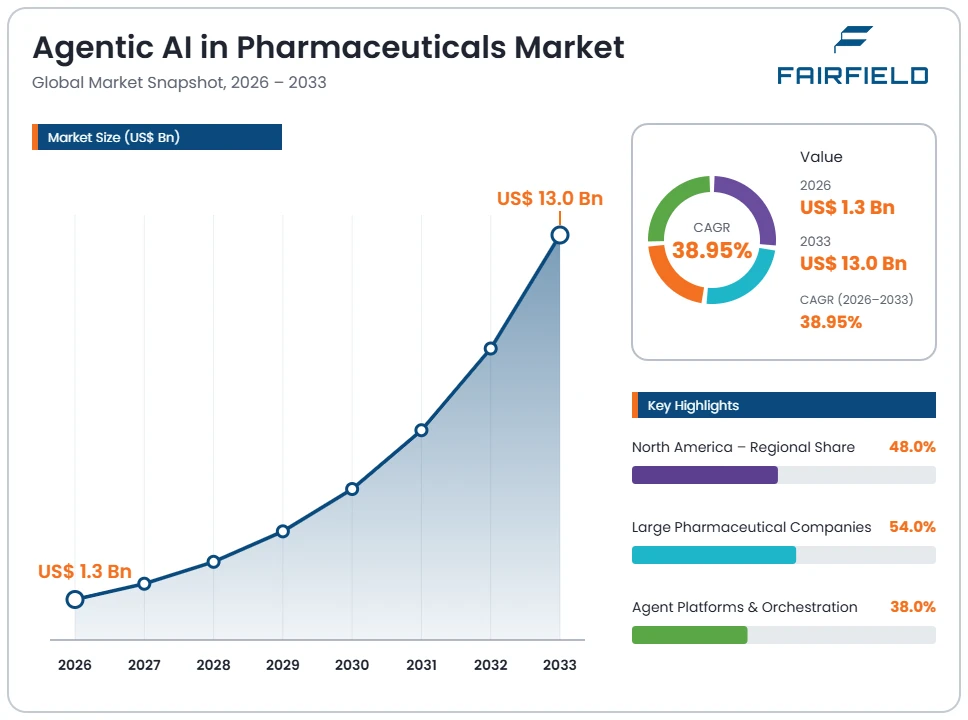
Global Agentic AI in Pharmaceuticals Market Trends and Insights
Drivers Impact Analysis
Two pressures explain most forecast spending, and both concern process cost rather than scientific novelty.
| Driver | Impact on CAGR Forecast | Geographic Relevance | Impact Timeline |
| Document-intensive regulatory, safety and trial workflows suited to multi-step automation | High | North America, Europe, Asia Pacific | Medium term (2–4 years) |
| Research and development productivity pressure from patent expiries and rising trial cost | High | North America, Europe | Long term (≥4 years) |
Document-Heavy Regulatory and Safety Workflows Pull Agents Into Pharmaceutical Operations
The strongest demand comes from processes that are structured, repetitive and expensive in skilled labour. Regulatory submissions, clinical study reports, protocol amendments, safety narratives and responses to health authority questions all follow templates, reference controlled source data and demand traceable consistency. An agent that retrieves the right source, drafts to the template, checks internal consistency and logs each step addresses the actual bottleneck, which is coordination rather than writing.
The causal mechanism is the gap between document volume and reviewer capacity. A single marketing application can run to tens of thousands of pages, and safety departments process individual case safety reports continuously under ICH E2B formats. Hiring medical writers and safety associates scales linearly with volume. Agent orchestration breaks that link by handling retrieval, assembly and quality checking, leaving qualified staff to review and approve.
Patent Expiries and Trial Cost Inflation Force Sponsors Toward Agent-Led Process Redesign
Economic pressure on research and development budgets is the second driver. Large sponsors face a dense run of patent expiries, slower price growth in major markets, and clinical trial costs that keep rising with protocol complexity. Shaving months from study start-up or submission preparation changes net present value materially, which makes automation a board-level priority rather than a digital pilot.
The mechanism runs through cycle time, not headcount reduction. Site identification, country feasibility analysis, data query resolution, protocol deviation review and medical monitoring each involve many dependent steps spread across separate validated systems. Agents can execute those chains continuously, overnight and across time zones, then escalate only the exceptions that need judgement. Sponsors that compress study timelines gain additional months of exclusivity, and that calculation justifies the validation investment far more convincingly than generic efficiency claims ever do.
Restraints Impact Analysis
Two constraints hold adoption well below technical possibility, and both are regulatory rather than commercial.
| Restraint | Impact on CAGR Forecast | Geographic Relevance | Impact Timeline |
| GxP computerised system validation and data integrity obligations for non-deterministic agents | High | Global | Long term (≥4 years) |
| Unsettled regulatory acceptability and accountability for autonomous agent decisions | High | Europe, North America | Long term (≥4 years) |
Validation and Data Integrity Rules Limit Where Autonomous Agents May Operate
Computerised system validation is the practical ceiling on deployment. Any system touching a regulated record must be qualified, change-controlled and auditable, and the evidence must survive inspection years later. Agents that plan their own steps produce different execution paths on different runs, which conflicts with the deterministic testing assumptions behind traditional validation. Most companies therefore confine agents to drafting and triage, with a qualified person approving every regulated output.
The underlying cost source is evidence generation, not licence fees. Compliance with 21 CFR Part 11 and EU GMP Annex 11 demands audit trails, electronic signature controls, access management and documented supplier assessment. Risk-based approaches such as GAMP 5 help, but firms must still define intended use, test boundaries, monitor drift and requalify after model updates. That recurring burden can exceed the original implementation cost.
Unclear Accountability for Agent Decisions Keeps Humans in Every Regulated Loop
Regulatory acceptability restrains autonomy more than performance does. Health authorities expect an identifiable responsible person behind a regulatory submission, a safety assessment or a batch decision. Where an agent selects its own sequence of actions, assigning accountability becomes difficult, so sponsors limit agents to recommendations. That design choice preserves most of the review labour the technology was meant to remove.
The cause is a genuinely open policy question. The FDA has described a risk-based credibility assessment framework for artificial intelligence used in regulatory decision-making, and the EMA has set out expectations in its reflection paper on artificial intelligence across the medicinal product lifecycle. Both stress human oversight, transparency and documented data provenance. Until guidance matures and inspection precedent accumulates, conservative interpretation will remain the default across Europe and North America.
Market Opportunities
Outsourced Pharmacovigilance Case Processing Becomes an Agent-Delivered Service Pool
Safety case processing is the clearest near-term revenue pool. Marketing authorisation holders must collect, assess, code and report adverse events continuously, and volumes grow with every product launch and literature source. The work is rule-bound, high-volume and currently delivered by large offshore teams. Agents that intake cases, perform duplicate detection, code to MedDRA, draft narratives and prepare E2B submissions convert that labour pool into software and managed-service revenue.
Specialist safety vendors, large service providers and platform companies with validated hosting can capture it, usually by pricing per case rather than per seat. Marketing authorisation holders and generics companies with wide portfolios create the demand, because their safety obligations scale faster than their revenue. Electronic reporting standards and structured safety databases such as EudraVigilance make the inputs and outputs machine-readable, which is what makes reliable agent execution feasible.
Contract Research and Manufacturing Providers Monetise Agent-Enabled Delivery Models
Service providers represent a second, distinct pool. Contract research and manufacturing organisations sell delivery capacity, so any technology that raises output per employee converts directly into margin or competitive price. Agent-enabled study start-up, data management, medical writing and chemistry, manufacturing and controls documentation let providers quote shorter timelines and move toward outcome-based rather than full-time-equivalent pricing.
The providers themselves make the investment, and sponsors create the demand by insisting on faster delivery at lower unit cost in competitive bids. Emerging biotechnology companies without internal infrastructure are particularly willing to buy an agent-enabled service rather than build and validate one. Supporting developments include standardised clinical data formats from CDISC, wider adoption of risk-based monitoring under ICH good clinical practice principles, and cloud platforms that supply pre-qualified regulated infrastructure to smaller providers.
Segment Analysis
By Component: Orchestration Platforms Lead While Packaged Agent Applications Scale Faster
Agent Platforms and Orchestration Software held 38.0% of 2026 revenue. Platforms lead because early adopters built bespoke agents against their own data, and because orchestration, tool connection, memory and guardrails are the layer that makes any pharmaceutical use case work. Large enterprise agreements with hyperscalers and data platform vendors concentrate spending here.
Domain-Specific Agent Applications are the fastest-growing component at a 43.5% CAGR to 2033. Buyers increasingly prefer a purchased agent for safety case triage or submission authoring that arrives with validation documentation, rather than a toolkit requiring internal engineering.
Implementation and Validation Services and Managed and Support Services account for the remainder, and services will stay unusually large as a share of total spending. The implication is that vendors able to supply qualification evidence alongside software will convert pilots into production faster than pure technology providers.
By Application: Discovery Spending Leads as Regulatory Writing Grows Quickest
Drug Discovery and Preclinical Research accounted for 29.0% of 2026 revenue. Discovery leads because computational investment began there years earlier, budgets tolerate experimentation, and outputs are hypotheses rather than regulated records. Agents that plan assay cascades, search literature and patents, and coordinate design-make-test-analyse cycles fit an environment with no submission risk.
Regulatory Affairs and Medical Writing is the fastest-growing application at a 44.8% CAGR. Submission documents follow strict templates and controlled source data, which gives agents a bounded problem and gives reviewers a clear basis for approval.
Clinical Development and Trial Operations, Pharmacovigilance and Drug Safety, Manufacturing and Quality Operations, and Commercial and Medical Affairs complete the picture. The business implication is that adoption spreads from low-risk scientific work into regulated documentation first, and into batch and quality decisions last.
By Deployment Model: Private Cloud Leads While Qualified Public Cloud Advances Fastest
Private Cloud held 39.0% share in 2026. Dedicated environments lead because regulated sponsors want control over data residency, model versions and audit trails, and because intellectual property in molecules and trial data is extremely sensitive. A single-tenant deployment simplifies the supplier assessment that GxP rules require.
Public Cloud GxP-Qualified SaaS is the fastest-growing model at a 43.8% CAGR to 2033. Providers now publish qualification packages, shared responsibility matrices and audit support, which removes much of the validation work customers previously repeated themselves.
On-Premises and Hybrid deployments retain a durable position, particularly in manufacturing sites and in markets with strict data localisation such as China. The implication is that commercial success depends on compliance documentation quality as much as on model performance, since procurement and quality assurance teams gate every purchase.
By End User: Large Pharmaceutical Companies Dominate While Service Providers Adopt Fastest
Large Pharmaceutical Companies held 54.0% share in 2026. They dominate because they own the biggest document volumes, the broadest safety portfolios and the internal data science, quality and information security functions needed to deploy agents under regulatory scrutiny. They can also absorb multi-year validation costs that smaller firms cannot.
Contract Research Organizations are the fastest-growing end user at a 42.5% CAGR. Their economics depend on output per employee, so automation translates immediately into margin, and sponsors are now asking about agent capability during vendor selection.
Emerging Biotechnology Companies and Contract Development and Manufacturing Organizations make up the balance. Smaller biotechs buy rather than build, favouring packaged applications. The implication is a two-speed market: enterprise platform deals at the top, and subscription applications across a long tail of smaller organisations.
Geography Analysis
Which Region Is Leading the Agentic AI in Pharmaceuticals Market?
North America leads with 48.0% of the agentic artificial intelligence pharmaceutical market in 2026. The United States concentrates global research and development spending, hosts most large sponsors and the principal cloud and model providers, and supports the venture funding that seeds specialist vendors. Canada contributes through clinical research capacity and a strong academic machine learning base.
Policy clarity reinforces the position. The FDA has published draft guidance on using artificial intelligence to support regulatory decision-making for drug and biological products, which gives sponsors a credibility framework to design against. Established 21 CFR Part 11 practice means validation expectations are familiar rather than novel. The main constraint is litigation and accountability risk, which keeps qualified human approval attached to every regulated output and limits the labour savings actually realised.
Europe Advances Carefully Under a Binding Artificial Intelligence Rulebook
Europe holds 25.0% of the 2026 market. Switzerland, Germany, the United Kingdom, France, Denmark and Ireland supply most demand, reflecting the location of major sponsors, biotechnology clusters and large-scale manufacturing. Regional adoption is deliberate and documentation-led rather than experimental, with quality assurance functions involved from the first pilot.
Regulation defines the pace. The EU Artificial Intelligence Act, Regulation (EU) 2024/1689, introduces risk classification, transparency and human oversight duties that apply alongside existing pharmaceutical rules. The EMA reflection paper on artificial intelligence in the medicinal product lifecycle sets lifecycle expectations, and EU GMP Annex 11 governs computerised systems in manufacturing. The General Data Protection Regulation adds constraints on clinical and patient data. Compliance cost is high, but once documented it creates durable vendor relationships.
Which Region Is Growing Fastest in the Agentic AI in Pharmaceuticals Market?
Asia Pacific is the fastest-growing geography at a 45.0% CAGR between 2026 and 2033, from 20.5% share in 2026. China, Japan, India and South Korea drive expansion from a smaller base. China combines large domestic innovator pipelines with substantial local model development, while India hosts enormous generics portfolios whose safety and regulatory workload is ideally suited to agent automation.
Structural factors accelerate adoption. Clinical trial activity and contract service capacity have grown steadily across the region, creating exactly the repeatable delivery work agents handle well. The PMDA and the NMPA are both engaging with artificial intelligence in regulatory processes. Data localisation rules and cross-border transfer restrictions, particularly in China, remain the practical barrier, pushing vendors toward in-country deployment and local partnerships.
Latin America Adoption Concentrates in Clinical Trial and Generics Hubs
Latin America represents 3.5% of 2026 revenue. Brazil, Mexico, Argentina and Colombia account for most activity, driven by growing clinical trial participation, large domestic generics manufacturers and regional service providers supporting global sponsors. Adoption typically arrives through multinational parent companies standardising tools across affiliates rather than through independent local purchasing.
Barriers are capability and budget related. Validation expertise and regulated cloud infrastructure are scarce, local language regulatory documentation adds complexity, and national agencies have issued limited guidance on artificial intelligence in pharmaceutical processes. Currency exposure on dollar-denominated subscriptions discourages commitment. The clearest opportunity lies in pharmacovigilance and regulatory operations for regional generics portfolios, where document volumes are high and the underlying tasks are highly standardised.
Middle East & Africa Builds Capability Through Sovereign Technology Programmes
Middle East & Africa accounts for 3.0% of the 2026 market, the smallest share. Demand is concentrated in Saudi Arabia, the United Arab Emirates and Israel, where sovereign investment programmes are funding national computing infrastructure, life sciences clusters and local pharmaceutical manufacturing. South Africa contributes clinical trial activity, particularly in infectious disease research.
Constraints remain substantial across most of the region. Regulatory capacity for assessing artificial intelligence in regulated processes is still developing, skilled validation and quality personnel are scarce, and much of the pharmaceutical sector is focused on generic manufacturing with thin technology budgets. The notable opportunity is the pairing of sovereign cloud and computing investment with new local manufacturing, which may allow some countries to adopt agent-enabled quality and regulatory systems without replacing older infrastructure first.
Competitive Landscape
The agentic artificial intelligence pharmaceutical market is fragmented and early. No vendor holds a commanding position, and the competitive field mixes four very different groups: hyperscale cloud and model providers supplying the underlying agent infrastructure, established life sciences software companies embedding agents into systems customers already validate, scientific software and simulation specialists extending into autonomous workflows, and a large population of venture-funded startups attacking single workflows such as safety narrative generation or protocol authoring. Fragmentation persists because success depends on narrow domain knowledge and validation evidence, which do not transfer easily between discovery, clinical operations and manufacturing. Consolidation has begun, with platform vendors acquiring workflow specialists to add regulated depth, and this is likely to accelerate as pilots convert to production contracts.
Competition turns on trust artefacts rather than raw capability. Buyers compare audit trail completeness, data provenance and lineage tracking, validation and qualification documentation, model change control, explainability of agent reasoning steps, and integration with existing clinical, regulatory and quality systems. Information security review and supplier audit outcomes frequently decide deals before technical evaluation concludes. Pricing models are unsettled, with per-seat, per-case, per-document and outcome-based approaches all in use. New entrants increasingly arrive as applied specialists with regulatory affairs or pharmacovigilance expertise embedded in the founding team, rather than as general artificial intelligence companies.
Strategic activity has centred on partnership rather than ownership. Software vendors have aligned with cloud and model providers to supply qualified infrastructure, service organisations have built internal agent capability to defend delivery margins, and sponsors have signed multi-year enterprise agreements that cover many workflows at once. Several firms have invested heavily in publishing validation frameworks, correctly judging that compliance documentation is a commercial asset.
Strategic direction is converging on three themes: embedding agents inside already-validated systems to avoid new qualification, specialising by regulated workflow instead of selling horizontal platforms, and competing on evidence of control rather than on autonomy.
Recent Industry Developments
- August 2024: The EU Artificial Intelligence Act, Regulation (EU) 2024/1689, entered into force – it created the first binding horizontal framework for artificial intelligence systems and set the phased timetable that pharmaceutical deployments in Europe must now plan against.
- January 2025: The FDA issued draft guidance on considerations for the use of artificial intelligence to support regulatory decision-making for drug and biological products – it introduced a risk-based credibility assessment framework that gives sponsors a concrete way to justify agent-produced evidence.
- February 2025: The prohibitions on unacceptable-risk artificial intelligence practices and the artificial intelligence literacy obligations under Regulation (EU) 2024/1689 became applicable – it obliged life sciences employers to demonstrate staff competence wherever agents are used in regulated work.
- August 2025: The governance provisions and obligations for general-purpose artificial intelligence models under Regulation (EU) 2024/1689 became applicable – it placed documentation and transparency duties on the model providers whose systems sit beneath most pharmaceutical agent deployments.
- August 2026: The general application date of Regulation (EU) 2024/1689 took effect for most remaining provisions – it moved European sponsors from preparation to demonstrable compliance and made risk classification a standing part of procurement.
Companies Covered in the Report
- Microsoft Corporation
- NVIDIA Corporation
- Veeva Systems Inc.
- International Business Machines Corporation
- Certara, Inc.
- Salesforce, Inc.
- Oracle Corporation
- SAP SE
- Dassault Systèmes SE
- Schrödinger, Inc.
- Benchling, Inc.
- Palantir Technologies Inc.
- ICON plc
Agentic AI in Pharmaceuticals Market Report Scope
| Metric | Value |
| Study Period | 2020–2033 |
| Market Size 2026 | US$ 1.3 Billion |
| Market Size 2033 | US$ 13.0 Billion |
| CAGR 2026–2033 | 38.95% |
| Absolute Dollar Opportunity | US$ 11.7 Billion |
| Largest Market | North America (48.0% share in 2026) |
| Fastest-Growing Market | Asia Pacific (45.0% CAGR 2026–2033) |
| Market Concentration | Low |
| Major Players | Microsoft Corporation, NVIDIA Corporation, Veeva Systems Inc., International Business Machines Corporation, Certara, Inc. |
Agentic AI in Pharmaceuticals Market Segmentation
Component
- Agent Platforms and Orchestration Software
- Domain-Specific Agent Applications
- Implementation and Validation Services
- Managed and Support Services
Application
- Drug Discovery and Preclinical Research
- Clinical Development and Trial Operations
- Regulatory Affairs and Medical Writing
- Pharmacovigilance and Drug Safety
- Manufacturing and Quality Operations
- Commercial and Medical Affairs
Deployment Model
- On-Premises
- Private Cloud
- Public Cloud GxP-Qualified SaaS
- Hybrid
End User
- Large Pharmaceutical Companies
- Emerging Biotechnology Companies
- Contract Research Organizations
- Contract Development and Manufacturing Organizations
Regions
- North America
- Europe
- Asia Pacific
- Latin America
- Middle East & Africa
- Executive Summary
- Global Agentic AI in Pharmaceuticals Market Snapshot
- Market Size and Trend Analysis 2020–2033
- Historical Growth 2020–2025
- Base Year 2025
- Forecast Outlook 2026–2033
- Key Report Takeaways
- Market Overview
- Market Definition and Report Scope
- Market Dynamics
- Drivers
- Document-Heavy Regulatory and Safety Workflows Pull Agents Into Pharmaceutical Operations
- Patent Expiries and Trial Cost Inflation Force Sponsors Toward Agent-Led Process Redesign
- Restraints
- Validation and Data Integrity Rules Limit Where Autonomous Agents May Operate
- Unclear Accountability for Agent Decisions Keeps Humans in Every Regulated Loop
- Market Opportunities
- Outsourced Pharmacovigilance Case Processing Becomes an Agent-Delivered Service Pool
- Contract Research and Manufacturing Providers Monetise Agent-Enabled Delivery Models
- Drivers
- Segment Analysis
- By Component: Orchestration Platforms Lead While Packaged Agent Applications Scale Faster
- By Application: Discovery Spending Leads as Regulatory Writing Grows Quickest
- By Deployment Model: Private Cloud Leads While Qualified Public Cloud Advances Fastest
- By End User: Large Pharmaceutical Companies Dominate While Service Providers Adopt Fastest
- Global Agentic AI in Pharmaceuticals Market Outlook, 2020–2033
- Global Agentic AI in Pharmaceuticals Market Outlook, by Component, Value (US$ Billion), 2020–2033
- Agent Platforms and Orchestration Software
- Domain-Specific Agent Applications
- Implementation and Validation Services
- Managed and Support Services
- Global Agentic AI in Pharmaceuticals Market Outlook, by Application, Value (US$ Billion), 2020–2033
- Drug Discovery and Preclinical Research
- Clinical Development and Trial Operations
- Regulatory Affairs and Medical Writing
- Pharmacovigilance and Drug Safety
- Manufacturing and Quality Operations
- Commercial and Medical Affairs
- Global Agentic AI in Pharmaceuticals Market Outlook, by Deployment Model, Value (US$ Billion), 2020–2033
- On-Premises
- Private Cloud
- Public Cloud GxP-Qualified SaaS
- Hybrid
- Global Agentic AI in Pharmaceuticals Market Outlook, by End User, Value (US$ Billion), 2020–2033
- Large Pharmaceutical Companies
- Emerging Biotechnology Companies
- Contract Research Organizations
- Contract Development and Manufacturing Organizations
- Global Agentic AI in Pharmaceuticals Market Outlook, by Region, Value (US$ Billion), 2020–2033
- North America
- Europe
- Asia Pacific
- Latin America
- Middle East & Africa
- Global Agentic AI in Pharmaceuticals Market Outlook, by Component, Value (US$ Billion), 2020–2033
- North America Agentic AI in Pharmaceuticals Market Outlook, 2020–2033
- Regional Market Leadership
- North America Agentic AI in Pharmaceuticals Market Outlook, by Component, Value (US$ Billion), 2020–2033
- Agent Platforms and Orchestration Software
- Domain-Specific Agent Applications
- Implementation and Validation Services
- Managed and Support Services
- North America Agentic AI in Pharmaceuticals Market Outlook, by Application, Value (US$ Billion), 2020–2033
- Drug Discovery and Preclinical Research
- Clinical Development and Trial Operations
- Regulatory Affairs and Medical Writing
- Pharmacovigilance and Drug Safety
- Manufacturing and Quality Operations
- Commercial and Medical Affairs
- North America Agentic AI in Pharmaceuticals Market Outlook, by Deployment Model, Value (US$ Billion), 2020–2033
- On-Premises
- Private Cloud
- Public Cloud GxP-Qualified SaaS
- Hybrid
- North America Agentic AI in Pharmaceuticals Market Outlook, by End User, Value (US$ Billion), 2020–2033
- Large Pharmaceutical Companies
- Emerging Biotechnology Companies
- Contract Research Organizations
- Contract Development and Manufacturing Organizations
- North America Agentic AI in Pharmaceuticals Market Outlook, by Country, Value (US$ Billion), 2020–2033
- United States Agentic AI in Pharmaceuticals Market Outlook, by Component, 2020–2033
- United States Agentic AI in Pharmaceuticals Market Outlook, by Application, 2020–2033
- United States Agentic AI in Pharmaceuticals Market Outlook, by Deployment Model, 2020–2033
- United States Agentic AI in Pharmaceuticals Market Outlook, by End User, 2020–2033
- Canada Agentic AI in Pharmaceuticals Market Outlook, by Component, 2020–2033
- Canada Agentic AI in Pharmaceuticals Market Outlook, by Application, 2020–2033
- Canada Agentic AI in Pharmaceuticals Market Outlook, by Deployment Model, 2020–2033
- Canada Agentic AI in Pharmaceuticals Market Outlook, by End User, 2020–2033
- Europe Agentic AI in Pharmaceuticals Market Outlook, 2020–2033
- Europe Advances Carefully Under a Binding Artificial Intelligence Rulebook
- Europe Agentic AI in Pharmaceuticals Market Outlook, by Component, Value (US$ Billion), 2020–2033
- Agent Platforms and Orchestration Software
- Domain-Specific Agent Applications
- Implementation and Validation Services
- Managed and Support Services
- Europe Agentic AI in Pharmaceuticals Market Outlook, by Application, Value (US$ Billion), 2020–2033
- Drug Discovery and Preclinical Research
- Clinical Development and Trial Operations
- Regulatory Affairs and Medical Writing
- Pharmacovigilance and Drug Safety
- Manufacturing and Quality Operations
- Commercial and Medical Affairs
- Europe Agentic AI in Pharmaceuticals Market Outlook, by Deployment Model, Value (US$ Billion), 2020–2033
- On-Premises
- Private Cloud
- Public Cloud GxP-Qualified SaaS
- Hybrid
- Europe Agentic AI in Pharmaceuticals Market Outlook, by End User, Value (US$ Billion), 2020–2033
- Large Pharmaceutical Companies
- Emerging Biotechnology Companies
- Contract Research Organizations
- Contract Development and Manufacturing Organizations
- Europe Agentic AI in Pharmaceuticals Market Outlook, by Country, Value (US$ Billion), 2020–2033
- Switzerland Agentic AI in Pharmaceuticals Market Outlook, by Component, 2020–2033
- Switzerland Agentic AI in Pharmaceuticals Market Outlook, by Application, 2020–2033
- Switzerland Agentic AI in Pharmaceuticals Market Outlook, by Deployment Model, 2020–2033
- Switzerland Agentic AI in Pharmaceuticals Market Outlook, by End User, 2020–2033
- Germany Agentic AI in Pharmaceuticals Market Outlook, by Component, 2020–2033
- Germany Agentic AI in Pharmaceuticals Market Outlook, by Application, 2020–2033
- Germany Agentic AI in Pharmaceuticals Market Outlook, by Deployment Model, 2020–2033
- Germany Agentic AI in Pharmaceuticals Market Outlook, by End User, 2020–2033
- United Kingdom Agentic AI in Pharmaceuticals Market Outlook, by Component, 2020–2033
- United Kingdom Agentic AI in Pharmaceuticals Market Outlook, by Application, 2020–2033
- United Kingdom Agentic AI in Pharmaceuticals Market Outlook, by Deployment Model, 2020–2033
- United Kingdom Agentic AI in Pharmaceuticals Market Outlook, by End User, 2020–2033
- France Agentic AI in Pharmaceuticals Market Outlook, by Component, 2020–2033
- France Agentic AI in Pharmaceuticals Market Outlook, by Application, 2020–2033
- France Agentic AI in Pharmaceuticals Market Outlook, by Deployment Model, 2020–2033
- France Agentic AI in Pharmaceuticals Market Outlook, by End User, 2020–2033
- Denmark Agentic AI in Pharmaceuticals Market Outlook, by Component, 2020–2033
- Denmark Agentic AI in Pharmaceuticals Market Outlook, by Application, 2020–2033
- Denmark Agentic AI in Pharmaceuticals Market Outlook, by Deployment Model, 2020–2033
- Denmark Agentic AI in Pharmaceuticals Market Outlook, by End User, 2020–2033
- Ireland Agentic AI in Pharmaceuticals Market Outlook, by Component, 2020–2033
- Ireland Agentic AI in Pharmaceuticals Market Outlook, by Application, 2020–2033
- Ireland Agentic AI in Pharmaceuticals Market Outlook, by Deployment Model, 2020–2033
- Ireland Agentic AI in Pharmaceuticals Market Outlook, by End User, 2020–2033
- Asia Pacific Agentic AI in Pharmaceuticals Market Outlook, 2020–2033
- Regional Growth Outlook
- Asia Pacific Agentic AI in Pharmaceuticals Market Outlook, by Component, Value (US$ Billion), 2020–2033
- Agent Platforms and Orchestration Software
- Domain-Specific Agent Applications
- Implementation and Validation Services
- Managed and Support Services
- Asia Pacific Agentic AI in Pharmaceuticals Market Outlook, by Application, Value (US$ Billion), 2020–2033
- Drug Discovery and Preclinical Research
- Clinical Development and Trial Operations
- Regulatory Affairs and Medical Writing
- Pharmacovigilance and Drug Safety
- Manufacturing and Quality Operations
- Commercial and Medical Affairs
- Asia Pacific Agentic AI in Pharmaceuticals Market Outlook, by Deployment Model, Value (US$ Billion), 2020–2033
- On-Premises
- Private Cloud
- Public Cloud GxP-Qualified SaaS
- Hybrid
- Asia Pacific Agentic AI in Pharmaceuticals Market Outlook, by End User, Value (US$ Billion), 2020–2033
- Large Pharmaceutical Companies
- Emerging Biotechnology Companies
- Contract Research Organizations
- Contract Development and Manufacturing Organizations
- Asia Pacific Agentic AI in Pharmaceuticals Market Outlook, by Country, Value (US$ Billion), 2020–2033
- China Agentic AI in Pharmaceuticals Market Outlook, by Component, 2020–2033
- China Agentic AI in Pharmaceuticals Market Outlook, by Application, 2020–2033
- China Agentic AI in Pharmaceuticals Market Outlook, by Deployment Model, 2020–2033
- China Agentic AI in Pharmaceuticals Market Outlook, by End User, 2020–2033
- Japan Agentic AI in Pharmaceuticals Market Outlook, by Component, 2020–2033
- Japan Agentic AI in Pharmaceuticals Market Outlook, by Application, 2020–2033
- Japan Agentic AI in Pharmaceuticals Market Outlook, by Deployment Model, 2020–2033
- Japan Agentic AI in Pharmaceuticals Market Outlook, by End User, 2020–2033
- India Agentic AI in Pharmaceuticals Market Outlook, by Component, 2020–2033
- India Agentic AI in Pharmaceuticals Market Outlook, by Application, 2020–2033
- India Agentic AI in Pharmaceuticals Market Outlook, by Deployment Model, 2020–2033
- India Agentic AI in Pharmaceuticals Market Outlook, by End User, 2020–2033
- South Korea Agentic AI in Pharmaceuticals Market Outlook, by Component, 2020–2033
- South Korea Agentic AI in Pharmaceuticals Market Outlook, by Application, 2020–2033
- South Korea Agentic AI in Pharmaceuticals Market Outlook, by Deployment Model, 2020–2033
- South Korea Agentic AI in Pharmaceuticals Market Outlook, by End User, 2020–2033
- Latin America Agentic AI in Pharmaceuticals Market Outlook, 2020–2033
- Latin America Adoption Concentrates in Clinical Trial and Generics Hubs
- Latin America Agentic AI in Pharmaceuticals Market Outlook, by Component, Value (US$ Billion), 2020–2033
- Agent Platforms and Orchestration Software
- Domain-Specific Agent Applications
- Implementation and Validation Services
- Managed and Support Services
- Latin America Agentic AI in Pharmaceuticals Market Outlook, by Application, Value (US$ Billion), 2020–2033
- Drug Discovery and Preclinical Research
- Clinical Development and Trial Operations
- Regulatory Affairs and Medical Writing
- Pharmacovigilance and Drug Safety
- Manufacturing and Quality Operations
- Commercial and Medical Affairs
- Latin America Agentic AI in Pharmaceuticals Market Outlook, by Deployment Model, Value (US$ Billion), 2020–2033
- On-Premises
- Private Cloud
- Public Cloud GxP-Qualified SaaS
- Hybrid
- Latin America Agentic AI in Pharmaceuticals Market Outlook, by End User, Value (US$ Billion), 2020–2033
- Large Pharmaceutical Companies
- Emerging Biotechnology Companies
- Contract Research Organizations
- Contract Development and Manufacturing Organizations
- Latin America Agentic AI in Pharmaceuticals Market Outlook, by Country, Value (US$ Billion), 2020–2033
- Brazil Agentic AI in Pharmaceuticals Market Outlook, by Component, 2020–2033
- Brazil Agentic AI in Pharmaceuticals Market Outlook, by Application, 2020–2033
- Brazil Agentic AI in Pharmaceuticals Market Outlook, by Deployment Model, 2020–2033
- Brazil Agentic AI in Pharmaceuticals Market Outlook, by End User, 2020–2033
- Mexico Agentic AI in Pharmaceuticals Market Outlook, by Component, 2020–2033
- Mexico Agentic AI in Pharmaceuticals Market Outlook, by Application, 2020–2033
- Mexico Agentic AI in Pharmaceuticals Market Outlook, by Deployment Model, 2020–2033
- Mexico Agentic AI in Pharmaceuticals Market Outlook, by End User, 2020–2033
- Argentina Agentic AI in Pharmaceuticals Market Outlook, by Component, 2020–2033
- Argentina Agentic AI in Pharmaceuticals Market Outlook, by Application, 2020–2033
- Argentina Agentic AI in Pharmaceuticals Market Outlook, by Deployment Model, 2020–2033
- Argentina Agentic AI in Pharmaceuticals Market Outlook, by End User, 2020–2033
- Colombia Agentic AI in Pharmaceuticals Market Outlook, by Component, 2020–2033
- Colombia Agentic AI in Pharmaceuticals Market Outlook, by Application, 2020–2033
- Colombia Agentic AI in Pharmaceuticals Market Outlook, by Deployment Model, 2020–2033
- Colombia Agentic AI in Pharmaceuticals Market Outlook, by End User, 2020–2033
- Middle East & Africa Agentic AI in Pharmaceuticals Market Outlook, 2020–2033
- Middle East & Africa Builds Capability Through Sovereign Technology Programmes
- Middle East & Africa Agentic AI in Pharmaceuticals Market Outlook, by Component, Value (US$ Billion), 2020–2033
- Agent Platforms and Orchestration Software
- Domain-Specific Agent Applications
- Implementation and Validation Services
- Managed and Support Services
- Middle East & Africa Agentic AI in Pharmaceuticals Market Outlook, by Application, Value (US$ Billion), 2020–2033
- Drug Discovery and Preclinical Research
- Clinical Development and Trial Operations
- Regulatory Affairs and Medical Writing
- Pharmacovigilance and Drug Safety
- Manufacturing and Quality Operations
- Commercial and Medical Affairs
- Middle East & Africa Agentic AI in Pharmaceuticals Market Outlook, by Deployment Model, Value (US$ Billion), 2020–2033
- On-Premises
- Private Cloud
- Public Cloud GxP-Qualified SaaS
- Hybrid
- Middle East & Africa Agentic AI in Pharmaceuticals Market Outlook, by End User, Value (US$ Billion), 2020–2033
- Large Pharmaceutical Companies
- Emerging Biotechnology Companies
- Contract Research Organizations
- Contract Development and Manufacturing Organizations
- Middle East & Africa Agentic AI in Pharmaceuticals Market Outlook, by Country, Value (US$ Billion), 2020–2033
- Saudi Arabia Agentic AI in Pharmaceuticals Market Outlook, by Component, 2020–2033
- Saudi Arabia Agentic AI in Pharmaceuticals Market Outlook, by Application, 2020–2033
- Saudi Arabia Agentic AI in Pharmaceuticals Market Outlook, by Deployment Model, 2020–2033
- Saudi Arabia Agentic AI in Pharmaceuticals Market Outlook, by End User, 2020–2033
- United Arab Emirates Agentic AI in Pharmaceuticals Market Outlook, by Component, 2020–2033
- United Arab Emirates Agentic AI in Pharmaceuticals Market Outlook, by Application, 2020–2033
- United Arab Emirates Agentic AI in Pharmaceuticals Market Outlook, by Deployment Model, 2020–2033
- United Arab Emirates Agentic AI in Pharmaceuticals Market Outlook, by End User, 2020–2033
- Israel Agentic AI in Pharmaceuticals Market Outlook, by Component, 2020–2033
- Israel Agentic AI in Pharmaceuticals Market Outlook, by Application, 2020–2033
- Israel Agentic AI in Pharmaceuticals Market Outlook, by Deployment Model, 2020–2033
- Israel Agentic AI in Pharmaceuticals Market Outlook, by End User, 2020–2033
- South Africa Agentic AI in Pharmaceuticals Market Outlook, by Component, 2020–2033
- South Africa Agentic AI in Pharmaceuticals Market Outlook, by Application, 2020–2033
- South Africa Agentic AI in Pharmaceuticals Market Outlook, by Deployment Model, 2020–2033
- South Africa Agentic AI in Pharmaceuticals Market Outlook, by End User, 2020–2033
- Competitive Landscape
- Market Concentration and Supplier Participation
- Competitive Factors and Strategic Direction
- Recent Industry Developments
- EU Artificial Intelligence Act Entry into Force August 2024
- FDA Artificial Intelligence Regulatory Decision-Making Draft Guidance January 2025
- EU AI Prohibitions and Literacy Obligations February 2025
- EU General-Purpose AI Model Obligations August 2025
- EU Artificial Intelligence Act General Application August 2026
- Company Profiles
- Microsoft Corporation
- NVIDIA Corporation
- Veeva Systems Inc.
- International Business Machines Corporation
- Certara, Inc.
- Salesforce, Inc.
- Oracle Corporation
- SAP SE
- Dassault Systèmes SE
- Schrödinger, Inc.
- Benchling, Inc.
- Palantir Technologies Inc.
- ICON plc
- Appendix
- Research Methodology
- Report Assumptions
- Acronyms and Abbreviations
Component
- Agent Platforms and Orchestration Software
- Domain-Specific Agent Applications
- Implementation and Validation Services
- Managed and Support Services
Application
- Drug Discovery and Preclinical Research
- Clinical Development and Trial Operations
- Regulatory Affairs and Medical Writing
- Pharmacovigilance and Drug Safety
- Manufacturing and Quality Operations
- Commercial and Medical Affairs
Deployment Model
- On-Premises
- Private Cloud
- Public Cloud GxP-Qualified SaaS
- Hybrid
End User
- Large Pharmaceutical Companies
- Emerging Biotechnology Companies
- Contract Research Organizations
- Contract Development and Manufacturing Organizations
Regions
- North America
- Europe
- Asia Pacific
- Latin America
- Middle East & Africa
Our Research Methodology
Considering the volatility of business today, traditional approaches to strategizing a game plan can be unfruitful if not detrimental. True ambiguity is no way to determine a forecast. A myriad of predetermined factors must be accounted for such as the degree of risk involved, the magnitude of circumstances, as well as conditions or consequences that are not known or unpredictable. To circumvent binary views that cast uncertainty, the application of market research intelligence to strategically posture, move, and enable actionable outcomes is necessary.
View Methodology
Quality Assured
Rigorous Validation Process

Confidentiality Assured
End-to-end Data Security

Custom Research Services
Tailored To Your Objectives
FAQs
The market is valued at US$ 1.3 billion in 2026, covering agent platforms, domain-specific applications, and the implementation, validation and managed services around them.
Revenue is forecast to reach US$ 13.0 billion by 2033 at a 38.95% CAGR, an absolute dollar opportunity of US$ 11.7 billion over the period.
Drug Discovery and Preclinical Research leads with 29.0% share in 2026, because unregulated scientific workflows carry far lower validation and submission risk.
Asia Pacific expands fastest at a 45.0% CAGR, driven by clinical trial capacity, large generics portfolios and growing domestic artificial intelligence development.
Concentration is low, as cloud providers, life sciences software vendors, simulation specialists and workflow startups all compete without any dominant position.
Related Reports
Sterile Injectable Contract Manufacturing Market Size, Share, Insights, Competitive Landscape, and Forecast 2026 to 2033
The sterile injectable contract manufacturing market will grow from US$16.89 billion in 2026 to US$36.37 billion by 2033, at an 11.6% CAGR.
Genetic Engineering in Agriculture Market Size, Share, Insights, Competitive Landscape, and Forecast 2026 to 2033
Genetic Engineering in Agriculture Market to reach US$60.3 Bn by 2033, growing at 6.8% CAGR, driven by gene editing, crop yields, and climate resilience.
Genetically Modified Feed Insights, Competitive Landscape, and Market Forecast 2026 to 2033
Genetically Modified Feed Market is valued at US$38.4 billion in 2026 and projected to reach US$54.4 billion by 2033, growing at a 5.1% CAGR.
Enzyme Engineering Insights, Competitive Landscape, and Market Forecast 2026 to 2033
The global Enzyme Engineering Market is projected to grow from US$3.2 billion in 2026 to US$5.7 billion by 2033, expanding at a CAGR of 8.6%.
Enzymatic RNA Manufacturing Market Insights, Competitive Landscape, and Market Forecast - 2033
The enzymatic RNA manufacturing market, valued at USD 1.10 billion in 2026 and projected to reach USD 4.32 billion by 2033, at a 21.6% CAGR
Nephrology Drugs Market Insights, Competitive Landscape, and Market Forecast 2033
The nephrology drugs market is forecast to grow from USD 24.50 billion in 2026 to USD 40.39 billion by 2033, driven by novel disease-modifying treatments.