



Algae-based Building Materials Market
Algae-based Building Materials Market Size, Share, Insights, Competitive Landscape, and Forecast 2026 to 2033
Algae-based Building Materials Market Analysis, 2026–2033
Algae-based Building Materials Market
Algae-based Building Materials Market Size, Share, Insights, Competitive Landscape, and Forecast 2026 to 2033
Algae-based Building Materials Market Size and Trend Analysis
How Fast Is the Algae-based Building Materials Market Growing?
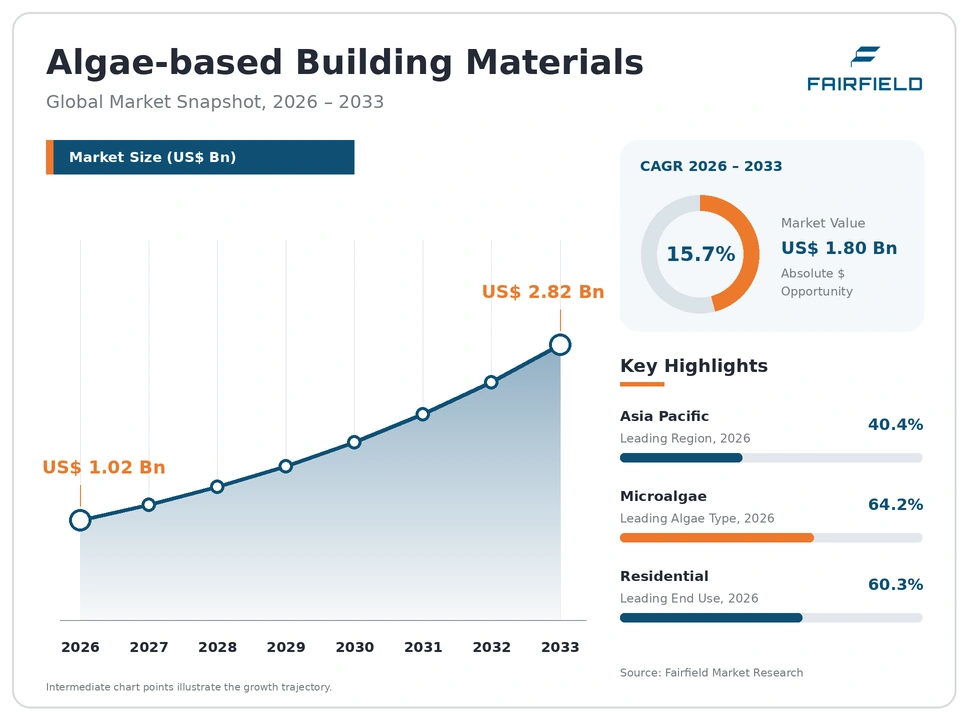
The global algae-based building materials market size is expected to be valued at US$ 1.02 billion in 2026 and projected to reach US$ 2.82 billion by 2033, growing at a CAGR of 15.7% between 2026 and 2033.
Between 2020 and 2025, the market grew at a CAGR of about 13.2%, as start-ups moved algae-based bio-cement, bioplastic composites, and insulation from university labs to pilot production, supported by venture capital and climate funds. Three factors now drive growth: pressure to cut embodied carbon in buildings, green building certification and public procurement rules, and better microalgae cultivation that lowers biomass costs. The market is shifting toward low-carbon concrete additives and cement replacements that fit existing ready-mix and precast processes, as well as seaweed-based insulation and bio-based panels.
Key Report Takeaways
- By Product: Concrete Additives & Bio-cement held 30.6% share in 2026, while Insulation Materials are projected to expand at a 18.1% CAGR through 2033, driven by bio-based insulation demand in energy-efficient renovation.
- By Algae Type: Microalgae held 64.2% share in 2026, while Macroalgae are projected to expand at a 17.2% CAGR through 2033, driven by seaweed farming growth and low-cost biomass for panels and insulation.
- By End Use: Residential Construction held 60.3% share in 2026, while Non-residential Construction is projected to expand at a 16.6% CAGR through 2033, driven by corporate net-zero targets and public building procurement.
- By Region: Asia Pacific held 40.4% share in 2026, while Europe is projected to expand at a 17.4% CAGR through 2033, driven by bioeconomy policies and new construction product rules.
Global Algae-based Building Materials Market Trends and Insights
Drivers Impact Analysis
Two drivers carry the strongest influence on algae-based building materials demand during the forecast period.
| Driver | Impact on CAGR Forecast | Geographic Relevance | Impact Timeline |
| Embodied carbon reduction in construction | High | Europe, North America, Asia Pacific | Long term (≥4 years) |
| Green building certification and public procurement | Medium | Europe, North America | Medium term (2-4 years) |
Embodied Carbon Reduction Is Driving the Algae-based Building Materials Market
Embodied carbon reduction in construction is the strongest driver of the algae-based building materials market. Cement and concrete production accounts for about 8% of global carbon dioxide emissions, so builders need lower-carbon alternatives.
The mechanism is carbon capture during algae growth. Algae absorb carbon dioxide as they grow, and some species produce calcium carbonate, known as biogenic limestone, which can replace quarried limestone in cement. Prometheus Materials makes a bio-cement from microalgae that it says can cut embodied carbon sharply compared with conventional concrete. Algae biomass can also be turned into bioplastics, binders, and insulation that store carbon for decades inside buildings. Developers, architects, and cement makers face pressure from investors and regulators to cut emissions. These pressures create demand for algae-based materials that work with existing construction methods and meet building codes.
Green Building Certification Is Expanding the Algae-based Building Materials Market
Green building certification and public procurement rules are expanding the algae-based building materials market. Certified buildings reward low-carbon and bio-based products.
The cause is policy and market demand for sustainable construction. Rating systems such as LEED, BREEAM, and DGNB award points for materials with low embodied carbon and verified environmental product declarations. The European Union Construction Products Regulation, which entered into force in January 2025, requires environmental information for construction products. Public buyers in California, New York, the Netherlands, and France set limits on the carbon content of concrete and other materials in public projects. France’s RE2020 regulation favors bio-based materials in new buildings. Corporate occupants seek green offices to meet net-zero goals. These rules create demand for bio-based materials with verified carbon data.
Restraints Impact Analysis
Two restraints limit how quickly the algae-based building materials market grows.
| Restraint | Impact on CAGR Forecast | Geographic Relevance | Impact Timeline |
| High production costs and limited scale | High | Global | Short term (≤2 years) |
| Building code approvals and performance uncertainty | Medium | North America, Europe, Asia Pacific | Medium term (2-4 years) |
High Costs and Limited Scale Slow the Algae-based Building Materials Market
High production costs and limited scale slow the algae-based building materials market. Construction materials are sold in huge volumes at low prices, so new products must compete on cost.
The specific causes are expensive algae cultivation and small production facilities. Growing algae in ponds or photobioreactors requires land, water, nutrients, light, and energy, and harvesting and drying biomass adds cost. Most algae-based material producers are start-ups with pilot plants, so they lack economies of scale. Conventional cement, insulation, and plastics are produced in large plants with long-established supply chains. Builders and contractors are reluctant to pay premiums unless required by clients or regulations. Venture funding for climate start-ups has become more selective. These factors slow commercial scaling and limit market penetration, particularly in price-driven housing and infrastructure projects.
Building Code and Performance Uncertainty Restricts the Algae-based Building Materials Market
Building code approvals and performance uncertainty restrict the algae-based building materials market. Construction is a conservative industry that relies on proven materials and standards.
The underlying causes are long testing cycles and limited track records. New structural materials must meet standards from bodies such as ASTM International and European standards organizations, which require extensive testing for strength, durability, fire resistance, and moisture behavior. Engineers and insurers are cautious about materials without decades of field performance. Bio-based products may raise concerns about rot, mold, or pests. Approval processes vary between countries and even cities. Contractors and installers need training to use new materials correctly. Product liability concerns make architects specify familiar materials. These factors delay adoption, especially in structural applications such as load-bearing concrete, bridges, and high-rise buildings.
Market Opportunities
Cement Replacement and Bio-cement Open a Large Revenue Pool
Cement replacement and bio-cement open a large revenue pool in the algae-based building materials market. Even a small share of the global cement market represents significant value.
Algae-based cement developers and cement producers can capture this opportunity. Prometheus Materials signed a 10-year partnership with Green Stream Algae in May 2026 to supply microalgae and biominerals for its ProZERO low-carbon cement blend, which replaces part of conventional cementitious material in ready-mix concrete. Biogenic limestone grown by algae can replace mined limestone in Portland cement production. Partnerships with cement and ready-mix companies speed market access. Carbon credits and low-carbon procurement rules add value. Suppliers that fit existing concrete processes can scale fastest, since producers need no new equipment. Algae ponds on non-arable land using non-potable water reduce competition with food crops.
Bio-based Insulation and Panels Create a Renovation Revenue Pool
Bio-based insulation and panels create a renovation revenue pool in the algae-based building materials market. Buildings must become more energy efficient, and renovation programs need sustainable insulation materials.
Insulation and panel makers can capture this opportunity. Seaweed-based insulation and algae-fiber boards offer thermal and acoustic insulation with low embodied carbon. Seaweed is naturally fire-resistant, breathable, and resistant to mold when properly processed. The European Union renovation wave and energy performance rules aim to renovate millions of buildings, creating large and lasting demand for insulation. Algae-based bioplastics and composites can be used in panels, tiles, flooring, and interior finishes. Algix and Algenesis Materials develop algae-based polymers, and Denmark and Germany have seaweed insulation pioneers. Premium eco-friendly products appeal to green homebuilders and renovation contractors.
Segment Analysis
By Product: Concrete Additives & Bio-cement Lead While Insulation Materials Grow Fastest
Concrete Additives & Bio-cement held 30.6% share in 2026. Algae-based additives and bio-cements reduce the carbon footprint of concrete, blocks, and precast elements. Prometheus Materials produces bio-cement and masonry units, while other developers work on biogenic limestone and admixtures. Large concrete volumes in Asia Pacific and North America support this segment.
Insulation Materials are the fastest-growing product, expanding at a 18.1% CAGR through 2033. Seaweed and algae-fiber insulation offer natural fire resistance, moisture regulation, and low embodied carbon. Renovation programs in Europe and green homebuilders in North America drive demand. Bioplastics and composites, coatings and paints, and facade elements form other segments, with research into algae biofilm facades in Germany. For the market, insulation growth extends algae materials into high-volume renovation.
By Algae Type: Microalgae Lead While Macroalgae Grow Fastest
Microalgae held 64.2% share in 2026. Microalgae are tiny single-celled organisms grown in ponds and photobioreactors. They can produce calcium carbonate for bio-cement, oils for bio-based binders, and biomass for bioplastics. Prometheus Materials and Green Stream Algae use microalgae, and improvements in strain selection and cultivation lower costs. Controlled growth allows consistent product quality.
Macroalgae are the fastest-growing algae type, expanding at a 17.2% CAGR through 2033. Macroalgae, or seaweed, are farmed in coastal waters in China, Indonesia, South Korea, and Chile, providing low-cost biomass. Seaweed is used in insulation, boards, bioplastics, and coatings. Seaweed farming needs no fresh water, fertilizer, or land, which improves sustainability. For the market, macroalgae growth broadens raw material supply and lowers costs.
By End Use: Residential Construction Leads While Non-residential Construction Grows Fastest
Residential Construction held 60.3% share in 2026. Homeowners, eco-builders, and housing developers use algae-based insulation, blocks, coatings, and finishes in new homes and renovations. Green home certifications and government incentives for energy efficiency support demand. Housing growth in Asia Pacific and renovation in Europe drive this segment.
Non-residential Construction is the fastest-growing end use, expanding at a 16.6% CAGR through 2033. Office developers, universities, retailers, and public agencies use low-carbon materials to meet net-zero targets and green procurement rules. Architecture firms such as Skidmore, Owings & Merrill, an early investor in Prometheus Materials, promote bio-based materials. Demonstration buildings and public projects showcase new materials. For the market, non-residential growth brings larger, higher-profile projects.
Geography Analysis
North America Advances the Algae-based Building Materials Market Through Start-ups
North America is an important algae-based building materials market driven by start-ups and climate investment. The United States hosts Prometheus Materials in Colorado, Algix in Mississippi, and Algenesis Materials in California. Prometheus Materials raised US$ 6.25 million in debt financing in 2024 and secured a long-term algae supply partnership in 2026. Buy Clean policies in California and New York encourage low-carbon materials. Canada supports bio-based construction research. Architecture firms and green building councils promote bio-based materials in demonstration projects. Federal research funding and private climate funds support new start-ups. One change shaping the region is the move from pilot to commercial production.
Which Region Is Growing Fastest in the Algae-based Building Materials Market?
Europe is growing fastest in the algae-based building materials market at a 17.4% CAGR through 2033. The European Union bioeconomy strategy, renovation wave, and Construction Products Regulation support bio-based materials. France’s RE2020 rules favor bio-based content, while Germany has researched algae biofilm facades. Denmark and the Netherlands have seaweed building pioneers, including traditional seaweed roofs on the island of Læsø, and AlgaEnergy in Spain and Corbion in the Netherlands produce algae. The United Kingdom and Ireland have seaweed processing companies exploring building uses. Strong carbon pricing makes low-carbon cement more competitive. One opportunity is seaweed insulation for renovation.
Which Region Is Leading the Algae-based Building Materials Market?
Asia Pacific is leading the algae-based building materials market with a 40.4% share in 2026. China is the world’s largest seaweed producer and the largest construction market, creating supply and demand for algae-based materials. Indonesia, South Korea, Japan, and the Philippines have large seaweed farming industries. Rapid urbanization and green building programs in China, Singapore, and India increase interest in low-carbon materials. Australia has algae research centers and coastal seaweed farming. Large cement and concrete industries in China and India are exploring ways to cut emissions. One change shaping the region is green building certification growth.
Latin America Develops the Algae-based Building Materials Market Through Seaweed Resources
Latin America is a developing algae-based building materials market. Chile is a major seaweed producer, providing raw material for bio-based products, while Brazil and Mexico have large construction sectors and growing green building certification. Mexico has studied sargassum seaweed, which washes ashore in large amounts, for building blocks. Peru also harvests seaweed along its coast. Key barriers include limited processing facilities, low awareness among builders, and limited funding for start-ups. Coastal cities in Mexico and the Dominican Republic spend heavily removing sargassum. One opportunity is building materials made from sargassum, turning a waste problem into a resource.
Middle East & Africa Explores the Algae-based Building Materials Market
Middle East & Africa is an early-stage algae-based building materials market. The United Arab Emirates and Saudi Arabia invest in sustainable cities, such as Masdar City and NEOM, and fund algae research for food and fuel. Strong desert sunlight and large coastal land areas suit algae cultivation. South Africa and Morocco have algae and seaweed research programs at universities. Green building codes in Dubai and Abu Dhabi encourage low-carbon materials. Key barriers include limited production, high costs, and water scarcity for cultivation in some areas. One opportunity is algae materials for sustainable city projects and demonstration buildings.
Competitive Landscape
The algae-based building materials market is fragmented. Prometheus Materials, Corbion, BASF, Algix, and Algenesis Materials are among the notable players, along with Evonik, AlgaEnergy, Flora Materials, Ocean Grows, and many university spin-offs. Most companies are small or early-stage, while large chemical firms supply algae ingredients and additives. Funding comes mainly from venture capital, climate funds, and government research grants.
Companies compete on carbon reduction, product performance, cost, certifications, and ability to scale production. Certifications from ASTM International and environmental product declarations are essential to win large construction contracts. Partnerships with algae growers, cement makers, architects, and contractors help start-ups reach customers and secure raw materials. Large firms could enter through acquisitions once technologies prove commercial.
Strategic moves show how competition is changing. In July 2024, Prometheus Materials raised US$ 6.25 million in debt financing to support production. In January 2025, the European Union’s revised Construction Products Regulation entered into force, requiring environmental data for construction products. In May 2026, Prometheus Materials signed a 10-year exclusive supply partnership with Green Stream Algae. These moves show competition shifting toward secure supply chains and commercial scale, as investors expect start-ups to prove revenue rather than only technology.
Three themes shape vendor strategy. First, companies are securing algae supply. Second, they are obtaining product certifications. Third, they are partnering with construction firms, architects, and cement producers to win early projects and build credibility with engineers.
Algae-based Building Materials Market Industry Leaders
- Prometheus Materials
- Corbion
- BASF
- Algix
- Algenesis Materials
Recent Industry Developments
- May 2026: Prometheus Materials signed a 10-year partnership with Green Stream Algae for exclusive microalgae supply in the Americas - secures raw material for its ProZERO cement blend.
- January 2025: The European Union’s revised Construction Products Regulation entered into force - requires environmental information that favors low-carbon, bio-based products.
- July 2024: Prometheus Materials raised US$ 6.25 million in debt financing - supports scaling of its microalgae bio-cement production.
Companies Covered in the Report
- Prometheus Materials
- Corbion
- BASF
- Algix
- Algenesis Materials
- Evonik
- AlgaEnergy
- Flora Materials
- Ocean Grows
- Green Stream Algae
- Minus Materials
- Solaga
Algae-based Building Materials Market Report Scope
This report covers building materials made from or with algae, including concrete additives and bio-cement, insulation materials, bioplastics and composites, coatings and paints, and facade elements, made from microalgae and macroalgae, used in residential and non-residential construction. It excludes algae-based fuels, food, and cosmetics, and conventional materials without algae content. The base year is 2025, and the forecast period runs from 2026 to 2033. All values are expressed in US$ Billion.
Product
- Concrete Additives & Bio-cement
- Insulation Materials
- Bioplastics & Composites
- Coatings & Paints
- Others
Algae Type
- Microalgae
- Macroalgae
End Use
- Residential Construction
- Non-residential Construction
Regions
- North America
- Europe
- Asia Pacific
- Latin America
- Middle East & Africa
Key Questions Answered in the Report
How big is the algae-based building materials market in 2026?
The algae-based building materials market is valued at US$ 1.02 billion in 2026, led by concrete additives and bio-cement products.
What is the algae-based building materials market forecast to 2033?
The market is projected to reach US$ 2.82 billion by 2033, growing at a 15.7% CAGR and adding US$ 1.80 billion.
Which product is growing fastest in algae-based building materials?
Insulation Materials are growing fastest at a 18.1% CAGR through 2033, driven by bio-based insulation demand in energy-efficient renovation.
Which region is growing fastest in the algae-based building materials market?
Europe is growing fastest at a 17.4% CAGR through 2033, driven by bioeconomy policies and new construction product rules.
Which region holds the largest algae-based building materials market share?
Asia Pacific holds the largest share at 40.4% in 2026, supported by large seaweed production and construction activity in China.
1. Executive Summary
1.1. Global Algae-based Building Materials Market Snapshot
1.2. Future Projections
1.3. Key Report Takeaways
1.4. Regional Snapshot
2. Market Overview
2.1. Market Definition and Report Scope
2.2. Historical Trends 2020–2025
2.3. Market Dynamics
2.3.1. Drivers
2.3.1.1. Embodied Carbon Reduction Is Driving the Algae-based Building Materials Market
2.3.1.2. Green Building Certification Is Expanding the Algae-based Building Materials Market
2.3.2. Restraints
2.3.2.1. High Costs and Limited Scale Slow the Algae-based Building Materials Market
2.3.2.2. Building Code and Performance Uncertainty Restricts the Algae-based Building Materials Market
2.3.3. Market Opportunities
2.3.3.1. Cement Replacement and Bio-cement Open a Large Revenue Pool
2.3.3.2. Bio-based Insulation and Panels Create a Renovation Revenue Pool
3. Global Algae-based Building Materials Market Outlook, 2020-2033
3.1. Global Algae-based Building Materials Market Outlook, by Product, Value (US$ Billion), 2020-2033
3.1.1. Concrete Additives & Bio-cement
3.1.2. Insulation Materials
3.1.3. Bioplastics & Composites
3.1.4. Coatings & Paints
3.1.5. Others
3.2. Global Algae-based Building Materials Market Outlook, by Algae Type, Value (US$ Billion), 2020-2033
3.2.1. Microalgae
3.2.2. Macroalgae
3.3. Global Algae-based Building Materials Market Outlook, by End Use, Value (US$ Billion), 2020-2033
3.3.1. Residential Construction
3.3.2. Non-residential Construction
3.4. Global Algae-based Building Materials Market Outlook, by Region, Value (US$ Billion), 2020-2033
3.4.1. North America
3.4.2. Europe
3.4.3. Asia Pacific
3.4.4. Latin America
3.4.5. Middle East & Africa
4. North America Algae-based Building Materials Market Outlook, 2020-2033
4.1. North America Algae-based Building Materials Market Outlook, by Product, Value (US$ Billion), 2020-2033
4.1.1. Concrete Additives & Bio-cement
4.1.2. Insulation Materials
4.1.3. Bioplastics & Composites
4.1.4. Coatings & Paints
4.1.5. Others
4.2. North America Algae-based Building Materials Market Outlook, by Algae Type, Value (US$ Billion), 2020-2033
4.2.1. Microalgae
4.2.2. Macroalgae
4.3. North America Algae-based Building Materials Market Outlook, by End Use, Value (US$ Billion), 2020-2033
4.3.1. Residential Construction
4.3.2. Non-residential Construction
4.4. North America Algae-based Building Materials Market Outlook, by Country, Value (US$ Billion), 2020-2033
4.4.1. United States Algae-based Building Materials Market Outlook, by Product, 2020-2033
4.4.2. United States Algae-based Building Materials Market Outlook, by Algae Type, 2020-2033
4.4.3. United States Algae-based Building Materials Market Outlook, by End Use, 2020-2033
4.4.4. Canada Algae-based Building Materials Market Outlook, by Product, 2020-2033
4.4.5. Canada Algae-based Building Materials Market Outlook, by Algae Type, 2020-2033
4.4.6. Canada Algae-based Building Materials Market Outlook, by End Use, 2020-2033
5. Europe Algae-based Building Materials Market Outlook, 2020-2033
5.1. Europe Algae-based Building Materials Market Outlook, by Product, Value (US$ Billion), 2020-2033
5.1.1. Concrete Additives & Bio-cement
5.1.2. Insulation Materials
5.1.3. Bioplastics & Composites
5.1.4. Coatings & Paints
5.1.5. Others
5.2. Europe Algae-based Building Materials Market Outlook, by Algae Type, Value (US$ Billion), 2020-2033
5.2.1. Microalgae
5.2.2. Macroalgae
5.3. Europe Algae-based Building Materials Market Outlook, by End Use, Value (US$ Billion), 2020-2033
5.3.1. Residential Construction
5.3.2. Non-residential Construction
5.4. Europe Algae-based Building Materials Market Outlook, by Country, Value (US$ Billion), 2020-2033
5.4.1. France Algae-based Building Materials Market Outlook, by Product, 2020-2033
5.4.2. France Algae-based Building Materials Market Outlook, by Algae Type, 2020-2033
5.4.3. France Algae-based Building Materials Market Outlook, by End Use, 2020-2033
5.4.4. Germany Algae-based Building Materials Market Outlook, by Product, 2020-2033
5.4.5. Germany Algae-based Building Materials Market Outlook, by Algae Type, 2020-2033
5.4.6. Germany Algae-based Building Materials Market Outlook, by End Use, 2020-2033
5.4.7. Denmark Algae-based Building Materials Market Outlook, by Product, 2020-2033
5.4.8. Denmark Algae-based Building Materials Market Outlook, by Algae Type, 2020-2033
5.4.9. Denmark Algae-based Building Materials Market Outlook, by End Use, 2020-2033
5.4.10. Netherlands Algae-based Building Materials Market Outlook, by Product, 2020-2033
5.4.11. Netherlands Algae-based Building Materials Market Outlook, by Algae Type, 2020-2033
5.4.12. Netherlands Algae-based Building Materials Market Outlook, by End Use, 2020-2033
5.4.13. Spain Algae-based Building Materials Market Outlook, by Product, 2020-2033
5.4.14. Spain Algae-based Building Materials Market Outlook, by Algae Type, 2020-2033
5.4.15. Spain Algae-based Building Materials Market Outlook, by End Use, 2020-2033
5.4.16. United Kingdom Algae-based Building Materials Market Outlook, by Product, 2020-2033
5.4.17. United Kingdom Algae-based Building Materials Market Outlook, by Algae Type, 2020-2033
5.4.18. United Kingdom Algae-based Building Materials Market Outlook, by End Use, 2020-2033
5.4.19. Ireland Algae-based Building Materials Market Outlook, by Product, 2020-2033
5.4.20. Ireland Algae-based Building Materials Market Outlook, by Algae Type, 2020-2033
5.4.21. Ireland Algae-based Building Materials Market Outlook, by End Use, 2020-2033
6. Asia Pacific Algae-based Building Materials Market Outlook, 2020-2033
6.1. Asia Pacific Algae-based Building Materials Market Outlook, by Product, Value (US$ Billion), 2020-2033
6.1.1. Concrete Additives & Bio-cement
6.1.2. Insulation Materials
6.1.3. Bioplastics & Composites
6.1.4. Coatings & Paints
6.1.5. Others
6.2. Asia Pacific Algae-based Building Materials Market Outlook, by Algae Type, Value (US$ Billion), 2020-2033
6.2.1. Microalgae
6.2.2. Macroalgae
6.3. Asia Pacific Algae-based Building Materials Market Outlook, by End Use, Value (US$ Billion), 2020-2033
6.3.1. Residential Construction
6.3.2. Non-residential Construction
6.4. Asia Pacific Algae-based Building Materials Market Outlook, by Country, Value (US$ Billion), 2020-2033
6.4.1. China Algae-based Building Materials Market Outlook, by Product, 2020-2033
6.4.2. China Algae-based Building Materials Market Outlook, by Algae Type, 2020-2033
6.4.3. China Algae-based Building Materials Market Outlook, by End Use, 2020-2033
6.4.4. Indonesia Algae-based Building Materials Market Outlook, by Product, 2020-2033
6.4.5. Indonesia Algae-based Building Materials Market Outlook, by Algae Type, 2020-2033
6.4.6. Indonesia Algae-based Building Materials Market Outlook, by End Use, 2020-2033
6.4.7. South Korea Algae-based Building Materials Market Outlook, by Product, 2020-2033
6.4.8. South Korea Algae-based Building Materials Market Outlook, by Algae Type, 2020-2033
6.4.9. South Korea Algae-based Building Materials Market Outlook, by End Use, 2020-2033
6.4.10. Japan Algae-based Building Materials Market Outlook, by Product, 2020-2033
6.4.11. Japan Algae-based Building Materials Market Outlook, by Algae Type, 2020-2033
6.4.12. Japan Algae-based Building Materials Market Outlook, by End Use, 2020-2033
6.4.13. Philippines Algae-based Building Materials Market Outlook, by Product, 2020-2033
6.4.14. Philippines Algae-based Building Materials Market Outlook, by Algae Type, 2020-2033
6.4.15. Philippines Algae-based Building Materials Market Outlook, by End Use, 2020-2033
6.4.16. Singapore Algae-based Building Materials Market Outlook, by Product, 2020-2033
6.4.17. Singapore Algae-based Building Materials Market Outlook, by Algae Type, 2020-2033
6.4.18. Singapore Algae-based Building Materials Market Outlook, by End Use, 2020-2033
6.4.19. India Algae-based Building Materials Market Outlook, by Product, 2020-2033
6.4.20. India Algae-based Building Materials Market Outlook, by Algae Type, 2020-2033
6.4.21. India Algae-based Building Materials Market Outlook, by End Use, 2020-2033
6.4.22. Australia Algae-based Building Materials Market Outlook, by Product, 2020-2033
6.4.23. Australia Algae-based Building Materials Market Outlook, by Algae Type, 2020-2033
6.4.24. Australia Algae-based Building Materials Market Outlook, by End Use, 2020-2033
7. Latin America Algae-based Building Materials Market Outlook, 2020-2033
7.1. Latin America Algae-based Building Materials Market Outlook, by Product, Value (US$ Billion), 2020-2033
7.1.1. Concrete Additives & Bio-cement
7.1.2. Insulation Materials
7.1.3. Bioplastics & Composites
7.1.4. Coatings & Paints
7.1.5. Others
7.2. Latin America Algae-based Building Materials Market Outlook, by Algae Type, Value (US$ Billion), 2020-2033
7.2.1. Microalgae
7.2.2. Macroalgae
7.3. Latin America Algae-based Building Materials Market Outlook, by End Use, Value (US$ Billion), 2020-2033
7.3.1. Residential Construction
7.3.2. Non-residential Construction
7.4. Latin America Algae-based Building Materials Market Outlook, by Country, Value (US$ Billion), 2020-2033
7.4.1. Chile Algae-based Building Materials Market Outlook, by Product, 2020-2033
7.4.2. Chile Algae-based Building Materials Market Outlook, by Algae Type, 2020-2033
7.4.3. Chile Algae-based Building Materials Market Outlook, by End Use, 2020-2033
7.4.4. Brazil Algae-based Building Materials Market Outlook, by Product, 2020-2033
7.4.5. Brazil Algae-based Building Materials Market Outlook, by Algae Type, 2020-2033
7.4.6. Brazil Algae-based Building Materials Market Outlook, by End Use, 2020-2033
7.4.7. Mexico Algae-based Building Materials Market Outlook, by Product, 2020-2033
7.4.8. Mexico Algae-based Building Materials Market Outlook, by Algae Type, 2020-2033
7.4.9. Mexico Algae-based Building Materials Market Outlook, by End Use, 2020-2033
7.4.10. Peru Algae-based Building Materials Market Outlook, by Product, 2020-2033
7.4.11. Peru Algae-based Building Materials Market Outlook, by Algae Type, 2020-2033
7.4.12. Peru Algae-based Building Materials Market Outlook, by End Use, 2020-2033
7.4.13. Dominican Republic Algae-based Building Materials Market Outlook, by Product, 2020-2033
7.4.14. Dominican Republic Algae-based Building Materials Market Outlook, by Algae Type, 2020-2033
7.4.15. Dominican Republic Algae-based Building Materials Market Outlook, by End Use, 2020-2033
8. Middle East & Africa Algae-based Building Materials Market Outlook, 2020-2033
8.1. Middle East & Africa Algae-based Building Materials Market Outlook, by Product, Value (US$ Billion), 2020-2033
8.1.1. Concrete Additives & Bio-cement
8.1.2. Insulation Materials
8.1.3. Bioplastics & Composites
8.1.4. Coatings & Paints
8.1.5. Others
8.2. Middle East & Africa Algae-based Building Materials Market Outlook, by Algae Type, Value (US$ Billion), 2020-2033
8.2.1. Microalgae
8.2.2. Macroalgae
8.3. Middle East & Africa Algae-based Building Materials Market Outlook, by End Use, Value (US$ Billion), 2020-2033
8.3.1. Residential Construction
8.3.2. Non-residential Construction
8.4. Middle East & Africa Algae-based Building Materials Market Outlook, by Country, Value (US$ Billion), 2020-2033
8.4.1. United Arab Emirates Algae-based Building Materials Market Outlook, by Product, 2020-2033
8.4.2. United Arab Emirates Algae-based Building Materials Market Outlook, by Algae Type, 2020-2033
8.4.3. United Arab Emirates Algae-based Building Materials Market Outlook, by End Use, 2020-2033
8.4.4. Saudi Arabia Algae-based Building Materials Market Outlook, by Product, 2020-2033
8.4.5. Saudi Arabia Algae-based Building Materials Market Outlook, by Algae Type, 2020-2033
8.4.6. Saudi Arabia Algae-based Building Materials Market Outlook, by End Use, 2020-2033
8.4.7. South Africa Algae-based Building Materials Market Outlook, by Product, 2020-2033
8.4.8. South Africa Algae-based Building Materials Market Outlook, by Algae Type, 2020-2033
8.4.9. South Africa Algae-based Building Materials Market Outlook, by End Use, 2020-2033
8.4.10. Morocco Algae-based Building Materials Market Outlook, by Product, 2020-2033
8.4.11. Morocco Algae-based Building Materials Market Outlook, by Algae Type, 2020-2033
8.4.12. Morocco Algae-based Building Materials Market Outlook, by End Use, 2020-2033
9. Competitive Landscape
9.1. Market Concentration and Industry Leaders
9.2. Competitive Differentiation
9.3. Strategic Moves and Market Direction
9.4. Recent Industry Developments
9.5. Company Profiles
9.5.1. Prometheus Materials
9.5.2. Corbion
9.5.3. BASF
9.5.4. Algix
9.5.5. Algenesis Materials
9.5.6. Evonik
9.5.7. AlgaEnergy
9.5.8. Flora Materials
9.5.9. Ocean Grows
9.5.10. Green Stream Algae
9.5.11. Minus Materials
9.5.12. Solaga
10. Appendix
10.1. Research Methodology
10.2. Report Assumptions
10.3. Acronyms and Abbreviations
| Segment | Categories |
|---|---|
| Product | Concrete Additives & Bio-cement, Insulation Materials, Bioplastics & Composites, Coatings & Paints, Others |
| Algae Type | Microalgae, Macroalgae |
| End Use | Residential Construction, Non-residential Construction |
| Regions | North America, Europe, Asia Pacific, Latin America, Middle East & Africa |
Our Research Methodology
Considering the volatility of business today, traditional approaches to strategizing a game plan can be unfruitful if not detrimental. True ambiguity is no way to determine a forecast. A myriad of predetermined factors must be accounted for such as the degree of risk involved, the magnitude of circumstances, as well as conditions or consequences that are not known or unpredictable. To circumvent binary views that cast uncertainty, the application of market research intelligence to strategically posture, move, and enable actionable outcomes is necessary.
View Methodology
Quality Assured
Rigorous Validation Process

Confidentiality Assured
End-to-end Data Security

Custom Research Services
Tailored To Your Objectives
FAQs
The algae-based building materials market is valued at US$ 1.02 billion in 2026, led by concrete additives and bio-cement products.
The market is projected to reach US$ 2.82 billion by 2033, growing at a 15.7% CAGR and adding US$ 1.80 billion.
Insulation Materials are growing fastest at a 18.1% CAGR through 2033, driven by bio-based insulation demand in energy-efficient renovation.
Europe is growing fastest at a 17.4% CAGR through 2033, driven by bioeconomy policies and new construction product rules.
Asia Pacific holds the largest share at 40.4% in 2026, supported by large seaweed production and construction activity in China.
Related Reports
Graphene-Enhanced Plastics Market Size, Share, Insights, Competitive Landscape, and Forecast 2026 to 2033
Graphene-enhanced plastics market to reach US$ 154.10 billion by 2033 at a 20.2% CAGR. Explore polymers, applications and regional trends.
Dimethylaminoethyl Methacrylate Market Size, Share, Insights, Competitive Landscape, and Forecast 2026 to 2033
Dimethylaminoethyl methacrylate market to reach US$ 0.282 billion by 2033 at a 4.5% CAGR. Explore grades, applications and regional trends.
Retail Ready Packaging Market Size, Share, Insights, Competitive Landscape, and Forecast 2026 to 2033
Retail ready packaging market to reach US$ 144.96 billion by 2033 at 5.7% CAGR. Explore products, materials, retail channels and regional trends.
PCR Cosmetic Tube Market Size, Share, Insights, Competitive Landscape, and Forecast 2026 to 2033
PCR cosmetic tube market to reach US$ 1.55 billion by 2033 at 11.8% CAGR. Explore materials, recycled content, applications and regional trends.
Metalized Flexible Packaging Market Size, Share, Insights, Competitive Landscape, and Forecast 2026 to 2033
Metalized flexible packaging market to reach US$ 20.80 billion by 2033 at 5.0% CAGR. Explore materials, formats and regional trends.
Baby Food Packaging Market Size, Share, Insights, Competitive Landscape, and Forecast 2026 to 2033
Baby food packaging market to reach US$ 13.53 billion by 2033 at 5.4% CAGR. Explore materials, pack formats, closures and regional growth trends.