



PCR Cosmetic Tube Market
PCR Cosmetic Tube Market Size, Share, Insights, Competitive Landscape, and Forecast 2026 to 2033
PCR Cosmetic Tube Market Analysis, 2026–2033
PCR Cosmetic Tube Market Size and Trend Analysis
How Fast Is the PCR Cosmetic Tube Market Growing?
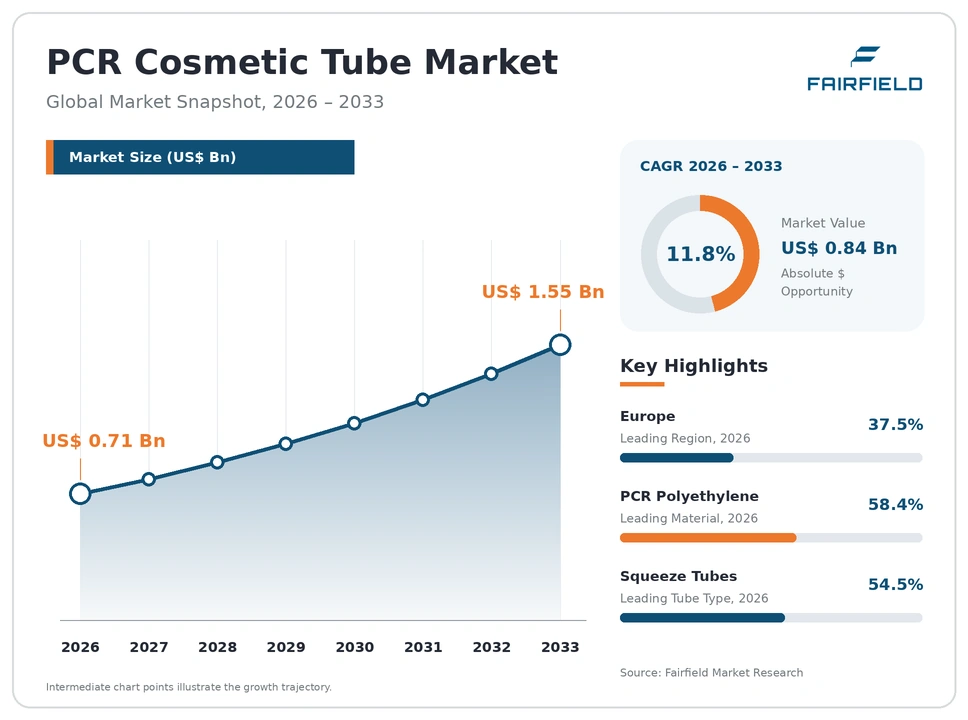
The global PCR cosmetic tube market size is expected to be valued at US$ 0.71 billion in 2026 and projected to reach US$ 1.55 billion by 2033, growing at a CAGR of 11.8% between 2026 and 2033.
Between 2020 and 2025, the market grew at a CAGR of about 13.5% from a small base, as beauty brands made public commitments to use recycled plastics and suppliers qualified post-consumer recycled resin for cosmetic contact. Three factors now drive growth: packaging regulations that set recycled content targets, brand sustainability pledges from large beauty companies, and consumer preference for sustainable cosmetic packaging. The market is moving from tubes with low PCR content toward tubes with 50% or more recycled plastic, recyclable mono-material designs, and recycled caps. Limited supply of high-quality recycled resin and higher costs remain key barriers to faster adoption.
Key Report Takeaways
- By Material: PCR Polyethylene held 58.4% share in 2026, while PCR Polypropylene is projected to expand at a 13.9% CAGR through 2033, driven by mono-material polypropylene tube and cap designs.
- By PCR Content: 25%-50% PCR held 47.6% share in 2026, while Above 50% PCR is projected to expand at a 15.2% CAGR through 2033, driven by brand pledges and recycled content regulations.
- By Tube Type: Squeeze Tubes held 54.5% share in 2026, while Airless Tubes are projected to expand at a 13.4% CAGR through 2033, driven by premium skincare that needs formula protection.
- By Application: Skincare held 48.2% share in 2026, while Haircare is projected to expand at a 13.1% CAGR through 2033, driven by shampoos, conditioners, and treatments in larger tubes.
- By Region: Europe held 37.5% share in 2026, while Asia Pacific is projected to expand at a 14.3% CAGR through 2033, driven by K-beauty, C-beauty, and growing sustainability expectations.
Global PCR Cosmetic Tube Market Trends and Insights
Drivers Impact Analysis
Two drivers carry the strongest influence on PCR cosmetic tube demand during the forecast period.
| Driver | Impact on CAGR Forecast | Geographic Relevance | Impact Timeline |
| Recycled content regulations and extended producer responsibility | High | Europe, North America | Medium term (2-4 years) |
| Beauty brand sustainability commitments | High | Europe, North America, Asia Pacific | Short term (≤2 years) |
Recycled Content Regulations Are Driving PCR Cosmetic Tube Demand
Recycled content regulations and extended producer responsibility are the strongest drivers of PCR cosmetic tube demand. Governments are requiring packaging to include recycled plastic and charging higher fees for packaging made from virgin materials.
The mechanism is mandatory targets and financial incentives. The European Union Packaging and Packaging Waste Regulation, in force since February 2025, sets minimum recycled content targets for plastic packaging from 2030 and requires all packaging to be recyclable. The United Kingdom Plastic Packaging Tax charges producers for plastic packaging containing less than 30% recycled content. California’s SB 54 requires reductions in single-use plastic packaging and higher recycling rates. Extended producer responsibility fees in France, Germany, and several U.S. states reward recycled and recyclable packaging. Beauty brands therefore switch tubes to PCR resins to reduce taxes and comply with upcoming rules.
Beauty Brand Commitments Are Expanding PCR Cosmetic Tube Adoption
Sustainability commitments from beauty brands are expanding PCR cosmetic tube adoption. Large cosmetic companies have pledged to cut virgin plastic use and increase recycled content across their packaging.
The cause is investor, retailer, and consumer pressure. L’Oréal, Unilever, Estée Lauder Companies, Procter & Gamble, and Beiersdorf have set targets for recycled or recyclable packaging, and many have signed the Ellen MacArthur Foundation Global Commitment. Retailers such as Sephora and Ulta Beauty promote clean and sustainable beauty programs that highlight recycled packaging. Younger consumers increasingly check packaging claims before buying. Tubes are widely used for creams, cleansers, sunscreens, and hair products, so switching them to PCR delivers large plastic savings. Tube suppliers offer PCR options in standard formats, making adoption easier for indie and mass brands.
Restraints Impact Analysis
Two restraints limit how quickly PCR cosmetic tubes are adopted.
| Restraint | Impact on CAGR Forecast | Geographic Relevance | Impact Timeline |
| Limited supply of high-quality recycled resin | High | Global | Medium term (2-4 years) |
| Higher costs and aesthetic limitations | Medium | Global | Short term (≤2 years) |
Limited High-quality Recycled Resin Supply Limits PCR Cosmetic Tube Growth
Limited supply of high-quality recycled resin limits PCR cosmetic tube growth. Cosmetic packaging needs clean, consistent, odor-free recycled plastics that meet safety requirements for contact with products applied to skin.
The specific causes are collection gaps and strict quality needs. Only a small share of plastic packaging is collected and recycled into high-quality resin, and demand from food, beverage, and household packaging competes for the same supply. Recycled polyethylene and polypropylene can contain contaminants, odors, and color variations that are unacceptable for cosmetics. The European Union Cosmetics Regulation requires products to be safe, so brands must test packaging for migration of substances. Food-grade and cosmetic-grade recycled resins require advanced sorting, washing, and decontamination. As a result, supply of suitable PCR is tight, slowing the move to higher recycled content.
Higher Costs and Aesthetic Limitations Slow PCR Cosmetic Tube Adoption
Higher costs and aesthetic limitations slow PCR cosmetic tube adoption, especially among price-sensitive and luxury brands. Recycled resins can cost more than virgin plastics and may not deliver the same appearance.
The specific cost sources are collection, sorting, decontamination, and certification. High-quality recycled resin often sells at a premium to virgin polyethylene, especially when oil prices are low. Testing, certification, and traceability systems add costs. PCR plastics can have gray or yellow tints, specks, and lower clarity, which limits bright colors and transparent designs that luxury brands prefer. Variations in melt flow and strength can affect tube extrusion and printing. Brands may need to redesign graphics, colors, and decoration methods. These factors cause some brands to use low PCR percentages or limit recycled content to inner or middle layers.
Market Opportunities
High-PCR Mono-material Tubes Open a Premium Sustainable Packaging Revenue Pool
High-PCR mono-material tubes open a premium sustainable packaging revenue pool in the PCR cosmetic tube market. Brands want tubes that both contain high recycled content and can be recycled after use.
Tube makers with advanced extrusion and barrier technology can capture this demand. Mono-material tubes made entirely of polyethylene or polypropylene, including caps, can be recycled in existing plastic streams. In May 2024, Hoffmann Neopac launched Polyfoil Sensation, a recyclable polypropylene barrier tube. Albéa presented its Greenleaf PCR tube with 50% recycled plastic at the 2026 PCD Paris packaging show. Skincare, suncare, and oral care brands are the main customers for these tubes. Tubes that meet recyclability guidelines and high PCR targets can command higher prices and win long-term contracts with major global beauty brands.
Chemically Recycled and Certified Resins Create a Cosmetic-grade Revenue Pool
Chemically recycled and certified resins create a cosmetic-grade revenue pool for PCR tube suppliers. Advanced recycling can produce recycled plastics with virgin-like purity, solving quality problems that limit mechanical recycling.
Resin producers, converters, and brands can capture this opportunity. Chemical recycling breaks plastic waste down into feedstock that is used to make new polymers, certified through mass-balance systems such as ISCC PLUS. Companies such as SABIC, LyondellBasell, ExxonMobil, and Dow offer certified circular polymers. These resins allow clear, white, and brightly colored tubes with recycled content, appealing to luxury brands. Premium skincare and fragrance brands are key customers. Long-term supply agreements and traceability systems support circular economy claims and premium pricing for cosmetic-grade recycled materials used in sustainable cosmetic packaging.
Segment Analysis
By Material: PCR Polyethylene Leads While PCR Polypropylene Gains Momentum
PCR Polyethylene held 58.4% share in 2026. Low-density and high-density polyethylene are the most common materials for extruded and laminated cosmetic tubes because they are soft, squeezable, and widely recycled. Recycled polyethylene supply is more established than other recycled resins, and most post-consumer recycled resin used in tubes today is polyethylene.
PCR Polypropylene is the fastest-growing material, expanding at a 13.9% CAGR through 2033. Mono-material polypropylene tubes and caps simplify recycling and offer good stiffness and chemical resistance. Suppliers such as Hoffmann Neopac have launched polypropylene barrier tubes. Recycled aluminum tubes and PCR laminate tubes remain important for products needing high barrier protection. For the market, polypropylene growth supports fully recyclable tube-and-cap designs and expands supplier options.
By PCR Content: 25%-50% PCR Leads While Above 50% PCR Grows Fastest
25%-50% PCR held 47.6% share in 2026. Many brands use moderate recycled content levels that balance sustainability goals with appearance, performance, and cost. Levels of 30% or more also qualify for tax relief under the United Kingdom Plastic Packaging Tax.
Above 50% PCR is the fastest-growing content level, expanding at a 15.2% CAGR through 2033. Brands seeking stronger sustainability claims and regulatory compliance are increasing recycled content, with some tubes now reaching 100% PCR in body layers. Better recycled resin quality and color management make higher levels technically feasible. Tubes below 25% PCR remain common in mass-market and price-sensitive products. For the market, high-content growth raises demand for cosmetic-grade recycled resin.
By Tube Type: Squeeze Tubes Lead While Airless Tubes Grow Fastest
Squeeze Tubes held 54.5% share in 2026. Standard extruded and laminated squeeze tubes are used for face washes, hand creams, body lotions, toothpaste, and hair products. They are simple, affordable, and easy to make with recycled resins.
Airless Tubes are the fastest-growing tube type, expanding at a 13.4% CAGR through 2033. Airless designs prevent air and contamination from entering the tube, protecting sensitive formulas such as serums, retinol, and preservative-free products. Premium skincare brands increasingly choose airless tubes with recycled content. Twist-off, nozzle, and applicator tubes serve niche uses such as eye creams and lip products. Airless systems with recycled content require precise engineering of pumps and valves. For the market, airless growth adds higher-value products with complex designs.
By Application: Skincare Leads While Haircare Grows Fastest
Skincare held 48.2% share in 2026. Moisturizers, cleansers, sunscreens, and hand creams are commonly packaged in tubes, and skincare brands such as CeraVe, Nivea, and La Roche-Posay are among active adopters of recycled packaging.
Haircare is the fastest-growing application, expanding at a 13.1% CAGR through 2033. Shampoo, conditioner, hair masks, and styling products increasingly use larger PCR tubes as brands move away from bottles to reduce plastic. Mass haircare brands from Unilever and L’Oréal use large volumes of packaging, so switching to PCR has big impact. Makeup, oral care, and body care remain important applications, with toothpaste brands also moving to recyclable and recycled-content tubes. For the market, haircare growth increases volume demand for larger PCR tubes.
Geography Analysis
North America Expands PCR Cosmetic Tubes Through State Laws and Brand Pledges
North America is a major PCR cosmetic tube market driven by state packaging laws and brand commitments. California, Oregon, Colorado, Maine, and Minnesota have adopted extended producer responsibility laws for packaging, increasing pressure to use recycled materials. Large beauty brands such as Estée Lauder Companies, Procter & Gamble, and Coty have set recycled content goals. Retailers such as Ulta Beauty and Sephora promote sustainable beauty programs. Canada adds provincial producer responsibility rules in Ontario and British Columbia. One change shaping the region is rapid growth in indie clean beauty brands using PCR tubes.
Which Region Is Leading the PCR Cosmetic Tube Market?
Europe is leading the PCR cosmetic tube market with a 37.5% share in 2026. France, Germany, the United Kingdom, and Italy host major beauty brands such as L’Oréal, Beiersdorf, and Chanel, along with leading tube makers such as Albéa and Hoffmann Neopac. The Packaging and Packaging Waste Regulation sets recycled content and recyclability requirements, and the United Kingdom’s Plastic Packaging Tax rewards recycled content. Strong collection systems and deposit schemes improve recycled resin supply for cosmetic brands. One change shaping the region is the rapid shift to fully recyclable mono-material tubes.
Which Region Is Growing Fastest in the PCR Cosmetic Tube Market?
Asia Pacific is growing fastest in the PCR cosmetic tube market at a 14.3% CAGR through 2033. China has a fast-growing beauty market with domestic brands adopting sustainable packaging, and South Korea leads K-beauty innovation and has strict recycling rules. Japan has advanced packaging technology and beauty brands such as Shiseido committed to sustainable packaging. India hosts EPL Limited, one of the world’s largest tube makers, which supplies global brands. Limited high-quality recycled resin and fragmented collection systems are challenges. Thailand and Indonesia host growing tube converting industries. One opportunity is local cosmetic-grade recycling capacity.
Latin America Develops PCR Cosmetic Tube Use Through Brand Commitments
Latin America is an emerging PCR cosmetic tube market where large beauty companies and local brands are adopting recycled packaging. Brazil is one of the world’s largest and most dynamic beauty markets, home to Natura &Co and Grupo Boticário, which promote sustainable packaging. Mexico, Colombia, and Argentina add demand as multinational beauty companies apply global packaging targets to local products. Natura has long promoted refillable and recycled packaging in the region. Key barriers include limited recycling infrastructure, cost sensitivity, and inconsistent recycled resin quality. One opportunity is partnerships with local recyclers and cooperatives to supply cosmetic-grade PCR.
Middle East & Africa Explores PCR Cosmetic Tubes for Sustainable Beauty
Middle East & Africa is a developing PCR cosmetic tube market where premium beauty demand and sustainability awareness are growing. The United Arab Emirates and Saudi Arabia have strong demand for international beauty brands that increasingly use recycled packaging. South Africa has growing recycling programs, producer responsibility rules, and local beauty brands. Key barriers include limited recycling systems, reliance on imported packaging, and higher costs for recycled resins. Governments in the Gulf are introducing plastic reduction policies, which may encourage local recycled packaging production over time. One opportunity is supplying recycled tubes to multinational beauty brands operating in the region.
Competitive Landscape
The PCR cosmetic tube market is moderately concentrated. Albéa, Hoffmann Neopac, EPL Limited, Amcor, which acquired Berry Global in 2025, Huhtamaki, and CTL Packaging lead global tube supply, while many regional converters serve local brands. Resin producers such as SABIC, Dow, and LyondellBasell supply certified recycled materials.
Companies compete on recycled content level, tube quality, decoration, barrier performance, recyclability, and cost. Brands want suppliers that can guarantee PCR availability, traceability, and regulatory compliance. Design innovation, such as mono-material tubes and recycled caps, differentiates leading suppliers. Partnerships between tube makers, resin producers, and recyclers help secure consistent PCR supply. Smaller converters compete on flexibility, short runs, and fast service for indie brands, while large suppliers offer global production networks for multinational brands. Printing and decoration techniques that hide PCR color variation are another important capability.
Strategic moves show how competition is changing. In May 2024, Hoffmann Neopac launched its Polyfoil Sensation recyclable polypropylene barrier tube. In November 2024, Ego Pharmaceuticals began moving its QV tubes from non-recyclable laminate to recyclable polyethylene. In April 2025, Amcor completed its acquisition of Berry Global, combining two major tube suppliers. In 2026, Albéa presented its Greenleaf PCR tube with 50% recycled content. These moves show competition shifting toward higher recycled content and fully recyclable designs.
Three themes shape vendor strategy. First, companies are securing recycled resin supply. Second, they are developing mono-material tubes. Third, they are increasing PCR percentages.
PCR Cosmetic Tube Market Industry Leaders
- Albéa
- Hoffmann Neopac
- EPL Limited
- Amcor
- Berry Global (Amcor)
Recent Industry Developments
- April 2025: Amcor completed its acquisition of Berry Global - consolidates two major cosmetic tube suppliers.
- November 2024: Ego Pharmaceuticals began moving QV tubes from laminate to recyclable polyethylene - shows brand shift to recyclable tubes.
- May 2024: Hoffmann Neopac launched Polyfoil Sensation recyclable polypropylene barrier tubes - advances mono-material tube design.
Companies Covered in the Report
- Albéa
- Hoffmann Neopac
- EPL Limited
- Amcor
- Berry Global (Amcor)
- Huhtamaki
- CTL Packaging
- Montebello Packaging
- Linhardt
- Tubex
- Pirlo
- Global Tube
PCR Cosmetic Tube Market Report Scope
This report covers cosmetic tubes made with post-consumer recycled materials, including PCR polyethylene, PCR polypropylene, recycled aluminum, and PCR laminate tubes, across squeeze, airless, and other tube types, used for skincare, haircare, makeup, oral care, and body care products. It excludes tubes made entirely from virgin materials and pharmaceutical tubes. The base year is 2025, and the forecast period runs from 2026 to 2033. All values are expressed in US$ Billion.
Material
- PCR Polyethylene
- PCR Polypropylene
- Recycled Aluminum
- PCR Laminates
PCR Content
- Below 25% PCR
- 25%-50% PCR
- Above 50% PCR
Tube Type
- Squeeze Tubes
- Airless Tubes
- Others
Application
- Skincare
- Haircare
- Makeup
- Oral Care
- Body Care
Regions
- North America
- Europe
- Asia Pacific
- Latin America
- Middle East & Africa
Key Questions Answered in the Report
How big is the PCR cosmetic tube market in 2026?
The PCR cosmetic tube market is valued at US$ 0.71 billion in 2026, led by PCR polyethylene tubes for skincare products.
What is the PCR cosmetic tube market forecast to 2033?
The market is projected to reach US$ 1.55 billion by 2033, growing at an 11.8% CAGR and adding US$ 0.84 billion.
Which PCR content level is growing fastest in cosmetic tubes?
Above 50% PCR is growing fastest at a 15.2% CAGR through 2033, driven by brand pledges and recycled content regulations.
Which region is growing fastest in the PCR cosmetic tube market?
Asia Pacific is growing fastest at a 14.3% CAGR through 2033, driven by K-beauty, C-beauty, and growing sustainability expectations.
Which region holds the largest PCR cosmetic tube market share?
Europe holds the largest share at 37.5% in 2026, supported by major beauty brands, tube makers, and strict packaging regulations.
1. Executive Summary
1.1. Global PCR Cosmetic Tube Market Snapshot
1.2. Future Projections
1.3. Key Report Takeaways
1.4. Regional Snapshot
2. Market Overview
2.1. Market Definition and Report Scope
2.2. Historical Trends 2020–2025
2.3. Market Dynamics
2.3.1. Drivers
2.3.1.1. Recycled Content Regulations Are Driving PCR Cosmetic Tube Demand
2.3.1.2. Beauty Brand Commitments Are Expanding PCR Cosmetic Tube Adoption
2.3.2. Restraints
2.3.2.1. Limited High-quality Recycled Resin Supply Limits PCR Cosmetic Tube Growth
2.3.2.2. Higher Costs and Aesthetic Limitations Slow PCR Cosmetic Tube Adoption
2.3.3. Market Opportunities
2.3.3.1. High-PCR Mono-material Tubes Open a Premium Sustainable Packaging Revenue Pool
2.3.3.2. Chemically Recycled and Certified Resins Create a Cosmetic-grade Revenue Pool
3. Global PCR Cosmetic Tube Market Outlook, 2020-2033
3.1. Global PCR Cosmetic Tube Market Outlook, by Material, Value (US$ Billion), 2020-2033
3.1.1. PCR Polyethylene
3.1.2. PCR Polypropylene
3.1.3. Recycled Aluminum
3.1.4. PCR Laminates
3.2. Global PCR Cosmetic Tube Market Outlook, by PCR Content, Value (US$ Billion), 2020-2033
3.2.1. Below 25% PCR
3.2.2. 25%-50% PCR
3.2.3. Above 50% PCR
3.3. Global PCR Cosmetic Tube Market Outlook, by Tube Type, Value (US$ Billion), 2020-2033
3.3.1. Squeeze Tubes
3.3.2. Airless Tubes
3.3.3. Others
3.4. Global PCR Cosmetic Tube Market Outlook, by Application, Value (US$ Billion), 2020-2033
3.4.1. Skincare
3.4.2. Haircare
3.4.3. Makeup
3.4.4. Oral Care
3.4.5. Body Care
3.5. Global PCR Cosmetic Tube Market Outlook, by Region, Value (US$ Billion), 2020-2033
3.5.1. North America
3.5.2. Europe
3.5.3. Asia Pacific
3.5.4. Latin America
3.5.5. Middle East & Africa
4. North America PCR Cosmetic Tube Market Outlook, 2020-2033
4.1. North America PCR Cosmetic Tube Market Outlook, by Material, Value (US$ Billion), 2020-2033
4.1.1. PCR Polyethylene
4.1.2. PCR Polypropylene
4.1.3. Recycled Aluminum
4.1.4. PCR Laminates
4.2. North America PCR Cosmetic Tube Market Outlook, by PCR Content, Value (US$ Billion), 2020-2033
4.2.1. Below 25% PCR
4.2.2. 25%-50% PCR
4.2.3. Above 50% PCR
4.3. North America PCR Cosmetic Tube Market Outlook, by Tube Type, Value (US$ Billion), 2020-2033
4.3.1. Squeeze Tubes
4.3.2. Airless Tubes
4.3.3. Others
4.4. North America PCR Cosmetic Tube Market Outlook, by Application, Value (US$ Billion), 2020-2033
4.4.1. Skincare
4.4.2. Haircare
4.4.3. Makeup
4.4.4. Oral Care
4.4.5. Body Care
4.5. North America PCR Cosmetic Tube Market Outlook, by Country, Value (US$ Billion), 2020-2033
4.5.1. United States PCR Cosmetic Tube Market Outlook, by Material, 2020-2033
4.5.2. United States PCR Cosmetic Tube Market Outlook, by PCR Content, 2020-2033
4.5.3. United States PCR Cosmetic Tube Market Outlook, by Tube Type, 2020-2033
4.5.4. United States PCR Cosmetic Tube Market Outlook, by Application, 2020-2033
4.5.5. Canada PCR Cosmetic Tube Market Outlook, by Material, 2020-2033
4.5.6. Canada PCR Cosmetic Tube Market Outlook, by PCR Content, 2020-2033
4.5.7. Canada PCR Cosmetic Tube Market Outlook, by Tube Type, 2020-2033
4.5.8. Canada PCR Cosmetic Tube Market Outlook, by Application, 2020-2033
5. Europe PCR Cosmetic Tube Market Outlook, 2020-2033
5.1. Europe PCR Cosmetic Tube Market Outlook, by Material, Value (US$ Billion), 2020-2033
5.1.1. PCR Polyethylene
5.1.2. PCR Polypropylene
5.1.3. Recycled Aluminum
5.1.4. PCR Laminates
5.2. Europe PCR Cosmetic Tube Market Outlook, by PCR Content, Value (US$ Billion), 2020-2033
5.2.1. Below 25% PCR
5.2.2. 25%-50% PCR
5.2.3. Above 50% PCR
5.3. Europe PCR Cosmetic Tube Market Outlook, by Tube Type, Value (US$ Billion), 2020-2033
5.3.1. Squeeze Tubes
5.3.2. Airless Tubes
5.3.3. Others
5.4. Europe PCR Cosmetic Tube Market Outlook, by Application, Value (US$ Billion), 2020-2033
5.4.1. Skincare
5.4.2. Haircare
5.4.3. Makeup
5.4.4. Oral Care
5.4.5. Body Care
5.5. Europe PCR Cosmetic Tube Market Outlook, by Country, Value (US$ Billion), 2020-2033
5.5.1. France PCR Cosmetic Tube Market Outlook, by Material, 2020-2033
5.5.2. France PCR Cosmetic Tube Market Outlook, by PCR Content, 2020-2033
5.5.3. France PCR Cosmetic Tube Market Outlook, by Tube Type, 2020-2033
5.5.4. France PCR Cosmetic Tube Market Outlook, by Application, 2020-2033
5.5.5. Germany PCR Cosmetic Tube Market Outlook, by Material, 2020-2033
5.5.6. Germany PCR Cosmetic Tube Market Outlook, by PCR Content, 2020-2033
5.5.7. Germany PCR Cosmetic Tube Market Outlook, by Tube Type, 2020-2033
5.5.8. Germany PCR Cosmetic Tube Market Outlook, by Application, 2020-2033
5.5.9. United Kingdom PCR Cosmetic Tube Market Outlook, by Material, 2020-2033
5.5.10. United Kingdom PCR Cosmetic Tube Market Outlook, by PCR Content, 2020-2033
5.5.11. United Kingdom PCR Cosmetic Tube Market Outlook, by Tube Type, 2020-2033
5.5.12. United Kingdom PCR Cosmetic Tube Market Outlook, by Application, 2020-2033
5.5.13. Italy PCR Cosmetic Tube Market Outlook, by Material, 2020-2033
5.5.14. Italy PCR Cosmetic Tube Market Outlook, by PCR Content, 2020-2033
5.5.15. Italy PCR Cosmetic Tube Market Outlook, by Tube Type, 2020-2033
5.5.16. Italy PCR Cosmetic Tube Market Outlook, by Application, 2020-2033
6. Asia Pacific PCR Cosmetic Tube Market Outlook, 2020-2033
6.1. Asia Pacific PCR Cosmetic Tube Market Outlook, by Material, Value (US$ Billion), 2020-2033
6.1.1. PCR Polyethylene
6.1.2. PCR Polypropylene
6.1.3. Recycled Aluminum
6.1.4. PCR Laminates
6.2. Asia Pacific PCR Cosmetic Tube Market Outlook, by PCR Content, Value (US$ Billion), 2020-2033
6.2.1. Below 25% PCR
6.2.2. 25%-50% PCR
6.2.3. Above 50% PCR
6.3. Asia Pacific PCR Cosmetic Tube Market Outlook, by Tube Type, Value (US$ Billion), 2020-2033
6.3.1. Squeeze Tubes
6.3.2. Airless Tubes
6.3.3. Others
6.4. Asia Pacific PCR Cosmetic Tube Market Outlook, by Application, Value (US$ Billion), 2020-2033
6.4.1. Skincare
6.4.2. Haircare
6.4.3. Makeup
6.4.4. Oral Care
6.4.5. Body Care
6.5. Asia Pacific PCR Cosmetic Tube Market Outlook, by Country, Value (US$ Billion), 2020-2033
6.5.1. China PCR Cosmetic Tube Market Outlook, by Material, 2020-2033
6.5.2. China PCR Cosmetic Tube Market Outlook, by PCR Content, 2020-2033
6.5.3. China PCR Cosmetic Tube Market Outlook, by Tube Type, 2020-2033
6.5.4. China PCR Cosmetic Tube Market Outlook, by Application, 2020-2033
6.5.5. South Korea PCR Cosmetic Tube Market Outlook, by Material, 2020-2033
6.5.6. South Korea PCR Cosmetic Tube Market Outlook, by PCR Content, 2020-2033
6.5.7. South Korea PCR Cosmetic Tube Market Outlook, by Tube Type, 2020-2033
6.5.8. South Korea PCR Cosmetic Tube Market Outlook, by Application, 2020-2033
6.5.9. Japan PCR Cosmetic Tube Market Outlook, by Material, 2020-2033
6.5.10. Japan PCR Cosmetic Tube Market Outlook, by PCR Content, 2020-2033
6.5.11. Japan PCR Cosmetic Tube Market Outlook, by Tube Type, 2020-2033
6.5.12. Japan PCR Cosmetic Tube Market Outlook, by Application, 2020-2033
6.5.13. India PCR Cosmetic Tube Market Outlook, by Material, 2020-2033
6.5.14. India PCR Cosmetic Tube Market Outlook, by PCR Content, 2020-2033
6.5.15. India PCR Cosmetic Tube Market Outlook, by Tube Type, 2020-2033
6.5.16. India PCR Cosmetic Tube Market Outlook, by Application, 2020-2033
6.5.17. Thailand PCR Cosmetic Tube Market Outlook, by Material, 2020-2033
6.5.18. Thailand PCR Cosmetic Tube Market Outlook, by PCR Content, 2020-2033
6.5.19. Thailand PCR Cosmetic Tube Market Outlook, by Tube Type, 2020-2033
6.5.20. Thailand PCR Cosmetic Tube Market Outlook, by Application, 2020-2033
6.5.21. Indonesia PCR Cosmetic Tube Market Outlook, by Material, 2020-2033
6.5.22. Indonesia PCR Cosmetic Tube Market Outlook, by PCR Content, 2020-2033
6.5.23. Indonesia PCR Cosmetic Tube Market Outlook, by Tube Type, 2020-2033
6.5.24. Indonesia PCR Cosmetic Tube Market Outlook, by Application, 2020-2033
7. Latin America PCR Cosmetic Tube Market Outlook, 2020-2033
7.1. Latin America PCR Cosmetic Tube Market Outlook, by Material, Value (US$ Billion), 2020-2033
7.1.1. PCR Polyethylene
7.1.2. PCR Polypropylene
7.1.3. Recycled Aluminum
7.1.4. PCR Laminates
7.2. Latin America PCR Cosmetic Tube Market Outlook, by PCR Content, Value (US$ Billion), 2020-2033
7.2.1. Below 25% PCR
7.2.2. 25%-50% PCR
7.2.3. Above 50% PCR
7.3. Latin America PCR Cosmetic Tube Market Outlook, by Tube Type, Value (US$ Billion), 2020-2033
7.3.1. Squeeze Tubes
7.3.2. Airless Tubes
7.3.3. Others
7.4. Latin America PCR Cosmetic Tube Market Outlook, by Application, Value (US$ Billion), 2020-2033
7.4.1. Skincare
7.4.2. Haircare
7.4.3. Makeup
7.4.4. Oral Care
7.4.5. Body Care
7.5. Latin America PCR Cosmetic Tube Market Outlook, by Country, Value (US$ Billion), 2020-2033
7.5.1. Brazil PCR Cosmetic Tube Market Outlook, by Material, 2020-2033
7.5.2. Brazil PCR Cosmetic Tube Market Outlook, by PCR Content, 2020-2033
7.5.3. Brazil PCR Cosmetic Tube Market Outlook, by Tube Type, 2020-2033
7.5.4. Brazil PCR Cosmetic Tube Market Outlook, by Application, 2020-2033
7.5.5. Mexico PCR Cosmetic Tube Market Outlook, by Material, 2020-2033
7.5.6. Mexico PCR Cosmetic Tube Market Outlook, by PCR Content, 2020-2033
7.5.7. Mexico PCR Cosmetic Tube Market Outlook, by Tube Type, 2020-2033
7.5.8. Mexico PCR Cosmetic Tube Market Outlook, by Application, 2020-2033
7.5.9. Colombia PCR Cosmetic Tube Market Outlook, by Material, 2020-2033
7.5.10. Colombia PCR Cosmetic Tube Market Outlook, by PCR Content, 2020-2033
7.5.11. Colombia PCR Cosmetic Tube Market Outlook, by Tube Type, 2020-2033
7.5.12. Colombia PCR Cosmetic Tube Market Outlook, by Application, 2020-2033
7.5.13. Argentina PCR Cosmetic Tube Market Outlook, by Material, 2020-2033
7.5.14. Argentina PCR Cosmetic Tube Market Outlook, by PCR Content, 2020-2033
7.5.15. Argentina PCR Cosmetic Tube Market Outlook, by Tube Type, 2020-2033
7.5.16. Argentina PCR Cosmetic Tube Market Outlook, by Application, 2020-2033
8. Middle East & Africa PCR Cosmetic Tube Market Outlook, 2020-2033
8.1. Middle East & Africa PCR Cosmetic Tube Market Outlook, by Material, Value (US$ Billion), 2020-2033
8.1.1. PCR Polyethylene
8.1.2. PCR Polypropylene
8.1.3. Recycled Aluminum
8.1.4. PCR Laminates
8.2. Middle East & Africa PCR Cosmetic Tube Market Outlook, by PCR Content, Value (US$ Billion), 2020-2033
8.2.1. Below 25% PCR
8.2.2. 25%-50% PCR
8.2.3. Above 50% PCR
8.3. Middle East & Africa PCR Cosmetic Tube Market Outlook, by Tube Type, Value (US$ Billion), 2020-2033
8.3.1. Squeeze Tubes
8.3.2. Airless Tubes
8.3.3. Others
8.4. Middle East & Africa PCR Cosmetic Tube Market Outlook, by Application, Value (US$ Billion), 2020-2033
8.4.1. Skincare
8.4.2. Haircare
8.4.3. Makeup
8.4.4. Oral Care
8.4.5. Body Care
8.5. Middle East & Africa PCR Cosmetic Tube Market Outlook, by Country, Value (US$ Billion), 2020-2033
8.5.1. United Arab Emirates PCR Cosmetic Tube Market Outlook, by Material, 2020-2033
8.5.2. United Arab Emirates PCR Cosmetic Tube Market Outlook, by PCR Content, 2020-2033
8.5.3. United Arab Emirates PCR Cosmetic Tube Market Outlook, by Tube Type, 2020-2033
8.5.4. United Arab Emirates PCR Cosmetic Tube Market Outlook, by Application, 2020-2033
8.5.5. Saudi Arabia PCR Cosmetic Tube Market Outlook, by Material, 2020-2033
8.5.6. Saudi Arabia PCR Cosmetic Tube Market Outlook, by PCR Content, 2020-2033
8.5.7. Saudi Arabia PCR Cosmetic Tube Market Outlook, by Tube Type, 2020-2033
8.5.8. Saudi Arabia PCR Cosmetic Tube Market Outlook, by Application, 2020-2033
8.5.9. South Africa PCR Cosmetic Tube Market Outlook, by Material, 2020-2033
8.5.10. South Africa PCR Cosmetic Tube Market Outlook, by PCR Content, 2020-2033
8.5.11. South Africa PCR Cosmetic Tube Market Outlook, by Tube Type, 2020-2033
8.5.12. South Africa PCR Cosmetic Tube Market Outlook, by Application, 2020-2033
9. Competitive Landscape
9.1. Market Concentration and Industry Leaders
9.2. Competitive Differentiation
9.3. Strategic Moves and Market Direction
9.4. Recent Industry Developments
9.5. Company Profiles
9.5.1. Albéa
9.5.2. Hoffmann Neopac
9.5.3. EPL Limited
9.5.4. Amcor
9.5.5. Berry Global (Amcor)
9.5.6. Huhtamaki
9.5.7. CTL Packaging
9.5.8. Montebello Packaging
9.5.9. Linhardt
9.5.10. Tubex
9.5.11. Pirlo
9.5.12. Global Tube
10. Appendix
10.1. Research Methodology
10.2. Report Assumptions
10.3. Acronyms and Abbreviations
| Segmentation | Coverage |
|---|---|
| Material | PCR Polyethylene; PCR Polypropylene; Recycled Aluminum; PCR Laminates |
| PCR Content | Below 25% PCR; 25%-50% PCR; Above 50% PCR |
| Tube Type | Squeeze Tubes; Airless Tubes; Others |
| Application | Skincare; Haircare; Makeup; Oral Care; Body Care |
| Regions | North America; Europe; Asia Pacific; Latin America; Middle East & Africa |
Our Research Methodology
Considering the volatility of business today, traditional approaches to strategizing a game plan can be unfruitful if not detrimental. True ambiguity is no way to determine a forecast. A myriad of predetermined factors must be accounted for such as the degree of risk involved, the magnitude of circumstances, as well as conditions or consequences that are not known or unpredictable. To circumvent binary views that cast uncertainty, the application of market research intelligence to strategically posture, move, and enable actionable outcomes is necessary.
View Methodology
Quality Assured
Rigorous Validation Process

Confidentiality Assured
End-to-end Data Security

Custom Research Services
Tailored To Your Objectives
FAQs
The PCR cosmetic tube market is valued at US$ 0.71 billion in 2026, led by PCR polyethylene tubes for skincare products.
The market is projected to reach US$ 1.55 billion by 2033, growing at an 11.8% CAGR and adding US$ 0.84 billion.
Above 50% PCR is growing fastest at a 15.2% CAGR through 2033, driven by brand pledges and recycled content regulations.
Asia Pacific is growing fastest at a 14.3% CAGR through 2033, driven by K-beauty, C-beauty, and growing sustainability expectations.
Europe holds the largest share at 37.5% in 2026, supported by major beauty brands, tube makers, and strict packaging regulations.
Related Reports
Graphene-Enhanced Plastics Market Size, Share, Insights, Competitive Landscape, and Forecast 2026 to 2033
Graphene-enhanced plastics market to reach US$ 154.10 billion by 2033 at a 20.2% CAGR. Explore polymers, applications and regional trends.
Dimethylaminoethyl Methacrylate Market Size, Share, Insights, Competitive Landscape, and Forecast 2026 to 2033
Dimethylaminoethyl methacrylate market to reach US$ 0.282 billion by 2033 at a 4.5% CAGR. Explore grades, applications and regional trends.
Algae-based Building Materials Market Size, Share, Insights, Competitive Landscape, and Forecast 2026 to 2033
Algae-based building materials market to reach US$ 2.82 billion by 2033 at a 15.7% CAGR. Explore products, algae types and regional trends.
Retail Ready Packaging Market Size, Share, Insights, Competitive Landscape, and Forecast 2026 to 2033
Retail ready packaging market to reach US$ 144.96 billion by 2033 at 5.7% CAGR. Explore products, materials, retail channels and regional trends.
Metalized Flexible Packaging Market Size, Share, Insights, Competitive Landscape, and Forecast 2026 to 2033
Metalized flexible packaging market to reach US$ 20.80 billion by 2033 at 5.0% CAGR. Explore materials, formats and regional trends.
Baby Food Packaging Market Size, Share, Insights, Competitive Landscape, and Forecast 2026 to 2033
Baby food packaging market to reach US$ 13.53 billion by 2033 at 5.4% CAGR. Explore materials, pack formats, closures and regional growth trends.